Phone Call Cuts Hospital Readmissions
The title of this post is the same as that of an article on page 18 of today’s copy of The Times.
This is the first paragraph.
A single phone call to an older patient who has been discharged from hospital can almost halve the odds of readmission, research suggests.
I have mined health-care data in the past several times and often something simple drops out from a simple analysis.
Some analyses produce the obvious like you gets lots of leg injuries on Saturday afternoons, due to football being played.
I also believe that analysis of health data in an area could pick up more sinister links.
This could be picked up by artificial intelligence scanning the various databases, but until such systems are fully developed, a lot can be picked up by analysts using simple tools. Even Excel can find a lot of problems, if used properly.
Turn Off Engine Or Face Parking Ban, Coach Drivers Told
The title of this post is the same as that of an article on page 12 of today’s copy of The Times.
This is the first paragraph.
Tourist coaches face being banned from parking in central London because of concerns that they pumping out toxic fumes as drivers leave engines idling.
Apparently, Westminster Council are thinking of reducing parking for coaches, if the practice continues.
Interestingly, this evening, I walked past two coaches parked close to Kings Cross station with their engines running.
M4: Alternative Solutions To Motorway Travel
The title of this post is the same as that of this article on the BBC.
It is a good read giving both sides of the problems of commuting.
This is an important section from an expert.
Prof Mark Barry, a transport expert at Cardiff University, said the M4 has been important in attracting manufacturing, but there have been negatives.
“The downside is we’ve built a lot more housing, retail and other business parks around the M4, that’s then made us over-dependent on the car,” he said.
I think Professor Barry is highlighting a problem, that is seen all over the UK. Like the United States, housing, office, medical and leisure developments are being built, where the only way to get there is by car.
I don’t drive because my eyesight has been damaged by a stroke, but I still have a full life, with more travel than the average man of 71.
Is There Nothing A Class 319 Train Can’t Do?
If a train every goes into orbit round the world, it will be highly-likely that it will be a Class 319 train!
Electric Trains In North-West England
The fleet of eighty-six trains entered service in 1987 on Thameslink and now twenty-seven are plying their trade on the electrified routes around the North-West of England.
- You don’t hear many complaints about them being called London’s cast-offs.
- Passengers fill them up in Blackpool, Liverpool, Manchester and Preston.
- They still do 100 mph where possible.
- They seem to be reliable.
- They are not the most attractive of trains.
But handsome is as handsome does!
Drivers have told me, that although the suspension may be a bit soft for the bumpy route across Chat Moss, the trains do have superb brakes.
Bi-Mode Class 769 Trains
Nearly thirty of the trains are being converted into bi-mode Class 769 trains for working partially-electrifired routes and although these are running late, they should be in service this year.
Rail Operations Group
Two Class 769 trains have been ordered to be fast logistics trains by Rail Operations Group.
Wikipedia says the trains will be used to transport mail.
But if you read the history of the Rail Operations Group, they make the assets sweat and I’ve read the trains will still have seats, so they might do some other rail operations.
The Hydrogen-Powered Class 799 Train
And now comes the Class 799 train!
This is a demonstrator to prove the concept of conversion to hydrogen power.
The fact that the train now has it’s own number must be of some significance.
Alstom are converting Class 321 trains into Class 321 Breeze trains.
- The conversion will reduce passenger capacity, due to the large hydrogen tank
- It will have a 1,000 km range.
- It will have regenerative breaking.
- It will have a new AC traction package
- It will probably have the interior of a Class 321 Renatus train.
The conversion will obviously build on Alstom’s experience with the Alstom Coradia iLint train and Eversholt’s experience with the Renatus.
When it comes to the Class 799 train, the following will apply.
- Porterbrook have all the experience of creating the bi-mode and dual-voltage Class 769 train.
- Birmingham University’s Birmingham Centre For Railway Research And Education (BCRRE) are providing the expertise to design and convert the Class 319 train to hydrogen power.
- I also wouldn’t be surprised to find out, that the BCRRE has applied some very extensive mathematical modelling to find out the performance of a hydrogen-powered Class 319 train or HydroFLEX train.
- The conversion could be based closely on Class 769 experience and sub-systems,
Could the main purpose be to demonstrate the technology and ascertain the views of train operators and passengers on hydrogen power?
The most important question, is whether the Class 799 train, will have the same passenger capacity as the original Class 319 train?
If it does, then BCRRE must have found a way to store the hydrogen in the roof or under the floor.
It should be noted, that it was only in September 2018, that the contract to develop the Class 799 train was signed and yet less than a year later BCRRE and Porterbrook will be demonstrating the train at a trade show.
This short development time, must mean that there is not enough time to modify the structure of the train to fit a large hydrphen tank inside, as Alstom are proposing.
A smaller hydrogen tank could be placed in one of three places.
- Underneath the train.
- On the roof.
- Inside the train, if it is small enough to fit through the train’s doors.
Note.
- I doubt that anybody would put the tank inside the train for perceived safety reasons from passengers.
- On the roof, would require substantial structural modifications. Is there enough time?
So how do you reduce the size of the hydrogen tank and still store enough hydrogen in it to give the train a useful range?
In Better Storage Might Give Hydrogen The Edge As Renewable Car Fuel, I indicated technology from Lancaster University, that could store four times as much hydrogen in a given size of tank.
This reduced tank size would make the following possible.
- The hydrogen tank, the fuel cell and the batteries could be located underneath the four-cars of the Class 319 train.
- The seating capacity of the Class 799 train could be the same as that of a Class 319 train.
Clever electronics would link everything together.
If BCRRE succeed in their development and produce a working hydrogen-powered Class 799 train, how would the technology be used?
Personally, I don’t think we’ll see too many hydrogen-powered Class 799 trains, running passengers on the UK network.
- The trains are based on a thirty-year-old train.
- The interiors are rather utilitarian and would need a lot of improvement, to satisfy what passengers expect.
- Their market can probably be filled in the short-term by more Class 769 trains.
But I do believe that the technology could be applied to more modern trains.
A Hydrogen-Powered Electrostar
Porterbrook own at least twenty four-car Electrostar trains, which have been built in recent years.
Six Class 387 trains, currently used by c2c, may come off lease in the next few years.
Could these trains be converted into a train with the following specification?
- Modern train interior, with lots of tables and everything passengers want.
- No reduction in passenger capacity.
- 110 mph operating speed using electrification.
- Useful speed and range on hydrogen power.
- ERTMS capability, which Porterbrook are fitting to the Class 387 trains to be used by Heathrow Express.
It should be born in mind, that a closely-related Class 379 train proved the concept of a UK battery train.
- The train was converted by Bombardier.
- It ran successfully for three months between Manningtree and Harwich.
- The interior of the train was untouched.
But what was impressive was that the train was converted to battery operation and back to normal operation in a very short time.
This leads me to think, that adding new power sources to an Electrostar, is not a complicated rebuild of the train’s electrical system.
If the smaller hydrogen tank, fuel cell and batteries can be fitted under a Class 319 train, I suspect that fitting them under an Electrostar will be no more difficult.
I believe that once the technology is proven with the Class 799 train, then there is no reason, why later Electrostars couldn’t be converted to hydrogen power.
- Class 387 trains from c2c, Great Northern and Great Western Railway.
- Class 379 trains, that will be released from Greater Anglia by new Class 745 trains.
- Class 377 trains from Southeastern could be released by the new franchise holder.
In addition, some Class 378 trains on the London Overground could be converted for service on the proposed West London Orbital Railway.
A Hydrogen-Powered Aventra
If the Electrostar can be converted, I don’t see why an Aventra couldn’t be fitted with a similar system.
Conclusion
A smaller hydrogen tank, holding hydrogen at a high-density would enable trains to be converted without major structural modifications or reducing the passenger capacity.
The development of a more efficient method of hydrogen storage, would open up the possibilities for the conversion of trains to electric-hydrogen hybrid trains.
42 Technology To Showcase Adaptable Carriage On Innovation Hub Train
The title of this post is the same as that of this article on Cambridge Network,
This page on the 42 Technology web site, is the original press release.
These are the first two paragraphs.
42 Technology has installed its innovative Adaptable Carriage seating system into a real train carriage for the first time as part of its Innovate UK ‘First of a Kind’ project.
The system has been installed on Porterbrook’s Innovation Hub which will be launched next week at Rail Live 2019 (19-20 June) at Quinton Rail Technology Centre, the dedicated rail testing and trialling site near Stratford-upon-Avon.
Porterbrook’s Innovation Hub is a Class 319 train, that is made available for innovators.
Like 42 Technology, an innovator might have ideas for how to design the inside of a train, or someone might want to run an innovative freight service and wants to design the containers.
At the lowest level, the Innovation Hub, gives innovators, the chance to see inside a real train.
This article on the BBC is entitled Pacer trains ‘could be used as village halls’.
Surely, the leasing companies, who own these trains should park one at a convenient site and allow interested parties and the wider public to look at it.
Who knows what will happen? There are some crazy people with even crazier ideas out there! But successful innovation is liberally sprinkled with people, who were three-quarters of the way to the funny farm.
House Prices And Stations
I clipped this from the Evening Standard.
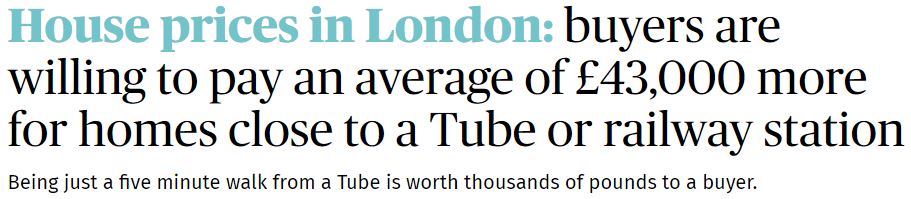
Enough said!
I purposely chose my house to be within ten minutes walk from the two Dalston Overground stations, that would open a couple of years after I moved in.
- It is also within walking distance of twelve major bus routes. All the routes can carry wheel-chairs, if I should ever need one!
- Five routes have stops, within a hundred metres, serving Bank, British Museum, Euston, Harley Street, Kings Cross, London Bridge, Manor House, Moorgate, Piccadilly Circus, Shaftesbury Avenue, St. Pauls, University College Hospital and Victoria.
- I’m only fifty metres from a major cycling route between the City and White Hart Lane.
- I even have a garage, that opens onto the street! But no car!
- My road is wide and there is usually plenty of parking space for visitors or on-line deliveries.
- A taxi ride from Euston, Liverpool Street or Kings Cross is usually under fifteen pounds at all times.
It will get even better!
- When Crossrail opens, I will have 10-12 buses per hour to the Moorgate/Liverpool Street station.
- Dalston Junction station will get a frequency of twenty trains per hour to and from Canada Water, Shoreditch and Whitechapel, that fan out to a selection of places in South London like Crystal Palace, Clapham Junction, Peckham and Penge.
- Dalston Kingsland station will get a frequency of twelve trains per hour to Stratford in the East and Camden, Clapham Junction, Hampstead and High Speed Two in the West.
- I will probably get a series of electric car charging points in the parking spaces in the road, where I live.
- I could put a personal electric car charging point in my garage.
I’m told the value of my house has risen well in the almost ten years, I’ve owned it.
Did somebody once say, that the location of a property, were the three most important things about it?
Conclusion
Make sure your next property has good access to public transport.
TfL Awards Contract For New DLR Fleet To Replace 30-year-old Trains
The title of this post, is the same as that of this article on Rail Technology Magazine.
I don’t think this is a surprise, as the winning design is based on CAF’s Metro train, which is in widespread use, in Europe and around the world.
The Trains
They would appear to be of a similar specification to most modern Metro trains, as would be expected.
The Possibility Of A Second Order
In Bombardier Transportation Consortium Preferred Bidder In $4.5B Cairo Monorail, I indicated that as the trains on the Tyne and Wear Metro and the trains on the Docklands Light Railway, are of a similar height and width, it might be possible to use the same same car bodies on both trains.
So now that CAF have got the first order for the Docklands Light Railway, they must be in prime position to obtain the Tyne and Wear Metro order!
The Removal Of Bedfont Lane Level Crossing
I also passed through Feltham station and noted that the notorious Bedfont Lane level crossing had been removed.
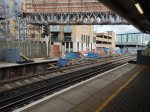
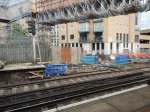
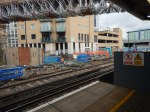

This page on the London Borough of Houslow web site, gives details of what is happening.
This is the schedule from the leaflet.
Spring 2019
- Network Rail to close Feltham West Level Crossing. There will be
no access across the level crossing. - Access will be via the temporary stepped footbridge or step-free access via Feltham Station
- Network Rail to remove the shopping centre bridge
- Network Rail starts work to extend platforms at Feltham
Winter 2019/2020
- Second step-free entrance to platform 1 open and accessible
from Hounslow Road (note this is
dependent on Hounslow Road
completion) - Platform extensions completed
Spring 2020
- Network Rail opens combined pedestrian and cycle railway footbridge at the level crossing site.
That all seems fairly straighforward, but a couple of visualisations would help.
This Google Map shows Feltham station a few months ago.
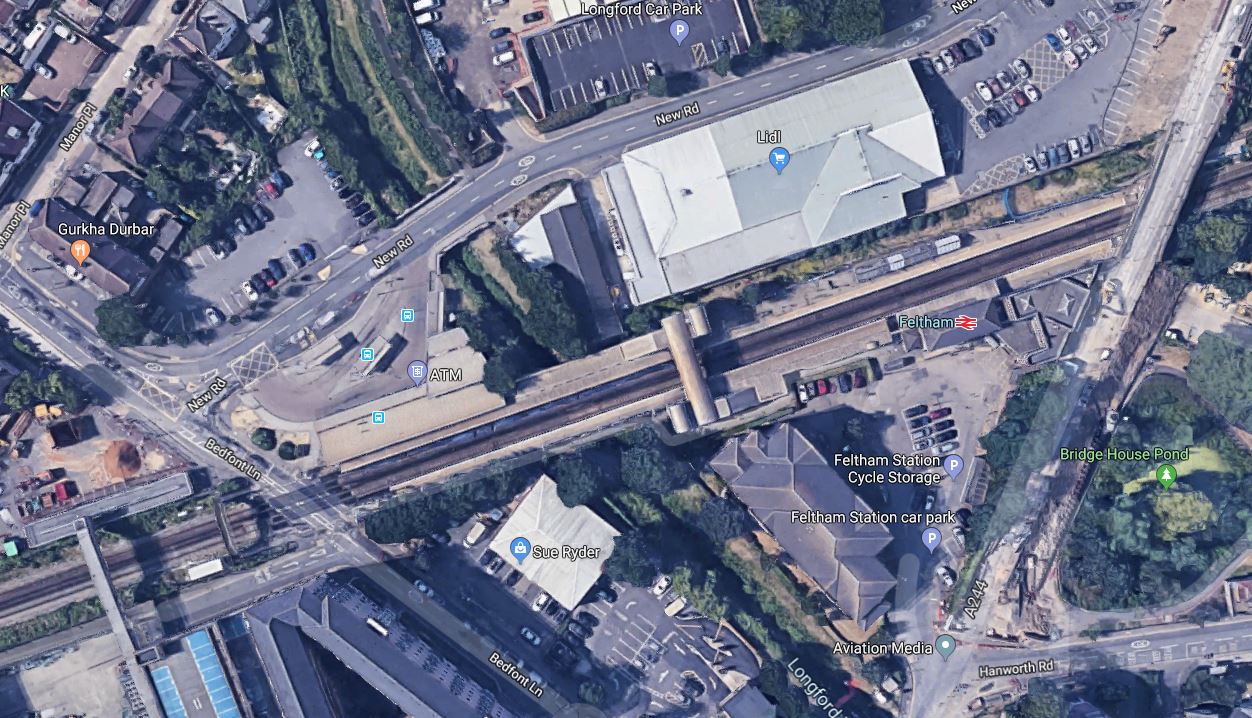
Note the awkward position of the Bedffont Lane level crossing to the West of the station.
Houslow’s Plans For Feltham
This page on the London Borough of Hounslow web site is entitled Funding Secured For Feltham’s Multi-Million-Pound Makeover.
It gives an overview of the £15.6million pound scheme.
These two paragraphs outline the scheme.
Network Rail is introducing ten car trains to increase capacity between London Waterloo and Reading, and proposes to increase the number of services from December 2018. To enable the longer trains to open all their doors at Feltham, and to eliminate the safety risks that were present at the level crossing, a decision was made to extend the platforms and close the level crossing following extensive consultation with local residents.
To ensure residents can still gain easy access between Bedfont and Feltham town centre, Network Rail will build a pedestrian/cycle bridge over the tracks and renovate the public space outside the station. Following the consultation, the council approved further measures to improve road safety and bus journey times between the station and Heathrow Airport, and to minimise the impact of the level crossing’s closure on surrounding roads.
There is a lot of work to do.
Conclusion
The removal of Bedfont Lane level crossing illustrates why the removal of level crossings is not always a simple process.
Nothing Seems To Be Happening At Syon Lane Station
I passed through Syon Lane station today and thought I’d have a look at the progress on the step-free access to the station.
This page on the South Western Railway web site describes in detail, the works that will be done.
This is the first paragraph.
From the beginning of April, we’ll be building a new accessible footbridge with a lift at Syon Lane. The project is expected to be completed later this year and is mainly funded by Hounslow Council. Making the station step free will be a real positive for people with limited mobility traveling round the Hounslow Loop, however the delivery of the new bridge will affect the station and the platforms. The station will remain operational throughout the works, but there will be some access changes during the project delivery:
Consider the bit about being finished later this year, then look at these pictures.
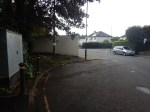
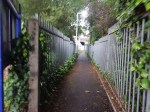
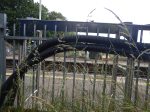
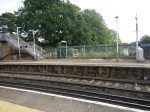
It looks like they’ve all packed up and gone home.
Surely, if the bridge is going to be finished this year, workmen should be hard at work building foundations and putting up towers for lifts.
But even the tea-hut has gone.
It appears that the following has been done at the station.
- Create a level step-free route from Syon Lane to the London-bound platform.
- Move the ticket machines and the card readers.
- Run temporary cable ducts, along the back of the platforms.
- Clear some ground behind the fence, where the lift towers might be placed.
- The long platforms have been narrowed, which Network Rail say is to give space for the work.
The 3D Google Map shows the station.
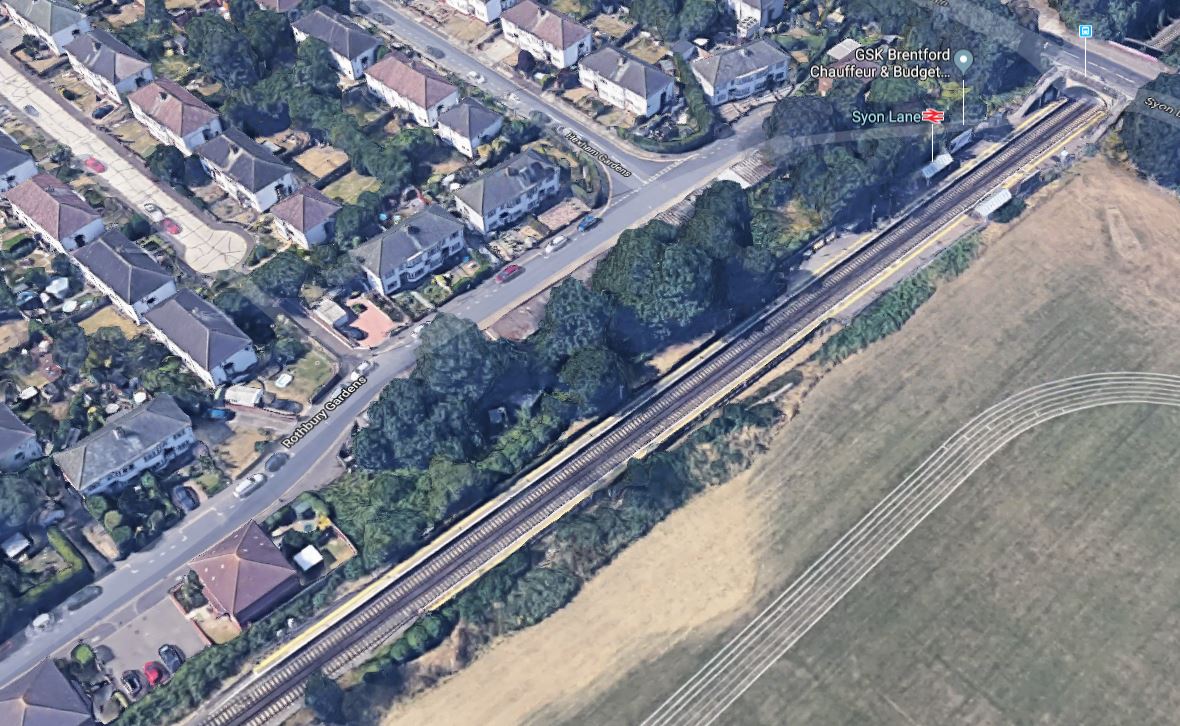
I don’t know when the picture was taken, but it does look that there could have been some ground clearing about halfway along the platform.
What Do I Think Is Happening?
I think, there could be these reasons for the lack of action.
- The project has been delayed for some reason.
- Something very different is happening at Syon Lane station!
Speaking to a couple of travellers at the station today, they had heard nothing and one was looking forward to the bridge.
I have no evidence, but I do have a devious and sometimes theatrical mind.
Are Network Rail conducting an experiment on the good people, who use Syon Lane station?
They have only said this about disruption to passengers.
The station will remain operational throughout the works, but there will be some access changes during the project delivery:
Could Network Rail be bringing in the bridge in a few sections and just lifting them in with a crane?
Look at the 3D Google Map above and note that the station in surrounded by houses and lots of leafy trees, which would make getting bridge sections and the crane into place difficult.
But look at the cross-section of the average footbridge tower or bridge and it is about the same as that of a train.
For this reason, I believe that the bridge components will be brought in on a special train with a large crane.
In Winner Announced In The Network Rail Footbridge Design Ideas Competition, I wrote how the competition was won by this bridge.
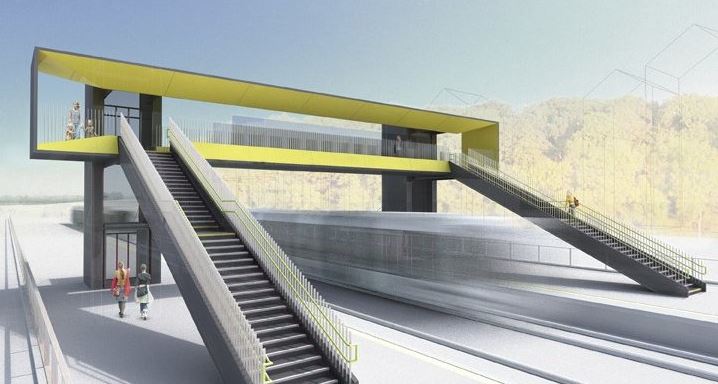
It is composed of the following major components.
- Two towers with lifts.
- Two sets of stairs
- A bridge deck.
All components would be built in a factory.
- They would be fully tested before delivery.
- The components would be delivered by train.
- The bridge would then be assembled using a rail mounted crane.
After testing, the Mayor could declare the bridge open
I suspect too, that the only preparation prior to the assembly of the bridge, is to have firm concrete bases for the bridge and a power supply for the lifts.
- The construction of the bases could be done from the railway, so there would be no problems of bringing in the concrete.
- The power supply might not even be needed, if the bridge had solar panels on the roof and a clear battery system.
- It’s all a bit like giant Lego construction, but then the architect of the bridge was Danish!
Could commuters on a Friday night return to a station little different to the one they’ve known for years and then on Monday morning find a working step-free bridge has been erected?
Engineering is the sconce of the possible, whereas politics is dreams of the impossible!
Is This The Future Of Step-Free Bridges?
Obviously not all, but I believe that up to a third of all stations that need a step-free bridge can use a bridge of this type.
But the station upgrade to step-free application is just one of several.
- New stations.
- Step-free bridges over busy roads, rivers or canals.
- Replacement of dangerous light-controlled road crossings.
The design could also be incorporated into other buildings.
Conclusion
Something different could be happening at Syon Lane station.
I Have Yet To See A Lady Driving A London Battery Taxi
You don’t see many ladies driving black cabs in London, but there are more than a few.
But I’ve yet to see one of the new LEVC TX taxi being driven by a lady!
As the numbers of these taxis appear to be increasing, I don’t think it will be long before I come home in a battery taxi, driven by a lady.
 The Anonymous Widower