Severn Toll Change
The title of this post is the same as that of a short article in the February 2019 Edition of Modern Railways.
This is the first paragraph.
There are concerns that the removal of toll charges on the M4 Severn Crossings on 17 December could result in a loss of rail freight traffic to road. The toll, for westbund vehicles only, was £16.70 per Heavy Goods Vehicle last year. It had been reduced from £20 in January 2018, when VAT ceased to be levied because the motorway bridges had passed from private to public ownership.
It now appears that it is now cheaper to get wine from Felixstowe to a warehouse in Avonmouth, by using a train to Cardiff and then using trucks, than by using a train to Bristol and a shorter truck journey.
Surely, the longer journeys by both diesel truck and probably diesel train, creates more carbon dioxide.
Obviously, the UK and Welsh Governments didn’t assess the carbon emission consequences of abolishing the tolls on the Severn Bridges.
I also wonder, if more people will now drive between South Wales and England, because of the incentive of a toll-free crossing, which will further increase carbon-dioxide emissions.
Network Rail Are Treating Norwich And Ipswich Fans With Contempt
Over the last few years, I have gone to perhaps half-a-dozen Ipswich-Norwich Derbies.
Last season, I didn’t get to either match, as Network Rail, thought that these days were ideal to do engineering work on the Great Eastern Main Line.
As if, there hasn’t been enough in the time since I’ve moved to London in 2010.
Normally, I would have bought a ticket for the match on February 10th in Norwich at 12:00 in the morning.
But I have just looked up the train times to get there for a match start at that time on a Sunday.
The only service leaves Liverpool Street at 07:08 and arrives in Norwich at 10:12! It also involves an hour on a bus. I would probably arrive back home at around seven in the evening.
I have other things to do, like getting something to eat and as a coeliac, I can’t just pop into the average take-away, unless I wanted to spend another three hours sitting on the toilet.
Why is there no liaison between Network Rail and the two football clubs, so that essential work is done on less important days?
To make things worse, on Saturday the 2nd, they’re getting the buses out again. So that’s another match I’ll miss!
This season it has been easier to watch Away matches than Home ones.
When are Network Rail going to stop treating regular travellers with such downright contempt?
Rail Operations Group Gets Serious About Thunderbirds Etc.
The February 2019 Edition of Modern Railways has an article entitled Class 93 Tri-Oomph!, which has been written by Ian Walmsley.
This is the first paragraph.
Rail Operations Group has become known for the efficient haulage of EMUs around the country using very clever tranlation devices built into Europhenix converted Class 37 kicos. As I described in the March 2016 issue (“Lost in translation”) it looked at tens of millions of pounds worth of EMUs being dragged around unbraked, thought ‘this can’t be right’, and proceeded to make 50-year-old locomotives operate with state-of-the-art computer kit.
Rail Operations Group (ROG) had employed classicdisruptive innovation to create a new market, that was to everybody’s benefit.
As Ian reports, the company has grown a lot in the last few years and now does a lot more than just move new trains around.
- Old trains are also moved.
- Old trains are also stored safely.
- Operations are all planned as a consultancy.
The company is already planning their next operational niche.
A Move Into Logistics
ROG is moving into logistics.
Ian talks about the inefficiency and polluting distribution system using trucks, that add to traffic congestion.
He talks about rail being a better way and then says this.
The difference with ROG is that the company is going to invest in two Class 769 (bi-mode 319s’) converted for parcel use, and while these are not my favourite trains, parcels are a lot less fussy than me about how long they take to get to top speed.
Using 769s’ means that your hubs can be almost anywhere; not necessarily on a 25 KVAC electrified siding, just close to a road system interchange area.
So what happens, if they don’t get a customer? The Class 769 trains will be delivered with seats, so they could be sub-leased for passenger use.
I wrote The Go-Anywhere Express Parcel And Pallet Carrier (HSPT) in May 2017, where I discussed the uses for this type of parcel carrier. This was my conclusion.
There is definitely a market for a HSPT.
If it does come about, it will be yet another tribute to the magnificent Mark 3 design!
As to the secondary use of these trains as passenger trains, there is nothing wrong with that. After all, we’ve all had our fill of the dreaded Rail Replacement Buses.
In Gospel Oak-Barking Fleet Plan Remains Unclear, I talked about the problems caused by late delivery of the new Class 710 trains.
The problem would have been eased, if two Class 769 trains in good condition could have been called up at a couple of days notice.
Surely, there are other applications.
- I suspect that given the number of level-crossing accidents in the UK, they will find a lot of use.
- I don’t think Porterbrook will mind, if ROG effectively offered a try-before-buy service to train operators.
- There must also be a market for pop-up rail services to large sporting and cultural events.
Again, it appears ROG have found a niche and have invested in it.
Before leaving the subject of Class 769 trains, I must mention Brexit.
Could the trains find a use in a no-deal Brexit-world moving high-value freight from ports and airports to inland distribution centres?
Thoughts On The Class 93 Locomotive
These are some thoughts from the article.
Available Power
Ian starts by saying this about the operation of the Class 93 locomotive.
Apart from the obvious electric (4,000kW) and diesel (900kW), the third mode is a Lithium Titanate Oxide (LTO) battery (400kW), which can be used in conjunction with the diesel to give a power boost up to 1,300kW or 1,743hp in old money.
The extra oomph from the battery takes you from a Class 33 to a Class 37 in old locos but with minimal losses, and you don’t need full power for very long on most non-electrified routes.
I suspect there’s a clever control system, that optimises the use of the battery.
The Ultimate Thunderbird
The locomotive appears to have a unique feature of a variable height coupler, which enables it to haul rolling stock with all the five standard heights of coupler, that exist on UK railways.
How did this madness occur?
But as the locomotive can deal with them all, Ian argues that the Class 93 locomotive could be the ultimate Thunderbird or rescue locomotive.
Moving Trains In The Future
Ian argues that ROC’s collection of locomotives used for moving new and replaced trains is getting older and will soon be difficult to service.
The Class 93 locomotives would be ideal for this role.
But Ian sees this very much as a fallback position, if the locomotives do not find innovative new uses.
Ian finishes with this paragraph.
When we first saw Dr. Beeching’s new Freightliners(now ‘intermodal’) in the 1960s, they did 75 mph. They still do, but there are some really smart looking 100 mph flats available. Remember the path-ology. There are plenty of cross-country runs where a Class 37 equivalent is fine for the diesel bits, then pan up and 4,000kW is yours. Come on. Not excited by this? You must be in the wrong job.
As an example some freight trains go between Felixstowe and Birmingham, Liverpool or Manchester using the North London Line.
They are hauled all the way by a Class 66 diesel.
Put the containers on the smart looking 100 mph flats with a Class 93 locomotive on the front and the following happens.
- The locomotive uses diesel between Felixstowe and Ipswich, with possibly some battery boost.
- The locomotive uses electric power for most of the journey.
- The locomotive might use diesel power at the destination for a short distance.
- On the double-track 100 mph Great Eastern Main Line, the operating speed will not be far off the new Class 745 and Class 720 trains.
- On the North London Line, the train will pass through some of the smartest parts of North London with lower levels of noise, vibration and pollution.
- On the West Coast Main Line, the train will be able to mix it with the new Class 730 trains on the slow lines.
Greater Anglia have the trains to run more services between London and Ipswich.
How many more could they squeeze in, if all freight trains had a similar performance to their express services?
Consider now, freight trains taking the cross-country route from Felixstowe to the North and Midlands via Peterborough.
- With track improvements at Haughley and doubling of the line between Kennett and Ely, I suspect that timings on the flat lands of East Anglia using hybrid power would be approaching those of Class 66 locomotive-hauled stock.
- With a faster cruise on the East Coast Main Line, would the trains take the direct route on the slow lines, rather than the diversion through Lincoln?
The Class 93 locomotive could be the ultimate Felixstowe Flyer.
Could it also be the freight locomotive that passenger train operators want reight operators to use, as it keeps freight trains out of the way of passenger ones?
Grayling Declares Government Will Not ‘Betray People In The Midlands And The North’ And Will Deliver HS2 In Full
The title of this post is the same as that of this article on Rail Technology Magazine.
There has been talk recently of cutting back High Speed Two.
Grayling has stated that this Government won’t do that.
I meet people, who think that High Speed Two is a waste of money.
Usually, they fit into one of the following categories.
- Nimbys
- People who always drive.
- Those that wouldn’t use a train, bus or tram if it was free.
I also think that most of the reasons people are against High Speed Two are for personal selfish reasons.
So why should High Speed Two be built?
Overwhelmingly, it is about greater capacity between the North and South of this country for freight and passengers.
Although, High Speed Two will not carry freight, it will free up capacity on the West and East Coast Main Lines, to allow more freight on these routes.
Could A Class 399 Tram-Train With Batteries Go Between Manchester Victoria And Rochdale/Bury Bolton Street/Rawtenstall Stations?
In Rossendale Reopening Prospect, I looked at a proposal to run a new service between Manchester Victoria and Bury Bolton Street stations.
Could this route be run by a Class 399 tram-train with a battery capability?
These tram-trains would be very similar to the Stadler Citylink Metro Vehicles, that have been specified for the South Wales Metro.
- Wikipedia gives the weight of the vehicle as 66 tonnes.
- Manchester Victoria has an altitude of 44 metres
- Bury has an altitude of 100 metres.
- Rochdale has an altitude of 137 metres.
- Rawtenstall has an altitude of 174 metres.
- I will assume 200 passengers at 90 Kg. each, which gives a weight of 12 tonnes.
Using Omni’s Potential Energy Calculator gives the following.
- Manchester Victoria to Bury Bolton Street has an increase in potential energy of 12 kWh.
- Manchester Victoria to Rochdale has an increase in potential energy of 20 kWh.
- Manchester Victoria to Rawtenstall has an increase in potential energy of 28 kWh.
When you consider that a Class 230 train has 400 kWh of batteries in a two-car train, I don’t think that there will be any problem fitting batteries big enough to take a Class 399 tram-train from Manchester Victoria to Bury Bolton Street, Rochdale or Rawstenstall stations under battery power with a full load of passengers.
- The batteries would be charged in Manchester Victoria station.
- Returning to Manchester Victoria station would use a small amount of battery power, with some assistance from Newton’s friend; gravity.
- The batteries would get a certain amount of charge from the regenerative braking of the tram-trains.
This Google Map shows the Eastern approaches into Manchester Victoria station.
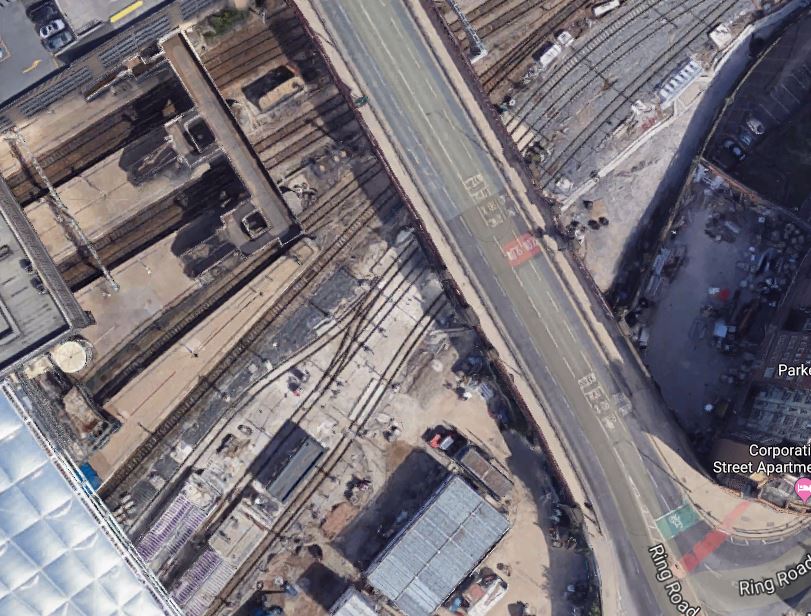
Note.
- The four through platforms numbered 3 to 6.
- The two bay platforms numbered 1 and 2.
- The four platform faces and three tracks of the Metrolink.
Having seen several tram-train systems all over Europe, I believe it would be possible to connect tram-trains running on batteries on the Calder Valley Line to the Manchester Metrolink at Manchester Victoria station.
- Going from Manchester to Bury Bolton Street, Rochdale or Rawtenstall, the tram-train would stop in the Manchester Victoria tram-stop, drop the pantograph and then continue on its way under battery power.
- Returning from the North, the tram-train would stop in the Manchester Victoria tram-stop, raise the pantograph and then continue on its way using power from the overhead wires.
- Batteries would be charged whilst running through Manchester.
There couldn’t be too many tram-train systems that would be easier to build than this?
It is interesting to note that Hebden Bridge station is just twenty-three miles from Manchester Victoria station and has an altitude of 190 metres.
So would it be possible for a Class 399 tram-train to reach Hebden Bridge station on battery power? I very much think it would be!
Class 399 Tram-Trains And Class 156 Trains
Class 156 trains are one of the better workhorses of the railways in the North and despite their age, they scrub up well.
If their performance is compared to that of a Class 399 tram-train, they are not that different.
- Noise and vibration of the electric tram-train is obviously much lower.
- The modern interior of the tram-train is geared to the needs of passengers.
- Passenger capacity of the two vehicles is also about the same.
- In Karlsruhe, tram-trains travel for up to 100 miles from the centre of the city.
Both Karlsruhe and Sheffield use three-car tram-trains, but Valencia uses much longer ones, so on heavily-used routes larger tram-trains could be used.
I doubt there would be many complaints, if a Class 156 service were to be replaced with one run by Class 399 tram-trains.
Electrification Of The Calder Valley Line
Electrifying the Calder Valley Line with 25 KVAC overhead wires as far as Rochdale station, would certainly make running to Hebden Bridge station possible.
- That electrification would also mean that electric trains could be turned-back at Rochdale station, just as diesel trains are now!
- I have flown my helicopter along the route and it looks like of the seven or eight bridges on the route, mostly appear to be modern structures for new roads or motorways.
- As 25 KVAC overhead electrification is currently being erected between Manchester Victoria and Stalybridge, a spur to Rochdale would be very much a simple addition.
It could be a very useful short length of electrification.
Tram-Trains In Manchester
This article on Rail Technology Magazine was puiblished yesterday and is entitled Plans For Tram-Trains In Manchester Unveiled As Grayling And Burnham Mull Expansion Of Metrolink.
Conclusion
Could we see tram-trains running from Bury Bolton Street, Hebden Bridge, Rawtenstall and Rochdale into Manchester Victoria and then taking to the existing tram network?
If you’ve ever been to Karlsruhe, as I have to see the Class 399 tram-trains German cousins, you wouldn’t rule out anything.
That would include tram-train services to Blackburn, Buxton, Chester, Glossop, Hebden Bridge, Sheffield, Southport and Wigan.
A Central Londoner’s View Of Thameslink
The Thameslink route, which runs North-South across London is used by different purposes, by different passengers.
- To many, who live close to its outer reaches it is a commuter railway into London.
- It serves two airports at Gatwick and Luton.
- Londoners use it to explore the delights of the South Coast of England.
But to those who live in Central London like me, it is a useful rail line.
Kings Cross And London Bridge
I regularly use Thameslink for this route, as compared to the Northern Line.
- The trains are more spacious and are generally less crowded.
- It is less walking at Kings Cross.
- The trains are air-conditioned.
- The trains have toilets.
- I have a convenient bus or taxi home from both end stations.
I suspect, I use this route a couple of times a week.
Access To Tate Modern
I like the Tate Modern and the gluten-free egg sandwiches are good.
There is also restaurants in the area; Leon and Carluccio’s for a start, that are good places for lunch or dinner.
So sometimes, I’ll use Thameslink to Blackfriars to visit the Tate Modern and then after my visit, I’ll walk over the Wobbly Bridge and take a bus home.
Thameslink is also an easy way to visit St. Paul’s and in a few years, the new Museum of London will be accessed from Farringdon station.
Access to Gatwick And Luton Airports
I haven’t used Luton Airport in years, as getting there by train is a bit tedious.
But I regularly use Gatwick Airport, usually by getting a bus to and from London Bridge station and then using Thameslink.
West Hampstead Thameslink
West Hampstead station on the Overground has recently been rebuilt and regularly I come home by changing between Thameslink and the Overground.
There is also a Marks & Spencer by the station, which helps too.
The area is becoming a major interchange and if the West London Orbital Railway is created, the Overground will be taking over or adding a platform at West Hampstead Thameslink station.
Does Thameslink Cater For All Passengers?
I say this deliberately, as I think that Thameslink concentrates more on the longer distance and airport passengers, rather than those, who use it as another North-South line across London.
Thameslink Will Run At Rapid Transit Frequencies
In the central core section between Blackfriars and St. Pancras International stations, the trains will run at a frequency of 24 trains per hour (tph) or a train every two and a half minutes.
Trains will run automatically at a frequency, that is higher than many rapid transit systems in the world.
Thameslink Is Part Of London’s Oyster/Contactless Ticketing Zone
From Gatwick Airport in the South to Elstree & Borehamwood and Hadley Wood in the North, Thameslink is part of London’s Oyster/Contactless Ticketing Zone.
In Oyster Card Scheme Extension Agreed, I wrote about how the zone is being extended to Luton Airport Parkway and Welwyn Garden City.
So increasingly, Thameslink will be covered by London’s ticketing, that is increasingly used by residents, commuters and visitors.
Thameslink Has Interchanges With The Underground And Overground
Thameslink has several interchange stations with the Overground and Underground.
These include.
- Blackfriars
- Denmark Hill
- Elephant & Castle
- Farringdon
- Finsbury Park
- Kentish Town
- London Bridge
- Peckham Rye
- St. Pancras Thameslink
- West Hampstead Thameslink
- Wimbledon
In addition East Croydon, Mitcham Junction and Wimbledon are interchanges with Tramlink and Blackfriars and London Bridge are interchanges with the river buses.
Thameslink Is Not On The Tube Map
This is a bone of contention with many! Including myself!
According to the Wikipedia entry for the Tube Map, Thameslink was shown on the map between 1977 and 1998.
So why was it removed?
Some Thameslink Stations Don’t Have Tube Maps On The Platforms
I was on the platform at City Thameslink station and needed a Tube Map.
There wasn’t one!
Why not?
Conclusion
Thameslink is very much part of London’s rail network.
It should be treated as such, by doing the following.
- Extending Oyster/Contactless ticketing to all Thameslink stations.
- Adding all or part of Thameslink to the Tube Map.
- Putting a Tube Map on all station platforms in the London area.
But this mess has existed for twenty years, since Thameslink was removed from the Tube Map.
Rossendale Reopening Prospect
The title of this post is the same as that of an article in the February 2019 Edition of Modern Railways.
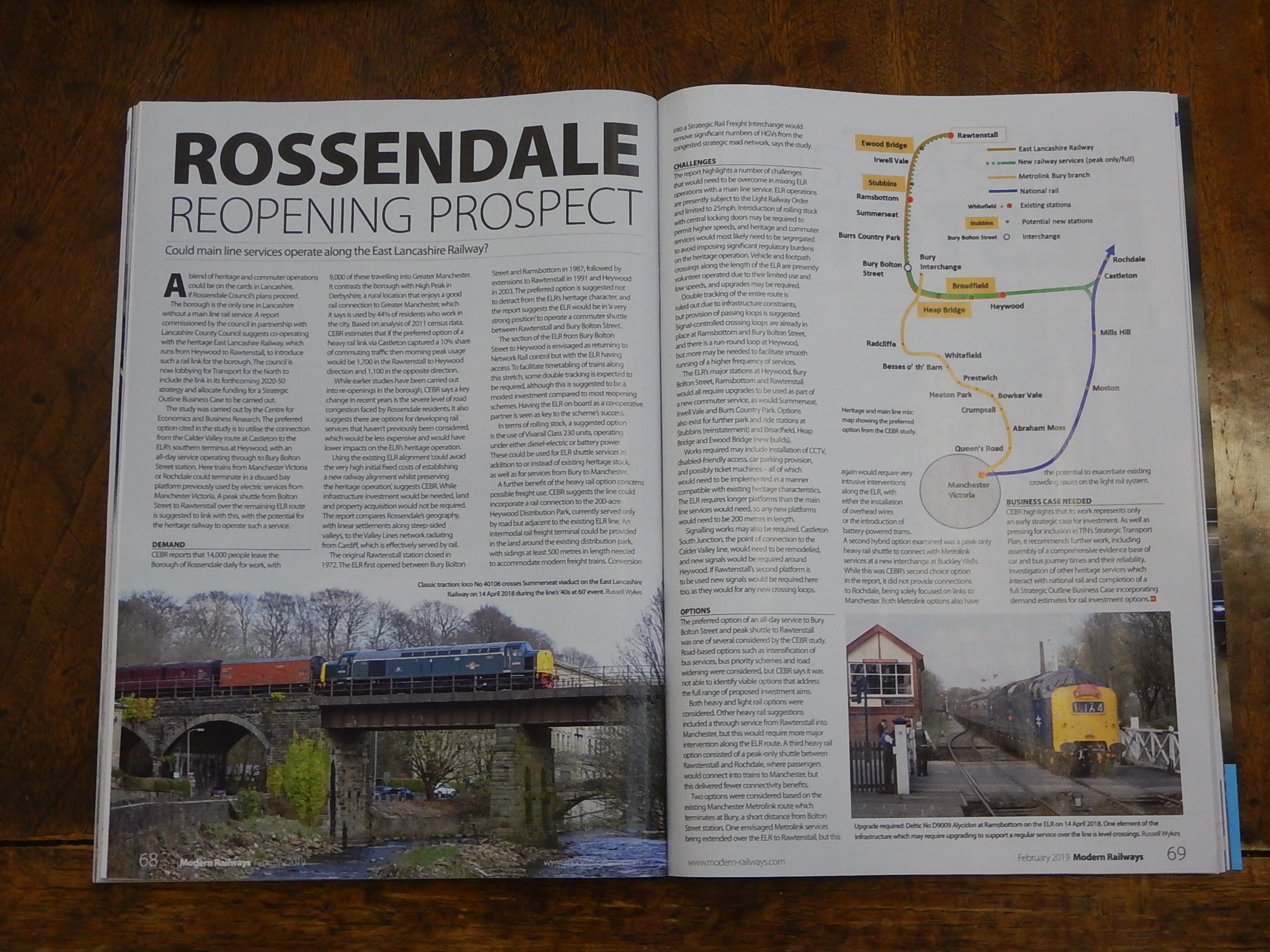
This is the opening two paragraphs.
A blend of heritage and commuter operations could be on the cards in Lancashire, if Rossendale Council’s plans proceed.
The borough is the only one in Lancashire without a main line rail service. A report commissioned by the council in partnership with Lancashire County Council suggests co-operating with the heritage East Lancashire Railway, which runs from Heywood to Rawstenstall, to introduce such a rail link for the borough.
Yesterday, I had a comment read out on the BBC, as I discussed in Wake Up To Money – New Stations.
Wake Up To Money yesterday was broadcast from Darwen, which is only a valley away from Rossendale.
- One of the complaints on the program was about crowded roads and bad transport links to Manchester and Manchester Airport.
- It looks to me, that the proposed Rossendale services will fulfil a similar need.
- The main objective appears to be to create good links to Manchester and Manchester Airport, with a secondary objective of creating a link across the Pennines to Leeds with a change at Rochdale.
The article gives more details of the proposal.
Track
The plan envisages reinstating the route between Rawtenstall and Castleton Junction on the Calder Valley Line.
The section between Rawtenstall and Heywood stations, via Bury Bolton Street station is the heritage line of the East Lancashire Railway (ELR). It is best described as predominately single-track with passing loops.
The article says this about improving the track.
The section of the ELR from Bury Bolton Street to Heywood is envisaged as returning to Network Rail control but with the ELR having access. To facilitate timetabling of trains along the stretch, some double-tracking is expected to be required, although this is suggested to be a modest investment compared to most reopening schemes. Having the ELR on board as a co-operative partner is seen as key to the scheme’s success.
Having flown my virtual helicopter along the line, it looks to me, that it could become another scenic route out of Manchester.
Castleton Junction
This Google Map shows Castleton Junction, where the East Lancashire Line meets the Calder Valley Line.
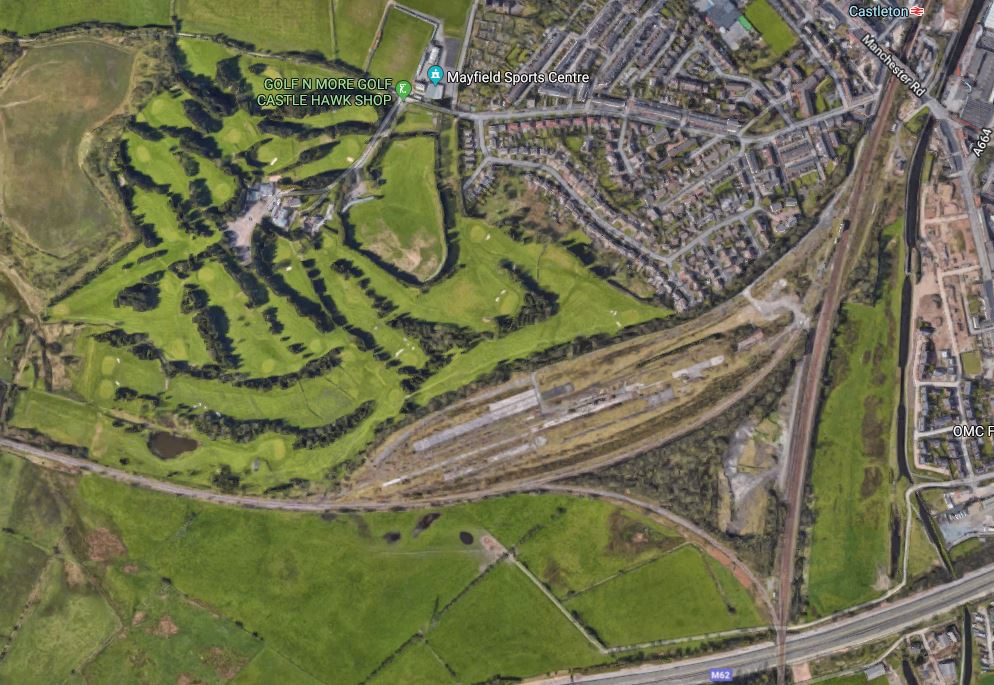
Note.
- The Calder Valley Line runs North-South.
- The ELR goes off to the West.
- Castleton station is in the North-East corner of the map.
What was or is the large site to the North-West of the junction?
The Junction will need to be upgraded and resignalled.
Electrification
It would be very unlikely, that the route will be electrified.
Although, I suppose there is a chance, that the Calder Valley Line might be electrified, to create an electrified route between Leeds and Manchester Victoria.
- If this were to happen, then there would be electrification between Manchester Victoria and Rochdale.
- Castleton Junction, where the new route would join the Calder Valley Line would be electrified.
This would make it easier and more likely for battery-electric trains to work the new route.
Possible Routes
Three routes are suggesting in the article.
- Manchester Victoria and Bury Bolton Street
- Bury Bolton Street and Rochdale
- Bury Bolton Street and Rawtenstall – Peak-Hour shuttle.
It is suggested that the third route would be run by the ELR.
Rolling Stock
The article says this about rolling stock.
In terms of rolling stock, a suggested option is the use of Vivarail Class 230 units, operating under either diesel-electric or battery power. These could be used for ELR shuttle services in addition to or instead of existing heritage stock, as well as for services from Bury to Manchester.
The Class 230 trains are an obvious choice, but I think that other trains could also be suitable.
These are my thoughts.
Class 230 Trains
I described a ride in a Class 230 train in Battery Class 230 Train Demonstration At Bo’ness And Kinneil Railway.
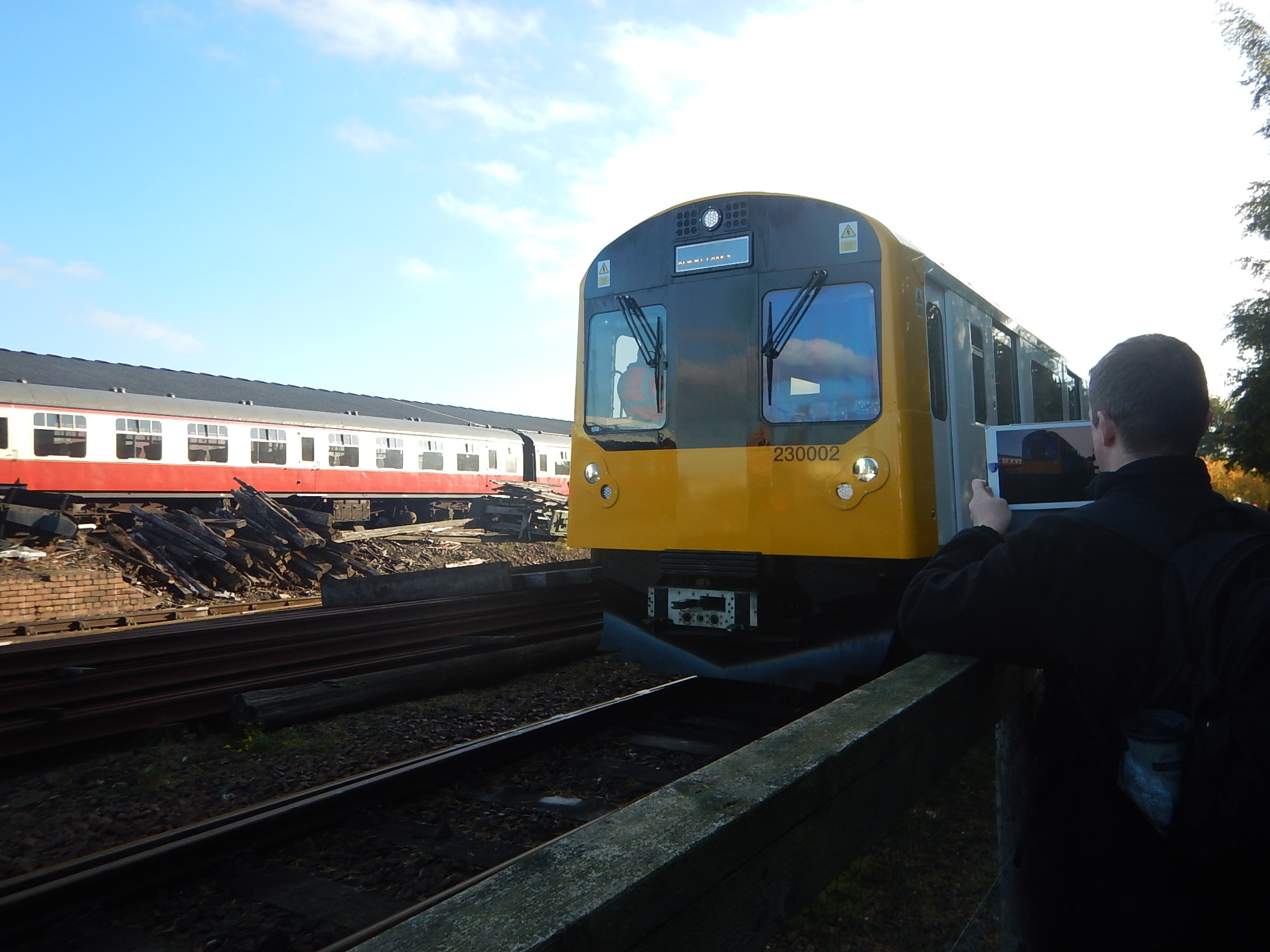
The Class 230 train would have these characteristics.
- The three-car train has a useful capacity of around 300 passengers.
- The range on battery power should enable a service between Bury Bolton Road and Manchester Victoria stations.
- The batteries can be charged in under ten minutes.
- The operating speed is 60 mph.
- The trains have been designed to be easy to service and this can be done on a remote basis.
- The trains are of an age, to fit in well on a heritage railway.
- I suspect the average competent heritage railway could do the servicing.
The trains also have the advantage of large windows for looking at the scenery.
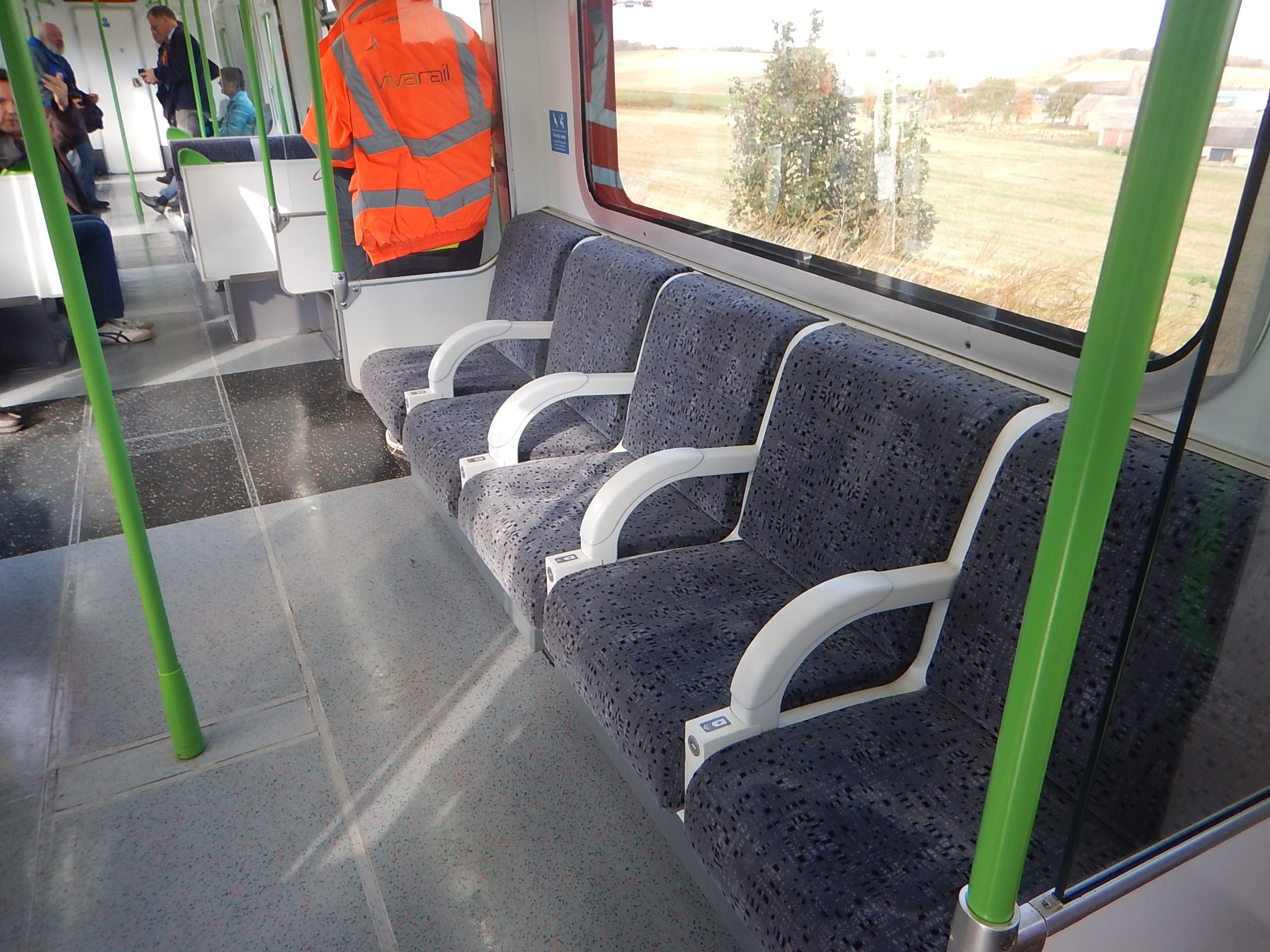
The trains would need to be charged at the end of the route and I suspect that Vivarail’s fast charging system would handle this in the terminal stations.
Class 769 Trains
Class 769 trains are electro-diesel trains, that use their diesel engines, where there is no 25 KVAC overhead electrification.
They are four-car trains with a passenger capacity of over 300 passengers.
They would have a very big advantage for the train operator.
Services across Manchester are often paired to give travellers the chance to do cross-city journeys without changing trains.
Using Class 769 trains would enable more services to be paired up.
Class 399 Tram-Trains
Class 399 tram-trains are under trial in Sheffield and they will also be used on the South Wales Metro.
The terrain in Rossendale involves a hundred metre or so climb from Bury Bolton Street to Rawtenstall. Rochdale is perhaps fifty metres higher than Bury Bolton Street.
Consider a Class 399 tram/train, working between Bury Bolton Street and Rawtenstall stsations.
- Wikipedia gives the weight of the vehicle as 66 tonnes.
- The altitude difference is 120 metres.
- I will assume 200 passengers at 90 Kg. each, which gives a weight of 12 tonnes.
This means that the train has a increase of potential energy of 25 kWh at Rawtenstall station. This would be easily stored in an appropriately-sized traction battery.
It would appear that tram-trains should be able to climb to Rawtenstall, provided they could get to Bury with a full battery.
I look at this in detail in Could A Class 399 Tram-Train With Batteries Go Between Manchester Victoria And Rochdale/Bury Bolton Street/Rawtenstall Stations?
Alstom Breeze Trains
Alston Breeze trains could be a possibility, if hydrogen trains are compatible with steam trains.
The trains would also be able to work across Manchester, as the Class 769 trains will be able to.
Battery-Electric Multiple Units
In Northern’s Battery Plans, I discuss CAF’s proposal to Northern to create battery-electric Class 331 trains.
These could be ideal.
Diesel Multiple Units
Northern have lots of better quality diesel multiple units including Class 156 and Class 170 trains. The company also has around sixty new Class 195 diesel multiple units on order.
These could obviously handle the route, but would it be better to use battery or more capable bi-mode trains on the route?
Diesel Use In Manchester
I suspect too, that train companies, their staff, passengers and all Mancunians would like to see Central Manchester’s railways become a diesel-free zone.
Train Timings
I obviously don’t have accurate figures, but I have a feeling that most of these trains could do a round trip in an hour between Manchester Victoria and Bury Bolton Street stations. The Class 230 trains would probably have time for a fast charge at each end of the route.
My Choice Of Train
It will be Class 230 or Class 769 trains.
Both trains could work the services to Bury Bolton Street station from Manchester Victoria and Rochdale stations.
The Class 769 has two advantages.
- It is the larger train.
- It could use its electric capability to cross Manchester.
Both trains wouldn’t look out of place running a shuttle between Bury Bolton Street and Rawtenstall stations, as they are rebuilt trains from a previous era.
Stations
A few points about the existing stations.
Bury Bolton Street Station
Bury Bolton Street station has four platforms and will be the interchange between the new services and those of the ELR.
The station has a bay platform that faces South East.
With modern signalling, I would expect that it could handle four trains per hour (tph).
Perhaps, these could be two tph from both Manchester Victoria and Rochdale stations.
Heywood Station
This Google Map shows Heywood station.
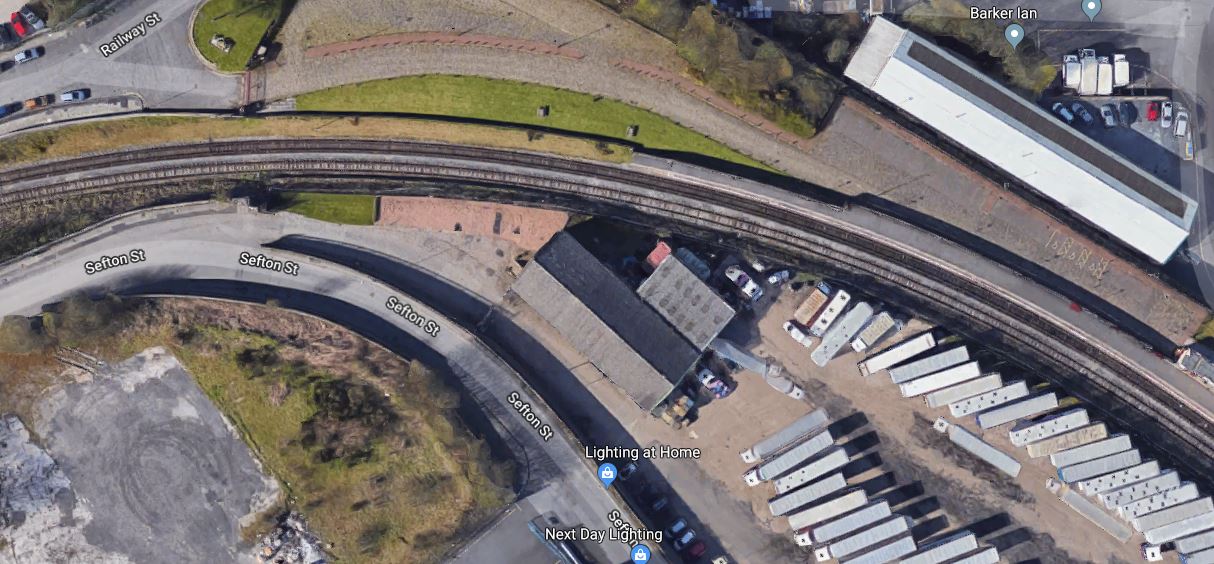
At present it has a long single curved platform.
I suspect to accommodate the new services, which could be four tph in both directions, the station would need a second platform.
Ramsbottom Station
This Google Map shows Ramsbottom station.
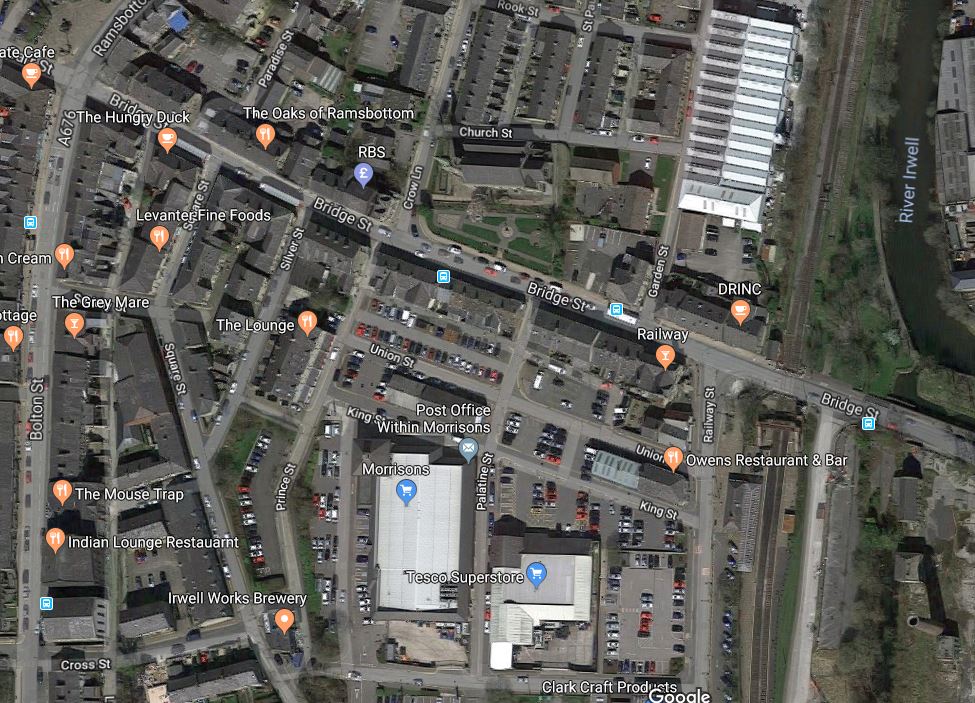
It is a two platform station, which appears to be close to the Town Centre and a Tesco Superstore and a Morrison’s.
Rawtenstall Station
This Google Map shows Rawtenstall station.
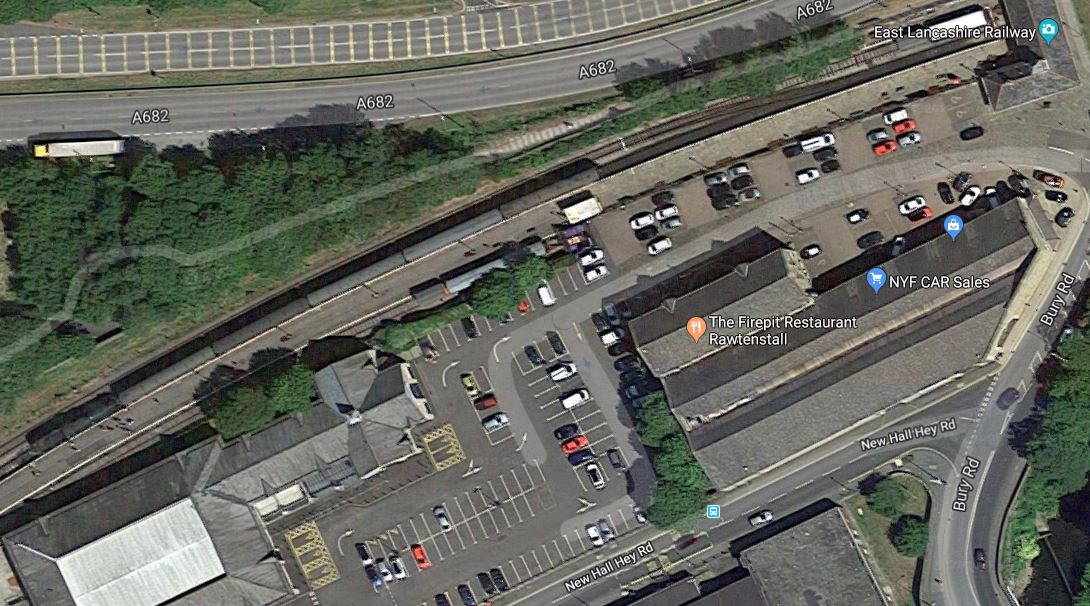
Note, the train in the single platform with a run round loop for a locomotive.
The article says it would be possible to create a second platform at the station.
It would appear that if Class 230 trains were to be used for the proposed.Peak Hour service to Rawtenstall station, then there would be space for installing a fast charger.
Rochdale Station
Rochdale station will be a terminus for services from Bury Bolton Street station.
This paragraph in the Wikipedia entry for Rochdale station describes the new bay platform at the station and how it is used.
In 2015, construction on a fourth railway platform began. It is located at the south end of the main island platform, with the southbound through line having been re-aligned slightly further east to accommodate the new terminating line.
This section of the Calder Valley Line appears to be very busy with a train every four minutes.
I wonder, if by diverting some services to Bury Bolton Street station, this helps ease traffic on the Calder Valley Line.
Could trains do the following triangular route?
- Manchester Victoria
- Heywood
- Bury Bolton Street
- Heywood
- Rochdale
- Manchester Victoria
Train timetablers with much more knowledge than myself, will have fun getting a workable timetable.
New Stations
About half-a-dozen new stations will need to be built.
Most will probably be fairly simple affairs and those North of Bury Bolton Street station could probably by just a single platform.
There is one possibly proposed station, that could be more complicated.
Buckley Wells station could be built where the Bury Line of the Manchester Metrolink and the East Lancashire Line cross by the A56.
Park-and-Ride stations are also suggested in the article at Broadfield, Ewood Bridge, Heap Bridge and Stubbins.
Freight
The article also raises the possibility of running freight trains between the Calder Valley Line and Heywood.
This is said.
,The line could incorporate a rail connection to the 200-acre Heywood Distribution Park, currently served only by road, but adjacent to the existing ELR line. An intermodal rail freight terminal could be provided in the land around the existing distribution park, with sidings at least 500 metres in length needed to accommodate modern freight trains. Conversion into a Strategic Freight Interchange would remove significant numbers of HGVs from the congested strategic road network.
Would the implementation of this plan for freight be popular with the residents of Rossendale?
Conclusion
The proposal is a comprehensive one, which could benefit several groups.
- The residents of Rossendale.
- Vsitors to the area
- Commuters to Manchester
- Travellers across the Pennines
- Travellers to Manchester Airport
- Freight companies.
The proposal needs further investigation to see whether there is a strong business case for implementation.
I also think, that this sort of project model, where a heritage line is integrated with the National Rail network, can be repeated elsewhere in the country.
We have some very well-managed heritage railways in the UK, some of which could be extended to the National Rail network to provide much needed passenger and freight services to new and existing developments and difficult to access towns.
The rules need to be developed, so that these projects can be developed.
New Station In Soham Revealed With Network Rail To Unveil Design Proposals At Public Meetings
The title of this post is the same as that of this article on Rail Technology Magazine.
Rebuilding of Soham station has been talked about for years and it now looks like it is finally on its way.
This is a significant paragraph.
The early design work for the new station would allow for a second platform and footbridge to be constructed and a second track added as part of a future project.
I think this means, that doubling the route between Kennett and Ely stations will be done after Soham station is rebuilt.
 The Anonymous Widower