How Did We Get Here?
As a 71-year-old, enjoying a comfortable retirement, who voted Remain, I’m watching UK politics from behind the sofa.
There appears to be no statesman or stateswoman to lead us out of this mess.
Hydrogen For Hydrogen-Powered Trains And Other Vehicles
I have received e-mails worrying about how hydrogen-powered trains and other vehicles, like buses and trucks, will get the fuel they need.
Production Of Hydrogen
There are two major methods of producing large quantities of hydrogen.
Steam Reforming Of Natural Gas
Steam reforming is used to convert natural gas into hydrogen by using high temperature and pressure steam in the presence of a nickel catalyst.
This section in Wikipedia is entitled Industrial Reforming, says this.
Steam reforming of natural gas is the most common method of producing commercial bulk hydrogen at about 95% of the world production of 500 billion m3 in 1998. Hydrogen is used in the industrial synthesis of ammonia and other chemicals. At high temperatures (700 – 1100 °C) and in the presence of a metal-based catalyst (nickel), steam reacts with methane to yield carbon monoxide and hydrogen.
It gives this chemical equation for the reaction.
CH4 + H2O ⇌ CO + 3 H2
I have two questions about steam reforming.
- How much fossil fuel energy is needed to create the high temperatures and pressures to make the process work?
- What happens to the carbon monoxide (CO)? Is it burnt to provide heat, thus producing more carbon dioxide (CO2)?
I therefor question the use of steam reforming to produce hydrogen for vehicles, especially, as a system might be required to be installed in a train, bus or freight depot.
The only time, where steam reforming could be used, is where an existing refinery producing large quantities of hydrogen by the process is close TO the point of use.
Electrolysis Of Water Or Brine
It is fifty years, since I worked in the chlorine-cell rooms of ICI’s Castner-Kellner chemical complex at Runcorn.
The process used was the Castner-Kellner Process and this is the first paragraph of the Wikipedia entry.
The Castner–Kellner process is a method of electrolysis on an aqueous alkali chloride solution (usually sodium chloride solution) to produce the corresponding alkali hydroxide, invented by American Hamilton Castner and Austrian Karl Kellner in the 1890s.
Brine from Cheshire’s extensive salt deposits is electrolysed using a graphite anode and a mercury cathode to produce chlorine, hydrogen, sodium hydroxide and sodium metal.
Large amounts of electricity are needed, but the biggest problem is the poisonous mercury used in the process.
My work incidentally concerned measuring the mercury in the air of the plant.
Since the 1960s, the technology has moved on, and ICI’s successor INEOS, still produces large quantities of chlorine at Runcorn using electrolysis.
More environmentally-friendly processes such as membrane cell electrolysis are now available, which produce chlorine, hydrogen and sodium hydroxide.
In the 1960s, the production of chlorine and hydrogen was a 24/7 process and I would suspect that INEOS have a good deal to use electricity from wind and other sources in the middle of the night.
The Future Of Hydrogen
Hydrogen is a clean fuel, that when it burns to produce heat or is used in a fuel cell to produce electricity, only produces steam or water.
There is also a lot of research going into hydrogen fuel-cells, hydrogen storage and batteries, and some of this will lead to innovative use of hydrogen as a fuel.
As an example, there is a growing market for fuel-cell forklifts. The first one was built in 1960, so fifty years from idea to fulfilment seems about right.
How many other applications of hydrogen will be commonplace in ten years?
- City buses
- Local delivery vans for companies like Royal Mail and UPS.
- Taxis
- Refuse trucks
I also think, some surprising applications will emerge driven by the need to clean up the air in polluted cities.
Ideally, these applications will need a hydrogen filling station at the depot.
Modern electrolysis technologies should lead to the development of simple cells, for the electrolysis of water to produce hydrogen and oxygen.
Powered by renewable energy sources or nuclear, this technology could be used to create zero-carbon hydrogen at the point of use.
Diesel Or Hydrogen?
The diesel engine in a New Routemaster bus is a Cummins diesel with these characteristics.
- 4.5 litre
- 138 kW
- 400 Kg
So how much would a 150 kW fuel-cell weigh?
A Ballard FCveloCity-HD, which is capable of producing 100 kW, weighs around 300 Kg.
I feel that as hydrogen and battery technology improves, that more and more city vehicles will be hydrogen-powered.
Hyundai Launch A Hydrogen-Powered Truck
This page on the Hyundai web site is entitled Hyundai Motor Presents First Look At Truck With Fuel Cell Powertrain.
It will be launched this year and looks impressive. Other articles say they have tied up with a Swiss fuel-cell manufacturer called H2 Power and aim to sell a thousand hydrogen-powered trucks in Switzerland.
Gospel Oak-Barking Fleet Plan Remains Unclear
The title of this post is the same as that of this article on Rail Magazine.
In the article, there is a picture of 378232 at Barking station.
According to the Wikipedia entry for Class 378 trains, this unit is listed as being four-cars and TBA (To Be Allocated?)
So is it a spare train, that is used for driver and staff training and route proving?
It was certainly doing the latter at Barking.
The Situation On The Gospel Oak To Barking Line Is Critical
This page on the Barking-Gospel Oak Rail User Group web site is their latest newsletter, which was issued on the 14th of January.
These are the headlines on the newsletter.
- Train Service On Brink Of Collapse
- Not Enough Trains For Viable Service
- TfL Has No Idea When New Trains Will Be Fit For Service
- Rail Users Demand Mayor Takes Action To Restore Reliable Train Service Now
- Rail Users Demand Compensation After Years Of Misery
It’s all strong stuff.
Trains that work are urgently needed to replace the diesel Class 172 trains, which will all leave by the end of April or even March.
Possible Replacement Trains
These types of trains have been touted as replacement trains.
Class 315 trains
TfL has started to send some Class 315 trains, made redundant by TfL Rail, for scrapping.
Could some of these be held back for use on the Gospel Oak to Barking Line?
- They should fit the route.
- London Overground already runs these trains to Cheshunt, Chingford and Enfield Town.
- The expertise and driving experience must be there to run a service.
But, as there have been no reports of any Class 315 trains on the route, I suspect that there’s a reason, why these trains can’t fill the gap.
Could it be the disability regulations, which kick in at the end of 2019?
The proposed Class 710 rains ordered for both Gospel Oak to Barking Line and the Watford DC Line are dual voltage.
As the Willesden TMD was built to handle trains with the ability to use third-rail electrification, is this ability needed to access the depot?
But Class 315 trains are 25 KVAC only, so this could mean they are unsuitable.
Class 365 Trains
Class 365 trains got ScotRail out of trouble, but like the Class 315 trains, they are 25 KVAC only, so may have the same stabling issues.
They would also be a new train class for London Overground.
Class 319 Trains
Class 319 trains are dual-voltage and could probably be used on both routes, but they would need a refurbishment and would also be a new train class for London Overground.
Class 378 Trains
Class 378 trains already work the Watford DC Line and after the test of a four-car unit to Barking, London Overground probably know how difficult, it would be for four-car trains to work the route.
The trains are dual-voltage and London Overground’s strategy of basing trains for both routes at Willesden TMD would probably be possible.
Drivers and other staff know them very well, as do the passengers.
I am drawn to the conclusion, that of the trains available in the event of non-delivery of Class 710 trains, the Class 378 trains are the best choice.
How Many Trains Are Needed For The Gospel Oak To Barking Line?
The full service was run by a fleet of eight Class 172 service.
As the same number of Class 710 trains have been pencilled in for the route, I must assume that this is the number of trains required. I think six trains are needed for the service, with two in reserve or maintenance.
How Many Class 378 Trains Are Needed For A Full Overground Service?
If I go through the routes of the original Overground, I find the following.
Dalston Junction And Clapham Junction
Trains take 46 minutes to go South and 44 minutes to come North and a round trip would take two hours.
This means thatthe current four trains per hour (tph) service would need eight trains.
Dalston Junction And New Cross
Trains take 22 minutes both ways and a round trip would take an hour.
This means that the current four tph service would need four trains.
Highbury & Islington And Crystal Palace
Trains take 44 minutes to go South and 43 minutes to come North and a round trip would take two hours.
This means that the current four tph service would need eight trains.
Highbury & Islington And West Croydon
Trains take 52 minutes both ways and a round trip would take two hours.
This means that the current four tph service would need eight trains.
Euston And Watford Junction
Trains take 47 minutes to go South and 50 minutes to come North and a round trip would take two hours.
This means that the current three tph service would need six trains.
Stratford And Richmond/Clapham Junction
Between Stratford and Richmond, trains take 59-64 minutes to go West and 62 minutes to come East.
Between Stratford and Clapham Junction, trains take 62 minutes to go West and 64 minutes to come East.
The round trip times are very similar and are around two and a half hours.
This means that the current eight tph service would need twenty trains.
Summarising, these services gives.
- Dalston Junction and Clapham Junction – 8 trains
- Dalston Junction and New Cross – 4 trains
- Highbury & Islington and Crystal Palace – 8 trains
- Highbury & Islington and West Croydon – 8 trains
- Euston and Watford Junction – 6 trains
- Stratford and Richmond/Clapham Junction – 20 trains
This gives a total of 54 trains. As there are fifty-seven Class 378 trains, this means there are three spares to cope for maintenance and breakdowns.
London Overground have plans to increase frequencies and they are detailed in this table.
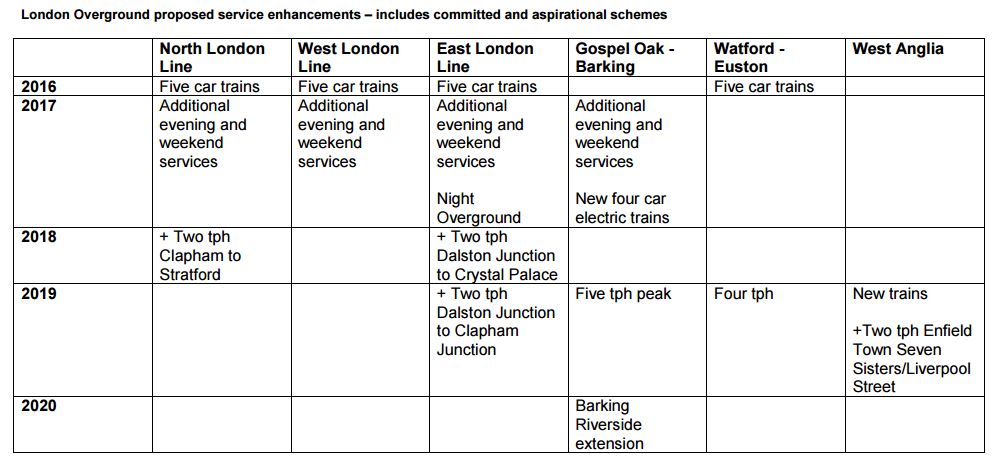
Note that four extra services are planned for the East London, North London and Watford DC Lines.
- Two extra tph between Stratford and Clapham Junction, which has already been implemented.
- Two extra tph between Dalston Junction and Clapham Junction. This would mean that twelve trains would be needed for this service.
- Two extra tph between Dalston Junction and Crystal Palace. This would mean that twelve trains would be needed for this service.
- One extra tph between Euston and Watford Junction. This would mean that eight trains would be needed for this service.
Summarising again gives.
- Dalston Junction and Clapham Junction – 12 trains
- Dalston Junction and New Cross – 4 trains
- Highbury & Islington and Crystal Palace – 12 trains
- Highbury & Islington and West Croydon – 8 trains
- Euston and Watford Junction – 8 trains
- Stratford and Richmond/Clapham Junction – 20 trains
This gives a total of 64 trains.
As London Overground only has 57 Class 378 trains, this proposed timetable is impossible without some new Class 710 trains.
London Overground plan to use some of the Class 710 trains to release Class 378 trains from the Watford DC Line, to reinforce East London Line services.
So it looks like the late delivery of the Class 710 trains has also scuppered London Overground’s plans to increase services on the East London Line.
How Many Class 378 Trains Could Be Scraped Together?
This table shows the number of Class 378 trains needed for the current service.
- Dalston Junction and Clapham Junction – 8 trains
- Dalston Junction and New Cross – 4 trains
- Highbury & Islington and Crystal Palace – 8 trains
- Highbury & Islington and West Croydon – 8 trains
- Euston and Watford Junction – 6 trains
- Stratford and Richmond/Clapham Junction – 20 trains
This gives a total of 54 trains. With just three trains spare.
As the Gospel Oak to Barking Line needs eight trains to run a full service, this is not enough.
What strategies can be applied to increase the number of trains available?
Reduce The Stratford And Clapham Junction Service To Two tph
The Stratford and Clapham Junction service was two tph until recently, when it was raised to four tph.
Reducing it back to two tph, would reduce the number of trains required on Stratford and Clapham/Richmond services by five.
This would give eight spare trains, which would be almost enough to run a full service on the Gospel Oak to Barking Line.
Provided of course, that there was a hundred percent availability, which is rather an impossible dream.
Introduce The Class 710 Trains On The Watford DC Line
The Class 710 trains for the Gospel Oak to Barking Line are dual-voltage trains, which will also run on the Watford DC Line. So would it be a sensible idea to introduce these trains first on the Watford DC Line?
- The third-rail electrification on the line is at least fifty years old, so must be fully tested.
- The drivers have extensive route knowledge of running electric trains on the route.
- Willesden TMD, where the Class 710 trains are stabled, is on the Watford DC Line.
- The route is only shared with the Bakerloo Line.
- The route is to be equipped with six Class 710 trains anyway.
Every Class 710 train introduced will release a Class 378 train.
But if the Class 710 trains don’t work, this is no help!
Introduce The Class 710 Trains On The North London Line
Running on the North London Line is more complicated than the Watford DC Line, but five-car Class 710 trains, are planned for this route.
They could be introduced to release Class 378 trains.
The Four-Car Train Problem
Every four-car train created means that a trailer car is removed from a five-car Class 378 train.
I would assume that it is most likely, these spare cars will be put into store until the, the new Class 710 trains finally enter service.
Or would they be added to other Class 378 trains to create six-car trains, which would then be run on the North or West London Lines, where the platforms could be almost long enough? Selective door opening on the trains could also be used at short platforms.
Conclusion
I feel if the London Overground swap trains around and perhaps reduce the Stratford and Clapham Junction service to its old level of 2 tph, then enough Class 378 trains would be available to run a full four-car service on the Gospel Oak to Barking Line.
Everybody Could Do Better For Rail In South Staffordshire
There were two unrelated events which show the poor state of rail services in South Staffordshire.
This article on Tamworth Informed is entitled Lichfield MP Asks The Prime Minister To Create A rail Passenger Service Direct From Lichfield To Burton And Beyond.
I heard the exchange during Prime Minister’s Questions and Michael Fabricant was passionate about creating the rail service on the freight-only line to give passenger train access to the National Memorial Arboretum and Alrewas.
Quite frankly, it is a disgrace, that the National Memorial Arboretum, has been designed for most visitors to come by car.
This Google Map shows the site of the National Memorial Arboretum.

Note the two rail lines running past the site.
- The freight-only line between Lichfield and Burton runs West-East to the North of the site.
- The line between Burton and Tamworth runs North-South to the East of the site.
Alrewas is to the North-West of the site.
The second incident happened later in the day.
Burton were playing Manchester City in the League Cup, so the Police thought it would be a good idea to shut the M6. Nothing moved for hours and many Burton supporters missed the match.
The incident was caused by illegal immigrants stuffed into the back of a truck, but surely the Police reaction to shut the motorway for so long was over the top?
I have been to Burton by train a couple of times and it is one of those places, you wouldn’t go to by train, unless it was absolutely essential.
If you look at the train services from the town, you can go to faraway places like Glasgow and Plymouth, but services to practical local places like Lichfield, Stock and Derby are rare. There used to be a service to London, but that was discontinued in 2008.
A regular service between Burton and Lichfield, running at a frequency of two trains per hour (tph) could connect at Lichfield to the following services.
- Hourly services on the West Coast Main Line
- Half-hourly services across Birmingham on the Cross-City Line.
If a decent service via Lichfield had existed, how many fans would have used the trains to get to Manchester?
Not many probably, as there would not have been a late train home, as is particularly common in The Midlands. Try getting back to London from Derby, Nottingham or Sheffield, after 21:30 for example!
Conclusion
Rail services in South Staffordshire could be greatly improved.
Images Of A Class 321 Train
I took these pictures at Ipswich Yard of a Class 321 train.
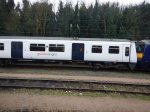
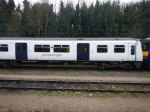
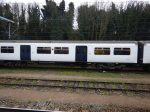
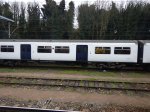
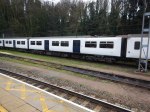
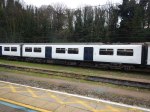
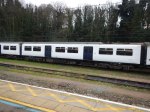
I needed some pictures to show how much space there is under each car.
It would appear that the underneath of the DTSO and TSO cars is fairly clear, but that lots of electrical gubbins are under the MSO car.
Economy Energy Customers Moved To Ovo Days After Ninth Bankruptcy In A Year
The title of this post is the same as that of this article on City AM.
These are two paragraphs from the article.
Ovo has already established itself as a so-called supplier of last resort, willing to take on customers of companies which are unable to keep trading.
In November it started serving almost 300,000 customers who were left without an energy supplier when Spark Energy went bankrupt.
Ovo is certainly growing its customer base from bankrupt suppliers and I hope it has got its sums correct and doesn’t overstretch itself.
It must be getting very practised at handling customers worried about their energy supply and costs.
In addition, it is showing itself to be an innovative supplier and is venturing into new markets.
Packaging That Can’t Be Opened
Two days ago, my kitchen scissors broke.
I suspect, they had been in our kitchen for at least twenty years and had stainless steel blades and red handles.
Usually, I kept them on my kitchen work-top to be handy to open the packaging, that seems to arrive tightly-wrapped around everything you buy.
So I bought a replacement pair in Sainsburys for just two pounds.
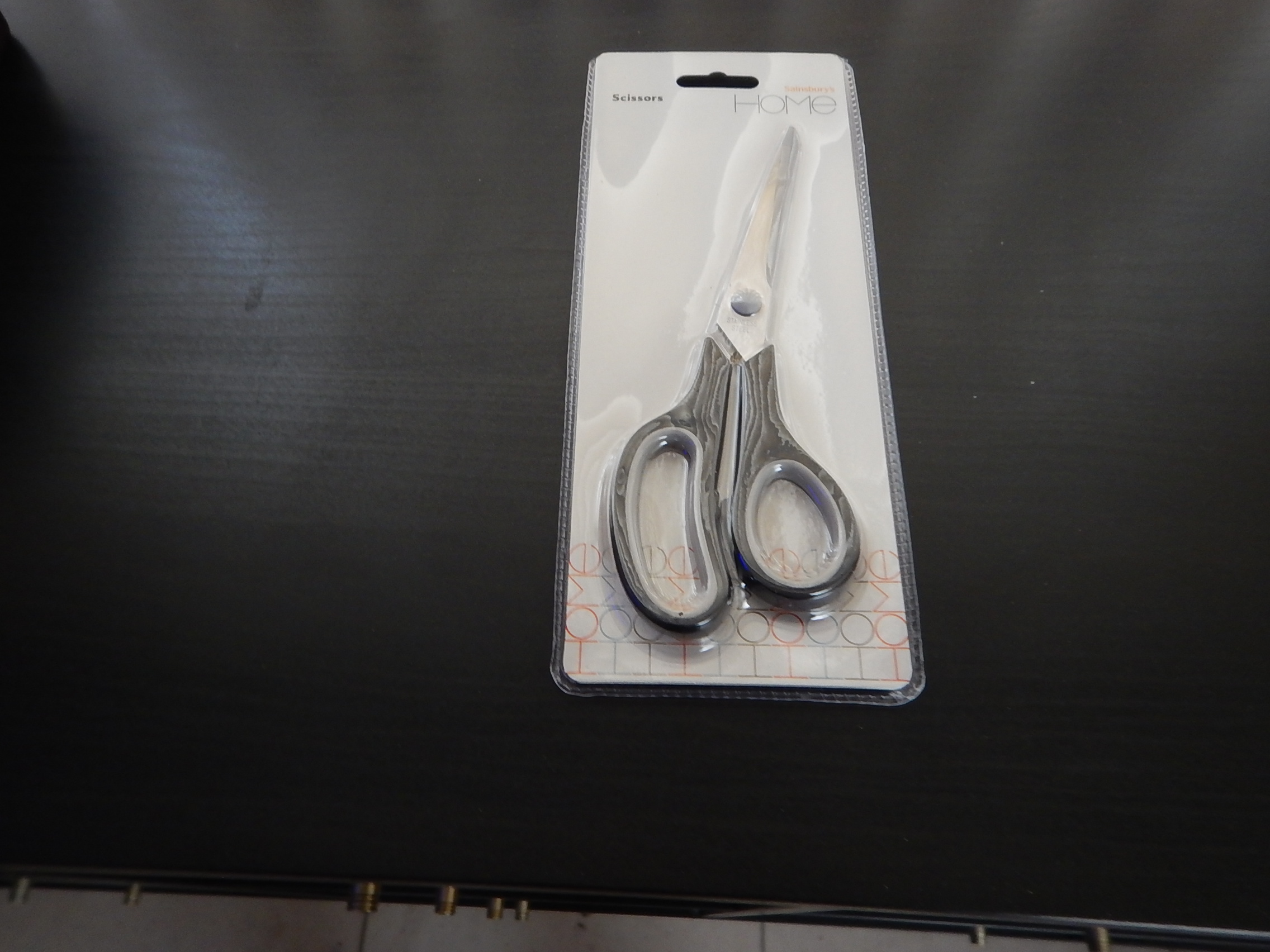
But I then had the problem of how to open the packaging, as after all my scissors were broken.
In the end, I used a small hacksaw.
Norfolk Rail Line To Remain Closed As £68m Upgrade Project Overruns
The title of this post is the same as that of this article on the BBC.
This is the first three paragraphs.
A major railway upgrade project has been delayed, meaning a Norfolk branch line will go longer without a service.
Network Rail is spending £68m to replace Victorian signalling equipment with a computer-based system between Norwich, Great Yarmouth and Lowestoft .
The project was due to be complete by 31 March, but the deadline will now be pushed back to allow for more testing.
As only Berney Arms station will be without a service, this probably isn’t a major disaster for the thousand passengers, who use the station in a year, but the story does have a very familiar ring.
Network Rail + Signalling = Overrun
Either they’ve found a very serious problem or the planning wasn’t the best!
The Possible Reinstatement Of The Reedham Chord
There used to be a direct Yarmouth to Lowestoft Line, but now it is possible to use the Wherry Lines, with a reverse at Reedham station.
Network Rail are talking about reinstating the Reedham Chord to create a more direct route between East Anglia’s largest North-Eastern towns. This is said about the Reedham Chord in Direct Yarmouth Services in the Wikipedia entry for Lowestoft station.
In January 2015, a Network Rail study proposed the reintroduction of direct services between Lowestoft and Yarmouth by reinstating a spur at Reedham. Services could once again travel between two East Coast towns, with an estimated journey time of 33 minutes, via a reconstructed 34-chain (680 m) north-to-south arm of the former triangular junction at Reedham, which had been removed in c. 1880. The plans also involve relocating Reedham station nearer the junction, an idea which attracted criticism.
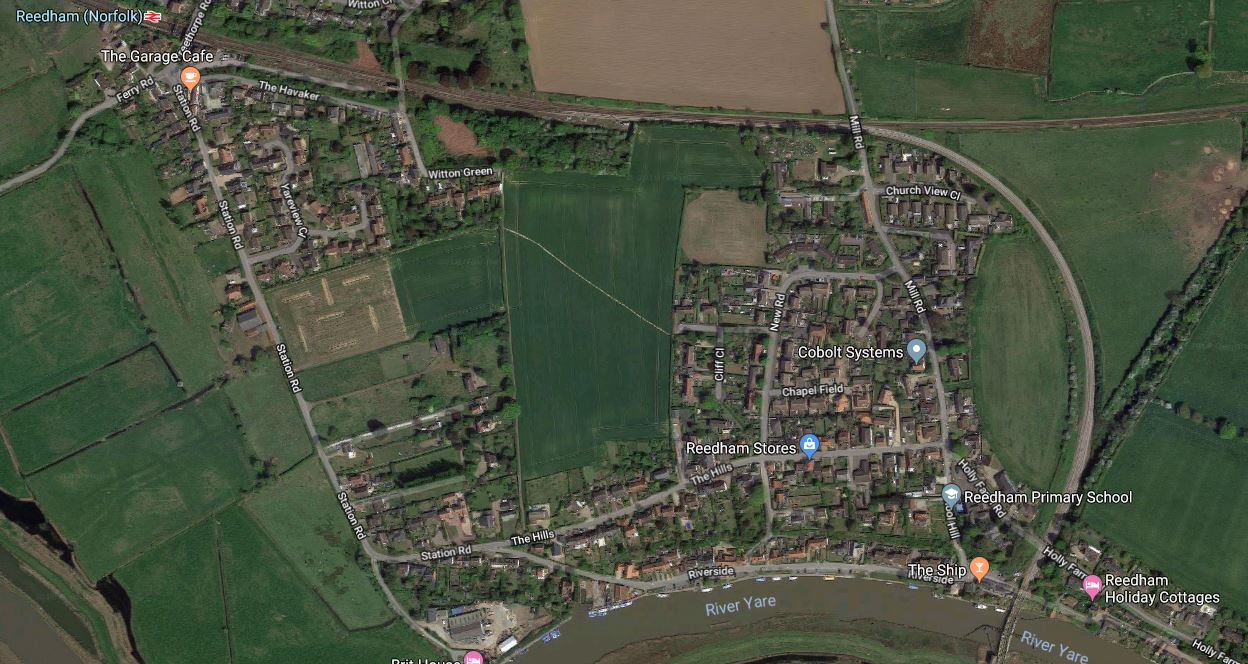
This is a Google Map of the Reedham area.
Note.
- Reedham station is in the North-West corner of the map.
- The single-track line to Yarmouth and the double-track line to Lowestoft, run together to form a triple-track railway to the East of Reedham station.
- There are a large number of cross-overs in the triple-track section to the East of Reedham station, so that trains can easily go between either platform at Reedham and Yarmouth or Lowestoft.
- The line to Yarmouth goes straight away to the East.
- The line to Lowestoft curves South to cross the River Yare.
- The Reedham to Lowestoft tracks appear to have been relaid, as far as the bridge.
Will the new track layout and signalling, allow trains between Lowestoft and Yarmouth to perform a fast reverse in either platform at Reedham station?
This approach has advantages over the reinstallation of the Reedham Chord.
- Reedham station won’t need to be relocated.
- All trains between Lowestoft and Yarmouth will stop at Reedham station.
- There would be no need to build the Reedham Chord.
I also suspect, that not building the Reedham Chord is the more affordable option.
Do Class 755 Trains Have a Fast Reverse Procedure?
Greater Anglia have a number of routes, that will be run by new Class 755 trains, where the trains will need to be reversed at either end.
- Cambridge and Ipswich
- Colchester and Peterborough
- Colchester Town and Sudbury
- Ipswich and Felixstowe
- Ipswich and Lowestoft
- Norwich and Lowestoft
- Norwich and Sheringham
- Norwich and Stansted Airport
- Norwich and Yarmoiuth
When Stadler designed the Class 755 trains for Greater Anglia, did they propose simple automation, so that trains could be reversed in the minimum time at these numerous terminals?
A simple system could be as follows.
- On arrival in a station, the driver would put the train into a standby mode, when it was safely stopped.
- The driver would then walk through the train to the second cab.
- Whilst the driver is changing ends, the conductor is opening and closing the train doors and supervising the loading and unloading of passengers.
- On arrival in the second cab, the driver would wake up the train and check everything.
- After the doors are closed and having received the all clear from the conductor and a green light from the signals, the driver would proceed.
At all times, the driver and conductor, would have emergency remote controls to immobilise the train, if something is not what it should be.
Modern automation is certainly able to design a very safe system, that would save time at every reverse.
What I have described here, is much less ambitious than the system I described in Crossrail Trains Will Have Auto-Reverse.
This auto-reverse system will be used at Paddington on Crossrail, by the Class 345 trains, to allow the driver to change ends on a two-hundred metre long train, whilst it is reversing to return to the East.
Testing The Signalling With The New Class 755 Trains
Obviously, adequate testing must be done with all trains that will use the new signalling on the Wherry Lines between Norwich, Lowestoft and Yarmouth.
This article on the BBC is entitled ScotRail Class 385 Fishbowl Windscreen Safety Concern.
This is the first three paragraphs.
Aslef has warned that modifications must be made to ScotRail’s new Class 385 electric trains – or its drivers will refuse to work them.
The train drivers’ union is concerned that the curved windscreen is causing reflections of other signals at night.
Drivers identified the problem on a recent evening test run between Glasgow Central and Paisley Gilmour Street.
Testing of the ~Norfolk signalling will cover a myriad of possible problems, against the whole route and all possible trains.
But there is one problem, that is probably delaying the project.
The Class 755 trains have not been certified yet! So starting of the testing can’t be started.
Conclusion
This delay is more complicated, than initial reports suggest.
On the other hand, I wouldn’t be surprised if Network Rail have produced a track and signalling solution, that will allow a direct service between Lowestoft and Yarmouth, with a reverse at Reedham.
Typical timings appear to be.
- Between Reedham and Yarmouth – 14-16 minutes
- Between Reedham and Lowestoft – 24-26 minutes
Given that the Class 755 trains have the following characteristics.
- They are 100 mph trains.
- They are optimised for fast stops.
I wouldn’t be surprised to see a sub-forty minute time between Lowestoft and Yarmouth.
Using the current times between Ipswich and Lowestoft and Norwich and Yarmouth, it also looks like a sub-three hour scenic route is possible between Ipswich and Norwich.
Procrastination Over Airport Rail Links
This article in the Glasgow Evening Times is entitled Glasgow Airport Rail Link: Fresh Fears Over Plans As MSP Slams Delay.
The title says it all.
Of the airports in the UK, the following have or will have good rail or tram links.
- Birmingham
- Cardiff
- Edinburgh
- Gatwick
- Heathrow
- London City
- Luton – Building a people-mover between the airport and station.
- Manchester
- Newcastle
- Southampton
- Southend
- Stansted
In addition, the following airports have been talking about rail links.
- Belfast City
- Bristol
- East Midlands
- Glasgow
- Leeds/Bradford
- Liverpool
In fact they’ve been talking about rail links for decades.
As I started with a report about Glasgow, if you want to see how they have taken two decades to get nowhere, read the Wikipedia entry for the Glasgow Airport Rail Link.
The latest £144million plan involves tram-trains running from Glasgow Central station.
Currently, of the airports, that have talked for years, I believe the following could use tram-train technology to provide the airport rail link.
- Bristol
- East Midlands
- Glasgow
- Leeds/Bradford
- Liverpool
Now that tram-trains are working well in Sheffield and have been ordered for the South Wales Metro, surely this technology can be considered almost mainstream for the UK.
In the specific case of Glasgow the following would be needed.
- Modification of platforms at Glasgow Central and Paisley Gilmour Street stations, so they would give level-access to the tram-trains.
- Creation of a single-track spur to the airport without electrification, that ends in a single platform, close to or in the airport terminal.
- A fleet of Class 399 tram-trains with a battery capability, as have been ordered for the South Wales Metro.
- Improved signalling to handle the extra trains.
Note.
- Space should be left, so that in the future, the airport spur could be doubled.
- A flat junction would probably work initially, but provision for a flying junction for the spur should be made.
- Currently, four trains per hour (tph) run past the Airport.
- Could the tram-trains be built to give level access to standard height platforms, so that no substantial modification of existing platforms would be needed?
It also strikes me, that this could be a privately funded scheme.
- Glasgow Airport is ultimately owned by Ferrovial and Macquarie Group, who will be the main beneficiary of the scheme.
- Both Ferrovial and Macquarie Group are companies that invest in infrastructure.
- The Class 399 tram-trains can obviously be leased.
So what’s the problem?
- Network Rail are against the scheme, as it’s not one of theirs.
- The Scottish government won’t sanction a privately-funded scheme.
- Various interests want a different scheme.
- The jury is still out on tram-trains.
- It’s a scheme for Glasgow and the decision is taken in Edinburgh.
- Glasgow would get a better airport link than Edinburgh.
Enlighten me!
Other Airport Links
Once Glasgow is completed, other airport links could be built using the same techniques.
I have a feeling, that another airport will get a tram-train link before Glasgow!
 The Anonymous Widower