World’s Largest Wind Farm Attracts Huge Backing From Insurance Giant
The title of this post, is the same as that of an article in the Business pages of yesterday’s copy of The Times.
It is not often that three words implying something big appear in the same sentence, let alone a headline! Such repetition would more likely appear in a tabloid to describe something sleazy.
Until recently, wind power was just something used by those in remote places. I remember a lady in Suffolk, who had her own turbine in the 1980s. She certainly lived well, although her deep freeze was in the next door farmer’s barn.
Now, with the building of the world’s largest wind farm; Hornsea, which is sixty miles off the coast of East Yorkshire, wind farms are talked of as creating enough energy for millions of homes.
Hornsea Project 1 is the first phase and Wikipedia says this about the turbines.
In mid 2015 DONG selected Siemens Wind Power 7 MW turbines with 154 metres (505 ft) rotor turbines for the project – around 171 turbines would be used for the wind farm.
Note that the iconic Bankside power station, that is now the Tate Modern had a capacity of 300 MW, so when the wind is blowing Hornsea Project 1 is almost four times as large.
When fully developed around 2025, the nameplate capacity will be around 6,000 MW or 6 GW.
The Times article says this about the funding of wind farms.
Wind farms throw off “long-term boring, stable cashflows”, Mr. Murphy said, which was perfect to match Aviva policyholders and annuitants, the ultimate backers of the project. Aviva has bought fixed-rate and inflation-linked bonds, issued by the project. While the coupon paid on the 15-year bonds, has not been disclosed, similar risk projects typically pay an interest rate of about 3 per cent pm their bonds. Projects typically are structured at about 30 per cent equity and 70 per cent debt.
Darryl Murphy is Aviva’s head of infrastructure debt. The article also says, that Aviva will have a billion pounds invested in wind farms by the end of the year.
Call me naive, but I can’t see a loser in all this!
- Certainly, the UK gets a lot of zero-carbon renewable energy.
- Aviva’s pensioners get good, safe pensions.
- Turbines and foundations are built at places like Hull and Billingham, which sustains jobs.
- The need for onshore wind turbines is reduced.
- Coal power stations can be closed.
The North Sea just keeps on giving.
- For centuries it has been fish.
- Since the 1960s, it has been gas.
- And then there was oil.
- Now, we’re reaping the wind.
In the future, there could be even more wind farms like Hornsea.
Ease Of Funding
Large insurance companies and investment funds will continue to fund wind farms, to give their investors and pensioners a return.
Would Aviva be so happy to fund a large nuclear power station?
Large Scale Energy Storage
The one missing piece of the jigsaw is large scale energy storage.
I suspect that spare power could be used to do something useful, that could later be turned into energy.
- Hydrogen could be created by electrolysis for use in transport or gas grids.
- Aluminium could be smelted, for either use as a metal or burnt in a power station to produce zero-carbon electricity.
- Twenty-four hour processes, that use a lot of electricity, could be built to use wind power and perhaps a small modular nuclear reactor.
- Ice could be created, which can be used to increase the efficiency of large gas-turbine power plants.
- Unfortunately, we’re not a country blessed with mountains, where more Electric Mountains can be built.
- Electricity will be increasingly exchanged with countries like Belgium, France, Germany, Iceland, Norway and The Netherlands.
There will be other wacky ideas, that will be able to store GWhs of electricity.
These are not wacky.
Storage In Electric Vehicles
Consider that there are three million vehicles in the UK. Suppose half of these were electric or plug-in hybrid and had an average battery size of 50 kWh.
This would be a total energy storage of 75,000 MWh or 75 GWh. It would take the fully developed 6GW Hornsea wind far over twelve hours to charge them all working at full power.
Storage In Electric And Hybrid Buses
London has around 8,500 buses, many of which are hybrid and some of electric.
If each has a 50 kWh batttery, then that is 425 MWh or .0.425 GWH. If all buses in the UK were electric or plug-in hybrid, how much overnight electricity could they consume.
Scaling up from London to the whole country, would certainly be a number of GWhs.
Storage In Electric Trains
I also believe that the average electric train in a decade or so could have a sizeable battery in each coach.
If we take Bombardier they have an order book of over four hundred Aventra trains, which is a total of nearly 2,500 coaches.
If each coach has an average battery size of 50 kWh, then that is 125 MWh or 0.125 GWh.
When you consider than Vivarail’s two-car Class 230 train has a battery capacity of 400 kWh, if the UK train fleet contains a high-proportion of battery-electric trains, they will be a valuable energy storage resource.
Storage in Housing, Offices and Other Buildings
For a start there are twenty-five million housing units in the UK.
If just half of these had a 10 kWh battery storage system like a Tesla Powerwall, this would be a storage capacity of 125 GWh.
I suspect, just as we are seeing vehicles and trains getting more efficient in their use of electricity, we will see buildings constructed to use less grid electricity and gas.
- Roofs will have solar panels.
- Insulation levels will be high.
- Heating may use devices like ground source heat pumps.
- Battery and capacitors will be used to store electricity and provide emergency back up.
- Electric vehicles will be connected into the network.
- The system will sell electricity back to the grid, as required.
Will anybody want to live in a traditional house, that can’t be updated to take part in the energy revolution?
Will The Electricity Grid Be Able To Cope?
National Grid have been reported as looking into the problems that will happen in the future.
- Intermittent power from increasing numbers of wind and solar farms.
- Charging all those electric vehicles.
- Controlling all of that distributed storage in buildings and vehicles.
- Maintaining uninterrupted power to high energy users.
- Managing power flows into and out of the UK on the various interconnectors.
It will be just like an Internet of electricity.
And it will be Europe-wide! and possibly further afield.
Conclusion
The UK will have an interesting future as far as electricity is concerned.
Those that join it like Aviva and people who live in modern, energy efficient houses will do well.
Will Trains Run Bi-Directionally On The New Third-Track Through Tottenham Hale?
I ask this question, as a station-man at Tottenham Hale station, said this is what will happen, when the third track is commissioned and there are four trains per hour (tph) between Stratford and Meridian Water stations.
As there is no passing loop between Lea Bridge and Meridian Water stations, only one train can run on the third track at any one time.
Currently timings on the route are as follows.
- Lea Bridge to Angel Road – 10 minutes
- Stratford to Angel Road – 16-18 minutes
- Angel Road to Stratford – 16-18 minutes
- Angel Road to Lea Bridge – 9 minutes
If I assume that it takes six minutes to change ends at Meridian Water and that journey times are a minute shorter due to the shorter distance, this means the following.
- A train would take twenty-three minutes to do a round trip between Lea Bridge and Meridian Water.
- A train would take thirty-eight minutes to do a round trip between Stratford and Meridian Water.
I am led to the following conclusions.
- A twenty-three minute round trip from Lea Bridge means that four tph isn’t possible using the third track bi-directionally.
- Thirty-eight minutes for the round trip from Stratford would probably mean only one extra trip in an hour is possible.
I am very certain that running a four tph service between Stratford and Meridian Water, using the third track in a bi-directional manner would be very difficult, if not impossible.
Cross-Platform Interchange Between Crossrail And Central Line At Stratford
Crossrail and the Central Line have a cross-platform interchange at Stratford.


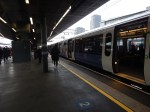

I turned up today, with trains in both platforms.
There needs to be more interchanges like this between different lines, around the UK.
I can’t think of many.
- Acton Town – District and Piccadilly Lines
- Barons Court – District and Piccadilly Lines
- Euston – Northern and Victoria
- Finchley Road – Metropolitan and Jubilee Lines
- Finsbury Park – Victoria and Piccadilly Lines
- Hammersmith – District and Piccadilly Lines
- Highbury & Islington – Northern City and Victoria Lines.
- Mile End – Central and Hammersmith & City Lines
- Oxford Circus – Victoria and Bakerloo Lines
- Ravenscourt Park – District and Piccadilly Lines
- Stockwell – Victoria and Northern Lines
- Turnham Green – District and Piccadilly Lines
- Wembley Park – Metropolitan and Jubilee Lines.
I don’t know of one outside the London area.
Northumberland Park Station – 26th November 2018
Northumberland Park station is now open for business.
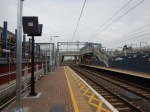
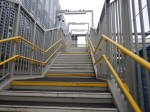
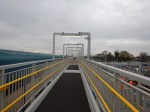

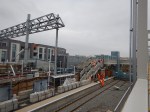
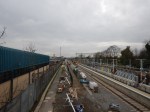
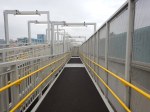

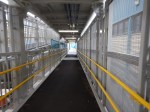
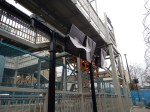
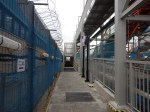
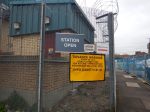
The pictures are in sequence as I walked from the Northbound platform, across the bridge and out the other side of the station.
- I used the steps on the Northbound platform.
- One lift is almost ready to use.
- The ramp on the Southbound platform is ready.
- Currently, there are three tracks, with space for a fourth.
- There is still a lot of finishing to do.
The station has been designed to be simple and won’t have a Ticket Office or entry gates.
Gluten-Free Spinach And Ricotta Ravioli From Marks And Spencer
Gluten-free ravioli is one of the foods that I have missed, since my diagnosis as a coeliac.
But, I was able to buy this new product this afternoon, at a cost of £3.70 for enough for two.

The proof will be in the eating.
London City Airport Appoints Former Crossrail Boss Rob Holden As New Chairman
The title of this post is the same as that of this article on City AM.
If this doesn’t get the extra station on Crossrail at Silvertown, that London City Airport needs and wants, then nothing will.
Paddington Bakerloo Line Link Project, London
The title of this post is the same as that of this page on the Institute Of Civil Engineering web site.
The page contains a video presentation of the building of the Paddington Bakerloo Line Link, that will connect the Bakerloo Line to Crossrail sometime next year.
If you think the golden age of British improvised tunnelling finished with the end of World War Two, with the likes of the Wooden Horse and the Great Escape, then think again.
- A redundant Royal Mail building stars as the cookhouse, where the tunnel starts under the floor.
- The old Rail Mail tunnel, doubles for the sewers.
- Sections were dug by hand.
I wouldn’t be surprised to see more pedestrian tunnels dug with all the ingenuity of this one.
South Australia Launches AU$50 Million Fund For Grid-Scale Energy Storage
The title of this post is the same as that of this article on Energy Storage News.
This is the first paragraph.
In order to address intermittency in its grid, the South Australian Government has introduced a AU$50 million (US$36 million) Grid Scale Storage Fund (GSSF) to help accelerate the deployment of new large energy storage projects, including pumped hydro, hydrogen, gas storage, solar thermal, bioenergy and battery storage.
It is a must-read article, which shows the way progressive governments are thinking.
Contactless Payments For Food In Marks And Spencer
I have been using contactless bank cards to buy my food in Marks and Spencer for about sixteen months now.
I started making a note of my spending this way, as I wanted to check that this method of payment was secure.
It is!
What has dropped out of my research is that the average price of an item over those sixteen months, has been a couple of pence over two pounds.
So now, I usually only buy fifteen items, so that I’m just below the contactless payment limit.
- If it’s a couple of pounds over, I just drop a couple of pound coins in from my pocket, before using the card.
- As it happens fifteen items always fit in my reusable bag, which I stow in my manbag.
- I haven’t bought a new bag for a year and rarely pay 5p. for a plastic one.
The self-imposed fifteen item limit has certainly speeded up my shopping.
I wonder if other chains have the same item cost!
Environmentally-Friendly Dry Cleaning
In the late-1960s, when I worked for ICI, the company was very worried about the effect of dry-cleaning chemicals on the health of workers and was constantly looking for better chemicals.
I suspect as that was fifty years ago, that the dry-cleaning process itself is very much more envionmentally friendly.
But look at these trousers, that I have just brought back from the dry cleaners.
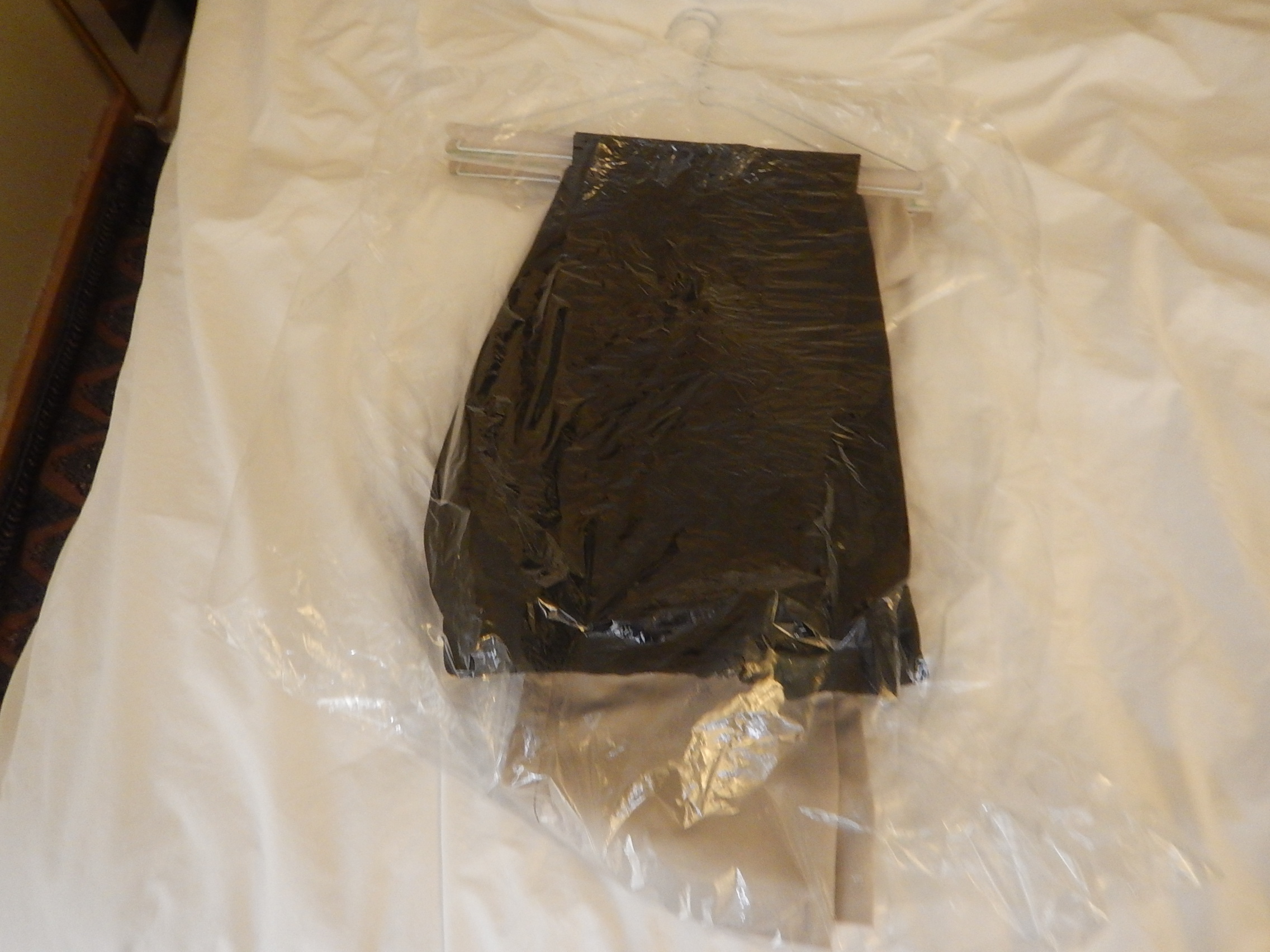
There are two things wrong with the packaging.
The awful wire coat hangers, which are a nuisance to deal with and go straight in the bin.
The plastic wrapping over the top, which I assume is not recyclable.
Years ago in Suffolk, we had a man who collected and returned our bed linen from the laundry, once a week. I can’t remember the company, but I hope they’re still going, as they did an excellent service.
They then started doing dry cleaning and they gave you the choice of having it on hangers or neatly folded in tissue paper.
I remember we chose the latter, as it was so much more convenient.
C would then put things that needed a hanger on proper wooden ones.
With the worries around plastic getting into the oceans, surely we should stop this needless wrapping of dry cleaning with plastic and fold things neatly in tissue paper!
I look forward to seeing a dry-cleaners, that says that we don’t use plastic!
 The Anonymous Widower