Siemens Unveils Plans For £200m Train Factory In East Yorkshire
The title of this post, is the same as that of this article in Rail Technology Magazine.
This is a key paragraph.
While the factory is only in the planning stage at the moment, Siemens hopes to begin construction later this year if the company can confirm some “major future orders.”
As to major future orders in the UK, the following would appear to be possibilities.
- New London Underground train orders for the Piccadilly, Bakerloo and Central Lines.
- New trains for HS2.
- New trains for the new East Midlands Franchise.
- New trains for the new Southeastern Franchise.
Note.
- Siemens have shown designs for the Underground, which I discussed in Siemen’s View Of The Future Of The Underground.
- HS2 will be built to the same standard as most European High Speed Lines.
- The trains for the East Midlands could probably be based on German ICE trains.
- Desiro City trains would handle a lot of Southeastern’s needs.
I suspect, that Siemens have designs that could be adapted for most of the UK’s possible large orders.
I shall a few thoughts to these orders.
New Tube For London
The New Tube For London is a very large project, that will do the following.
- Replace the current rolling stock on the Bakerloo, Central, Piccadilly and Waterloo and City Lines.
- Initially, there will be 250 new trains.
- Increase capacity.
- Increase frequency.
- Run under a much higher level of automation.
- Hopefully, the first train will run on the Piccadilly Line by 2023.
- It is also intended that the new trains will replace the current trains on other lines.
Wikipedia says this about the project cost.
The project is estimated to cost £16.42 billion (£9.86 bn at 2013 prices)
The following companies were on an approved short list.
- Alstom
- Siemens
- Hitachi,
- CAF
- Bombardier
Since this list was published, Bombardier and Hitachi have said they will propose a joint bid and Siemend and Alstom have merged their train-building interests.
So we are left with the following bidders.
- Alstom-Siemens, who have various small factories in the UK.
- Bombardier-Hitachi, who have two large factories in the UK.
- CAF, who are building a factory at Newport in South Wales.
Various factors will come into the choice of manufacturer.
- The London Underground order, is probably one of the largest train orders, that will be placed in the next few years and fulfilling it will most likely require a large manufacturing capacity in the UK.
- Bombardier-Hitachi and Alstom-Siemens have the resources to create such a manufacturing capacity. Would CAF have that capacity?
- Bombardier has been working with Transport for London for about thirty years and their recent trains for London have been generally well received.
- Hitachi will add Japanese technology and finance to the bid.
- Do Hitachi have a lot of space at Newton Aycliffe?
- Siemens are Europe’s biggest industrial company, so they can invest heavily to ensure they get the order.
- Delivering the first trains for the Piccadilly Line in 2023, could be a tough ask!
In a Brexit World, it will be interesting to see who gets the order.
Trains For HS2
Note these points about Siemens, High Speed Trains and the trains required for HS2.
- It would appear that most German ICE trains are built by Siemens or the company is involved in a consortium.
- Siemens latest trains for Eurostar have been well-received.
- The High Speed Train market around the World is increasing in size.
- The initial HS2 contract will be sixty trains, each of which will hold a thousand passengers.
As trains will be of two types;HS2-only and classic-compatible, the designing of the trains will be a challenging exercise.
But Siemens experience from Germany, where classic-compatible trains have to be extensively used, may give them an edge.
I have ridden High Speed Trains in France, Germany, Italy, Spain and Kent, and single-deck trains are very similar, especially where trains are classic-compatible.
They are certainly more similar, than say commuter trains, which all seem to suffer from lots of local preferences.
Another factor is the size of the site at Goole, which is 23 hectares or the size of 23 football pitches.
- Could Siemens be planning a new site to build its High Speed Trains?
- Are Siemens short of space for expansion at Krefeld?
- There is probably space for a test track at Goole, that could be connected to the factory.
- The site would be well-connected to the East Coast Main Line and the rest of the UK’s High Speed Network and the Channel Tunnel.
- Exports to the Rest of the World, could use the ports of the Humber.
- Siemens have a lot of investment in other industries in East Yorkshire.
It looks to be a logical choice of location to manufacture and commission trains.
If they get the order for the new trains for HS2, it would be the ideal manufacturing site.
But if they do, will Siemens manufacture High Speed Trains for export?
This could explain, why Chris Grayling was present for the announcement in Goole.
New Trains For The New East Midlands Franchise
With these trains, which will likely be bi-modes, it depends on whether they are trains like Hitachi Class 800 trains or classic-compatible versions of High Speed Trains.
But this order will be smaller than the London Underground or HS2 orders, so9 I wouldn’t be surprised if it went to the company with the best of the previous generation of 125 mph bi-mode trains.
New Trains For The New Southeastern Franchise
Surely, if Siemens get this order it will be for Desiro City trains and like the Class 700 trains for Thameslink, Siemens would seriously, think about building them in Germany.
On the other hand, Southeastern’s routes could be very much in Crossrail territory and as I showed in Is Crossrail Having An Affect On Train Purchases In The South East?, I think it is very likely that the nod will go to Aventras for the franchise.
But I estimate, there are 1,300 trains needed, so with the right offer, they might get the order and decide to build them at Goole.
Once this franchise is settled, there probably aren’t too many large train orders left in the UK, for this class of train.
And Then There Is Hydrogen!
I believe that just as Alstom converted a Alstom Coradia Lint, into a hydrogen version, that Siemens could apply the same process to create a hydrogen-powered Class 707 train, which would probably be a useful train for a train operating company to have in its fleet.
I describe my thinking in Could The Unwanted Class 707 Trains Be Converted To Hydrogen-Power?
Perhaps, the current unwanted thirty trains could be converted to dual-voltage hydrogen-powered trains?
But this is not a project that would require a large factory!
Unless of course, it was linked to the 1,300 new trains that the new Southeastern franchise could need.
Conclusion
I feel that Siemens is in pole position to build the High Speed Trains, but it could be more than that!
Are Siemens developing Goole as their main manufacturing site for High Speed Trains, due to limitations at Krefeld in Germany?
Does this leave the Bombardier-Hitachi consortium to pick up the London Underground order?
It’s all getting very interesting!
Will London Overground Procure Some Class 230 Trains?
Transport for London has a cash flow problem caused by various factors.
- The reduction in grant from Central Government.
- A fall in bus revenue caused by traffic congestion.
- The freeze of fares by the Mayor.
- The need to add services to stimulate much-needed housing.
This article in Rail Magazine is entitled Vivarail’s D-Trains Confirmed For Bedford-Bletchley.
As West Midlands Trains have now confirmed the order for the Class 230 trains, does this mean that buying Vivarail’s innovative refurbished London Underground D78 Stock, is now a less-risky train purchase?
Battery Or Diesel Class 230 Trains?
Would Transport for London buy a diesel or battery version of the Class 230 train?
Transport for London will have an exclusively electric fleet in a few months, when they have passed the Class 172 trains to West Midlands Trains.
I can’t believe they’d want to buy a small number of diesel trains, so I suspect they’ll go for battery versions.
Advantages Of Class 230 Trains For Transport for London
The trains must have advantages for Transport for London.
- They are simple trains, built for remote servicing.
- In some applications, their short length of just two cars must help, in that expensive platform extensions will not be needed.
- I would suspect that one two-car train is designed to rescue another.
- Capacity can be increased by adding a third-car.
- Transport for London must also have a lot of expertise on how to get the most out of these trains.
Possible Routes
There are a handful of possible routes.
Greenford Branch Line
The Greenford Branch Line must be a prime candidate for running with two-car battery version of a Class 230 train.
Consider.
- Using a four-car train, like a Class 710 train would require the platform at Greenford to be lengthened.
- A Class 230 train would only need some form of simple electrification at Greenford and/or West Ealing stations.
- Class 230 trains, would probably fit all platforms easily and give level access for wheelchairs and buggies.
- Could London Overground’s third-rail engineers add suitable electrification to charge the batteries at Greenford station?
- The branch is only four kilometres long.
- The branch only has the two tph passenger service and the occasional freight train.
- All trains use the new bay platform at West Ealing station.
One train could obviously work the current two trains per hour (tph) timetable, but could two trains and a possible spare run a four tph service on the branch?
The advantages of using Class 230 trains over a more conventional approach using perhaps Class 710 trains would include.
- No electrification of the branch.
- No platform lengthening and possibly little platform modification.
- Only a short length of third-rail electrification would be needed to charge the batteries.
- A four tph service might be possible.
The big advantage would be that it would be a low-cost project.
Romford To Upminster Line
The Romford To Upminster Line is currently run by a single four-car Class 315 train, which was to be replaced by a new Class 710 train.
In the March 2018 Edition of Modern Railways, whilst discussing nine more Class 71 trains for the London Overground, it is said, that a Class 315 train will be retained for the Romford To Upminster Line.
Why not procure another Class 230 train and use that to shuttle along the branch?
Consider.
- The electrification can be removed from the line, to save maintenance costs.
- A short length of third-rail electrification can be used to charge the batteries at Upminster station.
- The trains could be stabled at Upminster Depot.
The line used to have a short passing loop between Romford and Emerson Park station, that could be long enough for a two-car Class 230 train. If this loop were to be reinstated without electrification, if might allow a four tph service.
It would be another low-cost project.
Bromley North Line
The Bromley North Line is currently served by Southeastern.
Reading Wikipedia for the line, I get the impression, that the line isn’t a major problem, but there are little annoyances.
- Services are not frequent enough at some times of the day and week.
- Connection to services to and from London aren’t always convenient.
- It is not the easiest branch to provide with trains and drivers.
In addition, Southeastern would appear to be amenable to pass the line to Transport for London.
The track layout for the line has the following characteristics.
- Double-track throughout.
- There is a single platform at Grove Park station.
- There are two platforms at Bromley North station.
- The intermediate station; Sundridge Park has two platforms.
It looks like the line was designed so that two trains can operate simultaneously.
- Two Class 230 trains could run a four tph service.
- Stabling and servicing could be in Bromley North station.
- Trains could be third-rail or battery.
- A spare train could be held ready if it was felt needed.
It would be a self-contained low-cost solution.
Epping To Ongar
The Epping to Ongar service on the Central Line is no more, but would it be viable now with a Class 230 train?
Brentford Branch Line
The Brentford Branch Line has been proposed for reopening.
Class 230 trains powered by batteries would be ideal rolling stock.
The trains would be charged in Southall station.
West London Orbital
This article on Global Rail News is entitled Commitment To West London Orbital rail line.
This is said.
A press release distributed by the office of London Mayor Sadiq Khan said: “This new line, delivered through TfL, the West London Alliance, boroughs and Network Rail, could potentially support the delivery of an additional 20,000 homes, as well as employment growth in west London.”
In this article on Ian Visits, this is said about the service on the proposed West London Orbital line.
Phase 1: 4 trains per hour from West Hampstead to Hounslow, calling at West Hampstead, Cricklewood, Neasden, Harlesden, OOC, Acton Central, South Acton, Brentford, Syon Lane, Isleworth, Hounslow.
Phase 2: additional 4 trains per hour from Hendon to Kew Bridge, calling at Hendon, Brent Cross/Staples Corner, Neasden, Harlesden, OOC, Acton Central, South Acton, Kew Bridge.
The track is all in place and with a new bay platform at Hounslow, Class 230 trains could work Phase 1 on batteries with ease.
The key to the intermediate stations is property development. At Neasden, Harlesden and Old Oak Common, there is a lot of spare land around the Dudding Hill Line, where the trains will run. Developers will be told to build an appropriate amount of housing with a new station underneath.
The West London Orbital could be built to the following specification.
- No full electrification.
- Battery trains.
- Platforms long enough for four-car Class 710 trains.
- Bay platforms with possible charging at West Hampstead, Hendon, Hounslow and Key Bridge stations.
- Four tph on both routes.
It lends itself to a very efficient way of building the railway.
- Build a platform on the freight line through West Hampstead Thameslink station.
- Build a bay platform that will accept a four-car train at Hounslow station.
- Establish a four tph shuttle service between West Hampstead Thameslink and Hounslow stations calling at Acton Central, South Acton, Brentford, Syon Lane and Isleworth.
- Stations could be built at Neasden, Harlesden and Old Oak Common, where there is a generous amount of brownfield land, with lots of space for housing above the tracks and platforms.
Note.
- Batteries would be charged between Acton Central and Hounslow using the existing third-rail electrification.
- About five miles of the route would not be electrified.
- Housing developments on top of a station are a property developers dream.
The service could be started using Class 230 trains, with the option to switch to four-car Class 710 trains, powered by batteries, when more capacity is needed and Bombardier have fully developed the battery Aventra.
Phase two of the project would need development of platforms at Hendon and Kew Bridge stations.
The beauty of the West London Orbital, is that the only costs for Transport for London are four new platforms, some track-work and a fleet of new trains.
Hopefully, the development of the intermediate stations would be down to property developers, as they will make a fortune out of the housing!
Conclusion
I think the answer to my original question posed in the title of this post is Yes!
Do We Buy More Trains Than The Germans?
I ask this question with respect to the Germans, but I could ask the question with respect to the French, Italians or Spanish.
On my recent trip to Germany, the frequiency seemed to be less than I could expect in a similar route in the UK.
A a simple example, the frequency on the S-Bahn across Berlin, appeared to be very much inferior to London Overground’s East London Line.
There are possible reasons.
- Our signalling systems have a higher capacity.
- Train dwell times at stations are less.
- We have more trains on the route.
- Politics between Deutsche Bahn and the Local Authority get in the way.
Trains certainly don’t appear to be as frequent in Germany.
Vivarail To Supply Three D-Trains To West Midlands Trains
The title of this post is the same as this article on Rail Technology Magazine.
This order has been a long time coming and the three Class 230 trains will be used by West Midlands Trains on the Marston Vale Line, from December 2018.
Whether they will be diesel or battery versions of the Class 230 trains is not stated.
Is The Answer To Transport Problems 42?
This article in Rail Magazine is entitled Adaptable Carriage Secures Government funding.
This is the first two paragraphs.
Product development company 42 Technology has secured £350,000 worth of Government funding towards developing a system that can turn passenger carriages into goods vehicles.
The Adaptable Carriage system allows seats and tables to be stowed within three minutes, creating space for cargo that would normally be sent by road. 42 Technology envisages the system being employed on quieter off-peak services to carry low-density, high-value goods. It could also be used to create storage space for wheelchairs and bicycles, if required.
It is an idea that could work.
Take a route like Felixstowe to Ipswich, that I used to know well.
It gets commuter traffic at both ends of the working day.
But if it’s sunny and fine, the service would need extra space for bicycles and buggies for passengers going to enjoy the sea air.
The ability to be able to convert seats to bicycle, buggy and wheel-chair spaces might generate extra traffic.
That is only a simple example, but surely there are possibilities on routes between big cities for high-value traffic.
Red Star Parcels used to work well fifty years ago, so why shouldn’t a high speed parcels service work in this day and age?
During the Peak Hours all carriages would be setup for seats. but at other times, seats would be stowed to allow freight and parcels on wheeled pallets to be carried.
The Hitchhiker’s Guide to the Galaxy
Surely, only a company specialising in unusual designs in Cambridge, Shoreditch or California would call itself 42 Technology.
Midland Mark 4
The title of this post is the same as an article by Ian Walmsley in the March 2018 Edition of Modern Railways.
Ian builds on what he said in an article in the August 2017 Edition of the same magazine. I wrote about that article in We Should All Think Radically!
He proposes using Mark 4 coaches with two Class 43 power cars to create trains that meet the PRM-TSI regulations deadline, which will mean the replacement of the East Midland Franchise’s twelve InterCity 125s.
He suspects various technical solutions can be borrowed to make it all possible and because of the extra weight of the Mark 4 coaches, the trains may become 2+7 sets instead of the current 2+8.
The trains could be rather nice.
- The Mark 4 coaches have been extensively refurbished in the last two decades and have full wi-fi and power socket fitment.
- The Mark 4 coaches meet all the PRM-TSI regulations.
- 125 mph running would be possible, where the track allowed.
- The East Midland Franchise already has the Class 43 power-cars.
- If the electrification of the Midland Main Line is ever electrified, then the Class 43 power cars could be swapped for electric locomotives.
I would assume that three extra sets, that the franchise is acquiring from Grand Central could also be converted., giving the East Midlands Franchise, fifteen sets with a life of at least ten years.
A quick calculation would indicate that this reorganisation could see the current 132 Mark 3 coaches replaced by perhaps 120 Mark 4 coaches. I’ve just applied 7/8 to the Mark 3 coach total after the Grand Central trains have been added to the fleet.
What Will Happen To The Remaining Mark 4 Coaches?
Currently, there are 302 Mark 4 coaches in service on the East Coast Main Line with Virgin Trains East Coast.
In the Wikipedia entry for the Mark 4 coach, there is a section named Future.
This is said.
The Mark 4s are scheduled to be replaced on the East Coast Main Line by Class 801s in 2018. Some may be redeployed to Midland Main Line services.[19] Virgin Trains East Coast will retain seven or eight nine-carriage sets to operate extra services to Edinburgh.
In 2017, Alliance Rail Holdings announced that, owing to it being unable to source new build Class 390 EMUs for its intended service between London and Blackpool, it was revising its proposal to use the Class 91/Mark 4 combination instead
So it looks like seventy-two coaches will be retained for the East Coast Main Line.
As to how many trains will be needed between London and Blackpool, that’s the old question of how long is a piece of string.
Consider.
- I don’t think that the platforms at Blackpool will accept full-length sets.
- Class 180 trains used by various operators are five cars in length.
- There are fourteen Class 180 trains, running to Bradford, Hull and Sunderland.
- TransPennine Express has ordered several multiple units and rakes of coaches, that are five-cars long.
So perhaps three sets of five carriages, which seem adequate for Sunderland, would be a rough estimate.
This gives the following totals.
- East Midlands Franchise – 120
- East Coast Main Line – 72
- Euston-Blackpool – 15
Which gives a total of 207.
This leaves ninety-five coaches for other purposes. Or dare I say it, nineteen sets of five coaches?
Motive Power
The rakes of coaches will need to be powered.
These are a few possibilities.
Class 91 Locomotive And A Mark 4 Driving Van Trailer
Currently, Mark 4 coaches are powered and driven by a Class 91 locomotive with a Mark 4 Driving Van Trailer, at the other end of the train.
Total numbers available are
- 31 – Class 91 Locomotive
- 32 – Mark 4 Driving Van Trailer
If eight sets are retained for the East Coast Main Line, this means that a maximum of twenty-three trains could be created.
But except for limited use by Open Access Operators from London on fully-electrified lines, I can’t see all Class 91 locomotives being required.
Mark 4 Coaches Topped And Tailed With Class 43 Locomotives
This is Ian Walmsley’s plan for the Midland Main Line, as he outlined in the March 2018 Edition of Modern Railways.
Consider.
- There are quite a few Class 43 locomotives available. There are thirty-two on the East Coast Main line for a start.
- Ian feels that creating 2+7 sets is possible, but many needed would be shorter.
- According to the article, Mark 4 coaches would be more affordable than making Mark 3 coaches PRM-TSI compliant.
The trains would share the iconic appearance of the InterCity 125, which passengers seem to love so much!
Class 68 Locomotive And A Mark 4 Driving Van Trailer
Chiltern use Class 68 locomotives and Mark 3 Driving Van Trailers, with Mark 3 coaches, so it is likely perhaps after some modification, these locomotives could be used with Mark 4 coaches and an appropriate Driving Van Trailer.
If a Class 68 locomotive would work, surely the closely-related Class 88 locomotive could also be used.
Mark 4 Coaches Topped And Tailed With Class 68 Locomotives
This arrangement has been used between Norwich, Lowestoft and Yarmouth with an elderly rake of Mark 2 coaches for some time.
It is a method that could be surely be used with Mark 4 coaches after a few modifications.
A New Class Of Electro-Diesel Locomotive And A Mark 4 Driving Van Trailer
I very much feel we need a new electro-diesel locomotive for both freight and passenger purposes.
Mark 4 Coaches Topped And Tailed With A Class 68 And A Class 88 Locomotive
I have often wondered, if instead of using two Class 68 locomotives, whether a Class 68 and a Class 88 locomotive could be used at opposite ends, to create the ultimate hybrid train, with a powerful diesel locomotive on one end and a powerful electric locomotive on the other.
Summing Up Motive Power
With a bit of ingenuity, I’m sure that uses could be found for most of the Mark 4 coaches.
Possible Routes
These routes need good quality rolling stock and innovatively-hauled Mark 4 coaches could be a solution.
Wales
Scotland has decided that the best way of serving some of its long routes, is to use shortened InterCity 125s.
Surely, if the concept works in Scotland, it is likely to work in Wales.
These could use Mark 4 coaches or more likely updated Mark 3 coaches.
Liverpool and Manchester To Holyhead
Once the Halton Curve is open, the possibility of a Liverpool to Holyhead service must exist.
A quality service along the North Wales Coast, must surely be beneficial to residents, business and tourism.
London Waterloo To Exeter Via Basingstoke
This service is currently served by Class 158 or Class 159 trains.
- Trains generally work as six-car units.
- The route is electrified between London Waterloo and Basingstoke.
- Time could be saved by partial electric haulage.
The problem of this route might be solved by converting the Class 158/159 trains in bi-modes, as I wrote about in Class 158/159 Bi-Modes?
Cross-Country Routes
Cross Country routes and I don’t just mean those run by the company of the same name are often very-well pastronised, as often these routes are the only way to get between two provincial cities.
Take Norwich to Liverpool, which has a route, that definitely needs more coaches than those offered by a two-car Class 158 train.
Scenic Routes
Scotland is to run short-formation InterCity 125s between major cities.
IMany of these routes also fall into the category of scenic routes.
If this Scottish innovation is successful, will we see pressure for similar trains to work routes like Settle-Carlisle in England?
Summing Up Possible Routes
I don’t think there will be a shortage of routes to run Mark 4 coach-based services.
Conclusion
Don’t underestimate how the retired Mark 4 coaches will be used.
Class 158/159 Bi-Modes?
In the March 2018 Edition of Modern Railways, there is a short news item, which is entitled Bi-Mode Study For SWR DMUs.
The Class 158 and Class 159 diesel multiple units used by South Western Railway are diesel-hydraulic units.
Under their franchise aggreement, South Western Railway, agreed to perform a study, to see if the multiple units could be converted from diesel-hydraulic to diesel-electric transmission.
If this is successful, then the plan would be to fit a third-rail capability to the trains, so they could use the electrification between Basingstoke and Waterloo on services to Salisbury and Exeter.
Could the conversion also raise the operating speed of the trains from their current 90 mph to a more timetable-friendly 100 mph?
It looks like it could be a feasible , especially as the article states they might re-use redundant modern traction equipment from Class 455 trains, which are due for replacement.
Disruptive Innovation From Edinburgh
In The Future Of Diesel Trains, I talked about work being done in Edinburgh, by a company called Artemis Intelligent Power, to improve the efficiency of diesel-hydraulic trains.
This is an extract from the original post.
Artemis Intelligent Power has a page about Rail applications on their web-site.
This is the introductory paragraphs to their work.
Whilst electrification has enabled the de-carbonisation of much of the UK’s rail sector, the high capital costs in electrifying new lines means that much of Britain (and the world’s) railways will continue to rely on diesel.
In 2010, Artemis completed a study with First ScotRail which showed that between 64 and 73 percent of a train’s energy is lost through braking and transmission.
In response to this, Artemis began a number of initiatives to demonstrate the significant benefits which digital hydraulics can bring to diesel powered rail vehicles.
Two projects are detailed.
The first is the fitting of a more efficient hydraulic unit, that is described in the Rail Technology Magazine article.
Under a heading of Faster Acceleration, Reduced Consumption, there is a technical drawing with a caption of The Artemis Railcar.
This is said.
We are also working with JCB and Chiltern Railways on a project funded by the RSSB to reduce fuel consumption and improve engine performance by combining highly efficient hydraulic transmission with on board energy storage in the form of hydraulic accumulators, which store energy during braking for reuse during acceleration.
Note.
- The use of hydraulic accumulators to provide regenerative braking.
- The involvement of JCB, whose construction equipment features a lot of hydraulics.
- The involvement of Chiltern Railways, who like their parent company, Deutsche Bahn, have a lot of diesel-hydraulic multiple units and locomotives.
The article goes on to detail, how a test railcar will be running before the end of 2017.
I wonder if Artemis Intelligent Power have ideas for improving the efficiency and creating bi-modes of Class 158 and Class 159 trains?
Could they for instance produce a highly-efficient electrically-driven hydraulic pump, that could be powered by the third-rail electrification, where it is available?
If they can, the advantages of this approach include.
- The ability to swap from diesel to electric power as required.
- Regenerative braking could be made available.
- The trains would still use diesel-hydraulic transmission.
It must surely, be at a lower cost.
Is The World Cup In Russia Going To Be A Disaster For England?
A few weeks ago, I was travelling on a train to Southend and I was sitting opposite a guy about fifty.
He noticed my Ipswich Town bobble hat and we got talking about football.
Talk turned to the World Cup in Russia this Summer, after I said that I’d been to Moscow to support Ipswich about twenty years ago.
It turned out he was an analyst for one of the big betting firms and they felt from their research, that there were an awful lot of shenanigans being planned.
We parted by agreeing that the best place to watch the World Cup would be at home or in a friendly pub.
Can I Have Some Serious Rain, Please?
I haven’t really felt well since, I went to Sunderland a few weeks ago!
I’ve searched weather maps and systems and I can’t find any serious rain, anywhere!
Even Manchester hasn’t got any!
It’s all a Russian plot to kill me! Or at least get me seriously ill!
Maiden Lane And York Road Stations
These two disused stations are in the area of Kings Cross Central to the North of Kings Cross and St. Pancras stations.
- Maiden Lane station used to be on the North London Line and closed in 1916.
- York Road station used to be on the Piccadilly Line and closed in 1932.
This map from carto.metro.free.fr shows the layout of the lines and stations.
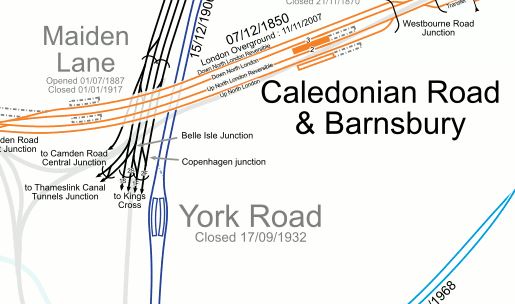
Note.
- The lines into Kings Cross station shown in black.
- The North London Line shown in orange.
- The Piccadilly Line shown in blue.
It would appear that York Road station has been designed to generous proportions.
Ian Visits
ThIs article on the Ian Visits web site, is entitled Reopening The Piccadilly line’s Disused York Road Tube Station.
Ian comes to the following conclusions.
A rebuilt Maiden Lane station on the Overground would be much cheaper to build, at around £8 million, and have much lower running costs. The site for the Overground station would be around 100 yards further to the north of York Road Station, roughly where a Camden Council maintains a bus garage.
Replacing that with the usual generic block of flats may generate the cash to fund a rebuilt Maiden Lane station.
However, York Road tube station is unlikely to ever reopen to the public again.
I very much agree.
However, there is a set of circumstances, where the building at York Road station may get reopened.
Look at this picture of York Road station.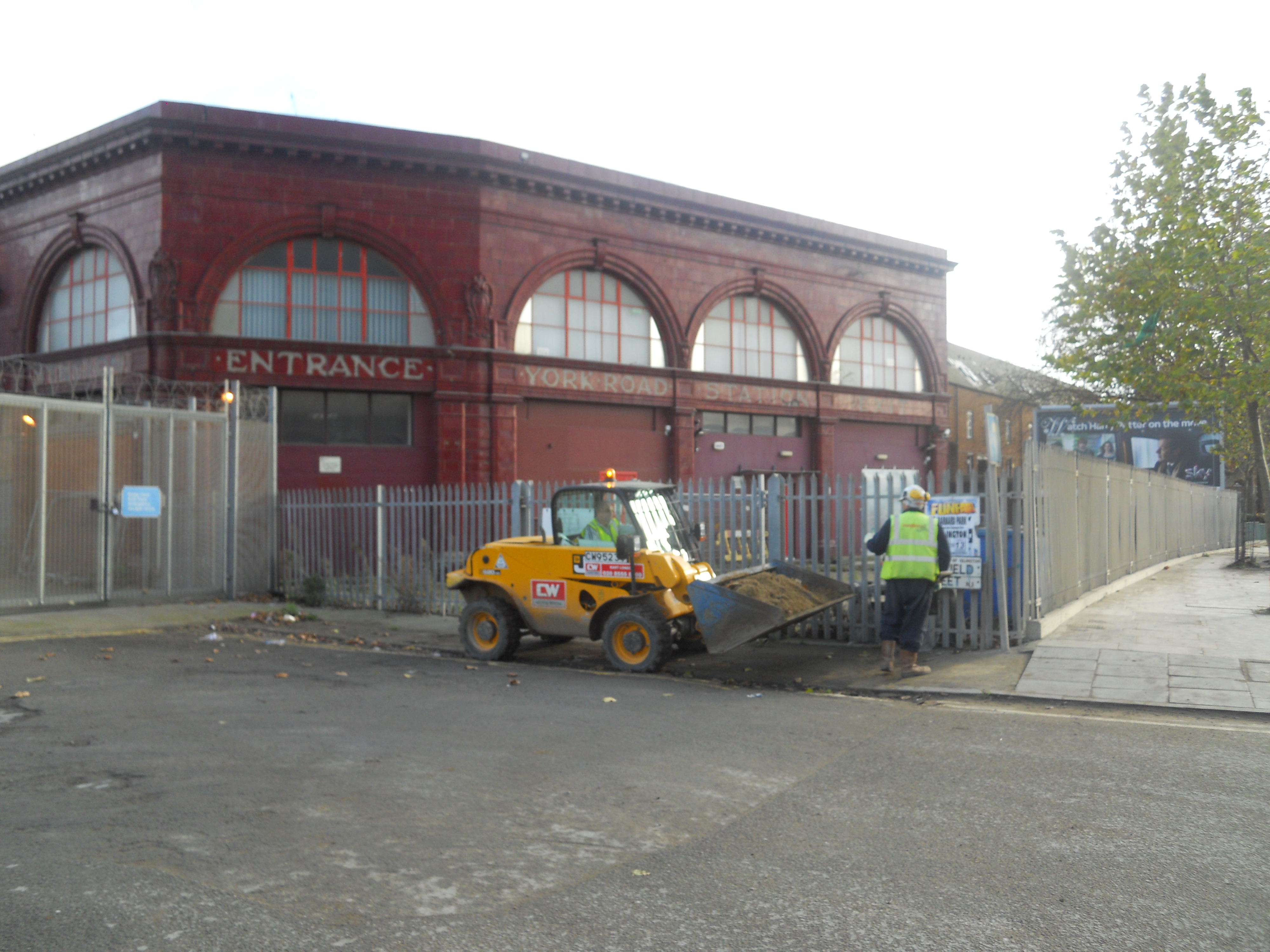
The station building is a classic design by Leslie Green and just across the road from Central St. Martins, which is a constituent college of the University of the Arts London. So surely, if the college were to have, it’s own station, it should be to one of London’s iconic designs.
Ian gives a lot of reasons, why York Road would be an expensive station to add to the Piccadilly Line, despite the fact that it could have lifts like Caledonian Road descending to the platforms.
But suppose the Docklands Light Railway were to be extended from Bank station as has been proposed.
This map shows a possible route.
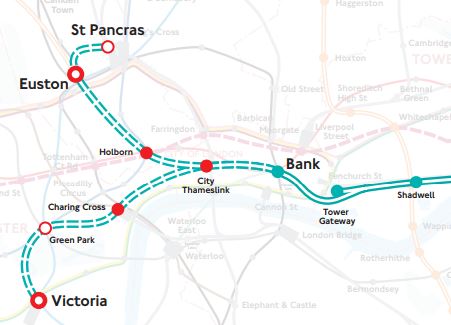
But why stop at S. Pancras.? It could be extended under Kings Cross station, stopping where required to finish at York Road station.
- Only the building would be used.
- There would be no connection to the Piccadilly Line.
- The Docklands Light Railway tunnels would be several metres down to travel under buildings and the stations.
- An underground passage could be built to a reopened Maiden Lane station.
A worthwhile use would have been found for an iconic building and Kings Cross Central would have much better public transport connections.
 The Anonymous Widower