Nuclear Deal Gives Rolls-Royce £2.5bn Boost
The title of this post, is the same as that of this article on The Times.
This is the sub-heading.
UK engineers selected to build a fleet of mini-nuclear power plants in the Czech Republic
These are the first two introductory paragraphs.
Almost £2.5 billion was added to the market value of Rolls-Royce after it was selected to build a fleet of mini-nuclear power plants in the Czech Republic, the first deal of its kind in Europe.
Rolls was selected as the preferred supplier for the development and construction of a number of small modular reactors by the Czech government from a shortlist of seven companies. The exact number of SMRs due to be delivered will be announced in the next few weeks.
Strangely, despite the announcement having a positive movement on the company’s share price, there was no corporate press release. but the Rolls-Royce subsidiary; Rolls Royce SMR did publish this press release, which is entitled Rolls-Royce SMR Named As Preferred Supplier To Build In Czechia.
These four paragraphs are the complete release.
Rolls-Royce SMR CEO, Chris Cholerton, said: “We welcome today’s landmark announcement by the Government of the Czech Republic and the Czech State utility, ČEZ Group, naming Rolls-Royce SMR as their preferred supplier for the development and construction of Small Modular Reactors (SMRs).
“This decision, to select Rolls-Royce SMR from a list of seven potential SMR technology providers, follows a rigorous evaluation process by ČEZ Group. Discussions are ongoing to finalise contract terms and the final agreements are subject to customary regulatory clearances. Details of the agreement will be published at signing.
“This important strategic partnership further strengthens Rolls-Royce SMR’s position as Europe’s leading SMR technology, and will put CEZ, Rolls-Royce SMR and its existing shareholders at the forefront of SMR deployment.
“Rolls-Royce SMRs will be a source of clean, affordable, reliable electricity for Czechia – creating jobs, enabling decarbonisation, reducing the reliance on imported energy and supporting the global effort to reach net zero.”
These are my thoughts.
Rolls-Royce And Small Nuclear Reactors
The Wikipedia entry for Rolls-Royce Submarines, who build the nuclear engines for submarines, indicates that the subsidiary was formed in 1954.
The first nuclear submarine with a Rolls-Royce engine was HMS Valiant, which was commissioned in 1966, according to its Wikipedia entry.
Valiant was powered, until it was decommissioned in 1994, by a Rolls-Royce PWR or Pressurised Water Reactor, that is described in this Wikipedia entry.
Since Valiant, the UK has built nearly forty nuclear submarines for the Royal Navy, and all have been or will be powered by that original Rolls-Royce PWR or derivatives of the design.
The next nuclear submarine project for Rolls-Royce Submarines, will be the nuclear power unit for the SSN-AUKUS, which is described in this Wikipedia entry, which describes the submarine like this in the first paragraph.
The SSN-AUKUS, also known as the SSN-A, is a planned class of nuclear-powered fleet submarine (SSN) intended to enter service with the United Kingdom’s Royal Navy in the late 2030s and Royal Australian Navy in the early 2040s. The class will replace the UK’s Astute-class and Australia’s Collins-class submarines.
The Wikipedia entry for the Rolls-Royce PWR, says this about the power unit for the SSN-AUKUS.
Rolls Royce is building the reactor for SSN-AUKUS, which may be the PWR3, or a derivative.
The PWR3 is the latest version of the original 1966 design.
If you fly on the latest Airbus A350, the aircraft is powered by Rolls-Royce Trent XWB engines, which are the most powerful engines in the Trent family of turbofan engines.
The Trent engine was developed from the RB-211 engine of the 1960s. The RB-211 may have bankrupted the company, but it later provided the cash-flow for the world-class company we see today.
I don’t think Rolls-Royce need have any fears about using sixty years of nuclear reactor technology to build the Rolls-Royce SMR.
Rolls-Royce And The US Department Of Defense Nuclear Microreactor Program
I discuss this in Rolls-Royce To Play Key Role In US Department Of Defense Nuclear Microreactor Program.
Surely to be involved in a key US program, Rolls-Royce’s offering must be tip-top.
Will The Czechs Play Any Part In The Manufacture?
This article in the Financial Times, is entitled Rolls-Royce Wins Pioneering Deal To Build Mini Nuclear pPlants In Czech Republic.
A paragraph sounds very much like active participation to me.
Between the Two World Wars, Skoda Works in Czechoslovakia, was according to its Wikipedia entry, was one of the largest European industrial conglomerates of the 20th century.
This paragraph from the Wikipedia entry describes their history after the First World War.
By World War I, Škoda Works had become the largest arms manufacturer in Austria-Hungary, supplying the Austro-Hungarian army with mountain guns, mortars and machine guns, including the Škoda M1909, and the ships of the Austro-Hungarian navy with heavy guns. After the end of the war and the creation of the First Czechoslovak Republic, the company, previously focused on manufacturing of armaments, diversified and became a major manufacturer of locomotives, aircraft, ships, machine tools, steam turbines, equipment for power utilities, among other industrial products.
The company sounded just like a Czechoslovakian version of Vickers.
I believe that as a teenager, I heard a story, that the armour plate for the British battleship; Duke of York, was smuggled out of Czechoslovakia, under the noses of the Nazis. I can’t find the story on the Internet, but Czech armour seemed to be of high quality, between the two wars.
This paragraph from the Wikipedia entry describes the history of Skoda Works after World War II.
After World War II, Škoda Works was nationalized and split into several companies by the newly communist government in Czechoslovakia. Important products during the Communist era include nuclear reactors and trolley buses.
I don’t think they made nuclear trolley buses, but they might have had the capability.
What happened to the knowledge about all the steelworking needed to make nuclear reactors?
This further paragraph gives an indication. that lack of modern designs killed the business.
The factory concentrated on markets in the Soviet Union and the Eastern Bloc. The company produced a wide range of heavy machinery such as nuclear reactors and locomotives. A lack of updates to its product designs and infrastructure considerably weakened the company’s competitive position and its brand.
Note.
- Can Rolls-Royce and their partner; The Welding Institute (TWI), provide modern designs and techniques to build the parts of reactors for modern SMRs in Czechia?
- The Welding Institute, which is based just outside of Cambridge, describes themselves as the leading engineering institution supporting welding and joining professionals with welding, joining and allied technologies.
- Czechia is also in the heart of Europe and components would be easily shipped by rail or road to European construction sites.
- Wikipedia also says that a lot of post-Soviet trams and trolley busses, were made by Skoda, so the same must count for something.
There will be much worse places to build components for SMRs than Czechia.
Will The Czechs Help With The Soviet Reactors?
If the Czechs built the reactors, they will have a lot of answers about things like.
- Where the Soviet reactors are?
- When will the Soviet reactors need replacing?
- How were they transported?
- How were they assembled?
- What will be the difficult parts to take apart?
Choosing the Czechs for their knowledge as partners seems a good idea.
Conclusion
The Czechs would appear to be good partners for Rolls-Royce.
Centrica And Moog Inc. Agree Major Solar Power Purchase Agreement
The title of this post is the same as that of this press release from Centrica.
This is the sub-heading.
Centrica Business Solutions has completed a long-term solar power purchase agreement (PPA) with aerospace defence designer and manufacturer, Moog Inc. The solar array will accelerate the decarbonisation of its aerospace manufacturing site in Wolverhampton and help the business achieve its net zero goals.
These three paragraphs introduce the project.
The agreement sees Centrica lease roof space from Moog Inc. to install a 2,200 solar panel array capable of generating circa 1MW. The energy company will finance the project and have agreed on a PPA with Moog Inc. for the renewable electricity generated on site.
Construction is set to complete in the spring and the panels will provide Moog Inc. with 800 MWh of renewable, reliable energy every year for the next 25 years – around 10 per cent of the site’s existing electricity requirements.
This gives Moog Inc. price certainty and access to green electricity without any upfront costs, and it will reduce operational CO2 emissions by 175 tonnes every year.
Note.
- The roof is one of Centrica’s biggest roof top solar arrays to date.
- It’s the first retrofit on an existing manufacturing plant of a solar array for Moog Inc. and wthe’re looking forward to doing more.
The Wikipedia entry for Moog Inc. starts with this paragraph.
Moog is an American-based designer and manufacturer of electric, electro-hydraulic and hydraulic motion, controls and systems for applications in aerospace, defense, industrial and medical devices. The company operates under four segments: aircraft controls, space and defense controls, industrial controls, and components. Moog is headquartered in Elma, New York and has sales, engineering, and manufacturing facilities in twenty-six countries.
Bill Moog, who founded the company, was a cousin of the guy who invented the Moog synthesizer.
Their products feature on the Airbus A 350, the Boeing 787, the Lockheed Martin F 35 and are used to operate the roofs on Centre Court and Court One at Wimbledon.
Conclusion
We will see a lot more solar installations like these.
I am not sure of the type of solar panels used on Moog’s Wolverhampton factory, but these roofs must be an ideal place to use BIPVco steel solar panels as Network Rail used at Denmark Hill station.
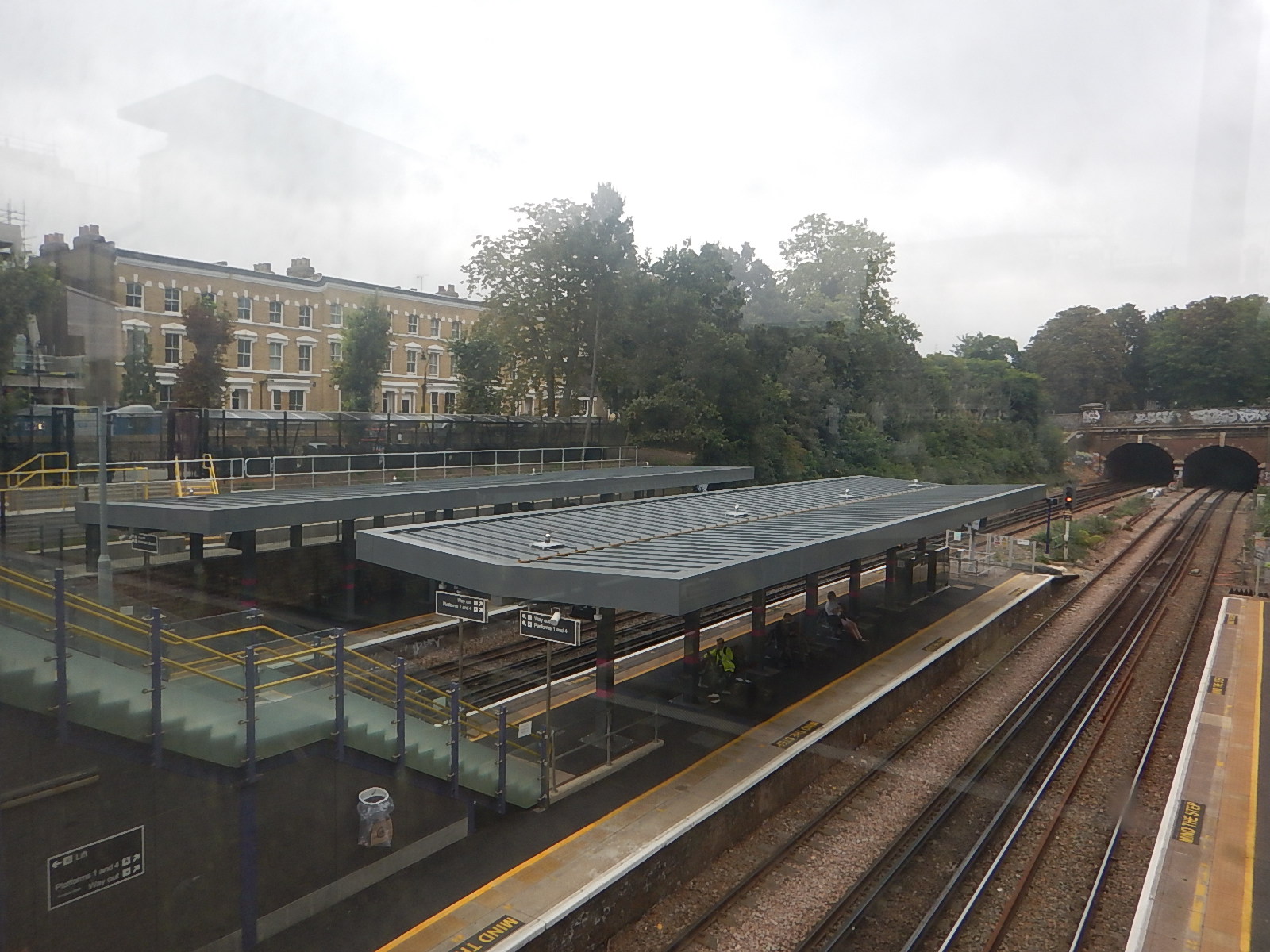
This roof became operational in 2021.
This picture shows a Ventum Dynamics turbine on Skegness Pier.
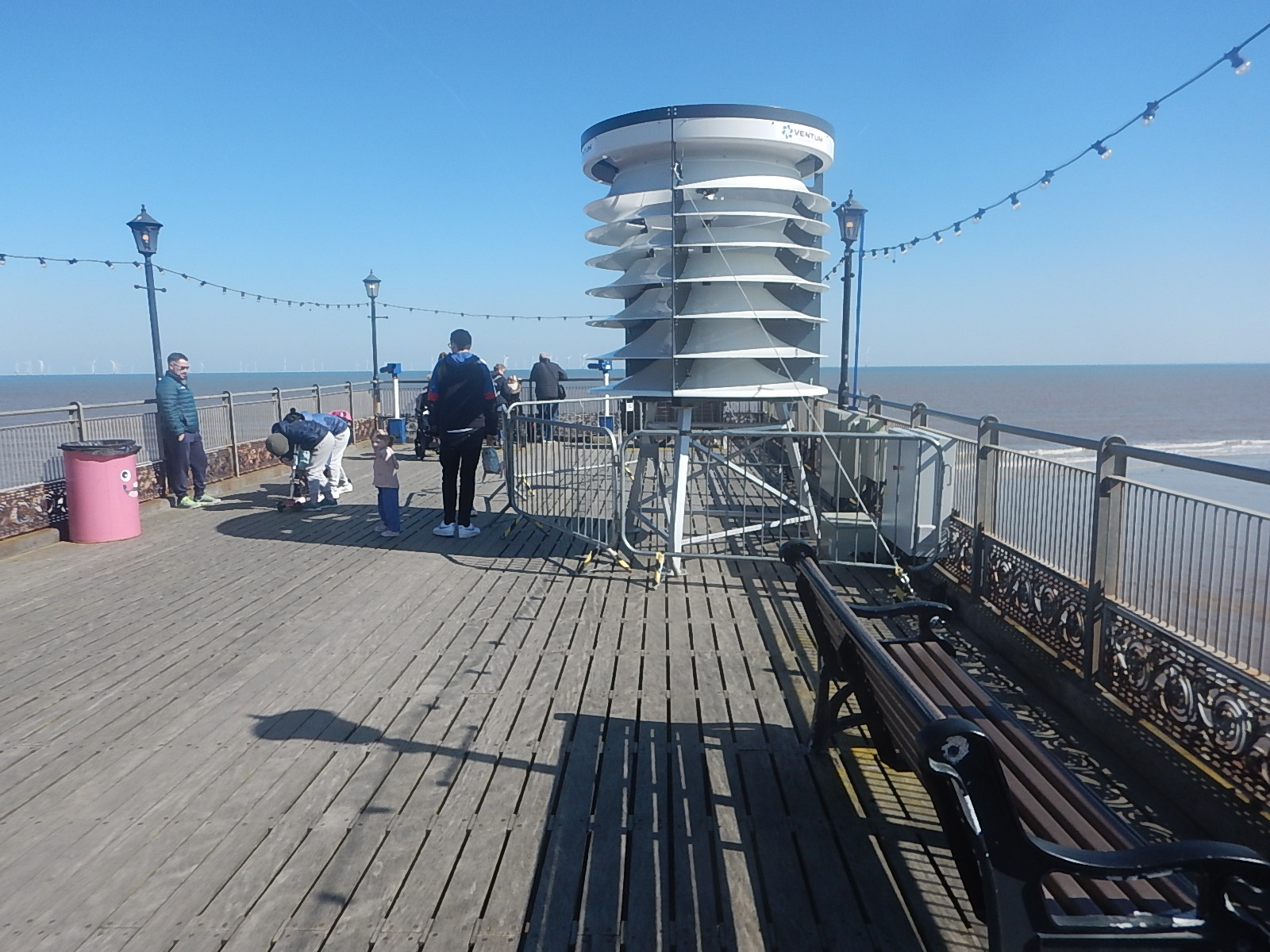
On the Ventum Dynamics web site, there are several pictures of buildings with flat roofs, that have several turbines on each.
I believe these turbines would fit neatly on some large industrial roofs with solar panels to form an efficient wind/solar application.
Rolls-Royce Completes Next Step On Its Journey To Decarbonising Business Aviation
The title of this post, is the same as that of this press release from Rolls-Royce.
This is the sub-heading.
Rolls-Royce today announces the successful completion of a series of tests with 100% Sustainable Aviation Fuel (SAF) on its latest generation of business aviation engines, the Pearl 15 and the Pearl 10X. The Pearl 15, the first member of the Pearl engine family, powers Bombardier’s Global 5500 and 6500 aircraft, while the Pearl 10X will power Dassault’s ultra-long-range flagship aircraft, the Falcon 10X.
These are the websites for the three aircraft, with number of passengers, typical cruise speed and range.
- Bombardier Global 5500 – 16 pax – Mach 0.85 – 5900 nm
- Bombardier Global 6500 – 17 pax – Mach 0.85 – 6600 nm
- Dassault Falcon 10X – 19 pax – Mach 0.925 – 7500 nm
This screenshot from the Dassault Falcon 10X web site shows the range from London.
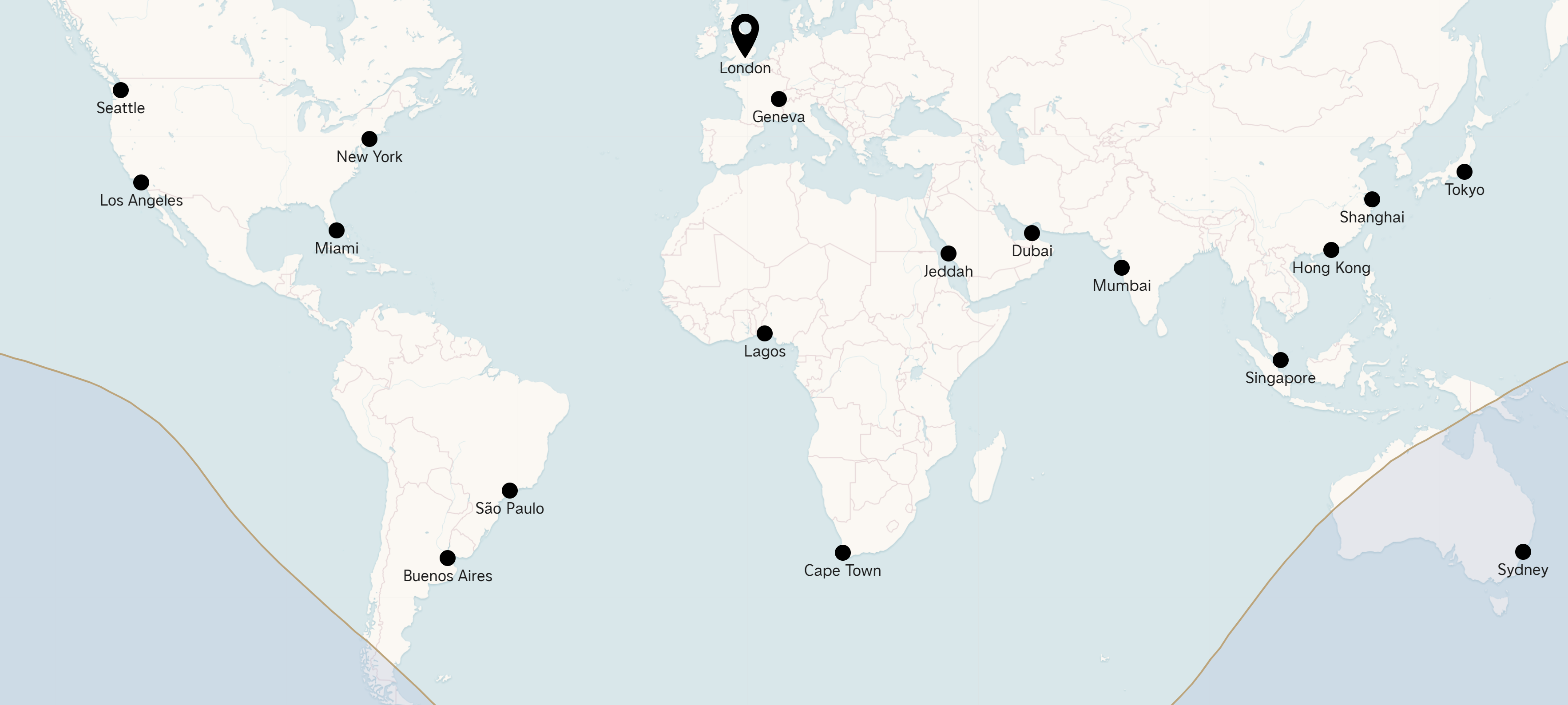
Note that Buenos Aires, the Falkland Islands, Seattle, Seoul and Tokyo are all within range.
I have a few thoughts and observations.
Jet A-1 And 100% SAF
This paragraph from the press release describes how Rolls-Royce are testing the compatibility of Jet A-1 and 100% SAF.
As well as proving compatibility with 100% SAF another target of the test campaign was to run a back-to-back engine test with both Jet A-1 and SAF on the same Pearl 10X engine. The aim was to confirm further improvements in the environmental footprint when switching to SAF. The results from this first back-to-back engine emission test under standard certification conditions provides important correlations for the evaluation of future SAF within our environmental strategy.
Compatibility and back-to-back running is surely very important, as it could be many years before all airports can supply 100 % SAF for visiting jet aircraft.
The Fuels Used In The Tests And The Benefits
These two paragraphs from the press release describes the fuels used and the benefits..
The HEFA (Hydro-processed Esters and Fatty Acids) SAF was produced from waste-based sustainable feedstocks such as used cooking oils and waste fat. This fuel has the potential to significantly reduce net CO2 lifecycle emissions by about 80% compared to conventional jet fuel.
The back-to-back tests conducted with conventional fossil-based fuel and subsequently SAF also confirmed a cleaner combustion of the sustainable fuel, with significantly lower levels of non-volatile particulate matter (nvPM). In combination with the low NOx combustor technology of the Pearl 10X and its additive manufactured combustor tiles a reduction of all emissions was achieved.
Note.
- An eighty percent reduction in lifecycle emissions is not to be sneezed at.
- Cleaner combustion and low NOx emissions are very much bonuses.
- Additive manufacture is better known as 3D-printing and I’m not surprised that Rolls-Royce have embraced the technology.
As an engineer and retired light aircraft pilot, I suspect the tests have met Rolls-Royce’s objectives.
Moving To 100 % SAF
This is the final paragraph of the press release.
The tests demonstrated once again that Rolls-Royce’s current engine portfolio for large civil and business jet applications can operate with 100% SAF, laying the groundwork for moving this type of fuel towards certification. At present, SAF is only certified for blends of up to 50% with conventional jet fuel. By the end of 2023 Rolls-Royce will have proven that all its in-production Trent and business aviation engines are compatible with 100% SAF.
It must be a good selling point for aircraft equipped with Rolls-Royce engines, that the buyer knows that the aircraft can run on 100% SAF.
100 % SAF As An Airline Marketing Tool
It will be interesting to see how airlines use 100% SAF to sell tickets.
As an example, I can see routes like London and Scotland becoming very competitive.
- Avanti West Coast, LNER and Lumo already run all-electric trains to Edinburgh and Glasgow.
- The technology exists to decarbonise trains to Aberdeen and Inverness..
- Other open access operators could well move in to a lucrative market.
- The only way, that the airlines will be able to compete on emissions, would be to move to 100 % SAF.
There must be hundreds of routes like London and Scotland around the world.
100 % SAF And Business Jets
In A Class 319 Train, But Not As We Know It!, I told this tale.
I am reminded of a tale, that I heard from a former GEC manager.
He was involved in selling one of GEC’s Air Traffic Control radars to a Middle Eastern country.
The only working installation of the radar was at Prestwick in Scotland, so he arranged that the dignitaries and the sales team would be flown to Prestwick in GEC’s HS 125 business jet.
As they disembarked at Prestwick and walked to the terminal, the pilot called the GEC Manager over.
The pilot told him “The Scottish Highlands at this time of the year, are one of the most beautiful places in the world! Would you and your guests like a low-level tour on the way back? I can arrange it, if you say so!”
Despite knowing GEC’s draconian attitude to cost control he said yes.
The sale was clinched!
I also remember an article in Flight International about how JCB sold diggers.
- Dealers in a country like Greece would put together a party of prospective customers.
- The customers would then be flown to East Midlands Airport in JCB’s business jet, which is close to the JCB factory at Rocester.
- After a sales demonstration and a tour of the factory they would be flown home.
I once met a lady who had been one of JCB’s cabin staff and she told me it was a very successful sales technique.
I suspect that a business jet running on 100 % SAF would be an even better sales aid.
There are also increasing protests from the greens about business jets, which are seen as producing pollution and are only the toys of the rich and powerful.
Surely, if they were running on 100 % SAF, this would make business jets more acceptable.
100 % SAF And Niche Airlines
In the web site for the Falcon 10X, there is a section called Mission Flexibility, where this is said.
As large as it is, the Falcon 10X can still access typical airports serving business aviation as well as others with challenging approaches. The Falcon 10X will be London City-capable so that it can fly you straight into the heart of global finance. When you’re ready for rest and relaxation, the 10X can whisk you to out-of-the-way corners of the world.
British Airways used to run a service between London City Airport and New York.
- The route used 32-seat Airbus A-318 airliners.
- The flight stopped at Shannon for refuelling.
- It was business class only.
I suspect someone will think about running a similar London City Airport and New York service using a Falcon 10X.
- It has nineteen seats.
- It could do it in one hop.
- It could run on 100 % SAF.
- British Airways must have all the passenger data from the discontinued service.
- A Falcon 10X flies higher than a Boeing 767, Boeing 787 or an Airbus A350.
I have a feeling that flight time would be comparable or better to a flight between Heathrow and New York.
Conclusion
Rolls-Royce would appear to have the right strategy.
If I was going to New York in business class, I’d use it.
The ZEROe Demonstrator Has Arrived
The title of this post, is the same as that of this press release from Airbus.
This is the introductory paragraph.
2022 marks a new and exciting phase for ZEROe – Airbus’ ambition to develop the world’s first zero-emission commercial aircraft by 2035. The multi-year demonstrator programme has officially been launched with the objective to test a variety of hydrogen technologies both on the ground and in the air.
The ZEROe demonstrator will be the first Airbus A 380 aircraft and it is shown in this Airbus visualisation.
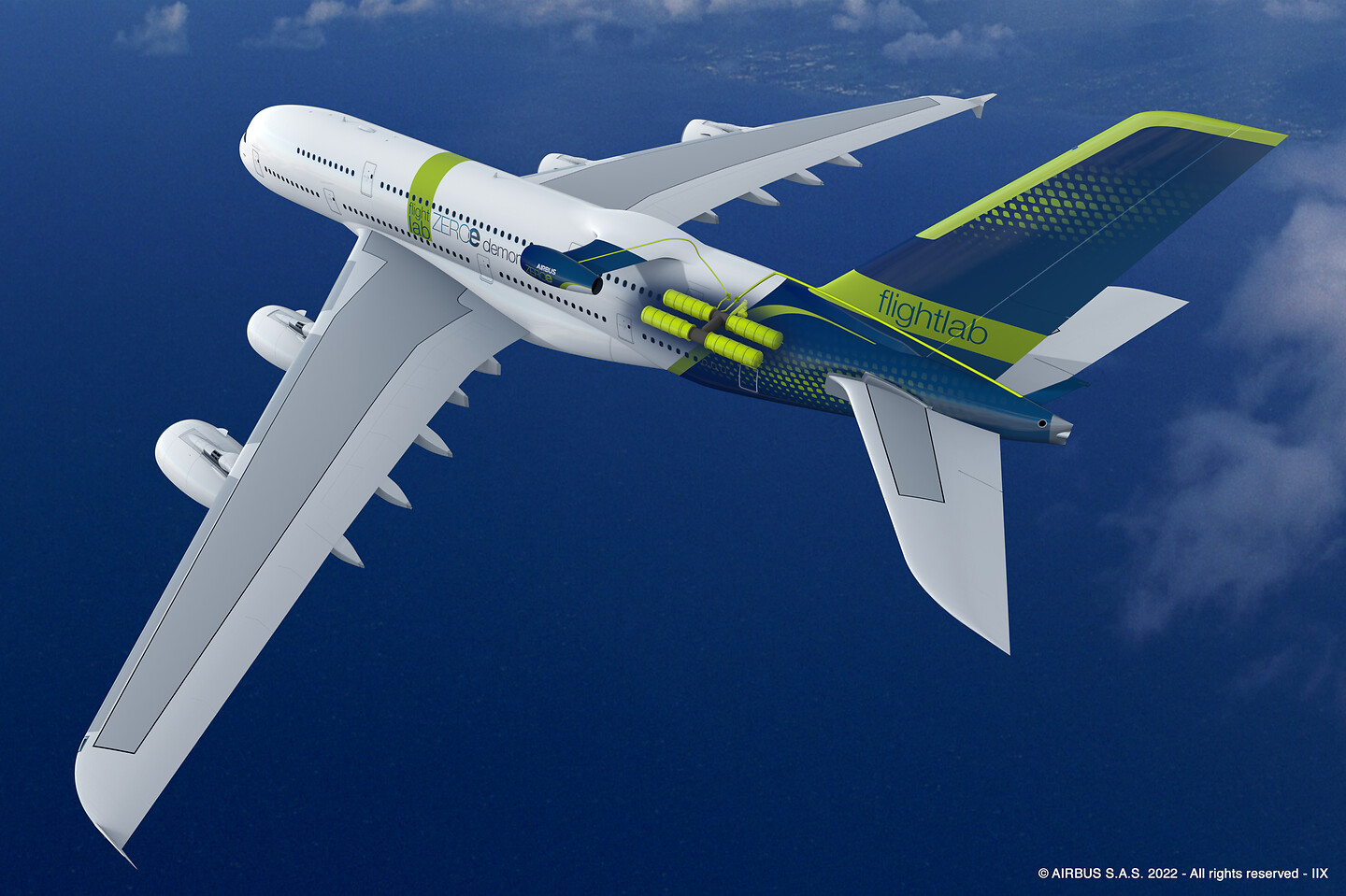
Note.
- The four hydrogen tanks in the fuselage.
- The fifth engine mounted in a pod on the fuselage.
- There’s certainly lots of space inside the fuselage for more hydrogen tanks and test and monitoring equipment.
I have a few thoughts.
This Aircraft Will Be A Superb Demonstrator
The press release says this about the use of an A 380 as a demonstrator.
The A380 is the world’s largest and most spacious passenger jet ever built – a size that makes it ideally suited to the role of test platform.
Today, the A380 MSN1 test aircraft is earmarked for a new role: to take the lead on testing the technologies that will be vital to bringing the world’s first zero-emission aircraft to market by 2035.
“The A380 MSN1 is an excellent flight laboratory platform for new hydrogen technologies,” says Mathias Andriamisaina, Airbus ZEROe Demonstrator Leader. “It’s a safe and reliable platform that is highly versatile to test a wide range of zero-emission technologies. In addition, the platform can comfortably accommodate the large flight test instrumentation that will be needed to analyse the performance of the hydrogen in the hydrogen-propulsion system.”
Initially, I suspect the aircraft will fly as a four-engined turbofan aircraft running on standard or sustainable aviation fuel.
The performance of the hydrogen engine will be tested in all phases of operation and at different altitudes.
What Size Is The Fifth Engine?
This layout is clever.
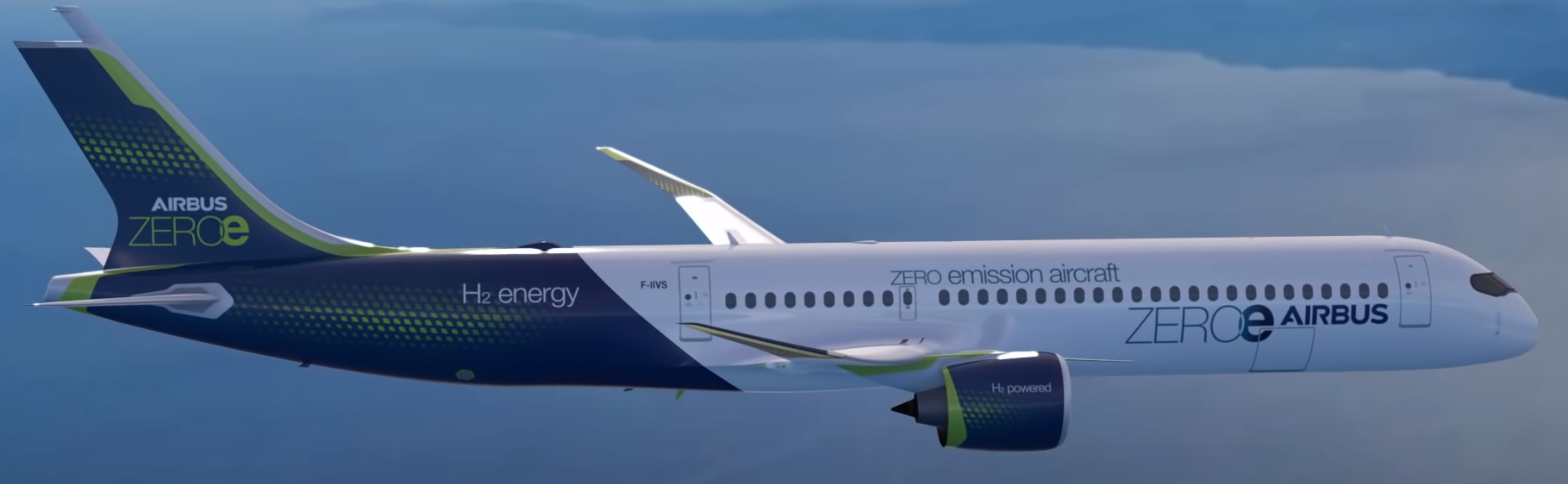
If Airbus want to test a smaller hydrogen engine for say an Airbus A 320-sized hydrogen aircraft like the ZEROe Turbofan shown in this Airbus visualisation, they fit it to the fifth pylon.
Note.
- The fifth pylon on the ZEROe Demonstrator could be the proposed pylon for the ZEROe Turbofan.
- The ZEROe Demonstrator could probably carry a lot of hydrogen to test out the hydrogen engine over a long duration.
- The hydrogen engine could be tested out over the full flight envelop of an Airbus A 380.
I would suspect that the tests on the hydrogen engine would be some of the most comprehensive ever carried out on a new engine.
If Airbus want to test a larger hydrogen engine for say an Airbus A 350-sized hydrogen aircraft, they would probably replace one of the four main engines with the hydrogen engine.
It looks like Airbus will be able to test hydrogen engines for all sizes of plane in their current range.
What Will Happen To Current A 380s?
Consider.
- The production of the A 380 has been stopped.
- There are 251 aircraft in service.
- They appear to be a reliable and safe aircraft.
- The aircraft can run on sustainable aviation fuel.
- The oldest aircraft are only thirteen years old.
- They are still reasonably modern aircraft, that if they needed to be updated to the latest standards could probably be easily done so.
- The aircraft have a lot of volume, which can hold over 500 passengers in a typical configuration.
- The flying characteristics and structure of the aircraft is well known.
I suspect there are a lot of aircraft leasing companies, who feel these aircraft are too good to scrap, just because they are not zero-carbon.
Could Hydrogen Be Stored In The Wing Of An A 380?
Hydrogen storage will get more capable in the next few years and we will see hydrogen stored in strange places in vehicles and aircraft using the gas as a fuel.
The A 380 may well have an advantage in that its wing is relatively thick compared to that of other airliners.
- The A 380 has a wing aspect ratio of 7.53.
- The Boeing 787 has a wing aspect ratio of 11.
- Gliders have wing aspect ratios as upwards of 30.
High aspect ratios are generally more economical on fuel.
But this relatively thick wing, may make it possible to store hydrogen in the wing of an A 380.
Could There Be A Hydrogen-Powered A 380?
I suspect part of the Airbus ZEROe progam will be to investigate the possibility of converting existing A 380 aircraft into a capable hydrogen-powered aircraft.
In Could An A320 neo Be Rebuilt As A ZEROe Turbofan?, I looked at the possibility of turning an existing Airbus A 320 neo into a ZEROe Turbofan running on hydrogen.
This was my conclusion.
I very much feel that there will be a route to convert some or all of the A 320 neo aircraft to hydrogen power.
So what will a ZEROe A 380 look like if it follows the same design route as an A 320 neo to a ZEROe Turbofan?
- There would be a large hydrogen tank in the rear fuselage.
- As I explained earlier, there may be a possibility for some hydrogen to be stored in the wing.
- Both passenger decks would be shortened and perhaps be able to hold the 350-410 passengers of the Airbus A350-1000.
- The cockpit, front part of the fuselage, wings, tailplane and landing gear would be unchanged.
- The aircraft would fit existing jetways at any airport, that can handle an existing A 380.
I believe that converting an existing Airbus A380 to a hydrogen-powered aircraft is possible and the conversion falls within Barnes Wallis‘s rule of problem solving.
There is no greater thrill in life, that proving something is impossible and then showing how it can be done.
The quote comes from a BBC program, where he was interviewed by Chris Brasher, who was another for whom impossible was just a minor hurdle in the way of meeting objectives.
Could There Be A Hydrogen-Powered A 380 Freighter?
Consider.
- I think it is likely, that companies like Amazon will come under pressure over their carbon footprint, as they transport increasing numbers of packages around the world.
- In DHL Express Shapes Future For Sustainable Aviation With First Order Of All-Electric Cargo Planes From Eviation, I talk about how DHL Express have ordered twelve Eviation Alice aircraft to create a zero-carbon service. DHL must feel this would be good for their image. So would they like an intercontinental zero-carbon freighter?
- Some people worry about the air-miles on their food!
There could be a worthwhile niche market for a high capacity intercontinental zero-carbon freighter.
Because it has such a large internal volume, an Airbus A 380 might make an ideal aircraft to convert.
Conclusion
Airbus will learn a lot from the ZEROe Demonstrator.
They may even learn how to develop, a long-range hydrogen-powered zero-carbon A 380 variant that could carry four hundred passengers between Europe and Australia.
Zero-Carbon Emission Flights To Anywhere In The World Possible With Just One Stop
The title of this post, is the same as that of this press release from the Aerospace Technology Institute.
This is the first sentence of the press release.
Passengers could one day fly anywhere in the world with no carbon emissions and just one stop on board a concept aircraft unveiled by the Aerospace Technology Institute (ATI) today.
These three paragraphs describe the concept.
Up to 279 passengers could fly between London and San Francisco, USA direct or Auckland, New Zealand with just one stop with the same speed and comfort as today’s aircraft, revolutionising the future of air travel.
Developed by a team of aerospace and aviation experts from across the UK collaborating on the government backed FlyZero project, the concept demonstrates the huge potential of green liquid hydrogen for air travel not just regionally or in short haul flight but for global connectivity. Liquid hydrogen is a lightweight fuel, which has three times the energy of kerosene and sixty times the energy of batteries per kilogramme and emits no CO2 when burned.
Realising a larger, longer range aircraft also allows the concentration of new infrastructure to fewer international airports accelerating the rollout of a global network of zero-carbon emission flights and tackling emissions from long haul flights.
These are my thoughts.
The Airframe
This picture downloaded from the Aerospace Technology Institute web site is a visualisation of their Fly Anywhere Aircraft.
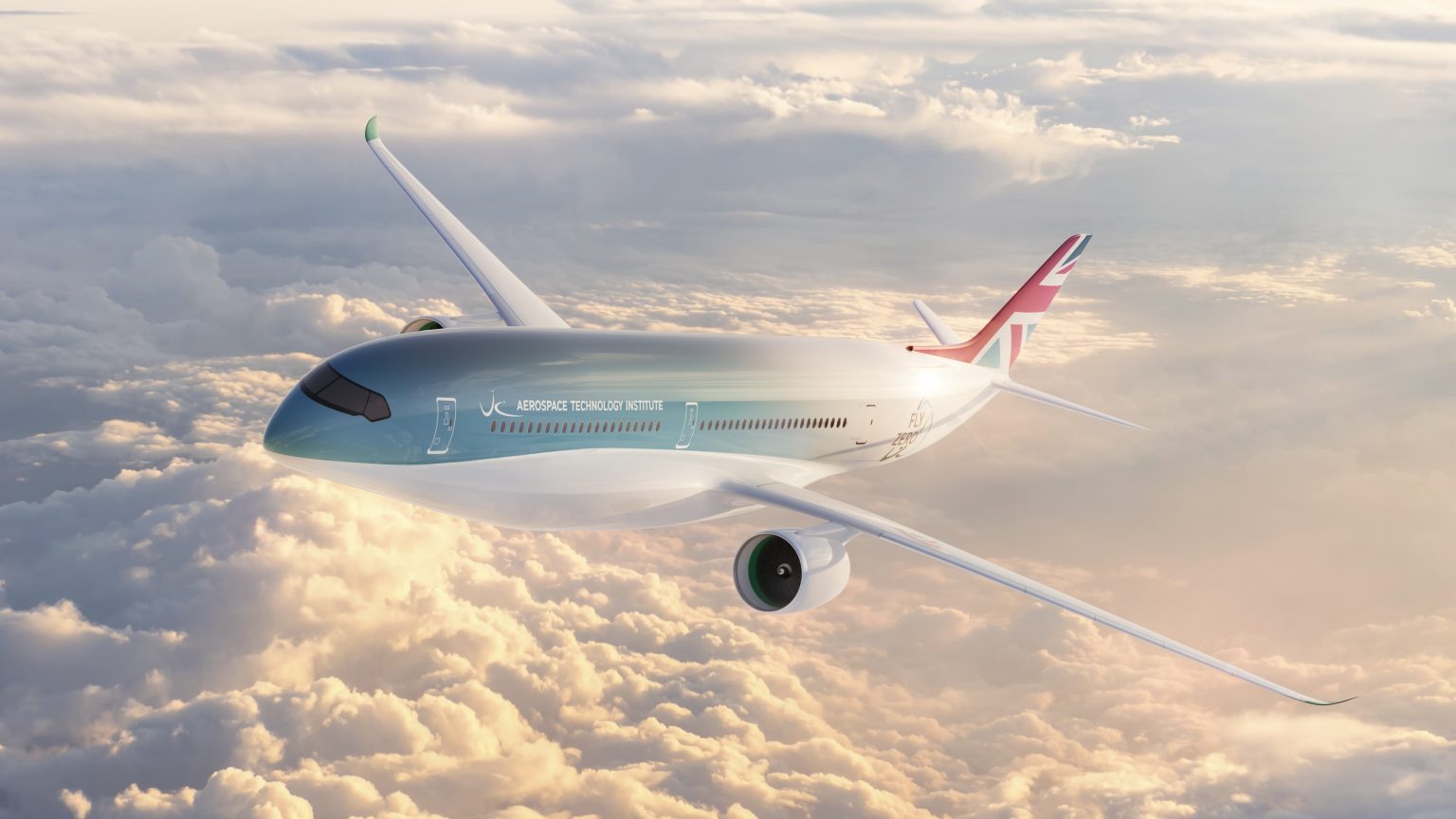
Some features stand out.
The wings are long, narrow and thin, almost like those of a sailplane. High aspect ratio wings like these offer more lift and stability at high altitude, so will the plane fly higher than the 41,000-43,000 feet of an Airbus A350?
I wouldn’t be surprised if it does, as the higher you go, the thinner the air and the less fuel you will burn to maintain speed and altitude.
The horizontal stabiliser is also small as this will reduce drag and better balance with the wing.
The tailfin also appears small for drag reduction.
The body is bloated compared to say an Airbus A 350 or a Boeing 777. Could this be to provide space for the liquid hydrogen, which can’t be stored in the thin wings?
The fuselage also appears to be a lifting body, with the wings blended into the fat body. I suspect that the hydrogen is carried in this part of the fuselage, which would be about the centre of lift of the aeroplane.
The design of the airframe appears to be all about the following.
- Low drag.
- high lift and stability.
- Large internal capacity to hold the liquid hydrogen.
It may just look fat, but it could be as radical as the first Boeing 747 was in 1969.
The Engines
I suspect the engines will be developments of current engines like the Rolls-Royce Trent XWB, which will be modified to run on hydrogen.
If they are modified Trent engines, it will be astonishing to think, that these engines can be traced in an unbroken line to the RB211, which was first run in 1969.
The Flight Controls
Most airliners these days and certainly all those built by Airbus have sophisticated computer control systems and this plane will take them to another level.
The Flight Profile
If you want to fly any aircraft a long distance, you generally climb to a high level fairly quickly and then fly straight and level, before timing the descent so you land at the destination with as small amount of fuel as is safe, to allow a diversion to another airport.
I once flew from Southend to Naples in a Cessna 340.
- I made sure that the tanks were filled to the brim with fuel.
- I climbed to a high altitude as I left Southend Airport.
- For the journey across France I asked for and was given a transit at Flight Level 195 (19,500 feet), which was all legal in France under visual flight rules.
- When the French handed me over to the Italians, legally I should have descended, but the Italians thought I’d been happy across France at FL195, so they didn’t bother to ask me to descend.
- I flew down the West Coast of Italy at the same height, with an airspeed of 185 knots (213 mph)
- I was then vectored into Naples Airport by radar.
I remember the flight of 981 miles took around six hours. That is an average of 163.5 mph.
I would expect the proposed aircraft would fly a similar profile, but the high level cruise would be somewhere above the 41,000-43,000 feet of an Airbus A 350. We must have a lot of data about flying higher as Concorde flew at 60,000 feet and some military aircraft fly at over 80,000 feet.
The press release talks about London to San Francisco, which is a distance of 5368 miles.
This aircraft wouldn’t sell unless it was able to beat current flight time of eleven hours and five minutes on that route.
Ground Handling
When the Boeing 747 started flying in the 1970s, size was a big problem and this aircraft with its long wing may need modifications to runways, taxiways and terminals.
Passenger Capacity
The press release states that the capacity of the aircraft will be 279 passengers, as against the 315 and 369 passengers of the two versions of the A 350.
So will there be more flights carrying less passengers?
Liquid Hydrogen Refuelling
NASA were doing this successfully in the 1960s for Saturn rockets and the Space Shuttle.
Conclusion
This aircraft is feasible.
First In-flight 100% Sustainable-Fuels Emissions Study Of Passenger Jet Shows Early Promise
The title of this post, is the same as that of this press release from Rolls-Royce.
This is the introductory paragraph.
Initial findings from a world-first study of the impact of 100% sustainable aviation fuel (SAF) on both engines of a commercial jet have provided promising early results.
The study was performed using an Airbus A350, which is powered by Rolls-Royce Trent XWB engines.
This paragraph describes the tests.
In April, the A350 flew three flights over the Mediterranean Sea pursued by a DLR Falcon chaser plane to compare in-flight emissions of both kerosene and Neste’s hydro-processed esters and fatty acids (HEFA) sustainable fuel. The team also carried out compliance tests using 100% SAF and no operational issues were experienced.
I was surprised, when I first read this, that they used a chase plane to measure emissions, as I thought they’d simulate that in a test cell on the ground.
But this is probably, the best way to test the engines, whilst running on sustainable aviation fuel, in real-world conditions.
Conclusion
I believe that sustainable aviation fuel (SAF) will be the interim solution to flying until hydrogen-powered aircraft are developed.
 The Anonymous Widower