Wrightbus At Heart Of £6.5bn Hydrogen Mega-Project Set To Transform UK Economy
The title of this post is the same as that of this article on Love Ballymena.
These are the first three paragraphs.
Ballymena’s Wrightbus is at the forefront of a transformative £6.5 billion clean hydrogen initiative that promises to create 24,300 jobs across the UK and position the nation as a global leader in renewable energy.
Project HySpeed, unveiled this week, unites some of Britain’s most influential companies—including Wrightbus, Centrica, JCB, and ITM Power—in a landmark effort to scale up green hydrogen production, reduce costs, and accelerate industrial decarbonisation.
The project is a major coup for Ballymena, where Wrightbus, a pioneer in zero-emission transport, has been a vital part of the local economy for decades. As a key member of the HydraB Power group, which spearheads HySpeed, Wrightbus brings its expertise as the producer of the world’s first hydrogen-powered double-decker bus.
I believe we need the Irish dimension in Project HySpeed, as the Irish have a unique way of getting things done.
I am reminded by a story, that I heard from a retired Guards officer about the liberation of Vienna in World War II.
The city was in a desperate state and as he hold me the story, the retired officer said that a woman could be had for the price of two cigarettes.
In the mess one evening, the officers were discussing what to do, when an Irish Guards officer said, “The people need some fun! Let’s organise a horse race meeting!”
They all thought he was joking, but that is what they did!
The guy, who told the story is long since dead, but he believed that day of fun meant that Austria wasn’t taken over by the Soviets, like so many other East European countries.
The Irish do have this unique way of getting things done.
Note that the CEO of Centrica is Chris O’Shea. Does he have Irish roots?
Jurgen Maier To Chair Great British Energy
This article in The Times is entitled Pylons Are The Price Of Lower Bills, Keir Starmer Tells Rural Britain.
These are two paragraphs from the article.
Starmer confirmed that Jürgen Maier, the former UK chief executive of the Siemens conglomerate, would chair the energy company.
Maier has advised Labour on rail and transport since December. He was openly critical of the party’s decision to drop a pledge to spend £28 billion a year on green investment, saying the figure was an “absolute minimum” and that scrapping the promise was “not good for climate change or for the growth of our economy”.
Note.
- His Wikipedia entry is impressive.
- He has dual Austrian and British citizenship.
- He went to school in Leeds and is a graduate of Nottingham Trent University.
- He rose to be Chief Executive of Siemens UK and retired in 2019 at 55.
- I have heard him several times on the radio and he seems to talk a lot of sense.
In my view he could be an excellent choice as Chair of Great British Energy.
I also have some further thoughts.
Jürgen Maier And Peter Hendy
Jürgen Maier and Peter Hendy, who is Starmer’s Rail Minister, have remarkably similar backgrounds and I wouldn’t be surprised if they know each other well, through dealings around Siemens’ contract for Transport for London’s new trains for the Piccadilly Line.
When last, were two technological heavyweights, so close to the heart of a UK government?
RWE
German energy company; RWE are the UK’s largest power generator.
- RWE have five gas-fired power stations with a total output of 6.56 GW.
- RWE have two onshore wind farms in operation with a total output of 67 MW.
- RWE have four offshore wind farms in operation with a total output of 1.88 GW.
- RWE have eight offshore wind farms under development with a total output of 9.90 GW.
- RWE also has other electrical gubbins, like an electrolyser in South Wales.
Would Jürgen Maier be an ideal person, to persuade RWE to keep investing in the UK?
When he was with Siemens, he certainly invested heavily in the UK.
The German Problem
Germany’s problem is how they generate electricity.
Sources are as follows for Germany and the UK.
- Coal – 26 % – 1 %
- Natural Gas – 10.5 % – 32 %
- Wind – 32 % – 29.4 %
- Solar 12.2 % – 4.9 %
- Biomass – 9.7 % – 12.3 %
- Nuclear – 1.5 % – 14.2 %
- Hydro – 4.5 % – 1.8 %
- Oil – 0.7 % – 0 %
- Other – 2.9 % – 0 %
- Storage – 0 % – 1 %
- Imports – 0 % – 10.7 %
Note.
- Figures are for 2023.
- Germany is the first percentage.
- UK is the second percentage.
- Germany has pledged to end coal-fired electricity production by 2030.
- Both countries seem to generate similar amounts of electricity from wind, biomass and hydro.
To replace the coal and make up for lack of nuclear, Germany needs to find a new power source.
The German Solution
The Germans are going for hydrogen in a big way.
The title of this page of the RWE web site is Welcome To The Age Of Hydrogen.
The page starts with this paragraph.
RWE is actively involved in the development of innovative hydrogen projects. The H2 molecule is considered to be an important future building block of a successful energy transition. RWE is a partner in over 30 H2 projects and is working on solutions for decarbonising the industry with associations and corporations like Shell, BASF and OGE. Hydrogen projects are comprehensively supported in the separate Hydrogen department of the subsidiary RWE Generation.
I also suggest, that you read this page on the RWE web site called AquaVentus.
The page starts with this RWE graphic.
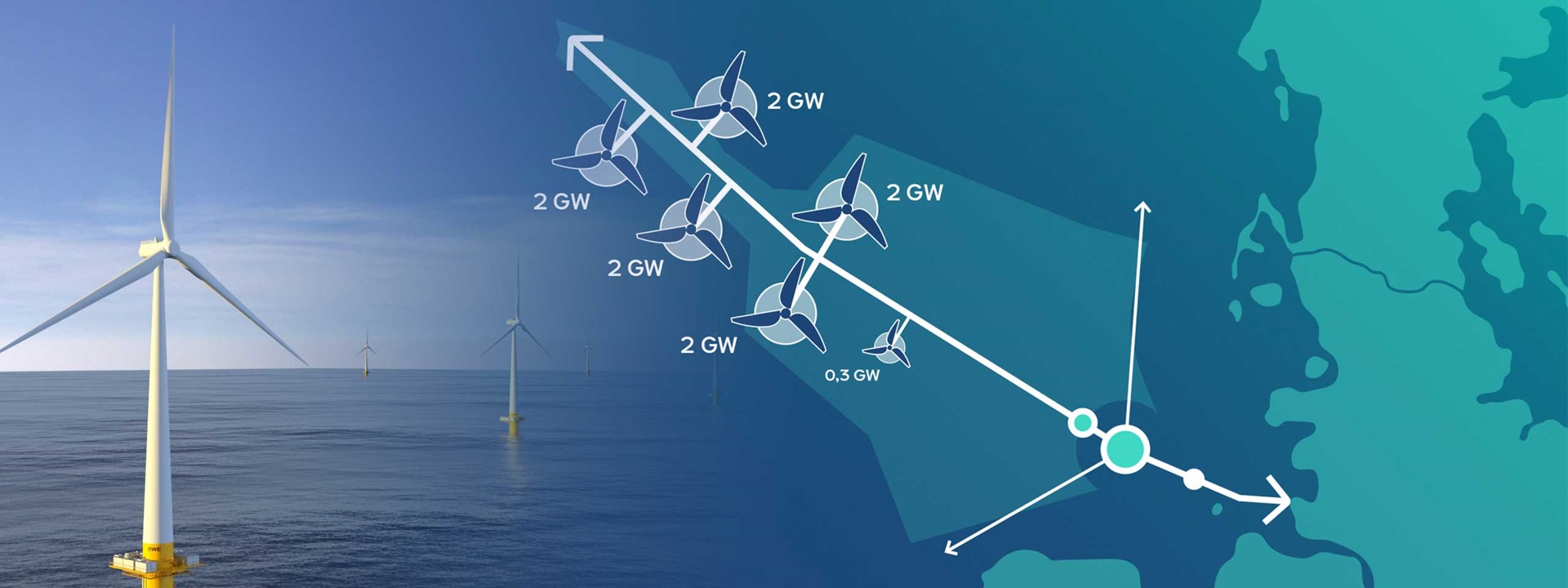
It appears that 10.3 GW of hydrogen will be created by wind farms and piped to North-West Germany.
These two paragraphs outline the AquaVentus initiative .
Hydrogen is considered the great hope of decarbonisation in all sectors that cannot be electrified, e.g. industrial manufacturing, aviation and shipping. Massive investments in the expansion of renewable energy are needed to enable carbon-neutral hydrogen production. After all, wind, solar and hydroelectric power form the basis of climate-friendly hydrogen.
In its quest for climate-friendly hydrogen production, the AquaVentus initiative has set its sights on one renewable energy generation technology: offshore wind. The initiative aims to use electricity from offshore wind farms to operate electrolysers also installed at sea on an industrial scale. Plans envisage setting up electrolysis units in the North Sea with a total capacity of 10 gigawatts, enough to produce 1 million metric tons of green hydrogen.
The page also gives these numbers.
- Total Capacity – 10 GW
- Tonnes Of Green Hydrogen – 1 million
- Members – 100 +
The web site says this about commissioning.
Commissioning is currently scheduled for early/mid 2030s.
The Germans can’t be accused of lacking ambition.
AquaVentus And The UK
This video shows the structure of AquaVentus.
I clipped this map from the video.

Note.
- There is a link to Denmark.
- There appears to be a undeveloped link to Norway.
- There appears to be a link to Peterhead in Scotland.
- There appears to be a link to just North of the Humber in England.
- Just North of the Humber are the two massive gas storage sites of Aldbrough owned by SSE and Brough owned by Centrica.
- There appear to be small ships sailing up and down the East Coast of the UK. Are these small coastal tankers distributing the hydrogen to where it is needed?
In the last century, the oil industry, built a substantial oil and gas network in the North Sea. It appears now the Germans are leading the building of a substantial hydrogen network.
AquaVentus And Aldbrough And Rough Gas Storage
Consider.
- In The Massive Hydrogen Project, That Appears To Be Under The Radar, I describe the Aldbrough Gas Storage.
- In Wood To Optimise Hydrogen Storage For Centrica’s Rough Field, I describe Centrica’s plans to turn Rough Gas Storage into the world’s largest hydrogen store.
- There is a small amount of hydrogen storage at Wilhelmshaven.
It looks like the East Riding Hydrogen Bank, will be playing a large part in ensuring the continuity and reliability of AquaVentus.
Dogger Bank South And AquaVentus
This Google Map shows the North Sea South of Sunderland and the Danish/German border.
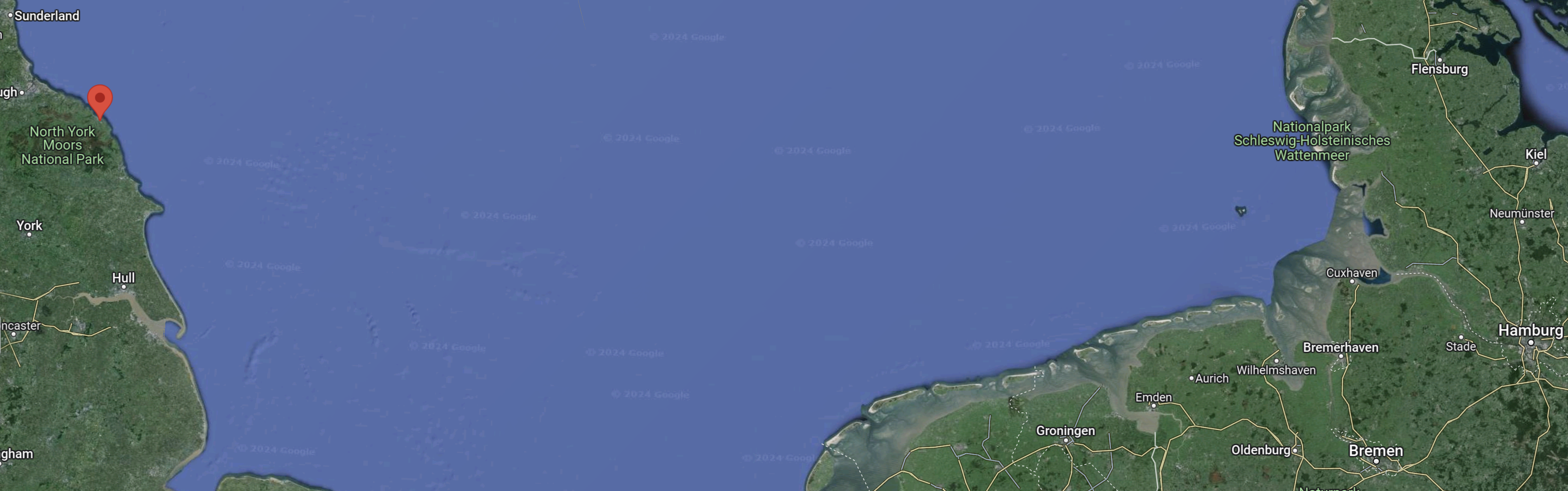
Note.
- Sunderland is in the top-left hand corner of the map.
- A white line in the top-right corner of the map is the Danish/German border.
- Hamburg and Bremen are in the bottom-right hand corner of the map.
If you lay the AquaVentus map over this map, I believe that RWE’s Dogger Bank South wind farm could be one of the three 2 GW wind farms on the South-Western side of the AquaVentus main pipeline.
- Two GW would be converted to hydrogen and fed into the AquaVentus main pipeline.
- Two GW of hydrogen will be a nice little earner for UK plc.
- One GW of electricity would be sent to the UK.
But this is only one of many possibilities.
Conclusion
Could Jürgen Maier, be the man to develop British links to AquaVentus for the benefit of both the UK and Germany?
- The UK’s wind farms could provide a lot of hydrogen for AquaVentus.
- Aldbrough And Rough Gas Storage are conveniently places to add the hydrogen storage, that AquaVentus needs.
- AquaVentus can certainly be expanded to Norway, and possibly Orkney and Shetland.
He certainly has a lot of relevant experience.
Zillertalbahn Hydrogen Plan Dropped In Favour Of Battery Traction
The title of this post, is the same as that of this article on Railway Gazette.
I wrote about this order in Zillertalbahn Orders Stadler Hydrogen-Powered Trains.
I didn’t blog about it but I remembered an article a few years ago about Stadler getting an order from the Zillertalbahn.
It appears the change is down to improvements in battery technology.
Narrow-gauge battery-electric multiple units must be right up Stadler’s street, as they built the new trains for the narrow gauge Glasgow Subway.
Stadler Presents Mock-Up Of Tram-Trains For German And Austrian Operators
The title of this post, is the same as that of this article on Railway Gazette.
This is the first paragraph.
A mock-up of the Citylink tram-trains that Stadler is to supply to operators in Karlsruhe, Saarbrücken, Neckar-Alb, Oberösterreich and Salzburg was unveiled at the Betriebshof West depot in Karlsruhe on December 13.
This is the most interesting paragraph.
‘Maximum standardisation and the fact that the order was shared between different operating companies reduces the costs by to up to €1m per vehicle’, said Karlsruhe Mayor Frank Mentrup at the unveiling ceremony.
It shows the value of standardisation and large orders.
106 Solaris Zero Emission Buses Headed To ÖBB Postbus’ Fleet In Austria
The title of this post, is the same as that as this article on Sustainable Bus.
This is the body of the story.
Up to 106 zero emission buses are headed to Austria, where ÖBB Postbus is going to deploy them starting from 2022 – 2025. Solaris has signed another framework agreement with the Austrian bus company Österreichische Postbus AG. It stipulates a possibility to deliver up to 106 battery-electric and hydrogen buses that would be deployed throughout Austria. The models offered include Urbino 9 LE electric and Urbino 12 hydrogen buses.
Solaris Bus and Coach is a Polish company, that is a subsidiary of CAF.
Alstom’s Coradia iLint Hydrogen Train Makes Its Swedish Debut
The title of this post, is the same as that of this article on Global Railway Review.
This picture shows a hydrogen-powered Alstom Coradia iLint train near Hamburg

If you’re ever in Hamburg, take a ride to Buxtehude and take a ride to Cuxhaven.
These trains are now in service in Germany and have been ordered in quantity in Germany and have been demonstrated in Austria, Italy and The Netherlands.
New Fleet To Make Nightjet ‘The Best Option For Travelling Between Major European Cities’
The title of this post, is the same as that of this article on Railway Gazette International.
This is the first paragraph.
The exterior design and first painted carbody for the fleet of coaches which Siemens Mobility is to supply for Nightjet night train services has been unveiled by Austrian Federal Railways.
This is a €500m project involving.
- New trains
- Additional destinations
- New services
ÖBB intends to buy 33 Nightjet trains, which will be introduced into services from 2022.
This is the last paragraph.
Meanwhile, ÖBB intends to introduce its planned Wien/Innsbruck – Amsterdam Nightjet service from April 2021, with Wien – München – Paris and Zürich – Amsterdam services following in December.
It looks like ÖBB are moving closer to the UK.
I’m looking forward to taking a sleeper between London and Vienna.
A Curious Link Between Pancreatic Cancer And COVID-19
i am involved in fund raising for pancreatic cancer research at Liverpool University, because my youngest son died of the awful disease, at just thirty-seven, leaving a widow and an eight-year-old daughter.
I am also a passionate analyser of data and databases.
For a few weeks now, I have had a feeling that there is a connection between pancreatic cancer and the old Austro-Hungarian Empire.
I found this simple description of the Austro-Hungarian Empire on this page on the Internet.
The former Austro-Hungarian Empire was spread over a large part of Central Europe, it comprises present Austria and Hungary as well as the Czech Republic, Slovakia, Slovenia, Bosnia, Croatia and parts of present Poland, Romania, Italy, Ukraine, Moldova, Serbia and Montenegro.
I had been looking at pancreatic cancer data on the World Life Expectancy database, which is based on World Health Organisation data.
I have built this table, which shows the top twenty countries for a death rate from pancreatic cancer.
These are the columns.
- Country
- Rate of pancreatic cancer deaths per 100,000 of the population.
- Quarantine or Travel Corridor based on this page of the Government web site.
- Member of the Austro-Hungarian Empire.
These are the top twenty countries.
- Hungary – 11.35 – Quarantine – AHE
- Uruguay – 10.72 – Quarantine
- Armenia – 10.34 – Quarantine
- Malta – 10.01 – Quarantine
- Czech Republic – 9.89 – Quarantine – AHE
- Estonia – 9.26 – Travel Corridor
- Iceland – 9.21 – Quarantine
- Israel – 9.18 – Quarantine
- Slovakia – 9.17 – Quarantine – AHE
- Austria – 9.13 – Quarantine – AHE
- Finland – 8.78 – Travel Corridor
- Japan – 8.74 – Travel Corridor
- Latvia – 8.72 – Travel Corridor
- Germany – 8.68 – Travel Corridor
- Slovenia – 8.55 – Quarantine – AHE
- Denmark – 8.51 – Quarantine
- Netherlands – 8.38 – Quarantine
- Croatia – 8.30 – Quarantine – AHE
- Lithuania – 8.21 – Travel Corridor
- Luxembourg – 8.15 – Quarantine
Note.
- I would hope that the Government’s Travel Corridor list has been devised in a scientifically-correct manner.
- Am I right to assume that the Travel Corridor list is a good measure of the level of Covid-19 in the country?
- The pancreatic cancer data is from 2018.
Of the countries I mentioned earlier, as being partly in the Austro-Hungarian Empire, only Montenegro is in the top thirty countries for pancreatic cancer deaths.
My Thoughts On The Data
These are my thoughts on the data.
The Significance Of The Austro-Hungarian Empire
Consider.
- All the countries that were fully or partly in the Austro-Hungarian Empire are on the Government Quarantine List, with the exception of Italy.
- Many will argue, including myself, that Italy, has too high a Covid-19 rate for a visit.
- Austria, Croatia, the Czech Republic, Hungary, Slovakia and Slovenia are in the top twenty countries for pancreatic cancer deaths.
It looks to me, that there is a correlation in there somewhere.
Germany And Japan Are The Odd Ones Out
The list of countries with high levels of pancreatic cancer, where there is no quarantine are.
- Estonia
- Finland
- Japan
- Latvia
- Germany
- Lithuania
If you eliminate the Baltic States and Finland from the worse countries for pancreatic cancer, you’re left with Germany and Japan.
Is There A Jewish Dimension?
I ask this question for these reasons.
- Israel is eighth on the pancreatic cancer list and has high levels of Covid-19 according to various news reports, like this one on the BBC, which is entitled Coronavirus: Israel Tightens Second Lockdown Amid Acrimony.
- I am not Jewish, but my great-great-great-grandfather from Konigsberg probably was and it looks like I inherited my coeliac disease from him and gave it to my son, who died from pancreatic cancer.
- The Baltic States and Finland, don’t seem to have large Jewish populations for various reasons and they have high levels of pancreatic cancer, but low levels of Covid-19.
- Germany has the third largest Jewish population in Europe, but seems to have done well in fighting Covid-19. Is that because their well-funded healthcare system has worked?
- Wikipedia states that, the Austro-Hungarian Empire was favourable to the Jews and even a sizeable numbers of its Army officers in Word War One were Jewish.
- According to reports locally and my observations, it appears that the Jewish community in Hackney, where I live has been badly hit by Covid-19.
I need an appropriate historian to give me answers.
Conclusion
I believe the correlation between pancreatic cancer and Covid-19 could be rather strong. More research needs to be done, as to why.
But I do wonder, if undiagnosed coeliac disease, as in my son, could be the alligator in the swamp.
Undiagnosed coeliacs seem to have poor immune systems, which makes them more susceptible to everything, that’s going around.
The more I learn about coeliac disease and its myriad effects on health, the more I’m convinced that it should be one of the diseases checked for in all young children.
It would certainly have changed my miserable always-ill childhood for the better.
Hydrogen Train “Coradia iLint”
The title of this post, is the same as that on this page of the Austrian Railways web site.
One of the sections is entitled Tried And Tested On Geographically Demanding Routes, where this is said.
Up to now, hydrogen trains have mainly been used on flat routes in Northern Germany and the Netherlands. By testing on geographically demanding, alpine routes in the southern parts of Lower Austria, the hydrogen train is now being put through its paces for the first time.
They also give a link to a route timetable.
World’s First Hydrogen-Powered Passenger Train Hits The Rails In Austria
The title of this post is the same as that of this article on Silicon Republic.
This is the first paragraph.
This week in future tech, an Alstom hydrogen-powered train will start taking passengers in Austria for the first time.
But for the covids, I’d be on my way tomorrow to do a bit of advanced-level trainspotting.
 The Anonymous Widower