France’s Aura Aero Unveils 19-Seat Electric Aircraft Development Plan
The title of this post is the same as that of this article on Flight Global.
This is the introductory paragraph.
French aerospace firm Aura Aero is intending to develop a 19-seat electric-powered regional aircraft, as it looks to certify its two-seat Integral R light single.
For a better picture and more information, look at this article in The Times, which is entitled French Electric Airliner Will Take To The Skies In Five Years.
Some clues as to the specification from the article and around the web.
- Nineteen seats.
- Maiden flight by 2024 and in service entry in 2026.
- It has six electric engines.
- Three hundred mile range.
- Hybrid power will be used to extend the range to 500 miles.
- A freighter version will be available.
This paragraph is from The Times article.
This week the company began production of a new two-seater plane made of carbon-wood, a lightweight composite material. It is confident that it can meet its ambitious timetable in a race to beat rivals in Europe, the US and Israel and overcome the formidable weight and range barriers to commercial electric passenger flight.
A carbon-wood airframe hints at possibly the world’s most successful composite aircraft; the wooden De Havilland Mosquito, which was light, strong and very fast.
- In fact, it was so fast, one aircraft could bomb Germany twice in one night, with two crews and a refuelling and a rearming in between.
- It could also carry a bomb load not far short of that of a Boeing B17 Flying Fortress.
Sadly, we didn’t realise the full potential of this aircraft in World War II, but if we had, fewer aircrew and civilians on the ground would have died, as waves of Mosquitos could have knocked out important targets with precision and surprise. I wrote about one of their precision raids in The Kunstzaal Kleizkamp Raid.
Conclusion
I think the mathematics and regulations point to an aircraft with the following specification, being the right plane to develop.
- Nineteen seats
- 300 mile range
- Versatile interior
- Sustainable aviation fuel range extender
It appears that both the Aura Aero Era and the Faradair BEHA are aimed at this market, with the Cessna eCaravan and the Eviation Alice aimed at a smaller number of passengers.
Note.
- Sustainable aviation fuel doesn’t need any specialist handling and can be delivered to the aircraft in a normal bowser.
- I suspect that one electric aircraft manufacturer or electric vehicle support company will develop a charging system, for the batteries, that is based on a vehicle that just plugs into the aircraft during loading.
I think this segment of the aviation market could be a big one and I wouldn’t be surprised to see other companies bringing forward 19 seat/300 miles aircraft.
Although, the market could be a bit squashed from the top. Airbus have proposed a ZEROe Turboprop, which I wrote about in ZEROe – Towards The World’s First Zero-Emission Commercial Aircraft.
This would be capable of carrying up to a hundred passengers over a thousand nautical miles, with no emissions except water.
Is This A Case Of The Sh1t Hitting The Turbofan?
The title of this post was inspired by this article on Nonwovens Industry, which is entitled British Airways to Use Fuel Sourced From Recycled Diapers.
This is the first paraph.
British Airways will likely soon have part of its fleet fueled by trash. The company has entered into a partnership to build facilities that convert household waste into renewable jet fuel. The first stage of the partnership is a feasability stage with final investment planned for 2019. If the first stage is successful, part of BA’s fleet will fly using the fuel.
Admittedly, this is old news and the plant is now being built by Altalto at Immingham.
But it does get rid of one of the problems of the modern world; disposable nappies.
Rolls-Royce And Tecnam Join Forces With Widerøe To Deliver An All-Electric Passenger Aircraft Ready For Service In 2026
The title of this post, is the same as that of this press release from Rolls-Royce.
This is the first paragraph.
Rolls-Royce and airframer Tecnam are joining forces with Widerøe – the largest regional airline in Scandinavia, to deliver an all-electric passenger aircraft for the commuter market, ready for revenue service in 2026. The project expands on the successful research programme between Rolls-Royce and Widerøe on sustainable aviation and the existing partnership between Rolls-Royce and Tecnam on powering the all-electric P-Volt aircraft.
This picture from Rolls-Royce shows the proposed aircraft.

The P-Volt aircraft is based on the Tecnam P2012 Traveller.
The specification of this aircraft is as follows.
- Crew – 1 or 2
- Capacity – 9 passengers
- Powerplant – 2 x 280 jW piston engines.
- Cruise speed – 200 mph
- Range – 1090 miles
- Service ceiling – 19,500 ft.
The aim is to have an aircraft in service by 2026.
Use By Widerøe
This paragraph from the press release, outlines Widerøe‘s planned use of the aircraft.
The collaboration offers an opportunity to develop an exciting solution to the commuter aircraft market. Before the pandemic, Widerøe offered around 400 flights per day using a network of 44 airports, where 74% of the flights have distances less than 275 km. The shortest flight durations are between seven and fifteen minutes. Developing all-electric aircraft will enable people to be connected in a sustainable way and will fulfill Wideroe’s ambition to make its first all-electric flight by 2026. The all-electric P-Volt aircraft, which is based on the 11-seat Tecnam P2012 Traveller aircraft is ideal for the short take-off and landing as well as for routes in the North and the West Coast of Norway.
Conclusion
There are now five electric or low-carbon aircraft in the sub-nineteen passenger segment.
- The Cessna eCaravan, which I wrote about in Watch First Electric Caravan Fly.
- The Eviation Alice, which I wrote about in Orders For A New All-Electric Airplane Now Top 150.
- The Faradair BEHA, which I wrote about in Faradair’s BEHA Hybrid Aircraft Boosted By Partnerships.
- Project Fresson, which is an electric version of a Britten-Norman Islander.
Note.
- The Slice and the Faradair are new designs.
- The Faradair is hybrid and all the others are fully electric.
- The Faradair can carry eighteen passengers and all the others are smaller.
- I suspect there are others under development.
Conclusion
The Tecnam P-Volt must have a high chance of success.
- It’s designed for a purpose in a particular airline.
- The Widerøe model would apply to large number of small feeder and commuter airlines.
- Rolls-Royce are well-respected in aviation.
- An existing airframe is being used, which shortens certification.
- Norway is not short of a few bob.
- Cape Air have ordered 93 of the piston engined variant.
I will look forward to flying this aircraft.
Honeywell Introduces Power Source For Hybrid-Electric Aircraft
The title of this post, is the same as that of this article on Flying Magazine.
Honeywell have created a power source for hybrid-electric aircraft, that will run on a wide range of fuels including jet fuel, diesel and sustainable aviation fuel.
The Flying Magazine article is a must-read, which is mainly based on this press release from Honeywell, which is entitled Honeywell’s Newest Turbogenerator Will Power Hybrid-Electric Aircraft, Run On Biofuel.
The turbogenerator has two main parts.
Small Turbofan Provides The Power
These are details of the turbo fan.
- The small turbo fan is the auxiliary power unit or APU from an Airbus A 350 XWB.
- The APU is identified as a Honeywell HGT1700.
- Over four hundred of these APU’s have been delivered in Airbus A350 XWBs.
- It can run on jet fuel, diesel and sustainable aviation fuel.
- It can also run on Honeywell Green Jet Fuel.
- I suspect in the future, it will be able to run on hydrogen.
The APU is obviously well-proven technology, from a company with a large share in the airliner market.
Generator To Provide Electricity
These are details of the generator.
- It weighs 127 Kg or about two of me.
- It can generate a megawatt of electricity.
The generator sounds powerful to me.
The first demonstration of this turbogenerator system will occur in the third quarter of 2021, with ongoing development and qualification to follow.
Honeywell says this about their collaboration with Faradair and other companies.
In December, Honeywell signed a memorandum of understanding with British startup Faradair Aerospace to collaborate on systems and a turbogeneration unit that will run on sustainable aviation fuel to power Faradair’s Bio Electric Hybrid Aircraft (BEHA). Faradair intends to deliver 300 hybrid-electric BEHAs into service by 2030, of which 150 will be in a firefighting configuration. Honeywell is in advanced discussions with several other potential turbogenerator customers, working to help define power requirements based on mission profiles required by various manufacturers.
I can see a lot of customers for this turbogenerator.
And not all will be in aviation!
Inside A $4 Million Electric Plane, The First Full-Size, All-Electric Passenger Aircraft In The World
The title of this post, is the same as that of this article on Business Insider.
Watch the video and think. Is it Alice in Wonderland?
I am looking forward to my first flight in an all-electric aircraft.
Can A Green Revolution Really Save Britain’s Crisis-Stricken Aerospace Industry?
The title of this post, is the same as that of this article on the Telegraph.
This is the sub-title.
The Prime Minister has set a challenging target of green flights within a generation, but is it a sustainable plan?
I have read the whole article, which is mainly about Velocys and their project at Immingham to create aviation biofuel from household rubbish.
They say the main problem is scaling up the process to get enough jet fuel. When I was working at ICI in the early 1970s, modelling chemical processes, scale-up always loomed-large as a problem.
Nothing changes!
I think we’ll get to our carbon-neutral objective, for aviation, but it will be a mixture of things.
- Aviation biofuel.
- All-electric airports.
- Efficient aerodynamics and engines.
- Electric short-haul aircraft.
- Rail substitution for short flights.
Traditional aerospace must reform itself or die!
As to Velocys, they must solve their scaleup problem, so that all suitable household and industrial rubbish ends up doing something more useful, than beinmg incinerated or nuried in landfill.
How Leeds Bradford Airport Can Be Catalyst For Green Aviation
The title of this post, is the same as that of this article on the Yorkshire Post.
The article was written by a geography student from Yorkshire, who is studying at Cambridge University.
He makes some interesting points.
- Leeds Airport is not a good customer experience.
- Manchester Airport will take passengers away from Leeds.
- Leeds is the biggest financial centre in the UK outside London.
- Leeds Airport should be improved to the highest environmental standards.
- Aviation biofuels should be provided.
- Short haul flights should be replaced by a train journey if possible.
- By 2030, a lot of short haul flights will be replaced by electric aircraft.
I agree with a lot of what he says.
There will still be a need to fly and we must make it as environmentally-friendly as possible.
If we don’t find ways of making flying carbon-neutral, we’ll hurt the economy.
Could High Speed Two Trains Serve Chester And North Wales?
This may seem a slightly outrageous proposal to run High Speed Two trains to Chester.
- The city is a major tourist destination.
- Despite its closeness to Crewe it is a major rail hub, with services across Wales to Cardiff, Holyhead and Llandudno and along the border between England and Wales to Shrewsbury and Newport.
- Merseyrail serves the city and the station can be considered to be part of Liverpool’s extensive commuting area. This service is likely to be more reliable and faster with the delivery of new Class 777 trains.
- For parts of Merseyside, travelling to London or Manchester Airport, is easier via Chester than Liverpool Lime Street or Liverpool South Parkway.
If the promoters of High Speed Two are serious about creating a railway for the whole country, then I feel that running trains direct to and from Chester could be very beneficial for the towns and cities, that can be served by the current network at Chester.
Current And Possible Timings
Currently, trains take two minutes over two hours between Euston and Chester.
When Avanti West Coast introduces the new Hitachi AT-300 trains on the route, the following times will be possible.
- Euston and Crewe via West Coast Main Line – 90 minutes – Fastest Pendelino
- Crewe and Chester – 24 minutes – Current timing
This would give a time of one hour and 54 minutes, which is a saving of 8 minutes. But a lot of carbon would not be emitted between Euston and Crewe.
I estimate, that with High Speed Two Phase 2a completed, the following timings will be possible.
- Euston to Crewe via HS2 – 55 minutes – HS2 website
- Crewe and Chester – 24 minutes – Current timing
This would give a time of one hour and 19 minutes, which is a saving of 43 minutes.
Infrastructure Needed
There will need to be some infrastructure changes.
Platform Lengthening At Chester Station
The station would probably be served by two-hundred metre long High Speed Two Classic-Compatible trains, which might need some platform lengthening.
This Google Map shows the station.
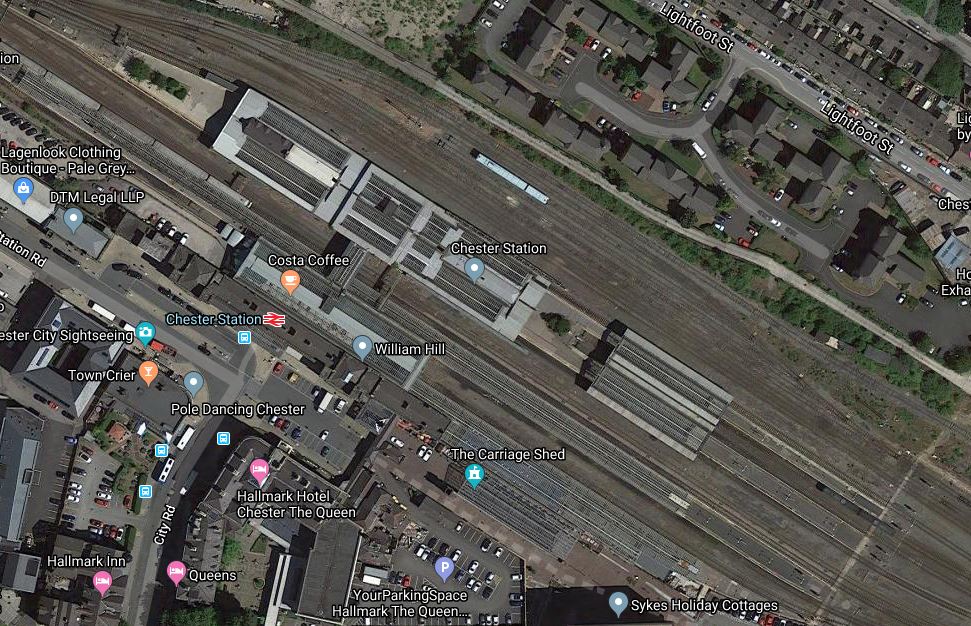
It looks to me, that there is plenty of space.
Will Chester And Crewe Be Electrified?
We know little about the capabilities of the trains proposed by the various manufacturers.
But, I wouldn’t be surprised that one or more of the proposals use batteries for one of the following purposes.
- Regenerate braking.
- Emergency power.
- Range extension for up to perhaps sixty miles.
As Chester and Crewe stations are only twenty-one miles apart with no intermediate stations, which will be run at an average speed of only 52 mph I don’t think it will be impossible to extend the service to Chester on battery power.
If electrification is required I wrote about it in Hitachi Trains For Avanti.
As it is only just over twenty miles, I don’t think it will be the most challenging of projects, although there does seem to be a lot of bridges.
Electrification would also allow Avanti West Coast’s Hitachi trains to run on electricity to Chester.
What About Holyhead?
Holyhead could become a more important destination in the next few years.
It is probably the best alternative to avoid flying and driving between Great Britain and the Island of Ireland.
And who can accurately predict, what effect Brexit and thinking about global warming will have?
I have a feeling that after electrification to Chester, using on-board energy storage could be used West of Chester.
It is very difficult to predict battery ranges in the future, but I can see a two hundred metre long High Speed Two Classic-Compatible train being able to reach Holyhead on battery power, with or without some limited extra electrification.
Alternatively, the UK and Welsh governments, might bite the bullet and just electrify the whole route between Crewe and Holyhead.
I have found a train on Real Time Trains, that covered the 105.5 miles between Holyhead and Crewe in two hours and 11 minutes at an average speed of 48 mph. The train took then a total of three hours and forty-five minutes to get to Euston
I estimate that with electrification and some track improvements, that it will be possible to travel between Euston and Holyhead in under three hours before High Speed Two.
Conclusion
It looks to me, that when High Speed Two, think about adding extra destinations, Chester and Holyhead could be on the list.
I also suspect that even without electrification and High Speed Two services, but with the new Class 805 trains, the route could be a valuable one for Avanti West Coast.
Trump And Flight PS572
What puzzles me about all this is Trump’s reaction.
If he were true to his past persona, he would be very much angrier and vowing vengeance, but his reaction seems almost calm and very measured.
Perhaps, he knows for certain, that it was a tragic accident, that happened to Flight PS572. After all the UK, US, Canada and Ukraine seem to be saying similar things.
Someone or something, seems to have got Trump to see sense!
Melania, Justin, Boris, Emmanuel, Dominic or Angela? Or was it the Italian guy, who does his hair?
The Power Of Check-Lists
The most interesting article in The Times yesterday was entitled How A Checklist Saved A Little Girls Life. It starts like this.
A simple procedure borrowed from the airline industry and a bit of humility has ensured many more patients survive
It is powerful stuff and I hope every doctor and health administrator reads it. But I doubt they will, as what does the aviation industry know about medicine?
The author of the article Atul Gawande is giving the Reith Lectures this year. I shall be listening.
 The Anonymous Widower