Extending The Sheffield Tram-Train To Adwick
I must admit, I very much like the Class 399 tram-trains in Sheffield and their German cousins in Karlsruhe.
I am not alone, as talking to an experienced Sheffield tram driver, he said that the extra power of the Class 399 tram-trains have over the Supertrams, mean they handle Sheffield’s hills with ease, when the tram-trains are full.
They have a top speed of 62 mph compared to a British Rail Class 150 train being able to manage 75 mph.
Passenger capacity of the two trains is probably about the same.
The Current Tram-Train Service
The service has the following characteristics.
- This runs between Sheffield Cathedral and Rotherham Parkgate via Meadowhall South and Rotherham Central stations.
- Services run every thirty minutes.
- I have heard rumours that an extra stop is going to be be added at Magna Science Adventure Centre.
London Overground and local rail services in Birmingham, Liverpool, Manchester and other cities in the UK, seem to run at a frequency of four trains per hour (tph).
The Current Northern Rail Service Between Sheffield And Adwick Via Doncaster
The service has the following characteristics.
- This runs between Sheffield and Aswick stations via Meadowhall, Rotherham Central, Swinton, Mexborough, Conisbrough, Doncaster and Bentley stations.
- Services run every hour.
- The service passes Rotherham Parkway Shopping Centre, but doesn’t stop.
Is there a need for this Northern Rail service to stop at Rotherham Parkway Shopping Centre?
The Current Electrification Between Sheffield And Rotherham
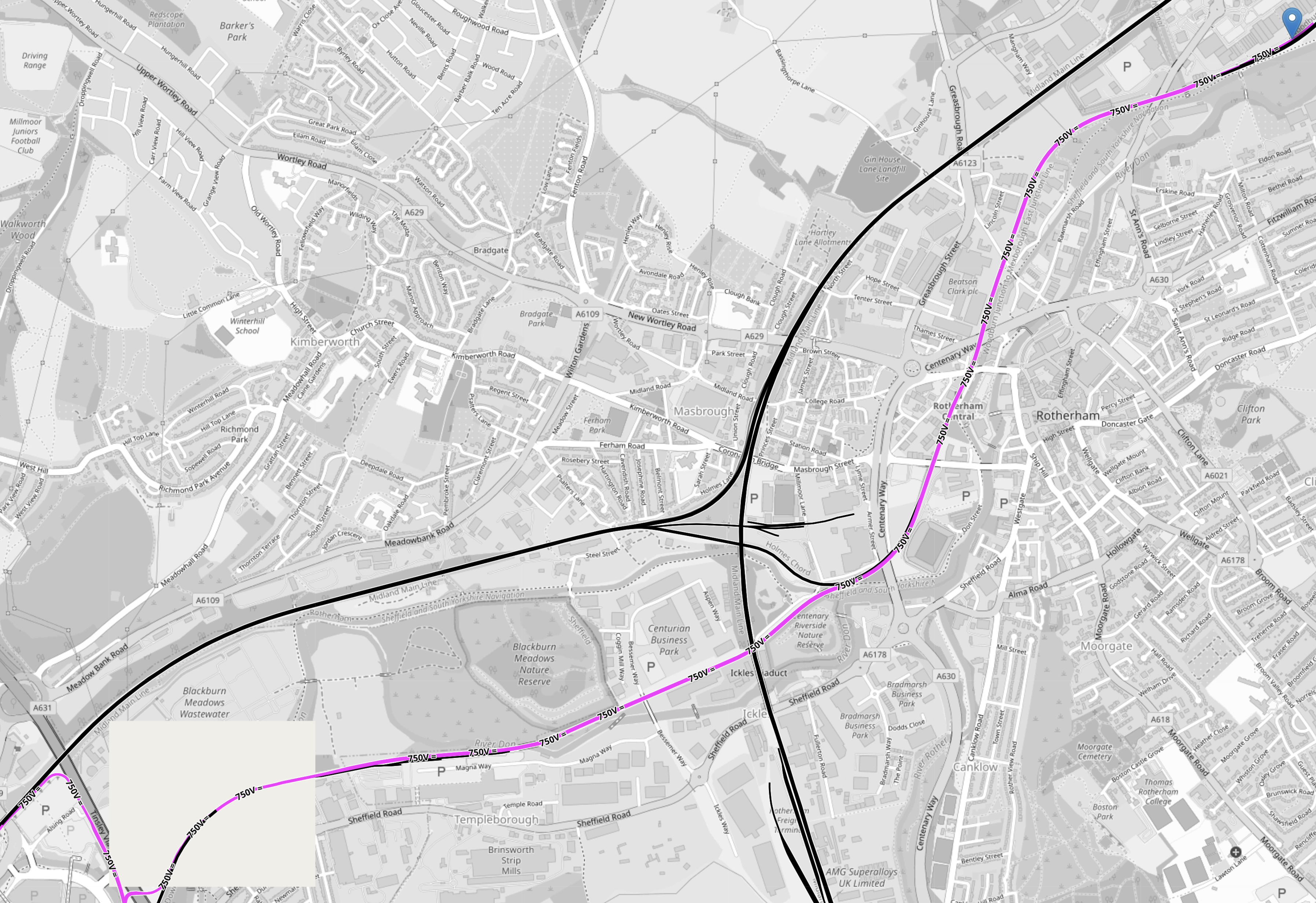
This OpenRailwayMap shows the electrified lines between Sheffield and Rotherham Parkway.
Note.
- Mauve tracks are electrified with 750 VDC overhead wires, so they can power Sheffield’s trams and tram-trains directly.
- Black tracks are not electrified.
- Meadowhall and its rail and tram interchange is in the South-West corner of the map.
- Note how mauve lines indicate the electrified tram tracks, that curve round the Meadowhall Shopping Centre.
- The blue arrow in the North-East corner indicates Rotherham Parkgate tram stop.
- The mauve line diagonally across the map, indicates the current electrification between Meadowhall South and Rotherham Parkgate tram stops.
- Magna Science Adventure Centre, is just to the South of the electrified Sheffield-Rotherham tram-line.
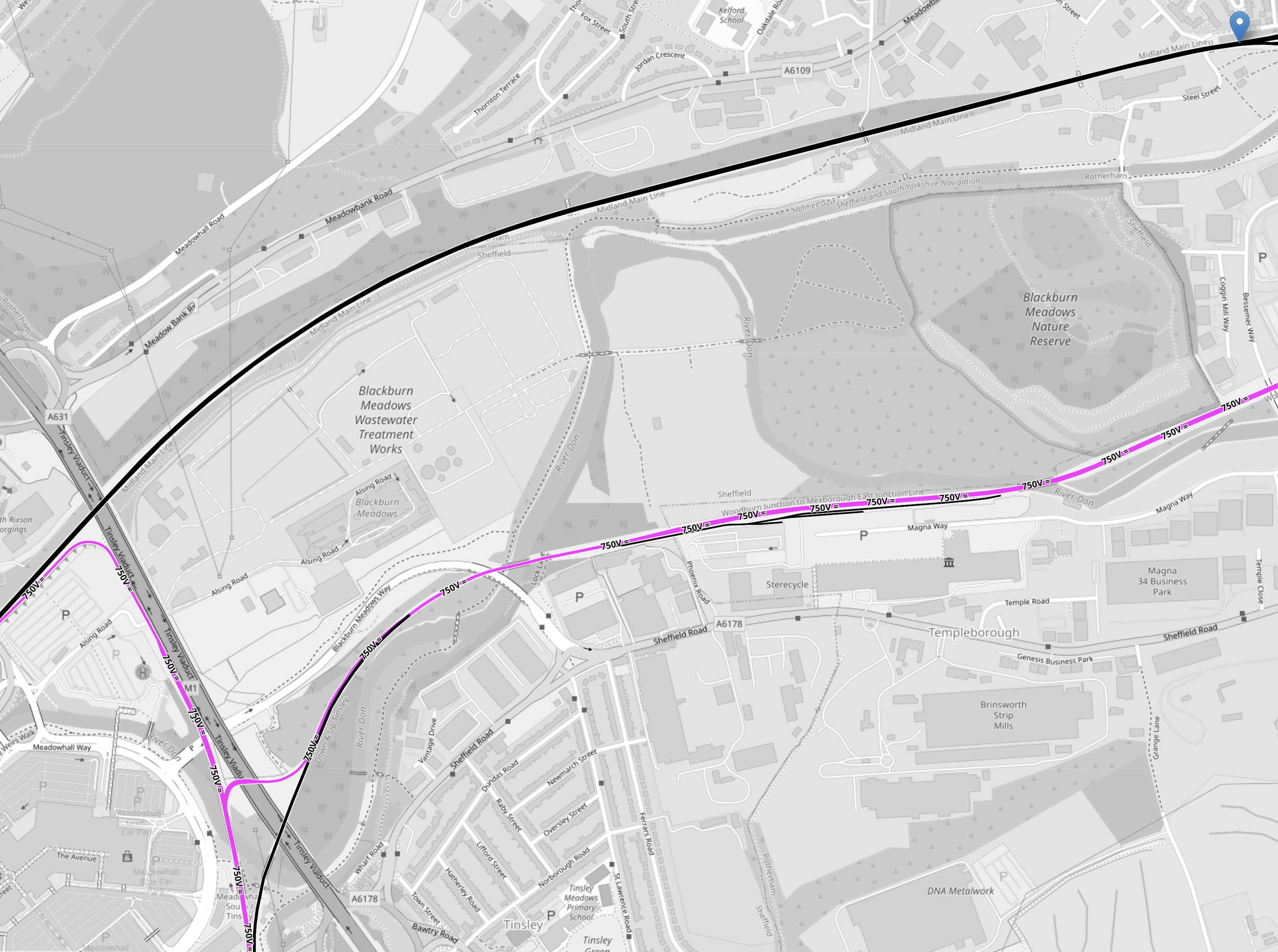
This second OpenRailwayMap shows the rail and tram lines between Sheffield and Rotherham in more detail.
Note.
- Track colours are as in the first map.
- The blue arrow in the North-East corner of the map indicates Holmes junction and is the route that Northern Rail’s current Sheffield and Adwick service takes.
- Sheffield and Rotherham Central stations are 6.1 miles apart.
- Sheffield and Adwick stations are 22.7 miles apart, but the Northern four miles between Doncaster and Adwick are electrified with 25 KVAC overhead wires.
This would indicate that a tram-train with a range of about twenty miles on battery power would be able to handle the route, if it could charge its batteries on the electrified lines.
Terminating a Sheffield And Adwick Service In Sheffield
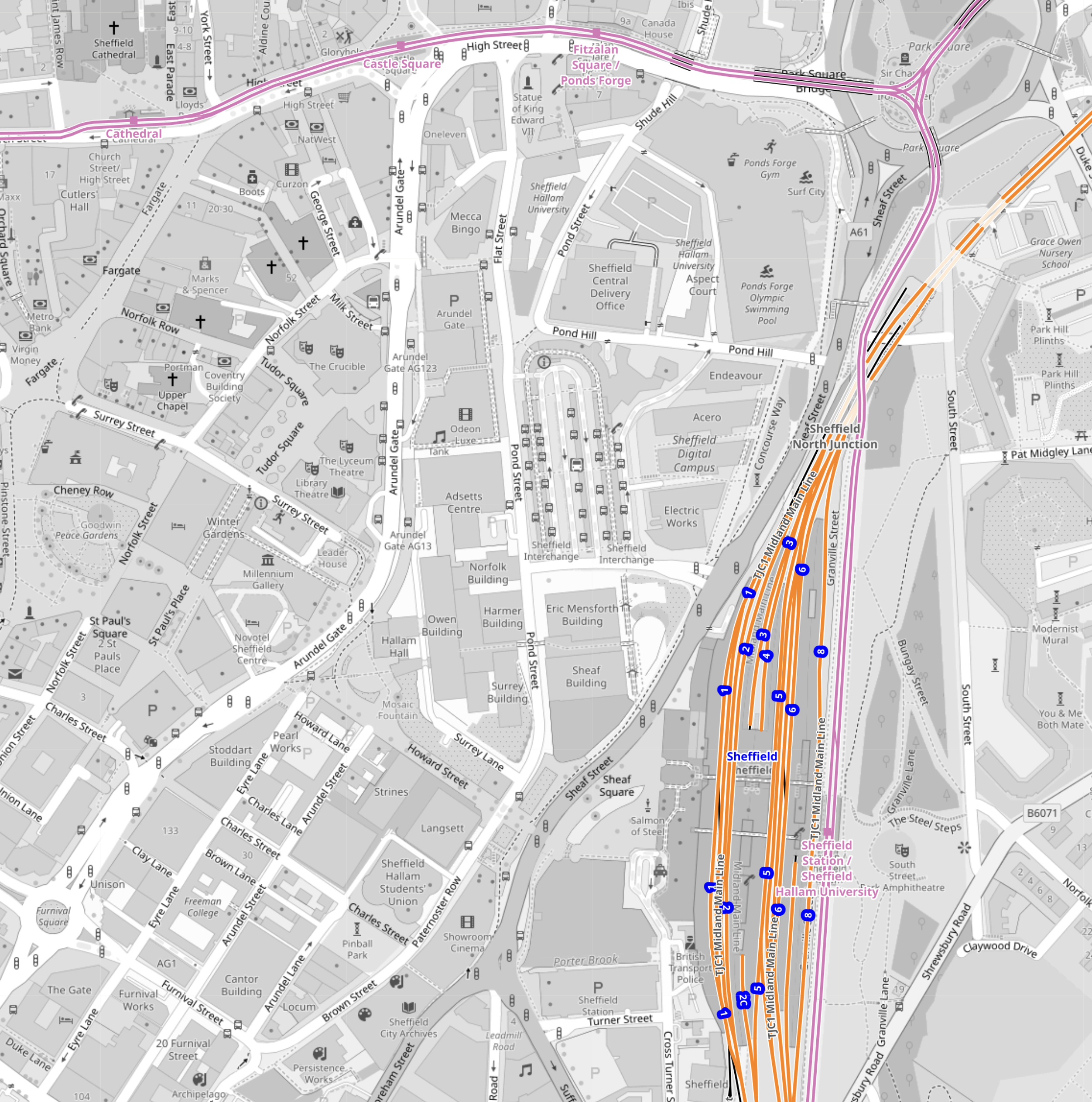
This OpenRailwayMap shows the rail and tram lines in and through Sheffield station.
Note.
- Rail lines are in orange.
- Tram lines are in mauve.
- Platform numbers in Sheffield station are shown as blue dots. Click on the map to show it on a larger scale.
- Sheffield Cathedral tram stop is in the North-West corner of the map.
- The triangular junction in the North-East corner of the map, allows trams to use all the main tram lines that go in three directions. A touch of genius as it gives a lot of flexibility, when adding extra services.
Currently, termination of the services from Rotherham and Doncaster is as follows.
- The tram-train terminates at the Sheffield Cathedral tram stop with a frequency of two tph.
- The train terminates in Platform 3 in Sheffield station with an hourly frequency.
- As typically a terminal platform can handle 4 tph, I don’t see why a second Sheffield and Adwick service can’t be running every hour into Sheffield station.
A short length of overhead electrification would need to be added on Platform 3 to recharge any tram-trains terminating in the platform.
It could also become a tram and run to any of the other destinations served from the triangular junction; Halfway, Herdings Park or Malin Bridge. This would allow batteries to be charged as the tram-trains ran across the city.
Remember, Sheffield station is likely to be electrified with 25 KVAC overhead wires in connection with running electric trains between London St. Pancras and Sheffield.
If the four bay platforms at Sheffield station, were to be electrified, then these would be ideal for recharging any battery-electric trains or tram-trains, that terminated in the station.
Battery-Electric Trains Between Manchester And Sheffield
Consider.
- Manchester Piccadilly station is already fully electrified.
- Currently, all Manchester Piccadilly and Sheffield, terminate in Platform 8 at Sheffield station.
- The distance between the electrification at Manchester Piccadilly and Platform 8 at Sheffield station is 40.2 miles.
- CAF are promising battery-electric versions of their Class 331 trains.
With a battery range of fifty miles, which is not outrageous, Manchester and Sheffield could be an electric service for the first time since January 1970, when the Woodhead route was closed.
FirstGroup’s Proposed London King’s Cross And Sheffield Service
This open access service might happen, although with this Government of all the Lawyers we have, who can predict anything.
- If it does happen, it is likely that the trains will be battery-electric Class 802 trains.
- These will be the same as those that will be run by Hull Trains.
- Battery range will be sufficient to handle Retford and Sheffield, which is 23.3 miles and much shorter than Temple Hirst junction and Beverley.
These trains will also need charging at Sheffield.
The current Sheffield and Adwick service terminates in platform 3 at Sheffield station, so this platform would probably need to have tramway electrification, so that it could charge the trams.
Updating Rotherham Parkgate Tram Stop
My preference would be for four tph passing through Rotherham Parkgate tram stop in both directions, so this would be a tram-train every seven minutes and thirty seconds, if there was only one platform as now.
I’m fairly sure, that Rotherham Parkgate tram stop needs to have a platform in both directions.
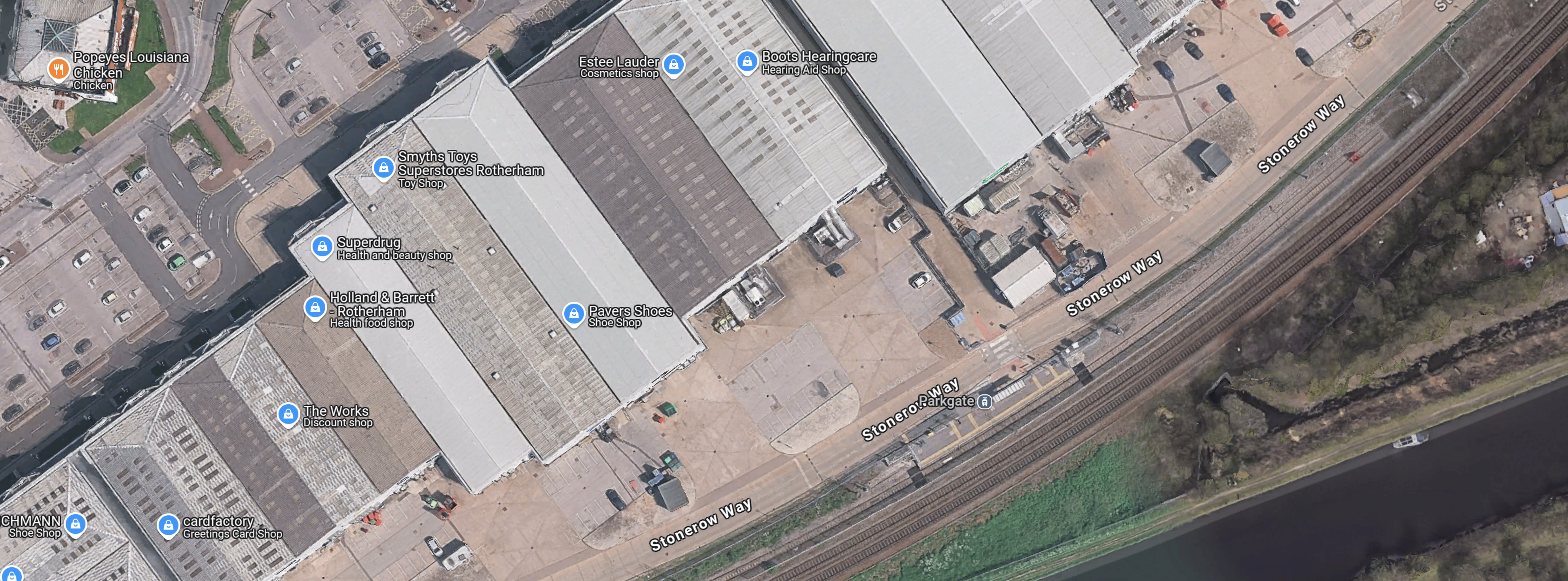
This Google Map shows the tram stop.
Note.
- The double-track rail line between Meadowhall and Doncaster curving to the South of the Rotherham Parkgate Shopping Centre.
- The Rotherham Parkgate tram stop on a spur from the rail line.
I am pretty certain, that a two-platform station could be squeezed in.
Designing A Battery-Powered Mountain Goat
When I wrote Up To Ebbw Vale From Newport, this comment was posted.
I’m not surprised that the Class 150 train, had no difficulty in climbing up to Ebbw Vale Town. The max gradient is around 1 in 65. There are plenty of places in Britain where gradients are steeper and indeed part of the type test for all dmus was to climb the 2 mile, 1 in 37.7 Lickey Incline starting a couple of hundred metres before the beginning of the slope.
It certainly got me thinking.
Could a line like Newport and Ebbw Vale be decarbonised, by simply fitting batteries to an appropriately-sized electric train?
- The battery would be charged using the 25 KVAC overhead electrification in Newport station.
- The train would climb the hill to Ebbw Vale Town on battery power.
- Coming down the regenerative braking would charge the battery.
- Once in the platform at Newport station, the battery would be topped up, to the level needed to climb the hill, from the existing electrification.
The question is can the train carry enough juice in a battery?
I will work the example through with a three-car Class 331 train.
- I have chosen a Class 331 train, as CAF have a factory in Newport.
- The train weighs 30.48 tonnes.
- It has 213 seats.
- If I assume that each passenger is 80 Kg including baggage, bikes and buggies, that gives a mass of 17.04 tonnes or a total mass of 47.08 tonnes.
- The difference in altitude between Ebbw Vale Town and Newport is 764 feet.
Using Omni’s Potential Energy Calculator, that gives a value of 29.9 kWh.
This OpenRailwayMap shows the tracks from Newport to Pye Corner.
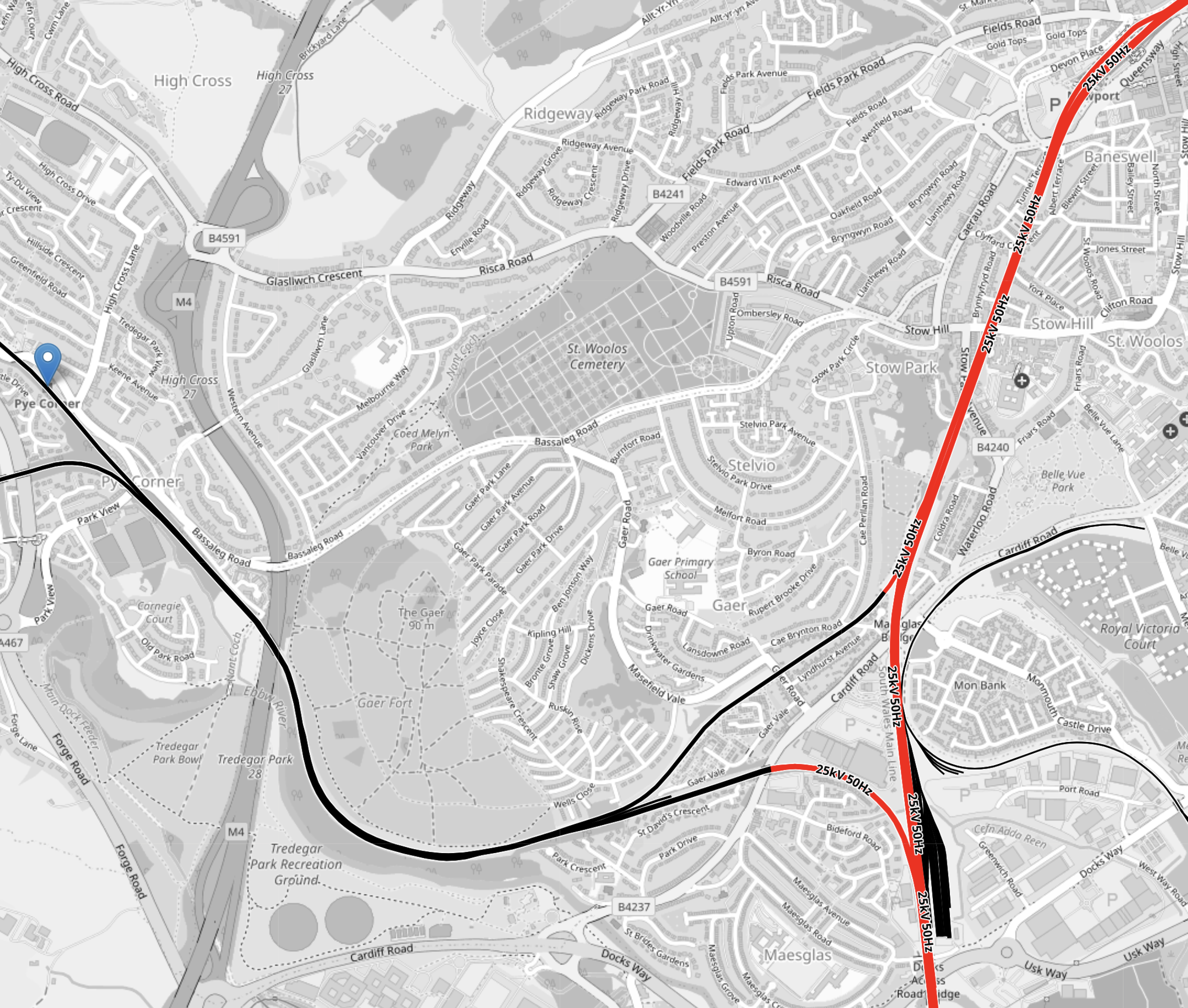
Note.
- Red tracks are electrified and black ones are not.
- Newport station is in the North-East corner of the map, with the South Wales Main Line running through.
- Pye Corner station is marked by the blue arrow and is the first station on the climb to Ebbw Vale.
- The unelectrified Ebbw Vale branch has a triangular junction with the electrified South Wales Main Line.
- The electrification continues for a short way towards Pye Corner and goes all the way to Newport and Cardiff.
- Trains take 24 minutes to turn round in Newport.
- Newport and Ebbw Vale Town is about twenty miles.
It can be safely said that trains will start their climb to Ebbw Vale with a full battery.
What Battery Size Will Be Needed?
I don’t think it will be that large and it will be the smallest battery, that could take a train up the hill.
As part of the climb is double track, the up track could be electrified to enable a smaller battery to be used, which would mean less power would be needed, due to the lower weight.
Conclusion
I believe that it will be possible to fit CAF’s Class 331 trains with a battery large enough to take a train up the hill to Ebbw Vale Town.
Ebbw Vale Town Station – 3rd February 2024
I took these pictures as Ebbw Vale Town station.



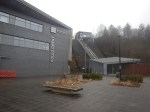
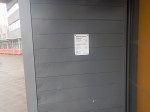


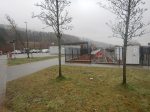
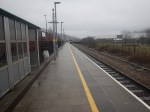


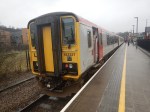
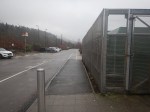
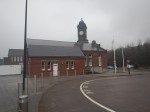
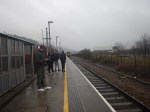


Note.
- There is a cableway to the main town.
- But t wasn’t working as it was Saturday.
- There is a large college.
- There was no information, as to how to get to the town.
- The Cardiff and Newport trains alternate every half hour.
The area certainly needed better information and perhaps a cafe, so that commuters can buy a coffee for their journey!
These are my thoughts.
The Capacity Of Ebbw Vale Town Station
According to this page on the Network Rail web site, the single platform at Ebbw Vale Town station is approximately 150 metres in length to fit up to six train carriages.
As at the current time, services are run by two- or three-car, it would appear that if a train failed in the station, the platform is long enough to accommodate another train to continue the services.
In the Wikipedia entry for Ebbw Vale Town station, it is indicated that a second platform could be built. There is certainly enough space.
Operation Of Ebbw Vale Town Station
I was at Ebbw Vale Town station for nearly two hours and I watched three Newport and two Cardiff trains arrive and leave every half-hour.
- I had arrived on the first train from Newport.
- The Cardiff trains were busy with passengers for the rugby.
- I took the third Newport train, so I could catch my train back to Reading.
- The system seemed to be working well.
Is there another single-platform station on a branch line, that serves two main line stations alternatively every half hour?
Increasing Capacity To Ebbw Vale Town Station
In Designing A Battery-Powered Mountain Goat, I stated that I believe that a small fleet of CAF’S Class 331 trains fitted with batteries could handle the Cardiff and Newport services to Ebbw Vale Town.
The sight and the curiosity of battery-electric trains climbing up the hills will certainly create more traffic on the route.
The simple solution is to lengthen the trains and that is easy at the moment, as the services are run using Class 150 trains with a Class 153 to add extra capacity, where needed.
But could a half-hourly service be run to both Cardiff and Newport?
This would double the capacity and make it more user friendly.
Nothing is said on the Internet about whether this is possible on not, but I believe that with modern digital signalling and battery-electric trains, with better performance than the elderly British Rail-era diesels, that it would be possible to run a half-hourly service to both Cardiff and Newport.
Conclusion
I believe that Network Rail have done a good job in designing this scheme.
Improvements To Leeds And Hull Services
This news story from the Department of Transport is entitled Yorkshire And The Humber To Benefit From £19.8 billion Transport Investment.
This is said about Leeds and Hull services.
Hull will also be brought into the Northern Powerhouse Rail network, reducing journey time from Leeds from 58 minutes to just 48. The number of trains between Hull and Sheffield will be doubled, to 2 per hour, with capacity also doubled. Journeys from Hull to Manchester will drop from 115 to 84 minutes, enabling 2 fast trains to Leeds.
I shall look at the 10:15 Northern Trains service between Hull and Leeds on the 13th October 2023.
- The distance is 51.8 miles.
- There are seven stops.
- The service is run by a diesel Class 158 train.
- Journey time is 69 minutes.
Ten minutes off this time would be worthwhile.
I shall look at the 10:03 TransPennine Express service between Hull and Leeds on the 13th October 2023.
- There are two stops.
- The service is run by a diesel Class 185 train.
- Journey time is 54 minutes.
Ten minutes off this time would be difficult.
Note.
- The line between Micklefield and Leeds is being electrified.
- The distance between Hull and Micklefield is 42 miles.
- The route has a maximum speed of between 75 and 90 mph.
There is also an historic swing bridge at Selby, which would probably be difficult to electrify.
How Many Minutes Could Electric Trains Save Between Leeds and Hull?
Electric trains have better acceleration and deceleration, when compared to diesel trains, so two minutes per stop and for the acceleration and deceleration at Hull and Leeds, would give the following times.
- Northern Trains – 53 minutes
- TransPennine Express – 48 minutes
As electrification is not mentioned for between Leeds and Hull, the only electric trains, that could work the route will be battery-electric trains.
Battery-Electric Trains Between Leeds and Hull
Consider.
- TransPennine Express already have Class 802 trains, from which the battery-electric version is being developed.
- Northern Trains would need a suitable battery-electric train. There has been talk of a CAF battery-electric Class 331 train, but nothing more. These would surly be ideal.
- Trains could be charged on new electrification in Hull station and between Micklefield and Leeds.
The trains would need a range of just 42 miles.
A Second Fast Train Between Leeds and Hull
What does this statement in the news story imply?
Journeys from Hull to Manchester will drop from 115 to 84 minutes, enabling 2 fast trains to Leeds.
I feel that this statement must be read in conjunction with the benefits of the TransPennine Route Upgrade.
One benefit is given as Faster Journeys, where this is said.
We’re speeding up journeys so you can travel to your favourite towns and cities more quickly. Our fastest journey times are forecast to be 63-66 minutes between Manchester and York and 41-42 minutes between Manchester and Leeds.
The news story says that the fastest journey times between Leeds and Hull will be 48 minutes, which would give a Hull and Manchester time of 89-90 minutes.
Alternatively, there could be these timings on one train.
- Hull and Leeds – 48 mins
- Hull and Manchester Victoria – 84 mins
- Leeds and Manchester Victoria – 36 mins
Note.
- The train would call at Brough, Selby, Leeds, Huddersfield and Stalybridge.
- There may be a new station at Leeds Thorpe Park
- The distance between Hull and Manchester Victoria is 94.7 miles.
- This is an average speed of 67.6 mph.
It almost looks like it’s connectivity East of Leeds and speed between Leeds and Manchester.
Conclusion
Battery-electric trains would provide all the improvements promised between Leeds and Hull.
Could Hull Station Be Electrified?
I took these pictures, as I passed through Hull station yesterday.
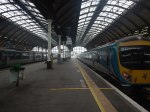
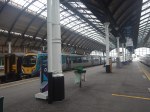
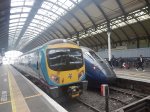
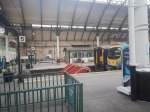
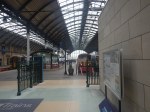


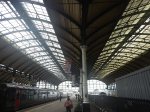
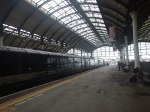
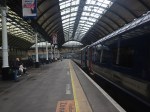

It appears that Hull station has a similar Victorian roof to Liverpool Lime Street and London Paddington, so I suspect the answer is yes.
These pictures show the platforms and overhead electrification at Liverpool Lime Street station, since the recent remodelling.


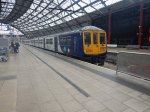
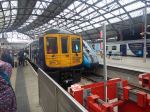
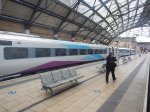

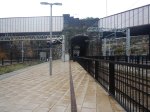
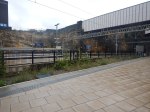

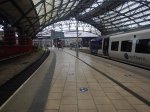

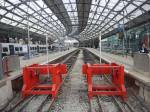
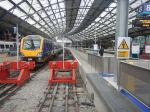

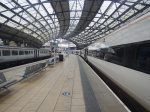

The electrification seems to be very traditional, with lots of steel gantries over the tracks.
These pictures show the platforms and overhead electrification at London Paddington station.
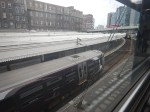
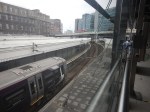
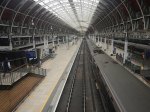
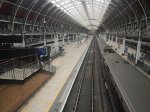
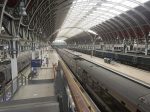
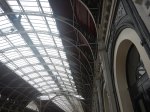

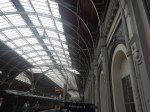
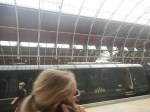
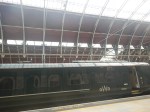
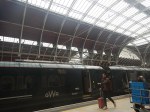
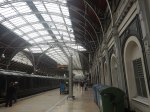

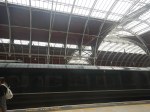
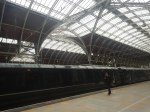
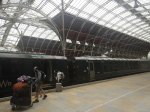
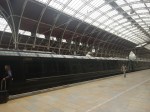
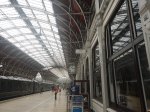
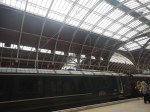
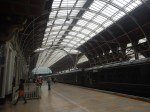
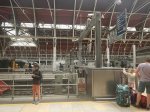
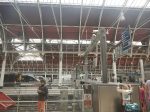
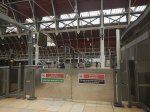
Note.
- The roof seems to have extra tie-bars reaching across.
- The wires seem to be hung from the roof.
- At the end of the platform they are fixed to large arch supports.
- Because Liverpool Lime Street’s electrification is newer than Paddington’s, it seems to have much more professional look.
After looking at the electrification in Liverpool Lime Street and Paddington, I believe that Hull station could be successfully electrified.
This map from OpenRailwayMap shows the platform layout at Hull station.
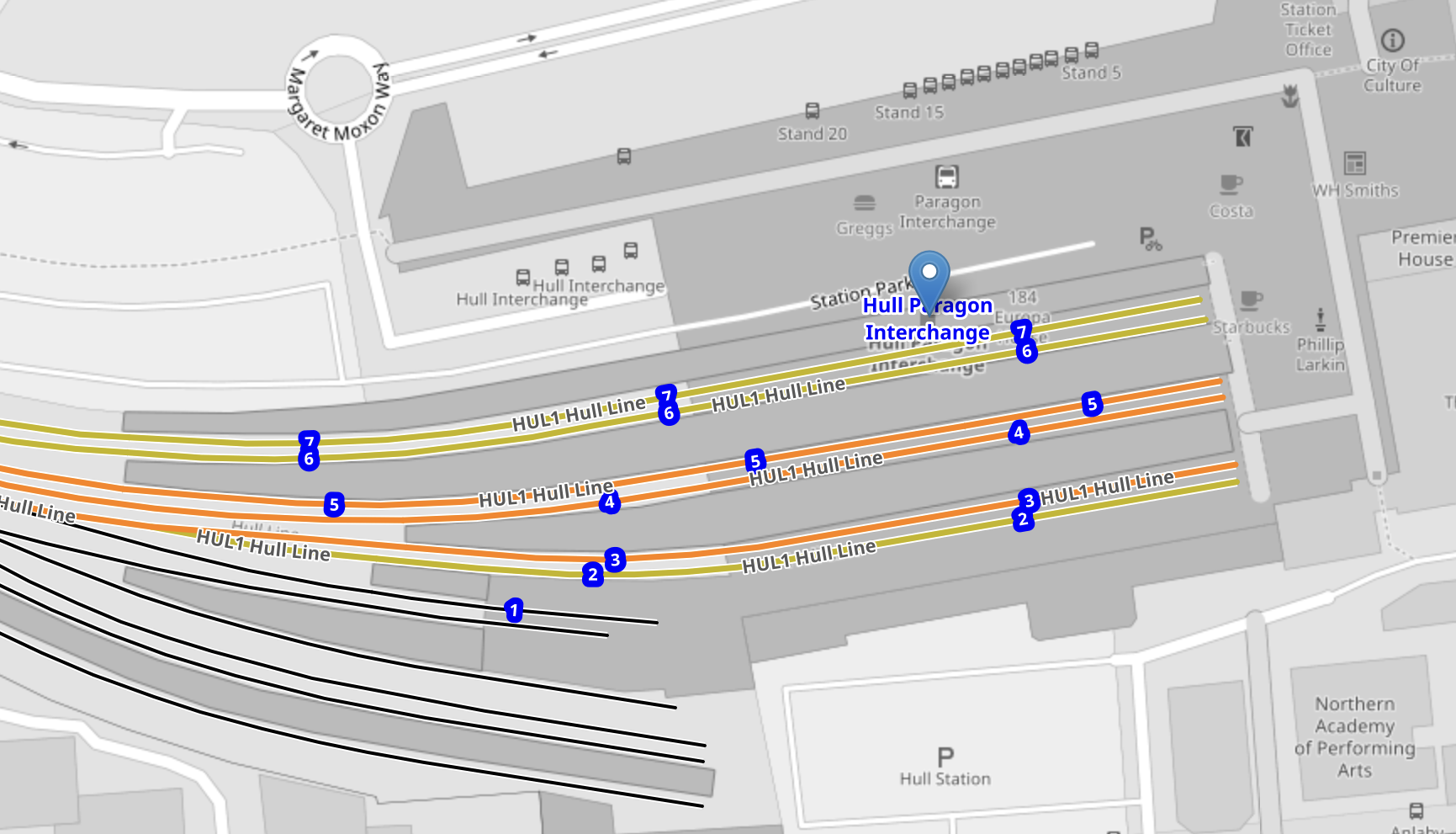
Note.
- Yesterday, my trains arrived in and left from Platform 7, which is the Northern-most platform.
- Other pictures in this blog show Hull Trains’s London service in Platform 7.
- Yesterday all Class 802 trains to and from London run by Hull Trains and LNER used Platform 7.
- I have been told by station staff, that Platform 7 can take a nine-car LNER Azuma.
- In Ten-Car Hull Trains, I talk about ten-car Class 802 trains running to and from Hull.
- Platform 7 or another platform at Hull station must be able to handle a ten-car train, which means that Hull station can handle a train, that is 260 metres long.
Looking at the station map, I believe that Hull station’s capacity for long express trains, is on a par with that of Liverpool Lime Street station.
I could see both stations handling two trains per hour (tph) across the Pennines and to and from London, with if necessary trains being formed of a pair of five-car trains.
How Many Services From Hull Station Can Be Run With Battery Trains?
Hull Trains service between London and Beverley travels for 44.5 miles on unelectrified track between Temple Hirst junction and Beverley.
Typically Hull Trains services wait in Hull station for the following times.
- Going between London King’s Cross and Beverley – Between ten and fifteen minutes.
- Returning to London King’s Cross – Upwards of twenty-five minutes.
I believe these waits in Hull station would mean that.
- A train going North to Beverley will have a battery containing enough electricity to get the train to Beverley and back, which is a distance of 16.7 miles.
- A train going South from Hull will have a battery containing enough electricity to get the train to Temple Hirst junction, which is a distance of 36.1 miles.
I believe that Hull Trains are currently working a timetable, that has been designed for operation by trains with a range on batteries of around fifty miles, provided there is electrification in at least one platform at Hull station to charge the trains.
It is also interesting to look at LNER’s two services that serve Hull.
- The 0700 to London, is scheduled to arrive at Hull station at 0635 from stabling at Doncaster and waits up to twenty-five minutes before leaving for London.
- The 2004 from London, is scheduled to arrive at Hull station at 2004 and waits up to twenty-five minutes before going South to overnight stabling in Doncaster.
It looks like LNER’s two trains follow Hull Trains rules.
- They use Platform 7 in Hull station.
- Trains going South have up to twenty-five minutes in the station.
It appears to me, that both Hull Trains and LNER are running a timetable, that would allow their services to be run using trains with a battery that had a range of around fifty miles, that could be fully-charged at Hull station before going South.
TransPennine Express run an hourly service to Liverpool Lime Street via Leeds and Manchester Victoria.
According to OpenRailwayMap’s map of electrification, when the TransPennine Upgrade is complete, the only section of the route without electrification will be the 42.1 miles between Hull and Micklefield.
As TransPennineExpress have some of the same Class 802 trains as Hull Trains, if there were at least two electrified platforms in Hull station, then Hull and Liverpool services could be run by battery-electric trains, with a similar specification to those of Hull Trains.
Northern Trains run an hourly service to Halifax via Leeds.
According to OpenRailwayMap’s map of electrification, , the only sections of the route without electrification will be the 42.1 miles between Hull and Micklefield and the 17.5 miles between Leeds and Halifax.
As Leeds and Micklefield is timetabled for seventeen minutes, I suspect this would be enough time to fully charge a battery-electric version of CAF’s Class 331 train and with charging in Hull station, then this route could be electrified.
Northern Trains also run other services, but because the Goole swing bridge is closed, I can’t get all the distances without electrification from Hull.
Ones I can find are.
- Beverley – 16.7 miles for return trip.
- Bridlington – 31.1 miles
- Doncaster – 40.8 miles
- Micklefield – 42.1 miles
- Scarborough – 53.8 miles
- Sheffield – 59.4 miles
- Temple Hirst – 36.1 miles
- York – 41.1 miles – Hull and Church Fenton
Note.
- York and Doncaster are electrified.
- Bridlington and Scarborough have suitable platforms where 25 KVAC overhead electrification could be installed to charge trains.
- Sheffield and Doncaster is only 18.6 miles and this may be the way to electrify between Sheffield and Hull.
- In The Data Sheet For Hitachi Battery Electric Trains, I state that Hitachi’s battery-electric trains have a range of 43.5 miles
It looks if enough platforms are electrified at Hull, all current services from the city could be run by battery-electric trains.
Conclusion
I believe that by electrifying Hull station, that Hull could have a station consistent with the HumberZero philosophy, with battery-electric trains running hither and thither, handling all rail traffic to and from the City.
Reopening Of Abandoned Merseyside Railway Under Consideration
The title of this post, is the same as that of this article on New Civil Engineer.
This is the sub-heading.
St Helens Borough Council is investigating the possibility of reopening part of the abandoned St Helens and Runcorn Gap railway in Merseyside.
This map from OpenRailwayMap shows the section of railway that will be reopened.
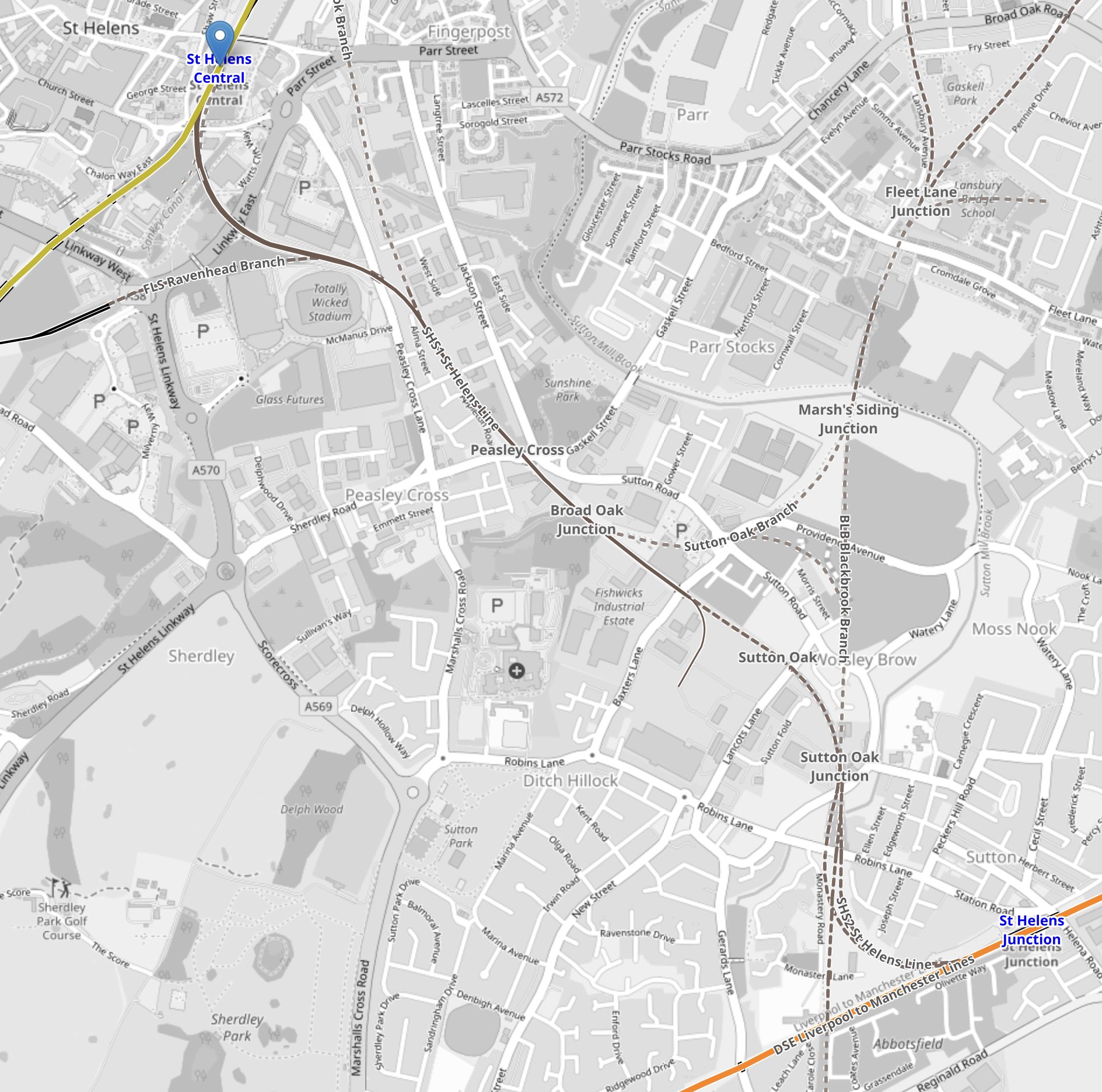
Note.
- The line runs between St. Helens Central and St. Helens Junction stations.
- St. Helens Central is in the North-West corner of the map and is marked by a blue arrow.
- St. Helens Junction station is in the South-East corner of the map.
- Both stations have two tracks and two platforms.
- St. Helens Central appears to have full disabled access,
- Both stations are electrified.
- It appears, that the route is still viable, but the track is not intact.
I have a few thoughts.
St. Helens Junction Station
This Google Map shows St. Helens Junction station.

Note.
- There are two platforms.
- Platform 1 is the Northern platform and trains go East.
- Platform 2 is the Southern platform and trains go to Liverpool Lime Street.
- There appears to be a footbridge at the Eastern end.
- Trains from the new route from St. Helens Central station would approach from and leave to the South-West.
- In a typical hour, between five and eight trains per hour (tph) go through the station in both directions on the main line.
I feel that a bay platform would need to be built at the station to handle the proposed service at St. Helens Junction station. But it would be able to handle four tph.
St. Helens Central Station
This Google Map shows St. Helens Central station.
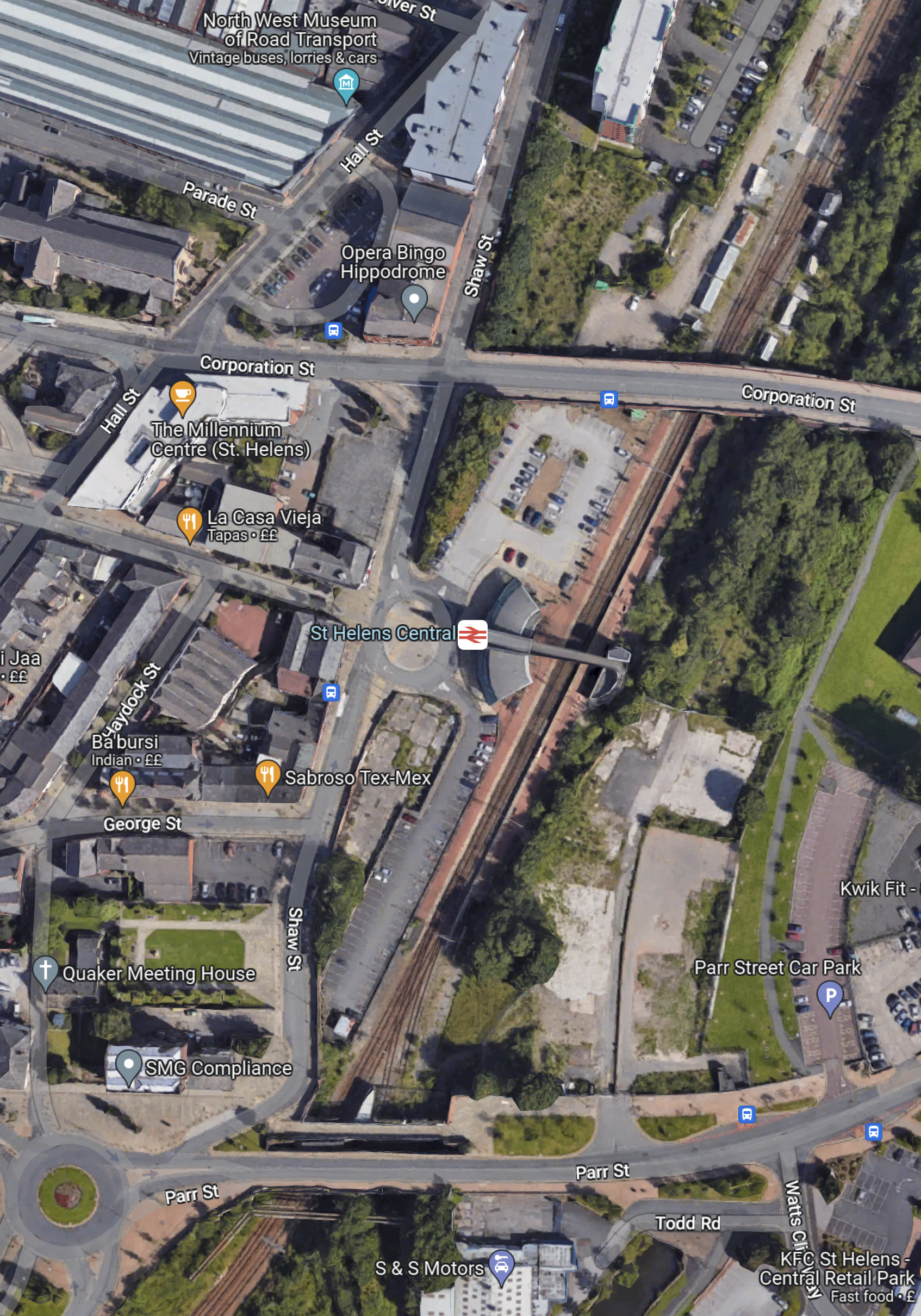
Note.
- There are two platforms.
- Platform 1 is the Western platform and trains go to Wigan North Western.
- Platform 2 is the Eastern platform and trains go to Liverpool Lime Street.
- There appears to be a footbridge in the middle, with lifts.
- Trains from the new route from St. Helens Junction station would approach from and leave to the South-West.
- In a typical hour, between two and three tph go through the station in both directions on the main line.
It may be possible to run two tph on the route to St. Helens Junction station, by using the Southern end of Platform 2.
It would probably be able to handle two tph, by fitting in between the current services.
If a new bay platform were to be built at St. Helens Central four tph would be possible.
What Would Be The Frequency Of The Service?
Consider.
- As I said earlier, because of the current frequency of trains through St. Helens Junction station, I feel a dedicated bay platform will be needed at that station, which would probably handle four tph.
- Without building a dedicated bay platform, I doubt that St. Helens Central station could have more than two tph.
- Two tph on the new route, would fit well with the services through St. Helens Central station.
I believe that providing it gave sufficient capacity for the route, that two tph will be the frequency, as it only needs one bay platform at St. Helens Junction station to be built.
What Length Of Train Will Be Used?
As a bay platform will have to be built at St. Helens Junction station, this will probably determine the length of train.
I would build the bay platform to accept a three or four car train, as lengthening platforms is always a pain.
Looking at the map of St. Helens Junction station, I suspect that a four-car platform may be the longest possible.
What Type Of Train Should Be Used?
If you look at all the Beeching Reversal schemes, there isn’t one like this, where two electrified lines are connected by a short length of new railway, which in this case is only 3.5 km, according to the New Civil Engineer article.
Consider.
- A round trip is only 7 kilometres.
- I suspect each trip between the two stations will take no more than ten minutes.
- If the frequency is two tph, there will be plenty of time to turn a train at each end.
- All new routes opened on UK railways from now on, should have carbon-free traction.
For these reasons, I suspect that the route could be run by a battery-electric train, which is charged at one end.
Putting up a short length of overhead electrification in the new bay platform at St. Helens Junction, as the station is already electrified, would not be the most challenging of tasks.
Alternatively, the train could be charged, whilst it is waiting to return in St. Helens Central, using the existing overhead electrification.
Will There Be Any Intermediate Stations Between St. Helens Central And St. Helens Junction?
On the first map the station sites of two former stations are shown; Peasley Cross and Sutton Oak.
According to the Wikipedia entry for Sutton Oak station, there was quite an intensive service a hundred years ago.
Why shouldn’t they be rebuilt? Especially, if there are plans for housing or regeneration in the area.
Will Between St. Helens Central And St. Helens Junction Be Single Track?
This would still enable two tph, if the trains did a quick turn-round in the bay platform at St. Helens Junction.
But it would mean.
- Lower cost infrastructure.
- Simple tram-style intermediate stations.
- One train on line operation for safety.
I feel that it is highly likely the new route will be single-track.
Carr Mill Station
This map shows Merseyrail’s future plans.

Note the proposed new station at Carr Mill, which is North-East of St. Helens Central on the Liverpool and Wigan Line.
The Wikipedia entry for Carr Mill station, says this about a proposed new station.
Proposals to construct a new station to serve the expanding population have been suggested by Merseytravel but funding has yet to arrive. A new proposal to open a station was raised by Metro Mayor of the Liverpool City Region Steve Rotheram as part of his re-election plans in January 2020.
It should be noted, that a new Carr Mill station could be on the East Lancashire Road, so it might be a good place to create a Park-and-Ride station for Liverpool and St. Helens.
Perhaps if a bay platform were to be incorporated into the new Carr Mill station, it might be better to run a service between Carr Mill and St. Helens Junction.
- There would be two tph.
- Intermediate stops would be St. Helens Central, Peasley Cross and Sutton Oak.
- I estimate the distance would be about four miles of which 1.8 miles would be electrified.
- The trains would be charged on the electrified line between Carr Mill and St. Helens Central stations.
There would be no need to electrify the bay platform at St. Helens Junction
Should The Service Go All The Way To Wigan?
It must surely be a possibility to run the service between Wigan North Western and St. Helens Junction.
- There would be two tph.
- Intermediate stops would be Carr Mill, Bryn, Garswood, St. Helens Central, Peasley Cross and Sutton Oak.
- I estimate the distance would be about eleven miles of which nine miles would be electrified.
- The trains would be charged on the electrified line between Wigan North Western and St. Helens Central stations.
This would create an excellent connection to Wigan North Western for all the long distance trains to Scotland and the South.
Should The New Route Be Electrified?
Consider.
- St. Helens and Wigan North Western is a fully-electrified route.
- It is only 2.2 miles, which would probably be single track railway.
- As there is electrification at both ends of the new route, there would be no problem arranging power.
- It would remove the need for battery-electric trains.
I suspect that this is one that accountants will decide, as both battery-electric and electrification will work equally well!
What Trains Would Be Used?
If the route is electrified, any electric train of a suitable length could be used. I would argue, that the same class of train, as is used through the two St. Helens stations, should be used for operational and passenger convenience.
To maintain the operational and passenger convenience, if battery-electric trains are used, then Northern’s Class 331 trains and Merseyrail’s Class 777 trains come or will come in both electric and battery-electric versions.
Conclusion
This looks like a very sensible scheme.
Could Class 777 Trains Create A Metro Centred On Preston?
Preston station is a major station on the West Coast Main Line, that will be served by High Speed Two.
- Electric long distance services to and from Birmingham, Carlisle, Liverpool, London Euston, Manchester, Edinburgh and Glasgow serve the station.
- Electric and diesel local services fan out from the station to Barrow-in-Furness, Blackburn, Blackpool, Burnley, Colne, Liverpool, Manchester and Ormskirk.
- Other local services could be developed.
Could the local services be turned into a zero-carbon Metro centred on Preston station, that would possibly use a version of Merseyrail’s Class 777 trains?
The Routes
These routes could be part of the Metro.
Preston And Barrow-in-Furness
Consider.
- This route is 55.8 miles long.
- The service calls at Lancaster, Carnforth, Silverdale, Arnside, Grange-over-Sands, Kents Bank, Cark, Ulverston, Dalton and Roose
- The route is electrified between Preston and Carnforth.
- 28.1 miles of the route are without electrification.
Northern use Class 195 diesel trains on this route.
Preston And Blackpool North
Consider.
- This route is 17.5 miles long.
- The service calls at Kirkham & Wesham, Poulton-le-Fylde and Layton
- The route is fully-electrified.
Northern use Class 195, 319 and 331 trains on this route.
Preston And Blackpool South
Consider.
- This route is 19.9 miles long.
- The service calls at Salwick, Kirkham & Wesham, Moss Side, Lytham, Ansdell & Fairhaven, St Annes-on-the-Sea, Squires Gate and Blackpool Pleasure Beach
- The route is electrified between Preston and Kirkham & Wesham
- 12.1 miles of the route are without electrification.
Northern use diesel trains on this route.
Preston And Colne
Consider.
- This route is 29.1 miles long.
- The service calls at Lostock Hall, Bamber Bridge, Pleasington, Cherry Tree, Mill Hill, Blackburn, Rishton, Church & Oswaldtwistle, Accrington, Huncoat, Hapton, Rose Grove, Burnley Barracks, Burnley Central, Brierfield and Nelson.
- Colne is 165 metres above sea level.
- The route is not electrified.
Northern use diesel trains on this route.
This route could also be extended to Skipton in Yorkshire, which is something that was promised by Government a few years ago.
The extension to Skipton could be another 15 miles.
Preston And Fleetwood
Consider.
- This route is 20.9 miles long.
- The service could call at Salwick, Kirkham & Wesham and Poulton-le-Fylde
- The route is electrified between Preston and Poulton-le-Fylde
- This route would need to be reinstated.
6.6 miles of the route are without electrification.
Preston And Liverpool Lime Street via St. Helens
Consider.
- This route is 35.2 miles long.
- The service calls at Huyton, St Helens Central, Wigan North Western, Euxton Balshaw Lane and Leyland
- The route is fully-electrified.
Northern use Class 319 and 331 trains on this route.
Preston And Manchester Airport
Consider.
- This route is 35.2 miles long.
- The service calls at Heald Green, Manchester Piccadilly, Manchester Oxford Road, Deansgate, Salford Crescent, Bolton, Lostock, Horwich Parkway, Blackrod, Adlington (1tph), Chorley, Buckshaw Parkway and Leyland
- The route is fully-electrified.
Northern use Class 195 and 331 trains on this route.
Preston And Ormskirk
Consider.
- This route is 15.3 miles long.
- The service calls at Burscough Junction, Rufford and Croston.
- The route is not electrified.
Merseyrail have their eyes on this route.
Preston And Windermere
Consider.
- This route is 50.3 miles long.
- The service calls at Lancaster, Carnforth, Oxenholme Lake District, Kendal, Burneside and Staveley
- The route is electrified between Preston and Oxenholme Lake District.
- 10.2 miles of the route are without electrification.
Northern use Class 195 diesel trains on this route.
Class 777 Trains
Consider.
- According to Stadler’s specification for the Class 777 IPEMU, the battery-equipped Class 777 trains have a range of 55 km or 34.2 miles.
- But, according to New Merseyrail Train Runs 135km On Battery, these trains have done 135 km or 83.9 miles.
- As there is no third-rail electrification at Preston, but lots of 25 KVAC overhead electrification, the version of the Class 777 train for 25 KVAC overhead will need to be used.
- There is no way that any third-rail electrification can be installed.
One comment to my post; The Stadler Data Sheet For A Class 777 IPEMU, suggests that batteries can’t be used with the 25 KVAC variant of the Class 777 due to lack of space.
I will use a starting point for the Class 777 IPEMU, that can access 25 KVAC has a range of 40 miles, which is just under half of the demonstrated maximum range of the current trains.
Class 331 Trains With Batteries
CAF have proposed a battery-electric version of their Class 331 train.
The closely-related Class 195 diesel trains and Class 331 trains already work some of the routes through Preston.
In Thoughts On CAF’s Battery-Electric Class 331 Trains, I estimated the range of these trains and reckoned that they would be between 35 and 70 miles.
The South Wales Valley Lines Solution
In The Greening Of The Valleys, I describe how the South Wales Metro will use a mix of trains.
- Stadler Citylink tram-trains for local routes.
- Stadler FLIRTs for routes on the main lines.
So could a Metro centred on Preston be based on the same principle?
I’ll look at each line in order.
Preston And Barrow-in-Furness
Consider.
- This route is 55.8 miles long.
- 28.1 miles of the route are without electrification.
- Northern use Class 195 diesel trains on this route.
A Class 331 with a battery range of sixty miles could work this route, charging the batteries between Preston and Carnforth.
Preston And Blackpool North
Any train that could use 25 KVAC electrification could use this route.
Preston And Blackpool South
Consider.
- This route is 19.9 miles long.
- 12.1 miles of the route are without electrification.
- Northern use diesel trains on this route.
A Class 777 with a battery range of 24.2 miles could work this route, charging the batteries between Preston and Kirkham & Wesham.
Preston And Colne
Consider.
- This route is 29.1 miles long.
- Colne is 165 metres above sea level.
- The route is not electrified.
- Northern use diesel trains on this route.
A Class 777 with a battery range of 30 miles could work this route, charging the batteries at Preston and Colne.
It might be prudent to electrify the single track line between Gannow Junction and Colne, so that trains have enough power to climb the hill to Colne and reach Colne with a full battery.
The extension to Skipton would require a range of 30 miles or just fifteen miles, if the 25 KVAC at Skipton was used to recharge the trains.
Preston And Fleetwood
Consider.
- This route is 20.9 miles long.
- 6.6 miles of the route are without electrification.
A Class 777 with a battery range of 13.2 miles could work this route, charging the batteries between Preston and Poulton-le-Fylde.
Preston And Liverpool Lime Street via St. Helens
Any train that could use 25 KVAC electrification could use this route.
Preston And Manchester Airport
Any train that could use 25 KVAC electrification could use this route.
Preston And Ormskirk
Consider.
- This route is 15.3 miles long.
- The route is not electrified.
A Class 777 with a battery range of 30.6 miles could work this route.
Trains would charge on their home network.
Preston And Windermere
Consider.
- This route is 50.3 miles long.
- 10.2 miles of the route are without electrification.
- Northern use Class 195 diesel trains on this route.
A Class 331 with a battery range of 20.4 miles could work this route, charging the batteries between Preston and Oxenholme Lake District.
Electrification Between Preston and Skipton Via Colne
Earlier when discussing the service to Colne and Slopton, I said this.
It might be prudent to electrify the single track line between Gannow Junction and Colne.
But surely, as this would mean, that virtually the whole route between The West Coast Main Line at Preston and the East Coast Main Line would be electrified, it would be sensible to electrify between Preston and Gannow Junction.
If this electrification were to be made continuous, this would mean the following.
- There would be a fully-electrified line between Blackpool and Leeds, which could be worked by Class 331 trains.
- There could be a valuable diversion route to help, whilst the main transPennine routes were upgraded.
- Class 777 trains with batteries would only be needed on the Blackpool South and Fleetwood routes from Preston.
The battery range needed would be just 24.2 miles to handle the longer Blackpool South route.
 The Anonymous Widower