Gresham House BESS Fund Energises 50MWh Asset
The title of this post, is the same as that of this article on Solar Power Portal.
These three paragraphs detail the project.
Gresham House Energy Storage Fund has energised a 50MW/50MWh battery energy storage system (BESS) in Lancashire.
Situated in Penwortham, south-west of the county capital Preston, the 1-hour duration BESS is set to be expanded to 2-hours in the summer, meaning its capacity would be 50MW/100MWh.
With the commencement of this new BESS, Gresham House Energy Storage Fund’s operational capacity has now reached 790MW/926MWh. The project is the fund’s 25th operational asset since IPO.
Note.
- The battery will be upgraded to a two-hour battery in the summer.
- The average battery would appear to be 32 MW/37 MWh.
- The average full-power duration for all Gresham House’s batteries appears to be around 70 minutes.
This Google Map shows the battery, which is located next to National Grid’s Penwortham substation.
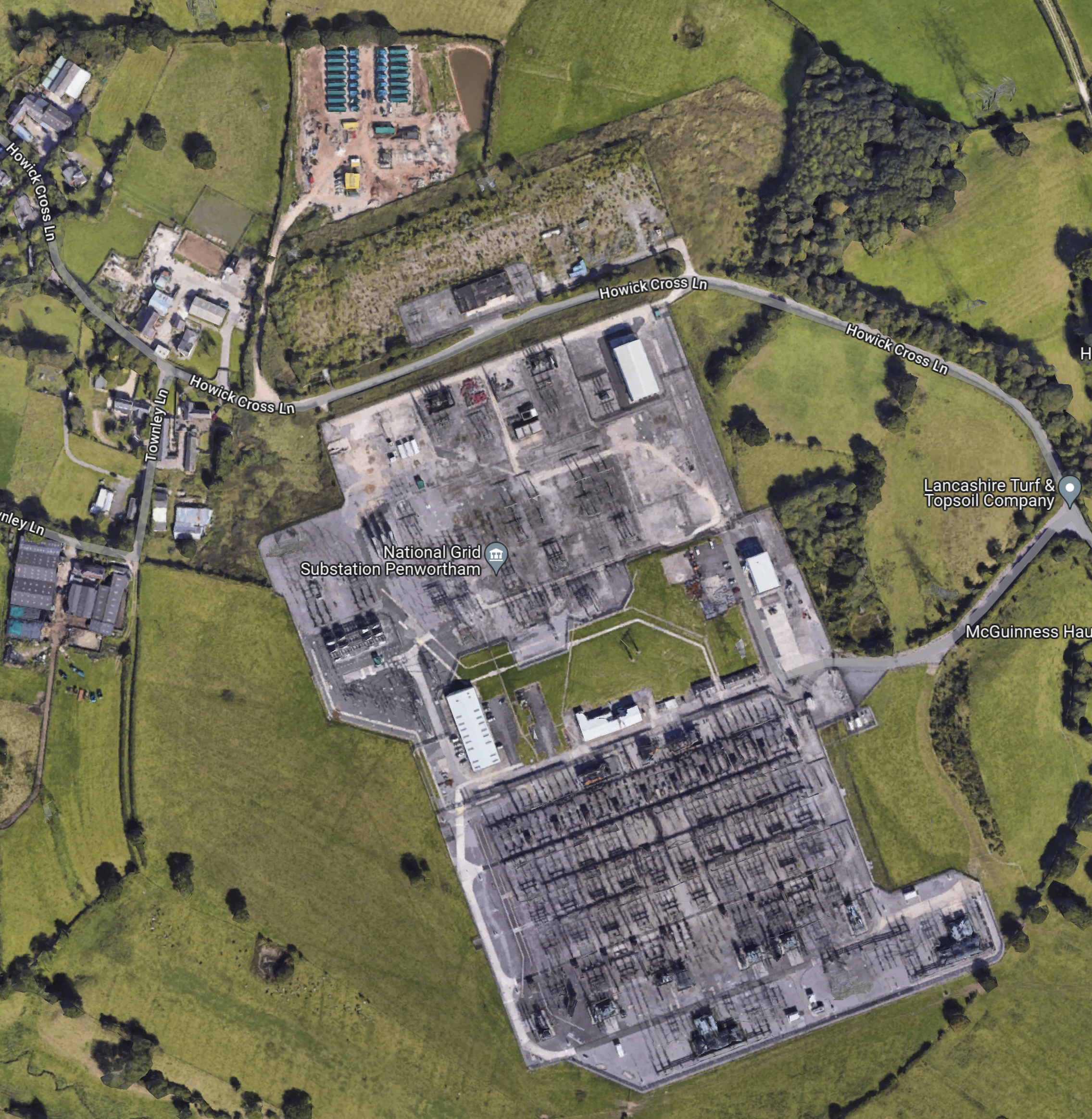
Note.
- The battery is the two rows of green containers at the top of the map.
- The substation appears to be large.
Co-location like this, must surely bring design, construction and operational advantages.
This page on the National Grid web site is entitled Network And Infrastructure, where this is said.
We own the national electricity transmission system in England and Wales. The system consists of approximately 4,500 miles of overhead line, over 900 miles of underground cable and over 300 substations.
If every substation in the UK were to be fitted with a 32 MW/64 MWh two hour battery, these would have a total capacity of 9.6 GW/19.2 GWh.
Compare that with these operational batteries and pumped-storage systems in the UK.
- Cruachan – 1000 MW/7.1 GWh – Pumped Storage
- Dinorwig – 1800 MW/9.1 GWh – Pumped Storage
- Ffestiniog – 360 MW/1.44 GWh – Pumped Storage
- Minety -150 MW/266 MWh – BESS
- Pillswood – 98 MW/196 MWh – BESS
And these systems are under development
- Coire Glas – 1.5GW/30 GWh – Pumped Storage
- Loch Na Cathrach/Red John – 450 MW/2.8 GWh – Pumped Storage
- London Gateway – 320 MW/640 MWh – BESS
There are at least another four substantial pumped storage systems under development.
Conclusion
A twin-track approach of grid-batteries at sub-stations and a few larger grid batteries and pumped storage hydroelectric schemes should be able to provide enough storage.
Aura Power Secures £10 Million Funding From Novuna
The title of this post, is the same as that of this article on Solar Power Portal.
These two paragraphs introduce the deal.
Aura Power has announced the successful closing of a £10 million debt facility with Novuna Business Finance. Novuna is a part of Mitsubishi HC Capital UK PLC, designed to support projects from early development through to the operational phase.
Bristol-based Aura Power is developing an active pipeline of utility-scale solar PV and battery energy storage of about 12GW in the UK, Europe and North America. The funding will help progress global development for Aura, covering expenditures like grid payments, planning fees and legal land costs.
These two paragraphs describe some of Aura’s projects.
In December 2023, Aura was granted planning permission for a 100MW/400MWh battery energy storage (BESS) project in Capenhurst, Cheshire. It was the third UK project to receive planning permission last year, alongside Aura’s 49.9MW Horton Solar Farm located in East Devon and its 49.9MW Hawthorn Pit Solar Farm in Durham.
Aura has been active within the solar and battery industries, with a pipeline in development in excess of 20GW. Last week (2 May), following an appeal, the developer secured planning permission for an Essex solar farm that will have an export capacity of 30 MW.
Nearly, forty years ago, I started a finance company in Ipswich with a friend. Our financing was mainly directed towards truck leasing for companies moving containers to and from the Port of Felixstowe.
Before, I committed my money to that venture, I built a large mathematical model of the proposed business. I found, that there were some unique financial properties to leasing quality trucks, that meant losing large sums of money were difficult.
I wouldn’t be surprised that leasing battery energy storage (BESS) systems have a lot of things going for them, if you have the right contract.
This may explain, why there a large number of companies in the market of providing grid batteries.
- At the top end; Centrica, Rolls-Royce and SSE will supply you with one.
- Funds like Gore Street and Gresham House and others allow you to invest in batteries.
- At the other end of the market are companies like Aura Power.
I suspect, that as with truck-leasing company, the financial flows are very stable and investor-friendly, if you get the model right.
SSE Renewables Buys 100MW/200MWh Northern Ireland BESS Project
The title of this post, is the same as that of this article on Energy Storage News.
These five paragraphs describe the acquisition and SSE Renewables progress as they build a portfolio of Battery Energy Storage Systems.
A 100MW/200MWh BESS project in Northern Ireland has been acquired by the renewable energy development subsidiary of UK-headquartered power generator and developer SSE.
The 2-hour duration Derrymeen battery in Dungannon, County Tyrone was bought from developer Heron Energy and would be the largest installed BESS facility in Northern Ireland when online.
Subject to a final investment decision by SSE Renewables, the shovel-ready project will be constructed on a greenfield site located outside Coalisland, around five miles from Dungannon.
If approved for final delivery, construction could commence early next year and the BESS would be operational by the end of 2026. It will connect to the grid via an underground cable to the nearby existing Tamnamore substation.
This is SSE Renewables’ first battery storage development in Northern Ireland, having already an established green portfolio in Britain. The firm launched its first operational BESS in the GB market on 15 April in the form of a 50MW/100MWh asset located in Salisbury, Wiltshire.
This battery is a two-hour battery, as are the other two batteries, that are mentioned in the article, that are being developed by SSE Renewables.
Is this a standard for SSE Renewables?
Rolls-Royce Supplies Large-Scale Battery Storage For Grid Stabilization And Electricity Trading To Encavis
The title of this post, is the same as that of this press release from Rolls-Royce.
These two bullet points, act as sub-headings.
- mtu EnergyPack system with 24 megawatt hours to balance out volatile power generation from renewable energies and increase security of supply
- Commissioning of the storage system based on lithium-ion technology in the first quarter of 2025
This paragraph outlines the project.
Rolls-Royce is supplying an mtu battery energy storage system with an output of 12 megawatts and a storage capacity of 24 megawatt hours to Encavis AG. The battery system will support the Hamburg-based electricity producer in trading the electrical energy generated by German wind and solar parks by, among other things, balancing out fluctuations in generation and increasing security of supply. Rolls-Royce will supply and install the energy storage system on a turnkey basis. It is expected to go into operation in the first quarter of 2025.
Note.
- The deal includes construction, installation and ten years of maintenance.
- The battery can supply full power for two hours.
- The battery is supporting renewables.
- In Would You Buy A Battery Energy Storage System From Rolls-Royce?, I looked at a mtuEnergyPack in detail.
- The respective capacity value and efficiency of the plant are guaranteed over the entire term.
This looks to be a very professional deal.
Conclusion
This is the second press release on the corporate web site after Rolls-Royce Supplies mtu Large-Scale Battery Storage To Secure The Latvian National Grid, that was published a month ago, that talks about the mtuEnergyPack.
Could it be that Rolls-Royce are looking for a share of the UK market for grid batteries?
Rolls-Royce Supplies mtu Large-Scale Battery Storage To Secure The Latvian National Grid
The title of this post, is the same as that of this press release from Rolls-Royce.
These four bullet points, act as sub-headings.
- Latvia synchronizes its electricity grid with the European grid in 2025
- Large-scale battery storage system from Rolls-Royce ensures stability of the power grid in Latvia
- Transmission system operator AST orders 160MWh mtu EnergyPack
- Facility will be one of the largest battery storage systems in the EU
This is the first paragraph.
Rolls-Royce has received an order from the Latvian transmission system operator Augstsprieguma tikls (AST) to supply an mtu large-scale battery storage system to secure the Latvian power grid. In 2025, Latvia, together with the other Baltic states, will synchronize its energy supply system with the continental European power grid.
Note.
- This is a Rolls-Royce press release, not a Rolls-Royce mtu press release.
- Recently, Rolls-Royce mtu supplied the generators for Redditch power station, which I wrote about in Centrica Completes Work On 20MW Hydrogen-Ready Peaker In Redditch.
- In The Modern Way To Grow Tomatoes, I describe how a Rolls-Royce mtu Combined Heat and Power unit (CHP), is used in the growing of tomatoes.
Could it be that using the Rolls-Royce name prominently, makes sales easier?
UK Has Almost 7GW Of Shovel-Ready Pumped Hydro, Says IHA
The title of this post, is the same as that of this article on Solar Power Portal.
This paragraph fills out the headline.
Former Australian Prime Minister and current president of the International Hydropower Association (IHA) Malcolm Turnbull has penned an open letter to Rishi Sunak stating that the UK has “almost 7GW of shovel-ready pumped storage hydropower projects with over 135GWh storage capacity”.
Note.
- At 7 GW, it would take 19.2 hours to run out of water.
- Currently, we have about 3GW/24GWh of pumped storage hydro.
- At the end of 2022, we had just 2.4GW/2.6GWh of connected battery storage sites.
It looks like we should start digging.
SSE Renewables Partners With Fluence And OCU Energy To Deliver Its Battery Storage Project At Fiddler’s Ferry
The title of this post, is the same as that of this press release from SSE Renewables.
This is the sub-heading.
*The 150MW / 300MWh battery energy storage system will be built on the site of the former SSE-owned coal fired power station*
These four paragraphs give full details of the project.
SSE Renewables has announced its principal contractor and battery supplier for its 150MW battery storage project at Fiddler’s Ferry, Warrington.
OCU Energy – who are Stockport-based and are currently working with SSE Renewables on its Ferrybridge battery storage project – will be the principal contractor at Fiddler’s Ferry.
Fluence, a global leader in energy storage technology, digital solutions and services, has been selected as the supplier of the battery-based energy storage system.
Construction is set to begin at the site in the coming weeks after SSE Renewables took a final investment decision back in December 2023.
Note.
- This will be a two-hour battery.
- Good to see a press release with both battery output and battery capacity shown in the appropriate units.
It’s also good to see, SSE adding to the fleet of the UK’s battery storage.
This page on the SSE Renewables web site is entitled About Solar And Battery.
This is the sub-heading.
SSE Renewables is progressing a 1.2GW secured pipeline of utility-scale solar and battery projects across the UK and Ireland and a further 1.3GW of other prospective sites under development. These assets complement SSE’s existing portfolio of other low carbon infrastructure such as wind and hydro.
This is the first paragraph.
Our solar projects will be capable of harnessing the abundant power of the sun to bring renewable power onto the grid, while our battery projects will be able to store renewable power when the sun doesn’t shine or the wind doesn’t blow. The delivery of these projects is part of our commitment to a net zero transition.
What follows is a job advert.
As an electrical and control engineer, who has enjoyed over fifty years exploring the mathematics of big engineering projects, I don’t regret the choice of career I made.
UK Onshore Wind Capacity Hits 15GW
The title of this post, is the same as that of this article on reNEWS.BIZ.
This is the sub-heading.
Milestone reached after 30MW West Benhar project entered operations.
These are the first three paragraphs.
RenewableUK has revealed the UK has installed 15,000MW of operational onshore wind capacity.
The project which enabled the UK to cross the threshold was EDF Renewables UK’s 30.1MW West Benhar onshore wind farm in North Lanarkshire, consisting of seven turbines.
The UK now has 2631 operating onshore wind schemes.
These are my thoughts.
I Am Surprised At The Total Of Onshore Wind
The title says it all.
But 15 GW is almost the same power as five big nuclear power stations, the size of the running-late Hinckley Point C.
Should Some Strategically-Placed Battery Energy Storage Systems (BESS) Be Added?
Some wind farms have been built with wind farms and I very much feel, that with some mathematical modelling some excellent BESS sites could be found.
We should also use batteries, so that no wind farm is ever shut down, because too much wind is being generated.
Where Is West Benhar?
West Benhar wind farm has a web site, where this is the sub-heading.
West Benhar is a 7 turbine wind farm capable of powering up to 18,000 homes located near Shotts in North Lanarkshire.
It was opened on 28 February 2024.
This Google Map shows the location of West Benhar between Edinburgh and Glasgow.

West Benhar is North-East of Shotts and just South of the M8.
There’s More Onshore Wind To Come
These onshore wind farms appear to have Contracts for Difference, but have not been completed.
- Arecleoch Wind Farm Extension – 72.8 MW – Completion 2024/25
- Broken Cross – 48 MW – Completion 2024/25
- Chirmorie – 81.6 MW – Completion 2024/25
- Cumberhead West – 126 MW – + 40 MW BESS – Completion 2024/25
- Douglas West Extension – 78 MW – Completion 2024/25
- High Constellation – 50 MW – Completion 2024/25
- Kilgallioch Windfarm Extension – 51.3 MW – Completion 2024/25
- North Kyle – 206 MW – Completion 2024/25
- Stornoway – 200 MW – Completion 2024/25
- Stranoch – 84 MW – Completion 2024/25
- Viking – 443 MW – Completion 2024
All of these are in Scotland.
But that’s another 1,440.7 MW of onshore wind.
Community Wind Funds
Scotland seems to be continuing to build onshore wind farms.
Could it be that communities have seen the benefits of Community Wind Funds?
This is said about the fund at Stronach.
When operational, EDF Renewables will provide a community benefit fund in line with the Scottish Government Good Practice Principles for Community Benefits from Onshore Renewable Energy Developments. The fund value for the community benefit fund would be £5,000 per megawatt for the lifetime of the wind farm. In the coming months we will begin to form a Community Liaison Group with local interested parties to decide how the funds will be disseminated once the wind farm becomes operational.
If the fund is yearly, then £420,000 is not money to be sneezed at!
Conclusion
It looks like in Scotland that Community Wind Funds promote the building of onshore wind.
UK’s Green Power Industry Receives Surprise £10bn Pledge
The title of this post, is the same as that of this article in the Guardian.
This is the sub-heading.
Potential investment by NatPower would create largest portfolio of battery storage projects in Britain
These five paragraphs outline the proposed investment.
Britain’s under-pressure green power industry has received a surprise fillip after a renewables developer pledged to plough £10bn into what would become the largest portfolio of battery storage projects in the country.
NatPower, a UK startup that is part of a larger European energy group, is poised to submit planning applications for three “gigaparks”, with a further 10 to follow next year.
Battery storage projects are seen as a key part of the jigsaw to decarbonise Britain’s power grid, allowing electricity generated by wind turbines and solar panels to be stored for use when weather conditions are still or not sunny.
The NatPower investment would lead to the construction of 60 gigawatt hours of battery storage, with solar and wind projects also in the pipeline.
The two gigaparks would be located in the north of England, with a further site in the west of the country planned later this year. The projects would be built on industrial land, and also through leasing deals with farmers.
Note.
- To gauge the scale of this development; the largest energy storage development in the UK at present is SSE Renewable’s massive Coire Glas pumped storage hydro in the Highlands of Scotland, which is a 1.5 GW/30 GWh monster, that is budgeted to cost £1.5 billion.
- NatPower has a web site, which has an opening video, which is all landscape, sun, water and wind, that would be worthy of an epic from Hollywood or by Eisenstein.
- NatPower’s investment of £10 billion, buys them 60 GWh of storage and if it’s a proportionate amount of capacity to Coire Glas, perhaps around 3GW or around the capacity of Hinckley Point C.
I have a few thoughts.
Is It All A Hoax?
Those who were alive and sober in 1977, may well remember the April Fools’ Day Hoax of the Guardian of that year, which concerned a fake supplement in the paper promoting the island of San Serriffe.
The story has its own Wikipedia entry.
The web site; http://www.sanserriffe.com, doesn’t seem to be accessible.
Today’s story seems genuine, although some will smell a rat.
Form Energy To Begin Manufacturing Iron Air Batteries In Weirton To Stabilize Electrical Grid
The title of this post, is the same as that of this article on wesa.fm.
These three paragraphs detail the story.
A company pioneering electrical grid batteries that will provide days of backup power for power plants reliant on renewable energy is building out its manufacturing arm throughout the greater Pittsburgh region.
Form Energy is on track to begin manufacturing the new kind of grid asset this spring, one the company says is sorely needed in a destabilized climate. As bonuses, it’s cheap — made of earth-abundant and predominantly domestically sourced materials — and Form needs a large, maker workforce to pull it off.
This is a welcomed development in the community of Weirton, West Virginia, which has seen population and industry decline steadily since the 1970s. Most recently, Cleveland-Cliffs — a neighbor company in the small town — announced it would idle its tinplate production plant and lay off up to 900 employees.
I like Form Energy’s iron-air batteries.
They would appear to be a direct replacement for lithium-ion batteries in stationary applications likeBattery-Energy Storage Systems (BESS).
I suspect they will work eoth the grid-balancing software developed for lithium-ion batteries.
- They use rust and air to store energy.
- The science came out of MIT.
- The venture is well-backed by the likes of Bill Gates.
There’s more about this factory on this page of their web site.
- The web site talks of innovative software, like grid modelling software.
- They aim to start production in the second half of this year.
- At full production the factory will employ 750 people.
- The annual production will be 500 MW of batteries.
This is a company to watch.
 The Anonymous Widower