Ecojet: Dale Vince Launches An Aviation Revolution
The title of this post is the same as that as this news story from Ecotricity.
This is the sub-heading.
The world’s first electric airline powered by renewable energy
These three paragraphs outline the project.
Ecotricity founder, Dale Vince, has announced the launch of Ecojet, the world’s first Electric Airline, powered by renewable energy. The move marks the beginning of an aviation revolution by making net-zero, emission-free air travel possible for the first time.
Ecojet’s fleet will comprise conventional planes retrofitted with hydrogen-electric powertrains. Once converted, the aircraft will operate with the same power output as before, but with a one-hundred percent reduction in CO2 emissions.
The decision to repurpose old planes rather than build new models from scratch will save 90,000 tonnes of carbon per year. The only byproduct will be water, which can be captured and released into the lower atmosphere to avoid the harmful effects of contrails.
These ae my thoughts.
The Aircraft
The news story contains pictures of two aircraft; a de Havilland Canada Twin Otter and a 737 or A320 variant.
- It also says that hydrogen-electric powertrains will be used.
- ZeroAvia in partnership with Cranfield Aerospace are developing such a powertrain and I suspect they could have one certified by 2025.
This would be used in the Twin Otter.
But what about 737 or A320 variant?
Airbus are already proposing the ZEROe Turbofan, which appears to be based on an improved A320 neo.
But the image on the news story looks more like a Boeing 737 from the wing-tips.
This article on the IET web site, which is entitled Airbus And Boeing To Embrace Hydrogen From Mid-2030s, indicates that it will be the mid-2030s before hydrogen twinjets of this size are in service.
This paragraph from the news story indicates his philosophy about the aircraft.
Short-term, to secure routes and a license from the Civil Aviation Authority, Ecojet will initially launch using conventionally fuelled planes. Ecojet will launch with two different sizes of turboprop aircraft (a 19-seat aircraft and a 70-seat aircraft). These aircraft will be retrofitted with the hydrogen-electric powertrains as they become approved for service by the CAA – the first retrofits will take place in 2025, one year after the commencement of flights.
Note.
- The news story clearly states that two types of aircraft will be used; a 19-seat turboprop and 70-seat turboprop.
- So the second picture of a Boeing 737 had nothing to do with the news story.
- They will be retrofitted with hydrogen-electric powertrains, when they have been certified.
- Flights are planned to start next year.
It looks a very canny philosophy, as Ecojet will be able to prove the route with aircraft running on traditional fuels or sustainable aviation fuel (SAF) and only switch to hydrogen, when the hydrogen-electric powertrains are proven, certified and installed, and the hydrogen infrastructure is in place.
The Smaller Aircraft
The first picture in the news story is of a de Havilland Canada Twin Otter.
- This aircraft accommodates 19-20 passengers.
- It has two turboprop engines.
- Production started in 1966 and it is still ongoing.
- Nearly a thousand have been built, so plenty of nearly-new examples will be available for refurbishment and conversion.
- Loganair operate three aircraft in Scotland.
It looks fairly certain, that Ecojet’s 19-seat aircraft will be a Twin Otter.
The Larger Aircraft
Possibilities would include these aircraft.
- ATR-72 – 72 seats
- de Havilland Canada Dash 8 – > 50 seats
Note.
- Both aircraft are still in production.
- In ZeroAvia To Bring Zero-Emissions Flight To Sweden, I talk about how ZeroAvia have sold their hydrogen-electric powertrains to Swedish ATR-72 operator; Braathens and are targeting Dash 8 operators.
- In Universal Hydrogen Successfully Completes First Flight Of Hydrogen Regional Airliner, I talk about Universal Hydrogen’s successful progress in selling hydrogen-electric powertrains for ATR-72s and Dash 8s. The first flight of their system was in an ATR-72.
It looks to me, that Dale Vince has a choice of two 70-seat aircraft and hydrogen-electric powertrains from two manufacturers; ZeroAvia and Universal Hydrogen.
In Monte To Purchase 100 FC Aircraft Drives From ZeroAvia, I talk about how Monte Aircraft Leasing have done a deal with ZeroAvia to lease ZeroAvia’s hydrogen-electric powertrains to regional airlines.
Has Dale Vince done a deal with Monte Aircraft Leasing for his aircraft?
- Monte Aircraft Leasing and ZeroAvia would get an eco-celebrity customer, who could even be the launch customer.
- Ecojet’s aircraft would all have similar ZeroAvia hydrogen-electric powertrains, although the size might be different.
- Dale Vince would only be sharing the risk, if the technology was a dog.
- De Havilland Canada and/or ATR will see how the passengers like zero-carbon flight.
There is also, one of aviation’s most powerful companies close to the deal, as Airbus own half of ATR.
Airbus are developing the hydrogen-powered ZEROe Turboprop, which is shown in this Airbus image.
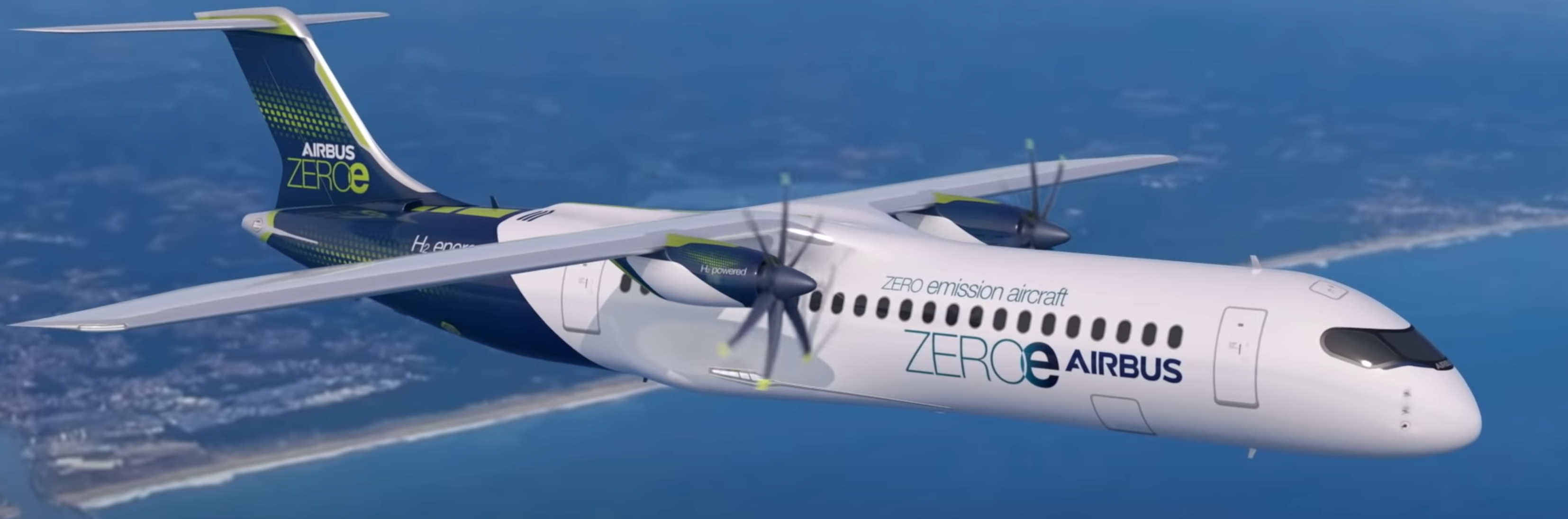
Note.
- It looks very much like an improved ATR-72.
- It has more extreme propellers and probably better aerodynamics.
- Airbus might like to persuade Ecojet to use ATR-72s as their 70-seat airliner.
- Information from an operator of hydrogen-powered airliners would be very valuable to Airbus.
I wouldn’t be surprised to see Ecojet lease some nearly new ATR-72s.
Would Airbus Fit ZeroAvia Hydrogen-Electric Powertrains In The ZEROe Turboprop?
This page on the Airbus website is entitled ZEROe.
In a section, which is entitled Hydrogen Propulsion To Power Future Aircraft, this is said.
All three ZEROe concepts are hybrid-hydrogen aircraft. They are powered by hydrogen combustion through modified gas turbine engines. Liquid hydrogen is used as fuel for combustion with oxygen.
In addition, hydrogen fuel cells create electrical power that complements the gas turbine, resulting in a highly efficient hybrid-electric propulsion system. All of these technologies are complementary, and the benefits are additive.
In 2022, we launched our ZEROe demonstrator with the aim to test hydrogen combustion technology on an A380 multimodal platform. Through future ground and flight testing, we expect to achieve a mature technology readiness level for a hydrogen-combustion propulsion system by 2025.
Note.
- Airbus state they are using modified gas turbine engines.
- Airbus also talk about using fuel cells to create electrical power that complements the gas turbines.
- Could the hydrogen fuel cells be used to power the aircraft’s systems, like avionics, control systems, air-conditioning and the hydrogen system for the main engine?
- This concept of effectively a hydrogen auxiliary power unit, might be a more efficient way of using the hydrogen, which either gives longer range or a smaller fuel tank.
- In The ZEROe Demonstrator Has Arrived, I talk about the ZEROe Demonstrator, which is a modified Airbus A 380.
Did the adding of hydrogen fuel cells to the ZEROe aircraft, lead to the concept of a hydrogen-powered auxiliary power unit, that I talked about in Airbus To Trial In-flight Auxiliary Power Entirely Generated By Hydrogen?
It looks to me, that Airbus have developed their own simple concept of powering the aircraft.
I doubt they will need ZeroAvia’s technology.
But.
- Aircraft manufacturers like Airbus generally fit the best and most suited engines they can find in their aircraft.
- The Wikipedia entry for ZeroAvia says that the prototype hydrogen-electric powertrain is in the cabin, consisting of two fuel cells and a lithium-ion battery for peak power.
- ZeroAvia have powerful shareholders like Amazon, Bill Gates and Royal Dutch Shell.
- ZeroAvia have also received grants from the UK Government.
I wouldn’t be surprised to learn, that Airbus have taken a long hard look at ZeroAvia’s technology.
After all, ZeroAvia could probably build a hydrogen fuel cell power pack, that would meet Airbus’s needs for a hydrogen-powered auxiliary power unit.
Remember too, that many fleets of aircraft have been updated with new engines for decades and I don’t think Airbus would mind ZeroAvia giving a new zero-carbon lease of life to the hundreds of ATR-72s in service around the world.
Surely, a successful hydrogen-powered ATR-72 is only going to create more interest in airlines buying ZEROe Turboprops.
All the converted aircraft will still need support from ATR.
Both the converted and new aircraft will need hydrogen refuelling services, so could the two aircraft use a common standard.
Airbus and ZeroAvia would appear to have several common interests.
Ecojet’s Core Route
This is a paragraph from the news story on the Ecotricity web site.
Dale has partnered with experienced pilot Brent Smith and a team of aviation specialists to set up Ecojet. Flights across the UK will commence in early 2024, starting with the Edinburgh to Southampton route, and expanding to mainland Europe shortly after, with long-haul flights planned for the future.
Note.
- The ATR-72 has a range of 949 miles, which is more than adequate for Southampton and Edinburgh, which is just over 350 miles.
- Diagonal journeys in the UK are often the most passenger-unfriendly by rail and tend to use diesel trains.
- Southampton Airport has good road and rail connections, with the terminal less than a minute from the station.
- Edinburgh Airport has good road and tram connections, with rail connections needing a short journey on the tram.
- Southampton Airport has flights to the Channel Islands, Ireland and Schiphol.
- Edinburgh Airport has a comprehensive service from major airlines and low-cost carriers, and several flights to destinations in the North of Scotland and on the Islands.
I think that it is a well-chosen core route for their 70-seat aircraft.
Which Routes Will Ecojet Fly With The Twin Otters?
Consider.
- My Scottish friends tell me that flying to the Scottish Islands, like the Hebrides, Orkney and Shetland is expensive.
- The growth of the Scottish wind power industry will mean, that more capacity is needed to serve the North of Scotland and the Islands.
- Tourism to the North of Scotland and the Islands is on the up.
- There will not be a shortage of green electricity to produce green hydrogen.
- The North of Scotland isn’t short of airports.
- The Twin Otter has a surprisingly long range on aviation fuel and I suspect, that a hydrogen version would be designed to have a similar range.
- The longest flight needed would probably be Edinburgh and Sumburgh, which is about 280 miles, which should be well within the range of a Twin Otter.
- I suspect that hydrogen refuelling could be easily provided at enough airports, to support hydrogen-powered airliners.
- I am sure, that the Twin Otters could be used on a network of zero-carbon flights from Edinburgh to the North of Scotland and the Islands.
- A zero-carbon airline would help Scotland’s net-zero ambitions.
There is certainly a need for another airline to connect Edinburgh to the North of Scotland and the Islands and the infrastructure could be upgraded to support a hydrogen-based zero-carbon airline.
Could Ecojet build a similar network at Southampton, that served the Channel Islands, Southern Ireland and Northern France?
Conclusion
There’s a lot more to this venture, than there appears at first sight.
O wish Vince and his partners well, but as a coeliac, I’ll skip the food.
Form Energy And The UK
This article on the Telegraph, which is entitled Britain Will Soon Have A Glut Of Cheap Power, And World-Leading Batteries To Store It, is proving to be a mine of information about the development of the UK Power Network.
Reliable information about US startup; Form Energy has been hard to find.
But the Telegraph article has these three paragraphs on Form Energy.
Form Energy in Boston – backed by Jeff Bezos and Bill Gates – is working on an iron-air “rust” battery based on the reversible oxidation of iron pellets. It does not require rare and polluting minerals such as vanadium, and will have a 100-hour range.
“The modules will produce electricity for one-tenth the cost of any technology available today for grid storage,” the company told Recharge.
Form Energy has been working with National Grid to map out the economics of UK renewables with storage, and how to cope with future curtailment. And it too praises the UK as a global trailblazer, though its pilot project next year will be in Minnesota.
Note.
- Iron certainly, isn’t an exotic material.
- A hundred hour range is claimed.
- If National Grid have been working with Form Energy, is it reasonable to assume, that they have been working with Highview Power?
- Good to see that Form Energy praises the UK as a global trailblazer. I have noted several times, that the Department for Business, Energy and Industrial Strategy seems to be well-advised.
Will National Grid put in one of Form Energy’s batteries? It would be a prudent thing to do, to make sure you get the best.
Fracking Has a Bad Rep, but Its Tech Is Powering A Clean Energy Shift
The title of this post, is the same as that of this article on Texas Monthly.
It shows how former frackers are developing their techniques to do the following.
- Extract heat and energy from shale using water.
- Store energy safely underground.
- Drill deeper and better geothermal wells.
One of the companies; Quidnet has been backed by Bill Gates and his friends. I wrote about Quidnet Energy a couple of years ago in How Do You Save Clean Energy? This Company Plans To Pump It Underground.
And all in environmentally-friendly ways, that would get a seal-of-approval from a committed anti-fracker.
It’s the best article I’ve read this week.
Bill Gates Invests In Verdox’s Carbon Capture Technology
The title of this post, is the same as that of this article on The Times.
This is the first paragraph.
Bill Gates has invested in a carbon capture start-up. His Breakthrough Energy Ventures fund has taken part in an $80 million fundraising for Verdox, a Massachusetts-based business whose technology aims to remove carbon dioxide directly from the air.
I have my doubts that this technology will ever be economic, especially as plant, trees and in particular rain forests, do a good job at using the carbon dioxide. Planting trees is also one of those feel-good community activities.
This last paragraph gives a few details of the process.
Verdox, which is a spinout from the Massachusetts Institute of Technology, claims that its system is cheaper and more efficient. It uses a special plastic, which when charged with electricity, can extract CO2 from a mixture of gases. A change in voltage releases the CO2.
It is a process with a good pedigree, but you’ve still got to find a way to store or use the carbon dioxide.
Plants worked out how to do that eons ago.
Form Energy’s New Low-Cost, Iron-Air Battery Runs For 100 Hours
The title of this post, is the same as that of this article on the Singularity Hub.
This paragraph sums up the genesis of the battery.
A secretive startup backed by Bill Gates’ Breakthrough Energy Ventures thinks it may have the answer, though. Form Energy, which was co-founded by the creator of Tesla’s Powerwall battery, Mateo Jaramillo, and MIT battery guru Yet-Ming Chiang, has unveiled a new battery design that essentially relies on a process of “reversible rusting” to provide multi-day energy storage at ultra-low costs.
And this paragraph describes the operation of the battery.
The company’s batteries are each about the size of a washing machine, and are filled with iron pellets and a water-based electrolyte similar to that used in AA batteries. To discharge, the battery breathes in oxygen from the air, converting the pellets to iron oxide, or rust, and producing electricity in the process. To charge, the application of a current converts the rust back into iron and expels the oxygen.
It’s all very fascinating and leads to a battery made from very affordable materials.
The article quotes between $50 to $80 per kilowatt-hour for lithium-ion batteries and around $20 per kilowatt-hour for Form Energy’s battery.
Conclusion
The article is definitely a must-read.
I feel that Form Energy should be added to my list of viable batteries.
Gates, Bezos Bet On Flow Battery Technology, A Potential Rival To Big Bets On Lithium-Ion
The title of this post is the same as that of this article on CNBC.
This is the first paragraph.
The U.S. energy storage market is expected to grow by a factor of 12 in the next five years, from 430MW deployed in 2019 to more than 5GW and a value of more than $5 billion by 2024, says Wood Mackenzie Energy Storage Service.
Those are big numbers and it makes me ask the question of whether Planet Earth has enough lithium.
The title of the article says that Bill Gates and Jeff Bezos are looking at flow battery technology, as a possibly alternative to lithium-ion batteries.
What Is Flow Battery Technology?
This is the first sentence of the Wikipedia entry for flow battery.
A flow battery, or redox flow battery (after reduction–oxidation), is a type of electrochemical cell where chemical energy is provided by two chemical components dissolved in liquids contained within the system and separated by a membrane.
Wikipedia’s explanation is comprehensive.
- There are seven different types.
- There are around twenty different chemistries.
- They have various advantages and disadvantages.
- They seem to be less efficient than lithium-ion batteries.
Applications include; load balancing, uninterruptible power supplies, power conversion, electric vehicles and standalone power supplies.
It looks like they are a lithium-ion replacement.
Conclusion
This technology is one to watch.
With all those types and chemistries someone could strike extremely lucky!
Malta Energy Storage System Is Looking Forward To First Pilot
The title of this post is the same as that of this article on Tech Eplore.
This is the first paragraph.
Malta has received a round of funding and is graduated from “project” to group that can sail. The Cambridge, MA-based company is focused on the storage of electro-thermal energy and the funding put the group in celebration mode this month. In return, the company is turning up the volume on its potential role in the future of energy storage—namely, working out salt-based electro-thermal energy storage.
The article goes on to describe how the system works and I suggest you read it.
This is the last paragraph.
Malta CEO Ramya Swaminathan said the challenge ahead is about design and manufacturing, in Xconomy. Swaminathan said customers were expected to come from a variety of points in the energy system. Such as? She said they expect “developers with wind or solar projects who want firm power, to grid scale applications that can be in the hundreds of megawatts range, to critical backup for data centers, to isolated grid systems like island economies.”
I believe the technology has a lot going for it.
- It has heavyweight financial backing.
- The technology is very conventional and well-understood, which will ease manufacture and maintenance.
- No complex or expensive raw materials are needed.
- I would suspect that few, if any dangerous chemicals are needed.
- It would have developing country applications.
- They would seem to have a large capacity.
I shall be following Malta Inc. with interest.
Gates Among Billionaires Backing Alphabet Energy Spinoff
The title of this post is the same as that of this article on Bloomberg.
This is the first paragraph.
Alphabet Inc.’s secretive X moonshot lab is spinning off an energy-storage project with backing from billionaires including Jeff Bezos and Bill Gates.
Read the article. This could be the affordable grid-scale energy storage everyone needs.
 The Anonymous Widower