Exploring London Bus Route 132
London Bus Route 132, is run by battery-electric buses and it the first in London to use opportunity charging.
These pictures show the route from North Greenwich to Bexleyheath Shopping Centre.
















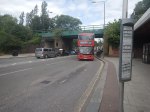







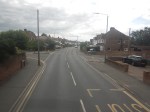

















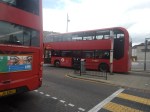

Note.
- These pictures were shot in two sections on the 3rd and the 6th of July 2023.
- The break was at Eltham station.
- Some sections of the route had a lot of cars.
- Some side roads were full of parked cars.
- There were large numbers of cars parked in front of houses.
There are my thoughts.
More will appear here over the next couple of days.
The Buses
The buses used on the route are Alexander Dennis Enviro400EV, which are built on a BYD Auto chassis.
They have a range of 160 miles.
The Route
The route has several inclines both ways and I estimate it is just under ten miles.
At North Woolwich, the bus didn’t appear to have a charge, but I can’t be sure.
But it disappear at Bexleyheath Shopping Centre and I was certain it went for a charge.
So is the operational philosophy to fill, the bus up overnight and then top the battery up every time, that it needs it at Bexleyheath.
A Comparison With A Similar Route In Birmingham That Has Hydrogen-Powered Buses
As the bus ran between North Woolwich and Bexleyheath Shopping Centre, I was comparing it, with the trip, I made across Birmingham, in hydrogen-powered buses, that I wrote about in Riding Birmingham’s New Hydrogen-Powered Buses.
Both were quality buses, but I felt the hydrogen bus had more power.
Opportunity Charging At Bexleyheath
If, buses need to be charged at the Bexleyheath Shopping Centre end of the route, where will they go?
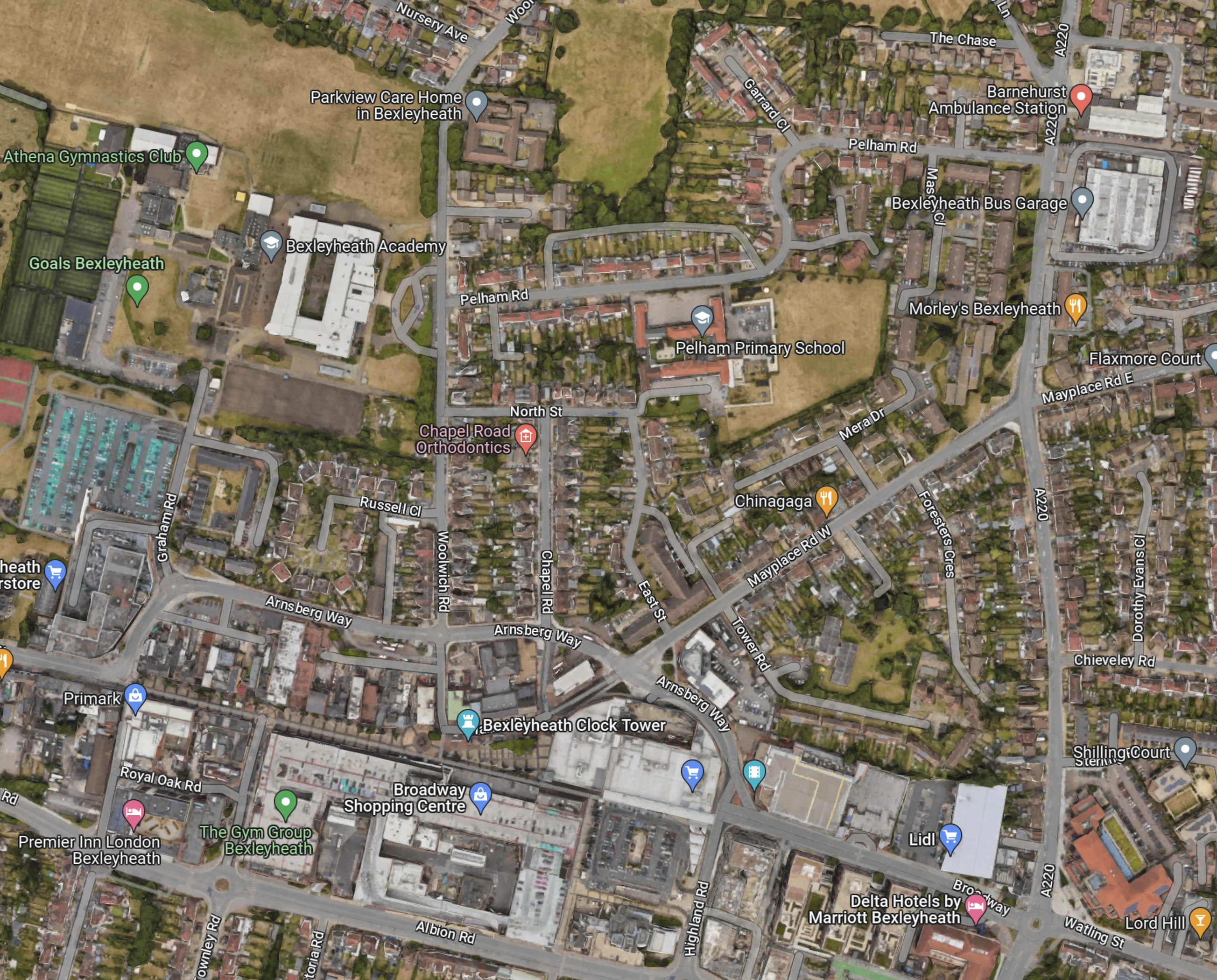
This Google Map shows Bexleyheath Bus Garage in relation to the Shopping Centre.
Note.
- Bexleyheath Bus Garage is in the North-East corner of the map.
- It looks like it shares a site with Bexley Fire Station and Barnehurst Ambulance station.
- So the garage is well located for any future lithium-ion battery fires.
- In the middle of the map at the bottom, is Bexleyheath Clock Tower, in the middle of the town centre.
- I estimate it’s less than two kilometres between Bexleyheath Bus Garage and the Shopping Centre.
This Google Map shows a close-up of the Western side of the Bexleyheath Bus Garage.
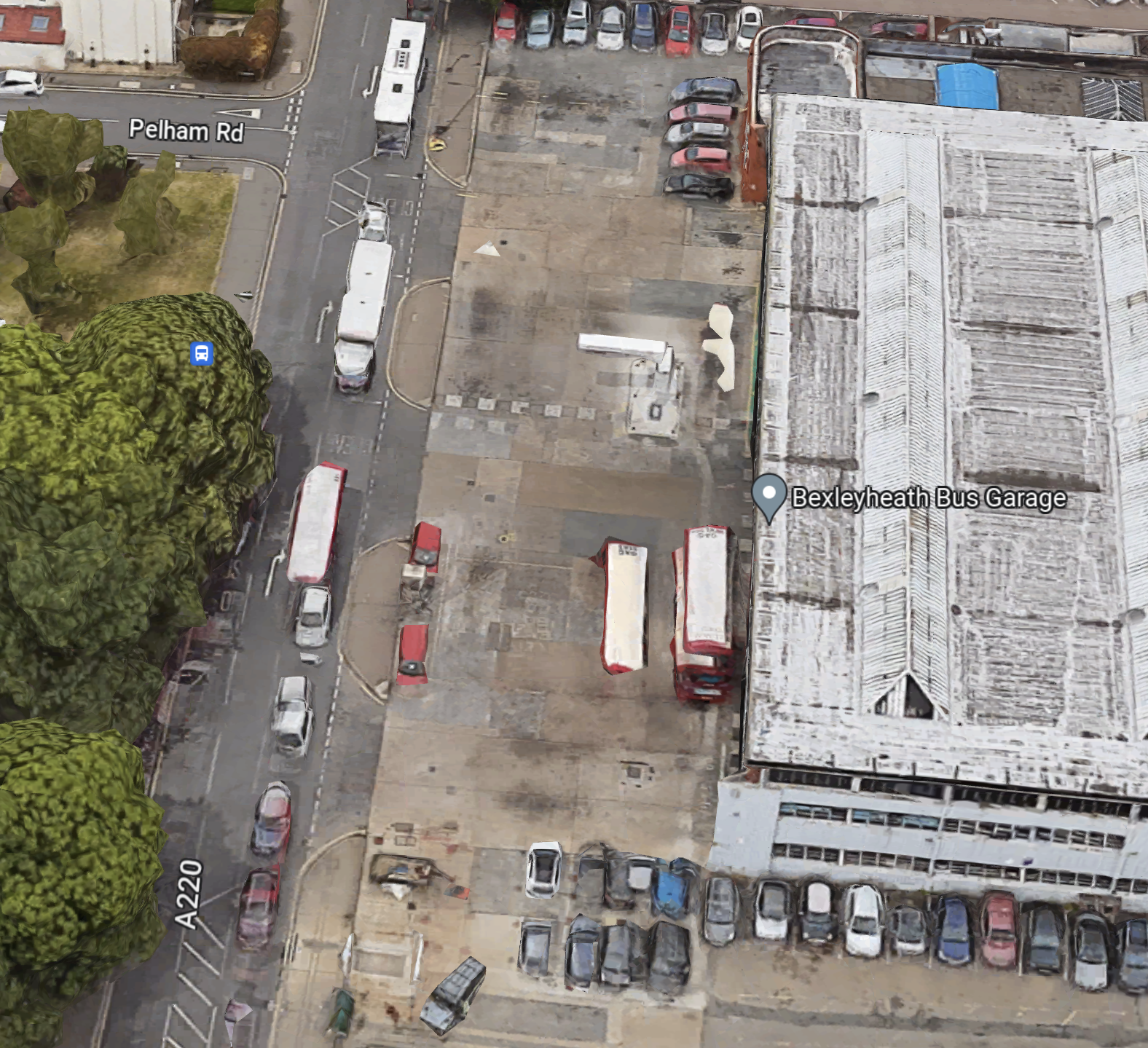
Note.
- The two buses parked by the side of the garage.
- Behind them a white arm reaches over towards the road.
- This is the charger and buses connect using a pantograph on the roof.
It could be an All-In-One Fast Charging Station AIO from Furrer+Frey.
The Electrical Connection At Bexleyheath Bus Garage
Consider.
- The bus garage shares a site with a fire station and an ambulance station, which surely must need a reliable power source.
- This is London’s first application of opportunity charging.
- There are improvements constantly happening to London’s struggling power network.
- It is a large site and I suspect there is space for a battery to boost power.
I would assume that Transport for London wouldn’t have chosen a bus garage with a dodgy power supply.
Could The Charger Be Solar-Powered?
This Google Map shows the roof of Bexleyheath Bus Garage.

Note.
- It appears to be a square with a length of about six buses.
- It looks rather dirty.
I suspect that the roof could be replaced with a modern solar roof.
Hydrogen Or Electric
This article on RouteOne is entitled Enviro400FCEV Hydrogen Bus Fleet For Liverpool Debuts.
This paragraph describes the performance.
Alexander Dennis has chosen the heavy-duty variant of VEDS. It is designed to deliver up to 410kW of power, but the vehicle OEM says that in the Enviro400FCEV, output is limited to 350kW. Such an approach will maximise fuel economy while still enabling a high road speed and good hill climbing ability. Expected range is up to 300 miles.
So the range on hydrogen is nearly doubled.
Wrightbus’s outwardly similar electric and hydrogen buses have ranges of 200 and 280 miles, but filling times of 2.5 hours and 8 minutes.
The problem with hydrogen in London, is that the Mayor and Transport for London, don’t appear to have a hydrogen policy.
But I think, that hydrogen will win out in cities and areas, where hydrogen can be supplied.
I also believe that hydrogen has other advantages.
- There is likely to be significant progress in improving hydrogen-powered heavy vehicles.
- Hydrogen internal combustion engines are coming and could promise more affordable hydrogen buses.
- Better and more affordable methods to create green hydrogen are being developed.
- Some existing diesel buses will be able to be converted to buses powered by hydrogen internal combustion engines.
- Lithium-ion batteries have a high environmental footprint.
Hydrogen is also likely to be the fuel of choice for heavy trucks.
My Second Ride In A Wrightbus Single-Decker Hydrogen Bus
Or it might have been the third or fourth, but it was the first outside of London in a single-decker Wrightbus hydrogen bus. The earlier rides were in the RV1 route, which I wrote about in London’s Hydrogen Buses.
I took these pictures.


















Note.
The trip was in Crawley and Go-Ahead are building a network of hydrogen buses to link the town and Gatwick Airport.
- It was a high quality bus.
- It was busy.
- It was the first bus, I’d seen in the UK, with a detailed route.
Someone had been thinking about how to design a bus route.
Goodyear Releases New EV Tire For Electric Metro Buses
The title of this post, is the same as that of this article on The Buzz EV News.
This is the sub-heading.
The new Urban Max BSAEV tire was designed in partnership with heavy-duty transit bus manufacturer Gillig.
This is the first paragraph.
The Goodyear Tire & Rubber Company has introduced its newest EV-ready tire for buses and transit fleets. The new Urban Max BSAEV (bus service all-position) tire was designed in partnership with Gillig, a manufacturer of American-built heavy-duty transit buses. The Urban Max BSAEV is the first Goodyear tire engineered specifically with low rolling resistance for EV transit and metro buses to help extend range and handle the increased load capacity, the company says.
This is an idea that could roll a long way.
Does your EV have low rolling resistance tyres?
Mercedes eCitaro Fuel Cell Will ‘See The Light’ At UITP Summit 2023
The title of this post, is the same as that of this article on Sustainable Bus.
This is the first paragraph.
Daimler Buses will unveil the Mercedes eCitaro fuel cell at UITP Global Public Transport Summit in early June. At the group’s stand, visitors will have the opportunity to see the first series-production eCitaro electric bus with a fuel cell as a range extender. First order for the vehicles dates back to October 2022.
This paragraph describes the bus.
The Mercedes eCitaro in fuel cell bus version offers a stated range of approximately 350 kilometers without the need for recharging. This goes together a passenger capacity, on the articulated version, of up to 128 passengers. The difference between the eCitaro fuel cell project and most of the fuel cell buses on the market stay in the battery capacity: while it’s common to feature a small LTO battery (below 50 kWh) accompanying the fuel cell module, the eCitaro is equipped with a battery capacity similar to its battery-electric counterpart (up to 392 kWh for the 18-meter).
It looks an impressive bus with a generous capacity and range.
But I doubt we’ll see many in the UK.
- Motorists object to their blocking of junctions.
- They were easy for dodging fares.
- In London, they were dubbed Ken’s Chariots of Fire.
I don’t think politicians will chance them in the UK!
Toyota And VDL Groep To Convert Heavy-Duty Vehicles Into Hydrogen Fuel Cell Trucks
The title of this post, is the same as that of this article on Hydrogen Fuel News.
This is the first paragraph.
Toyota Motor Europe (TME) and Dutch VDL Groep have teamed up to covert VDL’s existing heavy-duty trucks into hydrogen fuel cell trucks using Toyota’s fuel cell modules, with a goal to accelerate decarbonizing the road logistics sector while also breaking into Europe’s zero-emission heavy duty H2 trucks market.
Note.
- According to their Wikipedia entry, VDL Groep seem to manufacture buses, coaches, chassis modules and vehicle components.
- In Ricardo Supports Toyota To Develop Its First UK-Based Hydrogen Light Commercial Vehicle, I wrote about conversion of the Toyota Hilux to hydrogen.
- There are a large number of companies all over the world, who will convert vehicles to hydrogen.
- It could be argued that Wrightbus and Alexander Dennis, have designed hydrogen buses, that could be conversions of existing designs.
- Cummins are selling diesel engines, that can be converted to hydrogen.
Could these points indicate, that one of the main routes to the decarbonisation of the heavier end of the commercial vehicle sector will be conversion of existing vehicles to hydrogen fuel?
And will this lead to smaller conversion kits to decarbonise vehicles like Land Rovers, Range Rovers, larger BMWs, Jaguars and Mercedes?
If you consider, that when I was growing up in the 1950s, you rarely saw a small diesel vehicle and how diesel came to grab a large market share, due to good engineering and some misguided tax changes from Gordon Brown, I don’t think it is unreasonable to believe that good engineering and perhaps well-thought out tax changes could create an affordable route to decarbonise a large proportion of vehicles.
If I was still driving and lived away from dreaded ULEZs, then I would be keeping my reliable diesel Jaguar estate.
Hydrogen Buses Start Running Across Region
The title of this post, is the same as that of this article on the BBC.
These are the main points.
-
A fleet of 20 hydrogen powered buses start running in Merseyside
-
The zero emission buses will improve air quality, Mayor Steve Rotheram said
-
He wants the Liverpool City Region to be net zero carbon by 2040
The buses will operate on the 10A route between St Helens, Knowsley and Liverpool city centre.
I wonder, if they’ll go past my old digs on Huyton Lane.
South Korea Targets Over 2,000 Hydrogen Buses By 2026
The title of this post, is the same as that of this news item from Argus Media.
This is the sub-heading.
South Korea plans to convert more than 250 commuter buses intro hydrogen-fuelled buses by this year and more than 2,000 by 2026, in a concerted effort to raise the uptake of hydrogen vehicles.
It appears to be a well-thought plan.
This last paragraph gives South Korea’s long-term objective.
A higher uptake of hydrogen vehicles is in line with the hydrogen roadmap the government released in November 2022, where it envisioned the transportation sector as one of the key drivers of large-scale hydrogen demand. South Korea aims to raise its supply of high-mobility vehicles such as hydrogen buses and trucks, with a goal of producing 30,000 hydrogen commercial vehicles and building 70 liquid hydrogen refuelling stations in the country by 2030.
We need an ambitious plan like this in the United Kingdom.
As the UK population is thirty percent larger than South Korea’s we probably need one with similar but larger ambitions.
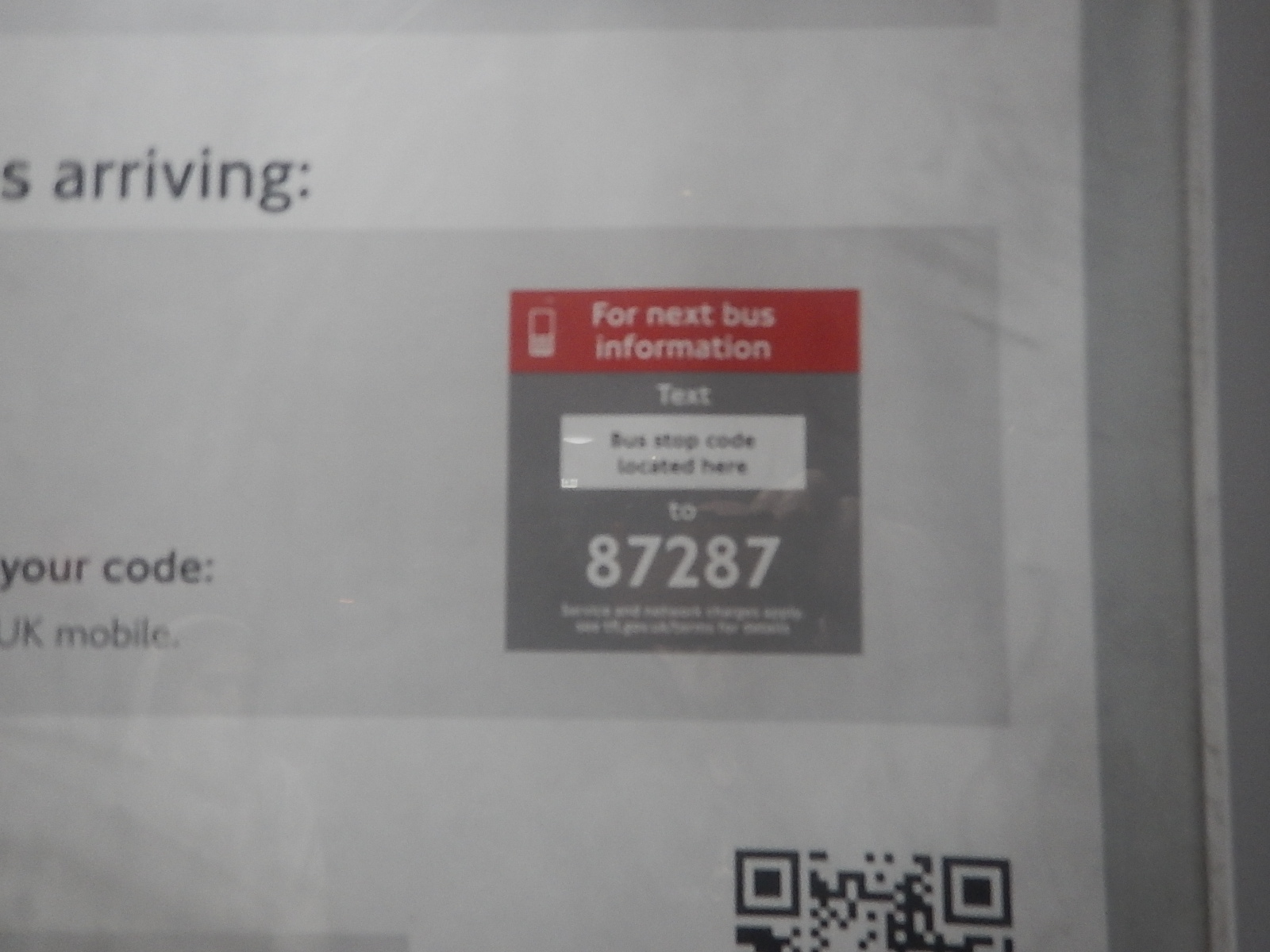
Where’s The Bus Stop Code?
In Is Transport for London’s Management Dysfunctional?, I said this.
Perhaps six years ago, I e-mailed TfL to ask, if the five-digit number displayed on the bus-stop, to get details of how long you will wait for the next bus, could be repeated under the shelter, so that if you are waiting in bad weather you can find out the next bus time without venturing outside.
I got a reply saying they’d look into it.
About a year ago, they changed the instructions on the bus stops and the new posters have a space for the installers to put in the stop number.But have I seen one of these spaces with the number in it? Of course not!
Sounds like one department made a worthwhile change and then didn’t inform those, who would carry it out.
TfL is a dysfunctional operation, that needs a thorough overhaul of management. Starting at the top!
I finally got a picture I can use, which shows the empty space in the poster for the number of the bus-stop.
Whilst, I’m about it, how about some other features.
Get Me To A Post Code
If the bus stop number was nnnnn, you might type something like “nnnnn SW1P 3PA” and you would be texted back with something like “Take 141 bus to Northchurch Road”.
Summon The Police
If the bus stop number was nnnnn, you might type something like “nnnnn Police” and they would come to your bus stop.
I Want To Get To The Nearest Station
If the bus stop number was nnnnn, you might type something like “nnnnn Station” and you would be texted back with something like “Take 141 bus to Old Street Station”
I Want To Get To The Nearest Hospital
If the bus stop number was nnnnn, you might type something like “nnnnn Hospital” and you would be texted back with something like “Take 25 bus to Whitechapel Station”
Old Street Station – 2nd May 2023
I took these pictures this morning, as my bus passed Old Street roundabout.












It’s still progressing as slowly as ever.
Nicholas Lane – 1st May 2023
Nicholas Lane is a lane in the City of London, that runs between Cannon Street in the South and Lombard Street in the North.
This Google Map shows the lane.
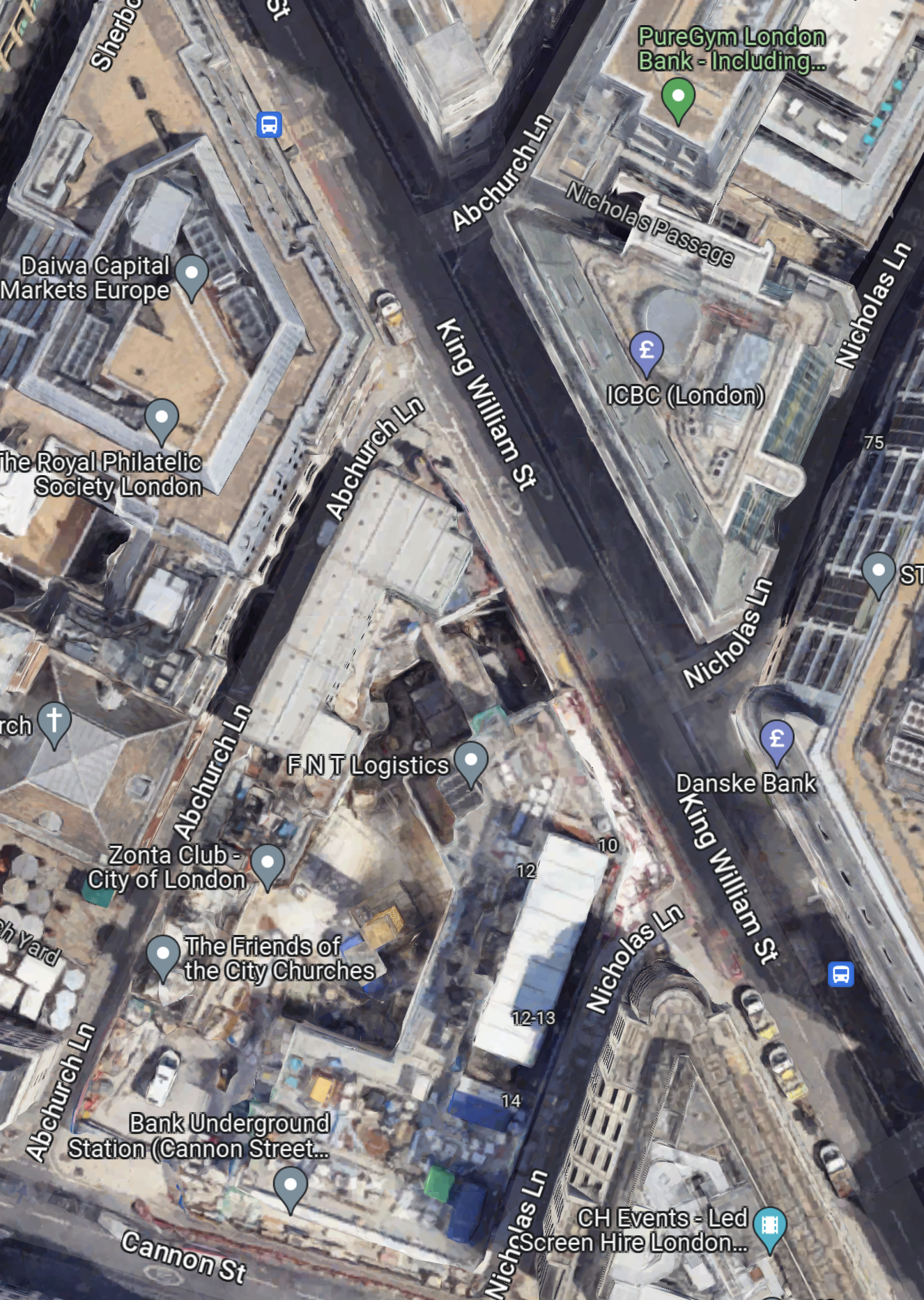
Note.
- Nicholas Lane tuns diagonally across King William Street.
- Cannon Street can be seen in the South-West corner of the map.
- The new entrance to Bank station is on Cannon Street.
- Nicholas Lane runs up the side of the new station entrance.
- There are two bus stops for the 21, 43 and 141 buses on King William Street.
The bus stops are within easy walking distance of the new station entrance, if you walk along the Southern section of Nicholas Lane.
These pictures show Nicholas Lane and King William Street.










Note.
- I suspect some coffee shops or a fast food joint will appear at the King William Street end of Nicholas Lane.
- The windows on the corner could be ready to be a shop.
- In Bank Station Upgrade – 6th January 2023, I described the eight storey building, that will sit on top of the station entrance.
The lane could also a preferred route for many, who are changing at Bank station to or from the buses.
 The Anonymous Widower