45 schools Benefit From Rail Safety Resources Supported By Lumo And Hull Trains
The title of this post, is the same as that of this article on The Shields Gazette.
This is the sub-heading.
The UK’s leading open access rail operators, Lumo and Hull Trains, are celebrating supporting the delivery of vital rail safety resources to 45 schools across the UK over the past year.
These three paragraphs add more detail.
In association with the Rail Safe Friendly Programme, the operators’ involvement has led to a social value impact of over £724,000, directly educating thousands of young people.
The programme is dedicated to spreading the vital message of rail safety among young people, educators and parents in schools across the UK. Lumo and Hull Trains have supported the important initiative for the past two years, with their support renewed for a third.
As part of the partnership, Lumo took over the Metrocentre’s ‘mini express train’ to highlight the issue of rail safety to families and children visiting the shopping centre during the school holidays in 2024. The project secured industry recognition at the recent Corporate Engagement Awards.
It’s not just in the UK, that this type of excellent engagement is being setup.
This train is the world’s first hydrogen-powered train to enter passenger service, between Hamburg and Cuxhaven in Germany.
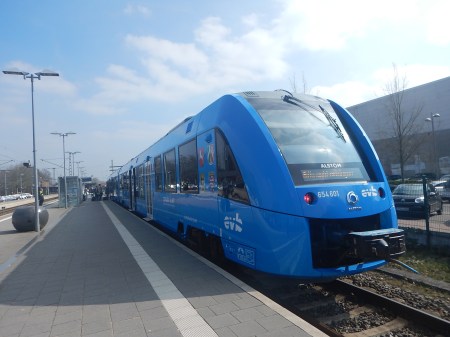
When I rode the train, a German schoolboy told me, that their school had given them safety lessons about hydrogen.
Is Alstom’s Proposal For A Service Between London Euston And Wrexham Part Of A Cunning Plan?
Alstom have built and introduced into service between Buxtehude and Cuxhaven in Germany, the Coradia iLint hydrogen-powered train. The prototype has performed demonstrations in Austria, Canada, The Netherlands and Saudi Arabia.
This picture shows a Coradia iLint in Germany.

In the UK, Alstom had a plan to convert redundant Class 321 trains into a fleet of hydrogen-powered trains called Breeze, which I wrote about in Hydrogen Trains Ready To Steam Ahead, in January 2019.
This visualisation is from Alstom.
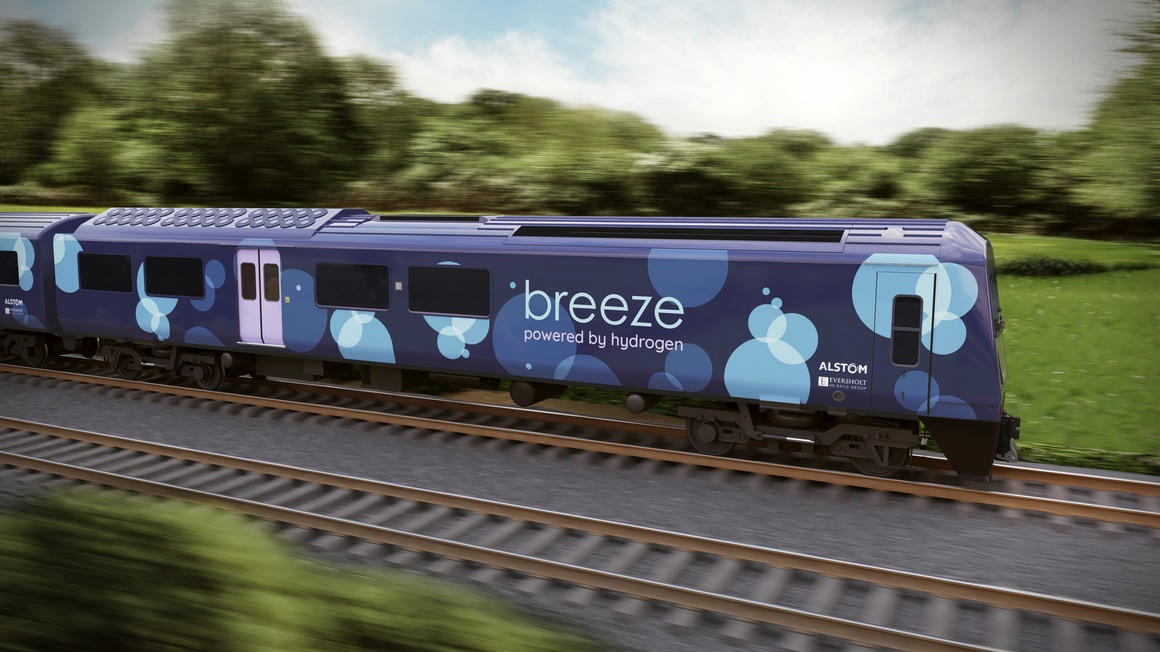
I suspect it didn’t appeal to train companies, as no orders appear to have been received.
But you can’t criticise Alstom for not trying, as in November 2021, they signed an agreement with Eversholt Rail Group to develop a hydrogen-powered Aventra, which I wrote about in Alstom And Eversholt Rail Sign An Agreement For The UK’s First Ever Brand-New Hydrogen Train Fleet.
This visualisation is from Alstom.
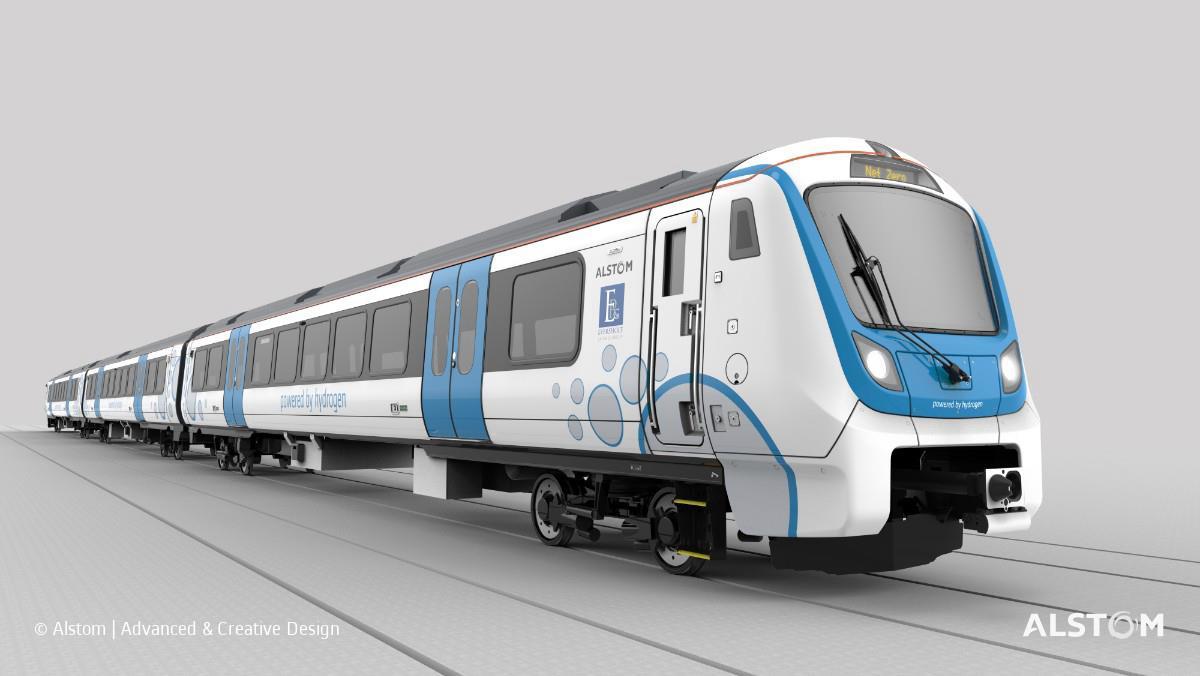
Visually, it looks just like any other Aventra and much better than the previous Breeze design.
In March 2018, I wrote Bombardier Bi-Mode Aventra To Feature Battery Power, which was based on this article in Rail Magazine.
These are a few points from the article.
- Development has already started.
- Battery power could be used for Last-Mile applications.
- The bi-mode would have a maximum speed of 125 mph under both electric and diesel power.
- The trains will be built at Derby.
- Bombardier’s spokesman said that the ambience will be better, than other bi-modes.
- Export of trains is a possibility.
- Bombardier’s spokesman also said, that they have offered the train to three new franchises. East Midlands, West Coast Partnership and CrossCountry.
Have Alstom looked at what they bought from Bombardier and decided the following train is possible, if they add some of their technology?
- A train the size needed by the customer, up to a length of at least ten cars.
- 125 mph under 25 KVAC overhead electrification.
- 100 mph with 750 VDC third rail electrification.
- Running on hydrogen away from electrification.
- 100 mph maximum speed running on hydrogen.
- A range of perhaps 500 miles, if it can emulate the hydrogen-powered Coradia iLint.
A train with this specification would have several applications in the UK.
- Fully-electric routes.
- Electric routes with perhaps a hundred miles of unelectrified track.
- Scenic routes, where the Nimbies wouldn’t like electrification.
These points should also be born in mind.
- There are now 110 mph Aventras in service with West Midland Trains on the West Coast Main Line.
- I recently came back from Cardiff to London in a twelve-car Class 387 train and there wasn’t too many unhappy passengers. It was certainly better than a rail replacement bus. I wrote about the trip in Cardiff To Reading In A Class 387 Train.
- Alstom believe you can certainly fit their hydrogen gubbins in an Aventra.
- The hydrogen gubbins appear to be from Cummins, who have a worldwide support network.
- Cummins can also supply complete hydrogen support systems. A truck can refuel the train, at one end of the route?
- Alstom have been doing the market research with the hydrogen-powered Coradia iLint, so I suppose they know what the market needs.
Could Alstom, with help from Cummins, have a zero-carbon 200 kph train and support systems, which has a hydrogen range of up to a thousand kms for export markets like the United States, Africa, Australia, India and South America?
Two big world-leading companies are surely better than one!
But Alstom has one big problem!
How do you fully test a 125 mph hydrogen-powered train?
- I know with aircraft, if you change the engine type on an existing aircraft, you only have to certify the engine and this is done on a Supplementary Type Certificate.
- Is it the same with trains, so a 110 mph Class 730 train, which is in service with West Midlands Trains, could be the basis of certifying a hydrogen-powered Aventra?
- The Coradia iLint was only a change from diesel to a hybrid hydrogen-electric engine, so was it certified this way?
- With the Coradia iLint, it seemed to go into service quite quickly, so did it do much of the testing in service?
I looks to me, that London Euston and Wrexham is an ideal route for a hydrogen bi-mode 125 mph train.
- The route has electrified sections, some of which have high operating speeds.
- The route has a convenient hydrogen supply from INEOS at Runcorn at the Northern end.
- Change between hydrogen and electric power would always take place in a station.
- A round trip needs less than 200 miles of running on hydrogen.
- South of Nuneaton, no hydrogen is used, so the train will be like a Class 730 train, that already uses the route.
- There are depots that can service Aventras on the route.
It is certainly a possibility, that the London Euston and Wrexham service will be used to test and showcase Alstom’s new Hydrogen Aventra.
Alstom Plans To Operate Its Own Passenger Train Service In The UK For The First Time
The title of this post, is the same as that of this press release from Alstom.
These two bullet points, act as sub-headings.
- Alstom is partnering with SLC Rail to form a new open access rail operation between North Wales, Shropshire, the Midlands and London
- Formal application now being submitted to the Office of Rail and Road (ORR) with passenger service sought from 2025
These are the first three paragraphs.
Alstom, global leader in smart and sustainable mobility, plans to operate a new passenger rail service across England and Wales. Working in partnership with consultancy SLC Rail, the open access operation will be known as Wrexham, Shropshire and Midlands Railway (WSMR).
As the country’s foremost supplier of new trains and train services, and a leading signalling and infrastructure provider, Alstom will operate its own rail service in the UK for the first time.
WSMR is seeking to introduce direct connectivity to and from North Wales, Shropshire, the Midlands and London that doesn’t exist today, linking growing communities and businesses, and making rail travel more convenient, enjoyable and affordable.
I can’t remember a service proposal being put forward by a train manufacturer since the privatisation of UK’s railways in the 1990s.
This is some more information and my thoughts.
The Route
This paragraph from the press release, describes the route.
The proposal envisages a service of five trains per day in each direction Monday to Saturday, with four travelling both ways on Sundays. Trains will stop at Gobowen, Shrewsbury, Telford Central, Wolverhampton, Darlaston, Walsall, Coleshill Parkway, Nuneaton and Milton Keynes on their journey between Wrexham General and London Euston.
Note.
- The proposed call at the new Darlaston station.
- The route is electrified between Euston and Nuneaton and Walsall and Wolverhampton.
- Much of the route North of Nuneaton is on tracks with a maximum speed of 70-80 mph.
The route is in these sections.
- Euston and Nuneaton – 96.7 miles – electrified
- Nuneaton and Walsall – 26.7 miles
- Walsall and Wolverhampton – 6.7 miles – electrified
- Wolverhampton and Shrewsbury – 29.7 miles
- Shrewsbury and Wrexham General – 30.3 miles
That is a total of 190.1 miles or 380.2 miles round trip.
I suspect that the service will need bi-mode trains.
Should The Service Call At Wellington?
This article on the BBC is entitled Rail Company Urged Not To Forget Wellington.
This is the sub-heading.
A rail company which is bidding to bring back a direct service between Shropshire and London has been urged not to forget a town.
These are the first three paragraphs.
Wrexham, Shropshire and Midlands Railway said it was preparing to apply to the government to run the service.
Trains would stop at Gobowen, Shrewsbury, Telford, Wolverhampton, Walsall, Coleshill and Nuneaton.
But Telford and Wrekin Council said the omission of Wellington as a stop was “short-sighted”.
Although Wellington is smaller than than Shrewsbury and Telford, it looks like a bit of analysis would provide a solution, that would be acceptable for all parties.
The Trains
In the press release, this phrase is used.
positive impact to both communities and the environment.
I can’t see any more electrification being erected on the route, so the trains will need to be bi-mode.
- Bi-mode diesel trains won’t have a positive impact on the environment.
- As the route between Wolverhampton and Wrexham General is not electrified, a battery-electric train would need a range of at least 60 miles or 120 miles for the round trip, if there were no charging at Wrexham General.
- But Alston are developing a Hydrogen Aventra, which I wrote about in Alstom And Eversholt Rail Sign An Agreement For The UK’s First Ever Brand-New Hydrogen Train Fleet.
So could Alstom be using this route to trial and showcase their new Hydrogen Aventra?
I believe that the route will be very suitable for a hydrogen train.
- Changeover between electric and hydrogen power can always take place in a station.
- All hydrogen refuelling could be performed at one end of the route.
- A large proportion of the UK’s green hydrogen is produced by INEOS at Runcorn, which is less than fifty miles from Wrexham. A refuelling tanker could supply the train, as they do on some hydrogen routes in Germany.
- London has only small amounts of hydrogen infrastructure.
I suspect that refuelling will be done at the Wrexham end of the route.
This Alstom visualisation shows the train.
But it is only a three-car train.
- That is not a problem, as Aventras can be lengthened as required to the length required for the number of passengers.
- Some Aventras, like the Class 701 trains for South Western Railway, have even been ordered as ten-car trains.
- Two three-car trains may also be the ideal capacity, running as a six-car train.
So capacity will not be a problem.
If it is assumed that Alstom’s trains for the WSMR route, can use the overhead wires, where they exist, each trip between Wrexham General and London will require a total of 86.7 miles or 140 kilometres of running on hydrogen.
- A round trip will therefor require 280 kilometres of running on hydrogen.
- But between London Euston and Nuneaton, it will just be another electric train.
- I suspect that like the similar Class 730 train, it will be capable of 110 mph on the West Coast Main Line.
- Alstom’s Coradia iLint hydrogen train has a range of around a 500-800 kilometres on hydrogen.
- The WSMR trains will probably be 100 mph trains using hydrogen on a route, where that speed is possible.
So if a Hydrogen Aventra has a similar range to the Coradia iLint, it will be able to do two round trips before refuelling.
How Long Will The Service Take?
West Midlands Trains, who use the similar Class 730 trains take one hour and eleven minutes between London Euston and Nuneaton with a single stop at Milton Keynes Central.
As the WSMR trains will use the same route, I suspect the same time can be used.
As Nuneaton and Wrexham General are 93.4 miles apart a table can be created showing the time for the rest of the journey for different average speeds
- 50 mph – 1 hour 52 minutes – 3 hours 3 minutes.
- 60 mph – 1 hour 33 minutes – 2 hours 44 minutes.
- 70 mph – 1 hour 20 minutes – 2 hours 31 minutes.
- 80 mph – 1 hour 10 minutes – 2 hours 21 minutes.
Note.
- The first time is the Nuneaton and Wrexham General time and the second time is the overall journey time.
- Typical Avanti West Coast services via Crewe and a change at Chester, take between two-and-a-half and three hours.
I suspect, if the WSMR trains can keep the speed up through the Midlands, that two hours and 30 minutes could be possible.
Could The Hydrogen Aventra Run At 125 mph Under The Wires?
In March 2018, I wrote Bombardier Bi-Mode Aventra To Feature Battery Power, which was based on this article in Rail Magazine.
These are a few points from the article.
- Development has already started.
- Battery power could be used for Last-Mile applications.
- The bi-mode would have a maximum speed of 125 mph under both electric and diesel power.
- The trains will be built at Derby.
- Bombardier’s spokesman said that the ambience will be better, than other bi-modes.
- Export of trains is a possibility.
- Bombardier’s spokesman also said, that they have offered the train to three new franchises. East Midlands, West Coast Partnership and CrossCountry.
Have Alstom looked at what they bought from Bombardier and decided the following train is possible?
- Five-cars or what the customer needs.
- 125 mph under the wires.
- Running on hydrogen away from the wires.
- 100 mph on tracks without electrification.
Obviously, maximum speeds would depend on track limits.
Looking at 125 mph Avanti West Coast trains that have a Milton Keynes stop between London Euston and Nuneaton, they can reach Nuneaton ten minutes quicker than West Midlands Trains 110 mph Class 730 trains.
Two hours and 30 minutes between London Euston and Wrexham is looking increasingly possible.
Are we seeing an audacious proposal from Alston to sell new trains to CrossCountry and a host of other franchises?
Conclusion
London Euston and Wrexham would appear to be an excellent route for an Aventra-based hydrogen train.
- It can probably cruise at 110 mph on the West Coast Main Line between London Euston and Nuneaton.
- All switchovers between electrification and hydrogen can be performed in electrified stations.
- Hydrogen would only be used North of Nuneaton.
- The train can be refuelled at Wrexham General, with fuel supplied from INEOS at Runcorn.
- Given the typical 1000 km. range of hydrogen trains, a train can probably do three round trips without refuelling.
I can see this being a service with an excellent operational record.
Saudi Arabia Railways (SAR) Partners With Alstom To Showcase The World’s First Passenger Hydrogen Train In The Kingdom Of Saudi Arabia
The title of this post, is the same as that as this press release from Alstom.
These are the three bullet points.
-
World’s first hydrogen-powered train demo in the Middle East and Africa
-
Alstom’s Coradia iLint train will be used for the demo in the Kingdom
-
Saudi Arabia Railways (SAR) and Alstom highlight their commitment to sustainable mobility and carbon emission reduction in the Kingdom
These are the first two paragraphs.
Saudi Arabia Railways (SAR), in partnership with Alstom, a global leader in smart and sustainable mobility, will operate and demonstrate the world’s first passenger hydrogen-powered train, the Coradia iLint in Riyadh in the month of October. This ground-breaking demonstration marks the first-ever introduction of a hydrogen-powered train in the Middle East and Africa. The collaboration between SAR and Alstom signifies a strong focus by the Kingdom to identify and test innovative sustainable mobility solutions to reduce carbon emissions from transport and meet Vision 2030 targets set by the Kingdom’s leadership.
The planned demonstration follows the memorandum of understanding signed by SAR and Alstom in September 2022 to develop or adapt hydrogen solutions for the needs of the Kingdom. Alstom’s Coradia iLint, a hydrogen-powered passenger train will embark on a first-of-its-kind journey in the Kingdom, travelling 10 to 20 kilometres on Riyadh’s East Network’s Line 1 or Line 2.
Note.
- Hopefully, this is not just green-washing?
- Will the train be powered by green hydrogen?
At least, Alstom will get their trains tested in an atmosphere full of sand.
Hydrogen Trains Are To Roll Between Stade And Bremervörde
The title of this post is the same as part of the title of this article on Hydrogen Central.
The original title mentions Switzerland, but Bremervörde is in Germany to the North-West of Hamburg.
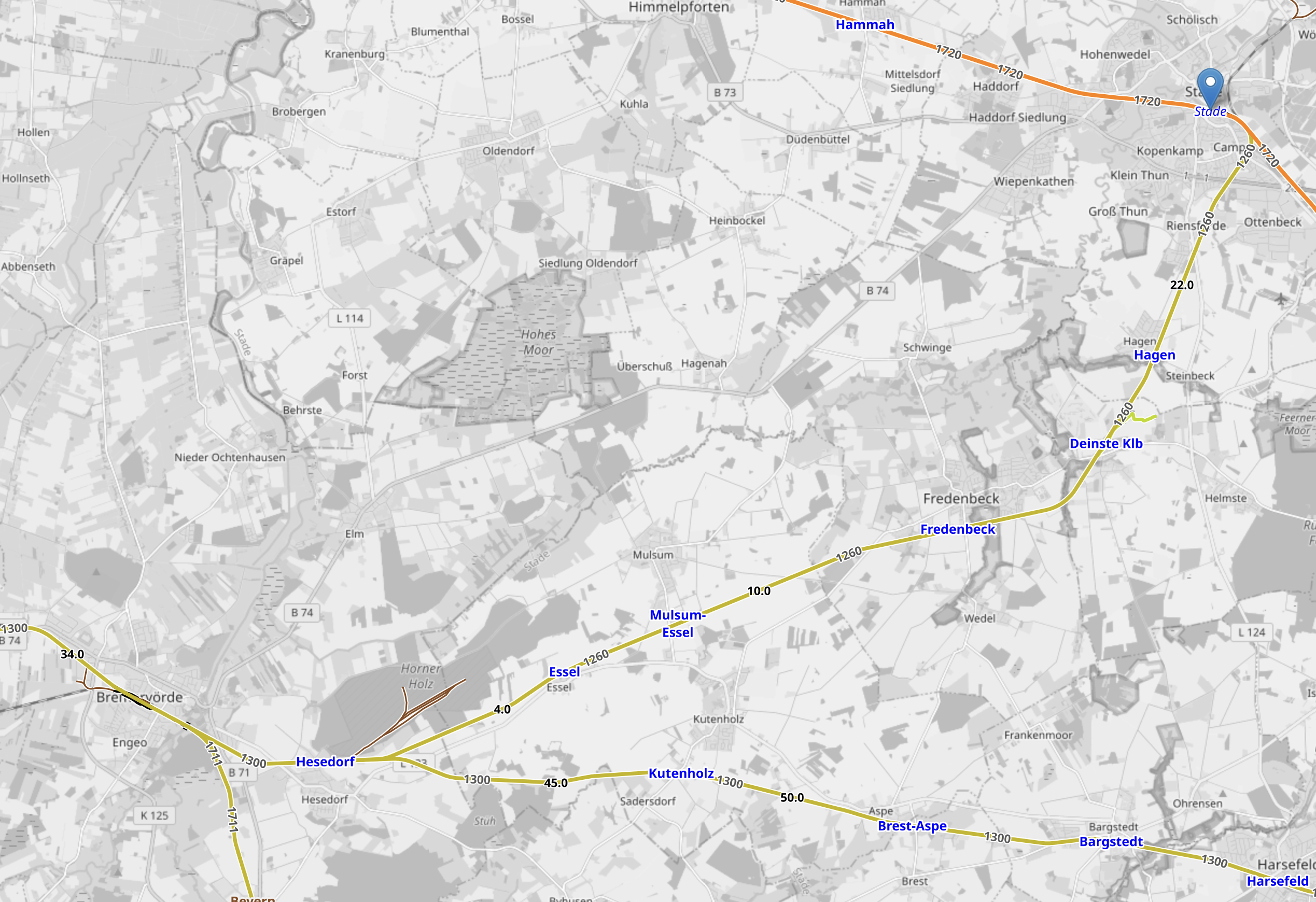
This map from OpenRailwayMap shows the route.
Note.
- Stade is in the North-East corner of the map and marked with a blue arrow.
- Stade station is on the Hamburg S-Bahn and has an hourly fast train between Hamburg and Cuxhaven.
- Bremervörde is in the South-West corner of the map, where the various routes converge.
- Bremervörde station is on the Buxtehude-Cuxhaven Line which is run by the hydrogen-powered Alstom Coradia iLint trains.
- Bremervörde appears to be, where the hydrogen-powered trains are serviced and refuelled.
- Currently, there are no passenger trains between Stade and Bremervörde, except at the weekends, when a heritage service called the Moor Express runs between Bremen Hauptbahnhof and Stade via Bremervörde.
- Freight trains also operate between Stade and Bremervörde.
At first sight it looks like the Stade and Bremervörde route, could be an ideal one to run with hydrogen-powered iLint trains.
- Servicing and refuelling of the trains could be shared with the existing Buxtehude-Cuxhaven service.
- The new service would probably need a few extra identical trains.
- The track is already in use, so probably wouldn’t need too much work.
- As some of the stations are in use by the Moor Express, there may not need to be too much work to bring them up to the required standard.
This re-opening, illustrates the advantage of having a fully-certified, independently-powered train, that can be deployed on non-electrified lines.
Key Mainline Testing Undertaken In Bi Modal Hydrogen Train Project
The title of this post, is the same as that of this article on Rail Technology Magazine.
This is a key paragraph.
In the test, lithium-titanate batteries and the hydrogen fuel cells have been retro-fitted to a CAF Civia Class 463 commuter electric unit train. This then has the ability to create a hybrid powertrain which can run on electrified lines alongside standard lines.
This paragraph describes some of the testing.
The new power system has been integrated into the existing vehicle’s traction system and the current tests on the mainline follow closed track testing and static testing at CAF’s plant in Zaragoza. The mainline testing has taken place across lines in Zaragoza, Madrid and Galicia but the crucial test run for the new unit was on the Zaragoza-Canfranc line where it ran in both electric mode on the electrified line before switching to hybrid mode, combining the fuel from hydrogen fuel cells and batteries where needed.
It sounds like this is a better specified hydrogen-powered train than Alstom’s iLint.
Lifting The Barriers To Refueling
The title of this post, is the same as that of this article on Railway Age.
It is a good summing up of Alstom’s problems of getting hydrogen for the iLint in Germany.
This paragraph from the article is puzzling.
Alstom’s task now is to clear external hurdles out of the way. Sprotte explains this using the Bremervörde project as an example: “The location is geographically favorable, almost in the middle of the regional transport network. If they were allowed to, Alstom and Linde could jointly supply several surrounding communities with ready-made hydrogen, for example for municipal commercial vehicles. But they can’t, and that’s because public funding for the project was only granted on the express condition that the filling station be used exclusively for rail transport.” This was met with incomprehension by the partners involved.
The Bremervörde project is to provide hydrogen for the Cuxhaven route that I wrote about in My First Ride In An Alstom Coradia iLint.
It strikes me that a certain amount of bureaucracy, is stopping the full deployment of the trains.
But then the London Mayor has a hydrogen policy of ignore it and it might go away.
Hydrogen Train To Be Demonstrated In Québec
The title of this post is the same as that of this article on the Railway Gazette.
These two paragraphs outline the project.
An Alstom Coradia iLint hydrogen fuel cell multiple-unit is to operate demonstration passenger services on the Chemin de fer de Charlevoix from June 17 to September 30.
The return service along the St Lawrence River between Parc de la Chute-Montmorency on the outskirts of Québec City and Baie-St-Paul is being organised by the province, short line operator Chemin de fer Charlevoix, tourist train operator Train de Charlevoix, hydrogen production technology company HTEC and Harnois Énergies, which will produce the green hydrogen at its Québec City site.
The Train de Charlevoix runs along the St. Lawrence River and is described on the web site as a unique experience.
I have felt for some time, that one of the uses of zero-carbon trains is as tourist trains, on quiet lines, where noise is probably not welcome.
It might even change the future of some lightly-used lines.
Do Cummins And Stadler Have a Cunning Plan?
Roger Ford in the December 2022 Edition of Modern Railways has written an article called Traction à la mode.
The article is a series of small sections, with the last section but one, labelled Monster.
Roger says this.
Finally, we come to the mighty Class 99, which is not at all flakey. In the past I have often commented on the UK railways’ prejudice against Co-Co bogies.
But with the ’99’ six axles will give 6MW (8,000 hp) at the rail, with contact patches to use all its 113 tonnes. Plus the extra axles mean it can accommodate the weight of a 2,400 hp Cummins diesel.
At the recent Rail Freight Group conference, Ross Shepherd, Chief Technical Officer of Beacon Rail, which has 30 locomotives on order for GB Railfreight, revealed a computer simulation which showed a Class 99 would save 36 minutes on a run timed for 1 hr 40 minutes for diesel traction. To quote Mr Shepherd:’It’s a monster and it’s coming.’
I have been doing some digging around the Internet and have found this bulletin from Cummins, which is entitled QSK60 For Rail.
The Class 99 locomotive appears to have a QSK50, which appears to be a less powerful version.
The bulletin describes a Stadler locomotive with a Cummins QSK60 engine, which Stadler are delivering to Bolivia.
This paragraph introduces the locomotives.
Stadler and the Bolivian Ferroviaria Andina (Andean
Railway) FCA have signed a contract for the supply of the first three state-of-the art South American Light
Loco (SALi) locomotives, which will feature the
Cummins QSK60 engine.
The bulletin gives these details.
- Locomotive type – diesel-electric
- Track gauge – one metre
- Axle load – 18 ton/axle
- Power – 1865 kW – 2500 hp
- Diesel engine – QSK60
- Maximum Speed – 100 km/h
- Starting Tractive Effort – 415 kN
- Coupling – AAR
- Fuel Tank – Up to 6000 litres
The bulletin is marked as Printed in UK, so does that mean that the engines will come from Darlington.
The weight of this locomotive is 98 tonnes and Roger says that the Class 99 locomotive is 113 tonnes. But the Class 99 locomotive is an electro-diesel locomotive with 6 MW available when running on 25 KVAC overhead electrification.
It looks to me that Stadler have arranged the substantial electrical gubbins around the Cummins QSK50 diesel engine to create Beacon Rail’s monster.
Cummins And Hydrogen
Cummins is a company, that is big in hydrogen.
- They own hydrogen fuel cell and electrolysis company; Hydrogenics.
- They supply the fuel cells for Alstom’s hydrogen-powered Coradia iLint.
In Werner Enterprises Signs Letter Of Intent Planning To Secure 500 X15H Engines From Cummins, I said this.
More details of the X15H engine are given in this earlier press release, which is entitled Cummins Inc. Debuts 15-Litre Hydrogen Engine At ACT Expo, which has this first paragraph.
Today, Cummins Inc. debuted its 15-liter hydrogen engine at ACT Expo in Long Beach, California. This engine is built on Cummins’ new fuel-agnostic platform, where below the head gasket each fuel type’s engine has largely similar components, and above the head gasket, each has different components for different fuel types. This version, with expected full production in 2027, pairs with clean, zero-carbon hydrogen fuel, a key enabler of Cummins’ strategy to go further faster to help customers reduce greenhouse gas (GHG) emissions.
I certainly like the concept of a fuel-agnostic platform, where below the head gasket, everything is similar, and above the head gasket, there are appropriate components.
Could This Philosophy Be Used To Create An Electro-Hydrogen Locomotive?
It looks to me that if Stadler use the Cummins QSK diesel engine in their locomotives, then if Cummins develop a hydrogen version of the QSK, Stadler can convert the locomotives to hydrogen, if Cummins follow their philosophy of a fuel-agnostic platform, with everything identical below the cylinder head gasket.
Over twenty years ago, I did a small data analysis task for Cummins in Darlington. One of their engineers explained to me how they would rearrange the components of diesel engines, so they fitted with the customer’s application. It looks to me that they have taken this philosophy a step further, so that the customer can have diesel or hydrogen engines in the same application, depending on what the end user wants.
In the case of the order from Beacon Rail for thirty Class 99 locomotives, they will be delivered as electro-diesel locomotives, but at some point in the future, when Cummins has developed the hydrogen engine, they will be able to be converted to electro-hydrogen locomotives.
These locomotives could be in front-line service for over forty years!
The Very Long Range Electro-Hydrogen Locomotive
Hydrogen surely has the power and range to move freight trains across continents.
But can everything be fitted in a standard locomotive body?
Alstom have come up with an innovative solution, which I described in From 2025, Nestlé Waters France Will Use The First Hydrogen-Powered Freight Train Through An Innovative Solution Developed by Alstom and ENGIE
I would also suspect a simple tender containing a tank full of hydrogen will also work.
Collateral Benefits Of A Electro-Hydrogen Locomotive
These are possible benefits of electro-hydrogen locomotives.
- Staff in ports and freight depots get all the clean-air benefits of working with zero-carbon and low-pollution locomotives.
- Ports are becoming hydrogen hubs to fuel ships and ground-handling equipment, so electro-hydrogen locomotives could be easily-fueled.
- Ports and freight depots don’t like electrification, as containers occasionally get dropped.
- Electro-hydrogen locomotives will be able to do their own shunting.
- Electro-hydrogen locomotives will not need all tracks to ports and freight depots to be electrified, but won’t mind if they are.
These benefits would allow Network Rail and the operators of ports and freight depots to develop the best solutions for their operations.
Alstom’s Coradia iLint Successfully Travels 1,175 km Without Refueling Its Hydrogen Tank
The title of this post, is the same as that of this press release from Alstom.
This paragraph describes the trip.
Alstom, global leader in smart and sustainable mobility, has demonstrated the effectiveness of its hydrogen powered solutions for long distance transportation. During a long-distance journey, an unmodified serially-produced Coradia iLint train covered 1,175 kilometres without refuelling the hydrogen tank, only emitting water and operating with very low levels of noise. The vehicle used for this journey comes from the fleet belonging to LNVG (Landesnahverkehrsgesellschaft Niedersachsen), the transport authority of Lower Saxony, and has been in regular passenger operation on the network of evb (Eisenbahnen und Verkehrsbetriebe Elbe-Weser GmbH) since mid-August. For the project, Alstom also partnered with the gas and engineering company Linde.
The distance is around 730 miles.
This paragraph describes the detailed route.
Starting in Bremervörde, the route took the Coradia iLint across Germany. From Lower Saxony, where the hydrogen train was built and developed by Alstom, it travelled through Hesse to Bavaria, all the way to Burghausen near the German-Austrian border before coming to a stop in Munich. Following this remarkable journey, the train will now head for the German capital. Several trips through Berlin are on the agenda as part of InnoTrans 2022, the premier International Trade Fair for Transport Technology, to be held from 20 to 23 September.
It looks to be a good test of a hydrogen-powered train.
It looks like Alstom believe that hydrogen trains can replace diesel ones, providing there is a source of hydrogen.
 The Anonymous Widower