UK To Launch Next CfD Allocation Round In July
The title of this post, is the same as that of this article on offshoreWIND.biz.
This is the sub-heading.
The UK government has announced that the next Contracts for Difference (CfD) allocation round will open in July 2026.
Contracts for Difference Allocation Round 7 did well and according to Google AI raised these contracts.
Contracts for Difference (CfD) Allocation Round 7 (AR7) results, announced in January 2026, secured a record 8.4 GW of offshore wind capacity, enough to power 12 million homes. The auction awarded contracts to 6.865 GW of fixed-bottom offshore wind and 192.5 MW of floating wind, with strike prices around £91/MWh (2024 prices).
Key Results of AR7:
Capacity Secured: Over 8.4 GW (8,437.5 MW) of offshore wind, with 6,090 MW in England, 1,380 MW in Scotland, and 775 MW in Wales.
Key Winners: RWE secured nearly 6.9 GW across four projects, including Dogger Bank South and Norfolk Vanguard; SSE Renewables secured 1,380 MW for Berwick Bank Phase B; and floating wind projects included Pentland and Erebus.
Strike Prices: Fixed-bottom offshore wind cleared at £91.20/MWh (£89.49/MWh in Scotland), while floating offshore wind cleared at £216.49/MWh.
Investment & Jobs: The projects represent over £22 billion in private investment and support approximately 7,000 jobs.
Timeline: The projects are expected to start delivering power from 2028 onwards.
Out of curiosity, I asked Google AI, “How Many GWs Are Expected To Be Signed Up In The UK’s CfD Round 8” and received this answer.
Allocation Round 8 (AR8) of the UK’s Contracts for Difference (CfD) scheme is expected to launch in July 2026. While specific, finalized GW targets for the winning bids have not yet been announced, the government is adapting the auction to support increasingly large projects, including potential floating offshore wind farms of 1GW+.
Following the record-breaking AR7, which secured 8.4 GW of offshore wind capacity in January 2026, AR8 is expected to focus on continuing this momentum to meet the UK’s “Clean Power 2030” objectives.
Key context regarding expected AR8 capacity includes:
Growing Project Scale: The AR8 consultation indicates that upcoming floating offshore wind projects are likely to be much larger (potentially 1GW+) than previously expected, prompting changes to the scheme to support this scale.
Targeted Procurement: Industry sources previously indicated that the combination of AR7 and AR8 was expected to secure significant capacity to meet 2030 goals, with over 20 GW of offshore wind previously identified as eligible for upcoming rounds.
Supply Chain Focus: The government has issued, or is planning, Supply Chain Plan requirements for solar projects of 300 megawatts or more and for onshore wind, indicating high volumes are anticipated in these sectors.
The application window for AR8’s Clean Industry Bonus is currently planned for May 2026, with the main auction following in July 2026.
Conclusion
It doesn’t really indicate a figure for AR8, but does indicate that AR7 and AR8 together have a joint target of over 20 GW.
- I can do a small calculation.
- AR7 secured 8.4 GW of offshore wind capacity in January 2026.
- As AR7+AR8 are expected to secure 20 GW before 2030, that means AR8 will secure 11.6 GW.
So this means that AR8 could be 38 % bigger than AR7.
Port Talbot To Become Offshore Wind Hub For Celtic Sea
The title of this post, is the same as that of this article on the BBC.
This is the sub-heading.
Port Talbot will become the first dedicated hub for floating offshore wind in the Celtic Sea.
These four introductory paragraphs add some detail.
Associated British Ports (ABP) will begin detailed design and engineering work on new port infrastructure after securing grant funding of up to £64m from the UK government.
The project will support the assembly and deployment of floating turbines that will operate in deeper waters off the Welsh coast. ABP said the development could support thousands of jobs and attract hundreds of millions of pounds in further investment.
The UK government said the new port would help deliver clean, homegrown electricity, protect households from volatile fossil fuel markets and create up to 5,000 new jobs.
Redeveloping the port to handle the assembly of wind turbines could position Port Talbot at the centre of a fast-growing clean energy sector.
I have some thoughts.
How Much Wind Power Is Planned For The Western Approaches?
In Ocean Winds Enters Lease Agreement With Crown Estate For 1.5 GW Celtic Sea Floating Wind Project, I published this Google AI estimate of the wind power, that could be developed in the Western Approaches.
How Much Wind Power Is Planned For The Western Approaches?
I asked Google AI, the title of this section and received this answer.
The UK has a target of 50 GW of offshore wind by 2030, with significant projects planned for the Celtic Sea (part of the Western Approaches), which is a key area for 5 GW of floating wind. Total UK offshore wind pipeline capacity exceeds 93 GW, with major developments in this region focusing on floating technology.
Key details regarding wind power in the Western Approaches (specifically the Celtic Sea) include:
Celtic Sea Developments: The area is a primary focus for floating wind projects, designed to capitalize on deep-water potential, with 5 GW of floating wind expected to be deployed across the UK by 2030.
Pipeline and Capacity: The total UK pipeline for offshore wind, which includes the Western Approaches, is 93 GW, and the government is aiming for 43-50 GW of installed offshore capacity by 2030.
Project Status: The region is expected to benefit from the Crown Estate’s leasing rounds aimed at accelerating floating wind, with 15.4 GW of new projects submitted across the UK in 2024.
Wales/South West England Context: Wales has 1.4 GW of projects in the pre-application stage, with some potential for developments off the South West coast.
For more detailed information on specific projects and their development status, you can visit the RenewableUK website and RenewableUK website.
It looks like about 20 GW of offshore wind could be installed in the Western Approaches.
I would expect, a lot of work will be generated in the Port Talbot area.
A Lot Of Steel Will Be Needed
Earlier in the weeek, the UK Government backed the steel industry in Port Talbot, with a press release entitled UK Steel Industry Backed By Major New Trade Measure And Strategy.
Port Talbot Is A Comprehensive, Well-Connected Site
This Google Map shows the site.
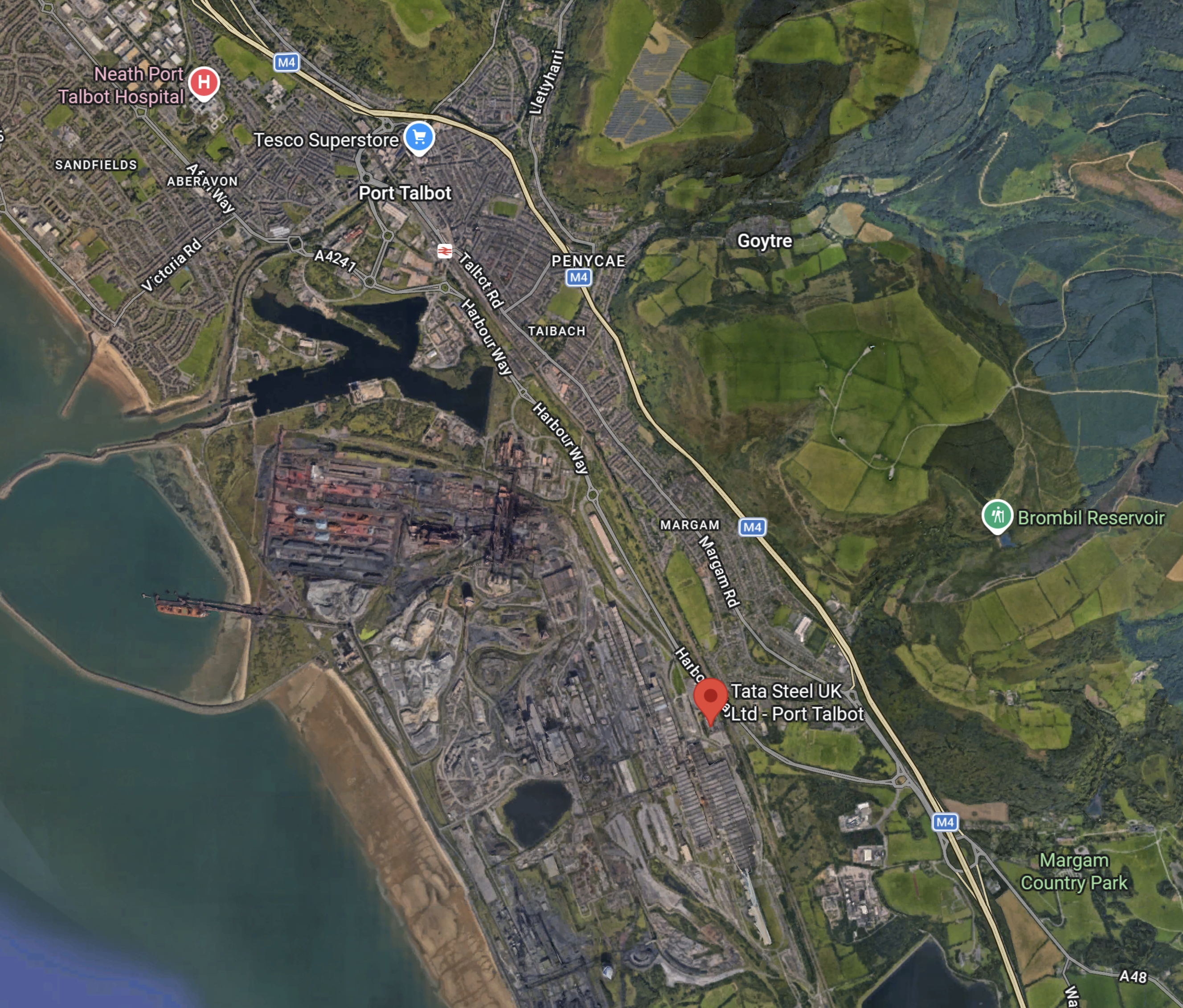
Note.
- The M4 running along the site.
- The South Wales Main Line running along the site, with Port Talbot Parkway serving the site.
- The harbour by the station.
- The Tata steelworks marked by the red arrow.
I hope the up to £64 million grant from the government is sufficient for Associated British Ports (ABP) to turn the harbour into a world-class floating wind facility and that the Treasury haven’t been too mean.
BW Ideol, ABP To Explore Serial Production Of Floating Wind Foundations At Port Talbot
I wrote a post with this name in December 2023, before the leases for the Celtic Sea windfarms had been awarded. As one has been awarded to EDf Renewables, BW Ideol seem to have made a good move.
BW Ideol have a web page, which describes their concrete floating wind foundations manufacturing line.
I hope South Wales has got enough concrete?
UK Continues Offshore Wind Expansion With 6 GW Leasing Round Planned For Early 2027
The title of this post, is the same as that of this article on offshoreWIND.biz.
This is the sub-heading.
The Crown Estate has unveiled plans for the UK’s Offshore Wind Leasing Round 6 to be held in the first half of 2027, targeting the development of at least 6 GW of new capacity.
These three paragraphs add some details.
The upcoming leasing process will focus on areas primarily located in the northeast of England. The sites are expected to be suitable for fixed-bottom offshore wind projects and will be brought forward following market and stakeholder engagement, including the National Energy System Operator’s (NESO) strategic plans for energy and for electricity networks, which will inform the exact capacity of the upcoming leasing round and refine specific site details and locations.
The Crown Estate said on 26 March that it had begun a programme of market engagement ahead of the official launch of a new leasing round, and is seeking market views on commercial approaches to the leasing round “to understand the potential viability and market appetite.”
The UK seabed manager said that it had also identified other areas of seabed opportunity across the South West, Wales and other regions which may form the basis of subsequent leasing rounds through the Crown Estate’s new seabed management tool, the Marine Delivery Routemap, which is being used for the first time in Round 6.
In Renewable Power By 2030 In The UK, I calculated how much offshore wind could be commissioned up to 2030.
These were my results.
This gives these yearly totals, if I use pessimistic dates.
- 2025 – 1,235 MW
- 2026 – 4,807 MW
- 2027 – 5,350 MW
- 2028 – 4,998 MW
- 2029 – 9,631 MW
- 2030 – 15,263 MW
This adds up to a total of 58,897 MW.
But This Doesn’t Include Round 5 Or Round 6!
But the article on offshoreWIND.biz does, say this about Round 5.
The Crown Estate’s previous leasing round, Round 5, focused on floating offshore wind in the Celtic Sea, covering areas off South Wales and South West England and targeting up to 4.5 GW of capacity. The round awarded seabed rights to Equinor, Gwynt Glas, and Ocean Winds, with individual project development areas of up to 1.5 GW. Agreements for lease were recently signed for all three Round 5 sites.
The article also indicates that 6 GW can be expected from Round 6.
Which gives a total of 69,397 MW or 69.4 GW.
No wonder the UK Government can back the steel industry, with press releases like this UK Steel Industry Backed By Major New Trade Measure And Strategy.
Lots of renewable energy, is the new rich!
Ocean Winds Enters Lease Agreement With Crown Estate For 1.5 GW Celtic Sea Floating Wind Project
The title of this post, is the same as that of this article on offshoreWIND.biz.
This is the sub-heading.
Ocean Winds has entered into an agreement for lease with the Crown Estate for a 1.5 GW floating offshore wind project, for which the developer secured a site in the Round 5 seabed auction last year.
These two paragraphs add detail to the story.
Offshore Wind Leasing Round 5, the UK’s first dedicated floating wind seabed leasing round, was launched in February 2024, offering three areas. In June 2025, the Crown Estate announced Equinor and Gwynt Glas, a joint venture between EDF and ESB, as preferred developers for two project sites and said it was working to ensure the delivery of the full potential capacity of Round 5, which is up to 4.5 GW.
Equinor and Gwynt Glas entered into lease agreements for their floating wind projects in October 2025 and, the following month, the Crown Estate said Ocean Winds had secured the third floating offshore wind site in the Celtic Sea.
This map shows the three wind farms, that make up the Glynt Glas wind farm.
Note.
- It is expected to be built from and connect to the grid at Port Talbot in South Wales.
- The three sites are expected to be commissioned by the early-to-mid 2030s.
- The elongated white dot to the East of the wind farms would appear to be Lundy Island.
- The large bay to the North of Lundy is Carmarthen Bay with Caldey Island at its West end and Llanelli on its East.
- The Gower separates Swansea Bay from Carmarthen Bay.
This Google Map shows the Bristol Channel from the wind farms in the West to Cardiff and Hinkley Point.
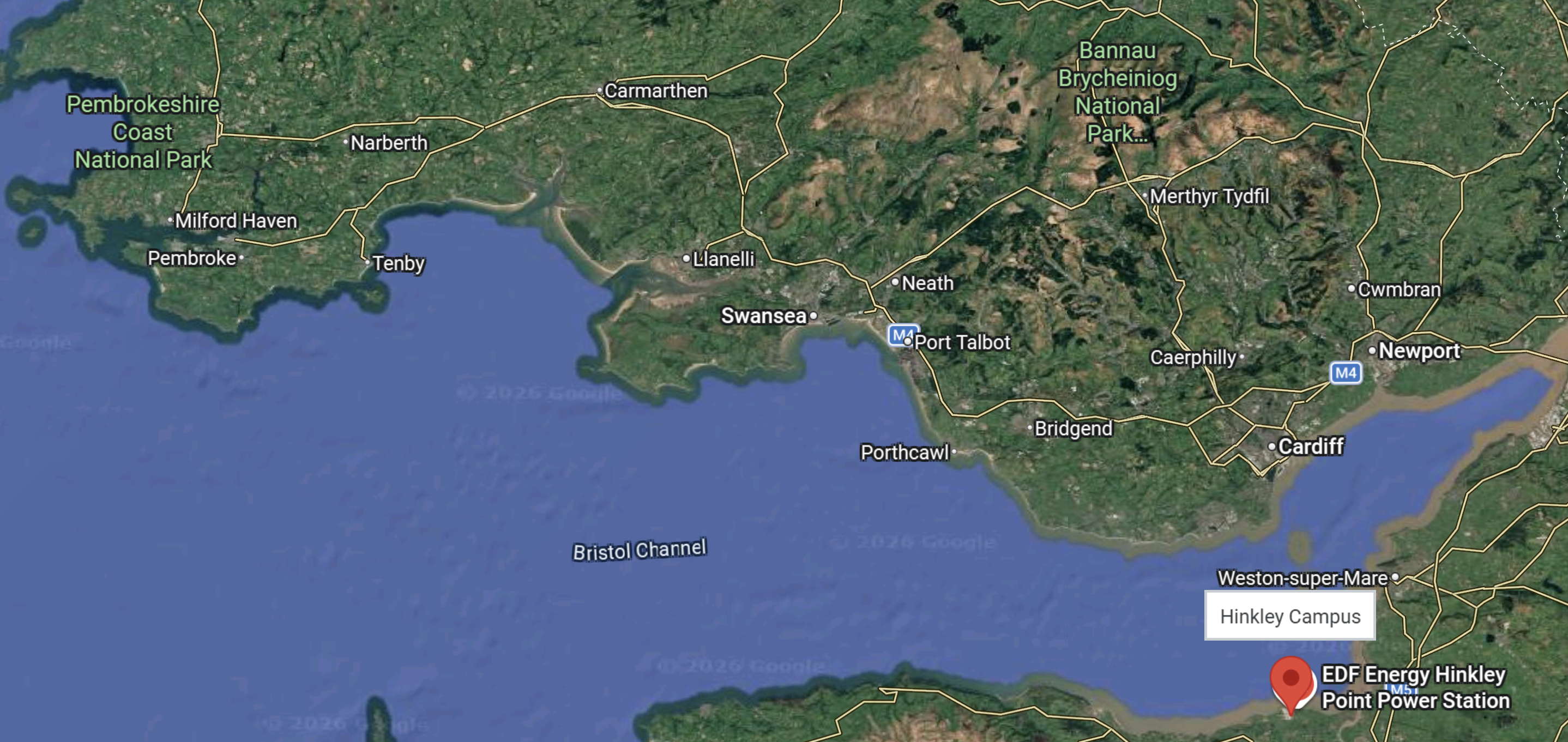
Note.
- Along the North coast of the Bristol Channel, working from West to East, my 78-year-old eyes can pick out Milford Haven, Pembroke, Caldey Island, Tenby, Llanelli, Swansea, Port Talbot, Porthcawl, BridgendCaerphilly, Cardiff and Newport.
- Coming back along the South Coast, I can see Weston-super-Mare, Hinkley Point C and the tip of Lundy Island in line with Tenby.
- The three sections of Glynt Glas will each generate 1.5 GW, making a total of 4.5 GW.
- Hinkley Point C when completed, will be a 3.26 GW nuclear power station.
- There is also a 2.2 GW gas-fired power station at Pembroke.
Nearly 8 GW of renewable electricity should be enough to convert Port Talbot steelworks to the manufacture of green steel.
How Much Wind Power Is Planned For The Western Approaches?
I asked Google AI, the title of this section and received this answer.
The UK has a target of 50 GW of offshore wind by 2030, with significant projects planned for the Celtic Sea (part of the Western Approaches), which is a key area for 5 GW of floating wind. Total UK offshore wind pipeline capacity exceeds 93 GW, with major developments in this region focusing on floating technology.
Key details regarding wind power in the Western Approaches (specifically the Celtic Sea) include:
Celtic Sea Developments: The area is a primary focus for floating wind projects, designed to capitalize on deep-water potential, with 5 GW of floating wind expected to be deployed across the UK by 2030.
Pipeline and Capacity: The total UK pipeline for offshore wind, which includes the Western Approaches, is 93 GW, and the government is aiming for 43-50 GW of installed offshore capacity by 2030.
Project Status: The region is expected to benefit from the Crown Estate’s leasing rounds aimed at accelerating floating wind, with 15.4 GW of new projects submitted across the UK in 2024.
Wales/South West England Context: Wales has 1.4 GW of projects in the pre-application stage, with some potential for developments off the South West coast.
For more detailed information on specific projects and their development status, you can visit the RenewableUK website and RenewableUK website.
It looks like about 20 GW of offshore wind could be installed in the Western Approaches.
Ocean Winds Secures Third Celtic Sea Floating Wind Site
The title of this post, is the same as that of this article on offshoreWIND.biz.
This is the sub-heading.
Ocean Winds has secured the third floating offshore wind site in the Celtic Sea, offered through the Crown Estate’s Round 5 auction earlier this year. The developer is joining Equinor and the Gwynt Glas joint venture, which were awarded rights for two of the three sites offered in Round 5 in June.
This paragraph outlines Ocean Winds’s deal.
On 19 November, the Crown Estate said that Ocean Winds was set to be awarded the rights for a third floating offshore wind site in the Celtic Sea.
There would now appear to be three Celtic Winds deals for wind farms.
- Gwynt Glas – 1.5 GW
- Ocean Winds – 1.5 GW
- Equinor – 1.5 GW
Note.
- 4.5 GW will be able to power a good proportion of South Wales and the South-West peninsular.
- In Gwynt Glas And South Wales Ports Combine Strength In Preparation For Multi-Billion Floating Wind Industry, I talk about partnerships between the wind farms and the ports.
- If you sign up for a large wind farm from the Crown Estate, do you get to have afternoon tea with Charles and Camilla in the garden at Highgrove or even Buckingham Palace?
This map of the wind farms is available from download from this page on the Crown Estate web site.
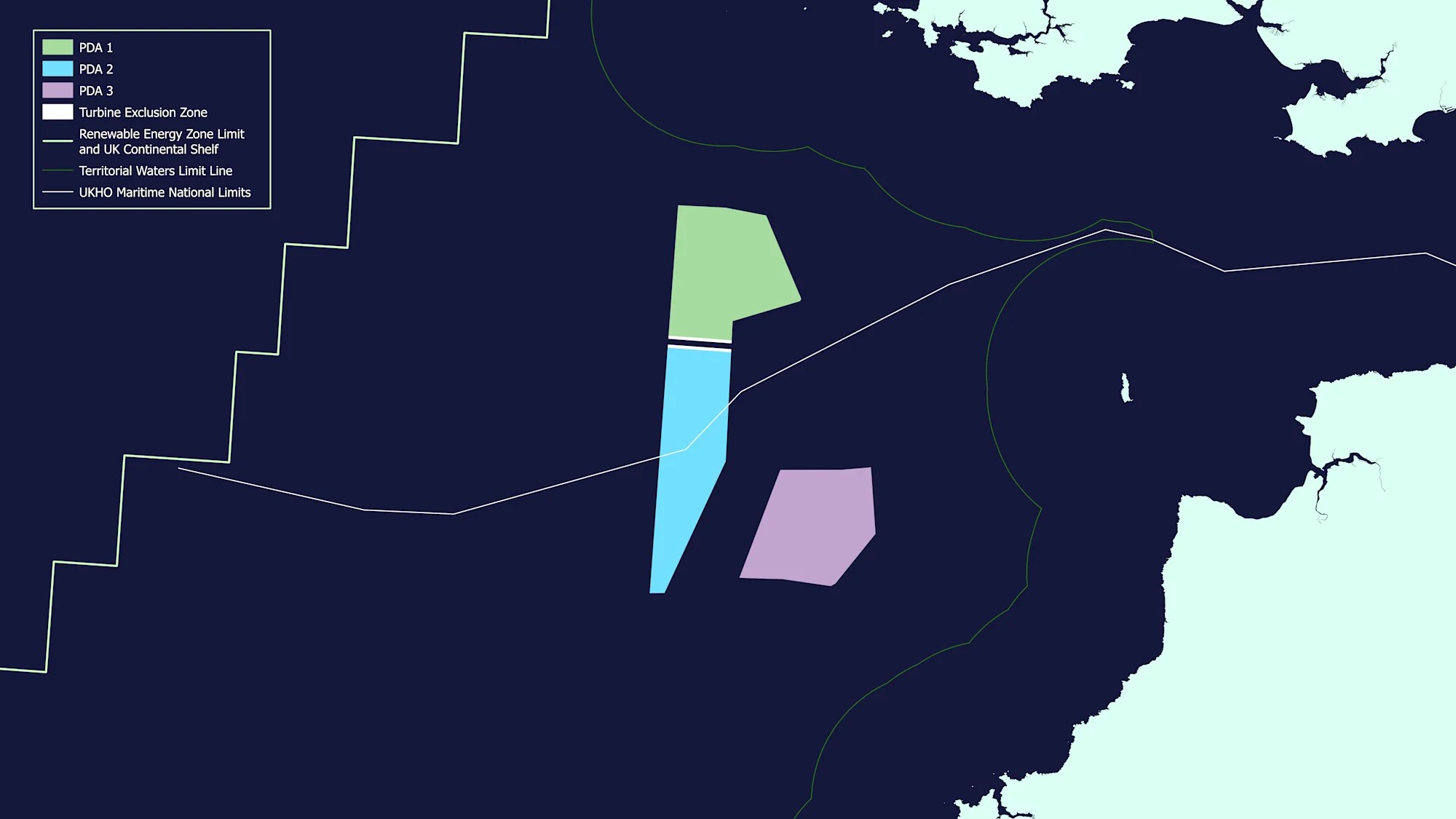
Note.
- Gwynt Glas is in green.
- Ocean Winds is in blue.
- Equinor is in mauve.
- The white dot to the East of the wind farms is Lundy Island.
This triple wind farm is certainly well-placed to supply power to Cornwall, Devon and South Wales.
Equinor, EDF-ESB Joint Venture Secure 1.5 GW Sites In UK Floating Wind Leasing Round
The title of this post, is the same as that of this article on offshoreWIND.biz.
This is the sub-heading.
The Crown Estate has selected Equinor and Gwynt Glas, a joint venture between EDF Renewables UK and ESB, as preferred bidders in the seabed leasing round for floating wind projects in the Celtic Sea.
These two paragraphs give more details.
Selected on 12 June, each of the two developers was awarded 1.5 GW of capacity in their respective project development area (PDA) for an annual option fee of GBP 350/MW (approximately EUR 410/MW).
The Crown Estate launched the floating wind leasing round (Offshore Wind Leasing Round 5) in February 2024, offering three areas off the coasts of Wales and South West England for a total of up to 4.5 GW of installed capacity.
Note.
- It looks like the Crown Estate are working to get a contract for the third site.
- The ports of Bristol and Port Talbot could be handling the assembly of the floating turbines.
- The Crown Estate has also established a new strategic approach with the National Energy System Operator (NESO).
Given the problems some wind and solar farms have had to get connected, the Crown Estate’s link up with NESO could be attractive to developers?
Conclusion
This looks a good bit of business by the Crown Estate in the Celtic Sea.
Did they get NESO to be helpful, by asking senior people for tea with Charles and Camilla at Highgrove?
Cammell Laird To Study Market Opportunities For UK-Built SOVs
The title of this post, is the same as that of this article on offshoreWIND.biz.
This is the sub-heading.
The Offshore Renewable Energy (ORE) Catapult, in partnership with the National Shipbuilding Office and The Crown Estate, has appointed Cammell Laird, part of APCL Group, to carry out a detailed analysis of the future market opportunity for UK-built service operation vessels (SOVs) for offshore wind.
These two paragraphs explain the plan.
According to an ORE Catapult analysis, hundreds of SOVs will likely be in operation worldwide in the coming years as global offshore wind capacity is expected to grow to over 850 GW by 2050. To support the capacity expansion, the global SOV fleet will need to grow as well, with an associated global market of nearly GBP 35 billion (approximately EUR 41.6 billion) expected between now and 2050.
The UK SOV Manufacturing Business Case Development study for which Cammell Laird has been commissioned will help to develop knowledge of how the UK can provide vessel manufacturing to support offshore wind, delivering jobs and economic investment to communities around the country, according to ORE Catapult.
These are my thoughts.
Cammell Laird Are Also To Build A New Mersey Ferry
I wrote about this in Sail Into The Future In Style With Super-Realistic Virtual Tour Of The New Mersey Ferry.
I wouldn’t put it past Liverpool, to use one of the City’s famous icons to sell UK-built service operation vessels (SOVs) for offshore wind.
Will Rolls-Royce Get Involved?
In Rolls-Royce Powers World’s Fastest Offshore Crew Transfer Vessels, I describe how Rolls-Royce mtu are providing powerful engines for Italian Crew Offshore Vessels.
Will Rolls-Royce mtu provide the power for Cammell Laird’s service operation vessels?
The Crown Estate Awards GBP 5 Million In First Supply Chain Accelerator Round
The title of this post, is the same as that of this article on offshoreWIND.biz.
This is the sub-heading.
The Crown Estate has awarded nearly GBP 5 million in funding to 13 organisations across England, Wales, and Scotland in the first round of its Supply Chain Accelerator.
These three paragraphs add more details.
According to The Crown Estate, the funding will help kick-start projects drawing down from a GBP 50 million fund established in May this year to accelerate and de-risk the early-stage development of UK supply chain projects that service the offshore wind sector.
The Crown Estate’s match funding will contribute to a combined development investment of over GBP 9 million, which, if the opportunities successfully conclude their respective development stages, could lead to more than GBP 400 million of capital investment, said the UK body.
Projects receiving funding include those enabling floating wind platforms, anchoring and mooring systems, operations and maintenance facilities, test facilities, and those supporting the skills
The grants have been widely spread in both the public and private sectors and appear to be supporting a variety of technologies.
What About Project Management?
When the four of us started Metier Management Systems to develop Artemis in the 1970s, we got no help from the Government or any agency.
I wonder what difference, government support of this nature would have made?
I don’t know whether any project management development is being supported, but it is my view, that each new generation of projects will bring forward new challenges.
Where’s The Plan, Rishi?
In RWE Goes For An Additional 10 GW Of Offshore Wind In UK Waters In 2030, I detailed how RWE intended to add an extra 10 GW of offshore wind to the seas around the UK.
As our current offshore wind capacity is around 15 GW, another 10 GW would surely be very welcome.
My post also outlined H2ercules, which is Germany’s massive project to create a hydrogen network to bring hydrogen to Southern Germany.
I also gave details of the hydrogen hub at Wilhelmshaven, which is being built by Uniper to feed H2ercules with green hydrogen from around the world.
I believe that some of this hydrogen for H2ercules will take a short trip across the North Sea from UK waters, after being created by offshore electrolysers.
Rishi Sunak’s Manifesto Speech – June 11
I also reported on Rishi Sunak’s Manifesto Speech, which he made on June 11th. This is an extract
This document on the Policy Mogul web site is entitled Rishi Sunak – Conservative Party Manifesto Speech – Jun 11.
These are three paragraphs from the speech.
We don’t just need military and border security. As Putin’s invasion of Ukraine has shown, we need energy security too. It is only by having reliable, home-grown sources of energy that we can deny dictators the ability to send our bills soaring. So, in our approach to energy policy we will put security and your family finances ahead of unaffordable eco zealotry.
Unlike Labour we don’t believe that we will achieve that energy security via a state-controlled energy company that doesn’t in fact produce any energy. That will only increase costs, and as Penny said on Friday there’s only one thing that GB in Starmer and Miliband’s GB Energy stands for, and that’s giant bills.
Our clear plan is to achieve energy security through new gas-powered stations, trebling our offshore wind capacity and by having new fleets of small modular reactors. These will make the UK a net exporter of electricity, giving us greater energy independence and security from the aggressive actions of dictators . Now let me just reiterate that, with our plan, we will produce enough electricity to both meet our domestic needs and export to our neighbours. Look at that. A clear, Conservative plan not only generating security, but also prosperity for our country.
It is now nine days since Rishi made that speech and I can’t remember any reports about an energy security policy, which he outlined in the last paragraph of my extract from his speech.
He particularly mentioned.
- New gas-powered stations
- Trebling our offshore wind capacity
- Having new fleets of small modular reactors.
He also said we would have sufficient electricity to export to our neighbours. As I said earlier some of this energy will be in the form of hydrogen, which has been created by offshore electrolysers.
If we are exporting electricity and hydrogen to Europe, this is likely to have three effects.
- An improvement in Europe’s energy security.
- H2ercules will improve and decarbonise German industry, using UK hydrogen.
- The finances of UK plc will improve.
It looks like there will be winners all round.
Rishi also said this, in his speech.
As Putin’s invasion of Ukraine has shown, we need energy security too.
The gas-powered stations, offshore wind farms and the fleets of small modular reactors, will be part of the equation.
But I believe, we need three other components to complete our energy security.
- The upgrading of the National Grid.
- The building of four x 2 GW interconnectors between Scotland and Eastern England.
- Large amounts of energy storage.
Note.
- The Great Grid Upgrade and the four x 2 GW interconnectors are being planned.
- In Huge Boost To UK Supply Chain As National Grid Launches The Great Grid Partnership With Seven New Industry Partners, All United In The Drive To Deliver The Great Grid Upgrade, I describe how National Grid has setup the Great Grid Partnership to deliver the Great Grid Upgrade.
- In UK Infrastructure Bank, Centrica & Partners Invest £300M in Highview Power Clean Energy Storage Programme To Boost UK’s Energy Security, I describe how the big boys do a deal with Highview Power to create affordable batteries for the UK and the world.
- In Grid Powers Up With One Of Europe’s Biggest Battery Storage Sites, I describe how the very large Swardeston BESS is to be built near Norwich.
- In Mercia Power Response & RheEnergise Working Together To Build Long Duration Energy Storage Projects In The UK, I describe another UK-developed long duration energy storage system, which is now being planned.
- In National Grid Shares Proposals For Green Electricity Projects In Lincolnshire And West Norfolk, Needed To Boost Home-Grown Energy Supplies And Progress Towards Net Zero, I describe National Grid’s projects in the East of England.
- In UK ESO Unveils GBP 58 Billion Grid Investment Plan To Reach 86 GW of Offshore Wind By 2035, I show how we’re not that far away from 86 GW by 2035.
- In 400k For National Grid Innovation Projects As Part Of Ofgem Fund To Help Shape Britain’s Net Zero Transition, I describe how National Grid is using innovation to help target net-zero by 2035.
- In Iberdrola Preparing Two East Anglia Offshore Wind Projects For UK’s Sixth CfD Round, I describe how Iberdrola is getting 1.7 GW ready for commissioning in 2026.
- In National Grid To Accelerate Up To 20GW Of Grid Connections Across Its Transmission And Distribution Networks, I describe how National Grid are accelerating the development of the electricity networks. 10 GW of battery storage is a collateral benefit.
These ten projects, most of which are financed and/or underway, would appear to be good foundations, on which to build the Great Grid Upgrade.
It looks to me, that National Grid, RWE, Centrica, Iberdrola and others, by just doing what comes naturally have offered the next government a road to a future.
It will be interesting, what gets said before the election.
Debenhams Oxford – May 27th, 2024
These pictures show the current state of the Debenhams store in Oxford.
















This will be the first development of those, that I talked about in Crown Estate To Spend £1.5bn On New Laboratories.
- I have deliberately shown pictures of the Junction, where the Debenhams building occupies the North-West corner.
- There is a Waterstones opposite the Debenhams building, on a busy junction between George and Magdalen Streets.
- There is a bus information display on the corner.
- There are a lot of chain eateries and a pub; the Wig & Pen.
These are a few thoughts.
Does the Debenhams Building Have Any Car Parking?
I would doubt it, but there may be a need to bring in large equipment.
Taxis To And From The Station
Note.
- I took a black taxi from the station to just outside the Debenhams building and it cost me the princely sum of £5,20.
- I also noted there was a rank at the rear of the building.
- In both locations, taxis were ready to roll.
That looked reasonable.
Buses To And From The Station
Staff at Oxford station, assured me that buses were available, but due to all the road works and Bank Holiday chaos, I suspect it could be improved, when the station upgrade is complete.
Walking To The Station
I took this second set of pictures as I walked from the Debenhams building back to the station.












Note.
- I walked from the junction by Debenhams, along George Street.
- It was a fairly straight line and level.
- There were no signposts between Debenhams and the station.
- There was quite a bit of blocked traffic.
- The route could do with some improvement like refurbished pavements and a few direction signs.
It took me about twenty-four minutes and at 76, I walked it easily.
On entering the station, I walked straight on to the platform for my train back to Reading, which was two minutes late.
Cycling
I suspect that many will cycle to work in the Debenhams building, as it is in Oxford.
But then, I suspect the Crown Estate, their architects and builders will know the appropriate provision to make.
Is The Debenhams Building At A Good Location?
When I was around 23, I used to reverse commute to ICI in Welwyn Garden City.
This involved.
- A ten-minute walk from St. John’s Wood to Chalk Farm tube station.
- A Northern Line train to King’s Cross station.
- A suburban train to Welwyn Garden City station.
- A fifteen-minute walk to my place of work.
St. John’s Wood to Oxford would involve.
- A fourteen-minute bus ride to St. Paddington station.
- A suburban train to Oxford station.
- A twenty-minute walk to my place of work.
A Brompton bicycle would help.
Knowing Cambridge as I do, the Debenhams building would be very well-located, if it were in Cambridge in a similar location, with respect to the railway station.
I feel that the Debenhams building passes the location test.
 The Anonymous Widower