‘Mobilising EUR 1 Trillion in Investments’ | North Sea Countries, Industry, TSOs to Ink Offshore Wind Pact
The title of this post, is the same as that of this article on offshoreWIND.biz.
This is the sub-heading.
Government officials from Belgium, Denmark, France, Germany, Ireland, Luxembourg, the Netherlands, Norway and the UK are set to sign a declaration confirming the ambition to build 300 GW of offshore wind in the North Seas by 2050, and an investment pact with the offshore wind industry and transmission system operators (TSOs) that is said to mobilise EUR 1 trillion in economic activity.
These three paragraphs add a lot of powerful detail.
Under the Offshore Wind Investment Pact for the North Seas, to be signed today (26 January) at the North Sea Summit in Hamburg, governments of the nine North Sea countries will commit to building 15 GW of offshore wind per year from 2031 to 2040.
The heads of state and energy ministers will also vow to de-risk offshore wind investments through a commitment to provide two-sided Contracts for Difference (CfDs) as the standard for offshore wind auction design. The pact also commits governments to remove any regulatory obstacles to power purchase agreements (PPAs), according to WindEurope, which will sign the pact on behalf of the industry.
On the industry’s side, the commitment is to drive down the costs of offshore wind by 30 per cent towards 2040, mobilise EUR 1 trillion of economic activity for Europe, create 91,000 additional jobs and invest EUR 9.5 billion in manufacturing, port infrastructure and vessels.
These two paragraphs say something about cost reductions.
The cost reduction of offshore wind is planned to be achieved through scale effects, lower costs of capital and further industrialisation supported by clarity and visibility on the project pipeline.
The transmission system operators (TSOs) will identify cost-effective cooperation projects in the North Sea, including 20 GW of promising cross-border projects by 2027 for deployment in the 2030s.
I hope there is a project management system, that can step into this frenzy, just as Artemis did in the 1970s with North Sea Oil and Gas.
The BBC has reported the story under a title of UK To Join Major Wind Farm Project With Nine European Countries.
this is the sub-title.
The UK is set to back a vast new fleet of offshore wind projects in the North Sea alongside nine other European countries including Norway, Germany and the Netherlands.
These six paragraphs add more detail.
The government says the deal will strengthen energy security by offering an escape from what it calls the “fossil fuel rollercoaster”.
For the first time, some of the new wind farms will be linked to multiple countries through undersea cables known as interconnectors, which supporters say should lower prices across the region.
But it could prove controversial as wind farm operators would be able to shop around between countries to sell power to the highest bidder – potentially driving up electricity prices when supply is tight.
Energy Secretary Ed Miliband will sign a declaration on Monday at a meeting on the future of the North Sea in the German city of Hamburg, committing to complete the scheme by 2050.
Jane Cooper, deputy CEO of industry body RenewableUK, said the deal would “drive down costs for billpayers” as well as increasing “the energy security of the UK and the whole of the North Sea region significantly”.
But Claire Countinho, shadow energy secretary, warned “we cannot escape the fact that the rush to build wind farms at breakneck speed is pushing up everybody’s energy bills.”
Claire Coutinho, as an outsider at present and a member of a party out of Government had to say something negative, but her negotiations when she was UK Energy Minister with her German opposite number, which I wrote about in UK And Germany Boost Offshore Renewables Ties, seem very much a precursor to today’s agreement.
US Government Sends Stop Work Order To All Offshore Wind Projects Under Construction
The title of this post, is the same as that of this article on offshoreWIND.biz.
This is the sub-heading.
The US Department of Interior has paused the leases and suspended construction at all large-scale offshore wind projects currently under construction in the United States, citing ”national security risks identified by the Department of War in recently completed classified reports.”
The wind farms named are.
- Coastal Virginia Offshore Wind-Commercial – 2,600 GW
- Empire Wind 1 – 810 MW
- Revolution Wind – 704 MW
- Sunrise Wind – 924 MW
- Vineyard Wind 1 – 806 MW
Note.
- These five wind farms total 5,844 MW or 5.8 GW.
- The Empire Wind development is being led by Equinor, who are Norwegian.
- The Revolution Wind and Sunrise Wind developments are being led by Ørsted, who are Danish.
- The Vineyard Wind development is being led by Iberdrola, who are Spanish and Copenhagen Infrastructure Partners, who are Danish.
- Coastal Virginia Offshore Wind project uses 176 Siemens Gamesa SG 14-222 DD (Direct Drive) offshore wind turbines.
- Empire 1 Wind is using Vestas V236-15MW offshore wind turbines.
- Revolution Wind is using 65 Siemens Gamesa SG 11.0-200 DD offshore wind turbines.
- Sunrise Wind is using Siemens Gamesa wind turbines, specifically their 8.0 MW models (SG 8.0-167).
- Vineyard 1 Wind is using General Electric (GE) Haliade-X 13 MW offshore wind turbines.
- Some of the components for the Siemens wind turbines will be manufactured in Virginia.
- Coastal Virginia Offshore Wind has a budget of $11.2-3 billion.
- Empire 1 Wind has a budget of $5 billion.
- Resolution Wind has a budget of $4 billion.
- Sunrise Wind has a budget of $5.3 billion.
- Vineyard 1 Wind has a budget of $4 billion.
There will only be one winner in this new round of the ongoing spat between Trump and the wind industry, that he hates so much – the 1.3 million active lawyers in the United States,which is a figure from according to Google AI.
Scotland And AquaVentus Partner On North Sea Hydrogen Pipeline Plans
The title of this post, is the same as that of this article on H2-View.
These four paragraphs introduce the deal and add some detail.
Hydrogen Scotland has committed to working with the AquaDuctus consortium on cross-border infrastructure concepts to connect Scotland’s offshore wind power to hydrogen production in the North Sea.
Under a Memorandum of Understanding (MOU), the two organisations plan to combine Scotland’s offshore wind with AquaVentus’ offshore electrolysis expertise, linking export and import goals across the North Sea.
The AquaDuctus pipeline is a planned offshore hydrogen link designed to carry green hydrogen through the North Sea, using a pipes and wires hybrid approach. The German consortium plans 10GW of offshore electrolysers in the North Sea, producing around one million tonnes of green hydrogen.
The pipeline design allows offshore wind farms to deliver electricity when the grid needs it, or convert power into hydrogen via electrolysis and transport it through pipelines.
Germany is embracing hydrogen in a big way.
- I introduce AquaVentus in AquaVentus, which I suggest you read.
- AquaVentus is being developed by RWE.
- AquaVentus connects to a German hydrogen network called H2ercules to actually distribute the hydrogen.
This video shows the structure of AquaVentus.
I clipped this map from the video.

Note.
- The thick white line running North-West/South-East is the spine of AquaVentus, that will deliver hydrogen to Germany.
- There is a link to Esbjerg in Denmark, that is marked DK.
- There appears to be an undeveloped link to Norway, which goes North,
- There appears to be an undeveloped link to Peterhead in Scotland, that is marked UK.
- There appears to be a link to just North of the Humber in England, that is marked UK.
- Just North of the Humber are the two massive gas storage sites of Aldbrough owned by SSE and Rough owned by Centrica.
- Aldbrough and Rough gas storage sites are being converted into two of the largest hydrogen storage sites in the world!
- There appear to be small ships sailing up and down the East Coast of the UK. Are these small coastal tankers, that are distributing the hydrogen to where it is needed?
When it is completed, AquaVentus will be a very comprehensive hydrogen network.
I believe that offshore electrolysers could be built in the area of the Hornsea 4, Dogger Bank South and other wind farms and the hydrogen generated would be taken by AquaVentus to either Germany or the UK.
- Both countries get the hydrogen they need.
- Excess hydrogen would be stored in Aldbrough and Rough.
- British Steel at Scunthorpe gets decarbonised.
- A 1.8 GW hydrogen-fired powerstation at Keadby gets the hydrogen it needs to backup the wind farms.
Germany and the UK get security in the supply of hydrogen.
Conclusion
This should be a massive deal for Germany and the UK.
mtu Engines From Rolls-Royce Provide Emergency Power On Offshore Wind Platforms In The UK
The title of this post, is the same as that of this press release from Rolls-Royce.
These two bullet points act as sub-headings.
- Four engines from the mtu Series 4000 provide emergency power for two converter platforms
- Norfolk wind farm will generate electricity for demand from more than four million households
This opening paragraph adds more detail.
Rolls-Royce has received a second order from Eureka Pumps AS to supply mtu Series 4000 engines to power emergency power generators for the Norfolk Offshore Wind Farm on the east coast of the United Kingdom. Rolls-Royce will thus supply a total of four mtu engines for the first and second phases of the large wind farm, which is operated by energy supplier RWE. The engines will be installed on two converter platforms at sea and onshore, which are the heart of the offshore grid connection: they ensure that the electricity generated at sea can be fed into the power grid. With a total capacity of 4.2 GW, the wind farm is expected to generate electricity for more than four million households during the course of this decade. It is located 50 to 80 kilometers off the east coast of the UK.
In some ways I find it strange, that a diesel generator is used to provide the necessary emergency power.
But when I asked Google if mtu 4000 generators can operate on hydrogen. I got this answer.
Yes, mtu Series 4000 engines, specifically the gas variants, can be adapted to run on hydrogen fuel. Rolls-Royce has successfully tested a 12-cylinder mtu Series 4000 L64 engine with 100% hydrogen fuel and reported positive results. Furthermore, mtu gas engines are designed to be “H2-ready,” meaning they can be converted to operate with hydrogen, either as a blend or with 100% hydrogen fuel.
That seems very much to be a definite affirmative answer.
So will these mtu Series 4000 engines for the Norfolk wind farms be “H2 ready”? The hydrogen needed, could be generated on the platform, using some form of electrolyser and some megawatts of electricity from the wind farms.
Will The Norfolk Wind Farms Generate Hydrogen For Germany?
Consider.
- Germany needs to replace Russian gas and their own coal, with a zero-carbon fuel.
- Germany is developing H2ercules to distribute hydrogen to Southern Germany.
- Germany is developing AquaVentus to collect 10 GW of hydrogen from wind-powered offshore electrolysers in the North Sea.
- The AquaVentus web site shows connections in the UK to Humberside and Peterhead, both of which are areas, where large hydrogen electrolysers are bing built.
- In addition Humberside has two of the world’s largest hydrogen stores and is building a 1.8 GW hydrogen-fired powerstation.
- The Norfolk wind farms with a capacity of 4.2 GW, are not far from the border between British and German waters.
- To the North of the Norfolk wind farm, RWE are developing the 3 GW Dogger Bank South wind farm.
- 7.2 GW of British hydrogen would make a large proportion of the hydrogen Germany needs.
I clipped this map from a video about Aquaventus.
Note.
- The thick white line running North-West/South-East is the spine of AquaVentus, that will deliver hydrogen to Germany.
- There is a link to Esbjerg in Denmark, that is marked DK.
- There appears to be an undeveloped link to Norway, which goes North,
- There appears to be an undeveloped link to Peterhead in Scotland, that is marked UK.
- There appears to be a link to just North of the Humber in England, that is marked UK.
- Just North of the Humber are the two massive gas storage sites of Aldbrough owned by SSE and Brough owned by Centrica.
- Aldbrough and Rough gas storage sites are being converted into two of the largest hydrogen storage sites in the world!
- There appear to be small ships sailing up and down the East Coast of the UK. Are these small coastal tankers, that are distributing the hydrogen to where it is needed?
When it is completed, AquaVentus will be a very comprehensive hydrogen network.
It will also be a massive Magic Money Tree for the UK Treasury.
So why is this vast hydrogen system never mentioned?
It was negotiated by Clair Coutinho and Robert Habeck, back in the days, when Boris was Prime Minister.
25-Year-Old Danish Offshore Wind Farm Gets Approval To Operate For 25 More Years
The title of this post, is the same as that of this article on offshoreWIND.biz.
This is the sub-heading.
After approving the production permit extension for the Samsø offshore wind farm earlier this month, the Danish Energy Agency (DEA) has now granted extended permits to two more of Denmark’s oldest offshore wind farms, Middelgrunden and Nysted.
These first two paragraphs add more details.
To support its decisions, the DEA has requested that the applicants for the production permit extensions deliver an impartial analysis of the remaining lifetime. After receiving the extensions, the owners are now obliged to carry out comprehensive annual service inspections.
The Middelgrunden offshore wind farm was built in 2000 and received its electricity production permit the same year, before full commissioning in March 2001. The DEA has now approved Middelgrunden to operate for 25 more years.
This must be a very good thing, if with a good well-planned maintenance regime, engineers can get a productive life of fifty years out of an offshore wind farm.
With nuclear power stations, engineers seem to be able to predict their life expectancy fairly well, so if we can do the same with wind farms, it must make the planning of future power capacity a lot easier.
I asked Google for an answer to how long do nuclear power stations last and got this AI Overview.
Nuclear power plants are typically designed to operate for 40 to 60 years, but some can be extended to 80 years or even longer with upgrades and maintenance. Early plants were often designed for 30 years, but many have been refurbished to extend their operational life, according to the World Nuclear Association. The actual lifespan can also depend on factors like financial viability, operating costs, and the need for decommissioning, according to the National Grid Group.
As I suspect that solar farms could remain productive for fifty or sixty years, a mix of nuclear, solar and wind should serve us well in the future. Especially, as every next generation of nuclear, solar and wind power should be better than the last.
As a very experienced mathematical modeller, I like it.
Ørsted Pulls Plug On 2.4 GW Hornsea 4 Offshore Wind Project In UK
The title of this post, is the same as that of this article on offshoreWIND.biz.
This is the sub-heading.
Ørsted has discontinued the development of the UK’s Hornsea 4 offshore wind farm in its current form. The developer said the 2.4 GW project has faced rising supply chain costs, higher interest rates, and increased construction and delivery risks since the Contract for Difference (CfD) award in Allocation Round 6 (AR6) in September 2024.
This introductory paragraph adds more detail.
In combination, these developments have increased the execution risk and deteriorated the value creation of the project, which led to Ørsted stopping further spending on the project at this time and terminating the project’s supply chain contracts, according to the Danish company. This means that the firm will not deliver Hornsea 4 under the CfD awarded in AR6.
Consider.
- Hornsea 4 will be connected to the grid at a new Wanless Beck substation, which will also include a battery and solar farm, which will be South West of the current Creyke Beck substation. Are Ørsted frightened of opposition from the Nimbies to their plans?
- I also wonder if political uncertainty in the UK, and the possibility of a Reform UK government, led by Nigel Farage is worrying companies like Ørsted.
So will factors like these prompt companies like Ørsted to move investment to countries, where they welcome wind turbines like Denmark, Germany and The Netherlands.
Could Ørsted Be Looking At An Alternative?
This is a map of wind farms in the North Sea in the Dogger Bank and Hornsea wind farms, that I clipped from Wikipedia..
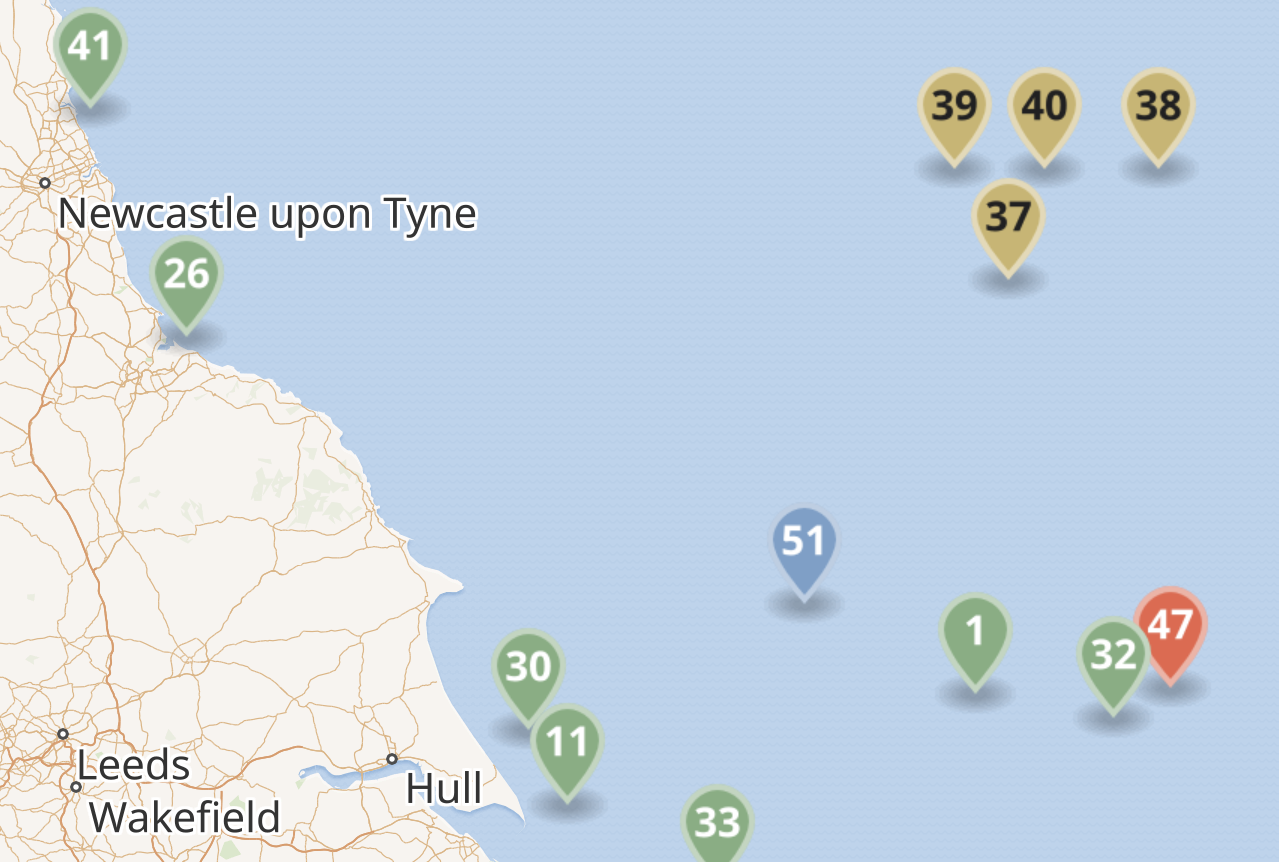
These are the Dogger Bank and Hornsea wind farms and their developers and size
- 37 – Dogger Bank A – SSE Renewables/Equinor – 1,235 MW
- 39 – Dogger Bank B – SSE Renewables/Equinor – 1,235 MW
- 38 – Dogger Bank C – SSE Renewables/Equinor – 1,218 MW
- 40 – Sofia – RWE – 1,400 MW
- 1 – Hornsea 1 – Ørsted/Global Infrstructure Partners – 1,218 MW
- 32 – Hornsea 2 – Ørsted/Global Infrstructure Partners – 1,386 MW
- 47 – Hornsea 3 – Ørsted – 2,852 MW
- 51 – Hornsea 4 – Ørsted – 2,400 MW
Note.
- That is a total of 12, 944 MW, which is probably enough electricity to power all of England and a large part of Wales.
- Wikipedia’s List of offshore wind farms in the United Kingdom, also lists a 3,000 MW wind farm, that is being developed by German company ; RWE called Dogger Bank South,
- The Dogger Bank South wind farm is not shown on the map, but would surely be South of wind farms 37 to 40 and East of 51.
- The Dogger Bank South wind farm will raise the total of electricity in the Dogger Bank and Hornsea wind farms to just short of 16 GW.
Connecting 16 GW of new electricity into the grid, carrying it away to where it is needed and backing it up, so that power is provided, when the wind doesn’t blow, will not be a nightmare, it will be impossible.
An alternative plan is needed!
AquaVentus To The Rescue!
AquaVentus is a German plan to bring 10 GW of green hydrogen to the German mainland from the North Sea, so they can decarbonise German industry and retire their coal-fired power stations.
- I introduce AquaVentus in AquaVentus, which I suggest you read.
- AquaVentus is being developed by RWE.
- AquaVentus connects to a German hydrogen network called H2ercules to actually distribute the hydrogen.
This video shows the structure of AquaVentus.
I clipped this map from the video.
Note.
- The thick white line running North-West/South-East is the spine of AquaVentus, that will deliver hydrogen to Germany.
- There is a link to Esbjerg in Denmark, that is marked DK.
- There appears to be an undeveloped link to Norway, which goes North,
- There appears to be an undeveloped link to Peterhead in Scotland, that is marked UK.
- There appears to be a link to just North of the Humber in England, that is marked UK.
- Just North of the Humber are the two massive gas storage sites of Aldbrough owned by SSE and Brough owned by Centrica.
- Aldbrough and Rough gas storage sites are being converted into two of the largest hydrogen storage sites in the world!
- There appear to be small ships sailing up and down the East Coast of the UK. Are these small coastal tankers, that are distributing the hydrogen to where it is needed?
When it is completed, AquaVentus will be a very comprehensive hydrogen network.
I believe that offshore electrolysers could be built in the area of the Hornsea 4 and Dogger Bank South wind farms and the hydrogen generated would be taken by AquaVentus to either Germany or the UK.
- Both countries get the hydrogen they need.
- Excess hydrogen would be stored in Aldbrough and Rough.
- British Steel gets decarbonised.
- A 1.8 GW hydrogen-fired powerstation at Keadby gets the hydrogen it needs to backup the wind farms.
Germany and the UK get security in the supply of hydrogen.
These may be my best guesses, but they are based on published plans.
Danish Shoppers Boycott Coca-Cola Over Trump
The title of this post, is the same as that of this article in the Telegraph.
This is the sub-heading.
Sales slump in Scandinavian nation following US president’s threats to annex Greenland
These are the first two paragraphs.
Shoppers are boycotting Coca-Cola amid a backlash over Donald Trump’s erratic foreign policy, Carlsberg has said.
The Danish brewer, which bottles the fizzy drink in its home country, said sales were “slightly down” as consumers protested against the US president.
Trump obviously doesn’t realise that every action has an equal and opposite reaction.
New York Governor: ‘I Will Not Allow This Federal Overreach To Stand’
The title of this post, is the same as that of this article on offshoreWIND.biz.
This is the sub-heading.
Following the order of the US Department of the Interior (DOI) to halt all construction activities on the Empire Wind 1 offshore wind project, New York Governor Kathy Hochul said she would fight the federal decision.
This fight could get very nasty.
In the green corner, we have the New York governor; Kathy Hochul, Østed, Denmark and probably a lot of workers who thought they’d retrained for a new growing industry.
And in the orange corner, we have Donald Trump, Vladimir Putin and all the other useful idiots.
Interestingly, I may have met one of referees to this spat.
In The Lady On The Train, I describe a meeting with one of the most powerful justices in the United States.
As she either sat on the US Supreme Court or the New York State Supreme Court, it will be interesting how she would judge this case, given the liberal scientifically-correct conversation we had a few years ago.
The fight in the Courts would be very hard against a whole bench of formidable adversaries like this lady.
Trump’s Eyeing Greenland – But Other Arctic Investment Is Frozen
The title of this post, is the same as that of this article on the BBC.
The BBC Article is a good introduction to Trump’s ideas for Greenland.
This is my one thought.
Do we side with Trump and the United States or our Danish friends?
Siemens Gamesa To Soon Install 21 MW Offshore Wind Turbine Prototype At Danish Test Site — Reports
The title of this post, is the same as that of this article on offshoreWIND.biz.
This is the sub-heading.
Siemens Gamesa is transporting a nacelle from its facility in Brande, Denmark, to the Østerild wind turbine test centre, a company spokesperson confirmed to offshoreWIND.biz. The spokesperson declined to reveal any specifics about the wind turbine but Danish media writes that it is the new prototype which Bloomberg reported earlier this year to have a capacity of 21 MW.
These first two paragraphs give a few more details.
DR (Danish Broadcasting Corporation) reported on 6 December that lamp-posts and traffic signs were being dismantled, and roundabouts widened last week to make room for an 11×11-metre nacelle to pass through on its way to Hvide Sande, starting last Friday. From there, the nacelle will be shipped to Hanstholm and then transported to Østerild, where it will be mounted on an already installed 170-metre tower, according to DR.
In June, Bloomberg reported sources familiar with the matter said that Siemens Energy had told customers it planned to build the largest wind turbine in the world by the end of the decade and the new offshore model would have an output of 21 MW, 40 per cent more than the company’s current largest turbine, the 14 MW platform that can reach up to 15 MW with the company’s feature called Power Boost.
I have a few thoughts.
Will Bigger Be Better?
Going back to the days of North Sea Oil and Gas, I can remember project managers saying that platform installation took off dramatically, as larger platforms, barges, cranes and equipment became available.
I can particularly remember one project manager extolling the virtues of giant 3000 tonne cranes.
Do We Need A Test Centre For Giant Turbines In The UK?
The question has to be asked, as we certainly have large open spaces of sea to put a 40 MW or larger turbine.
 The Anonymous Widower