Floating Offshore Substation Project Secures EUDP Funding
The title of this post, is the same as that of this article on offshoreWIND.biz.
This is the sub-heading.
Semco Maritime, ISC Consulting Engineers, Aalborg University, Energy Cluster Denmark, and Norway and Sweden-based Inocean have secured funding to further develop a floating offshore substation (FOSS) concept.
This is the first paragraph.
The parties announced their collaboration in 2022 and are now set to further accelerate floating offshore substation development through funding from the Energy Technology and Demonstration Program (EUDP).
These three paragraphs talk about the design.
The substation layout has been developed to fit the shape of a three-column stabilised substructure, according to the partners.
The floating offshore substation is a crucial component in the offshore wind farm industry as deeper ocean sites further from the coastline are to be utilised, the partners said.
Between 60-80 per cent of the world’s offshore wind energy potential is in areas with depths greater than 60+ metres, which presents a need for an alternative solution to bring the power to shore, such as a floating offshore substation, according to the developers.
That all seems sensible.
The Netherlands Chooses Site For World’s Largest Offshore Wind-to-Hydrogen Project
The title of this post, is the same as that of this article on offshoreWIND.biz.
This is the sub-heading.
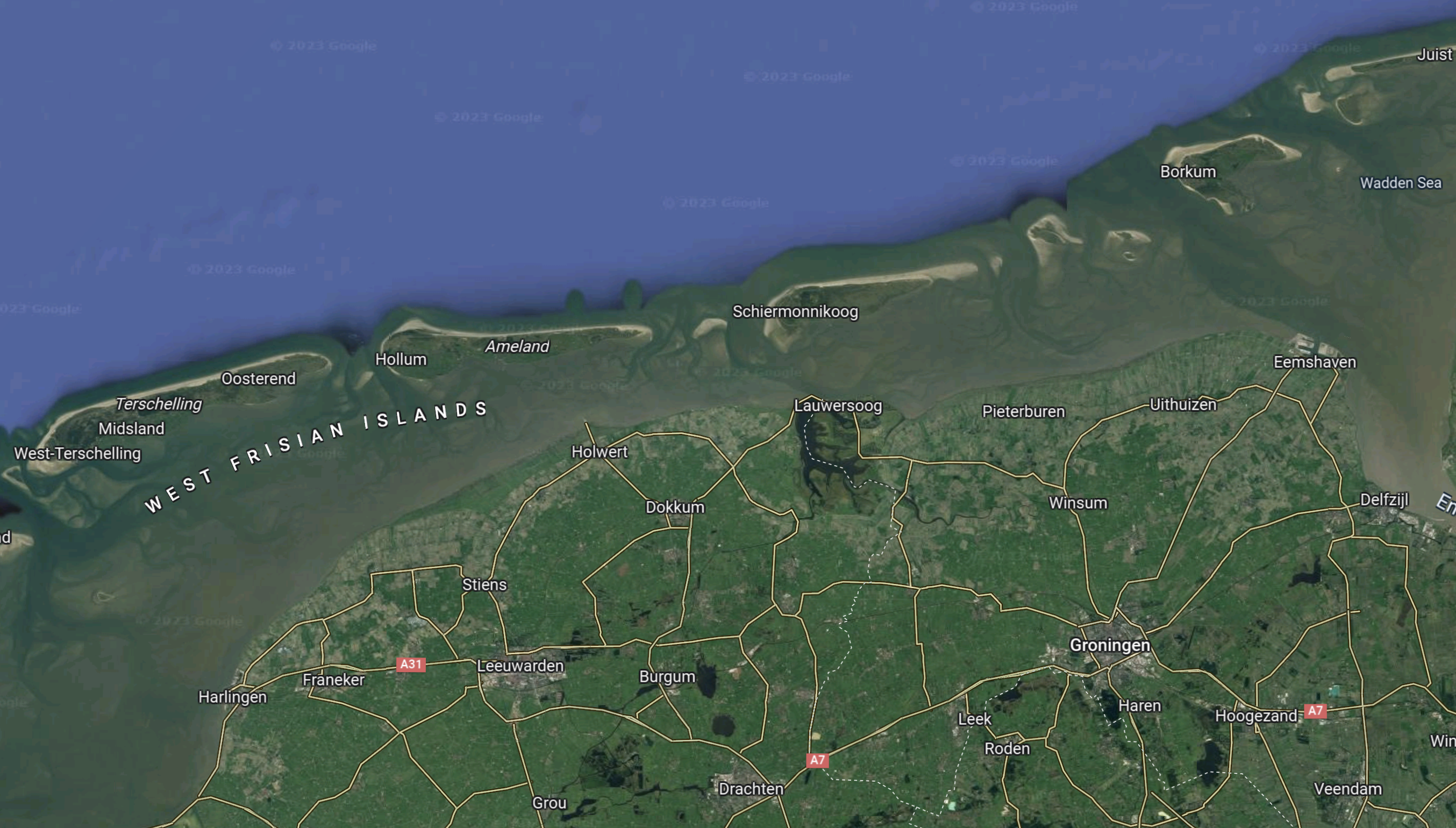
The Dutch government has designated an area for what will become the world’s largest offshore hydrogen production project. That area is Ten noorden van de Waddeneilanden (the North of the Wadden Islands), identified earlier for offshore wind development and deemed most suitable for providing 500 MW of electrolysis capacity and for the transport of hydrogen to land.
This Google Map shows the Wadden Islands.
Note.
- Groningen is in the South-East corner of the map.
- I wrote about Eemshaven, which is to the North-East of Groningen in The Train Station At The Northern End Of The Netherlands.
- The Wadden or Frisian Islands are along the coast.
The Wadden Islands of the Netherlands, Germany and Denmark are a World Heritage Site.
In Can The UK Have A Capacity To Create Five GW Of Green Hydrogen?, I said the following.
Ryze Hydrogen are building the Herne Bay electrolyser.
- It will consume 23 MW of solar and wind power.
- It will produce ten tonnes of hydrogen per day.
The electrolyser will consume 552 MWh to produce ten tonnes of hydrogen, so creating one tonne of hydrogen needs 55.2 MWh of electricity.
If the Dutch build a 500 MW electrolyser it will produce 217 tonnes of hydrogen per day.
The Dutch Plan For Hydrogen
This 500 MW electrolyser fits well with the The Dutch Plan For Hydrogen.
Project Launches To Pair Offshore Wind With Sustainable Food Production
Note that it’s a little over a fortnight to April Fool’s Day!
The title of this post, is the same as that of this article on offshoreWIND.biz.
This is the sub-heading.
Win@Sea, a new collaboration between Vattenfall and Danish universities and companies, will investigate how to produce offshore wind power and sustainable food – all while improving the marine environment and biodiversity in the same marine area.
This is the first paragraph.
The partners will look into whether an offshore wind farm could simultaneously produce fossil-free electricity and sustainable food while also contributing positively to biodiversity in the same area.
But this report is not alone, in using the sea as a farm.
- Amazon Finances First-Ever Commercial-Scale Seaweed Farm Located Between Offshore Wind Turbines
- Brown Seaweed Could Remove 550 Million Tons Of Carbon
- The Plans For Giant Seaweed Farms In European Waters
- Oysters Get New Home At Eneco Luchterduinen Offshore Wind Farm
It sounds to me like a case of great minds thinking alike.
European Company To Make All Wind Turbine Blades 100 % Recyclable, Plans To Build Six Recycling Factories
The title of this post, is the same as that, of this article on offshoreWIND.biz.
This sub-heading outlines what the company plans to do.
A Denmark-based company Continuum plans to make all wind turbine blades fully recyclable and stop landfilling and their emissions-intensive processing into cement with six industrial-scale recycling factories across Europe, backed by investment from the Danish venture capital firm Climentum Capital and a grant from the UK’s Offshore Wind Growth Partnership (OWGP).
Other points in the article include.
- Continuum plan six factories.
- The first factory will open at Esbjerg in Denmark in 2024 and will be able to accept end-of-life blades this year.
- The second factory will be in the UK and it will be followed by others in France, Germany, Spain, and Turkey.
- Each factory will have the capacity to recycle a minimum of 36,000 tonnes of end-of-life turbine blades per year.
This paragraph describes, what will happen to the recycled turbine blades.
The company will recycle wind turbine blades into composite panels for the construction industry and the manufacture of day-to-day products such as facades, industrial doors, and kitchen countertops.
Looking at their description of their mechanical separation process, I suspect that they could recycle other products and manufacture lots of others.
Denmark’s Bank Robbers Count The Cost Of Cashless Society
The title of this post is the same as that of this article on The Times.
This is the second paragraph.
Figures from Finans Danmark, an industry association, show the number of attacks has collapsed in recent years as the shift towards online transactions has led many Danish banks to abandon cash services in branches. While there were 221 bank robberies in 2000, the number of hold-ups in Denmark fell to 121 in 2004, before declining to one in 2021 and none last year.
There were also no attacks on ATM machines.
Doing away with cash certainly cuts crime and it must be twelve years, since a Unite representative on Manchester buses told me he wanted cashless ticketing on Manchester’s buses and trams, as since it had been introduced in London, attacks on staff had declined dramatically.
I also wonder by how much the Income Tax take would rise?
Danes Talk 62 MW Offshore Wind Turbines For North Sea Energy Island
The title of this post, is the same as that of this article on Offshore Energy.
The Danes may talk 62 MW, but that four times larger than one of the biggest today, that I wrote about in Vestas 15 MW Prototype Turbine Produces First Power.
This paragraph says a bit more about the 62 MW turbine.
According to the DEA’s framework document for the draft plan for the strategic environmental assessment (SEA), this could be a 500-metre-tall wind turbine with a rotor diameter of 480 metres and a capacity of up to 62 MW.
This turbine is bigger in terms of capacity, than than some whole farms.
Gasunie Investigates Hydrogen Network In North Sea
The title of this post, is the same as that of this news article on the Gasunie web site.
Dogger Bank – The Joke That Is Growing Up To Be A Wind Powerhouse
The Wikipedia entry for the Dogger Bank, describes it like this.
Dogger Bank is a large sandbank in a shallow area of the North Sea about 100 kilometres (62 mi) off the east coast of England.
But many of my generation remember it from its use in the Shipping Forecast and as a joke place like the Balls Pond Road, Knotty Ash and East Cheam, in radio and TV comedy from the 1950s and 1960s.
But now it is being turned into one of the largest wind powerhouses!
According to Wikipedia’s list of the UK’s offshore wind farms, these wind farms are being developed on the Dogger Bank.
- Sofia Offshore Wind Farm – 1400 MW – Under Construction – Commissioning in 2023/26 – £39.65/MWh – RWE
- Dogger Bank A – 1235 MW – Under Construction – Commissioning in 2023/24 – £39.65/MWh – SSE/Equinor
- Dogger Bank B – 1235 MW – Pre-Construction – Commissioning in 2024/25 – £41.61/MWh – SSE/Equinor
- Dogger Bank C – 1218 MW – Pre-Construction – Commissioning in 2024/25 – £41.61/MWh – SSE/Equinor
- Dogger Bank D – 1320 MW – Early Planning – SSE/Equinor
- Dogger Bank South – 3000 MW – Early Planning – RWE
Note.
- These total up to 9408 MW.
- The Dogger Bank wind farms have their own web site.
- The Sofia offshore wind farm has its own web site.
- The Dogger Bank South wind farms have their own web site.
- Dogger Bank A and Dogger Bank B will connect to the National Grid at Creyke Beck to the North of Hull.
- Sofia and Dogger Bank C will connect to the National Grid at Lazenby on Teesside.
But this is only the start on the British section of the Dogger Bank.
This map, which comes courtesy of Energy Network Magazine and 4C Offshore is entitled 2001 UK Offshore Windfarm Map shows all UK offshore wind farms and their status. It looks to my naive mind, that there could be space for more wind farms to the North and West of the cluster of Digger Bank wind farms.
The North Sea Wind Power Hub
The UK doesn’t have full territorial rights to the Dogger Bank we share the bank with the Danes, Dutch and Germans.
In the Wikipedia entry for the Dogger Bank wind farm, this is said about the North Sea Wind Power Hub.
Dutch, German, and Danish electrical grid operators are cooperating in a project to build a North Sea Wind Power Hub complex on one or more artificial islands to be constructed on Dogger Bank as part of a European system for sustainable electricity. The power hub would interconnect the three national power grids with each other and with the Dogger Bank Wind Farm.
A study commissioned by Dutch electrical grid operator TenneT reported in February 2017 that as much as 110 gigawatts of wind energy generating capacity could ultimately be developed at the Dogger Bank location.
Note.
- 110 GW shared equally would be 27.5 GW.
- As we already have 9.4 GW of wind power, under construction or in planning around the Dogger Bank, could we find space for the other 18.1 GW?
- I suspect we could squeeze it in.
If we can and the Danes, Dutch and Germans can generate their share, the four countries would each have a 27.5 GW wind farm.
What would put the icing on the cake, would be if there could be a massive battery on the Dogger Bank. It wouldn’t be possible now and many would consider it a joke. But who knows what the capacity of an underwater battery based on concrete, steel, seawater and masses of ingenuity will be in a few years time.
Where Does Norway Fit In To The North Sea Wind Power Hub?
It could be argued that Norway could also connect to the North Sea Wind Power Hub.
- 110 GW shared equally would be 22 GW.
- Norway can build massive pumped storage hydroelectric power stations close to the landfall of an interconnector to the North Sea Wind Power Hub.
- the British, Danes, Dutch and Germans can’t do that, as they don’t have any handy mountains.
- Norway is a richer country the others involved in the project.
I can see Norway signing up to the North Sea Wind Power Hub.
The North Sea Link
The Wikipedia entry for the North Sea Link, introduces it like this.
The North Sea Link is a 1,400 MW high-voltage direct current submarine power cable between Norway and the United Kingdom.
At 720 km (450 mi) it is the longest subsea interconnector in the world. The cable became operational on 1 October 2021.
It runs between Kvilldal in Norway and Blyth in Northumberland.
I wouldn’t be surprised to see that the North Sea Link is modified, so that it has a connection to the North Sea Wind Power Hub.
North Seas Countries Commit To 260 GW Of Offshore Wind By 2050
The title of this post, is the same as that of this article on Renewables Now.
This is the first two paragraphs.
The nine member countries of the North Seas Energy Cooperation (NSEC) on Monday committed to at least 260 GW of offshore wind energy by 2050.
The NSEC aims to advance offshore renewables in the North Seas, including the Irish and Celtic Seas, and groups Belgium, Denmark, France, Germany, Ireland, Luxembourg, the Netherlands, Norway, Sweden and the European Commission.
Note.
Intermediate targets are 76 GW by 2030 and 193 GW by 2040.
The UK has a target of 50 GW by 2030, of which 5 GW will be floating offshore wind.
The UK is not mentioned, but has joint projects with the Danes, Germans, Irish, Norwegians, Spanish and Swedes.
There is nothing about energy storage or hydrogen!
On the figures given, I think we’re holding our own. But then we’ve got more sea than anybody else.
Germany Has Potential For 82 GW Of Offshore Wind
The title of this post, is the same as that of this article on Renewables Now.
These are the two introductory paragraphs.
Germany has the potential to raise its offshore wind energy capacity to 81.6 GW which is above the federal government’s target of 70 GW by 2045, a study by research institute Fraunhofer IWES shows.
To exploit all the potential for wind energy in the North Sea and the Baltic Sea, Germany needs to devise a strategy for more efficient use of the available space and use new offshore wind power technologies in additional areas in a way that will not raise concerns and affect nature conservation.
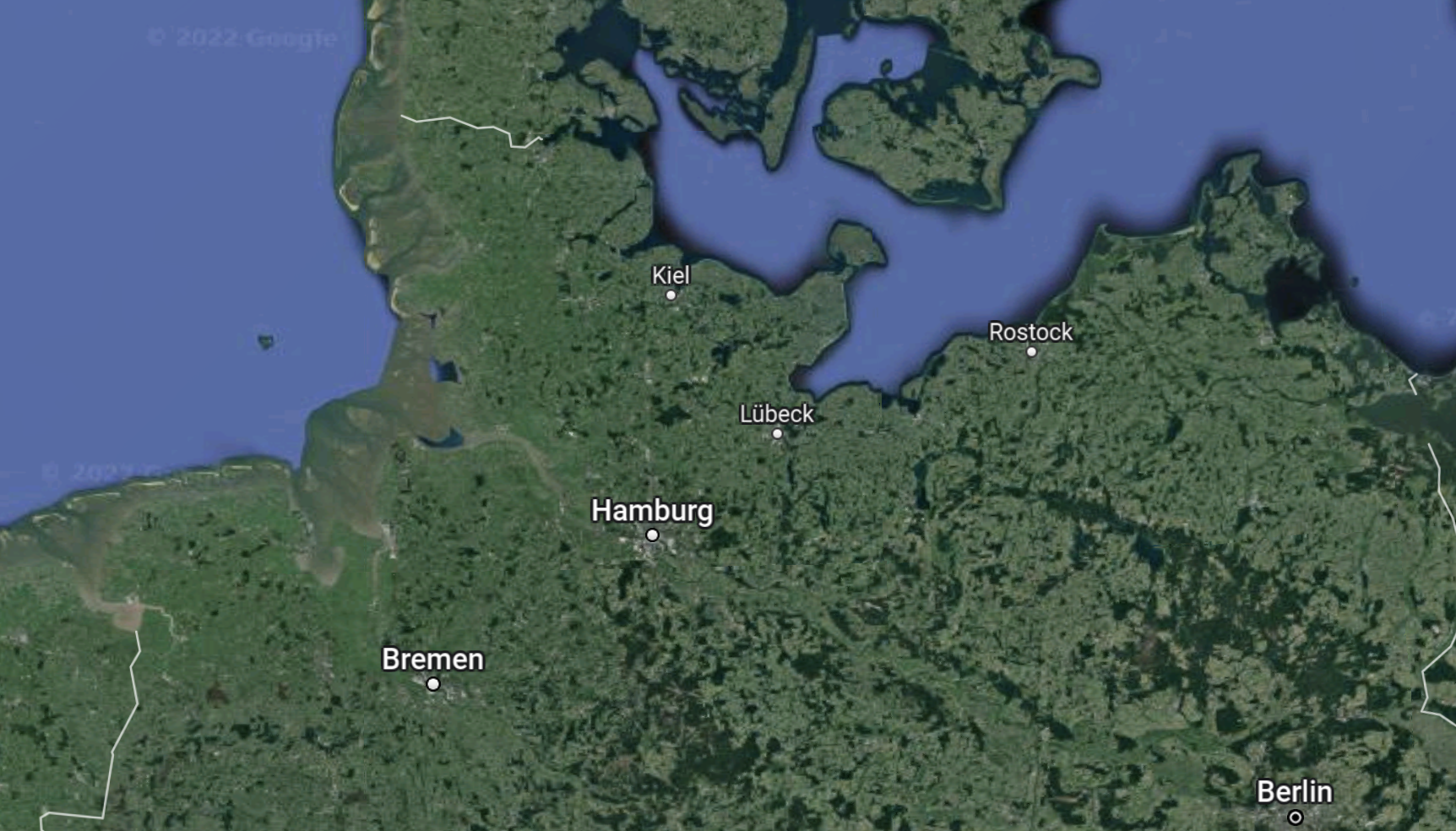
This map shows the German parts of the North Sea and the Baltic Sea.
Note.
- White lines show the borders with The Netherlands, Denmark and Poland.
- Heligoland in the South-East corner of the North Sea. Could this island be used as a giant offshore substation?
- There are plenty of ports to service offshore developments.
- It looks like compared to the UK, a fair proportion of German offshore wind farms will be closer to the land.
Currently, Germany has 7.8 GW of offshore wind in operation, with around seventy percent of the turbines in the North Sea.
According to the Wikipedia entry called Wind Power In The UK, in 2019, the UK had installed 8.4 GW of offshore wind turbines, and there could be a potential to have a total of 120 GW in British waters.
With the Belgians, Danes, Dutch, Irish, Norwegians, Poles and Swedes joining this party, I can see the world’s largest wind power station being developed in the North and Baltic Seas.
 The Anonymous Widower