Will HS2 And Northern Powerhouse Rail Go For The Big Bore?
Different Versions Of This Post
The original post was published on the 25th August 2019.
It has been updated on the 21st November 2020 to reflect changes made to High Speed Two (HS2).
It has been updated on the 13th January 2023 for piggy-back freight trains.
The Merging Of High Speed Two And Northern Powerhouse Rail
It looks to me that there will be increasing links and merging between High Speed Two (HS2) and Northern Powerhouse Rail (NPR).
This report on the Transport for the North web site, is entitled At A Glance – Northern Powerhouse Rail.
Proposals and possibilities include.
- NPR will have a Western terminal at a new station in Liverpool City Centre.
- HS2 trains would access Liverpool and Manchester via a junction between HS2 and NPR at High Legh.
- There will be six trains per hour (tph) between Liverpool and Manchester via Manchester Airport.
- The route between Manchester and Manchester Airport is planned to be in tunnel.
- There will be six tph between Manchester and Leeds.
In addition, Boris has made positive noises about a high speed line between Manchester and Leeds being of a high priority.
So will the planners go for the logical solution of a High Speed tunnel between Manchester Airport and Leeds?
- There could be a theoretical capacity of perhaps 18 tph, which is the design capacity of High Speed Two.
- Speeds of up to 125 mph or more could be possible. The Gottard Base Tunnel has an operating speed for passenger trains of 125 mph.
- Stations could be at Manchester Airport, Manchester Piccadilly/Piccadilly Gardens/Victoria, Huddersfield, Bradford and Leeds.
- West of Manchester Airport, the route appears easier and the tunnel would emerge close to the airport. High Speed Two is planning that the tunnel emerges just to the North of the Airport and that the station is below ground level.
- East of Leeds the tunnel would join up with existing routes to Doncaster, Hull, Newcastle and York.
- Freight trains would be allowed at speed of up to 100 mph.
I believe such a tunnel could be built without disrupting existing rail services and passengers. Remember building Crossrail’s tunnels in London was an almost invisible process.
It would result in two rail systems across Northern England.
- Upgraded Classic Rail Routes
- The Big Bore
My thoughts on the two systems follow.
Upgraded Classic Rail Routes
This could include improvements such as these,
- Extra passing loops.
- Selective electrification
- Improved stations
- Comprehensive in-cab digital signalling
- More paths for passenger and freight trains.
Which could be applied to routes, such as these.
- The Huddersfield Line
- The Chat Moss Line
- The Calder Valley Line
- The Hope Valley Line
- The Dearne Valley Line
- The Selby Line
- The Midland Main Line North Of Clay Cross
In addition, there could be the reopening of some closed or freight routes to passenger trains.
This article on Rail Technology Magazine is entitled Network Rail Reveals Detailed £2.9bn Upgrade Plans For TransPennine Route.
It is a comprehensive upgrade that includes.
- Improvement between Huddersfield and Westtown, which is near Dewsbury
- Grade separation or a tunnel at Ravensthorpe
- Rebuilding and electrification of eight miles of track.
- Possible doubling the number of tracks from two to four.
- Improved stations at Huddersfield, Deighton, Mirfield and Ravensthorpe.
This project would be a major improvement to the Huddersfield Line.
In Sheffield Region Transport Plan 2019 – Hope Valley Line Improvements, I talked about planned improvements to the Hope Valley Line, which should begin in the next couple of years.
These improvements are given in detail under Plans in the Wikipedia entry for the Hope Valley Line.
The Hope Valley Improvements will cost in the region of tens of millions of pounds and Wikipedia sums up the benefits like this.
These changes to allow three fast trains, a stopping train and freight trains each hour were also supported in a Transport for the North investment report in 2019, together with “further interventions” for the Northern Powerhouse Rail programme.
It seems like good value to me!
So could we see other multi-million and billion pound projects created to improve the classic routes across the Pennines?
Projects would be fully planned and the costs and benefits would then be assessed and calculated.
Then it would be up to the Project Managers to devise the optimal structure and order in which to carry out all the projects.
I wouldn’t be surprised to see the following techniques used.
- Discontinuous electrification to avoid bridge reconstruction.
- Intelligent, hybrid diesel/electric/battery trains from Bombardier, CAF, Hitachi or Stadler, capable of 125 mph running and changing mode at speed.
- Modular digital signalling
- Factory built stations and step-free bridges.
- Removal of all level crossings.
- All stations updated for step-free access between train and platform.
The objectives would be as follows.
- More train paths, where needed.
- Faster line speed.
- Less running on diesel.
- Fast station stops.
Hopefully, the upgrading could be done without too much disruption.
Remember though, that disruption to existing users during a project, is most likely down to bad project management.
The Big Bore
The Central Core tunnel of Crossrail between Royal Oak and East London, was virtually a separate project before Crossrail’s stations and much of other infrastructure was built.
I believe that digging the tunnel first gave a big advantage, in that it could be constructed as an independent project, provided that the logistics of delivering the components and removing the junk was done efficiently.
But it did mean that travellers wouldn’t see any benefits until the project was almost complete.
HS2 and NPR are different in that they also envisage upgrading these routes.
- The Huddersfield Line
- The Chat Moss Line
- The Calder Valley Line
- The Hope Valley Line
- The Dearne Valley Line
- The Selby Line
- The Midland Main Line North Of Clay Cross
Only the Huddersfield Line is directly affected by the Big Bore.
Effectively, the Big Bore will provide a by-pass route for passenger trains between Leeds and West of Manchester Airport, to take the fast trains of HS2 and NPR underneath the congested classic lines.
In Changes Signalled For HS2 Route In North I said this about a tunnel between Leeds and Manchester.
To get a twenty-five minute time between Leeds and Manchester with a ten minute frequency, which I believe is the minimum service the two cities deserve, would be like passing a whole herd of camels through the eye of a single needle.
The Swiss, who lets face it have higher hills, than we have in Northern England would create a new route mainly in tunnel between the two cities, with perhaps an underground station beneath the current Grade I Listed; Huddersfield station.
The transport for the North report suggests Bradford Low Moor station, as an intermediate station, so why not Bradford Low Moor and Huddersfield stations?
Note that the Gotthard Base Tunnel, which opened a couple of years ago, deep under the Alps, is about the same length as a Leeds and Manchester tunnel, and cost around eight billion pounds.
It would be expensive, but like Crossrail in London, the tunnel would have big advantages.
- It could be built without disrupting current rail and road networks.
- It would have a capacity of up to thirty tph in both directions.
- Unlike Crossrail, it could handle freight trains.
- It would unlock and join the railway systems to the East and West.
I believe, it would be a massive leap forward for transport in the North of England.
It would be a very big project and probably one of the longest rail tunnels in the world.
Comparison With The Gotthard Base Tunnel
But surely, if a small and rich nation like Switzerland can build the Gotthard Base Tunnel, then we have the resources to build the Big Bore between Manchester Airport and Leeds.
Consider these facts about the Gotthard Base Tunnel.
- It is two single track bores.
- Each bore has a track length of around 57 kilometres or 35 miles.
- The tunnel may be deep, but it is direct and level.
- The maximum speed is 250 kph or 160 mph.
- The operational speed for passenger trains is 200 kph or 125 mph.
- The operational speed for freight is 100 kph or 62 mph.
- It can take the largest freight trains.
To make numbers even more impressive it is joined to the shorter Ceneri Base Tunnel, to provide an even longer route.
Manchester Airport And Leeds Direct
Now consider Manchester Airport and Leeds.
- The current rail distance is 56 miles.
- There are stops at Manchester Piccadilly, Manchester Oxford Road, Manchester Victoria and Huddersfield stations.
- Journey time is eighty minutes.
But the direct distance is only 68 kilometres or forty-three miles.
Surely if the Swiss can blast and dig two 57 km. single-track rail tunnels through solid rock, we can go eleven kilometres further with all the recent experience of tunnelling around the world.
The lengths of the various legs would be as follows.
- Manchester Airport and Manchester – 14 km.
- Manchester and Huddersfield – 35 km.
- Huddersfield and Bradford – 17 km.
- Bradford and Leeds – 13 km
Trains running on the various legs at 200 kph, which is the cruising speed of a 1970s-built InterCity 125, could take the following times for the various legs.
- Manchester Airport and Manchester – 4.2 minutes
- Manchester and Huddersfield – 10.5 minutes
- Huddersfield and Bradford – 5.1 minutes
- Bradford and Leeds – 13 km – 3.9 minutes
Leeds and Manchester Airport would be under thirty minutes apart, even allowing two minutes each for the three stops.
Looking at NPR between Liverpool and Hull, times could be as follows.
- Liverpool and Manchester – 26 minutes
- Manchester and Leeds – 20 minutes
- Leeds and Hull – 38 minutes
Or a Coast-to-Coast time of under ninety minutes.
Train Frequencies
HS2 is being designed to handle eighteen tph, although slower intensive railways in the UK can handle up to twenty-four tph.
At the current time or certainly in a few years time, the theoretical maximum frequency through the Big Bore should be between these two figures. I will assume at least eighteen tph in this post.
The At A Glance – Northern Powerhouse Rail report talks about the following frequencies.
- Liverpool and Manchester via Manchester Airport – Six tph.
- Manchester and Leeds – Six tph
- Leeds and Hull – Two tph
This is all so lacking in ambition. It is like building a new high capacity road and only allowing those with status to use the road.
If Leeds and Manchester Airport can handle eighteen tph, why not use some of it to create an Express Metro under the Pennines?
To me, if the Big Bore is built, nothing short of twelve tph or a train every five minutes is acceptable, at Liverpool, Manchester Airport, Manchester, Huddersfield, Bradford and Leeds stations.
The extension to Hull could be reduced to perhaps six tph, but with the upgrading of the Hull and Leeds Line to perhaps 140 mph, I’d be bold and create a true TransPennine Express;
Hull and Liverpool every five minutes would be the ultimate Marketing Man’s dream.
The Underground Stations
Manchester Airport, Manchester, Huddersfield, Bradford and Leeds would all be through stations deep underground.
- They would be connected to the surface by lifts and escalators.
- Some entrances to the stations would connect to existing stations and others might emerge in City squares like Manchester’s P:iccadilly Gardens.
- Most stations would be just two platforms, as all trains would pass through on either side of a large underground concourse.
- Bay platforms could be added as required.
- All stations would have platform edge doors.
- Passengers would be able to reverse direction by just walking across the concourse.
Stations would build on the lessons learned from Crossrail. But then NPR is closer to Crossrail than a Classic High Speed Line.
Weston Williamson’s Vision For Manchester Piccadilly Station
I wrote about this in The Rival Plans For Piccadilly Station, That Architects Say Will ‘Save Millions’.
I believe that this is the way to create an underground station.
The Terminal Stations
The two main terminal stations for NPR and trains running through the Big Bore would be the proposed High Speed station at Liverpool and the existing Hull station.
But one other terminal station is being created; Edinburgh.
I have been going to Edinburgh station to and from England for perhaps thirty years and the capacity of the station has constantly increased.
Recent developments have been an extended Platforms 5 and 6, that can take the longest LNER trains.
I wouldn’t be surprised to find out that with the application of digital signalling, that there is capacity for at least eight tph between Edinburgh and Newcastle.
There would certainly be capacity for at least two tph between Liverpool and Edinburgh via Manchester Airport, Manchester, Huddersfield, Bradford, Leeds, York and Newcastle.
In the East the other possibilities for terminals are Doncaster, Newcastle and York.
- I would discount Newcastle, as it lacks capacity and its location would make it difficult to add more.
- Doncaster has good connectivity and space, but do Leeds and Hull offer similar connectivity?
So that leaves Hull, Edinburgh and York, as the only Eastern terminals.
In the West, there is probably a need to connect to the Northern section of the West Coast Main Line (WCML).
- Glasgow Central is probably the obvious terminal, but it would need an extra connection at the junction of HS2, NPR and WCML at High Legh.
- If necessary Preston could be used, as it has space and lots of connectivity.
- Why not use Blackpool North, as it sits on a large site and is fully electrified. It could certainly take four tph?
- A lot of the things I said for Blackpool, also apply to Chester, which would give a gateway to Mid and North Wales!
The trains through the Big Bore could fan out at both the East and West.
Tunnel Size
As Manchester will be served by High Speed Two’s Full-Size trains from Birmingham and London, both Manchester stations will need to be built to accept these trains.
I feel that the whole tunnel between Manchester Airport and Leeds, should be built to the High Speed Two size, so that it can accept the largest possible passenger and freight trains, in the future.
That would obviously include the ability to handle piggy-back freight trains.
Integration Of HS2 and NPR
The At A Glance – Northern Powerhouse Rail report is proposing this and it looks that the following HS2 services could be possible between Euston and Manchester.
- Two tph – Euston and Hull via Old Oak Common, Manchester Airport, Manchester, Huddersfield, Bradford and Leeds
- Two tph – Euston and Edinburgh via Old Oak Common, Manchester Airport, Manchester, Huddersfield, Bradford, Leeds, York and Newcastle.
Note.
- Manchester Airport, Manchester, Huddersfield, Bradford and Leeds would all have four tph to and from London, by the Western arm of HS2’s Y.
- If in addition there were two tph between Liverpool and Hull and Liverpool and Edinburgh, this would mean four tph from the Big Bore of NPR to both Hull and Edinburgh.
- None of these core services need to terminate in the Big Bore.
I very much feel that integrating HS2 and NPR is the way to go.
Could We See A High Speed Northern Metro?
If we assume that the Big Bore could handle the HS2 frequency of at least eighteen tph, then it would be possible to create a high speed service across the Pennines with the following Metro-like frequencies.
- Liverpool and Hull – 4 tph
- Liverpool and Edinburgh – 2 tph
- Glasgow and Hull – 2 tph
- London Euston and Hull – 2 tph
- London Euston and Edinburgh – 2 tph
- London Euston and Glasgow – 2 tph
This would result in the following frequencies
- Liverpool – 6 tph
- Glasgow – 4 tph
- London Euston – 4 tph
- Manchester Airport – 12 tph
- Manchester – 12 tph
- Huddersfield – 12 tph
- Bradford – 12 tph
- Leeds – 12 tph
- Hull – 8 tph
- York – 4 tph
- Newcastle – 4 tph
- Edinburgh – 4 tph
What would these frequencies do for train travel in the North of England?
Freight
The Gotthard Base Tunnel has been designed so that both freight and passenger trains can use the route.
There is a need for extra freight capacity across the country and I wonder if freight trains could use the Big Bore.
I estimate that the Big Bore would be 68 kilometres if bored straight and level between West of Manchester Airport and Leeds.
Lets assume it is seventy kilometres or 43.5 miles.
So times, through the tunnel at various average speeds would be.
- 125 mph – 21 minutes
- 110 mph – 23.7 minutes
- 100 mph – 26.1 minutes
- 90 mph – 29 minutes
- 80 mph – 32.6 minutes
- 62 mph (Gotthard Base Tunnel speed for freight) – 42 minutes.
Could it be mandated that freight trains can use the tunnel, if they could maintain a particular speed?
Consider.
- A 125 mph train with stops at Manchester Airport, Manchester, Huddersfield, Bradford and Leeds would probably take thirty minutes to transit the tunnel.
- A freight train running at 90 mph would take more or less the same time.
- Fifteen tph would mean a train every four minutes.
- Automatic control of all trains in the tunnel would be a possibility. It appears to work on the much more complicated Thameslink.
I think with the following conditions, one or even two freight trains per hour, in addition to the passenger trains, can pass through the Big Bore in each direction.
- The locomotives have the performance of at least the Class 93 locomotive, which is currently being built.
- Freight trains can be hauled through at a minimum speed, which could be between 90 and 110 mph.
- The passenger trains and train and platform staff work together to produce very short station dwell times.
- All passenger trains are identical.
- Station platforms are designed so that passengers can leave and enter the trains rapidly.
It will be a Big Bore with a capacity to match!
What About Sheffield?
I haven’t forgotten Sheffield, but I think it could be linked across the Pennines by another route.
Under the upgrades for Northern Powerhouse Rail, it is proposed that services between Sheffield and Leeds become 4 tph in 25 minutes along the Dearne Valley Line.
Does Boris Know More Than He Lets On?
The headline on the front cover of Issue 885 of Rail Magazine is Boris Backs New Pennine Railway.
There is also a sub-heading of PM commits to Leeds-Manchester line.
Boris didn’t apply any substance to the speech, except to say that it will be funded.
Conclusion
I believe that my naïve analysis in this post shows that a TransPennine tunnel is possible.
But I believe that the right tunnel could have one big advantage.
Suppose it was built to handle the following.
- A capacity of eighteen tph, which is the same as High Speed Two.
- An operating speed of 140 mph or more. The Gotthard Base Tunnel has a maximum operating speed of 160 mph.
- High Speed Two’s Full-Size trains.
- The largest freight trains.
It would be future proofed for longer than anybody could envisage.
There are also other smaller advantages.
- It would by-pass a lot of difficult areas.
- It would cause very little aural and visual disruption.
- If it were designed with care, it would not affect the flora and fauna.
- As with the Swiss tunnel, it could be dug level, which would save energy and allow trains to run faster.
- It could be running twelve tph between Leeds and Manchester Airport via Bradford, Huddersfield and Manchester Piccadilly.
- Existing surface railways at the Eastern end could serve Cleethorpes, Darlington, Doncaster, Edinburgh, Hull, Middlesbrough, Newcastle, Scarborough, Sheffield and York
- Existing surface railways at the Western end could serve Barrow, Blackpool, Carlisle, Chester, Glasgow, Liverpool. North Wales, Preston and Wigan.
It would be more like Thameslink for the North turned on its side, rather than Crossrail for the North.
Government Announces £25m Brexit High-Speed Medicines Train
The title of this post is the same as that of this article on Rail Technology Magazine.
It’ll be interesting to see what happens to this proposal!
The Heaviest Freight Train Running In The UK
This is a paragraph from an article on Railway Gazette, which is entitled World Rail Freight News Round-Up.
Genesee & Wyoming subsidiary Freightliner has successfully operated a 4 624 tonne ‘jumbo train’ of aggregates from Merehead in Somerset to Acton in London, which it described as ‘the heaviest freight train currently running in the UK’. This was a trial run ahead of Freightliner taking over the haulage contract for the Mendip Rail joint venture of Hanson UK and Aggregate Industries. As the contract envisages the movement of 8 million tonnes/year, G&W’s Bulk Commercial Director for the UK/Europe Region, David Israel said ‘it was crucial that we tested the maximum haulage capability using one of our powerful Class 70 locomotives’
That is some train for the UK!
A few figures and calculations.
- Compare the weight of 4,624 tonnes with that of a nine-car 125 mph Class 800 train, which is just 438 tonnes.
- Fully loaded with 90 Kg passengers a Class 800 train weighs 494 tonnes.
- The Class 70 locomotive that is mentioned in the paragraph has a power of 2,750 kW and a weight of 129 tonnes.
- Travelling at 125 mph, the full passenger train has an energy of 214 kWh.
- Travelling at 41 mph, the freight train has an energy of 215 kWh
The stone train at 41 mph has a similar kinetic energy to a Class 800 train at 125 mph.
Just Look How The Port Of Felixstowe Has Grown
This article on Rail Engineer is entitled Felixstowe Branch Line Capacity Enhancement Goes Live.
This is the introductory paragraph.
Funded by the Strategic Freight Network, with a contribution from Hutchinson Ports UK (HP-UK), a £60.4 million investment to create a new 1.4km loop on the Felixstowe branch line in Suffolk was successfully brought into service on 29 May 2019, on time and on budget. It facilitates an increase from 33 to 47 freight train paths a day in each direction on this key artery, carrying the highest freight tonnage in the country and serving the largest container port in the UK.
High Speed Two it is not, but if you read the article, you’ll see that a substantial amount of work has been done, involving track, footbridges, level crossings and signalling.
I can remember the Port of Felixstowe, when it was a just a small basin, with the Little Ships Hotel, a couple of warehouses and the giant seaplane crane. A couple of times, I used the Harwich Ferry to cross the harbour to Harwich on the Brightlingsea.
In some ways Felixstowe has come a long way in those sixty years.
With the increase in capacity on the Felixstowe Branch Line, the rail link can handle the container traffic through the Port better!
Note this about trains between Ipswich and Felixstowe.
- 47 freight trains per day between Ipswich and Felixstowe is roughly two trains per hour (tph) in both directions.
- The current passenger service is one tph.
- In addition, there is an hourly Ipswich and Lowestoft train, which shares track between Ipswich and Westerfield Junction.
- The new Class 755 trains are faster and will have shorter dwell times than the current trains.
Between Ipswich and Westerfield, there are four tph.
- The route is double-track.
- Not all trains stop at Westerfield
- The level-crossing at Westerfield station has been improved and is now is a Manually Controlled Barrier with CCTV
- The signalling has been improved and moved to Colchester Power Signal Box.
Between Westerfield and Felixstowe, there are three tph.
- The route is single track with loops to the East of Derby Road and the West of Trimley stations.
- The level crossings have been improved and three have been converted to Manually Cntrolled Barriers.
- The signalling has been improved and moved to Colchester Power Signal Box..
It looks to my untrained eye, that these service pattern are possible.
So what will happen in the future?
In the next few sections, I talk about the future.
Could More Passenger Trains Be Run To Felixstowe And Lowestoft?
I suspect here, that the limiting factor will be platform capacity at Ipswich station.
Ipswich station will have at least four tph running between Stowmarket and Colchester (3 x London and Norwich and 1 x Peterborough and Colchester), that will use Plstform 2 at Ipswich station. I suspect that this means Lowestoft and Felixstowe trains will have to share the Bay Platform 1.
With good signalling and precision driving, I suspect that the single platform could handle 2 tph to both Felixstowe and Lowestoft.
There would only ever be one train in Platform 1 at Ipswich station, unlike now, where two trains share. The new Class 755 trains will be just too long.
Could Two tph Be Run Between Ipswich And Felixstowe?
The current timetable is as follows.
- Leaves Ipswich at XX:58 and arrives Felixstowe at XX:24
- Leaves Felixstowe at XX:28 and arrives Ipswich at XX::54
Note.
- The clock-face nature of the timetable.
- Both journeys are 26 minutes
- There is four minutes for the driver to change ends and have a break.
This service would need two trains and if there’s one thing that Abellio Greater Anglia aren’t short of, it’s three-car Cl;ass 755 trains.
If the trains had the branch to themselves, there could be a two tph service between Ipswich and Felixstowe.
But they have to share it with freight trains running at two tph.
This would mean the following.
- Five tph between Ipswich and Westerfield
- Four tph between Westerfield and Felixstowe.
As two tph between Ipswich and Felixstowe is likely to be on Greater Anglia’s wish list, I suspect the new track layout was designed with this service in mind.
Currently, there is one or two cars per hour between Ipswich and Felixstowe, but a two tph service would mean a minimum of six cars per hour or a massive increase in capacity.
Could Two tph Be Run Between Ipswich And Lowestoft?
The current timetable between Ipswich and Lowestoft stations is as follows.
- An almost clock-face hourly service in both directions.
- A journey time of just under one-and-a-half hours.
- There are nine stops on the route.
- There are several minutes for the driver to change ends and have a break.
When the new Class 755 trains are working the route, the following will apply.
- The Class 755 trains are faster and have a shorter dwell time in stations.
- There will be four London and Lowestoft services per day.
I think it is true to say, that journey times will be reduced.
I suspect that the following could be possible.
- A journey time of perhaps one hour and twenty minutes.
- Trains would leave Lowestoft at XX:07
- Trains would leave Ipswich at XX:37
This or something like it, would be an acceptable clockface timetable.
I strongly believe that an improved service will be possible between Ipswich and Lowestoft.
- I feel that two tph between Ipswich and Lowestoft might be difficult to achieve without extra works on the track.
- Extra capacity can be added by using four-car Class 755 trains on the route.
- Faster services will certainly be introduced, as the train’s faster speed and shorter dwell times will knock several minutes from the journey.
I also think, that it may be possible to introduce a second service on the Southern section of the route, which runs to perhaps Leiston or even Aldeburgh. This would give the busier Southern section of the route two tph.
So Platform 1 at Ipswich station could see the following trains.
- Two tph Ipswich and Felixstowe
- One tph Ipswich and Lowestoft
- One tph Ipswich and Leiston/Aldeburgh
I believe that timetabling of the route would not be a difficult task!
Four Trains Per Day Between Lowestoft and London
The London and Lowestoft service could be arranged as follows.
- Lowestoft station has three platforms., so one could be reserved for the London service.
- If the last service arrived back late or the first service needed to leave early, the dedicated platform could be used for overnight stabling.
- When running between Ipswich and Lowestoft it would take over, one of the Ipswich and Lowestoft paths.
- The trains will stop at all stations between Ipswich and Lowstoft, as there will be jealousy between users.
- It would call in the through platforms 2 and 3 at Ipswich station..
- The trains would make as few calls as possible South of Ipswich, as the Lowestoft train will be a fourth fast London service in the hour.
No new infrastructure would be required.
Could London And Lowestoft Services Be A Dedicated Shuttle Train?
This may have marketing advantages, as the train could have its own livery and perhaps a buffet or a catering trolley.
If you assume that the working day for a train is 0600-2400, then this means the following.
- A round trip must be performed in four and a half hours.
- A London and Lowestoft time of two hours and fifteen minutes,.
- The journey time would include the turnround time at the destination.
As Ipswich and London times of an hour are possible with a 100 mph trains, like the Class 755 train, Ipswich and Lowestoft would have to be run in a time as close to an hour as possible.
Consider.
- The only trains on the East Suffolk Line will be Class 755 trains between Ipswich and Lowestoft.
- Class 755 trains may be able to stop at stations in under a minute.
- Line speed could possibly be increased, as the route appears reasonably straight
- Some level crossings could probably be removed.
- The current average speed on the line is around 35 mph.
I also suspect that Greater Anglia have run tests with the current Class 170 trains, which are 100 mph trains to determine what times are possible.
I wouldn’t be surprised if using a single shuttle train to run the four trains per day between London and Lowestoft, is possible.
- Services could leave Lowestoft at 06:00, 10:30, 15:00 and 19:30
- Services could leave Liverpool Street at 08:15, 12:45, 17:15 and 21:45
The last service would arrive back in Lowestoft at midnight.
Tram-Trains Between Ipswich And Felixstowe
This report on the East-West Rail web site is entitled Eastern Section Prospectus and gives full details of their proposals for the Eastern section of the East-West Rail Link.
This is said in the report.
Introduction of a tram-train service on the Felixstowe branch, with doubling between Derby Road and Felixstowe and street running through
Ipswich.
It is also said, that there will be a frequency of four tph between Ipswich and Felixstowe.
It looks like the plan is to fully-double the branch line to the East of Derby Road station.
To the West of Derby Road, the line is mainly single track until it joins the East Suffolk Line close to Westerfield station.
The problem is that the single-track railway goes over the over the Spring Road Viaduct. Rebuilding the viaduct to add the second track, would be something that everybody would want to totally avoid, as how would the containers from forty-seven freight trains per day in both directions, be moved in and out of the Port of Felixstowe?
If the capacity can’t be increased, the demand will have to be reduced.
A Possible Tram-Train Proposal
The East West Rail report is proposing that the 1-2 tph passenger service between Ipswich and Felixstowe should be replaced by a four tph tram-train service.
- The tram-train service would start at Ipswich station, running as a tram.
- It would probably meander through Ipswich, serving places like Portman Road, the Town Centre< Christchurch Park, the new housing in the North, Ipswich Hospital and the Retail Parks in the East.
- If Ipswich gets a new Northern Ring Road, the tram-trains, might run on the original by-pass, that goes past Ipswich Hospital.
- It would then join the double-track section of the Felixstowe Branch Line on the Eastern outskirts of the town.
- Extra stops might be built between Ipswich and Felixstowe.
- At Felixstowe station, the tram-trains could revert to tram mode and might even go as far as the sea-front, using battery-power.
There are a lot of possibilities to give Ipswich and Felixstowe, one of the best local transport links in the world.
There will be some collateral benefits.
- Extra freight trains can probably be squeezed through.
- Ipswich Hospital will get the updated transport links, that it badly needs.
- Road traffic would be reduced.
I also believe that the tram-train could be added to the Felixstowe Branch Line without disrupting trains, freight or passengers.
Electrification
I can remember reports from the 1960s, which said that felt the Felixstowe Branch Line would be electrified.
- With a frequency of four tph, the route would surely be electrified for the tram-trains.
- It would probably be electrified at 25 KVAC, so that freight trains could take advantage.
- When street running in Ipswich and Felizstowe,, 750 VDC electrfication or battery-power could be used.
There would be no extra electrification needed to enable all freight trains going via London to be electric-hauled.
Freight Locomotives
I think it likely, that increasingly, we’ll see Class 93 locomotives and other electro diesel locomotives with a Last Mile capability taking freight trains into and out of the Port of Felixstowe.
These new breed of 110 mph locomotives will be able to take maximum-length freight trains on routes to, from and through London, but a new locomotive will be needed to take trains across East Anglia to Ely and Pryrtborough and then on to the Midlands and the Notth.
Conclusion
The Port of Felixstowe and the railways connecting it to the rest of the UK have come a long way in sixty years and they will expand more in the next decade or two!
An Unnecessary Diesel-Hauled Train
I took these picture at Blackhorse Road station this morning.
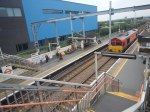
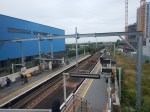


This train from Moss End to Dagenham Dock is pathed to be electric-hauled. So why was it hauled by a noisy and polluting Class 66 locomotive?
Toshiba Unveils Tri-Mode Locomotive Demonstrator
The title of this post is the same as that of this article on Railway Gazette.
This is the first two paragraphs.
Toshiba Railway Europe unveiled a electric-diesel-battery hybrid traction technology demonstrator locomotive at the Transport Logistic trade show in München on June 4.
The company has a contract to supply 50 diesel-battery centre cab locomotives to DB Cargo from 2021, TRE Managing Director Hinrich Krey told Railway Gazette. The demonstrator is intended to showcase the company’s design work to date as well as highlighting future development options.
It is based on the frame and bogies of a heavy shunting locomotive.
- There are two MAN 471 kW gensets.
- The diesel engines are compatible with EU Stage V emissions regulations.
- There are two SCiB 62 kWh lithium titanate oxide traction batteries.
- Battery life is quoted as up to ten years.
- The design is modular, so that a diesel engine can be replaced with another battery pack.
- A pantograph working with common European voltages can provide electric power.
The locomotive is aimed at heavy shunting and light freight.
Conclusion
The power of the locomotive is probably about 1MW, which is less than half the power of a Class 66 locomotive. But locomotives like the Class 66 are often used for tasks, where a smaller locomotive could do an excellent job.
The low pollution of the Toshiba locomotive probably means it could work in sensitive areas or close to a workforce.
The locomotive appears to be a well-designed locomotive for an important niche market.
If this design and others like the Stadler Class 93 locomotive succeed it will lead nearer to the ultimate goal of a high performance heavy freight zero-carbon locomotive to replace the polluting diesel locomotives, that are so common on the railways of the world.
CoolRail To Cut Carbon Footprint Of Fresh Food
The title of this post is the same as that of this article on Railway Gazette International.
These first two paragraphs outline the plan.
Food logistics company Euro Pool System has launched a thrice-weekly CoolRail dedicated temperature-controlled service to transport fresh produce between Valencia in Spain and Rotterdam in the Netherlands.
This is intended to be first route of planned network of CoolRail services which would link Spain with Germany, Scandinavia and the UK.
I can see this method of fresh food transportation growing, especially as CoolRail claim it is as fast as by road and cuts CO2 emissions by 70 to 90 %.
It also appears that the UK through the Channel Tunnel is in CoolRail’s plans.
Fish, Lamb And Beef To Europe
The obvious British export, that could use the service the other way to Europe is probably fish, as a large proportion of UK-landed fish goes to Europe at the present time.
This page on the Seafish web site, gives details about fish imports and exports.
Quality meat, like Welsh lamb and Scottish beef could also be sent to Europe, after being slaughtered in the UK.
What About Quality Food And Drink?
This page on the Scotch Whisky Association web site is entitled Scotch Whisky Exports On The Up in 2018.
This is two paragraphs from the page.
In 2018, the export value of Scotch Whisky grew +7.8% by value, to a record £4.70bn. The number of 70cl bottles exported also reached record levels growing to the equivalent of 1.28bn, up +3.6%.
The United States became the first billion pound export market for Scotch Whisky, growing to £1.04bn last year. The EU remains the largest region for exports, accounting for 30% of global value and 36% of global volume.
That means that Scotland exported to the EU, the equivalent of 461 million bottles of whisky, that is worth around £1.41billion.
A twenty-foot shipping container has a volume of 33.2 cubic metres., so with allowance for packaging, one could probably hold 33,200 bottles worth about £100,000.
To accommodate all Scotch Whisky exports to Europe on the 2018 figures, would need 14,000 containers per year or a very civilised thirty-eight containers a day.
Conclusion
There’s certainly a large market for food transport by rail across Europe and to the UK, some of which will be in containers with refrigeration and some without!
£14m Peak District Rail Freight Extension Unveiled
The title of this post is the same as that of this article on Rail Technology Magazine.
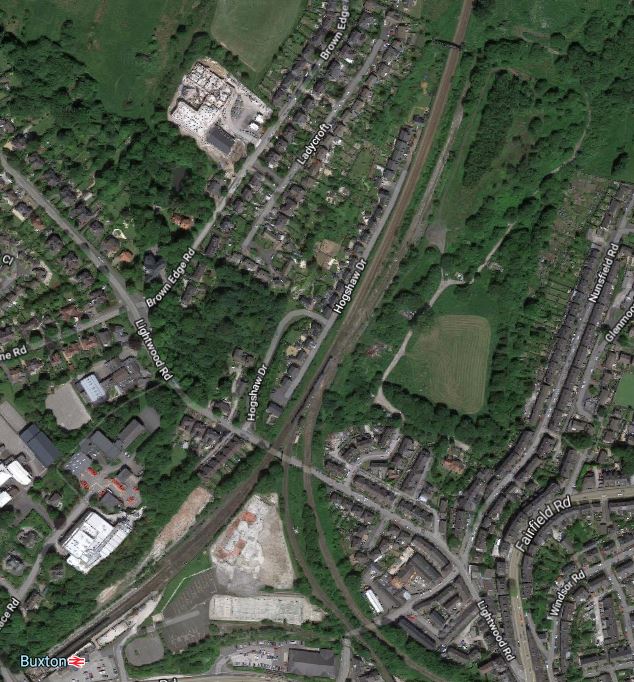
I discussed this project in full in Peak District Freight Sidings Get £18m Network Rail Boost, where I showed this Google Map of the sidings at Buxton, where the stone trains must reverse.
This latest Google Map, which is to a more detailed scale and 3D, clearly shows the lengthened sidings alongside the Manchester-Buxton Line.
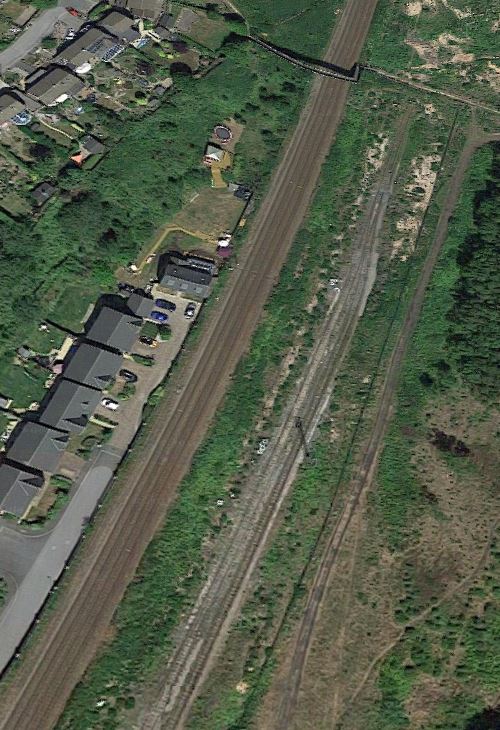
Note the footbridge across the lines appears in both maps.
Conclusion
It looks to me that Network Rail have managed to implement this freight project to bring more stone out of the Peak District by train.
As the cost of the completed project is quoted as less than the figure quoted before the project started., the project could even have been completed within the budget.
This has been a project when £18million has been spent for these benefits.
- Each train will transport 2,500 tonnes of materials.
- Each train will take 76 lorry loads from the roads.
- Less trains will be needed to transport the same tonnage.
How many other small projects like this could be undertaken?
Startup Nikola Bets Hydrogen Will Finally Break Through With Big Rigs
The title of this post is the same as that of this article on Forbes.
Read the article, as it is an interesting concept.
- Nikola Motor will not only build the trucks, but the hydrogen filling station network across North America.
- They believe big trucks are ideal for hydrogen power.
- They will also make their hydrogen filling station network available to car makes.
- The founder of the company; Trevor Milton, claims it’s easier to package hydrogen tanks in big vehicles than small ones.
- He also claims that hydrogen-powered trucks are much lighter than battery ones.
- Hydrogen will be produced from renewable sources, where it is needed.
- They are raising $1.2billion dollars to fund it.
First trucks will be delivered in 2022,, if all goes well with the funding.
I have no idea, whether it will work successfully, but surely a network of hydrogen filling stations, generating their own hydrogen across a Continent could be the kick, that hydrogen power for vehicles needs.
The UK is a small island and comparing it to North America, probably means the concept wouldn’t work in the UK, but if it works in North America, it will work in Europe.
But, if Trevor Milton’s mathematics work for big trucks in North America, they may well work with trains in the UK. A few hydrogen filling stations for trains and locomotives at strategic depots might power a whole new generation of rail vehicles. The rail filling stations could be co-located with filling stations for hydrogen road vehicles.
Trucks In Cities And Large Urban Areas
As I walk around London I see lots of large trucks, that can be put into a few categories.
- Articulated delivery trucks, often for the big supermarkets.
- Eight-wheel rigid trucks moving loads of building materials or soil and rubble dug out of construction sites.
- Refuse trucks.
- Skip trucks
- Cement mixer trucks
With the exception of the first, many of these vehicles don’t do a large number of miles in a working day.
Will we see companies like Nikola Motor and others developing hydrogen or battery-powered trucks for these niches?
If they do, I can see some interesting working and fuelling strategies developing.
Would Hydrogen Trucks Be Ideal For Cross-Channel Traffic?
Imagine a journey between Stuttgart and the Toyota plant in Derby.
- Using the European hydrogen network, the truck arrives at Calais with a low hydrogen level.
- On arrival in Dover it goes to a convenient hydrogen station and fills up with enough hydrogen to make the five hundred mile return journey to Derby.
- The return journey to Stuttgart, would use a hydrogen filling station at Calais to speed the truck on it’s way.
Because of the distances involved, I’m sure hydrogen would work for regular high-value truck journeys across the Channel, even if different tractors were used on either side of the Channel, as they often are now!
You could also argue, that this journey would be better done by rail. But if that is the case, why is it so much cross-Channel freight moved by trucks?
Conclusion
Hydrogen will continue to attract innovation and it is not time to write it off yet.
Can You Fit These Cases In A Class 800 Train?
I took this picture at Edinburgh station, after arriving there on an Aberdeen to London train.
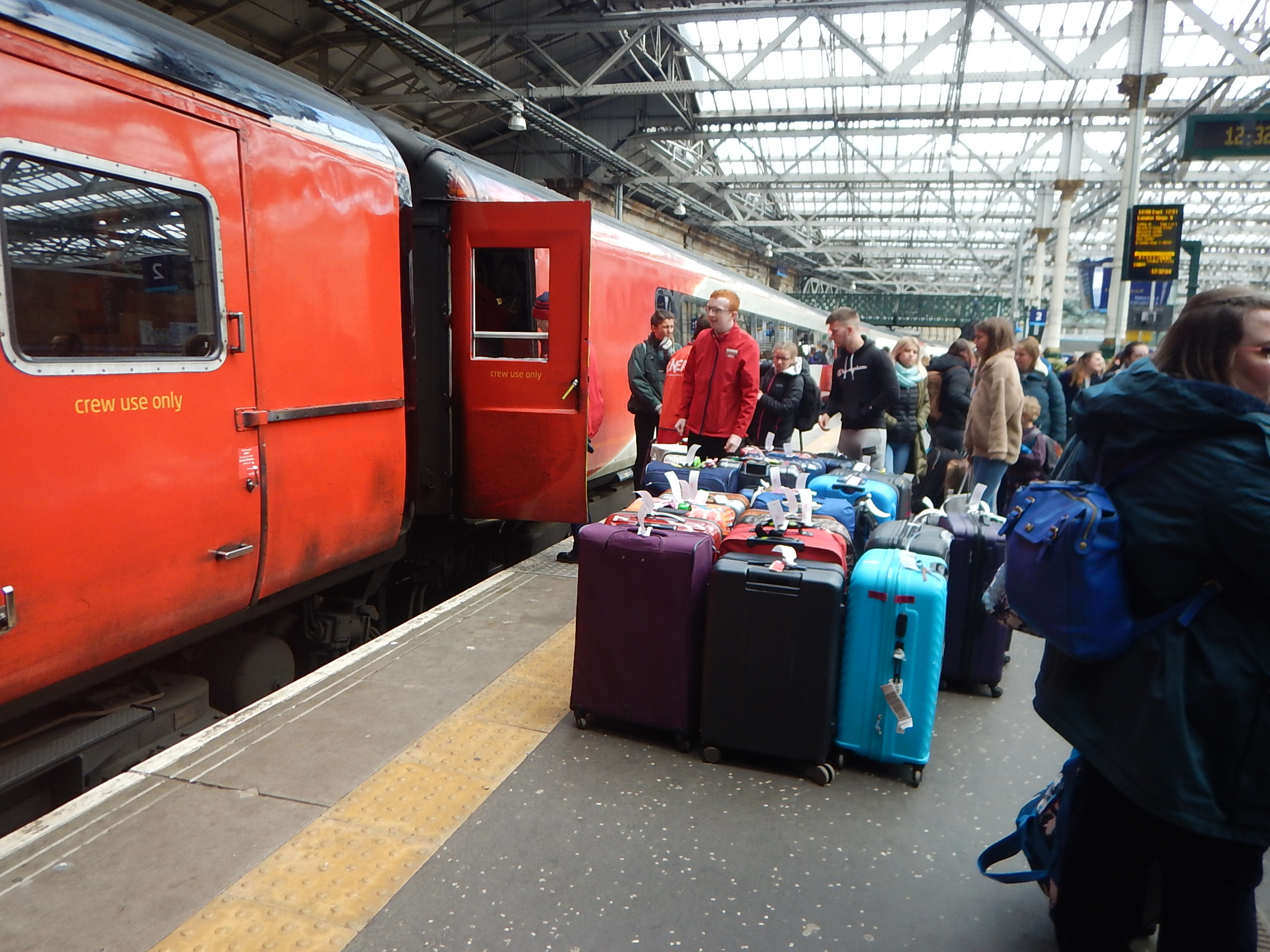
Could these cases be fitted into a new Class 800 train?
I’ve seen surfboards and heavily-loaded bikes being swallowed by a Class 43 locomotive in an InterCity 125.
Perhaps, passengers with loads like this, will fly to Edinburgh and then use ScotRail’s Inter7City trains around Scotland.

