Legal Challenge Against Gatwick Airport’s Second Runway To Begin
The title of this post is the same as that of this article on ITVX.
These four paragraphs add more details.
Plans to challenge a second runway at Gatwick Airport will be heard in the High Court next week.
The campaign and environmental group Communities Against Gatwick Noise Emissions (CAGNE) opposes Transport Secretary Heidi Alexander’s decision to grant development consent for the project.
In the hearing, which will run from 20 to 23 January 2026, CAGNE’s argues that the climate change impacts of the extra runway have not been properly assessed.
The planned expansion would see the repurposing of Gatwick Airport’s emergency runway for use as a second operational runway. The extra capacity is expected to lead to more than 100,000 more flights per year.
These two paragraphs give CAGNE’s case.
CAGNE says that this decision was flawed, arguing that there are numerous gaps in the environmental assessment of the airport expansion. These include a failure to adequately assess inbound flight emissions, the climate impact of non-carbon dioxide emissions, the handling of additional sewage, and noise pollution.
The group also argues that the second runway plans rely too heavily on the UK’s Jet Zero Strategy (JZS), which assumes ambitious improvements in the aviation industry in areas such as fuel efficiency.
My feelings are as follows.
- We need more runway capacity.
- Eventually all aircraft will be powered by electricity, hydrogen or sustainable aviation fuel (SAF).
- Because of the need for large amounts of renewable electricity to make hydrogen and SAF, the runway will need to be near offshore wind farms.
Only Doncaster Sheffield, Gatwick, Liverpool, Stansted and some Scottish airports are near the sea or could be connected to the coast by an easy-to-build cable or pipeline.
CAGNE may well win their case, but I fell Nimbys will also stop Heathrow getting a third runway.
Gatwick Second Runway Plan Approved By Transport Secretary
The title of this post is the same as that of this article on the BBC.
This is the sub-heading.
Transport Secretary Heidi Alexander has approved plans for a second runway at London Gatwick Airport, as the government looks for economic growth opportunities.
These four introductory paragraphs add some detail.
The £2.2bn privately-financed project involves in effect moving the current Northern Runway 12 metres to bring it into regular use, as well as other developments, including extending the size of terminals.
The airport says its plans will bring jobs and boost the local economy. But there has long been opposition from campaigners and groups worried about the impact on the surrounding area.
Gatwick currently handles about 280,000 flights a year. It says the plan would enable that number to rise to around 389,000 by the late 2030s.
A government source has described the plans as a “no-brainer for growth,” adding that “it is possible that planes could be taking off from a new full runway at Gatwick before the next general election.”
Over the last fifty years, I’ve been involved in many large projects, as I used to write project management software and at one period in the 1980s, half of all the world’s major projects, were being managed by the Artemis software, that I wrote in a Suffolk attic.
I am starting this post by asking Google AI, when Gatwick’s Northern Runway was built. This was the answer I received.
Gatwick’s Northern Runway was built in 1979 by widening an existing taxiway to serve as an emergency runway. While the main runway is known as 08R/26L, the standby or emergency runway is designated as 08L/26R and is located just to the north of the main runway.
Note.
- 08 means that the runway is aligned at 080 degrees, which is almost due East.
- 26 means that the runway is aligned at 260 degrees, which is almost due West.
- Normally, when landing and taking off at Gatwick, your aircraft will use the Southern runway, which points to the West or Runway 26L.
This Google Map shows the layout of the airport.

Note.
- The longer Southern 08R/26L runway.
- The shorter Northern 08L/26R runway.
- The station in the North-East corner of the map is Horley.
- The station to the East of the runways is Gatwick Airport station.
- Both stations are on the Brighton Main Line, which runs North-South past the Airport.
- As when it was built, the Airport envisaged that the Northern runway would be turned into a runway that would meet all standards, I doubt there will be any problems rebuilding the Northern Runway, the required twelve metres to the North.
It was a cunning plan, when it was executed in the late 1970s and worthy of Baldrick at his best.
I do wonder, if it had been developed using Artemis!
Gatwick To Accept ‘Stricter Limits’ On Plane Noise
The title of this post, is the same as that of this article on the BBC.
This is the sub heading.
Gatwick Airport has said it will accept stricter limits on aircraft noise and has put forward what it called improved plans in response to the government’s approval for a second runway.
These two introductory paragraphs give a bit of detail about the deal that seems possible.
Last month Transport Secretary Heidi Alexander said that she was “minded” to give consent for the airport to bring its second runway into use.
Gatwick has now responded to the Secretary of State’s letter with what it called an “improved noise scheme for local residents.”
This certainly appears to be a fruitful start to negotiations.
The airport also seems to have put forward a package of proposals.
- The airport said it accepts a requirement to have 54% of passengers using public transport before it brings the Northern Runway into operation. – but it needs support.
- Gatwick said it needs help from others, including the Department for Transport, to meet the target.
- The full Gatwick Express train service should be reinstated.
- If the 54% public transport target is not achieved then an alternative cars-on-the-road limit should be met instead.
- If neither the public transport mode share or the cars-on-the-road limit are met, then the second runway would be delayed until £350m of road improvements have been completed.
- The airport also responded on sustainable design and reducing emissions.
I also think, we should note, that Heidi Alexander was seen at Newton Aycliffe, at the launch of Grand Central’s new trains, which I wrote about in Arriva Group Invests In New Battery Hybrid Train Fleet In Boost To UK Rail Industry.
It does seem, that after one trip to Hitachi’s factory in the North-East and she has softened her attitude on open access operators.
Perhaps, the sushi was excellent?
Since that trip to the North-East, Arriva Group have put in another application for an open access service, which I wrote about in Arriva Group Submits Open Access Rail Application To Connect Newcastle And Brighton, Via London Gatwick.
This proposal could mean the following.
- Lots of neglected places between Newcastle and Brighton get an improved and better connected rail service.
- Gatwick gets extra trains, which will increase the proportion of passengers going to Gatwick by train.
- Arriva Group’s owner ; I_Squared meet one of their corporate objectives of improving transport links.
- This could help the airport meet the conditions for a new runway.
- Hitachi get an order for a few more trains.
- An optimist, might even think, that this deal could result in some exports of Hitachi trains.
Being a politician, Heidi will claim the credit, if it all works out well.
Arriva Group Submits Open Access Rail Application To Connect Newcastle And Brighton, Via London Gatwick
The title of this post, is the same as that of this press release from Arriva Group.
These three bullet points act as sub-headings.
- New services operated by Arriva’s Grand Central would introduce a direct rail connection between the Northeast and Midlands to London Gatwick and the South Coast.
- Making better use of available network capacity, the proposed route would connect underserved communities in the UK and enhance long-distance connectivity without the need to interchange through London.
- The application reflects Arriva’s wider European strategy to connect people and places through sustainable transport solutions, strengthening regional economies and supporting modal shift.
This introductory paragraph provides more details.
Arriva Group has today announced it is submitting an open access application to the Office of Rail and Road (ORR) to introduce a new direct rail service between Newcastle and Brighton, via London Gatwick, providing vital connectivity for underserved communities along the route.
Other points to note include.
- There will be five trains per day in each direction.
- The proposed service would call at Durham, Darlington, Northallerton, York, Doncaster, Sheffield, Derby, Burton-on-Trent, Birmingham New Street, Warwick Parkway, Banbury, Oxford, Reading, Wokingham, Guildford, Redhill, London Gatwick and Haywards Heath.
- The service would be operated by Grand Central.
- The service could be introduced from December 2026.
It will be the be the first direct service between Newcastle and Brighton.
This final paragraph outlines where the service fits in Arriva’s wider philosophy.
The plans are part of Arriva Group’s broader commitment to strengthening regional connectivity and making better use of available rail capacity. By opening up new travel corridors, Arriva is helping to connect more people to jobs, education and leisure opportunities – and to encourage a greater shift from private cars to public transport.
There are certainly plenty of places in Europe, that could use a service like this one between Brighton and Newcastle.
In The Ultimate Open Access Service, I describe a possible open access service between Amsterdam and Hamburg, which is about the same distance as Brighton and Newcastle, which is 372.8 miles by Arriva’s proposed route.
These are some of my thoughts in no particular order.
A High-Class Service Between Oxford And Brighton Could Be An Interesting Development In Its Own Right
Governments, rail operators and passenger groups of all persuasions and flavours have warmly welcomed the planned reopening of the rail route between Oxford and Cambridge.
I suspect an Oxford and Brighton service would be equally welcomed.
Brighton may not be an academic powerhouse yet, but it does have one thing that Oxford and Cambridge lack ; the sea.
Gatwick Airport Will Surely Welcome The Extra Connectivity
Gatwick Airport will expand and extra rail services will do the following for the airport.
- Make it easier to get the planning permission for the second runway.
- Make it easier for passengers and airport and airline staff to get to the airport.
- Surely, the more direct rail connections the airport has, will increase the likelihood, that families and other groups, will choose to fly from Gatwick.
- More train services could cut the amount of car parking per flight needed at the airport.
Gatwick Airport station has recently rebuilt and added extra capacity, so I doubt there will be trouble accommodating another ten trains per day.
Would The Army Welcome The New Service?
Two of the British Army’s main training areas are in North Yorkshire and in Surrey.
Would they find a train service between the two areas useful?
What Trains Will Grand Central Trains Use For The New Service?
In Arriva Group Invests In New Battery Hybrid Train Fleet In Boost To UK Rail Industry, I talked about how Grand Central will be acquiring Hitachi trains for their routes between London and Bradford and Sunderland.
- These will be Hitachi tri-mode trains.
- The trains will have a range of over forty miles on batteries.
- They will probably be serviced in Yorkshire or the North-East.
- The trains will be built by Hitachi at Newton Aycliffe, with batteries from Turntide Technologies in Sunderland.
- The first trains will be delivered in 2028.
As Arriva intend to start services from December 2026, they would probably use diesel trains to start with.
I would expect that Grand Central would go for a unified fleet, which would mean more Hitachi tri-mode trains.
For convenience, they could all be serviced at Doncaster, which all Grand Central services will pass through.
What Sections Will Not Be Electrified Between Brighton and Newcastle?
As far as I can see from OpenRailwayMap, the following sections of the route are not electrified.
- Two sections of the North Downs Line – 29 miles.
- Didcot and Birmingham New Street – 80.9 miles
- Birmingham New Street and Derby – 41.3 miles
- Derby and Sheffield – 36.4 miles
- Sheffield and Doncaster – 18.4 miles
Note.
- Electrification South of Reading will be third rail, so some trains will need to have third-rail shoes.
- The length without electrification is a total of 206 miles.
- As Newcastle and Doncaster, Redhill and Brighton, Reading and Didcot, and Birmingham New Street station are all electrified, the longest sections the trains would run without electrification would be between Didcot and Birmingham New Street and between Birmingham New Street and Doncaster.
- The planned electrification between Derby and Sheffield would make life easier.
It appears that trains capable of handling a hundred miles of unelectrified railway are needed.
Hitachi have shown that a five-car train with one battery will travel 70 km (43.5 miles) on a full battery, so one with three batteries should be able to manage the hundred miles needed in a few years.
Will Any Extra Electrification Be Needed?
I think Birmingham New Street station will be the critical point.
- The next electrification on the route to the South of Birmingham New Street is at Didcot, which is 80.9 miles away.
- The next electrification on the route to the North of Birmingham New Street is at Doncaster, which is 96.1 miles away.
These battery ranges should be possible, but an alternative would be to provide an electrified platform at one or more intermediate stations to be safe.
Stations that could be equipped to the South would include Oxford and Banbury and to the North would include Burton-on-Trent, Derby and Sheffield.
Perhaps electrifying a single platform at these stations, should be the first thing to be done, so that battery-electric trains can run on some useful routes as soon as they are delivered and approved.
Electric Trains, Even Battery-Electric Ones, Will Be Quick Off The Mark
Electric trains have good acceleration and I wonder, if this acceleration will enable stops, that are not feasible with diesel trains to be fitted in with electric trains, without having to take the same time penalty.
This might allow useful stops to be added to the service.
- Chesterfield is not mentioned, but most trains passing through stop.
- As I said, Farnborough North could be a useful stop for the Army.
- There might be a case for selective stopping patterns.
Battery-electric trains stop without any noise or pollution.
Connection To The Ivanhoe Line At Burton-on-Trent
The proposed Ivanhoe Line is intended to link Burton-on-Trent and Leicester.
As it is intended that the Newcastle and Brighton service will call ten times per day at Burton-on-Trent station, this must surely improve the economics of the Ivanhoe Line.
Are there any other new or reopened rail schemes, that will be helped by the proposed Brighton and Newcastle service?
Updated Frequencies At Sheffield
Currently, trains at Sheffield have these daily frequencies to the towns and cities on the proposed Newcastle and Brighton route.
- Newcastle – 18
- Durham – 16
- Darlington – 15
- Northallerton – 0
- York – 19
- Doncaster – 64
- Derby – 58
- Burton-on-Trent – 9
- Birmingham New Street – 21
- Warwick Parkway – 0
- Banbury – 0
- Oxford – 3
- Reading – 4
- Wokingham – 0
- Guildford – 0
- Redhill – 0
- London Gatwick – 0
- Haywards Heath – 0
- Brighton – 0
Note.
- Sheffield gets five trains per day (tpd) direct connections to nine new destinations.
- Other useful destinations will get five more tpd.
- Reading is a useful interchange for Wales and the West.
- Guildford is a useful interchange for Portsmouth, Southampton and West Surrey.
- Reading and Guildford have coach services to Heathrow.
There are also a large number of universities along the route.
Hitachi Can Offer A One-Supplier Battery-Electric Train Solution
It should be noted that Hitachi can offer a complete package including battery-electric trains and all the electrification, transformers and other electrical gubbins needed.
So perhaps for the Chiltern Main Line, which is used for part of the route between Didcot and Birmingham, Hitachi could deliver a one-supplier solution, that would also electrify Chiltern’s services between Marylebone and Birmingham Moor Street.
Remember, Chiltern are another Arriva Group company.
If Hitachi get this right, I can see other lines being electrified in this way.
Could This One-Supplier Battery-Electric Solution Be Exported?
I discussed this in Arriva Group Invests In New Battery Hybrid Train Fleet In Boost To UK Rail Industry, where I suggested that the United States could be a market.
- Arriva Group are ultimately American-owned.
- Hitachi’s battery technology is also American-owned.
In these days of Trump’s tariffs, these could prove useful facts.
As Arriva Group used to be owned by Deutsche Bahn, they may be another interested party, especially as they have a lot of lines, where I believe Hitachi’s solution would work.
Conclusion
A battery-electric railway service of nearly four hundred miles would certainly attract the passengers.
The UK’s Worst Airport For Flight Delays Revealed
The title of this post, is the same as that, as this article in The Times.
This is the sub-heading.
The shortage of air traffic controllers is a European problem but some in the industry have blamed early retirement during the pandemic
These are the first two paragraphs.
Gatwick was the country’s worst airport for delays last year as it struggled with air traffic issues and capacity.
Departures were an average of more than 23 minutes late, according to analysis of Civil Aviation Authority (CAA) data. It is the second year in a row it has topped the late league table.
It does look that the first paragraph is saying they need more air traffic controllers and that second runway.
Ironically, one of the adverts in my copy of the article was for Avanti West Coast.
AI Could Make New Runways Obsolete
The title of this post, is the same as that of this article on Jewish News.
This is the sub-heading.
As Heathrow’s controversial third runway gets the green light and Gatwick looks on track for a second one, an Israeli tech innovation could reduce the need for such costly expansions.
These paragraphs add some detail.
IntellAct is a cutting-edge AI company that helps airports maximise efficiency, cut delays and save billions of pounds. By optimising ground operations and reducing aircraft turnaround times, it could spare airports the need for new runways entirely.
“The aviation industry is bleeding from a thousand cuts,” says Udi Segall, IntellAct’s founder and CEO. “Constant delays – with an average of 15.5 minutes per flight — add up to billions in costs. We saw a financial opportunity in how airlines manage their activities, and that’s where IntellAct comes in.”
IntellAct leverages big data and machine learning to provide airlines, airports and ground handling teams with real-time visibility into service performance bottlenecks and the ability to address them in a way that can yield significant operational improvements and a dramatic reduction in flight delays.
It’s an interesting thought.
I am reminded of a story from the 1960s, from ICI.
They had a polypropylene plant, that was notoriously inefficient, so a guy called Humphrey Bowen (?) used a discrete simulation program called HOCUS to create a board game of the chemical plant. This game was then played one Sunday, with beer and sandwiches between the various teams of production workers. It became heated at one point, but they did learn a lot about the behaviour of the plant and improved its efficiency.
I think it is true to say, that in the early 1970s, I worked with a bunch of interesting people at ICI Plastics.
These days, use might be made of a digital twin.
Gatwick’s Hydrogen Advantage Over Heathrow
The Future Of Hydrogen In Aviation
I believe that hydrogen will have a big future in aviation.
Powering Aircraft
It will be some years, but not as many as some people think, before we see hydrogen-powered aircraft in the air.
Airbus have produced this infographic of three possible hydrogen-powered aircraft.

Discover the three zero-emission concept aircraft known as ZEROe in this infographic. These turbofan, turboprop, and blended-wing-body configurations are all hydrogen hybrid aircraft.
I wrote a bit more about these three hydrogen-powered concepts in ZEROe – Towards The World’s First Zero-Emission Commercial Aircraft.
My best estimate is that we’ll see hydrogen-powered aircraft in the air by 2035.
Towing Aircraft Around
Most aircraft are very heavy and towing them around needs a lot of zero-carbon energy.
So I think it is likely, that at some time in the near future,tugs to tow large aircraft around an airport will be hydrogen powered.
If you type “hydrogen-powered aircraft tug” into Google, you get several sensible product developments, including ones from.
- Exeter Airport
- Teesside Airport
- The Royal Air Force.
- The US Air Force
Note.
- The involvement of the military.
- At least two of the tugs are conversions of existing equipment.
- The extra weight of the battery in an electric-powered tug, may make the realisation of a viable electric aircraft-tug difficult.
I suspect we’ll see hydrogen-powered aircraft tugs in use on airports around the world in the near future.
Long-Term Car-Park Buses
I would have thought that using hydrogen-powered or battery-electric buses to serve long-term car-parks at an airport would be an obvious application. But it does appear that airports using zero-carbon buses to serve long-term car-parks are not very common.
- Gatwick uses a large fleet of hydrogen buses to bring passengers and staff to the airport, but these don’t appear to be linked to car parking.
- Incheon Airport in Korea does appear to use hydrogen-powered buses.
Please let me know, if you know of any other uses of hydrogen-powered vehicles at airports.
Hydrogen For Heathrow
This Google Map shows Heathrow Airport.
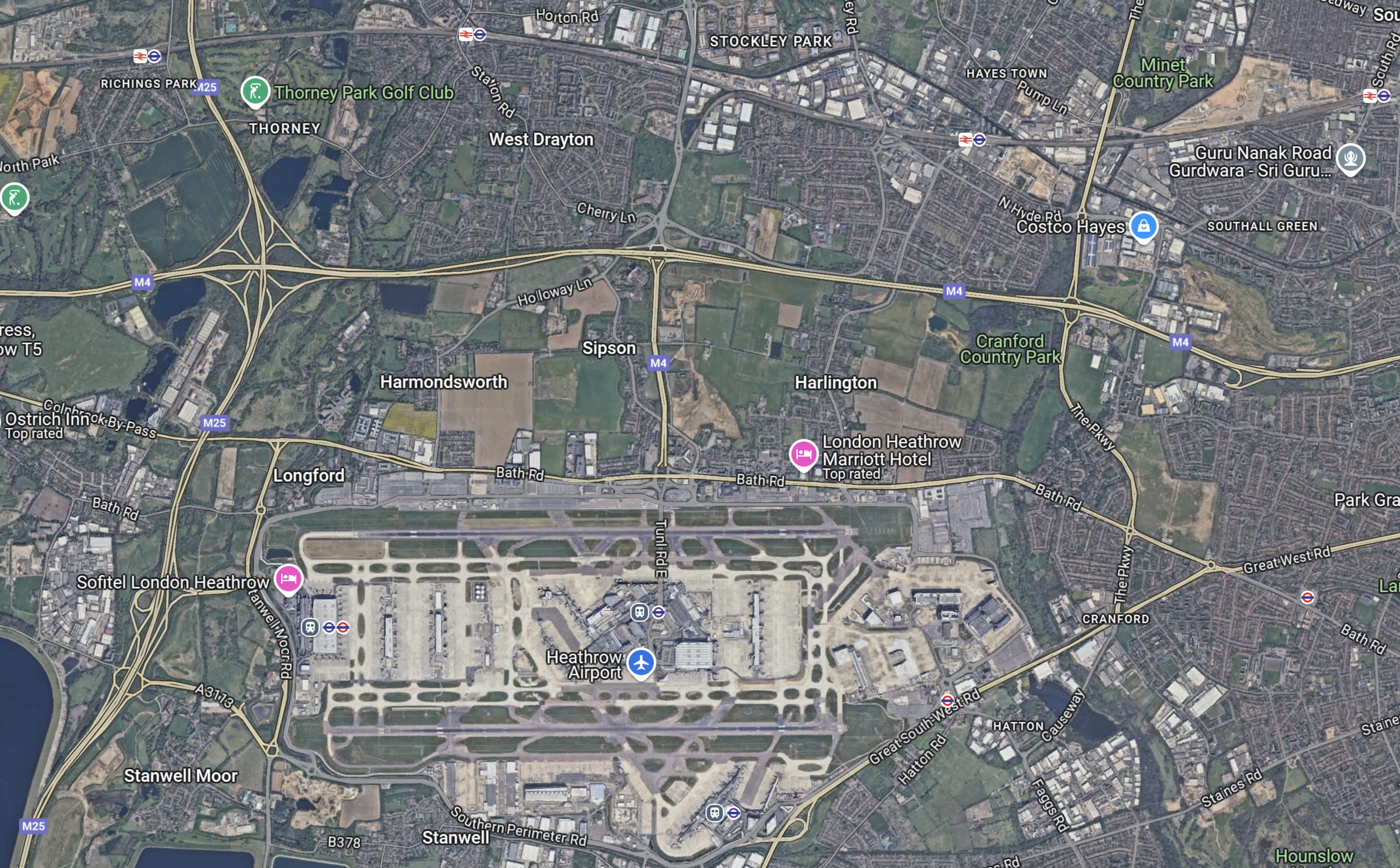
Note.
- The M4 going across the map.
- The two main runways.
- A new third runway would go between the M4 and the Northern runway.
It is likely if the third runway goes ahead, the village of Harmondsworth will be flattened.
It is likely that supplying hydrogen to Heathrow will mean a hydrogen terminal somewhere South of the M4, which could be supplied by rail tankers.
Hydrogen For Gatwick
This Google Map shows Gatwick Airport.
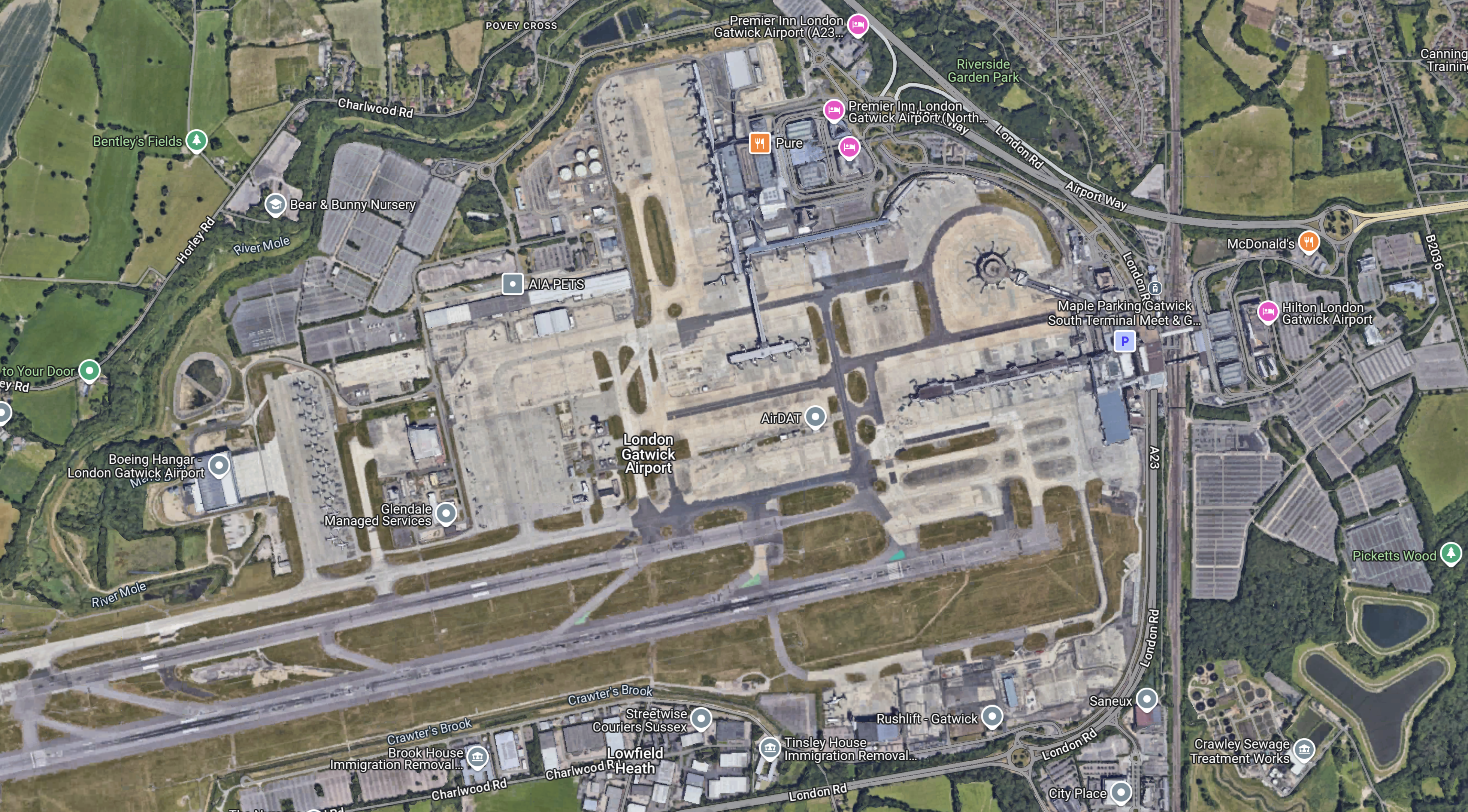
Note.
- The current main runway with the emergency runway to its North.
- Because the runways are too close together they cannot be used simultaneously.
- To create a second runway, the two runways would be moved further apart and the current emergency runway would be enlarged.
- The Brighton Main Line runs North-South past the Eastern end of the main runway.
Gatwick’s expansion plan doesn’t appear to require any properties outside the airport boundaries to be demolished.
This Google Map shows Sussex between Gatwick Airport and Brighton.
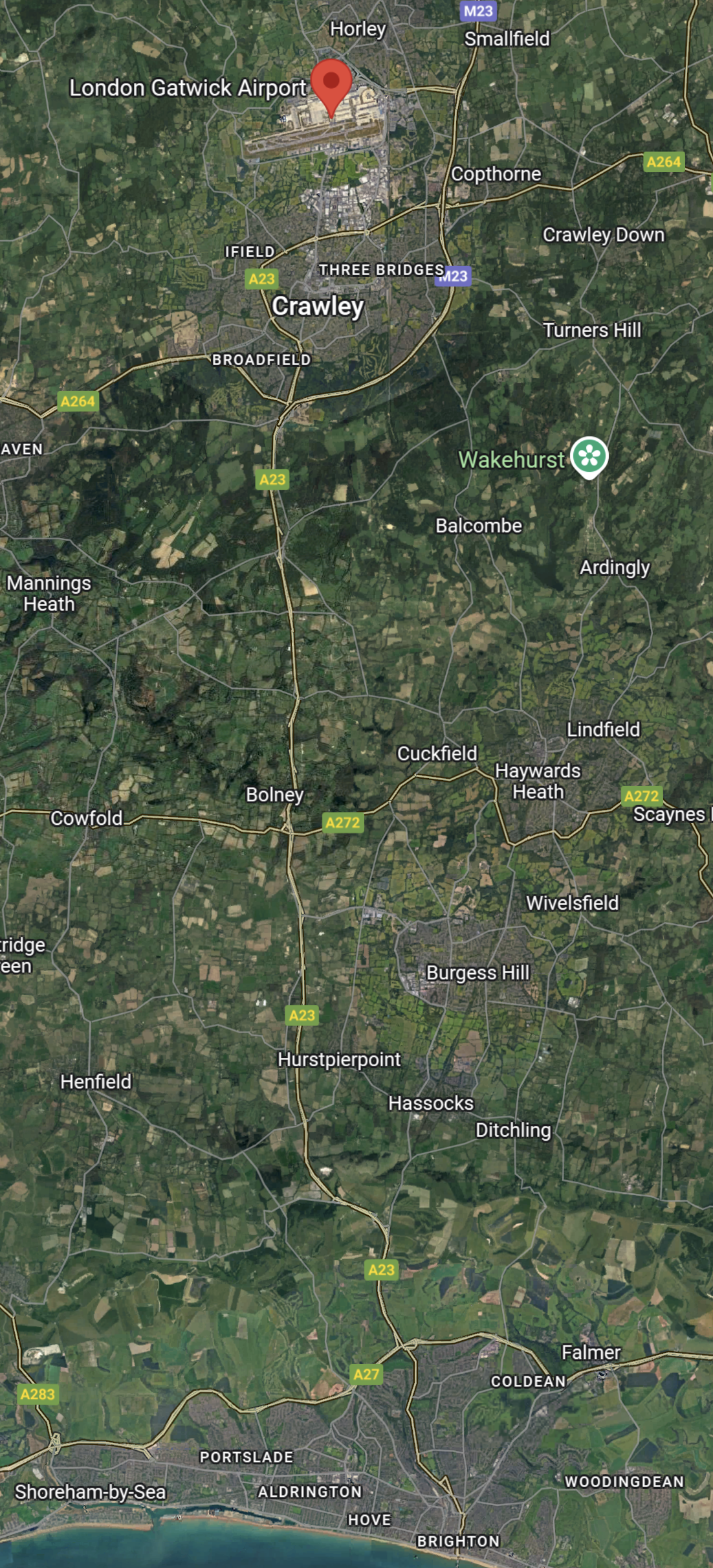
Note.
- Gatwick Airport is indicated by the red arrow at the top of the map.
- Gatwick’s runways can be picked out under the red arrow.
- The South Coast is at the bottom of the map.
- The M23 and the Brighton Main Line connect Gatwick Airport and Brighton.
- Shoreham and Brighton are on the South Coast.
- Click the map to show on a larger scale.
Under current plans, the Ramplion offshore wind farm off the South Coast is going to be increased in size to 1.6 GW.
The simplest plan to provide large amounts of green hydrogen to Gatwick would be to build a large electrolyser in the Port of Shoreham and pipe it along the railway to Gatwick Airport. Hydrogen could also be shipped at night into the Airport using rail tankers.
There’s no doubt in my mind, that it will be much easier to supply large quantities of hydrogen to Gatwick, rather than Heathrow.
In 2023, I wrote Discover How Greater Brighton Is Championing The Transition To Hydrogen, which probably indicates that the locals and their politicians, would welcome the investment in hydrogen in their city.
It should also be noted that world class consultants Ricardo, who are very much involved in the development and promotion of hydrogen technology are based in Shoreham.
Liquid hydrogen could also be imported and distributed from the Port of Shoreham.
Brighton could end up as the South of England’s Hydrogen City.
Never Mind Heathrow: Gatwick Airport Is Close To Getting A New Runway
The title of this post, is the same as that of this article on The Times.
A friend passed through at Gatwick Airport yesterday, so I went to wish him well. For a change , I took a Metrobus from Sutton station to the South terminal – This route is free and doesn’t need a ticket with a Freedom Pass!
The bus was no ordinary bus, but a brand new Wrightbus hydrogen double decker from Ballymena.
It took a round-about route, as its main function is to bring local workers and passengers into the airport and handle traffic to Redhilll, Reigate and East Surrey Hospital.
But if this is the shape of buses to come, then I’m for it. Quality was more coach than bus and performance was sparkling with little or no noise and vibration.
Gatwick and Metrobus are building a network of local hydrogen buses to bring workers and passengers into the airport and I suspect, if the Airport has the fuel, they’ll use it for other purposes, like air-side vehicles, aircraft tow-trucks and car park buses.
Gatwick unlike Heathrow has a close-by source of electricity to produce hydrogen in the soon-to-be-extended 1.6 GW Ramplion offshore wind farm, just off Brighton.
Airbus are talking about bringing hydrogen aircraft into service by 2035 and I believe that by this date we’ll be regularly seeing hydrogen-turboprops on short routes.
As someone, whose software planned the Channel Tunnel, I think it reasonable by 2035, the following projects will be completed.
- Zeroavia are talking of converting aircraft to hydrogen in the next few years.
- A number of short-haul hydrogen aircraft are in service.
- Gatwick’s new runway and terminals are built.
- Ramplion is pumping hydrogen to the airport.
- The station has been updated.
- The Thameslink frequency of trains will have been increased.
Gatwick could be the first major airport to use large amounts of hydrogen, to cut emissions.
 The Anonymous Widower