Cold Snap Leaves Britain With Less Than A Week’s Worth Of Gas
The title of this post, are the same as that of this article on The Times.
This is the sub-heading.
The closure of Russian pipelines through Ukraine and recent weather conditions have left gas stores ‘concerningly low’
These are the first two paragraphs.
Britain has less than a week of gas supplies in storage, the country’s largest supplier has warned after plunging temperatures and high demand.
Centrica, the owner of British Gas, said the UK’s gas storage was “concerningly low” after coming under pressure this winter.
The two largest gas storage facilities in this country are both in the Humberside area.
- Aldbrough is in salt caverns North of Hull and is owned by SSE.
- Rough is under the North Sea and is owned by Centrica
Both are being converted to store hydrogen.
Some might thing that is a bit stupid if we’re short of storage, but we need the hydrogen storage for four reasons.
- To store hydrogen created by electrolysers on Humberside, which will enable heavy gas users in the area to decarbonise.
- The hydrogen will also be burnt in a 1 GW hydrogen-fired power station at Keadby to back up the wind turbines, with zero-carbon electricity.
- The hydrogen will also be sold to the Germans to replace Putin’s blood-stained gas. It will be sent to Germany in a pipeline called AquaVentus, which will also deliver Scottish hydrogen across the North Sea. Hopefully, the Germans will pay a good price for the hydrogen.
- The hydrogen will be used for transport.
The mistake the Government is making is not to develop smaller gas fields, so that domestic gas users can continue to use natural gas, until the technology to replace it with zero-carbon sources is fully developed.
BP’s Morven Wind Farm At Risk Of Missing Start Date
The title of this post, is the same as that as this article in The Times.
This is the sub-heading.
A lengthening queue for grid connection could scupper plans to provide energy for three million homes from a development in the North Sea by the end of the decade
These two paragraphs introduce the article.
One of the largest wind farms in the UK risks missing its 2030 target to start generating power, due to lengthy grid connection queues and supply chain shortages.
The Morven Wind Farm being developed by BP, which is to be located 38 miles off the coast of Aberdeen, will have capacity of 2.9 gigawatts, which is expected to be capable of powering three million homes in Britain.
The delays in getting a grid connection and obtaining various electrical parts could derail BP’s plans.
The Morven wind farm is one of three being developed by a partnership of BP and a German company, which is outlined in this paragraph.
Morven is one of three UK wind farms being built by BP in a joint venture with Energie Baden-Württemberg AG (EnBW), the German energy company. The other two, Mona and Morgan, are being developed in the Irish Sea and have already secured grid connections.
These are my thoughts on the problems with the Morven Wind Farm.
Everybody is assuming that there will be a large cable to bring the 2.9 GW of electricity to the Scottish coast somewhere near Aberdeen.
Cables can be a problem as the article indicates, with connection to the grid and the erection of large numbers of pylons being major ones.
But the energy from Morven doesn’t necessarily need to go to Scotland.
It can be converted into hydrogen using an offshore electrolyser and sent to where it is needed by pipeline or a tanker ship.
I have also noted that BP’s partners are German and Germany has a massive need for zero-carbon energy to replace the large amount of coal they burn.
The Germans are building a massive pipeline called AquaVentus, from their North-West coast to the Dogger Bank, to collect hydrogen created by up to 10 GW of offshore wind farms in the German Ocean or their part of the North Sea to the shore.
I introduced AquaVentus in this post called AquaVentus.
This video shows the structure of AquaVentus.
I clipped this map from the video.

Note.
- The thick white line running North-West/South-East is the spine of AquaVentus, that will deliver hydrogen to Germany.
- There is a link to Esbjerg in Denmark, that is marked DK.
- There appears to be an undeveloped link to Norway, which goes North,
- There appears to be an undeveloped link to Peterhead in Scotland, that is marked UK.
- There appears to be a link to just North of the Humber in England, that is marked UK.
- Just North of the Humber are the two massive gas storage sites of Aldbrough owned by SSE and Brough owned by Centrica.
- Aldbrough and Rough gas storage sites are being converted into two of the largest hydrogen storage sites in the world!
- There appear to be small ships sailing up and down the East Coast of the UK. Are these small coastal tankers, that are distributing the hydrogen to where it is needed?
When it is completed, AquaVentus will be a very comprehensive hydrogen network.
- Pipelines from Denmark, Norway, The Netherlands and the UK will feed directly into AquaVentus.
- Will enBW and BP build a giant offshore electrolyser at Morven and send the hydrogen to Germany via the spine of AquaVentus?
- Will AquaVentus use the vast hydrogen storage North of Hull to store excess hydrogen?
- Will connections be built between AquaVentus and the UK’s Northern gas terminals at St Fergus and Easington?
If AquaVentus works as intended, Germany’s Russian gas will be replaced by zero-carbon hydrogen, a large proportion of which will come from the UK’s waters.
Where Will We Get Our Electricity From?
If the energy from Morven is sold to the Germans as hydrogen, where will we get the energy we need?
Morven is just one of several large wind farms and being developed around the North of Scotland and we’ll probably use the energy from another wind farm.
- Wind farms that can best send their energy to the grid, will do so.
- Wind farms that can best send their energy to one or more of the large Scottish pumped storage hydro-electric power-stations, will do so.
- Wind farms that can best send their energy to Germany as hydrogen, will do so.
- Wind farms that can best send their energy to Scotland or another country as hydrogen, will do so.
The hydrogen will get distributed to those who need it and can pay the appropriate price.
Where Will The Turbines And the Electrical Gubbins Come From?
I’m sure that if Morven was sending a couple of GW of hydrogen to Germany, Siemens could build the turbines and the associated electrical gubbins needed at a favourable price, with an acceptable delivery date.
Conclusion
Germany will likely be pleased, in that they will be able to close a lot of very dirty coal-fired power stations, by replacing coal with green hydrogen.
The UK should be pleased, as the Germans will pay us for the hydrogen.
As for Putin, who knows, what the mad Russian will do?
Large Scale Hydrogen Storage Sites Could Reduce Customer Energy Costs By £1bn Per Year
The title of this post, is the same as this press release from Centrica.
These four paragraphs summarise the report.
Centrica and FTI report finds that hydrogen storage would help balance the UK’s energy system and reduce bills.
A net zero scenario including large scale hydrogen storage – specifically, a redeveloped Rough gas storage facility – would reduce energy costs by an additional £1bn per year by 2050.
Report also finds that a UK energy system focused on renewable generation risks high levels of intermittency without an established hydrogen market. By 2050, electricity generation from renewables could exceed total demand around 15% of the time.
Electricity generation from renewables could also rise or fall by as much as 100GW over the course of a single day. More than twice current levels of peak demand on winter evenings and the equivalent energy output from over 30 Hinkley Point C nuclear power stations.
Note.
- Hydrogen Central entitles their article about the Centrica press release Centrica Says Hydrogen Can Reduce Household Bills by £35 a Year. That’s almost a bottle of my favourite Adnams beer a week!
- I talked about the redevelopment of the Rough facility into hydrogen storage in Aberdeen’s Exceed Secures Centrica Rough Contract.
- Generating hydrogen from excess electricity and storing it until it is needed, must be an efficient way of storing electricity or powering industrial processes that need a lot of energy, if storing hydrogen makes £1bn per year!
- It should be noted that Centrica have a large interest in HiiROC, who are developing an efficient way to generate hydrogen from any hydrocarbon gas from chemical plant off-gas through biomethane to natural gas. In a perfect world a HiiROC system in a sewage works could capture the biomethane and split it into hydrogen and carbon black. The hydrogen could be used to refuel vehicles and the carbon black would be taken away to someone, who has need of it.
In some ways, it is surely sensible to have enough energy in a store, if the renewables fail. As Rough is already there and functioning, it is surely one of the easiest routes to redevelop Rough, so that it is in top-quality condition.
It should also be noted, that Rough is not far from the Aldbrough Gas Storage, which SSE are converting to a second massive hydrogen store.
So Humberside will have two of the largest hydrogen stores in the world, which Centrica and SSE will use to maxise energy security in the wider Humberside and East Yorkshire area, and I suspect to maximise their profits as well.
This video shows the structure of AquaVentus, which is a pipeline system, that the Germans are building to bring much-needed hydrogen to German industry from electrolysers in the North Sea and other countries like Denmark, Norway, the Netherlands and the UK.
I clipped this map from the video.
Note how a branch of AquaVentus makes landfall around the Humber estuary at a UK label.
Will Centrica and SSE be trading hydrogen from Rough and Aldbrough with the Germans through AquaVentus? You bet they will, as the Germans are short of both hydrogen and hydrogen storage.
German Firm Plans To Build Britain’s Biggest Solar Farm
The title of this post, is the same as that as this article on The Times.
These three paragraphs outline the project.
The developers behind a controversial solar power project in Oxfordshire have submitted a planning application for what is thought will be the largest such scheme in western Europe.
The site in Botley West is being developed by Photovolt, a German company, and could generate 840 megawatts (MW) of electricity, enough to power about 330,000 homes.
However, the project has sparked a backlash among some local residents, who argue the scheme will blight the landscape.
A map shows the site and it is certainly a large one.
- The Botley West site will cover a total of about 3,200 acres.
- It will pass through 15 villages.
- About 1,235 acres will not be covered with solar panels.
- It has a web site, which gives more information.
- There is also a Stop Botley West web site.
I can certainly understand the opposition.
These are my thoughts.
I Would Add A Battery To The Panels
An added battery would undoubtedly smooth the output of the solar panels. Especially, when the sun is not out to play!
A total capacity of 840 MW is planned for Botley West and in my opinion as a Control Engineer, a sizeable battery is needed.
I would not use a Battery Energy Storage System or BESS based on lithium-ion batteries, as I believe that Highview Power’s liquid air batteries and others offer cost and environmental advantages. But that is one for the accountants and the environmentalists!
I Might Add A Few Appropriately-Sized Wind Turbines To The Farm
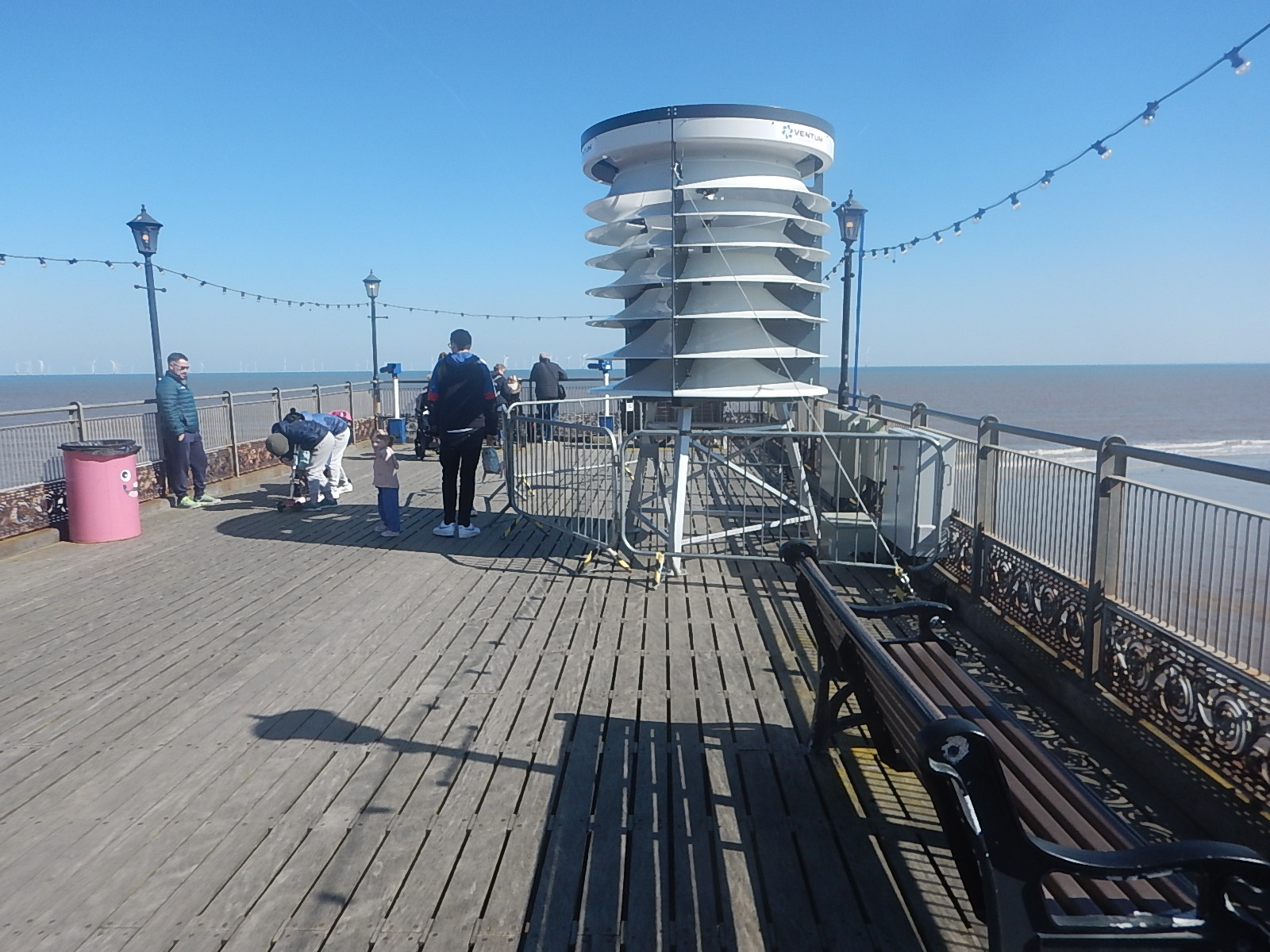
In Skegness Wind Turbine Trial To Light Up Pier In UK First, I discuss using small, vertical wind turbines from a Norwegian company called Ventum Dynamics.
This picture shows a Ventum Dynamics turbine on Skegness Pier.
On the Ventum Dynamics web site, there are several pictures of buildings with flat roofs, that have several turbines on each.
Surely, if you’re installing a comprehensive electrical network, then it should be used to collect all the electricity it can.
I believe that Ventum’s turbines could be alternated in a line with trees, so that they merged more into the countryside. Some experiments need to be done.
I Would Also Fit Solar Roofs To Suitable Buildings
Every little helps!
Conclusion
When mixing solar panels and wind turbines into the countryside, you need to be bold and discard preconceived ideas.
UK And Germany To Upgrade Some Sea Kings For Ukraine
Yesterday, the UK government issued a press release, which is entitled Landmark UK-Germany Defence Agreement To Strengthen Our Security And Prosperity.
This is the sub-heading.
A landmark defence agreement will be signed by Defence Secretary John Healey MP and German Defence Minister Boris Pistorius in London today in a major moment for NATO, and European security and prosperity. It is the first-of-its-kind agreement between the UK and Germany on defence.
This introductory paragraph, lays down the tone and objectives of the agreement.
The signing of the Trinity House Agreement marks a fundamental shift in the UK’s relations with Germany and for European security. This agreement between Europe’s two biggest defence spenders will strengthen national security and economic growth in the face of growing Russian aggression and increasing threats.
It is a wide-ranging document, but in this post, I will concentrate on one topic; Sea King helicopters, which are talked about in this paragraph.
New Ukraine support – new joint work to enable German Sea King helicopters to be armed with modern missile systems as well as work on capability coalitions.
As Ukraine is a mainly landlocked company, I do think it must be a compliment to the Sea Kings’ capabilities that the Ukrainians find the naval helicopters useful.
These three paragraphs from the Wikipedia entry for the Westland Sea King, document the history of operations of the Sea King in the Ukrainian Naval Aviation.
In November 2022, in response to the 2022 Russian invasion of Ukraine the United Kingdom announced they were donating three former Royal Navy Sea Kings to Ukraine. In January 2023, the first Sea King was videoed being used by the Ukrainian Naval Aviation.
In April 2023, the BBC did an interview with one of the co-pilots of a UK donated Sea King to Ukraine. These helicopters served in the Falklands War so they are at least some 40 years old. The co-pilot has said that the Sea King is used for rescuing pilots who have ejected, delivering soldiers, and conducting reconnaissance, among other tasks. One engineer also told the BBC: “They are old…but they have gone through modernisation, and we need them very much. I believe this is just the start of our work together.” The BBC also reports that a third Sea King is being prepared to be sent to Ukraine in the “coming weeks”. The third Sea King HU.5 was delivered to Ukraine in May 2023.
In January 2024, Germany agreed to send 6 further Sea Kings to Ukraine.
I feel the Ukrainians, with their initiative, will find the elderly Sea Kings very useful.
Equinor Acquires Minority Stake In Ørsted, Becomes Second-Largest Shareholder
The title of this post, is the same as that of this article on offshoreWIND.biz.
This is the sub-heading.
Norway-headquartered Equinor has acquired a 9.8 per cent minority stake in Denmark’s Ørsted, making it the second-largest shareholder behind the Danish state, which holds a controlling stake in the company.
These are the first two paragraphs.
According to Equinor, the company is supportive of Ørsted’s strategy and management and is not seeking board representation.
“Equinor has a long-term perspective and will be a supportive owner in Ørsted. This is a counter-cyclical investment in a leading developer, and a premium portfolio of operating offshore wind assets”, said Anders Opedal, CEO of Equinor.
Could it also be two Scandinavian companies getting together to put up a stronger front to outside interests?
Are they frightened of the actions that might be taken by Great British Energy and by the Germans with their massive thirst for hydrogen?
Stadler Presents A World First In Berlin
The title of this post, is the same as that of this press release from Stadler.
These are the first two paragraphs.
With the RS ZERO, the rail vehicle manufacturer is presenting the successor to the successful Regio-Shuttle RS1 model. There is a choice of two modern and environmentally friendly drive technologies: Hydrogen and battery. Both will enable CO2 emission-free operation of secondary lines in the future.
Stadler today unveiled the prototype of the new RS ZERO, the innovative successor to the successful RS1 Regio-Shuttle. The Regio-Shuttle has been one of the most popular vehicles in German regional rail transport for 28 years, with around 500 RS1 vehicles currently in operation in Germany and the Czech Republic. Stadler is building on this proven technology and integrating state-of-the-art, environmentally friendly drive systems. The RS ZERO is optionally available with a hydrogen and/or battery drive and thus not only sets new standards for environmentally friendly rail transport, but also presents a world first.
These pictures from Chemnitz Trams And The Chemnitz Model, show the Regio-Shuttle RS1.




Note.
- The Regio-Shuttles can run as up to seven car trains.
- These Regio-Shuttles are electro-diesel.
- The distinctive diagonal windows.
- They can carry 170 passengers at 75 mph.
- They can run as train-trams using the Chemnitz model on compatible tram networks.
The Regio-Shuttle Wikipedia entry gives more details.
This image from the press release shows the prototype RS ZERO.
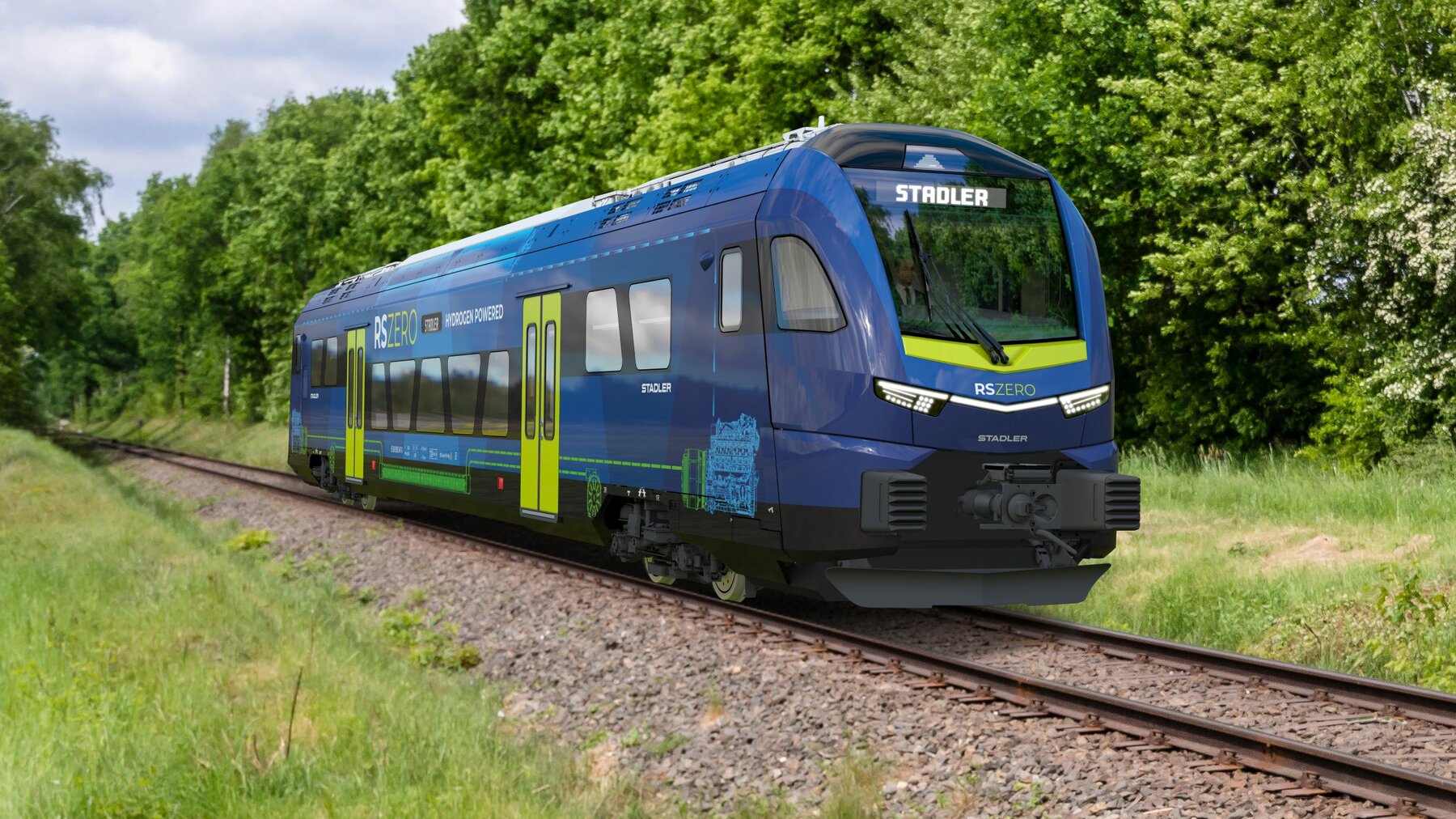
It looks very similar to my pictures from Chemnitz.
I have a few thoughts.
Comparison To A Class 150 Train
A Class 150 train can carry up to 149 seated passengers at 75 mph, which is similar to the RS ZERO.
As Stadler have built trains for Greater Anglia, Merseyrail and the Glasgow Subway, I believe that Stadler could build an RS ZERO, that would fit the UK loading gauge.
In What Train Is This?, I show the standard of interior, that can be achieved by refurbishing a Class 150 train, but unlike the RS ZERO, the train won’t be zero-carbon.
Does The RS ZERO Have A Toilet?
This is a paragraph from the press release.
The prototype of the RS ZERO presented today in Berlin is a one-car vehicle with hydrogen drive. Stadler is demonstrating the numerous design options with a multi-purpose area equipped for carrying bicycles, pushchairs and bulky luggage, lounge and comfort zones, standard and privacy seats, a wheelchair space, WC and a train office.
The train appears to be able to have what an operator might need.
What Will Be The Range Of An RS ZERO On Hydrogen?
I suspect, Stadler will provide a train, that will handle the route.
Conclusion
This could be a very handy train to decarbonise branch and secondary lines in the UK.
Solar With Battery In Germany Now Cheaper Than Conventional Power
The title of this post, is the same as that of this article on Renewables Now.
These two paragraphs outline the article.
Ground-mounted solar PV and onshore wind energy are the most cost-effective technologies among all types of new power plants in Germany, with levelised cost of electricity (LCOE) ranging from EUR 41 (USD 44.75) to EUR 92 per MWh, according to a study by research institute Fraunhofer ISE.
The LCOE for new solar installations in combination with battery systems vary between EUR 60 and EUR 225 per MWh reflecting the high cost differences for battery and solar systems along with the different levels of solar radiation.
Note.
- The article states that these figures are lower than newly-built coal and gas-fired power plants.
- The Fraunhofer Institute for Solar Energy Systems ISE in Freiburg, Germany is the largest solar research institute in Europe.
The original Renewables Now article is well worth reading in full.
Conclusion
This paragraph concludes the Renewables Now article.
These calculations show that the large-scale projects currently underway in Germany, which combine ground-mounted PV systems, wind farms and stationary battery storage systems, are good investments,” says Christoph Kost, head of the Energy System Analysis Department at Fraunhofer ISE and lead author of the study.
As the climate for much of Northern Europe is not that different to Germany, I suspect we’ll be seeing large numbers of hybrid wind/solar/battery power plants created in the next few years.
AquaVentus
I suggest, that you read this page on the RWE web site called AquaVentus.
The page starts with this RWE graphic.
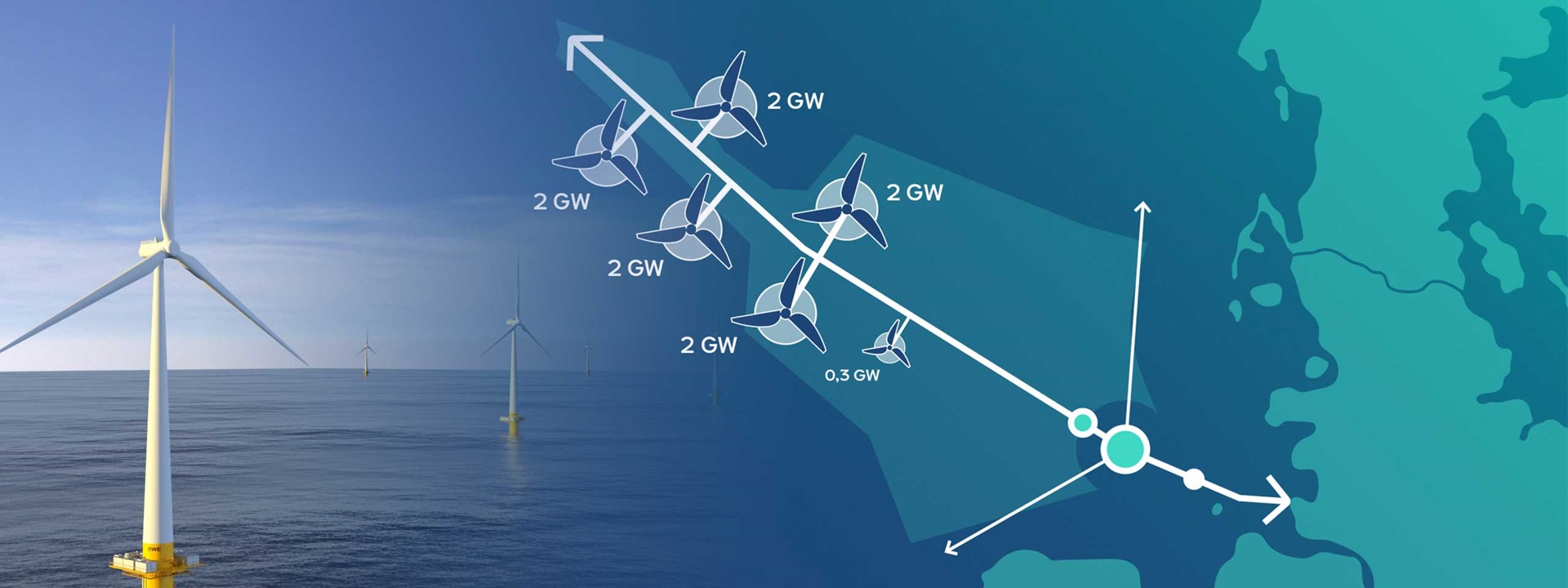
It appears that 10.3 GW of hydrogen will be created by offshore wind farms and piped to North-West Germany.
These two paragraphs outline the AquaVentus initiative .
Hydrogen is considered the great hope of decarbonisation in all sectors that cannot be electrified, e.g. industrial manufacturing, aviation and shipping. Massive investments in the expansion of renewable energy are needed to enable carbon-neutral hydrogen production. After all, wind, solar and hydroelectric power form the basis of climate-friendly hydrogen.
In its quest for climate-friendly hydrogen production, the AquaVentus initiative has set its sights on one renewable energy generation technology: offshore wind. The initiative aims to use electricity from offshore wind farms to operate electrolysers also installed at sea on an industrial scale. Plans envisage setting up electrolysis units in the North Sea with a total capacity of 10 gigawatts, enough to produce 1 million metric tons of green hydrogen.
The page also gives these numbers.
- Total Capacity – 10 GW
- Tonnes Of Green Hydrogen – 1 million
- Members – 100 +
The web site says this about commissioning.
Commissioning is currently scheduled for early/mid 2030s.
The Germans can’t be accused of lacking ambition.
Conclusion
AquaVentus will bring the Germans all the hydrogen they need.
I suspect AquaVentus can be expanded into the waters of other countries surrounding the German territorial waters.
 The Anonymous Widower