AI Forecast To Fuel Doubling In Data Centre Electricity Demand By 2030
The title of this post, is the same as that as this article in The Times.
This is the sub-heading.
International Energy Agency predicts that artificial intelligence could help reduce total greenhouse gas emissions
These are the first two paragraphs.
Data centres will use more than twice as much electricity by 2030 than they do today as artificial intelligence drives demand, the International Energy Agency predicts.
The agency forecast that all data centres globally will use about 945 terawatt-hours of electricity each year by 2030, roughly three times as much as the UK’s total annual demand of 317 terawatt-hours in 2023.
I am very much an optimist, that here in the UK, we will be able to satisfy demand for the generation and distribution of electricity.
- Our seas can accommodate enough wind turbines to provide the baseload of electricity we will need.
- Roofs and fields will be covered in solar panels.
- SSE seem to be getting their act together with pumped storage hydro in Scotland.
- I am confident, that new energy storage technologies like Highview Power with the packing of companies like Centrica, Goldman Sachs, Rio Tinto and others will come good, in providing power, when the wind doesn’t blow and the sun doesn’t shine.
- Hopefully, Hinckley Point C and Sizewell C will be online and soon to be joined by the first of the new small modular nuclear reactors.
- Hopefully, Mersey Tidal Power will be operating.
- There will be innovative ideas like heata from Centrica’s research. The economical water heater even made BBC’s One Show last week.
The only problem will be the Nimbies.
Europe’s Biggest Battery Storage Project Goes Live In Scotland
The title of this post, is the same, as this article in The Times.
This is the sub-heading.
Zenobe’s site at Blackhillock can store surplus generation for when the wind doesn’t blow and the sun doesn’t shine
These are the first two paragraphs.
Europe’s biggest battery storage project has entered commercial operation in Scotland, promising to soak up surplus wind power and prevent turbines being paid to switch off.
Zenobe said the first phase of its project at Blackhillock, between Inverness and Aberdeen, was now live with capacity to store enough power to supply 200 megawatts of electricity for two hours. It is due to be expanded to 300 megawatts by next year.
I believe we can do better, than install large lithium-ion batteries.
We need to get the pumped storage like Coire Glas, the liquid air like Highview Power and the gravity batteries like Gravitricity going as fast as we can.
They are more environmentally friendly than Tesla’s lithium ion tiddlers and a second generation liquid air battery appears to be 200 MW and 2.5 MWh, so they can supply 200 MW for 12.5 hours.
The Blackhillock battery can do just two hours.
Two of them working as a pair, with a 1 GW wind farm, are as big as a small modular nuclear reactor, so could do the same job, with respect to power supply, using machinery and tank designs, that have been used for decades.
I suspect, that like 1960s coal-fired power stations, they would keep running for fifty years and be simply recycled as steel, copper and other scrap.
Highview Power could make Bishops Stortford famous!
UK Government Sets 8-Hour Minimum For LDES Cap-And-Floor Sheme
The title of this post, is the sa,e as that of this article on Energy Storage News.
This is the sub-heading.
The UK government has published a Technical Decision Document confirming crucial aspects of its long duration electricity storage (LDES) cap-and-floor scheme, which includes increasing the minimum duration required from six hours to eight
These paragraphs give full details.
The document, released by regulator Ofgem on 11 March, details the final overarching rules and requirements for the scheme as well as how it will be implemented, though significant detail still remains to be worked out.
The scheme will provide a cap-and-floor revenue protection for 20-25 years that will allow all capital costs to be recoverable, and is effectively a subsidy for LDES projects that may not be commercially viable without it. Most energy storage projects being deployed in the UK today are lithium-ion battery energy storage systems (BESS) of somewhere between 1-hour and 3-hour in duration (very occasionally higher).
One of the most significant new details of the scheme is that, following industry feedback, the minimum duration for projects to qualify has been increased from six hours to eight hours of continuous rated power.
The ‘continuous rated power’ aspect prevents shorter duration projects from bidding in a smaller section of their MW capacity in order to act like an 8-hour system.
Another interesting detail pointed out by several commentators is that the cap is a ‘soft’ one, meaning it will allow extra revenue to be shared between developers and consumers. Exact details on the ratio are yet to be determined.
As a Graduate Control Engineer from Liverpool University in the 1960s, I hope that the move from a six to eight hours minimum duration is feasible.
I wasn’t dealing with power systems, but with multi-vessel chemical plants.
These are my thoughts.
The biggest project, I was dealing with a few years later in the 1970s, was the modeling of all the the reservoirs and pipelines by the Water Resoures Board.
As the supply side of the water industry hasn’t had too many issues with the volume of water supplied, I feel that the main modelers must have done a reasonable job.
Six To Eight Hours Of Continuous Operation
The article says this about uprating from six to eight hours of continuous operations.
All the systems that have been proposed for cap-and-floor operation, seem to have some form of physical storage.
- Energy Dome appears to have tents of carbon dioxide.
- Energy Vault uses stacks of heavy weights.
- Form Energy has tanks of rust.
- Gravitricity has huge weights in disued mine shafts.
- Highview Power has large tanks of liquid air.
- Pumped storage hydro has two lakes, that hold water.
- Rheenergise has two large tanks, of a water-based slurry.
So to go from six to eight hours will hopefully just need some more storage.
Highview Power appears to use similar gas tanks to those used to store natural gas or hydrogen.
This image clipped from Highview’s web site, shows large tanks for liquified gas storage.
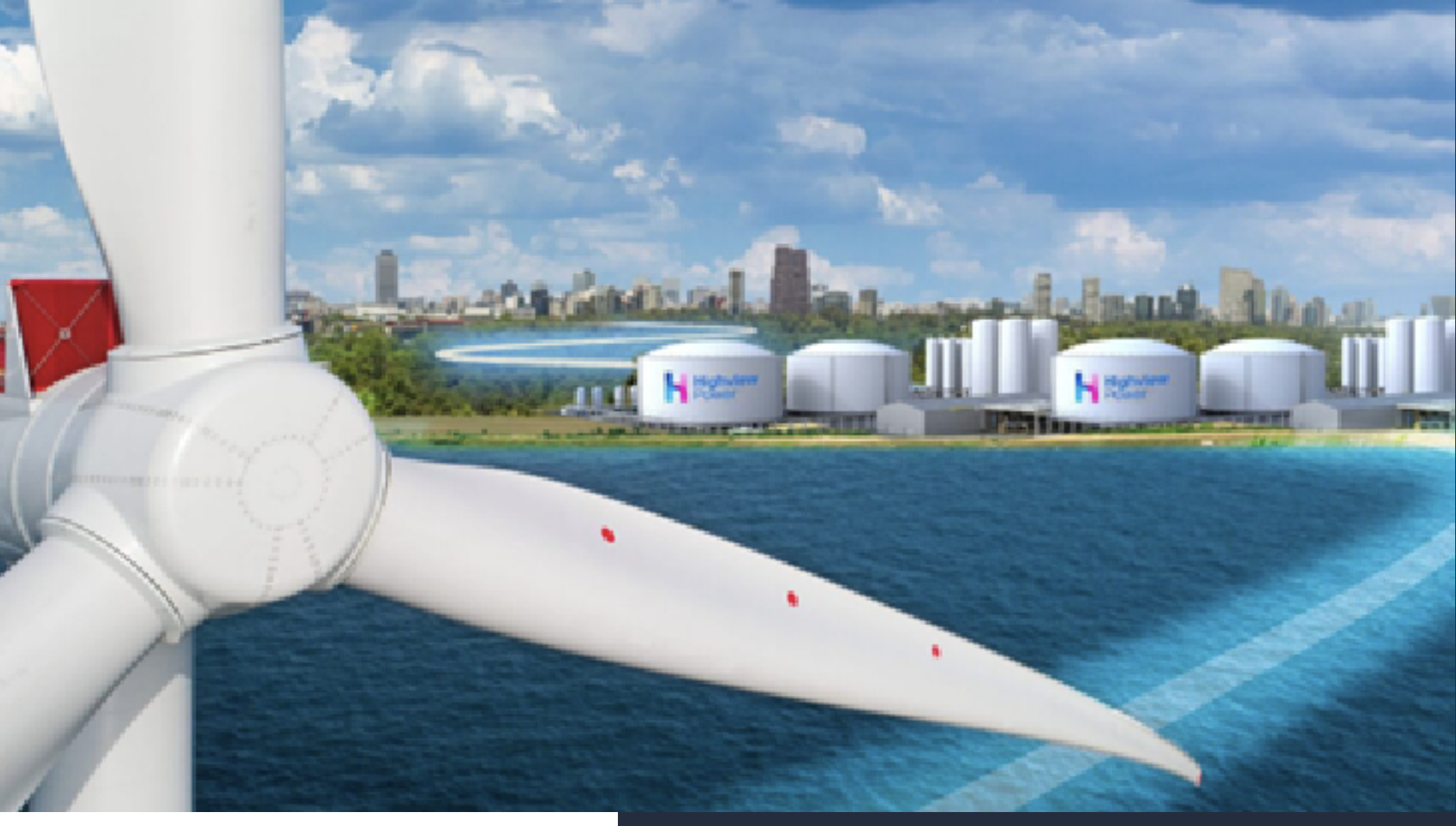
With tanks like these, which can hold GW-equivalents of liquid air, Highview could be building batteries with storage to rival the smaller pumped storage hydroelectric power stations. They are already talking of 200 MW/2.5 GWh systems, which would have a 12.5 hour continuous rating and would probably need two to three tanks.
Coire Glas Pumped Storage
I’ll use Coire Glas pumped storage hydro electric power station as an example.
As currently planned SSE’s Cioire Glas pumped storage hydroelectric power station is 1.5 GW/30 GWh, so it has a a 20 hour continuous rating.
In The UK’s Pumped Storage Hydroelectricity, I gave a rough estimate of the pumped storage hydroelectricity systems in operation or planed as nearly 11 GW/224GWh.
The Soft Cap
The article says this about a soft cap.
Another interesting detail pointed out by several commentators is that the cap is a ‘soft’ one, meaning it will allow extra revenue to be shared between developers and consumers. Exact details on the ratio are yet to be determined.
I seem to remember that when I was modeling a larger multi-vessel chemical plant at ICI, I was using sharing between vessels, to get the system to operate on a PACE-231R analog computer.
So I suspect a soft cap is possible.
UK Wind Risks ‘Exponentially Rising’ Curtailment Without Energy Storage
The title of this post, is the same as that of this article on Recharge.
This is the sub-heading.
UK liquid battery pioneer Highview Power is working with renewable energy giant Orsted on plan to store excess power from its Hornsea offshore wind projects
This is the introductory paragraph.
The UK wind sector faces “exponentially” increasing curtailment of assets without a rapid rollout of energy storage, says the chief of liquid battery pioneer Highview Power, which is working with Orsted on a project to store excess offshore wind power.
The article also states that according to Octopus Energy, this cost could have been as high as a billion pounds last year.
In Grid Powers Up With One Of Europe’s Biggest Battery Storage Sites, I described how Ørsted were planning to build a large BESS near the Swardeston substation in Norfolk, where the Hornsea 3 wind farm will connect to the grid.
Have Ørsted decided to put a Highview Power battery on the Swardeston site, as it can be a bigger battery, as Highview Power talk about 200MW/2.5GWh capacity batteries on the projects page of the web site?
Highview also say this about co-operation with Ørsted on that page.
Highview Power and Ørsted’s joint study shows that the co-location of LAES with Ørsted’s offshore wind offers a step forward in reducing wind curtailment, and helping to move to a more flexible, resilient zero carbon grid.
The words are accompanied by pictures of a smart gas storage site, which shows four of the largest tanks, that might be used to store LNG.
In Could A Highview Power CRYOBattery Use A LNG Tank For Liquid Air Storage?, I estimated that one of the largest LNG tanks could hold about a GWh of energy.
So Highview Power’s visualisation on their project page would be a 4 GWh battery.
.
How To Keep The Lights On When The Wind Doesn’t Blow
The title of this post, is the same as that of this article in The Times.
This is the sub-heading.
Britain came close to a blackout this month. Gas is being phased out and renewables are intermittent, so can energy storage stop us going dark?
These are the first two paragraphs.
It was 8.29pm on the first Tuesday in January when the alert was issued by the electricity control room. Freezing temperatures had coincided with unusually low wind speeds, and it was making the National Energy System Operator (Neso) jittery.
Engineers forecast a 1.6GW shortfall — the requirement for about 1.5 million homes — for a three-hour period from 4pm the following afternoon. “System operators are requested to notify Neso of any additional megawatt capacity,” the message said.
Luckily, the plea worked.
The article then goes on to describe the various technologies that are being deployed.
The article starts by talking about pumped storage hydroelectricity.
This paragraph gives a superb illustration about how things have changed in energy and energy storage in the UK in the last few decades.
In the past, when coal provided the bulk of British power, this system was used to meet fluctuating demand levels. But now it is also required to meet fluctuating supply levels from renewable sources. Martin Pibworth, chief commercial officer at SSE, started with the company as a trainee in 1998. “Back then, at our Foyers pumped storage plant [at Loch Ness] we would switch modes, from pumping to not pumping and back again, maybe 600 to 700 times a year. Last year we switched modes there 6,500 times. It’s an insight into how the market has changed and how much more flexibility is needed, and how responsive that has to be.”
We have to be more agile, with our handling of storage to back up the various methods of generation.
Could Highview Power’s Batteries Be Used Offshore?
When I first saw Highview Power’s Liquid Air batteries or Long Duration Energy Storage (LDES), I liked them.
This was partly because I’d investigated large tanks for chemical reactions and I like their mathematics.
But it was mainly because the concept had been developed by a lone inventor in Bishops Stortford.
In Could A Highview Power CRYOBattery Use A LNG Tank For Liquid Air Storage?, I bcalculated, that a 5,000 cubic metre tank could hold about a GWh of electricity as liquid air.
So just as steel and concrete tanks were placed on the sea floor to hold oil and gas, could they be placed on the sea floor to hold compressed air?
I don’t see why not!
I suspect, that it’s all fairly standard offshore engineering.
If you want more storage, you would just add more tanks.
Could They Be Combined With Electrical Substations?
I don’t see why not!
There may be advantages with respect to safety and noise.
US DOE Offers US$1.76 billion Loan To Hydrostor For A-CAES California Project
The title of this post, is the same as that of this article on Energy Storage News.
These three paragraphs give more detail.
The US Department of Energy’s (DOE) Loan Programs Office (LPO) has made a conditional commitment for a loan to long-duration energy storage (LDES) developer and operator Hydrostor of up to US$1.76 billion.
If finalised, the loan would be used to help fund the Willow Rock Energy Storage Centre, a 500MW/4,000MWh, 8-hour advanced compressed air energy storage system (A-CAES) in Eastern Kern County, California, led by Hydrostor subsidiary GEM A-CAES.
Compressed air energy storage (CAES) charges by pressurising air and funnelling it into a storage medium, often a salt cavern, and discharges it by releasing the compressed air through a heating system, which expands air before it is sent through a turbine generator.
Note.
- Both the Canadian Hydrostor and the British Highview Power use air in their batteries, with the Canadians using compressed air, often in salt caverns and the British using liquid air in tanks.
- Highview Power’s first large scale battery will be 200MW/2.5GWh, which is about half the size of Hydrostor’s, which will be 500MW/4.0GWh.
- Having mathematically-modeled large tanks full of chemicals in the 1970s for ICI, I wouldn’t be surprised, if the Highview Power battery is more easily scalable.
This could be an interesting technological shootout.
Complicating matters could be Trump’s policies to big batteries.
This article on Utility Dive, which is entitled Potential Trump Policies Pose Risks For US Storage Sector, With Musk Impact Uncertain.
Analysts Say Gives A Reasoned.
Higher battery material tariffs and phased-down IRA tax credits threaten a 15% drop in U.S. storage deployment through 2035 in a “worst-case” scenario,
BNEF analysts said.
‘Europe’s Biggest Battery Farm’ Built On Coal Mine
The title of this post, is the same as that of this article on the BBC.
This is the sub-heading.
Work is under way to create what has been described as Europe’s largest battery storage project at Coalburn in South Lanarkshire.
These three paragraphs add a bit more detail.
Developers say the two huge neighbouring battery farms – one at the site of a former opencast coal mine – will store enough electricity to power three million homes.
Battery Energy Storage Systems (BESS) are being built across the UK to help balance the electricity grid, which is becoming increasingly powered by renewables.
Almost 90% of the electricity generated in Scotland last year was from low carbon sources like wind, solar or nuclear, according to figures from the Scottish government.
A search of the Internet found this paragraph describing the size of the battery.
The CIP BESS portfolio (Coalburn 1, Coalburn 2, and Devilla) will have total power capacity of 1.5GW and will be able to store and supply the grid with a total of 3GWh of electricity, equivalent to the electricity demand of over 4.5 million households, across a 2-hour period.
Note.
- CIP is Copenhagen Infrastructure Partners, who are a large developer of energy infrastructure.
- It appears there are three separate 500 MW/ 1 GWh batteries being developed together.
- The batteries can supply electricity for two hours.
This looks like a sensible project in an area, where there could be plenty of spare electricity.
Competition With Highview Power
Highview Power’s web site has a Projects section, where this is said.
Scotland And The North-East, UK
Highview Power’s next projects will be located in Scotland and the North East and each will be 200MW/2.5GWh capacity. These will be located on the national transmission network where the wind is being generated and therefore will enable these regions to unleash their untapped renewable energy potential and store excess wind power at scale.
I can see Highview Power’s 200MW/2.5GWh liquid air batteries and 500 MW/ 1 GWh Battery Energy Storage System (BESS) competing for the same projects.
However, it does appear at Trafford Energy Park, both types of battery appear to be being installed.
- Carlton Power Secures Planning Consent For World’s Largest Battery Energy Storage Scheme
- Centrica Invests In Renewable Energy Storage Capabilities To Boost UK’s Energy Security And Accelerate Transition To Net Zero
Perhaps the two together give the best response?
Start-Up’s Plan To Convert Food Waste Into Green Fuel
The title of this post, is the same as that, of this article in The Times.
This is the sub-heading.
Dark Green wants to build biogas production plants to supply local authorities and businesses
These three paragraphs give some detail to the plans.
A Nottingham-based start-up wants to become the first company to build a fleet of plants that would convert food waste into green energy in urban centres across Britain, producing an alternative fuel for businesses and local authorities attempting to shrink their carbon footprints.
Dark Green expects to submit planning applications for six biogas production plants, including one each in Birmingham and Huddersfield, with a further six in the pipeline.
The facilities, which are more usually sited on farms, will be capable of handling 60,000 tonnes of organic waste a year, saving the same amount of carbon dioxide as taking 65,000 cars off the road, the company estimates, and will produce seven megawatts of energy, capable of powering around 6,000 homes.
I have a feeling that Dark Green fit a theme, that this blog has been following for a couple of years now.
I have been commenting on a company called HiiROC.
- I first became aware of HiiROC and their new method of generating hydrogen in this news item from Centrica, which is entitled Centrica And HiiROC To Inject Hydrogen At Brigg Gas-Fired Power Station In UK First Project.
- HiiROC is a Hull-based startup-up, that is backed by Cemex, Centrica, Hyundai, Kia, Siemens and other big names.
- HiiROC can take any hydrocarbon gas from something like chemical plant off-gas, through biomethane to natural gas and split it into hydrogen and carbon black.
- HiiROC call their process thermal plasma electrolysis.
- The carbon black has uses in the manufacture of tyres and rubber products, anodes for lithium-ion batteries and other materials and in agriculture, it can be used to improve soils.
HiiROC claim that their method uses a fifth of the energy to create hydrogen, than electrolysis.
It looks to me that if you pipe Dark Green’s methane-rich gas into one of HiiROC’s thermal plasma electrolysers, you’ll get two valuable products; hydrogen and carbon black.
Centrica have also been active with an energy storage company called Highview Power recently, in the company of Goldman Sachs and Rio Tinto.
Centrica seem to have a cunning plan!
Is Dark Green going to be part of it?
Agrivoltaics Deal To Bring 9,000 Sheep To 1GW Solar Park
The title of this post, is the same as that of this article on Solar Power Portal.
When I saw the title, I felt I just had to call it out.
A 1GW Solar Park
Normally, a 50-100 MW solar farm is considered large for the UK, so a 1 GW solar farm must be truly enormous, by any standards.
According to the heading of the Great North Road Solar and Biodiversity Park web site, which says this.
Elements Green is developing proposals for a new solar and energy storage park located to the northwest of Newark-on-Trent, Nottinghamshire.
With a potential generation capacity of around 800 megawatts (MW) AC of solar energy, the scheme has the potential to provide enough clean, affordable energy to meet the power needs of approximately 400,000 homes while avoiding more than 250,000 tonnes of CO₂ emissions every year.
The size appears to be around 800 MW.
But that is still large!
The Project Area
This article on the BBC is entitled Survey Suggests Opposition To Major Solar Farm, has this as a caption to the first picture.
The solar project is made up of around 1.5 million panels covering 7,000 acres.
That is around eleven square miles or a 3.3 mile square.
A Map Of The Project
This map of the project was clipped from the Elements Green web site.
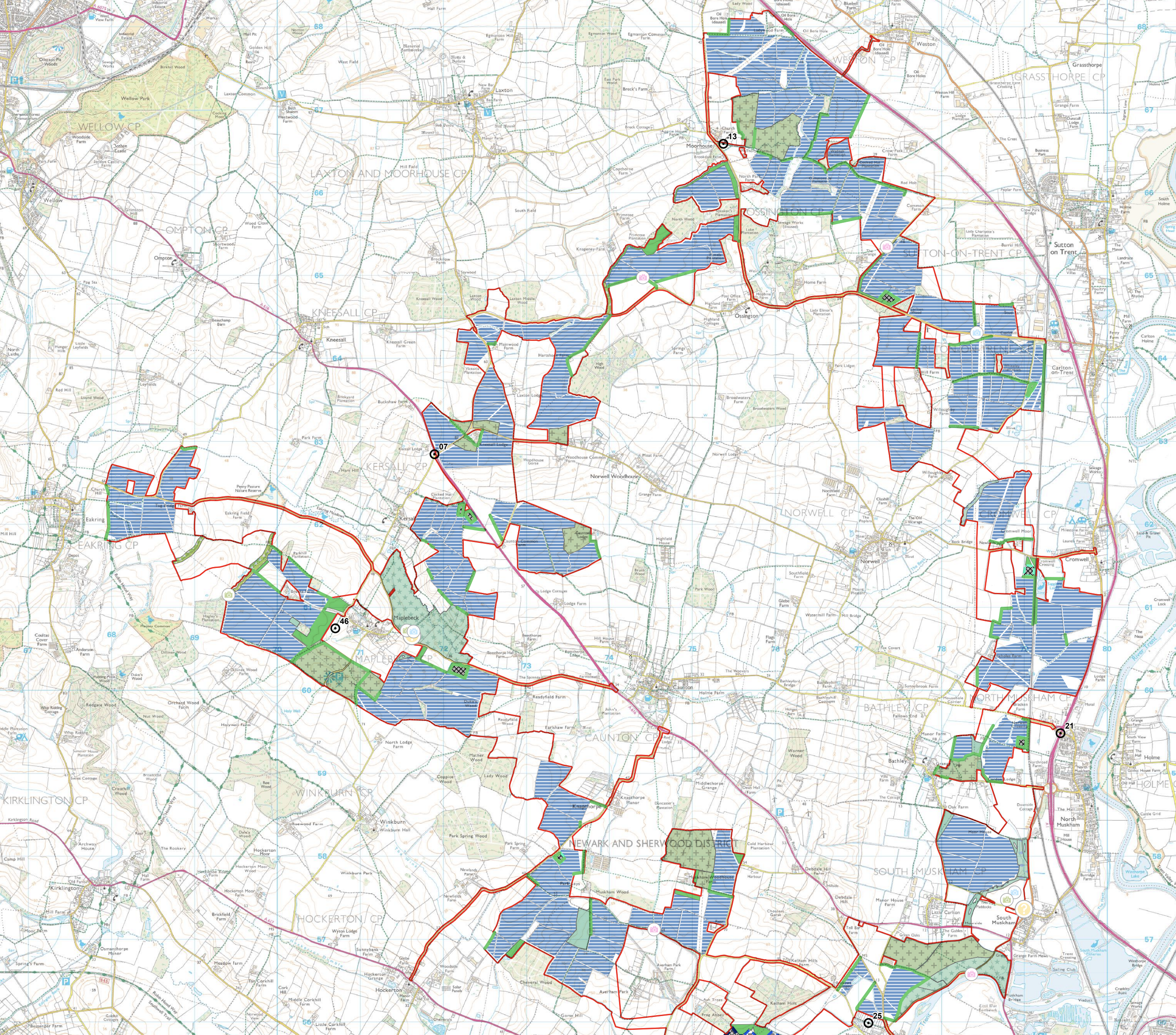
Note.
- The blue areas are solar panels.
- The red line at the right hand side is the A1 Great North Road.
- There is a lot of space for more solar panels.
It could be even bigger than 1 GW.
There Is Opposition To The Wind Farm
This article on the BBC is entitled Survey Suggests Opposition To Major Solar Farm.
This is the sub-heading,
A consultation about a major solar farm in Nottinghamshire has shown the scale of the opposition it faces to being built.
These two paragraphs detail the scale of the opposition.
The consultation, held in January and February, found 54% of respondents opposed the scheme, with 16% supporting the current plan.
Among the main reasons people gave for opposing the scheme were its visual and ecological impact.
The reasons for opposition are typical.
These two paragraphs describe the actions of the developer.
Having received the backing in principle of several key nature charities and trusts, the Great North Road Solar Park project will be renamed ‘Great North Road Solar and Biodiversity Park’, with a new logo to reflect this.
Communities who were consulted on the original proposals in early 2024 expressed a strong desire to protect and enhance their natural environment. Acting upon this feedback, developer Elements Green has formed partnerships with the RSPB, Sherwood Forest Trust, Nottinghamshire Wildlife Trust, and The Trent Rivers Trust, to ensure that nature benefits from their ambitious project.
I suspect that some of the opposition groups have labelled the last paragraph as green-washing.
Nine Thousand Sheep!
Usually, when large numbers of sheep are mentioned on the Internet, it’s usually something a bit coarse.
But in this project, it’s only letting sheep, do what they do well ; act as green lawnmowers, have lambs and provide meat and wool to increase the bottom line.
Where Is The Connection To The Grid?
The FAQs section of the Great North Road Solar and Biodiversity Park web site has this question.
Why has Elements Green chosen this location for the solar park?
This answer is given.
A key factor influencing the location of GNR Solar and Biodiversity Park is the availability of a connection at National Grid’s Staythorpe substation. The closure of fossil fuel power stations has created capacity on the grid. This would enable GNR Solar and Biodiversity Park to continue the tradition of power generation in the area using a clean, renewable resource.
In addition, a range of planning and environmental factors such as the existing land use, quality of land, as well as designations and planning and technical constraints have also informed our choice of location for the scheme.
So if you’re near the site of a disused coal- or gas-fired power station, don’t expect it to be developed as agricultural land, woodland or housing.
The Wikipedia entry for Staythorpe power station, reveals there is a 1,850 MW gas-fired power station on the site.
The Great North Road Solar and Biodiversity Park would appear to have a very able gas-fired back-up,
No Battery Or Energy Storage Is Mentioned
In an idealised day, there is a period of light and a period of darkness.
A battery would allow any excess electricity generated in the day to be used at night.
Google searches reveal energy storage could be fitted.
One of Highview Power’s environmentally-friendly 200 MW/3.25 GWh liquid-air batteries could be a starting point for a one GW solar or wind farm.
Could A Wind Farm Be Added To The Solar Farm?
In An Excursion To Retford And Worksop, I noticed a large hybrid solar and wind farm alongside the railway.






As the Great North Road Solar and Biodiversity Park uses a lot of land, would some be available for a sprinkling of wind turbines?
Conclusion
Looking at the map, you can understand some peoples’s enthusiasm for large solar farms and large onshore wind farms, as they can be so easily connected to the infrastructure of a decommissioned coal- or gas-fired power station.
 The Anonymous Widower