Permission Granted For Ayrshire Renewables Hub
The title of this post, is the same as that of this article on Scottish Construction Now.
This is the sub-heading.
Planning consent has been granted for a £150 million upgrade to an Ayrshire marine yard, paving the way for increased offshore wind power off the UK’s west coast.
These are the first three paragraphs.
Peel Ports Clydeport has secured permission for the complete redevelopment of the Hunterston marine yard as it prepares the site for major renewables infrastructure. The redevelopment works – which are expected to start in early 2025 and last for around two years – will include substantial upgrades to the marine yard, including infilling the current dry-dock basin and the creation of a new quay wall.
Highview Power recently announced it is to construct the world’s largest Liquid Air Energy Storage (LAES) facility at Hunterston, the latest in a string of renewables projects that are either underway, or in the pipeline, at the site.
The overall redevelopment of Hunterston is expected to attract £3.5 billion in inward investment and create over 5,000 jobs.
Note.
- The Highview Power battery will be 200 MW/3.25 GWh.
- There is also a 400 MW/400 MWh BESS being built at Hunterston.
- The 2 GW MacHairWind project is planned off the coast of Islay.
- According to their web site, MacHairWind will export its first power in the early 2030s.
More renewable infrastructure will surely follow.
Invinity’s New Flow Battery Aimed At Enabling ’24/7 Solar’ For The Grid
The title of this post, is the same as that of this article on Solar Power Portal.
These three paragraphs outline the story.
New vanadium redox flow battery (VRFB) technology from Invinity Energy Systems makes it possible for renewables to replace conventional generation on the grid 24/7, the company has claimed.
Anglo-American flow battery company Invinity launched its new product, Endurium, today. It follows around three years of R&D, testing, and prototyping, during which Invinity has partnered with Siemens Gamesa on technology development.
Designed for high energy throughput with unlimited cycling and with at least a 50% reduction in the footprint required for installation at project sites, the company said it could cost-competitively tackle present-day energy storage markets and emerging long-duration energy storage (LDES) opportunities alike.
This looks like it could be a bit of a breakthrough.
After reading this article, it would appear that traditional lithium-ion battery energy storage systems (BESS) now have another competitor along with Highview Power’s liquid air battery.
New Bid To Connect Heritage Railway To Mainline
The title of this post, is the same as that of this article on the BBC.
The is the sub-heading.
A bid to connect one of the longest heritage railways in Britain with mainline services has taken a step forward.
These are the first two paragraphs.
West Somerset Railway (WSR) and Somerset Council have now submitted a business plan to the government to restore the mainline from Taunton to the final WSR stop at Bishop’s Lydeard.
The proposal suggests Bishop’s Lydeard could become a commuter and tourist hub.
There has been several attempts to connect the branch to Taunton station.
These are my thoughts.
Minehead, Bishop’s Lydeard And Hinckley Point C
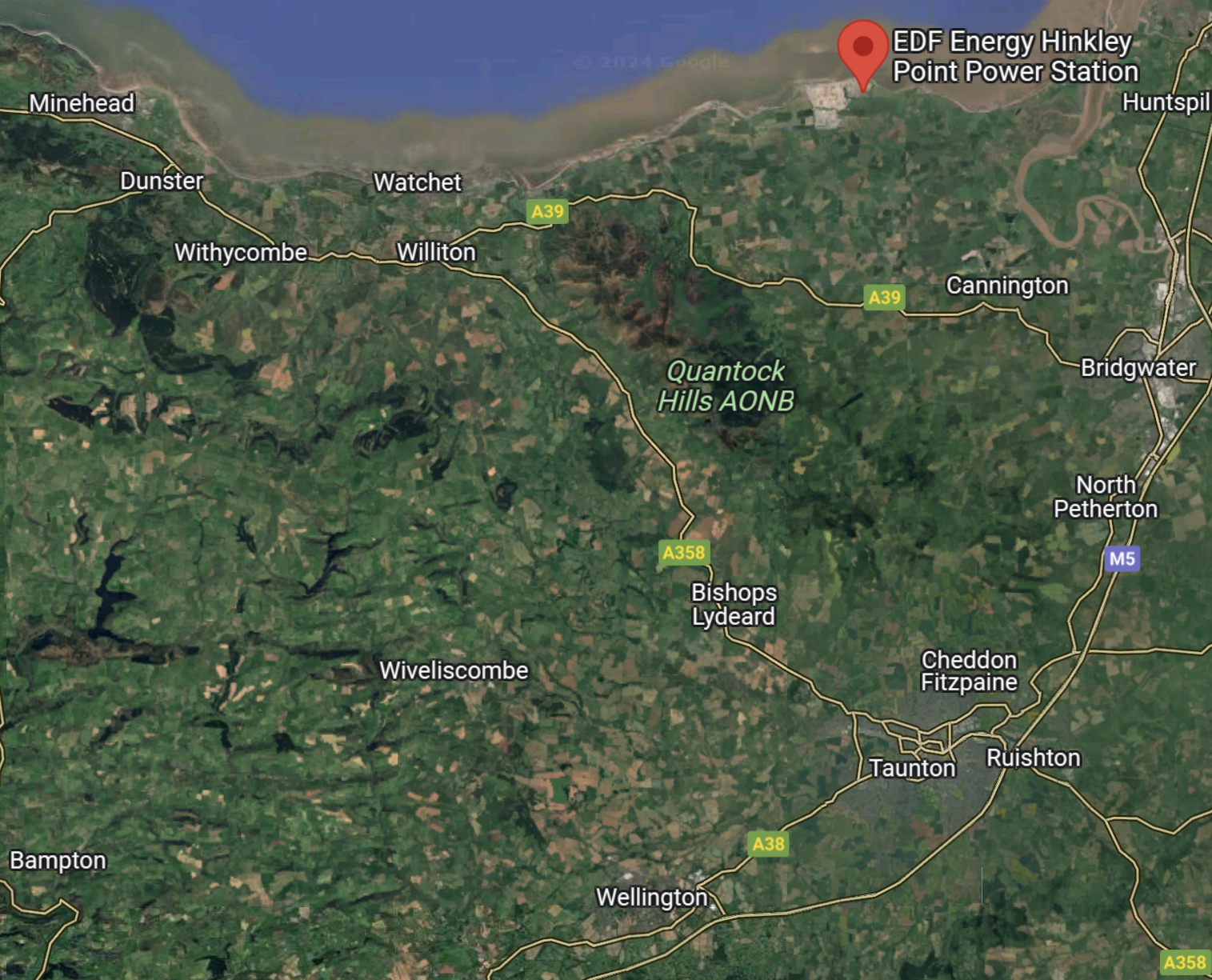
This Google Map shows the area.
Note.
- Minehead is in the North-West corner of the map.
- Hinckley Point power station is indicated by the red arrow.
- Bishop’s Lydeard is in the middle of the map.
- The M5 motorway curves diagonally between the North-East and South-West corners of the map.
- There are motorway services at Taunton Deane, which is to the South of Taunton and Cullompton, which is a few miles South-West of Wellington.
- The large town of Taunton is the junction of the London and Exeter and the Bristol and Exeter railway lines.
- The town of Wellington will be getting a new railway station.
It is a very busy area and it will only get busier, as the availability of power will only attract industry, like the battery factory pencilled in for Bridgewater.
The Major Effect Of Hinckley Point C
Hinckley Point C will generate 3.26 GW of electricity and to operate the power station will need around nine hundred workers.
I can also expect that the Hinckley Point site will get involved in other energy handling and use.
- The site would be an ideal place for a large electrolyser to produce hydrogen.
- Wind turbines in the Bristol Channel could use Hinckley’s grid connection.
- Energy could be stored on the site. It could be an ideal location for one of Highview Power’s 200 MW/3.25 GWh liquid air batteries.
- Hydrogen could be exported using coastal tankers.
- Interconnectors could take electricity to Cornwall, Devon, Wales and Ireland.
All of these activities would create needs for workers at all levels.
- A rail connection to Taunton and Bristol, will probably be needed to bring workers into Hinckley Point.
- A rail connection would be ideal for bringing construction materials, steel and other heavy goods into and out of the Hinckley Point site.
- Hydrogen could also be taken out in rail tankers.
- Nuclear waste could be taken out by train.
I think it is highly likely, that Hinckley Point will need a rail connection for efficient operation.
Sizewell C And Hydrogen
Hydrogen is so important to the philosophy of the design and construction of Sizewell C, that hydrogen has its own section on the Sizewell C web site.
Hydrogen produced by nuclear power stations like Hinckley Point C, is called pink hydrogen, but like green hydrogen it is zero-carbon and pollution-free.
Hinckley Point C And Hydrogen
I can envisage Hinckley Point C will create a lot of hydrogen both for use locally and distribution to remote users.
- Hydrogen could be delivered locally by truck, just as propane is today around the world.
- Coastal tankers could distribute the hydrogen from a jetty.
- Pipelines could connect the two nearby motorway service stations to the power station site.
Just as is happening at Sizewell, a local hydrogen network could be built.
Hydrogen Refuelling On The M5
Consider.
- In MAN Expands Its Zero-Emission Portfolio, I talked about MAN’s new hydrogen-powered hTGX truck, which has been designed with a 600 km. or 373 mile range.
- As Cullompton, which is the Southernmost of the two services on the M5 that are close to Hinckley Point C, is only 124.9 miles from Penzance, it should be possible for a truck, with a range similar to that of the MAN hTGX to do a round trip from the Southern end of the M5 to Penzance, without refuelling.
- As the total length of the M5 is only 163 miles, a hydrogen-powered truck with the range of the MAN hTGX would be able to do a delivery anywhere along the motorway and return to the hydrogen from Hinckley Point C, without refuelling.
- MAN are saying that the hTGX truck can be refuelled in less than fifteen minutes.
It looks to me, that a hydrogen electrolyser at Hinckley Point C would be ideally located to provide pink hydrogen for a zero-carbon hydrogen-powered route to and from the far South-West.
I believe that if there were a best-in-class hydrogen-refuelling facility close to Hinckley Point C, it would encourage those who regularly drove to Devon and Cornwall to look seriously at hydrogen-powered vehicles.
The Nature Of The Hinckley Point C Rail Link
Sizewell C are using a simple practical approach to connect the Sizewell C site to the nearby East Suffolk Line.
- The existing freight sidings are being expanded.
- Two Park-and-Ride sites are being created at stations in the East Suffolk Line.
- A link road will be built between the railway and the Sizewell C site.
- A fleet of hydrogen-powered double-deck buses has been ordered to take workers between the railway and the power station.
- The signalling on the East Suffolk Line is being improved.
This map from OpenRailwayMap shows the Northern end of the West Somerset Railway and its relationship to Hinckley Point C power station.

Note.
- Hinckley Point C power station is in the North-East corner of the map.
- Crowcombe & Heathfield, Stogumber, Sampford Brett, Doniford Halt, Williton, Watchet, Washford and Blue Anchor are existing or former stations on the West Somerset Railway.
- Existing stations are shown in blue.
- West of Blue Anchor are the two existing stations of Dunster and Minehead.
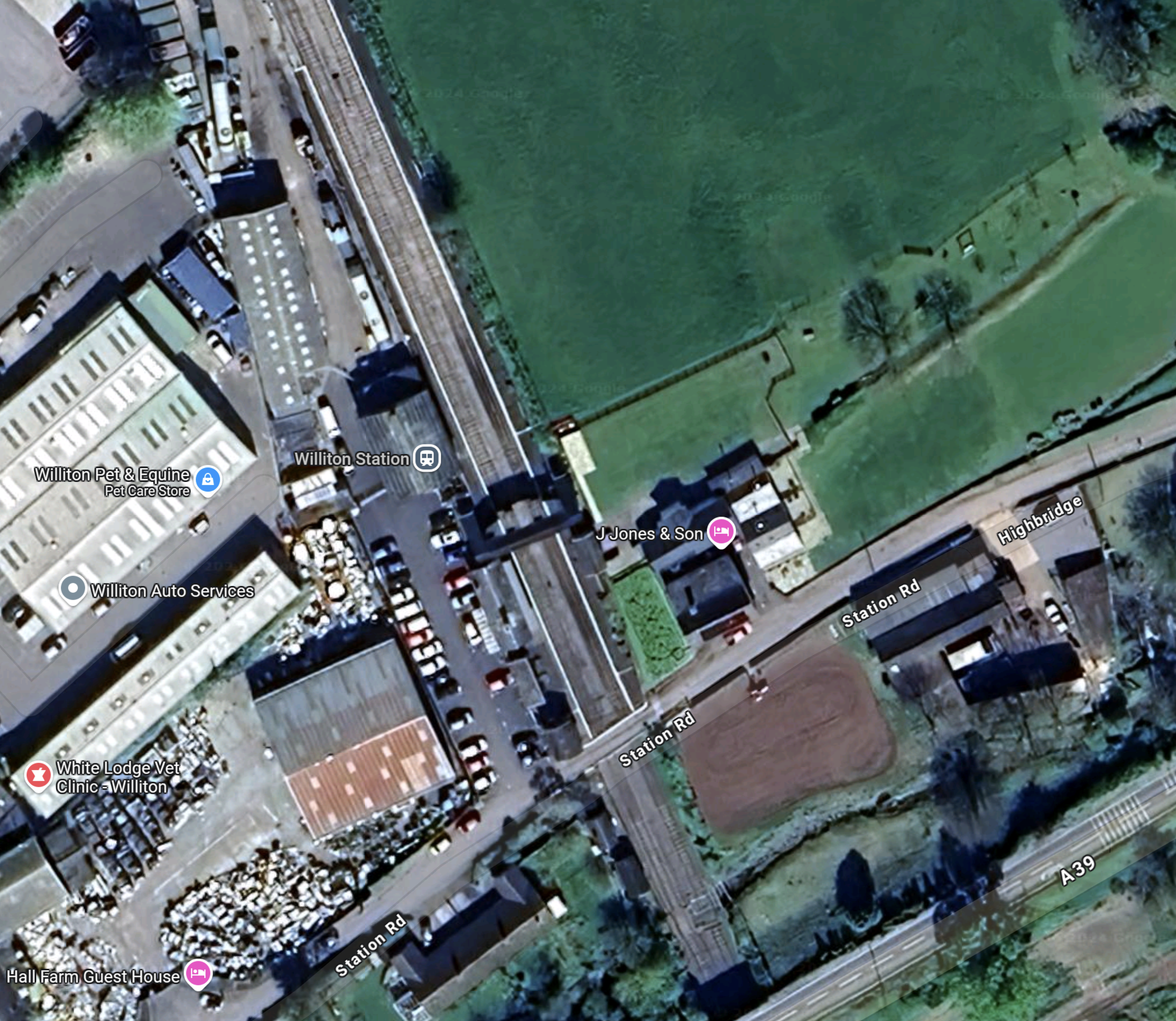
This Google Map shows Williton station, which is the nearest station to Hinckley Point C.
Note.
- The station has a footbridge, which was erected in 2011, so is probably in good condition.
- There are several Listed buildings on the site.
- Going East on the A39 should lead to Hinckley Point C.
I suspect a quality bus company could build a small fleet of buses to shuttle workers, visitors and others to Hinckley Point C.
As I’m sure, hydrogen will be in plentiful supply, I’m certain hydrogen-powered buses could be used.
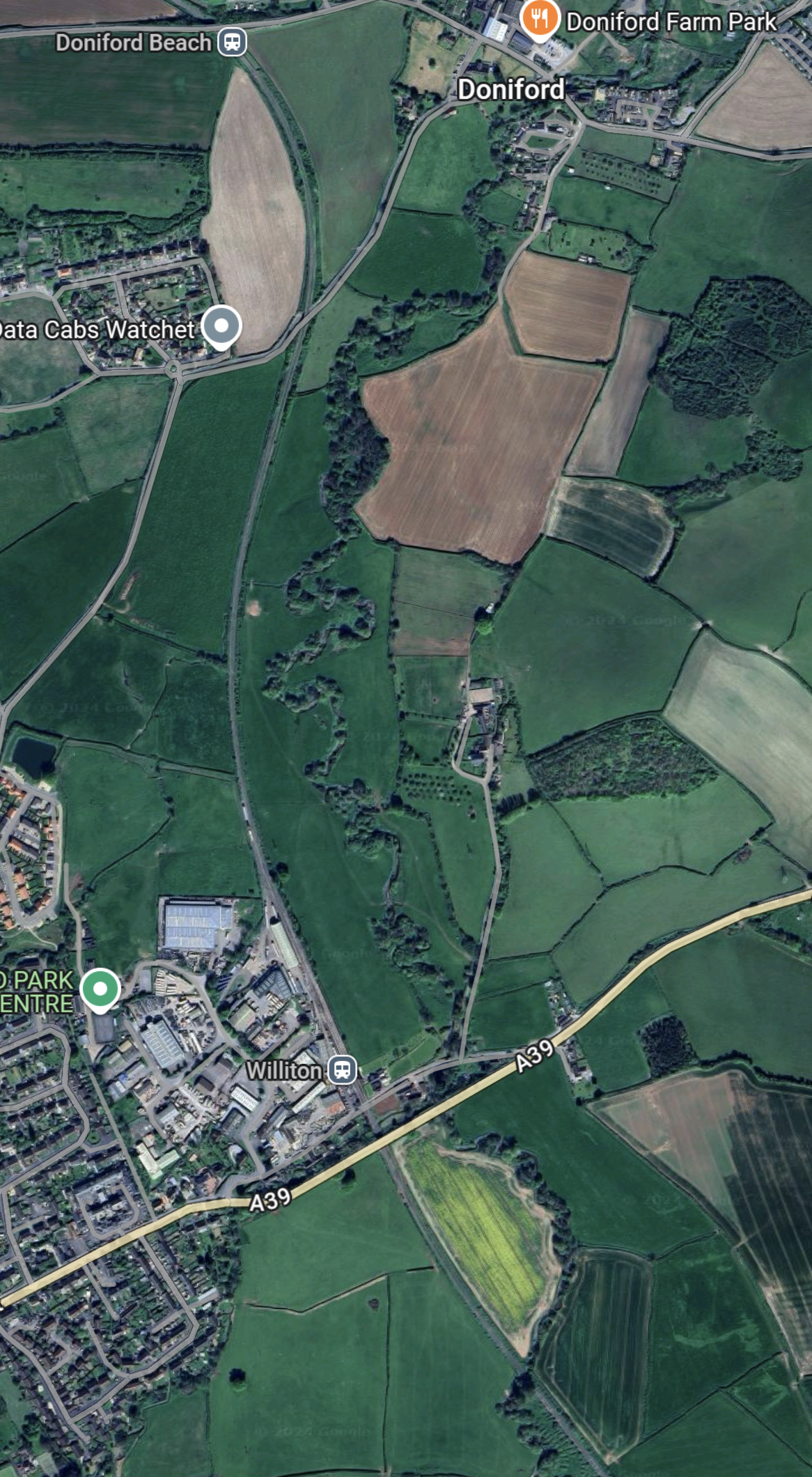
This Google Map shows a longer section of the West Somerset Line through Williton station.
Note.
- The West Somerset Line runs North-South down the map.
- Doniford Halt station is at the top of the map, where the coast road crosses the railway on a bridge.
- Williton station is in the middle of the map, where the A39 crosses the railway.
Looking at the railway, which runs mainly between fields, I wouldn’t be surprised that if Hinckley Point wanted a freight siding, they could fit one in.
Go-op
Go-op are an open access railway company, that wants to run services in Somerset.
I wrote about their successful application in Regulator Approves New Go-op Train Service Between Swindon, Taunton and Weston-super-Mare.
This is the first paragraph of their Wikipedia entry.
Go-op Cooperative Ltd.,[ branded as Go-op, is an open access train operating company, proposing to operate a service in south-west England between Taunton and Swindon, via Westbury. It aims to become the first cooperatively owned train operating company in the United Kingdom, to improve access to the public transport infrastructure through open access rail services linking main lines to smaller market towns, and by co-ordinating services with light rail, bus links and car pools.
If you read their Wikipedia entry and their web site, they seem to have ambition and be different.
According to Wikipedia, they have made no less than five different proposals, but it is the fourth that I find interesting.
In 2021, Go-op began discussions with Network Rail for services between Swindon and Bishops Lydeard (just beyond Taunton), which it hoped to begin in mid-2022. At first there could only be three services per day, due to congestion between Swindon and Westbury; a further three could be provided to Frome or Westbury, connecting with existing services to Swindon. These plans would also improve local services on the TransWilts Line, calling at Trowbridge and Melksham.
The plans for Bishops Lydeard would restore the link broken in 1971 between the national network and the preserved West Somerset Railway, which runs leisure services to Minehead.
This sounds very much like an extended and simplified version of the West Somerset Line proposal.
But it does look like two groups have looked at the infrastructure and what is needed and come to similar conclusions.
Perhaps, they have other things in common like train procurement and servicing.
Stadler Presents A World First In Berlin
The title of this section, is the same as that of this press release from Stadler.
These are the first two paragraphs.
With the RS ZERO, the rail vehicle manufacturer is presenting the successor to the successful Regio-Shuttle RS1 model. There is a choice of two modern and environmentally friendly drive technologies: Hydrogen and battery. Both will enable CO2 emission-free operation of secondary lines in the future.
Stadler today unveiled the prototype of the new RS ZERO, the innovative successor to the successful RS1 Regio-Shuttle. The Regio-Shuttle has been one of the most popular vehicles in German regional rail transport for 28 years, with around 500 RS1 vehicles currently in operation in Germany and the Czech Republic. Stadler is building on this proven technology and integrating state-of-the-art, environmentally friendly drive systems. The RS ZERO is optionally available with a hydrogen and/or battery drive and thus not only sets new standards for environmentally friendly rail transport, but also presents a world first.
These pictures from Chemnitz Trams And The Chemnitz Model, show the Regio-Shuttle RS1.




Note.
- The Regio-Shuttles can run as up to seven car trains.
- These Regio-Shuttles are electro-diesel.
- The distinctive diagonal windows.
- They can carry 170 passengers at 75 mph.
- They can run as train-trams using the Chemnitz model on compatible tram networks.
The Regio-Shuttle Wikipedia entry gives more details.
This image from the press release shows the prototype RS ZERO.
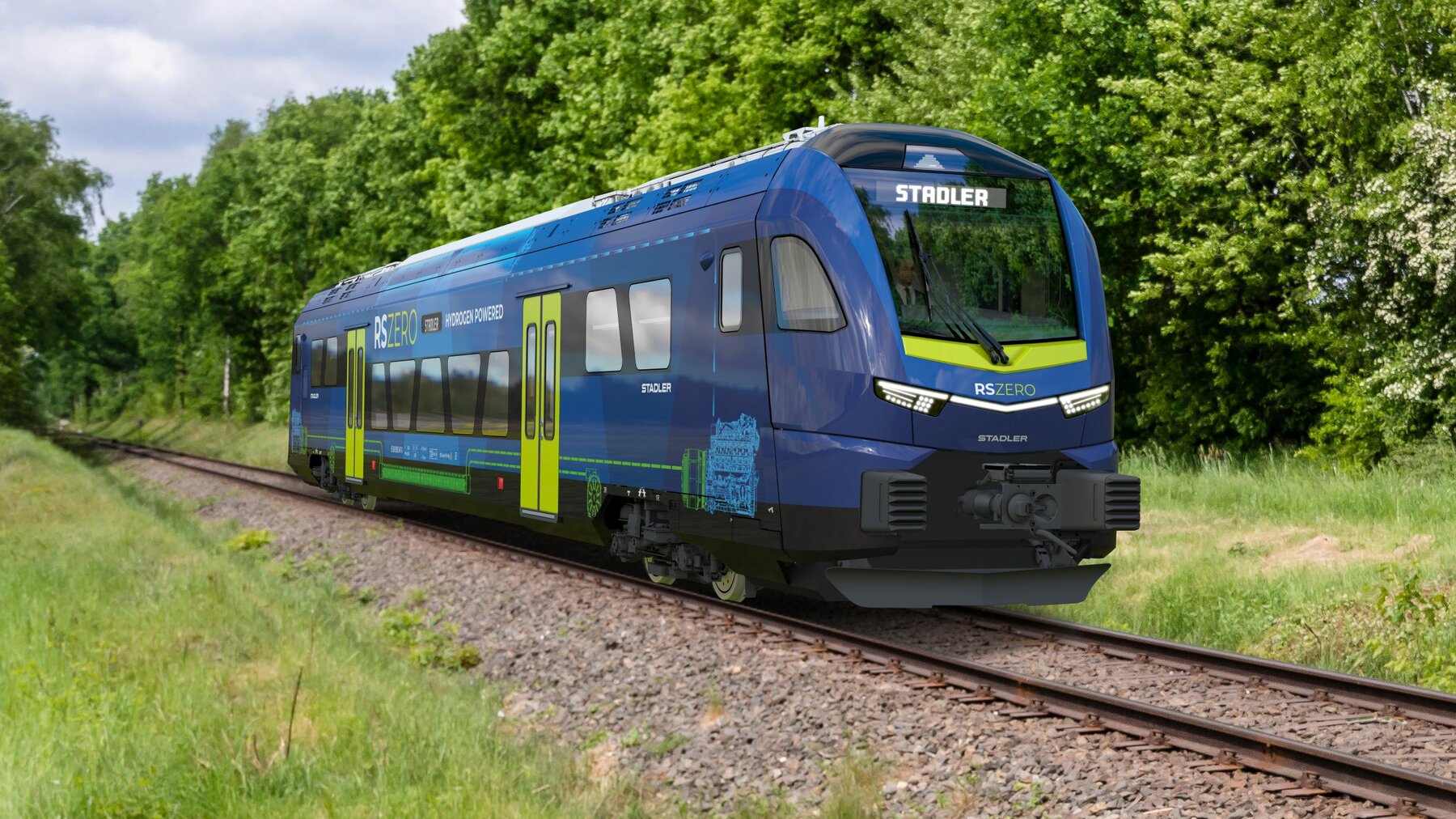
It looks very similar to my pictures from Chemnitz.
I have a few thoughts.
Comparison To A Class 150 Train
A Class 150 train can carry up to 149 seated passengers at 75 mph, which is similar to the RS ZERO.
As Stadler have built trains for Greater Anglia, Merseyrail and the Glasgow Subway, I believe that Stadler could build an RS ZERO, that would fit the UK loading gauge.
In What Train Is This?, I show the standard of interior, that can be achieved by refurbishing a Class 150 train, but unlike the RS ZERO, the train won’t be zero-carbon.
Does The RS ZERO Have A Toilet?
This is a paragraph from the press release.
The prototype of the RS ZERO presented today in Berlin is a one-car vehicle with hydrogen drive. Stadler is demonstrating the numerous design options with a multi-purpose area equipped for carrying bicycles, pushchairs and bulky luggage, lounge and comfort zones, standard and privacy seats, a wheelchair space, WC and a train office.
The train appears to be able to have what an operator might need.
What Will Be The Range Of An RS ZERO On Hydrogen?
I suspect, Stadler will provide a train, that will handle the route.
Would Stadler Be Able To Produce An RS ZERO That Could Satisfy The West Somerset/Go-op Requirement?
I obviously, can’t answer that.
But.
- The train is zero-carbon.
- It’s the right size.
- I suspect that the hydrogen fuel will be available from Hinckley Point C.
- The design has a proven track record.
- The train is not by any means vapourware!
- Stadler need a launch order.
- An experienced ROSCO would probably finance the trains.
One perk is that those involved in buying the train, could probably wangle a trip to Chemnitz to see several Regio-Shuttle RS1 trains at work.
Note that Chemnitz used to be Karl-Marx Stadt, so some of our Government will feel nostalgic.
But I do believe, this could be a very handy train to decarbonise branch and secondary lines in the UK.
DOE Funds Research Into Long-Duration Energy Storage Using Lead-Acid Batteries
The title of this post, is the same as that of this article on Best Magazine.
This is the sub-heading
US federal cash is on its way to fund research into long-duration energy storage using lead-acid batteries.
These two paragraphs give more details.
A consortium backed by industry bodies Battery Council International and the Consortium for Battery Innovation, will conduct pre-competitive research aimed at improving lead battery performance. Companies participating in the consortium include Advanced Battery Concepts, C&D/Trojan, Clarios, Crown Battery, East Penn Manufacturing, EnerSys, Gridtential and Stryten Energy. The collaborating national laboratories are Argonne, Oak Ridge and Pacific Northwest (PNNL).
The $5 million award from the US Department of Energy, announced on 27 September, will support work to develop lead batteries capable of 10+ hours of storage with a pathway to $0.05/kWh levelised cost of storage by 2030.
Note.
- The companies involved have names that indicate they could be battery makers.
- The collaborating national laboratories are world-class Premier League players.
- Over the nearly fifty years, that I drove cars, lead-acid batteries improved a lot and there might be more to come.
- The last paragraph is ambitious, unless they know more than I do about lead-acid batteries. Which is likely!
This is also said in one of Highview Power’s news items.
Highview Power, the global leader in long-duration energy storage solutions, is pleased to announce that it has developed a modular cryogenic energy storage system, the CRYOBattery, that is scalable up to multiple gigawatts of energy storage and can be located anywhere. This technology reaches a new benchmark for a levelized cost of storage (LCOS) of $140/MWh for a 10-hour, 200 MW/2 GWh system. Highview Power’s cryogenic energy storage system is equivalent in performance to, and could potentially replace, a fossil fuel power station. Highview Power’s systems can enable renewable energy baseload power at large scale, while also supporting electricity and distribution systems and providing energy security.
The battery researchers are saying $0.05/kWh levelised cost of storage by 2030 and Highview Power are saying $0.14/kWh for the same parameter.
Could Elon Musk’s Relationship With Donald Trump Be The Fly In The Ointment?
Would Musk want research to go on, that might weaken the use of his lithium-ion batteries for stationary applications?
Lakeside Facility Connects To Grid And Becomes UK’s Largest Transmission Connected Battery
The title of this post, is the same as that of this press release from National Grid.
These three bullet points, act as sub-headings.
- National Grid plugs TagEnergy’s 100MW battery project in at its Drax substation.
- Following energisation, the facility in North Yorkshire is the UK’s largest transmission connected battery energy storage system (BESS).
- The facility is supporting Britain’s clean energy transition, and helping to ensure secure operation of the electricity system.
This paragraph introduces the project.
A battery storage project developed by TagEnergy is now connected and energised on the electricity transmission network, following work by National Grid to plug the facility into its 132kV Drax substation in North Yorkshire.
- Lakeside Energy Park’s 100MW/200MWh facility is now the largest transmission connected BESS project in the UK following energisation.
- The new facility will boost the capacity and flexibility of the network, helping to balance the system by soaking up surplus clean electricity and discharging it back when the grid needs it.
- To ensure a safe connection, National Grid, working with its contractor Omexom, upgraded its Drax 132kV substation to accommodate the additional clean power.
- Works included extending the busbars – which enable power flows from generation source on to power lines – upgrading busbar protection and substation control systems, and installing an operational tripping scheme, all of which helps keep the network stable and operating securely.
Owned and operated by TagEnergy – with Tesla, Habitat Energy and RES as project partners – the newly-connected battery will help exploit the clean electricity potential of renewable projects in the region, storing and releasing green energy to power homes and businesses and also helping to relieve any system constraints.
National Grid’s adjacent Drax 400kV substation already hosts the connection for Drax power station – the UK’s largest biomass facility – and will also connect the Eastern Green Link 2 electrical superhighway when it starts importing clean energy from Scotland in 2029.
Drax power station seems to be growing into a large node with several gigawatts of electricity, the UK’s largest BESS, a large biomass power station and the Eastern Green Link 2 electrical superhighway which will import clean energy from Scotland from 2029.
Drax appears to be transforming from the dirty man of the UK into a Jolly Green Giant.
I can see further power stations and sources, storage devices and technology joining the party at Drax.
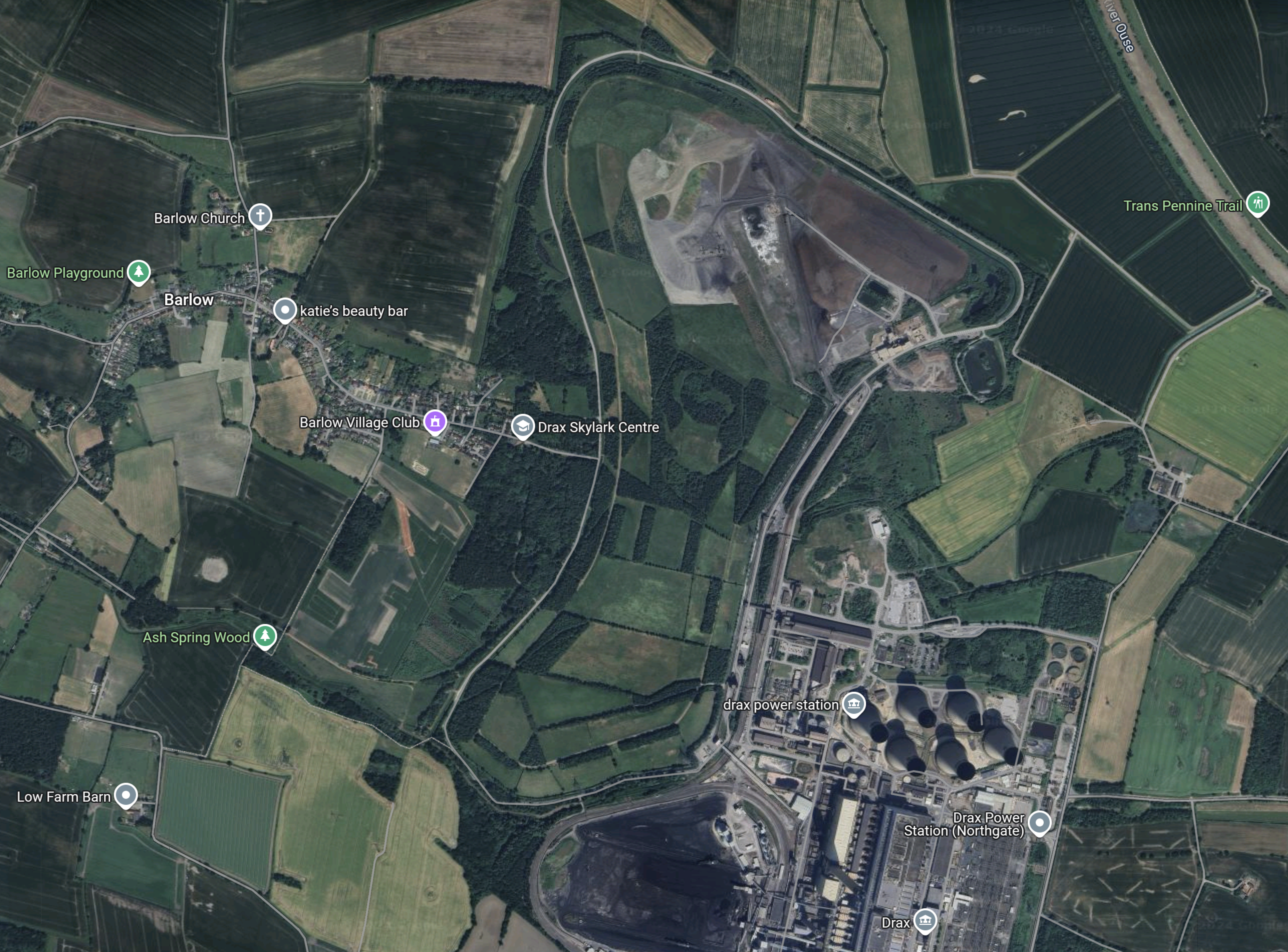
This Google Map shows the Drax site.
Note.
- The cooling towers can be picked out in the South-East quarter of the map.
- The site is rail and road connected, with the River Ouse nearby.
- There is a lot of space.
Surely, Drax would have a big enough space, with a high quality and high capacity electrical connection for Ørsted and Highview Power to put one of their three 200 MW/2.5 GWh batteries, that I talked about in Centrica Business Solutions And Highview Power.
Highview Power Releases More Details Of The Hunterston LDES
In a long and detailed press release, these are the first two paragraphs.
London, 15 October 2024: The First Minister for Scotland, John Swinney MSP, welcomed Highview Power Executives to Scotland House in London today as the company announced its intention to develop its Hunterston project in Scotland as part of its multi-billion-pound LDES programme. Hunterston will deliver five times Scotland’s current operational battery storage capacity and is strategically placed in the grid transmission network to maximise the use of Scottish-produced renewable electricity. This follows Highview Power’s funding round in June where it secured a £300 million investment for its 300MWh proprietary Liquid Air Energy Storage (LAES) technology at Carrington, near Manchester.
Supported by the Scottish Government, Hunterston is the first project in Highview Power’s second phase, which comprises four projects across Scotland and Northern England. The 2.5GWh LAES plant at Hunterston will deliver an 8-fold increase in storage capacity on Carrington – to deliver enough power 650,000 homes for 12.5 hours.
Note these important points.
- The Hunterston battery will be the first of four 200 MW/2.5 GWh batteries.
- Together, these four batteries will have a distributed 1600 MW/10 GWh capability.
- For comparison, Dinorwig pumped storage hydroelectric power station, in Snowdonia, which opened in 1984, has a 1600 MW/9.1 GWh capability.
- The second battery will be in Aberdeenshire.
- The Hunterston project will support 1,000 jobs onsite during construction and 650 jobs in the supply chain.
John Swinney, who is First Minister for Scotland, summed the project up like this.
The creation of the largest liquid air energy facility in the world, in Ayrshire, demonstrates just how valuable Scotland is in delivering a low carbon future as well as supporting the global transition to net zero.
Highview Power Plans To Develop 2.5GWh LDES Project In Scotland
The title of this post is the same as that of this article on Power Technology.
This is the sub-heading.
The liquid air energy storage plant at Hunterston is set to deliver a substantial increase in storage capacity
These first three paragraphs add a few more details.
Highview Power has announced plans to develop a long-duration energy storage (LDES) project in Ayrshire, Scotland, with a capacity of 2.5 gigawatt hours (GWh).
The project will be built at Peel Ports’ property at Hunterston, North Ayrshire and will provide five times the existing battery storage capacity of Scotland.
It is supported by the Scottish government and its strategic location optimises the use of renewable electricity produced in the country.
Note.
- Highview Power talks of 200MW/2.5GWh capacity batteries in Scotland on its web site, so I suspect this battery is one of those.
- This battery is as large as some pumped storage hydro systems.
- In UK Infrastructure Bank, Centrica & Partners Invest £300M in Highview Power Clean Energy Storage Programme To Boost UK’s Energy Security, I described the funding now behind Highview Power. The funding appears to be solid, as it includes the UK Infrastructure Bank, Centrica, Goldman Sachs and Rio Tinto.
This is a good start for Highview Power.
UK To Fund Hydro Energy Storage Projects
The title of this post, is the same as that of this article on The Times.
This is the sub-heading.
New infrastructure aims to help balance the electricity system after the rapid growth in renewables
These three paragraphs infrastructure the article.
Projects that use water to store and release energy are to be given government support, in an attempt to help manage the volatility in supply and demand as more green power enters the grid.
From next year, pumped hydro storage projects will be able to apply for government subsidies, which will be provided via a “cap and floor” mechanism. These would guarantee revenues if prices drop below a certain floor but prevent providers from charging above a ceiling when power prices are high.
Like other government support schemes, any cost will be levied on energy bills, while consumers will be paid back any money generated above the cap. It is yet to be decided precisely how the cap and floor will be set.
I feel it is reasonable to expect the system to be a success, as a similar system is used for interconnectors and this article on Offshore Energy is entitled Over $86 million To Be Split Between UK and Belgium Consumers As 1 GW Subsea Interconnector’s ‘Remarkable’ Revenues Exceed Ofgem’s Cap.
It looks like Ofgem played this right for interconnectors and the Nemo Link is making a substantial payment.
It will be interesting to see what happens when “cap and floor” contracts are assigned.
This move by Ofgem will probably have effects in two areas.
- SSE, Statera and Statkraft, who are typically developing systems at the high end with a size of about 1.5 GW/25 GWh could find money is easier to come by.
- At the lower end, companies like Highview Power, who have systems of 50 MW/300 MWh and 200 MW/2.5 GWh under development, will also benefit.
My Control Engineering thoughts are leaning towards the 200 MW/2.5 GWh systems being the popular ones. Especially as they would appear to be close to the right size to support a 1 GW wind farm for two hours.
A Highview Power Two-Hour Liquid Air Battery could fit nearly with a fleet of Two-Hour BESS.
It should be noted that CAF use a little-and-large approach to theit battery-electric trams in the West Midlands.
A large lithium-ion battery is the main storage device.
A supercapacitor handles the high-frequency response and keeps the power steady.
Pairing a Highview Power Two-Hour Liquid Air Battery and a Two-Hour BESS could achieve the same performance and possibly result in some cost savings.
Out Of Thin Air: Solving The Dilemma Of Long-Duration Storage
The title of this post, is the same as that of this excellent article on the Australian Financial Review.
This is the sub-heading.
Two first-of-a-kind technologies in Australia are firming up as options to crack the tough nut of energy storage that lasts much longer than batteries.
This is the first paragraph.
Two competing technologies that use different forms of air to store energy are emerging as potential solutions for the thorny problem of long-duration storage needed to smooth out Australia’s bumpy transition to low-carbon energy.
The article then compares the two competing technologies.
- Hydrostor of Canada are developing the 200 MW/1600 MWh Silver City Energy Storage Centre at Broken Hill in New South Wales.
- Highview Power of the UK are proposing a 12-hour energy store for the Northern Territory.
Australia certainly has plenty of solar power to fill the energy storage.
Gresham House Energy Storage Reaches 1 Gigawatt Of Capacity
The title of this post, announcing a major milestone for Gresham House Energy Storage Fund appears on several web pages.
Many grid batteries are designed to give full power for two hours, so applying that rule to the Gresham House Energy Storage fleet, will mean that the total fleet would be a 1 GW/2 GWh battery.
Consider.
- In Centrica Business Solutions And Highview Power, I showed how Highview Power’s batteries could be used, instead of lithium-ion batteries.
- Highview Power’s largest battery is 200 MW/2.5 GWh, which compares well with the largest lithium-ion batteries, in the UK fleet.
- The Ffestiniog Power Station is a 360 MW/1.44 GWh pumped-storage hydroelectric power station in Wales. It is slightly smaller than Highview Power’s largest battery.
- Moss Landing Power Plant in California is proposing to have a 1,500 MW / 6,000 MWh lithium-ion battery.
- Other GWh-scale systems are under trial.
It would appear that battery systems are widening the sizes of where they can be employed.
This hopefully, will mean more competition and keener prices for battery systems.
 The Anonymous Widower