The Chemical Engineer Magazine On Highview Power
This is said in the Wikipedia entry for The Chemical Engineer Magazine.
The Chemical Engineer is a monthly chemical engineering technical and news magazine published by the Institution of Chemical Engineers (IChemE).
I first read the magazine perhaps fifty years ago, when it explained a chemical process, I was working on at ICI.
It is one of several well-respected magazines published by UK scientific, medical and engineering institutions.
This article in the magazine is entitled Energy Stored As Liquefied Air: £300m Investment Triggers Construction Of UK’s First Commercial-Scale Plant.
These three paragraphs introduce the investment.
HIGHVIEW POWER has received £300m (US$379m) in funding to build the UK’s first commercial-scale liquid air energy storage plant (LAES), designed to balance peaks and troughs in power demand as more renewable energy sources are brought online.
Construction of the facility is now underway in Carrington near Manchester. It is scheduled to begin operations in early 2026 and the company predicts it will provide more than 700 jobs in construction and the supply chain.
The plant will have a storage capacity of 300 MWh and an output of 50 MW per hour for six hours.
The rest of the article is just two sections.
- How Will Highview’s New Plant Work?
- Why Is The Technology Needed?
This article in the magazine is an absolute must read.
Are Goldman Sachs Stitching Together A Large Deal On Energy Storage?
In UK Infrastructure Bank, Centrica & Partners Invest £300M in Highview Power Clean Energy Storage Programme To Boost UK’s Energy Security, I talked about a deal to invest £300 million into energy storage company; Highview Power.
These three paragraphs are from the Highview Power news item, on which I based my post.
Highview Power has secured the backing of the UK Infrastructure Bank and the energy industry leader Centrica with a £300 million investment for the first commercial-scale liquid air energy storage (LAES) plant in the UK.
The £300 million funding round was led by the UK Infrastructure Bank (UKIB) and the British multinational energy and services company Centrica, alongside a syndicate of investors including Rio Tinto, Goldman Sachs, KIRKBI and Mosaic Capital.
The investment will enable the construction of one of the world’s largest long duration energy storage (LDES) facilities in Carrington, Manchester, using Highview Power’s proprietary LAES technology. Once complete, it will have a storage capacity of 300 MWh and an output power of 50 MWs per hour for six hours. Construction will begin on the site immediately, with the facility operational in early 2026, supporting over 700 jobs in construction and the supply chain.
Note.
- The UK Infrastructure Bank is a is a British state-owned development bank.
- Centrica plc is an international energy and services company.
- Rio Tinto is a leading global mining group that focuses on finding, mining and processing the Earth’s mineral resources.
- The Goldman Sachs Group, Inc. is a leading global investment banking, securities and investment management firm.
- KIRKBI is the Kirk Kristiansen family’s private holding and investment company founded to build a sustainable future for the family ownership of the LEGO Group.
- Mosaic Capital are an American investment firm.
With six partners, that is just £50 million per partner.
As that sum is very much small change for the likes of these guys and the question of taking an equity stake is not mentioned in Highview Power’s news item, it looks like this deal could be a try-before-you-buy deal with some of the partners or a simple investment with others.
Consider.
- Gresham House, Gore Street and others have proven that investing in lithium-ion batteries give a good return on investment.
- The Carrington long duration energy storage facility will be located near to the 884 MW gas-fired Carrington power station. I suspect that Centrica and Rio Tinto will be interested to see how the hybrid power-station performs.
- Could the Lego Group owners be looking at using solar power, wind power and a LDES to reduce the carbon footprint of their stores?
I would assume, that all the investors would get full details on the performance of the batteries.
Someone To Build The LDES
In Bilfinger Drives Highview Power’s Innovative Storage Project, Accelerating The Energy Transition, I describe how German company will build the Carrington LDES.
The Advantages Of An LDES over a BESS
This is only a short list, of the advantages I see.
- An LDES is easily recyclable.
- The LDES has less exotic materials.
- An LDES can be built from zero-carbon steel.
- Highview are claiming a 40-year life for their LDES.
- Highview is already talking about 200MW/2.5GWh LDES systems.
- Two 200MW/2.5GWh systems working together with a wind or solar farm, can replace a 400 MW gas- or coal-fired station.
- I suspect one of Highview’s LDES systems could be placed offshore, if needed.
I also believe that Highview’s LDES systems could be incorporated into complex chemical plants to increase the efficiency.
Are Goldman Sachs Stitching Together A Large Deal On Energy Storage?
Everything now seems to be in place to build these LDES one after the other, to accelerate the energy transition.
With a good supply of orders and enough money to build each system, I cab see no reason, why several systems a month cannot be built and installed.
I have worked with companies like Goldman Sachs in the past, and I wouldn’t be surprised to find, that they have created the consortium, so that all members get the returns and recognition, they disserve.
Adding Lego Group To The Consortium Could Be A Masterstroke
The Lego Group has lots of stores and theme parks worldwide and a reputation for good design and environmental standards.
Last year, I wrote Bedford Depot’s Massive Solar Roof Helps Thameslink On Way To Net Zero. This was putting a solar roof on a rail depot, but surely buildings like this would be suitable for a Highview LDES.
Where’s The Plan, Rishi?
In RWE Goes For An Additional 10 GW Of Offshore Wind In UK Waters In 2030, I detailed how RWE intended to add an extra 10 GW of offshore wind to the seas around the UK.
As our current offshore wind capacity is around 15 GW, another 10 GW would surely be very welcome.
My post also outlined H2ercules, which is Germany’s massive project to create a hydrogen network to bring hydrogen to Southern Germany.
I also gave details of the hydrogen hub at Wilhelmshaven, which is being built by Uniper to feed H2ercules with green hydrogen from around the world.
I believe that some of this hydrogen for H2ercules will take a short trip across the North Sea from UK waters, after being created by offshore electrolysers.
Rishi Sunak’s Manifesto Speech – June 11
I also reported on Rishi Sunak’s Manifesto Speech, which he made on June 11th. This is an extract
This document on the Policy Mogul web site is entitled Rishi Sunak – Conservative Party Manifesto Speech – Jun 11.
These are three paragraphs from the speech.
We don’t just need military and border security. As Putin’s invasion of Ukraine has shown, we need energy security too. It is only by having reliable, home-grown sources of energy that we can deny dictators the ability to send our bills soaring. So, in our approach to energy policy we will put security and your family finances ahead of unaffordable eco zealotry.
Unlike Labour we don’t believe that we will achieve that energy security via a state-controlled energy company that doesn’t in fact produce any energy. That will only increase costs, and as Penny said on Friday there’s only one thing that GB in Starmer and Miliband’s GB Energy stands for, and that’s giant bills.
Our clear plan is to achieve energy security through new gas-powered stations, trebling our offshore wind capacity and by having new fleets of small modular reactors. These will make the UK a net exporter of electricity, giving us greater energy independence and security from the aggressive actions of dictators . Now let me just reiterate that, with our plan, we will produce enough electricity to both meet our domestic needs and export to our neighbours. Look at that. A clear, Conservative plan not only generating security, but also prosperity for our country.
It is now nine days since Rishi made that speech and I can’t remember any reports about an energy security policy, which he outlined in the last paragraph of my extract from his speech.
He particularly mentioned.
- New gas-powered stations
- Trebling our offshore wind capacity
- Having new fleets of small modular reactors.
He also said we would have sufficient electricity to export to our neighbours. As I said earlier some of this energy will be in the form of hydrogen, which has been created by offshore electrolysers.
If we are exporting electricity and hydrogen to Europe, this is likely to have three effects.
- An improvement in Europe’s energy security.
- H2ercules will improve and decarbonise German industry, using UK hydrogen.
- The finances of UK plc will improve.
It looks like there will be winners all round.
Rishi also said this, in his speech.
As Putin’s invasion of Ukraine has shown, we need energy security too.
The gas-powered stations, offshore wind farms and the fleets of small modular reactors, will be part of the equation.
But I believe, we need three other components to complete our energy security.
- The upgrading of the National Grid.
- The building of four x 2 GW interconnectors between Scotland and Eastern England.
- Large amounts of energy storage.
Note.
- The Great Grid Upgrade and the four x 2 GW interconnectors are being planned.
- In Huge Boost To UK Supply Chain As National Grid Launches The Great Grid Partnership With Seven New Industry Partners, All United In The Drive To Deliver The Great Grid Upgrade, I describe how National Grid has setup the Great Grid Partnership to deliver the Great Grid Upgrade.
- In UK Infrastructure Bank, Centrica & Partners Invest £300M in Highview Power Clean Energy Storage Programme To Boost UK’s Energy Security, I describe how the big boys do a deal with Highview Power to create affordable batteries for the UK and the world.
- In Grid Powers Up With One Of Europe’s Biggest Battery Storage Sites, I describe how the very large Swardeston BESS is to be built near Norwich.
- In Mercia Power Response & RheEnergise Working Together To Build Long Duration Energy Storage Projects In The UK, I describe another UK-developed long duration energy storage system, which is now being planned.
- In National Grid Shares Proposals For Green Electricity Projects In Lincolnshire And West Norfolk, Needed To Boost Home-Grown Energy Supplies And Progress Towards Net Zero, I describe National Grid’s projects in the East of England.
- In UK ESO Unveils GBP 58 Billion Grid Investment Plan To Reach 86 GW of Offshore Wind By 2035, I show how we’re not that far away from 86 GW by 2035.
- In 400k For National Grid Innovation Projects As Part Of Ofgem Fund To Help Shape Britain’s Net Zero Transition, I describe how National Grid is using innovation to help target net-zero by 2035.
- In Iberdrola Preparing Two East Anglia Offshore Wind Projects For UK’s Sixth CfD Round, I describe how Iberdrola is getting 1.7 GW ready for commissioning in 2026.
- In National Grid To Accelerate Up To 20GW Of Grid Connections Across Its Transmission And Distribution Networks, I describe how National Grid are accelerating the development of the electricity networks. 10 GW of battery storage is a collateral benefit.
These ten projects, most of which are financed and/or underway, would appear to be good foundations, on which to build the Great Grid Upgrade.
It looks to me, that National Grid, RWE, Centrica, Iberdrola and others, by just doing what comes naturally have offered the next government a road to a future.
It will be interesting, what gets said before the election.
TetraSpar Demonstrator Floating Wind Turbine Hits 63 Pct Capacity Factor In Norway
The title of this post, is the same as that of this article on offshoreWIND.biz.
This is the sub-heading.
Stiesdal has revealed that its TetraSpar Demonstrator, located in Norway, has reached a capacity factor of 63 per cent.
These three paragraphs give a few more details.
Since its commissioning in late 2021, the TetraSpar Demonstrator has been operational at METCentre in Norway, delivering green energy, gathering data, validating numerical models, supporting research and development projects, and serving as a living laboratory for the development of floating wind technology, said Stiesdal in a recent social media post.
To date, the demonstrator has generated more than 37 GWh of renewable energy, according to the company. The 3.6 MW Siemens Gamesa direct-drive wind turbine and very high wind speeds at the METCentre site combined to yield a capacity factor of 54 per cent, said Stiesdal.
In the first two years of operation, the availability was recorded at 97 per cent and 98.3 per cent, respectively. For 2024, the availability has increased to 99.5 per cent with a capacity factor of almost 63 per cent, according to the company.
I have some further thoughts.
Tetra Offshore Foundations For Any Water Depth
The title of this section, is the same as that of this page on the Siesdal web site.
The page gives a lot of information and says that the TetraSpar can handle water depth of over a thousand metres.
Wind Farm Capacity Factor
The Wikipedia entry for capacity factor says this about the range of wind farm capacity factors.
Wind farms are variable, due to the natural variability of the wind. For a wind farm, the capacity factor is determined by the availability of wind, the swept area of the turbine and the size of the generator. Transmission line capacity and electricity demand also affect the capacity factor. Typical capacity factors of current wind farms are between 25 and 45%. In the United Kingdom during the five year period from 2011 to 2019 the annual capacity factor for wind was over 30%.
From that paragraph, 63 % seems to be extraordinarily good.
Conclusion
The TetraSpar appears to be a powerful concept.
Crown Estate To Spend £1.5bn On New Laboratories
The title of this post, is the same as that of this article on The Times.
These three paragraphs introduce the Crown Estate’s plan.
The Crown Estate is to spend £1.5 billion over the next decade building more laboratories nationwide and will start by redeveloping the old Debenhams store in Oxford city centre.
The King’s property company, which looks after the royal family’s £16 billion historic land portfolio, will invest £125 million to buy the former department store and will turn it into laboratory space.
The building has been empty for omore than three years, having closed down in early 2021 after Debenhams collapsed during the pandemic. The Crown has bought a long leasehold of the store from DTZ Investors, the freeholder, which is keeping the street-level retail units. Subject to planning, construction is expected to start at the site next year, with the labs expected to be fully operational in 2027 or 2028.
This looks very much like a smaller version of British Land’s plan for the Euston Tower, which I wrote about in British Land Unveils Plans To Transform London’s Euston Tower Into A Life Sciences And Innovation Hub.
These are my thoughts.
Helping Start-Ups
I have been involved with perhaps half a dozen start-up ventures. Two were very successful and the others generally scraped along or just failed.
One common theme, was the lack of small convenient premises, where perhaps up to a dozen people could work.
- I don’t know Oxford well, but I would assume that the Debenhams site, is good for public transport and cycle parking.
- I also hope there’s a good real ale pub nearby, for some productive group thinking!
If this venture from Crown Estate helps start-ups to get over the first difficult hurdle, then it will be a development to be welcomed.
Location, Location, Location
It has been said, that the three most important things in property development are location, location and location.
This 3D Google Map shows the approximate location of the Debenhams building.

Note.
- The red arrow indicates a pub called the Wig and Pen , which is on the opposite side of George Street to the Debenhams building.
- The railway with its excellent connections runs North-South down the Western edge of the map.
- I estimate that walking distance to the station is about 500-600 metres.
I shall be going to Oxford in the next couple of days to take some pictures of the building and the walk.
We Can’t Have Too Many Laboratories
The British and the sort of people we attract to these isles seem to be born innovators and inventors.
My father’s male line is Jewish and my paternal great-great-great-grandfather had to leave his home city of Königsberg in East Prussia for the sole reasons he was eighteen, male and Jewish. As both Königsberg and London, were on the trading routes of the Hanseatic League, he probably just got on a ship. As he was a trained tailor, he set up in business in Bexley.
My mother’s male line is Huguenot and somewhere in the past, one of her ancestors left France for England. My grandfather was an engraver, which is a common Huguenot craft. Intriguingly, my mother had very French brown eyes.
Why did my ancestors come here?
It was probably a choice between escape to the UK or die!
This Wikipedia entry, which us entitled History of the Jews in Königsberg, gives a lot of detail.
Note.
- My ancestor left Königsberg around 1800.
- He probably brought my coeliac disease with him.
- In 1942, many of the Jews remaining in Königsberg were sent to the Nazi concentration camps.
- About 2,000 Jews remain in Königsberg, which is now Kaliningrad in Russia.
I am an atheist, but some years ago, I did a computing job for a devout Orthodox Jewish oncologist and he felt my personal philosophy was very much similar to his.
This Wikipedia entry, which is entitled Huguenots, gives a brief history of the Huguenots.
Whatever you’re attitude to immigration, you can’t deny these facts.
- Immigration increases the population.
- As the population increases, we’re going to need more innovation to maintain a good standard of living.
- Just as we need more places to house immigrants, we also need more places, where they can work.
- Immigration brings in those with all types of morals, sexualities and intelligences.
- Like the Jews and Huguenots of over two centuries ago, some emigrants will dream of using their skills and intelligence to start a successful business.
- It is likely, that some immigrants, who came here to study, might also want to stay on and seek employment here, using the skills they’ve learned and acquired. Some may even start successful businesses.
I also wonder, if immigration is difficult, does this mean, that the intelligent and resourceful are likely to be successful migrants. I heard this theory from a Chinese lady, who started her immigration to the UK, by swimming from mainland China to Hong Kong.
I feel, that unless we are prepared to ban immigration completely, not allow students to come here and study and be prepared to accept our current standard of living for the future, then we will need more laboratories and suitable places for entrepreneurs to start new businesses.
Conclusion
The Crown Estate appears to be getting more entrepreneurial.
In UK Unveils GBP 50 Million Fund To Boost Offshore Wind Supply Chain, I describe how they6 are using funds to accelerate the building of wind farms in theCetic Sea.
Has the King changed the boss or the rules?
Or have they employed a world-class mathematical modeller?
It is my experience, that modelling financial systems, can bring surprising results.
Electricity Networks Accelerate Potential Connection Dates Of Over 200 Clean Energy Projects
The title of this post, is the same as that of this press release from National Grid.
This is the sub-heading.
7.8GW of clean energy projects, more than double the output of Hinkley Point C nuclear power station, have had their connection offer dates brought forward by up to 10 years through the Technical Limits programme, which is allowing projects to connect to lower voltage distribution networks prior to reinforcement of the high voltage transmission network.
These are the first two paragraphs.
Networks have so far sent offers to 203 projects totalling 7.8GW with an average connection acceleration of 6.5 years. In total 393 projects are eligible for the programme with the further 190 projects able to receive accelerated offers once they have progressed through the connection offer process. Last month a solar farm near Bridgwater in Somerset became the first project to be energised under this scheme. Horsey Levels solar farm, which will provide clean energy for 10,000 homes annually, connected to National Grid’s electricity distribution network significantly ahead of its original planned connection date. This initial acceleration has been delivered in the first phase of the Technical Limits programme, with further phases and analysis planned.
Technical Limits, a collaborative project from National Grid Electricity Transmission, Energy Networks Association, the Electricity System Operator and the Distribution Network Operators (DNOs) forms part of the ongoing collaborative industry efforts, together with Ofgem and government, to speed up and reform connections to the grid. Scottish Transmission and Distribution network owners have been involved in developing the Technical Limits programme and are in the process of rolling out the programme in their license areas also.
Note.
- National Grid seem to measure large amounts of power, with respect to Hinkley Point C nuclear power station, which will have an output of 3.26 GW.
- The Technical Limits programme seems to be a sensible idea.
- Was the idea thought up by National Grid or is it an idea borrowed from another country?
- If it allows another 7.8 GW of clean electricity projects to be connected an average of 6.5 years earlier, then there can’t be much wrong with the idea.
- Horsey Levels solar farm is to the East of the M5, just to the North of Bridgwater.
I shall be following the roll-out of National Grid’s Technical Limits programme, as more clean power projects are connected to the grid.
National Grid And Innovation
This is another post about innovation at National Grid.
Others include.
- £9.2m Electricity Research Project To Save 39,000 Tonnes Of C02 Gets Go-Ahead, which talks about modifying transmission lines to carry more electricity. This means, that theoretically, we’ll need less and smaller transmission lines.
- £400k For National Grid Innovation Projects As Part Of Ofgem Fund To Help Shape Britain’s Net Zero Transition, which talks about Ofgem grants to fund innovation.
- National Grid Fast-Tracks Overhead Line Upgrade Project To Help Accelerate Connection Dates Of 175 Clean Energy Projects, which describes acceleration of projects.
- National Grid To Accelerate Up To 20GW Of Grid Connections Across Its Transmission And Distribution Networks, which also describes acceleration of projects.
- National Grid Goes Carbon-Free With Hydrogen-Powered Substation Trial, which describes work to use hydrogen as back-up power for substations.
- University Of Manchester And National Grid Team Up To Develop SF6-Free Retrofill Solution For Electricity Network, which describes a project to remove SF6 from the grid. SF6 is a greenhouse gas.
- National Grid Installs LineVision Sensors To Expand The Capacity Of Existing Power Lines, which describes an interesting idea from the United States.
- National Grid ESO And Reactive Technologies Launch Flagship Inertia System To Measure Grid Stability, which describes an innovative Spanish way to measure grid stability.
Note.
- I have included projects, that accelerate connection of new projects to the grid.
- Does National Grid benefit from operating grids in the UK and US, as it gets offered the best technology from both sides of the Pond?
National Grid seem to be big innovators.
Octopus Energy Invests In Floating Offshore Wind Tech Company
The title of this post, is the same as that of this article on offshoreWIND.biz.
This is the sub-heading.
Octopus Energy’s generation arm has invested in US-headquartered Ocergy to boost the development of floating offshore wind farms globally.
These are the first three paragraphs.
According to Octopus, Ocergy has an innovative approach to designing and manufacturing floating foundations, reducing the time and cost of building them.
Ocergy is pioneering a hyper-local supply chain approach, working with local manufacturers and creating green jobs in the areas where the wind turbines are installed, said the company.
Further efficiencies are unlocked through Ocergy’s lighter and modular designs which make the turbine foundations easy to transport and assemble at their final destination, according to the press release.
This page on the Ocergy web site contains the press release, mentioned in the article.
These are some sentences from the press release.
- Ocergy, which is headquartered in the US and has operations in France, is pioneering a hyper-local supply chain approach, working with local manufacturers and creating green jobs in the areas where the turbines are installed.
- Further efficiencies are unlocked through Ocergy’s lighter and modular designs which make the turbine foundations easy to transport and assemble at their final destination.
- Floating foundations are used in areas with coastlines that are too deep for foundations that are fixed to the seabed. Around 80% of global offshore wind resources are located in deep waters, underscoring this technology’s vast untapped potential.
- It comes as governments across the globe have set ambitious targets for floating offshore wind. The UK alone is targeting 5 GW of floating offshore wind capacity by 2030.
I certainly like their approach.
believe that innovative designs and streamlined manufacturing will play a large part in installing the large amount of floating wind, that is planned by governments worldwide.
I also believe that because of the repetitive nature of the building of these floating structures, innovative project management software and systems will be developed.
I certainly have my own ideas for that!
£9.2m Electricity Research Project To Save 39,000 Tonnes Of C02 Gets Go-Ahead
The title of this post, is the same as that of this press release on National Grid.
These four paragraphs detail the project.
National Grid Electricity Transmission (NGET) has been successful in securing £8.12m of funding from Ofgem’s Network Innovation Competition (NIC) to research the uprating of overhead lines, with the remainder being funded by National Grid.
The RICA (Retro-Insulated Cross-Arms) research project will commence in early 2021 and aims to develop an innovative method for uprating overhead lines, allowing the voltage on 275kV overhead lines to be increased to 400kV. This potentially paves the way for uprating 400kV lines to 550kV in the future.
By removing the suspended insulators on these overhead lines and instead insulating the cross arms, the wires will be held higher and further apart, thereby enabling an increased voltage to be carried.
Uprating lines in this way could allow 45% more power to be carried on some existing routes and support significant reductions in UK CO2 emissions – 39,000 tonnes. This could deliver up to £286m of efficiencies to consumers and with future development, it could open the door to ultra-high voltage networks in the UK.
This is a National Grid picture of fitters installing the new system.
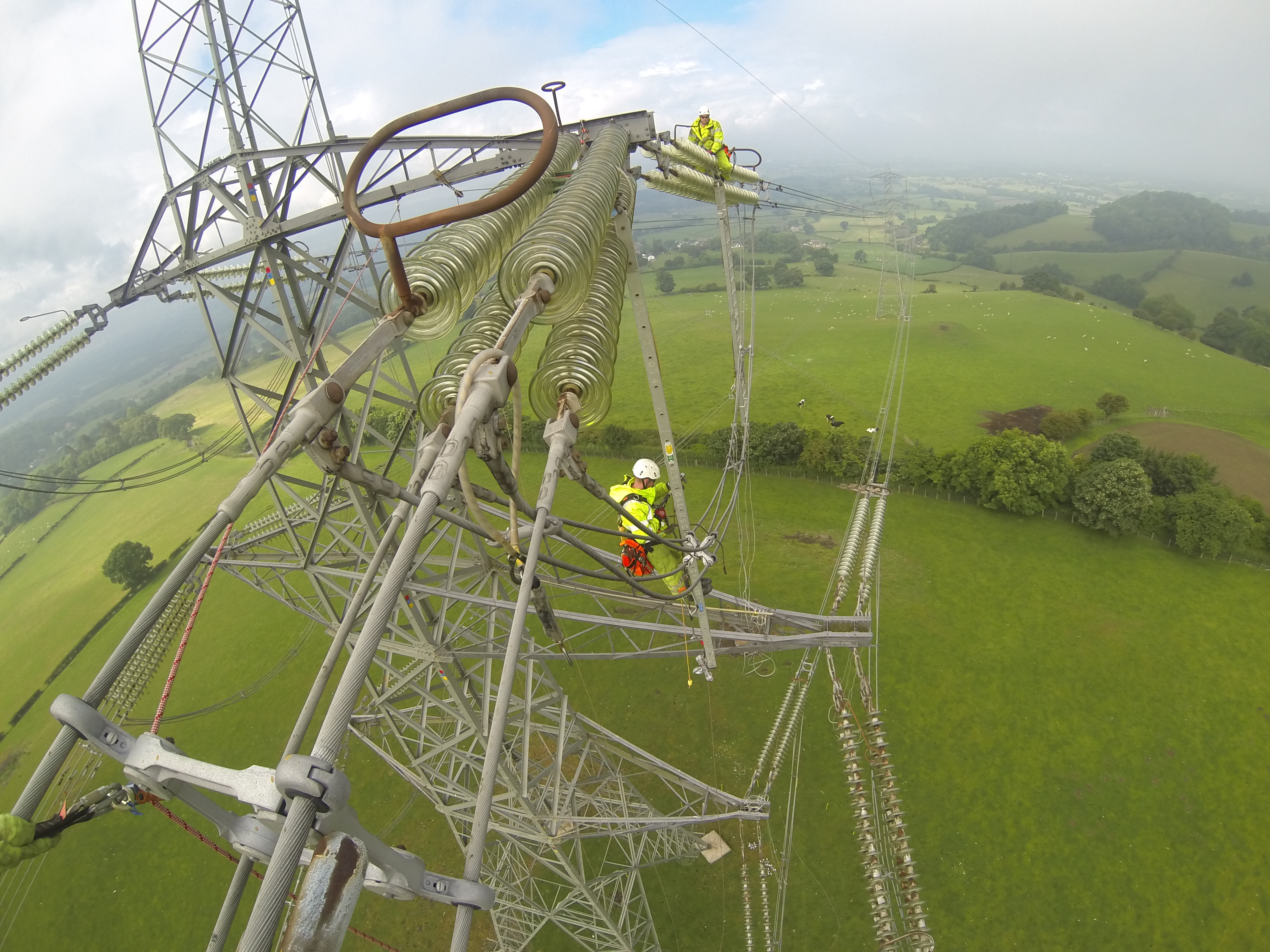
Note.
- Surely, if you can increase the capacity of an electricity line by 45 %, by using innovation and just changing the insulators, this would be much cheaper, than adding another high voltage line.
- It would also incur less legal costs and disruption, than a second line.
I like this idea and hopefully it will please the Nimbies.
More About RICA
This web page is the RICA web site.
This document gives a lot more information.
Conclusion
It appears to be a simple solution to increasing the capacity of the grid.
I’d like to see some recent results.
£400k For National Grid Innovation Projects As Part Of Ofgem Fund To Help Shape Britain’s Net Zero Transition
The title of this post, is the same as that, of this press release from National Grid.
These three bullet points, act as sub-headings.
- Three transmission and distribution network innovation projects receive green light
- Funding kickstarts projects for the discovery phase of Ofgem innovation scheme
- 14 National Grid projects worth £4m have won innovation funding since scheme began
These are the three projects.
HIRE – Hybrid-Network Improvement & Reliability Enhancement
This is National Grid’s description of the £135,000 project.
Researching new state-of-the-art condition monitoring to improve the commissioning and operation of offshore cables. This new, robust system will mitigate the risk of failure, overcome the limitations of existing techniques (e.g. cable length) and aid network operators in decision making for a more flexible grid. PROJECT PARTNERS: University of Manchester, DNV, Monitra, SSEN Transmission.
With all the offshore cables, that have been laid around the UK, Europe and the world in recent years, I am surprised that such a system has not been developed before.
But I suspect, that the project partners know that if they can develop a superior cable monitoring system, then it could be a nice little earner in addition to its job with UK offshore cables.
According to their web site, Monitra seem to be the monitoring experts.
This is the mission statement on their home page.
Our aim is to maximise the uptime of every high voltage asset worldwide.
I like this company’s attitude and it should make the world a better place.
I certainly think that the £135,000 will be well spent.
REACH – Rural Energy And Community Heat
This is National Grid’s description of the £120,000 project.
Working with rural community energy groups to develop a modular rural energy centre that will help communities make cost effective decarbonisation plans. The solution will offer shared low carbon heating, rapid EV charging, and renewable generation in areas not served by commercial markets, and where there is limited electricity network capacity.
Rolls-Royce mtu seem to have a system, that might go some way to satisfy National Grid’s ambitions, that I wrote about in Would You Buy A Battery Energy Storage System From Rolls-Royce?.
Road to Power
This is National Grid’s description of the £140,000 project.
Developing specific tools to forecast future energy consumption and infrastructural impact of works, to support the street and road works sector as it decarbonises 7.8TWh of energy demand across 700,000 major works in the sector’s pivotal transition to net zero by 2030.
This sounds like an excellent idea. Especially, if it makes street and road works quieter and less polluting.
Conclusion
I like these three projects and have already added them to my list of Google Alerts.
Aurizon Secures Funding To Develop Next-Generation Freight Trains Using Renewable Energy
The title of this post, is the same as that of this press release from Aurizon.
These five paragraphs outline the project.
Australia’s largest rail freight company Aurizon, today received a major boost to its program to develop the next generation of Australian freight trains, aiming to replace diesel fuel with renewable energy sources on its locomotive fleet.
Aurizon has secured a $9.4 million grant from the Australian Renewable Energy Agency (ARENA) to develop, test and trial a battery electric tender (BET) to be used in conjunction with a modified locomotive. (refer graphic below).
The tender – essentially a big battery-pack on wheels – will couple with the modified locomotive to operate as a hybrid unit using both diesel and battery-electric power sources. The tender’s battery will also harness re-generative energy captured as the train travels down grades and brakes as part of normal operation.
The ARENA grant represents half of the required funding for the ‘Battery Powered Tender for Heavy Haul Fleet Decarbonisation’ project, with the balance of the investment to be funded by Aurizon. The battery-electric tender and modified locomotive project will be built by Aurizon and technology project partner, Alta Battery Technology (Alta) at a facility in Australia, with design and technology inputs from Alta.
Aurizon appreciates the Federal Government making funding available to support the development of a range of new zero emissions technologies in the transport sector, including technologies that can be developed for application in rail-based freight supply chains that are integral to Australia’s export and domestic industries that rely on transport services.
At a first glance it appears to be suited to Aurizon and its long routes with heavy freight trains across Australia.
These are some more specific thoughts.
Alstom Have Built A Train With a Hydrogen Tender
In From 2025, Nestlé Waters France Will Use The First Hydrogen-Powered Freight Train Through An Innovative Solution Developed by Alstom and ENGIE, I describe a train powered by an electric locomotive with an attached hydrogen power unit.
The Future Of The Class 68 Locomotives
Could these be given a reduced-carbon second life, by developing a specialised tender?
I wrote about this in The Future Of The Class 68 Locomotives.
I suspect Stadler, who seem to be excellent innovators will be watching.
There Seems To Be A Lot Going On In Australia
I have written several posts about decarbonisation of freight trains in Australia.
- BHP To Trial Battery Locos On Pilbara Iron Ore Network
- Battery-Electric Power Rides The Rails
- Wabtec And Roy Hill Unveil The First FLXdrive Battery Locomotive
- Fortescue Unveils World-First Electric Train Using Gravity To Recharge
- BHP Joins The Party On Electric Rail
- Rio Tinto Orders Wabtec FLXdrive Battery Locomotives To Reduce Emissions
The big mining companies certainly seem keen to decarbonise.
 The Anonymous Widower