New Baltic Sea Interconnector On Horizon As Lithuania, Latvia, and Germany Plan Cross-Border Link
The title of this post, is the same as that of this article on offshoreWIND.biz.
This is the sub-heading.
Lithuania, Latvia, and Germany are planning a joint offshore interconnector that would enable electricity trading between the Baltic countries and Germany and allow for the integration of up to 2 GW of offshore wind capacity in Lithuania and Latvia
These first two paragraphs add more detail to the article.
The energy ministers of the three countries signed a joint declaration of intent on 18 February, paving the way for the development of the Baltic-German PowerLink interconnector, which would, in addition to electricity trading and offshore wind capacity integration, also enable the expansion of onshore renewable energy capacity.
The Lithuanian, Latvian, and German transmission system operators (TSOs) – Litgrid, Augstsprieguma tīkls and 50Hertz – agreed to assess the feasibility of the hybrid electricity interconnection.
As Germany, has the following connections under development in the West.
- AquaVentus to Aberdeen, Humberside, Denmark, Norway and The Netherlands.
- NeuConnect to the Isle of Grain In England.
- GriffinLink, which is an offshore link to England.
The Germans seem to be putting themselves at the centre of an energy distribution system, that has the capability to stabilise European and UK electricity for thousands of years. Especially, if the network grows to include more countries.
This paragraph says this about the Baltic-German PowerLink project.
The Baltic-German PowerLink project concept developed by Litgrid, Augstsprieguma tīkls, and 50Hertz includes a 2 GW, approximately 600 kilometres long hybrid offshore connection, with the connection point in the Baltic States planned to be on the border between Lithuania and Latvia. The exact location is to be determined after technical studies.
Note.
- The interconnectors may be long, but they are not longer than anything built successfully before in European waters.
- The UK and the Island of Ireland are well-linked.
- There would appear to be no need for challenging projects like the Morocco-UK Power Project
I suspect that Germany will get the energy it needs and the British Isles will get a nice little earner.
If Europe is generating large amounts of wind and solar energy with its variable output it will need lots of energy storage.
What Countries Have The Terrain For Pumped Storage Hydro In Europe?
I asked Google AI and received this answer.
Key countries with ideal, high-elevation terrain and significant existing or planned capacity include:
Alpine Region (The Heart of European Pumped Storage):
Switzerland: Extremely high capacity due to steep, mountainous landscapes and significant water sources, hosting the world’s oldest working pumped storage plant.
Austria: Heavily mountainous, it is a major player in PSH expansion and modernization.
France: Home to one of Europe’s largest, the Grand Maison hydroelectric power station.
Italy: Holds high capacity with numerous planned projects.
Germany: Strong existing infrastructure.
Southern Europe:
Spain: Features some of Europe’s largest plants (e.g., La Muela/Cortes-La Muela).
Portugal: Significant recent investment in large-scale projects like the Tâmega complex.
Other Potential Areas:
Norway: High potential due to its mountainous, water-rich terrain.
United Kingdom: High project volume currently under construction.
Balkans & Central Europe:
Countries like Bulgaria, Romania, and the Czech Republic have suitable terrain for further development.
These countries benefit from significant hydraulic head (steep drop) and natural or artificial reservoir potential, making them ideal for storing energy for peak consumption hours.
Note.
- As expected, the Alpine region is Top of the League.
- The UK is holding its own despite its small mountains.
- There is a lot of potential to be developed.
But then Electric Mountain in Snowdonia is certainly at the top table of pumped storage systems despite being built in the 1980s.
What Countries Have The Terrain For Hydrogen Storage In Europe?
I asked Google AI and received this answer.
Key European countries with suitable geological terrain—specifically salt caverns and depleted gas fields—for large-scale, underground hydrogen storage include Germany, the Netherlands, Denmark, the United Kingdom, and France. Other significant regions for storage potential include Spain, Hungary, and Austria, which are developing porous storage facilities.
Key Regions & Terrain Types:
Salt Caverns (North-Western Europe): Germany, the Netherlands, Denmark, France, and the UK have substantial salt deposits suitable for creating caverns, identified as cost-efficient for large-scale storage.
Depleted Gas Fields (Porous Rock): The Netherlands, Germany, and parts of Central/Southern Europe (Spain, Hungary) have significant capacity in existing porous storage, particularly in the North Sea region.
Specific Projects: Germany (Uniper’s Krummhörn project), Netherlands (HyStock), and France (HYPSTER at Etrez) are active, with Spain and Denmark emerging as major hydrogen hubs.
Capacity Potential: The Netherlands, for instance, holds massive potential (35-60 TWh) due to its offshore and onshore depleted fields.
Salt cavern projects, which offer high-deliverability storage, are heavily concentrated in the North-Western European industrial corridor.
I was lucky enough have a tour of ICI’s salt mine in Cheshire, when I worked there in the 1960s and I remember these facts from those days.
- There was enough salt in the ground under Cheshire to last several thousand years.
- Most salt was extracted from boreholes, for making chlorine using electrolysis and the Castner-Kellner process.
- Hydrogen was a by-product and much of it was mixed with coal gas to raise steam for the works.
The same technique used to make boreholes to extract the salt, is used to hollow caverns in the salt to store gases like hydrogen.
Once, when they were digging salt out of the salt mine at Winsford, a worker broke into an unmarked borehole and ICI nearly lost the mine because of the water rushing in.
Two stories stand out from the rescue of the mine.
- There was a need for dry clothes for all the workers, so ICI took a truck to Marks & Spencer in Northwich and emptied it of anything they might need. I was told the story enriched with plagues of locusts.
- A Ford Transit was found to have travelled a few thousand miles underground in axle deep salt slurry. Rather, than scrap it and buy another, it was offered back to Ford, who were delighted to swap it for a new one. I heard that Ford said, that the accelerated corrosion research would have taken many years, if done on the roads.
Always think out of the box.
Do British And German Offshore Wind Farm Generate Maximum Power At Different Times
In National Grid, TenneT Germany Launch GriffinLink, A First Of A Find Project To Maximise Offshore Wind, I discussed GriffinLink, which will be an offshore link between British and German offshore wind farms.
Somebody has asked me if wind farms are in phase with each other, as obviously this would effect how they perform and are are controlled.
So I asked Google AI, the question in the title of this post and received this reply.
Yes, British and German offshore wind farms often generate their maximum power at different times, although they are both located in the North Sea and share similar peak seasons. The variations in generation are driven by localized weather patterns, specifically the movement of low-pressure systems.
Key Differences in Generation Times:
Regional Weather Patterns: While North Sea wind farms are often closely correlated, significant differences arise when weather systems move from west to east. Wind often hits the UK’s North Sea sites first, meaning they may hit maximum generation capacity hours before German or Danish sites, which are further east.
Time of Day (Diurnal Differences): Because UK wind farms are located in the Irish Sea, the Scottish coast, and the North Sea, they can exhibit different diurnal (daily) peak times compared to German sites in the North Sea and Baltic Sea.
Seasonal Peaks: Both countries experience the highest output during winter months (e.g., December). However, during specific, localized, long-lasting high-pressure systems (“Dunkelflaute”), one country might experience a complete drop in wind while the other continues to produce, or vice versa.
Why They Differ:
Geography: The UK’s extensive, spread-out coastline (Irish Sea, Atlantic coast, North Sea) offers a different wind profile than the more concentrated German offshore projects in the North Sea and Baltic Sea.
Correlation Challenges: Research shows that while North Sea countries have similar wind profiles, there is not 100% correlation. Meteorological differences in how wind speeds behave across the North Sea allow for complementary production.
This difference is highly advantageous for European energy security, as it allows for the balancing of intermittent wind power across the region.
The conclusion from Google AI, is almost predicting that GriffinLink will be developed. From my experience of mathematical modelling the cost and financial benefits should be fairly easy to predict.
Will The UK And The Republic Of Ireland Link Their Offshore Wind Farms To Improve Efficiency?
This may seem an obvious idea, especially as UK and Republic of Ireland are heavily interconnected.
So I asked Google AI, the question in the title of this section and received this reply.
Yes, the United Kingdom and the Republic of Ireland are taking significant, active steps to link their offshore wind farms and electricity grids to improve efficiency, increase renewable energy production, and enhance energy security. Following a Memorandum of Understanding (MoU) signed in September 2023, the two countries are collaborating on developing subsea energy infrastructure in the Irish and Celtic Seas.
Here are the key details regarding this cooperation:
Deepened Collaboration: As of March 2025, the UK and Ireland are working on a new data-sharing arrangement to lay the groundwork for directly connecting offshore wind farms to each other’s national energy networks.
Offshore Hybrid Assets (OHAs): The plans include developing offshore hybrid assets, which are subsea cables that directly link offshore wind farms to both countries’ grids, reducing infrastructure costs and maximizing efficiency.
Subsea Mapping & Interconnection: Both nations are mapping the Celtic Sea to identify optimal locations for interconnectors and to improve the interoperability of their grids.
Existing & New Projects: While Ireland’s current interconnection to the UK is limited (approx. 500MW), capacity is planned to increase significantly. Specific projects like Mares Connect (linking North Wales and Ireland) are being developed to provide750MW of additional capacity.
Regional Cooperation: Ireland is also participating in the “Hamburg Declaration” (signed Jan 2026), joining the UK and other North Sea countries to commit to 300GW of offshore wind by 2050 through shared, regional infrastructure.
This cooperation aims to allow Ireland to export its surplus renewable energy during high generation, while benefiting from the UK’s robust grid during lower wind conditions.
Will The UK AndNorway Link Their Offshore Wind Farms To Improve Efficiency?
As we have interconnectors with Norway, I asked Google AI, the question in the title of this section and received this reply.
Yes, the UK and Norway are actively planning and implementing initiatives to link their offshore wind farms and electricity grids to improve efficiency, energy security, and grid balancing. Following a series of agreements, including a major pact in January 2026, the two countries are collaborating on “hybrid” projects that connect offshore wind sites directly to multiple countries.
It does look like that the co-operations between the UK and Germany, Norway and the Republic of Ireland are setting examples that should be copied all over the world.
But then, you should always follow the mathematics.
But somehow, I can’t see President Trump signing any windmill co-operation with his neighbours.
National Grid, TenneT Germany Launch GriffinLink, A First Of A Find Project To Maximise Offshore Wind
The title of this post is the sane as that of this press release from National Grid.
These three bullet points serve as sub headings.
-
National Grid and TenneT Germany announce our cooperation on GriffinLink, a planned GB-Germany multi-purpose interconnector (MPI).
-
GriffinLink would support energy security, accelerate the connection of offshore wind and mark a coordinated approach on supply chains and infrastructure.
-
Announced at the North Sea Summit in Hamburg, the project could maximise shared offshore wind resources in the most efficient way.
These two paragraphs add more detail.
National Grid will partner with TenneT Germany to develop GriffinLink, a new multi-purpose interconnector (MPI) project, which could connect British and German offshore wind to both countries. It marks a step towards a more integrated, flexible, and efficient energy system for both Great Britain and Germany which delivers secure, affordable energy for consumers.
GriffinLink could make an important contribution to security of supply and market integration in northwestern Europe. Cross-border hybrid energy systems such as GriffinLink make it possible to feed cleaner electricity into the grid where it can be generated and transport it exactly where it is needed.
Note this integrated approach means.
- Better utilisation of the grids and is a more efficient use of renewable energy across national borders;
- Lowering the costs involved, and the supply chain materials required and;
- A reduced impact on coastal communities and the environment.
As a ‘multi-purpose’ interconnector connecting wind in two countries, GriffinLink would be the first project of its kind in Europe and a milestone for cross-border energy security and stability.
It will also connect the UK’s offshore wind power to someone someone who needs it and will pay good money for it.
I asked Google AI, “How much energy we will be exporting to Europe in 2030” and received this reply.
By 2030, the UK is expected to be exporting significant amounts of electricity to Germany, largely enabled by the NeuConnect interconnector, which is set to become operational around 2028 and will have a capacity of 1.4 GW. While precise, definitive figures for 2030 are subject to market conditions, key data suggests:
NeuConnect Capacity: The 725km subsea link between Kent (UK) and Wilhelmshaven (Germany) will allow 1.4 GW of electricity to flow in either direction.
Net Export Position: The UK is positioned to become a net exporter of electricity to Europe by the 2030s, fueled by a massive expansion in offshore wind capacity, aiming for up to 50GW by 2030.
Grid Interconnection: By 2030, the UK’s total interconnection capacity to Europe is planned to increase to 18GW, up from 8GW.
Hydrogen Focus: In addition to electricity, the UK is exploring the potential to export up to 35 TWh of hydrogen to Germany by 2030.
That will do nicely!
French Companies Unite On Superconducting Cable Project For Distant Offshore Wind Farms
The title of this post, is the same as that of this article on offshoreWIND.biz.
This is the sub-heading.
Air Liquide, CentraleSupélec, ITP Interpipe, Nexans, and RTE have joined forces to develop a project that connects distant offshore wind farms to shore via a High Voltage Alternating Current (HVAC) superconducting transmission system.
This introductory paragraph adds some detail.
The SupraMarine demonstrator project will study the electrical connection between offshore wind farms and the coastline using High-Temperature Superconducting (HTS) cables. Cooled by liquid nitrogen, the cables are said to transport electricity with near-zero energy loss.
Note.
- No details of the target distances are indicated.
- There is a detailed exploratory diagram.
It is certainly an ambitious project, but I feel it could have substantial uses.
I have a few thoughts and questions.
Can Sodium Metal Be Used For High Voltage Electrical Underground Cables?
Google AI answers this question as follows.
Yes, sodium metal was investigated and used in trial runs for high-voltage underground electrical cables in the late 1960s and early 1970s, as a potentially cheaper and more flexible alternative to copper and aluminum. However, it is not in common use today due to safety concerns and unfavorable lifecycle economics compared to aluminum.
When I was at ICI around 1970, they were researching the use of sodium for high voltage power cables.
- ICI had access to large amount of sodium chloride in Cheshire.
- The sodium metal can be obtained by electrolysis.
- Renewable electricity for electrolysis will be plentiful.
- Someone told me that their prototype cable was a polythene pipe with Sodium metal in the middle.
- I’ve read somewhere that sodium cables have interesting safe overload properties.
- I can understand the safety concerns and unfavorable lifecycle economics, especially where water is concerned.
Perhaps, French technology has improved in the sixty years?
Will Sodium Metal Be Used In The French Superconducting Cable?
Nothing has been disclosed!
But the office chat at ICI from those, who knew their sodium and their polythene, as they’d been working at ICI Mond Division for decades, was of the opinion that sodium/polythene cables were possible!
From The Diagram, It Looks Like Power Is Needed At Both Ends Of The Superconducting Cable
The diagram shows wind turbines at one end and the grid at the other end of the cable.
So will a battery or some other form of stabilisation be needed for when the wind isn’t blowing?
Will The French Superconducting Cable Have A High Capacity?
The basic capacity of a cable depends on three properties.
- The resistance of the cable.
- The cross-section area of the cable.
- The design of the cable must also be able too conduct away the heat generated by electricity flowing through.
Will The Technology Work For Interconnectors?
I don’t see why not!
Canal Water To Heat Some Of Liverpool’s Most Famous Buildings In Hi-Tech Carbon-Cutting Scheme
The title of this post is the same as that of this press release from Liverpool City Region.
These five bullet-points act as subheadings.
- Energy generated from Leeds and Liverpool canal by one of the UK’s largest water source heat pumps
- Announcement comes as Mersey Heat Energy Centre officially opens
- Scheme to connect Georges Dock, Cunard and the Museum of Liverpool buildings to Mersey Heat Network
- Joint project between Combined Authority, Liverpool City Council and National Museums Liverpool
- Key part of Combined Authority plan to reach net zero by 2035
These introductory paragraphs add more detail.
Three major public buildings on Liverpool’s waterfront are to slash carbon emissions by joining a heat network driven by energy from canal water.
Under the plan, an extended pipeline will connect Georges Dock building, the Cunard building, and the Museum of Liverpool, part of National Museums Liverpool (NML), to the Mersey Heat network.
The newly opened Mersey Heat Energy Centre is already supplying the Liverpool Waters site, the Titanic Hotel and the Tobacco Warehouse apartments.
It uses one of the UK’s largest water source heat pumps to extract energy from the Leeds and Liverpool Canal to power a network of heating pipes.
The project is the latest in the Liverpool City Region’s five-year carbon action plan and journey to reach net zero. The Combined Authority has recently secured an additional £35m to decarbonise dozens of other public buildings from the Department of Energy Security and Net Zero.
This map of the Liverpool Waterfront shows the canal and some of the buildings mentioned.
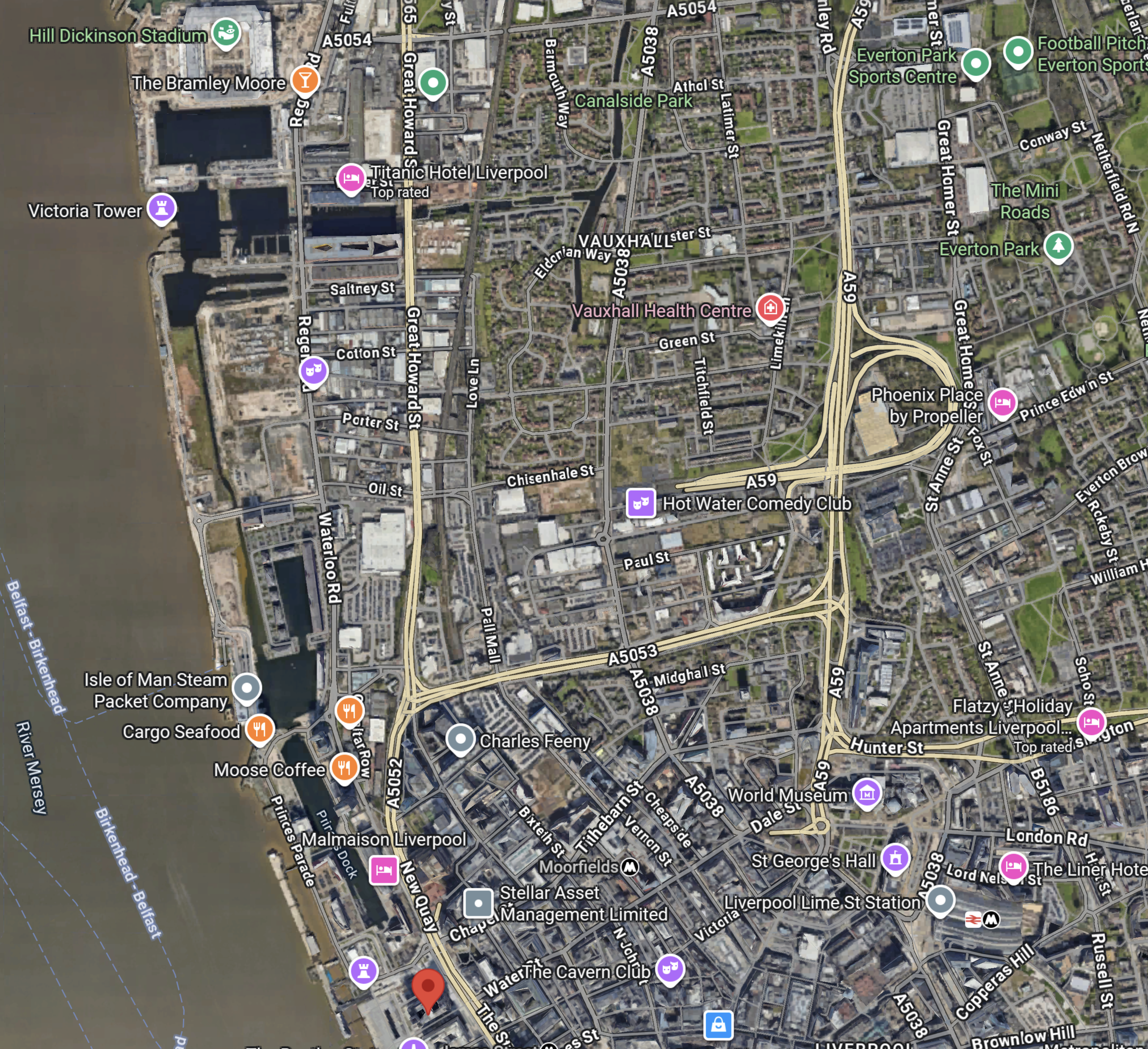
Note.
- In the top-left corner is Everton’s new Hill-Dickenson Stadium, which at the time of this map was under construction.
- The pink arrow to its right indicates the Titantic Hotel.
- The Leeds and Liverpool canal passes on the South side of the hotel.
- On the other bank of the canal is the Tobacco Warehouse.
- The canal goes East and then turns North before going all the way to Leeds. The Wikipedia entry gives full details of the canal.
- From the Titanic Hotel, the Leeds and Liverpool Canal also turns South and boats can go along Liverpool’s famous Waterfront to Canning Dock, in front of the Tate Liverpool.
- The red arrow marks the Liver Building.
- Georges Dock building, the Cunard building, and the Museum of Liverpool are just to the South the Liver Building.
- To the East of the Liver building, there is Liverpool City Centre, with beyond it Liverpool Lime Street station, with another collection of important buildings including St. George’s Hall, the Picton Library, World Museum and the Walker Art Gallery.
The Combined Authority will not have a shortage of buildings to decarbonise with the £35m from the Department of Energy Security and Net Zero.
These are my thoughts.
What Is A Water Source Heat Pump?
I asked Google AI this question and received this answer.
A water source heat pump (WSHP) is a highly efficient, low-carbon renewable energy system that extracts heat from a nearby water source like a lake, river, or canal to provide heating and hot water for a building, and can also be used for cooling. It works by using electricity to transfer this thermal energy into the building’s heating system, offering a more efficient alternative to traditional boilers and reducing energy bills. There are two main types: closed-loop systems, which circulate a fluid through pipes submerged in the water, and open-loop systems, which directly pump and then discharge the water.
Is Mersey Heat Energy Centre A Closed Or Open-Loop Water Source Heat Pump?
I asked Google AI this question and received this answer.
The Mersey Energy Heat Centre uses an open-loop water source heat pump system. It abstracts water from the Leeds and Liverpool Canal, extracts heat from it, and then returns the water back to the dock system.
As the Leeds and Liverpool Canal is 127 miles long, and there appears from the map to be a lot of water in the docks at the Liverpool end, I would expect that Liverpool will have more than enough water to extract heat from.
Where Exactly Is The Mersey Heat Energy Centre?
In this article on Place North West, which is entitled Work Begins On Peel’s Mersey Heat Energy Centre, has this image, which is labelled as the Mersey Heat Energy Centre.
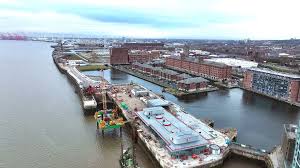
Note the large building in the foreground with the circular objects on the roof. Could these be fans or vents?
This Google Map shows the area.
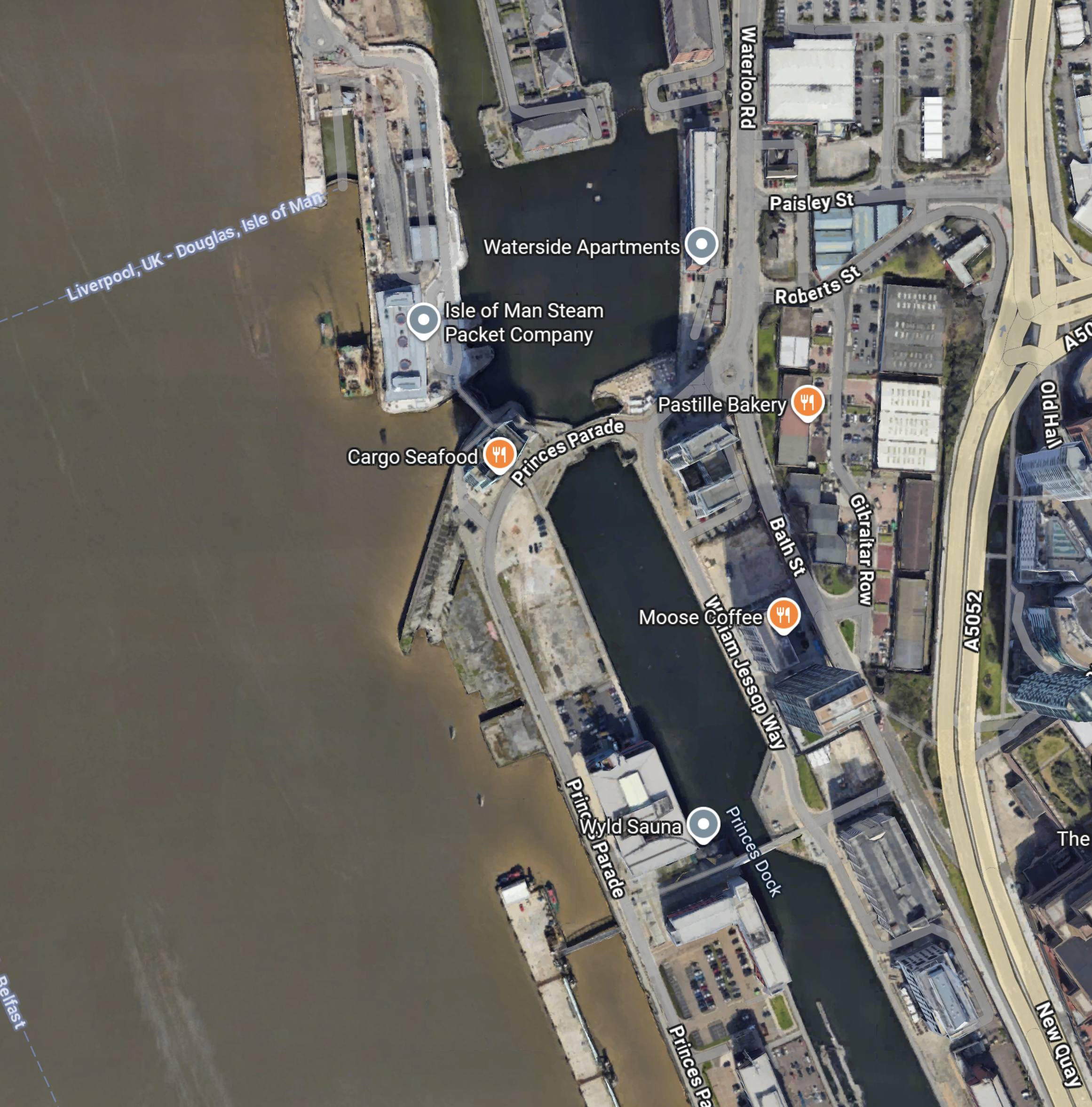
Note.
- The two docks at the top of the map can be picked out in the image.
- The main breakwater on the left, which is marked Isle of Man Steam Packet Company, looks very similar to the one shown in the image.
- The bridge between the two docks on the left appears to be the same in both map and image.
I am fairly sure, that the large building on the breakwater with the three circles on the roof, is the Mersey Heat Energy Centre.
It certainly looks to be a building, that could provide a substantial amount of heat and power .
What Is The Output Of The Mersey Heat And Energy Centre?
I asked Google AI this question and received this answer.
The Mersey Heat and Energy Centre produces low-carbon heat for up to 6,700 homes and 1.3 million square feet of commercial space, aiming to deliver around 20GWh of heat per year. The project is also planned to expand to supply around 45GWh annually. This heat is delivered to buildings for their heating and hot water needs through the Mersey Heat network.
This article on Place North West, also has this similar answer.
Led by district heat network specialist Ener-Vate, the Mersey Heat Energy Centre will feature two 3MW water source heat pumps that would work on an ‘open loop’ system to take heat from water from the Leeds-Liverpool canal. This heat would be used to warm surrounding homes and businesses within six kilometres.
Plans form the first phase of Peel NRE’s Mersey Heat network. The initial project could supply 20GWh of heat every year, with planning permission secured to expand to supply around 45GWh – the equivalent of supplying heating and hot water to 17,000 homes.
It looks like we’re getting similar answers from different sources.
Does the Merseyside Area Have Enough Green Electricity To Power A Large Water Source Heat Pump?
In Could Liverpool Develop A Massive Zero-Carbon Data Centre?, I calculated the operational and planned offshore wind power in Liverpool Bay and got these results.
- 2509 MW has been commissioned.
- 3980 MW is being planned.
That is a total of 6489 MW or about twice the output of Hinckley Point C nuclear power station.
This map shows the existing wind farms in the sea between Liverpool, Lancashire and the Isle of Man.
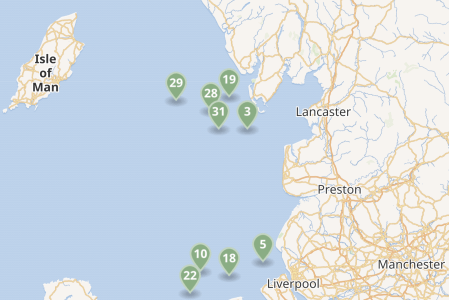
Note.
- Each green arrow is a wind farm.
- There is the 2452 MW Heysham nuclear power complex near Lancaster.
- The Western HVDC Link is a 2250 MW connection between Hunterston in Western Scotland near Glasgow and Connah’s Quay on the Wirral.
- I also suspect more space in Liverpool Bay could be developed with wind farms.
Spinal Tap turned the power up to 11, Liverpool, being Liverpool, they have enough power to go to at least sixteen.
Will Merseyside Have Lots Of Data Centres?
Consider.
- It has the power.
- It has the water.
- The locals speak a form of English.
- Merseyside will be two hours from London by train.
- There are two Premier League football teams.
- The golf courses are good.
- It is a city that is famous all over the world.
I am sure the number of data centres will grow.
Investment in Grain LNG
The title of this post, is the same as that of this press release from Centrica.
This sub-heading outlines the deal.
Centrica plc (the “Company”, “Centrica”) is pleased to announce the acquisition of the Isle of Grain liquified natural gas terminal (“Grain LNG”) in partnership1 with Energy Capital Partners LLP (“ECP”) from National Grid group (“National Grid”) for an enterprise value of £1.5 billion. After taking into account approximately £1.1 billion of new non-recourse project finance debt, Centrica’s 50% share of the equity investment is approximately £200 million.
The press release lists these key points.
- Grain LNG delivers vital energy security for the UK, providing critical LNG import/export, regasification and rapid response gas storage capacity to balance the energy system.
- Aligned with Centrica’s strategy of investing in regulated and contracted assets supporting the energy transition, delivering predictable long-term, inflation-linked cash flows, with 100% of capacity contracted until 2029, >70% until 2038 and >50% until 2045.
- Opportunities for efficiencies to create additional near-term value, and future development options including a combined heat and power plant, bunkering, hydrogen and ammonia.
- Highly efficient funding structure, with Centrica’s equity investment of approximately £200 million alongside non-recourse project financing.
- Strong life of asset returns aligned with Centrica’s financial framework, with an expected unlevered IRR2 of around 9% and an equity IRR2 of around 14%+
Underpins delivery of £1.6 billion end-2028 EBITDA target3 – Centrica’s share of EBITDA expected to be approximately £100 million per annum and cash distributions expected to be around £20 million on average per annum for 2026-2028, representing an attractive yield on Centrica’s equity investment - Partnership with ECP (part of Bridgepoint Group plc), one of the largest private owners of natural gas generation and infrastructure assets in the U.S. with direct experience in supporting grid reliability.
This Google Map shows the various energy assets on the Isle of Grain.
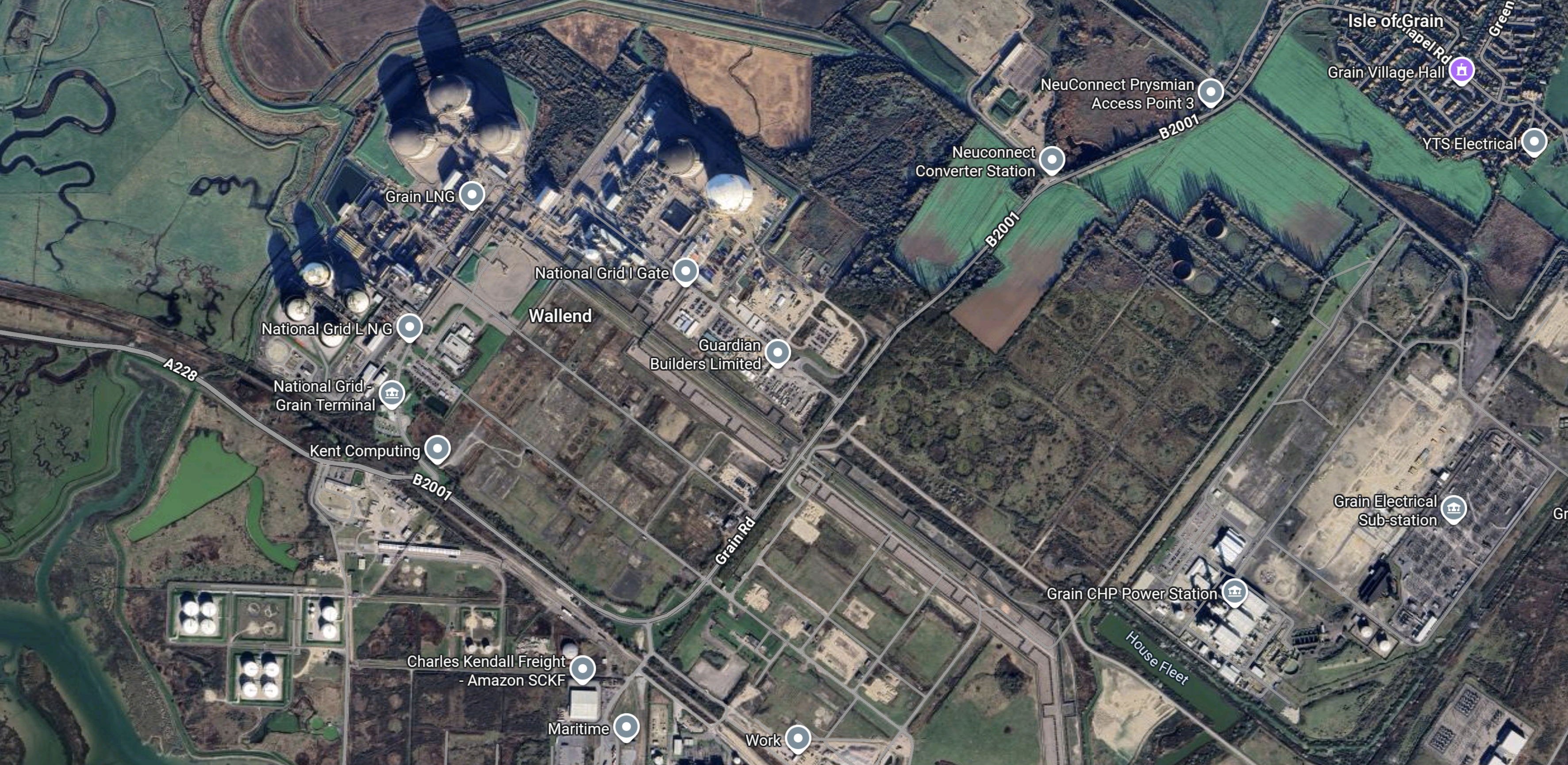
Note.
- It appears that works for the 1, 400 MW NeuConnect interconnector to Wilhelmshaven in Germany, are taking place in the North-East corner of the map.
- Grain CHP powerstation is a 1,275MW CCGT power station, which is owned by German company; Uniper, that is in the South-East corner of the map, which can also supply up to 340MW of heat energy recovered from the steam condensation to run the vapourisers in the nearby liquefied natural gas terminal.
- The Grain LNG terminal is at the Western side of the map.
- In the Thames Estuary to the East of the Isle of Grain, I estimate that there are about 1,500 MW of wind turbines.
I find it interesting that two of the assets are German owned.
I have some thoughts.
It Is A Large Site With Space For Expansion
This Google Map shows the whole of the Isle of Grain.
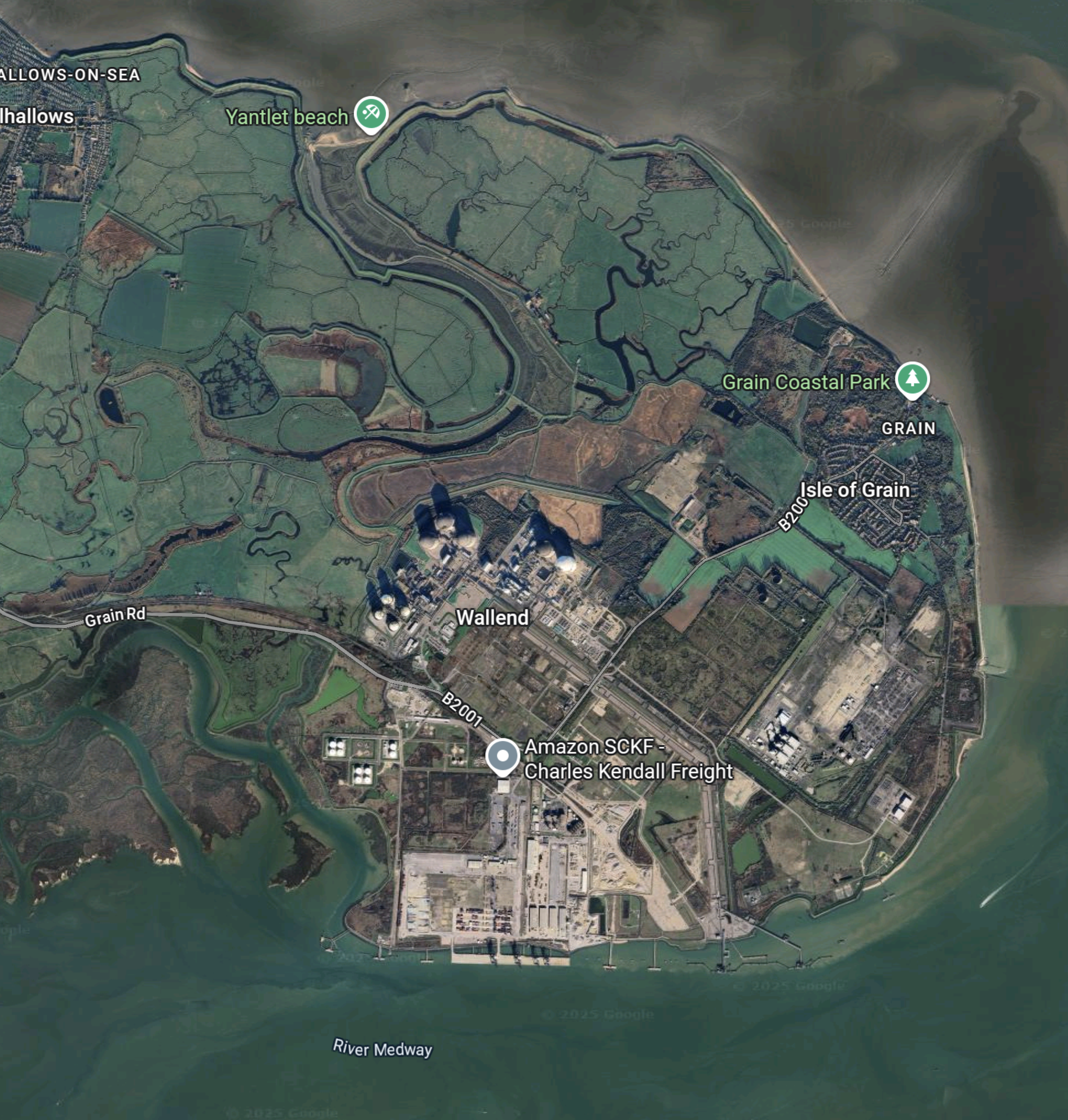
Note.
- The Grain LNG terminal is around the label Wallend.
- The River Medway runs East-West at the bottom of the map.
- Gas tankers deliver and take on gas at jetties on the North Bank of the Medway.
There could be space to expand the terminal, if the RSPB would allow it.
As an example, I asked Google AI, if peregrine falcons nest on chemical plants and got this reply.
Yes, peregrine falcons do nest on chemical plants. They have adapted to using various urban and industrial structures, including chemical plants, for nesting. This is particularly true in areas where natural cliff habitats are scarce.
Peregrine falcons are known for their adaptability, and their population has seen a resurgence in recent decades, partly due to their ability to utilize man-made structures. These structures often mimic their natural cliffside nesting
Cliffs do seem scarce on the Isle of Grain. I also asked Google AI, if peregrine falcons ate small rodents, as several chemical and other plants, where I’ve worked, had a rodent problem. One plant had a cat problem, as there had been so many rats. This was the reply.
Yes, peregrine falcons do eat small rodents, though they primarily consume birds. While their diet mainly consists of other birds like pigeons, doves, and waterfowl, they will also hunt and eat small mammals, including rodents such as mice, rats, and voles. They are opportunistic hunters and will take advantage of readily available prey, including insects, amphibians, and even fish.
I’m sure if Centrica wanted to expand, they’d employ the best experts.
Who Are ECP?
One of the key points of the press release is that this deal is a partnership with ECP (part of Bridgepoint Group plc), one of the largest private owners of natural gas generation and infrastructure assets in the U.S. with direct experience in supporting grid reliability.
The Wikipedia entry for ECP or Energy Capital Partners has this first section.
Energy Capital Partners Management, LP (ECP) is an American investment firm headquartered in Summit, New Jersey. It focuses on investments in the energy sector. The firm has additional offices in New York City, Houston, San Diego, Fort Lauderdale and Seoul.
In August 2024, ECP merged with Bridgepoint Group to form a private assets investment platform.
The Wikipedia entry for the Bridgepoint Group has this first paragraph.
Bridgepoint Group plc is a British private investment company listed on the London Stock Exchange and is a constituent of the FTSE 250 Index.
The company had started as part of NatWest.
Are The Germans Going To Take Away Some Of Our Electricity?
Consider.
- Germany has a big need to replace Russian gas and indigenous coal, and to decarbonise.
- Neuconnect is a 1.4 GW interconnector between the Isle of Grain and Wilhelmshaven in Germany. It is scheduled to be completed in 2028.
- The Grain CHP powerstation is a 1,275MW CCGT power station, which is owned by German company; Uniper, could almost keep NeuConnect working at full power on its own.
- I said earlier, in the Thames Estuary to the East of the Isle of Grain, I estimate that there are about 1,500 MW of wind turbines. One of which is part German-owned.
The Germans are also building a large electrolyser at Wilhelshaven, which is described by Google AI like this.
The Wilhelmshaven Green Energy Hub will initially feature a 500MW electrolyzer, with plans to potentially expand to 1GW, according to Energy Monitor. The hub, a joint project between Tree Energy Solutions (TES) and EWE, aims to produce green hydrogen using renewable energy sources like offshore wind. The 500MW electrolyzer is scheduled to be operational by 2028.
I wouldn’t be surprised to see that the Wilhelmshaven electrolyser were to be powered by British-generated electricity flowing down NeuConnect.
Centrica Says Their Future Development Options Include A Combined Heat And Power Plant
This objective was set in one of the key points.
This is the first paragraph of the Wikipedia entry for the Grain LNG Terminal.
Grain LNG Terminal is a Liquefied Natural Gas (LNG) terminal on the Isle of Grain, 37 miles (60 km) east of London. It has facilities for the offloading and reloading of LNG from ships at two jetties on the River Medway; for storing and blending LNG; for truck loading; and regasifying and blending natural gas to meet UK specifications. The terminal can handle up to 15 million tonnes per annum of LNG, has a storage capacity for one million cubic metres of LNG, and is able to regasify up to 645 GWh per day (58 million cubic metres per day) for delivery into the high pressure gas National Transmission System (NTS). The facility is owned and operated by National Grid Grain LNG Ltd, a wholly owned subsidiary of National Grid.
Note.
- This paragraph was written before the Centrica takeover.
- The terminal also converts liquid natural gas into gas to be distributed around the UK.
The heat needed to convert the liquid natural gas to gas is provided by the Grain CHP power station.
- Currently 340 MW of heat is provided.
- If the Grain LNG terminal is expanded, it will probably need more heat.
I can see Centrica building a combined heat and power (CHP) power station, that can be expanded to meet the current and future needs of gasification at the Grain LNG terminal.
I wouldn’t be surprised to see the CHP power station fitted with carbon capture, as Kent is surely one county, where carbon dioxide can be used in food production, so we can generate our carbon dioxide and eat it.
Centrica Says Their Future Development Options Include Hydrogen
This objective was set in one of the key points.
Consider.
- Centrica are an investor in HiiROC, who have a unique method of generating affordable zero-carbon hydrogen called thermal plasma electrolysis, which uses a fifth of the electricity, that traditional electrolysis does.
- HiiROC can use natural gas as a feedstock. Centrica won’t be short of that at Grain.
- There is space to build a large HiiROC system at the Isle of Grain site.
- The hydrogen could be taken away by tanker ships.
Like the electricity , which will use the 450 mile NeuConnect interconnector, the hydrogen could even be exported to Wilhelmshaven in Germany by pipeline.
Wilhelmshaven is being setup to be a major German hub to both generate, import and distribute hydrogen.
I asked Google AI, how much hydrogen a GWh would produce and received this answer.
A GWh of electricity can produce approximately 20-22 tonnes of hydrogen through electrolysis, depending on the efficiency of the electrolyzer. Modern commercial electrolyzers operate at an efficiency of roughly 70-80%, meaning they require about 50-55 kWh of electricity to produce 1 kg of hydrogen. A GWh (1 gigawatt-hour) is equal to 1,000,000 kWh, and 1 tonne of hydrogen contains roughly 33.33 MWh of energy.
As it is claimed on the web that HiiROC is five times more efficient than traditional electrolysis, it could need around 10-11 kWh to produce one kg. of hydrogen.
1 GWh would produce between 90-100 tonnes of hydrogen.
Centrica Says Their Future Development Options Include Ammonia
This objective was set in one of the key points.
I asked Google AI if ammonia can be produced from hydrogen and received this answer.
Yes, ammonia (NH3) can be produced from hydrogen (H2) through a process called the Haber-Bosch process. This process involves combining hydrogen with nitrogen (N2) from the air, under high temperature and pressure, in the presence of a catalyst.
Ammonia has a large number of uses, including making fertiliser and the powering of large ships.
I asked Google AI, if there are small Haber-Bosch processes to make ammonia from hydrogen and nitrogen and received this answer.
Yes, there are efforts to develop smaller-scale Haber-Bosch processes for ammonia production. While the traditional Haber-Bosch process is typically associated with large industrial plants, research and development are exploring ways to adapt it for smaller, distributed production, particularly for localized fertilizer or fuel applications.
I wondered if Centrica are involved in the efforts to develop smaller-scale Haber-Bosch processes for ammonia production.
Google AI gave me this quick answer.
Centrica is involved in research related to the Haber-Bosch process, particularly in the context of transitioning to a low-carbon energy future. They are exploring how to adapt the Haber-Bosch process, which is crucial for fertilizer production but also a significant source of CO2 emissions, to utilize renewable energy sources. This includes investigating the use of green hydrogen produced from water electrolysis and renewable electricity. Centrica is also involved in research related to using ammonia as a fuel, including potentially for power generation
That looks to be a very positive answer. Especially, as local low-carbon fertiliser production could be a very powerful concept.
Centrica Says Their Future Development Options Include Bunkering
This objective was set in one of the key points.
Bunkering is the process of refuelling ships.
I didn’t know much about bunkering, when I started to read Centrica’s press release, but the Wikipedia entry, was a good way to get some information.
This section in the Wikipedia entry is entitled Two Types Of Bunkering, where this is said.
The two most common types of bunkering procedure at sea are “ship to ship bunkering” (STSB), in which one ship acts as a terminal, while the other moors. The second type is “stern line bunkering” (SLB), which is the easiest method of transferring oil but can be risky during bad weather.
Over the years, I have found, that two zero-carbon fuels are under development, for powering ships; hydrogen and ammonia. Others are developing ships powered by naturalo gas.
I asked Google AI if hydrogen can power ships and received this answer.
Yes, hydrogen can power ships. It can be used as a fuel for fuel cells, which generate electricity to power the ship’s propulsion and other systems, or it can be burned in modified combustion engines. Hydrogen offers a zero-emission solution for shipping, with water vapor being the only byproduct when used in fuel cells.
Google AI also told me this.
The world’s first hydrogen-powered cruise ship, the “Viking Libra”, is currently under construction and is scheduled for delivery in late 2026. This innovative vessel, a collaboration between Viking Cruises and Italian shipbuilder Fincantieri, will utilize hydrogen for both propulsion and electricity generation, aiming for zero-emission operation.
I also asked Google AI if ammonia can power ships and received this answer.
Yes, ammonia can be used to power ships and is considered a promising alternative fuel for the maritime industry. Several companies and organizations are actively developing ammonia-powered ship designs and technologies. While challenges remain, particularly around safety and infrastructure, ammonia is seen as a key potential fuel for decarbonizing shipping.
Finally, I asked I asked Google AI if natural gas can power ships and received this answer.
Yes, ships can be powered by natural gas, specifically in the form of liquefied natural gas (LNG). LNG is increasingly used as a marine fuel, offering environmental benefits over traditional fuels like diesel.
It would seem to be a case of you pays your money and makes a choice between one of four technologies; ammonia, hydrogen fuel-cell, hydrogen-ICE and LNG.
I looks to me, that if Centrica provide bunkering services for ships, they have the means to cover most of the market by providing hydrogen and ammonia, in addition to natural gas.
Although, I don’t know much about bunkering, I do feel that the two current methods, that work for oil, could be made to work for these fuels.
This Google Map shows the Thames Estuary.
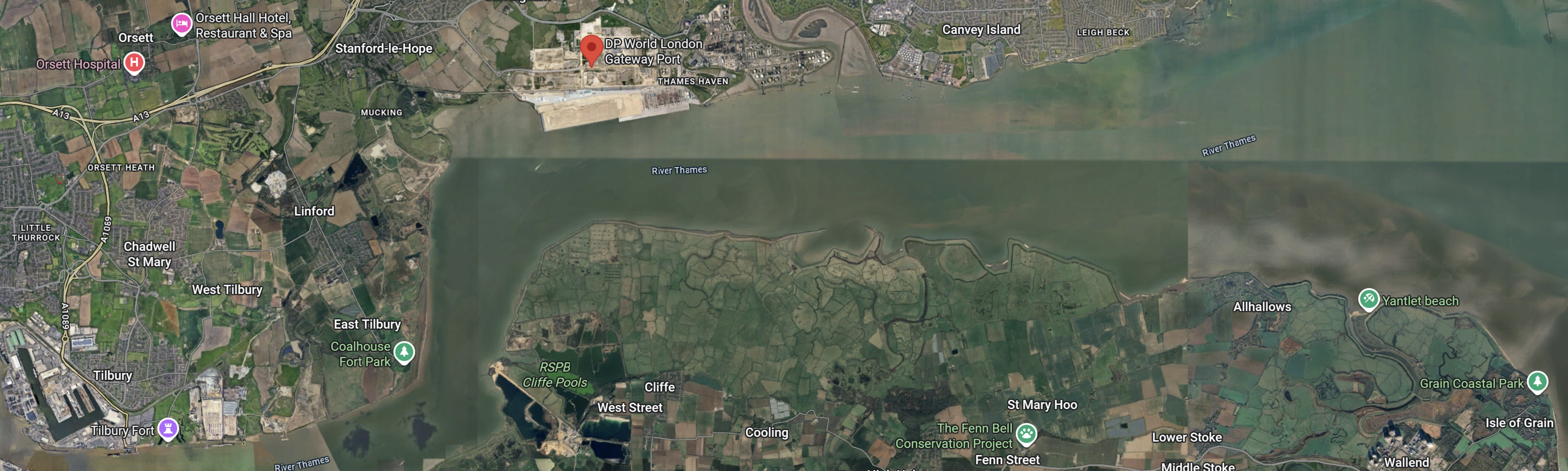
Note.
- The Port of Tilbury is in the South-West corner of the map.
- London Gateway is indicated by the red arrow.
- The Isle of Grain is in the South-East corner of the map.
- Other ports between Tilbury and the Isle of Grain include Barking, Dagenham, Dartford, Erith, Greenwich, Northfleet, Purfleet, Silvertown and Thurrock.
There was never a more true phrase than – “Location, Location and Location”. And the Isle of Grain would appear to be in the right place to send out a bunkering tanker to a passing ship, that was calling at a port in London or just passing through the Strait of Dover.
This Google Map shows the Thames between London Gateway and the Isle of Grain.
Note.
- London Gateway is indicated by the red arrow.
- The Isle of Grain is in the South-East corner of the map.
It seems to me, that a refuelling philosophy could easily be worked out.
How Large is The Bunkering Market?
I asked Google AI this question and received this answer.
The world bunker fuel market is a multi-billion dollar industry, with the market size valued at USD 150.93 billion in 2023. It is projected to reach USD 242.29 billion by 2032, growing at a CAGR of 5.4% according to SkyQuest Technology. In terms of volume, the global bunker demand was estimated at 233.1 million metric tons in 2023 according to the IMO.
The market is not small!
Flotation, Vargronn Complete NorthConnect Deal
The title of this post, is the same as that of this article on Renews.biz.
This is the sub-heading.
1.4GW Cenos floater backers seal ‘productive partnership’ with interconnector acquisition
These three paragraphs add more details to the deal.
Flotation Energy and Vargronn have closed their acquisition of the NorthConnect interconnector project between Scotland and Norway.
The developers said the deal had followed close collaboration on shared transmission infrastructure and a common grid connection point for the interconnector and the proposed 1.4GW Cenos floating wind farm off east Scotland.
NorthConnect already has consent for an offshore and onshore cable route to a substation near Boddam, Aberdeenshire, that will link to SSEN’s Peterhead substation.
This looks like a clever use of the permissions for the interconnector to connect the Cenos wind farm to the grid.
Offshore Grid For Irish, Celtic and North Seas Closer To Delivery
The title of this post, is the same as that of this article on The Irish Times.
This is the sub-heading.
Joint development can be ‘key step for Europe’s energy future’ and climate neutrality
These paragraphs add detail.
EirGrid and other leading European power transmission system operators (TSOs) have backed moves to develop an offshore electricity grid for the Irish, Celtic and North seas.
The next stage in a collaboration, being undertaken by nine system operators under the Offshore TSO Collaboration (OTC), was announced at the WindEurope annual conference in Copenhagen on Wednesday.
It followed the initial results of a pilot study evaluating how the grid could be established.
The report supports Europe’s goal of establishing a “green power plant” offshore that will play a crucial role in the Continent securing an independent, affordable and climate-neutral energy supply.
If you open the article, there is an excellent map of the various interconnectors, that will be in place by 2040.
Conclusion
This is all good stuff and can only lead to energy security for the participating countries.
Drax To Get £24m In Green Subsidies For Pumped Hydro
The title of this post is the same as that of this article in The Times.
These three paragraphs give details of the subsidy.
Drax will bank £24 million in green subsidies from energy bill-payers for its pumped hydro assets, ahead of a revival in the energy storage technology in Britain.
The FTSE 250 constituent, which also operates Britain’s largest power station in North Yorkshire, has secured contracts to provide 434 megawatts of capacity from its pumped storage and hydro assets, the largest of which is the Cruachan power station near Oban in Scotland.
The contracts cover energy to be delivered between October 2028 to September 2029, at a price of £60 a kilowatt a year.
This will arouse the anti-Drax lobby, but it should be born in mind, that according to Wikipedia, Cruachan can provide a black start capability to the UK’s electrical grid.
This is Wikipedia’s definition of a black start.
A black start is the process of restoring an electric power station, a part of an electric grid or an industrial plant, to operation without relying on the external electric power transmission network to recover from a total or partial shutdown.
After the Great Storm of 1987, we were without power in my part of Suffolk for two weeks and I suspect there were several black starts in the South of England.
I suspect that power from interconnectors could now be used.
Drax is expanding Cruachan from 440 MW to 1 GW, which will be a large investment and surely increase its black start capability.
So in this case the future subsidy could be considered something like an insurance policy to make sure black start capability is available.
UK, Netherlands To Connect Grids via Nederwiek 3 Offshore Wind Farm
The title of this post, is the same as that of this article on offshoreWIND.biz.
This is the sub-heading.
Dutch Climate and Green Growth Minister Sophie Hermans has included LionLink, said to be the first direct-current hybrid interconnector, in the country’s latest Offshore Wind Energy Development Framework. LionLink will use the offshore grid connection of Nederwiek 3 offshore wind farm in the Netherlands to connect to both the Dutch and the UK onshore high-voltage grids.
These are points from the article.
- The interconnector can also be used as an additional high-voltage link to exchange electricity between the countries.
- With LionLink now added to the offshore wind development framework, TenneT may now make investments in the project, which the Dutch transmission system operator (TSO) is realising in close cooperation with UK partner National Grid Ventures (NGV).
- Nederwiek 3 is planned to be launched in 2026.
The offshore grid between the UK and Europe is on its way.
 The Anonymous Widower