Hyundai Heavy Sets Sights On Scottish Floating Offshore Wind
The title of this post, is the same as that of this article on offshoreWIND.biz.
This is the sub-heading.
Major South Korean shipbuilder, HD Hyundai Heavy Industries, has signed a Memorandum of Understanding with two Scottish enterprise agencies which is expected to unlock expertise in the design and manufacture of floating offshore wind substructures.
These are the first three paragraphs.
Scottish Enterprise (SE) and Highlands & Islands Enterprise (HIE) signed the MoU with Hyundai Heavy in Edinburgh, described as a “vote of confidence” in Scotland, committing each other to pursue opportunities for floating offshore wind projects in Scotland.
This is the South Korean company’s first agreement in Europe on floating offshore wind manufacturing.
HD Hyundai Heavy Industries is the world’s largest shipbuilding company and a major manufacturer of equipment such as the floating substructures that form a critical part of the multi-billion offshore wind supply chain.
To say this is a big deal, could be a massive understatement, as my history with large Korean companies could say otherwise.
Around 1980, one of the first prestigious overseas projects, that was managed by Artemis was in Saudi Arabia.
- This may have been something like the King Khaled City, but I can’t be sure.
- Most of the hard work on the project was done by labour imported by Hyundai from South Korea.
After a few years, the Korean running Hyundai’s part of the project returned to Korea and he indicated that he would help us break into the Korean market.
Our salesman; Paul, with responsibility for Korea, who sadly passed away last year, told me this tale of doing business in the country.
Our Korean friend had bought a system for Hyundai in Korea and he organised a meeting for important Korean companies, so that Paul could present the system.
Everything went well, with our friend doing the necessary pieces of translation.
When he had finished, Paul asked if there were any questions.
The most common one was “Can we see the contract?”
Contracts were given out and after a cursory read, the leaders of Korean industry, all started signing the contracts.
So Paul asked our Korean friend, what was going on.
After a brief discussion, Paul was told. “If it’s good enough for Hyundai, it’s good enough for my company!”
And that was how we broke the Korean market.
Conclusion
In UK And South Korea Help Secure Millions For World’s Largest Monopile Factory, I talked about Korean company; SeAH Wind’s new monopile factory on Teesside.
In South Korea, UK Strengthen Offshore Wind Ties, I talk about a developing partnership.
In Mersey Tidal Project And Where It Is Up To Now, I talk about Korean involvement in the Mersey Tidal Project.
The Koreans are coming and Hyundai’s endorsement will help.
South Korean Team To Develop SMR-Powered Ships
The title of this post is the same as that of this article on Neutron Bytes.
This is the introductory paragraph.
Nine South Korean organizations have signed a memorandum of understanding (MoU) to cooperate on the development and demonstration of ships and offshore systems powered with small modular reactors (SMRs). The partners will also develop marine systems and the production of hydrogen using molten salt reactors (MSRs).
These points are listed about nuclear-powered ships.
- Over 160 ships are powered by more than 200 small nuclear reactors.
- Most are submarines, but they range from icebreakers to aircraft carriers.
- In future, constraints on fossil fuel use in transport may bring marine nuclear propulsion into more widespread use.
- So far, exaggerated fears about safety have caused political restrictions on port access.
Note.
- When as a child, I used to watch the large container ships at Felixstowe, I thought then, that they could be nuclear-powered.
- One engineering lecturer at Liverpool University in the 1960s, was talking about nuclear-powered tunneling machines.
- Rolls-Royce to name just one company must have the reactor technology.
I just wonder, when the Korean President and his wife visited the UK, just before Christmas, that nuclear-powered ships were discussed.
British Gas Joins Forces With Samsung To Help Customers Power Smarter Energy Use
The title of this post, is the same as that of this press release from Centrica.
This is the sub-heading.
British Gas and Samsung have today announced the exciting first step in a long-term venture – aimed at helping customers better manage their energy use and increase the adoption of low carbon heating technologies in homes across Britain.
These are the first two paragraphs.
The collaboration will see British Gas integrate with Samsung’s SmartThings app to help customers optimise their home appliances to use energy when the cost and demand are lower. This is now possible through the integration of SmartThings Energy and British Gas’ PeakSave demand flexibility scheme informing customers (by sending notifications via their smartphone, TV or other compatible devices) of the best times to use household appliances to save money.
The PeakSave scheme includes PeakSave Sundays, running every Sunday until the end of February with half-price electricity from 11am to 4pm for British Gas customers and PeakSave Winter events which encourages customers to move their electricity use out of peak times when there is high demand on Britain’s energy grid.
As a Graduate Control Engineer, I believe that this could make optimising your energy use much easier.
- It would surely be a lot easier to check usage on your phone rather than a smart meter, when you perhaps cook a ready meal, so that you can see if your microwave or traditional cooker is cheapest.
- Suppose you and everybody, who lives with you are out for supper and British Gas want to cut off your gas for a reward, you can make an appropriate decision.
- Hopefully, if you have the right controls, you’ll be able to switch lights and appliances off and on.
The possibilities are endless.
I shall certainly be looking at the reviews of this app.
There is a section in the press release called Scaling Up Low Carbon Heating Opportunities, where this is said.
The collaboration will also help support customers in their journey to decarbonising their homes by introducing smart technologies in a way that is simple and empowering. From early 2024, British Gas will include Samsung heat pumps in its offering to British households to support the UK’s commitment to reach net zero by 2050.
The venture will see specially trained British Gas surveyors and engineers working with consumers to explain the benefits of heat pumps and then conducting the installations on-site. Samsung will be supporting workforce training as part of their efforts to upskill the heating industry to ensure there are enough installers to service the expected growing demand.
British Gas also offers customers the chance to purchase heat pumps through flexible financing methods. This, combined with the recently increased UK Government Boiler Upgrade Scheme grant of £7,500, creates an attractive package of financing options to help people make the transition more affordable.
Various plumbers, who I would trust, have given me different views about heat pumps.
I suspect the Samsung’s SmartThings app might be able to simulate your energy usage with or without the heat pump, as it would know your energy use with your current boiler.
I was doing similar calculations for chemical plants in the early 1970s at ICI, using a PACE 231-R computer.

Consider.
- It may look rather old fashioned, but it could solve a hundred simultaneous differential equations in one go.
- Two similar computers linked together were the analogue half of NASA’s moon mission simulator.
- Without these wonderful machines, NASA would not have been able to re-calculate the dynamics of Apollo 13 and the mission would be remembered as a disaster, rather than the first space rescue.
The average current smart phone has more computing power than a PACE 231-R.
What’s In It For Samsung?
I have a Samsung television, but unfortunately it has a screen fault because of age. So if I had the Samsung app and liked it, I might buy another Samsung TV.
Similarly, the app might give me a financial reason to buy a Samsung heat pump.
Samsung will sell more equipment.
What’s In It For Centrica?
Centrica would appear to be a loser, as bills will fall and they could be paying customers to not use energy.
But they are surely hoping that their market share will increase and I’m sure Samsung will give them a commission.
What’s In It For The Consumer?
Hopefully, they’ll get lower energy bills.
But also they might get a lot of convenience controlling their appliances and heating.
Conclusion
Using energy is becoming a computer game with monetary rewards.
Is the deal between Centrica/British Gas and Samsung another deal that has been brought to fruition by the Korean President’s visit to the UK?
It looks like this is the third recent deal signed between UK and Korean companies, after these two.
- South Korea, UK Strenghten Offshore Wind Ties
- UK And South Korea Help Secure Millions For World’s Largest Monopile Factory
I suspect, there might be a few more deals, if Charles and Camilla really turned on the charm.
In Mersey Tidal Project And Where It Is Up To Now, I wrote about talks between Liverpool City Council and Korea Water about a tidal barrage of the Mersey. This project must surely be a possibility!
This is said in the Wikipedia entry for Korean Air under Fleet Plans.
At the Association of Asia Pacific Airlines Assembly in 2018, Korean Air announced that it was considering a new large widebody aircraft order to replace older Airbus A330, Boeing 747-400, Boeing 777-200ER and Boeing 777-300. Types under consideration for replacement of older widebody aircraft in the fleet include the Boeing 777X and Airbus A350 XWB. At the International Air Transport Association Annual General Meeting (IATA AGM) in Seoul, Chairman Walter Cho said Korean Air’s widebody order is imminent and it is considering an extra order of Airbus A220 Family including developing version, Airbus A220-500.
Note.
- Airbus A350 XWB have Welsh wings and Rolls-Royce engines.
- Airbus A220-500 are made in Canada with wings and composite parts from Belfast. Rolls-Royce may have a suitable engine.
Could a deal have something in it for the UK?
Although Korea has its own SMR program, I wonder, if there could be a link-up between Korean industry and Rolls-Royce over SMRs?
UK And South Korea Help Secure Millions For World’s Largest Monopile Factory
The title of this post, is the same as that of this article on offshoreWIND.biz.
This is the sub-heading.
UK Export Finance (UKEF) and South Korea’s export credit agency Korea Trade Insurance Corporation (K-Sure) have helped SeAH Wind to secure GBP 367 million in Standard Chartered Bank and HSBC UK financing to build the world’s largest wind monopile manufacturing facility.
These three paragraphs outline the story.
UKEF and K-Sure have secured support worth GBP 367 million for South Korean manufacturer SeAH Steel Holding’s construction of a wind tech factory near Redcar, in the Tees Valley.
Issuing its first-ever “Invest-to-Export” loan guarantee to secure overseas investment in British industry, UKEF together with K-Sure has ensured that SeAH Wind UK can fund the construction project – worth almost GBP 500 million – with GBP 367 million in financing from Standard Chartered Bank and HSBC UK.
SeAH Wind UK, a subsidiary of South Korean steel company SeAH Steel Holding, announced its decision to invest and broke ground at Teesworks Freeport last summer.
The article also says.
- This is SeAH Wind’s first such investment outside Korea.
- The factory will make between 100 and 150 monopiles a year.
- The factory will create 750 jobs when it opens in 2026.
- The factory is conveniently placed for transport to the North Sea.
Everybody seemed to have worked hard during the state visit of the Korean President and his wife.
South Korea, UK Strengthen Offshore Wind Ties
The title of this post, is the same as that of this article on offshoreWIND.biz.
This is the sub-heading.
The Republic of Korea (ROK) and the UK have signed a memorandum of understanding (MoU) concerning cooperation on offshore wind energy
These three paragraphs outline the MoU.
The UK and ROK already have a proven relationship in offshore wind, with large-scale investments in the UK’s supply chain and in the development of ROK’s offshore wind sector.
This MoU emphasises the will to build on this existing cooperation to accelerate deployment, address barriers to trade, and encourage mutual economic development through regular government-to-government dialogue and business-to-business cooperation, according to the partners.
The participants will support the UK and ROK’s offshore wind deployment by sharing experience and expertise from their respective sectors.
These are my thoughts.
The British And The Koreans Have A Long Record Of Industrial Co-operation
My own experience of this, goes back to the last century, where one of the biggest export markets for Artemis; the project management system, that I wrote was South Korea.
We had started with Hyundai in Saudi Arabia, where the Korean company was providing labour for large projects.
I can remember modifying Artemis, so that it handled the Korean won, which in those days, came with lots of noughts.
The Korean, who managed their Saudi projects returned home and luckily for us, wanted a system in Korea.
Paul, who was our salesman for Korea, used to tell a story about selling in Korea.
Our Korean friend from Hyundai had setup a demonstration of Artemis with all the major corporations or chaebols in Korea.
Paul finished the demonstration and then asked if there were any questions.
There was only one question and it was translated as “Can we see the contract?”
So Paul handed out perhaps a dozen contracts.
Immediately, after a quick read, the attendees at the meeting, started to sign the contracts and give them back.
Paul asked our friendly Korean, what was going on and got the reply. “If it’s good enough for Hyundai, it’s good enough for my company!”
The King Played His Part
King Charles, London and the UK government certainly laid on a first class state visit and by his references in his speech the King certainly said the right things.
I always wonder, how much the Royal Family is worth to business deals, but I suspect in some countries it helps a lot.
With Artemis, we won two Queen’s Awards for Industry. Every year the monarch puts on a reception to which each company or organisation can send three representatives. I recounted my visit in The Day I Met the Queen.
For the second award, I suggested that we send Pat, who was the highest American, in the company.
Later in his career with the company, when he was running our US operations, Pat. found talking about the time, he met the Queen and Prince Philip, very good for doing business.
I wonder how many business and cooperation deals between the UK and Korea, will be revealed in the coming months.
This Deal Is Not Just About The UK And Korea
This paragraph widens out the deal.
In addition, participants accept to promote business activities and facilitate opportunities for UK and ROK companies to collaborate in ROK and the UK, as well as joint offshore wind projects in third countries, according to the press release from the UK Government.
An approach to some countries without the usual bullies of this world may offer advantages.
Has One Secondary Deal Already Been Signed?
This paragraph talks about a recent deal between BP, Dutch company; Corio and the South Koreans.
The news follows the recent announcement from South Korea’s Ministry of Trade, Industry and Energy that two UK companies, Corio Generation and BP, submitted investment plans for offshore wind projects in South Korea totalling about EUR 1.06 billion.
This deal was apparently signed during the state visit.
There’s A Lot Of Wind Power To Be Harvested
These last two paragraphs summarise the wind potentials of the UK and Korea.
The UK has the world’s second-largest installed offshore wind capacity, with a government target to more than triple this capacity by 2030 to 50 GW, including 5 GW of floating offshore wind.
Back in 2018, the South Korean Government set a 2030 offshore wind target of 12 GW in its Renewable Energy 3020 Implementation Plan, which was reaffirmed by the now-former South Korea’s president Moon Jae-in in 2020. Since 2022, it has been reported that the country has a target of reaching 14.3 GW of offshore wind power by 2030.
Note that the UK’s population is almost exactly 30 % bigger than Korea’s.
So why will the UK by 2030, be generating three-and-half times the offshore wind power, than Korea?
Twenty days ago, I wrote UK And Germany Boost Offshore Renewables Ties, where I believe the sub-plot is about long-term power and energy security for the UK and Germany.
Long term, the numbers tell me, that UK and Irish seas will be Europe’s major powerhouse.
Australia’s Offshore Wind Market Could Significantly Benefit from Collaboration with UK Suppliers, Study Says
The title of this section, is the same as that of this article on offshoreWIND.biz.
This is the sub-heading.
A new study has been launched that highlights significant opportunities for the UK to share its wind farm expertise with Australia’s emerging offshore wind market
These three paragraphs outline the study.
The Australian Offshore Wind Market Study, conducted by Arup, evaluates potential Australian offshore wind markets and analyses the strengths, weaknesses, and opportunities for UK support.
Key findings indicate that the Australian offshore wind market could “substantially” benefit from collaboration with the UK suppliers, given the UK’s 23 years of experience and its status as the second largest offshore wind market globally, boasting 13.9 GW of installed capacity as of 2023, according to the UK Government.
Currently, Australia has over 40 offshore wind projects proposed for development.
I believe that the Australians could be a partner in the deal between the UK and Korea, as all three countries have similar objectives.
Conclusion
The Korean and German deals. and a possible Australian deal should be considered together.
Each country have their strengths and together with a few friends, they can help change the world’s power generation for the better.
- Just as the UK can be Europe’s powerhouse, Australia can do a similar job for South-East Asia.
- Any country with lots of energy can supply the green steel needed for wind turbine floats and foundations.
I would have felt the Dutch would have been next to join, as their electricity network is solidly connected to the UK and Germany. But after this week’s Dutch election, who knows what the Dutch will do?
South Korea Targets Over 2,000 Hydrogen Buses By 2026
The title of this post, is the same as that of this news item from Argus Media.
This is the sub-heading.
South Korea plans to convert more than 250 commuter buses intro hydrogen-fuelled buses by this year and more than 2,000 by 2026, in a concerted effort to raise the uptake of hydrogen vehicles.
It appears to be a well-thought plan.
This last paragraph gives South Korea’s long-term objective.
A higher uptake of hydrogen vehicles is in line with the hydrogen roadmap the government released in November 2022, where it envisioned the transportation sector as one of the key drivers of large-scale hydrogen demand. South Korea aims to raise its supply of high-mobility vehicles such as hydrogen buses and trucks, with a goal of producing 30,000 hydrogen commercial vehicles and building 70 liquid hydrogen refuelling stations in the country by 2030.
We need an ambitious plan like this in the United Kingdom.
As the UK population is thirty percent larger than South Korea’s we probably need one with similar but larger ambitions.
Mersey Tidal Project And Where It Is Up To Now
The title of this post, is the same as that of this article on the Liverpool Echo.
This is the sub-heading.
With a major agreement on the project reached this week, we take a look at what it all means.
There is a section, which is called So What Is A Mersey Tidal Project?, where this is said.
The idea is to build a huge damn structure in the River Mersey with turbines that can harness energy from the tides of the river and convert it into clean power. The city region combined authority is hopeful that this could power up to 1 million homes and create thousands of local jobs
The city region has one of the country’s largest tidal ranges so it is seen as a perfect opportunity to explore a tidal project here. It is hoped such a project could generate a ‘plentiful, reliable supply of clean, green energy for generations to come.
In the 1970s, I did a small project management consultancy at Frederick Snow and Partners in London. They showed me their ambitious plans for a Severn Barrage, which was a tidal scheme, that would have created a tenth of our electricity and would have cost around a billion pounds.
But Harold Wilson, who was Prime Minister at the time, felt that the money would be better spent on building massive coal-fired power stations, rather than building a clean power station, that would last centuries.
A second section is called What Happened This Week?, where this is said.
This week the Liverpool City Region signed an agreement with the company behind the current world’s current largest tidal project with a view to learning lessons.
The Sihwa Lake tidal range power plant, which is operated by Korea Water Resources Corporation, generates 552GWh of clean, green energy every year, replacing the equivalent of 862,000 barrels of oil a year.
Jeong Kyeong Yun, Vice President of Korea Water Resources Corporation, known as K-water, was in Liverpool this week to sign an historic Memorandum of Agreement with Mayor Rotheram. It is hoped the agreement will pave the way for close co-operation between the two tidal power projects, through reciprocal visits and information sharing.
Note.
- The Liverpool Echo is still making spelling mistakes, like damn instead of dam. In the 1960s, Fritz Spiegl used to give us all pleasure by writing about them.
- 552 GWh would keep the UK powered up for nearly a month.
- The Sihwa Lake Tidal Power Station has a comprehensive Wikipedia entry.
- The Sihwa dam has a road over the top.
- Unlike Frederick Snow’s scheme for the Severn, Sihwa only generates power, on the incoming tide. But it does generate 254 MW.
As ever, Liverpool is thinking big and getting the experience from those, who know what they are doing.
This last paragraph, gives the thoughts of the Mayor.
Mayor Rotheram said that with the right support, he hopes the project could be generating clean, renewable power by the end of this decade.
I would go along with that.
The Mersey Tidal Project And The Mersey Gateway Bridge
Frederick Snow’s plans for the Severn could have incorporated a new road and rail crossing of the estuary.
This Google Map shows the the Sihwa Lake Tidal power station.
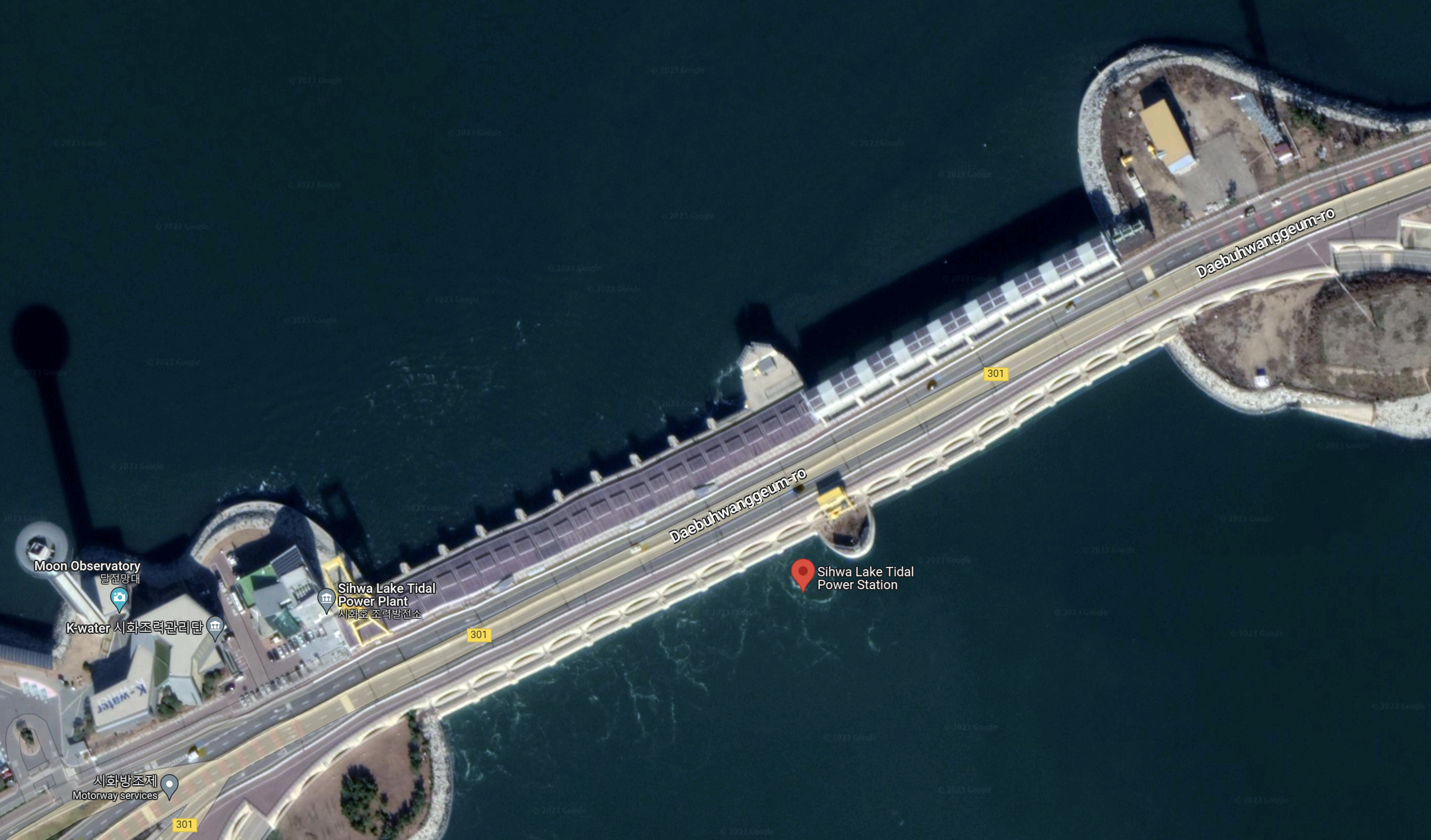
The road over the dam is clearly visible.
I took these pictures of the Mersey Estuary as I came back from Liverpool on Tuesday.





This Google Map shows the Mersey Estuary.
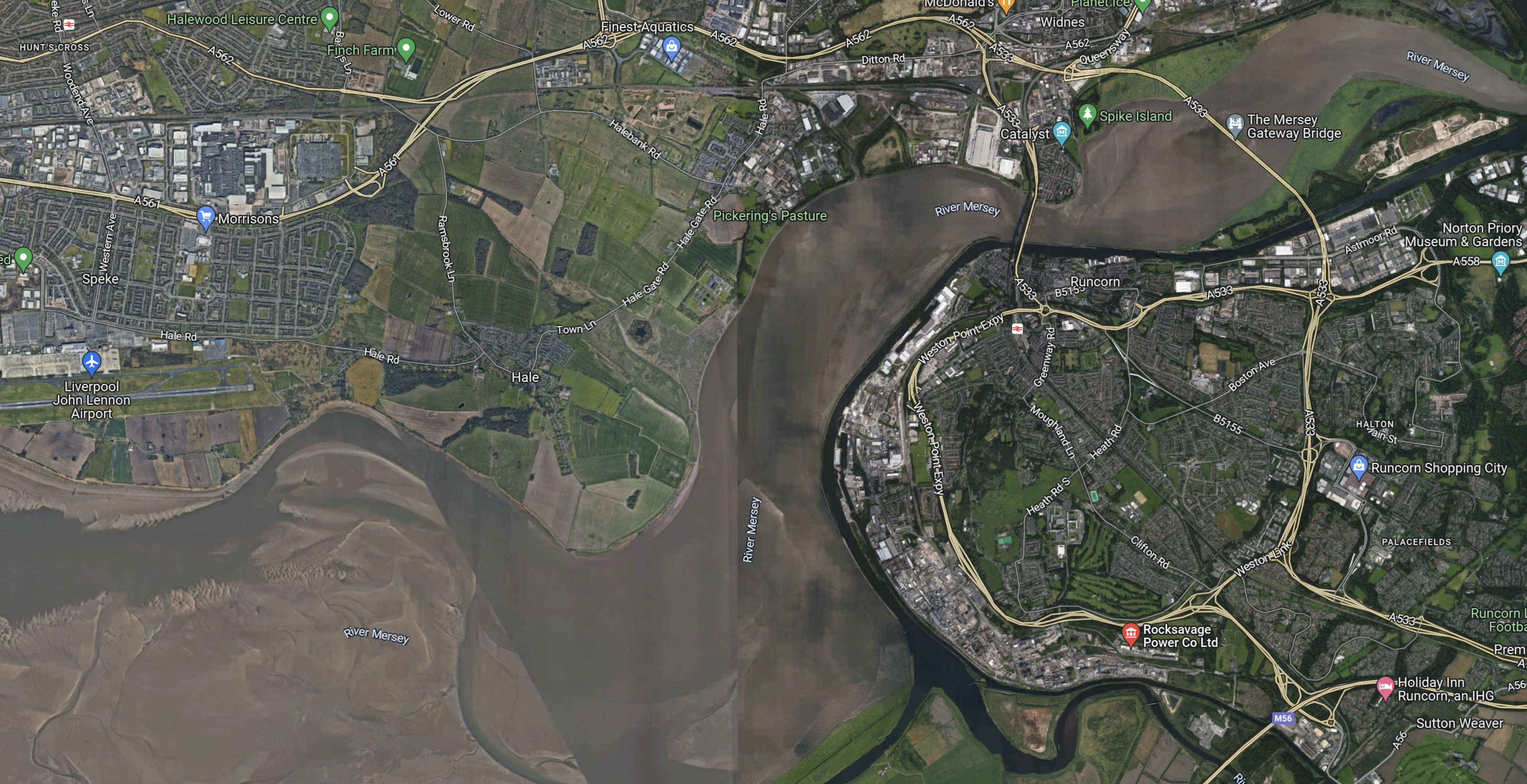
Note.
- The River Mersey flowing from the North-East corner of the map to the South-West corner.
- On the South Bank of the Mersey, there is the deep-water channel of the Manchester Ship Canal.
- The bridge in the North-East corner of the map is the Mersey Gateway Bridge.
- Then there is the pair of bridges at Runcorn; the Silver Jubilee Bridge and the Runcorn Railway Bridge.
I am fairly sure, that the Mersey Tidal Project would be built downstream of the pair of bridges at Runcorn.
This Google Map shows the Mersey Estuary from the Runcorn Bridges to the mouth of the Manchester Ship Canal.

Note.
- The Mersey Gateway Bridge and the two Runcorn bridges are in the North-East corner.
- The route of the Manchester Ship Canal is clearly visible.
- Liverpool John Lennon Airport is on the North Bank of the Mersey.
- The M56 and M53 Motorways run East-West across the map to the South of the River.
This map leads me to the conclusion, that a tidal barrage with a road on top could link Liverpool to the M56.
I have some thoughts.
Rail Access To Liverpool
There is an electrified railway between Liverpool and Ellesmere Port.
- The railway can be picked out running across the bottom of the map.
- In Liverpool’s Vision For Rail, I talked about Liverpool City Region’s plan to expand this service to Helsby, Frodsham and Runcorn East.
- Helsby and Frodsham are shown on the map.
I wouldn’t be surprised to see a new Park-and-Ride station, where the M56 and the railway cross.
Ship Access To Manchester And Other Ports
Barrages usually have to provide access for ships to pass through to any ports behind the barrage.
But the Mersey Tidal Project already has that access. – It was built in the 1893 and is called the Manchester Ship Canal.
There is probably strong protection between the Mersey and the Canal between the mouth of the Canal and Runcorn, which may impact positively on the costs of the barrage.
The Simple Barrage
Sihwa Lake Tidal power station is a simple barrage with a bridge over the power station in the middle.
This Google Map shows the location of the power station.
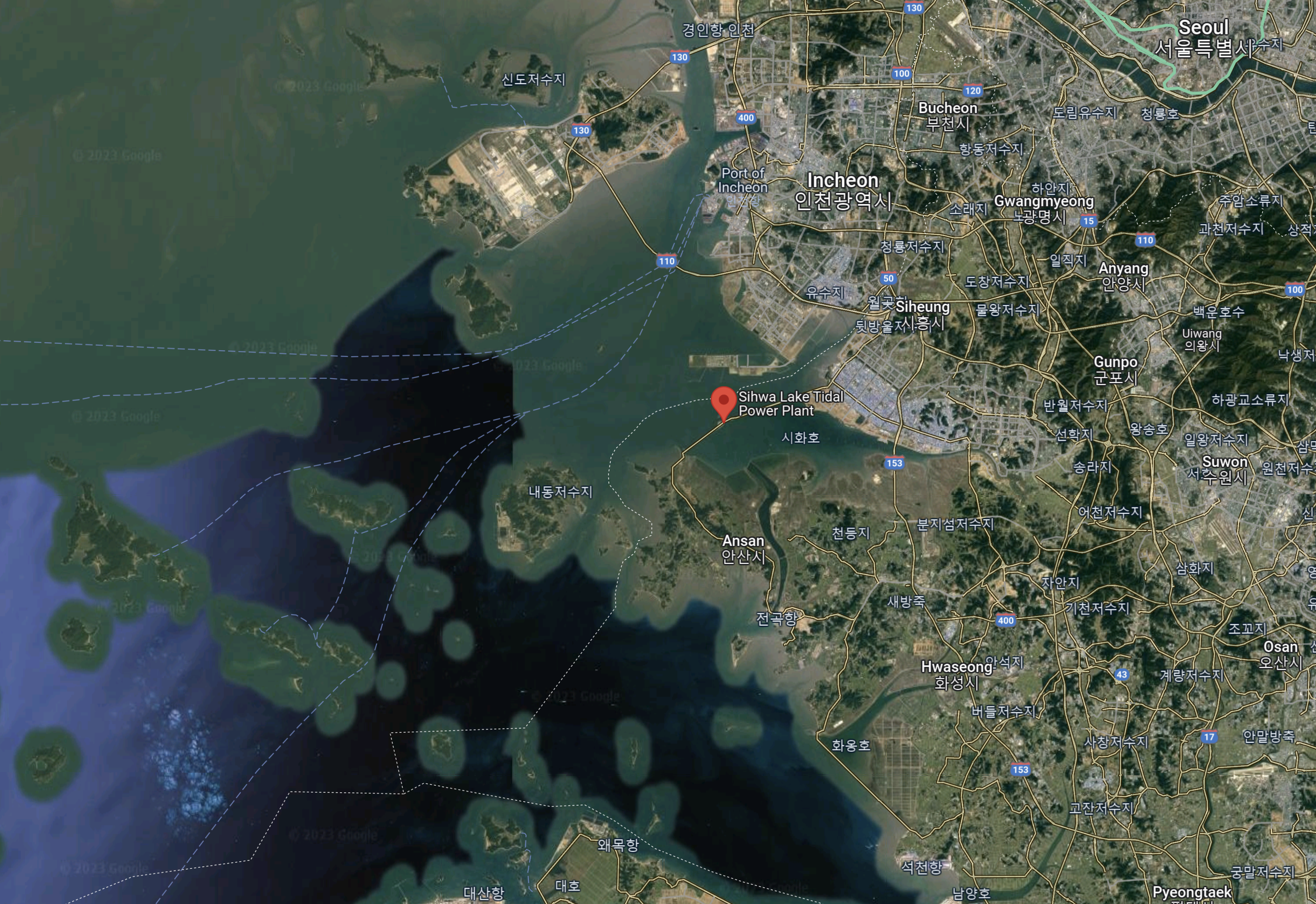
Note.
- Seoul is in the North-East corner of the map.
- The Sihwa Lake Tidal power station is marked by the red arrow.
This Google Map shows a close-up of the power station.
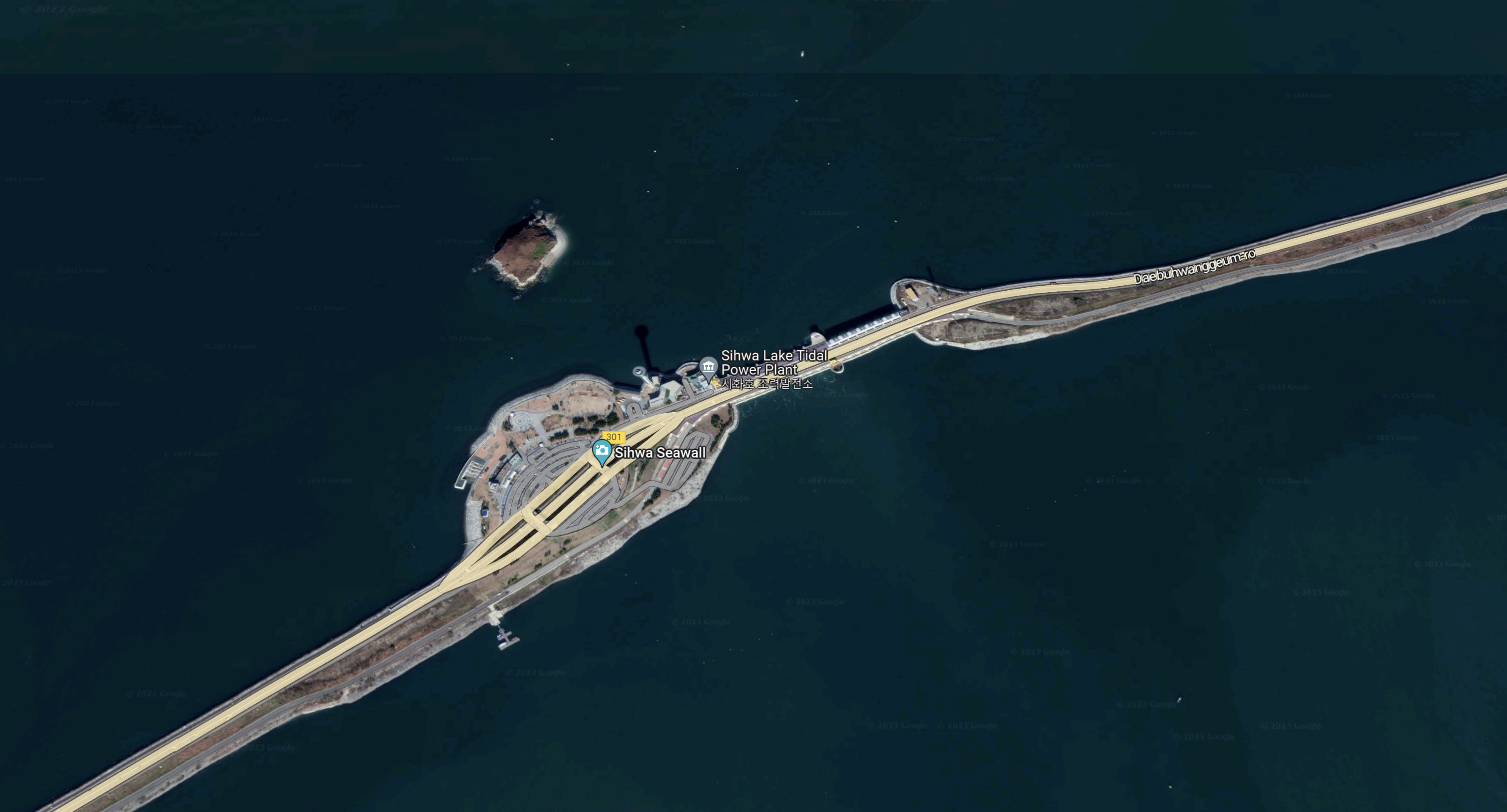
Note.
- The ten turbines appear to be in the gap.
- There appears to be a road on top of the barrage.
- The area to the West of the power station is marked as a rest area.
- A Moon Observatory is marked.
- It has bus stops, showing that it is served by the 123 and 123-1 buses.
It is an impressive structure.
I’m sure that this type of barrage would work over the Mersey.
- A road could be built on top.
- It may only be able to generate electricity,from an incoming tide, like Sihwa.
- It could incorporate a rest area.
I do suspect though Liverpudlians would add a few unique touches of their own. Perhaps some liver birds or superlambananas.
The Frederick Snow Solution
The Severn is a wide river and he proposed that there would be a dam across the river, with a spine running East along the middle of the river.
- The spine would divide the river into two lakes.
- On the incoming tide, sluices would open and allow water to flow into the Northern or high lake from the Mersey estuary.
- On the outgoing tide, sluices would open and allow water to flow out of the Southern or low lake into the Mersey estuary.
- Water would flow between the high and low lake through turbines to generate electricity.
- I have assumed that the high lake is on the North side, but if the geography is more suitable, the high and low lakes could be reversed.
In the design for the Severn Barrage, an International airport would have been built on the spine.
But Liverpool already has a nearby International airport, so perhaps it could be much better to install a large electrolyser and hydrogen storage on the spine.
Ørsted Signs Two ‘Industry First’ Monopile Contracts For Hornsea 3 Foundations
The title of this post, is the same as that of this press release from Ørsted.
This is the introductory paragraph.
Ørsted, the world’s most sustainable energy company, has signed two ‘industry first’ contracts for the fabrication of XXL monopile foundations for the Hornsea 3 offshore wind farm.
I have a few thoughts about the press release.
XXL Monopile Foundations
These four paragraphs describe Hornsea 3’s XXL monopile foundations.
Subject to Ørsted taking a Final Investment Decision on Hornsea 3, the contracts have been finalised with Haizea Wind Group, through its subsidiary Haizea Bilbao, and SeAH Wind Limited, a UK-based subsidiary of SeAH Steel Holdings (SeAH).
Ørsted will be the first major customer at SeAH Wind’s new monopile facility in Teesside, and the agreement with Haizea marks the company’s first XXL monopile contract with Ørsted.
The deal with SeAH represents the single largest offshore wind foundations contract secured by any UK company. Haizea’s agreement is the largest single contract ever secured by Haizea Wind Group.
Each of the huge foundation structures for Hornsea 3 will weigh between 1,300 and 2,400 tonnes and measure in at between 83 and 111 metres in length. Monopile production is expected to start in 2024.
Note
- These are huge steel structures.
- But then the water depth appears to be between 36 and 73 metres.
- It looks like the orders are shared between Spanish and Korean companies
This article on offshoreWIND.biz, is entitled Beyond XXL – Slim Monopiles For Deep-Water Wind Farms.
These are some points from the article.
- XXL-Monopiles have been successfully used for water depths of up to 40 metres. Now wind farm developers need monopiles “beyond XXL”.
- The extension of the range is needed, mainly to enable the use of larger turbines, deeper water, and harsher environmental situations.
- These monopiles will allow turbines of up to 15 megawatts with rotor diameters of up to 230 metres.
- This monopile design automatically induces the idea of design and fabrication optimisation to ensure that monopiles continue to lead the ranking of most economical foundation systems.
In the 1970s, I was involved with a Cambridge University spin-out company called Balaena Structures, who were using similar much larger structures to support oil and gas production platforms.
I was just doing calculations, but I do wonder if these XXL monopile foundations, owe things in their design to work done by structural engineers, like those I met at Cambridge fifty years ago.
Another Aussie Green Hydrogen Hub In The Works As Total Eren Eyes 1GW Darwin Project
The title of this post, is the same as that of this article on Recharge.
These two paragraphs introduce the project.
Developer Total Eren is sizing up the potential for a 1GW green hydrogen project in Australia’s Northern Territory (NT), taking the total capacity of green H2 projects under development in the state to 13.8GW.
A Memorandum of Understanding (MoU), signed between Total Eren and the NT state government on Monday, will see the two work together to progress the project, dubbed the Darwin H2 Hub.
This paragraph gives a few numbers.
Plans for the scheme comprise more than 2GW of solar PV generation, which will power a 1GW electrolyser. The project aims to produce 80,000 tonnes of hydrogen a year, equivalent to around 4% of the 1.96 million tonnes of green H2 South Korea expects to import from overseas by 2030.
Note.
- Australia seems to be the place to develop large hydrogen and energy projects.
- South Korea will beat a path to your door, if you have the capacity to create millions of tonnes of green hydrogen.
The article finishes with a good summary of the future prospects of Australia’s green hydrogen industry.
I believe that Australia could become a world superpower, as it will certainly provide zero-carbon power to a good proportion of South East Asia.
South Korea Is On The Hunt For An Overseas Hydrogen Production Location
The title of this post, is the same as that of this article on Hydrogen Fuel News.
It is an interesting article, which talks about how both South Korea and Japan are looking to source hydrogen from another country and how Australia is in prime position.
This Wikipedia entry, which is entitled Energy In South Korea, has this breakdown of electricity production in South Korea.
- Thermal – 65.3%
- Nuclear – 31.1%
- Hydro – 1.6%
- Other – 2%
Note that at the time of writing the UK is producing 39.0% of electricity from renewables and 15.9% from low-carbon sources.
Consider.
- As South Korea imports a lot of liquified natural gas and has no oil or gas resources of its own, importing hydrogen is just replacing a carbon-dioxide producing fuel with a zero-carbon one, that is produced from renewables.
- Other than Australia, other possible sources of hydrogen mentioned include Saudi Arabia and the United States, but is their hydrogen produced from renewables or steam-reforming of methane?
- I suspect another could be South Africa, as they can develop a lot of wind power around the Cape.
I think we’ll see more countries going down the same route as Japan and South Korea and importing large quantities of hydrogen.
- Countries with lots of renewables like geothermal, hydro, solar and wind will benefit.
- Countries with plenty of gas can use steam-reforming to create hydrogen.
But surely, the biggest beneficiaries will be world-class companies, like ITM Power in Rotherham, who build electrolysers.
 The Anonymous Widower