New Baltic Sea Interconnector On Horizon As Lithuania, Latvia, and Germany Plan Cross-Border Link
The title of this post, is the same as that of this article on offshoreWIND.biz.
This is the sub-heading.
Lithuania, Latvia, and Germany are planning a joint offshore interconnector that would enable electricity trading between the Baltic countries and Germany and allow for the integration of up to 2 GW of offshore wind capacity in Lithuania and Latvia
These first two paragraphs add more detail to the article.
The energy ministers of the three countries signed a joint declaration of intent on 18 February, paving the way for the development of the Baltic-German PowerLink interconnector, which would, in addition to electricity trading and offshore wind capacity integration, also enable the expansion of onshore renewable energy capacity.
The Lithuanian, Latvian, and German transmission system operators (TSOs) – Litgrid, Augstsprieguma tīkls and 50Hertz – agreed to assess the feasibility of the hybrid electricity interconnection.
As Germany, has the following connections under development in the West.
- AquaVentus to Aberdeen, Humberside, Denmark, Norway and The Netherlands.
- NeuConnect to the Isle of Grain In England.
- GriffinLink, which is an offshore link to England.
The Germans seem to be putting themselves at the centre of an energy distribution system, that has the capability to stabilise European and UK electricity for thousands of years. Especially, if the network grows to include more countries.
This paragraph says this about the Baltic-German PowerLink project.
The Baltic-German PowerLink project concept developed by Litgrid, Augstsprieguma tīkls, and 50Hertz includes a 2 GW, approximately 600 kilometres long hybrid offshore connection, with the connection point in the Baltic States planned to be on the border between Lithuania and Latvia. The exact location is to be determined after technical studies.
Note.
- The interconnectors may be long, but they are not longer than anything built successfully before in European waters.
- The UK and the Island of Ireland are well-linked.
- There would appear to be no need for challenging projects like the Morocco-UK Power Project
I suspect that Germany will get the energy it needs and the British Isles will get a nice little earner.
If Europe is generating large amounts of wind and solar energy with its variable output it will need lots of energy storage.
What Countries Have The Terrain For Pumped Storage Hydro In Europe?
I asked Google AI and received this answer.
Key countries with ideal, high-elevation terrain and significant existing or planned capacity include:
Alpine Region (The Heart of European Pumped Storage):
Switzerland: Extremely high capacity due to steep, mountainous landscapes and significant water sources, hosting the world’s oldest working pumped storage plant.
Austria: Heavily mountainous, it is a major player in PSH expansion and modernization.
France: Home to one of Europe’s largest, the Grand Maison hydroelectric power station.
Italy: Holds high capacity with numerous planned projects.
Germany: Strong existing infrastructure.
Southern Europe:
Spain: Features some of Europe’s largest plants (e.g., La Muela/Cortes-La Muela).
Portugal: Significant recent investment in large-scale projects like the Tâmega complex.
Other Potential Areas:
Norway: High potential due to its mountainous, water-rich terrain.
United Kingdom: High project volume currently under construction.
Balkans & Central Europe:
Countries like Bulgaria, Romania, and the Czech Republic have suitable terrain for further development.
These countries benefit from significant hydraulic head (steep drop) and natural or artificial reservoir potential, making them ideal for storing energy for peak consumption hours.
Note.
- As expected, the Alpine region is Top of the League.
- The UK is holding its own despite its small mountains.
- There is a lot of potential to be developed.
But then Electric Mountain in Snowdonia is certainly at the top table of pumped storage systems despite being built in the 1980s.
What Countries Have The Terrain For Hydrogen Storage In Europe?
I asked Google AI and received this answer.
Key European countries with suitable geological terrain—specifically salt caverns and depleted gas fields—for large-scale, underground hydrogen storage include Germany, the Netherlands, Denmark, the United Kingdom, and France. Other significant regions for storage potential include Spain, Hungary, and Austria, which are developing porous storage facilities.
Key Regions & Terrain Types:
Salt Caverns (North-Western Europe): Germany, the Netherlands, Denmark, France, and the UK have substantial salt deposits suitable for creating caverns, identified as cost-efficient for large-scale storage.
Depleted Gas Fields (Porous Rock): The Netherlands, Germany, and parts of Central/Southern Europe (Spain, Hungary) have significant capacity in existing porous storage, particularly in the North Sea region.
Specific Projects: Germany (Uniper’s Krummhörn project), Netherlands (HyStock), and France (HYPSTER at Etrez) are active, with Spain and Denmark emerging as major hydrogen hubs.
Capacity Potential: The Netherlands, for instance, holds massive potential (35-60 TWh) due to its offshore and onshore depleted fields.
Salt cavern projects, which offer high-deliverability storage, are heavily concentrated in the North-Western European industrial corridor.
I was lucky enough have a tour of ICI’s salt mine in Cheshire, when I worked there in the 1960s and I remember these facts from those days.
- There was enough salt in the ground under Cheshire to last several thousand years.
- Most salt was extracted from boreholes, for making chlorine using electrolysis and the Castner-Kellner process.
- Hydrogen was a by-product and much of it was mixed with coal gas to raise steam for the works.
The same technique used to make boreholes to extract the salt, is used to hollow caverns in the salt to store gases like hydrogen.
Once, when they were digging salt out of the salt mine at Winsford, a worker broke into an unmarked borehole and ICI nearly lost the mine because of the water rushing in.
Two stories stand out from the rescue of the mine.
- There was a need for dry clothes for all the workers, so ICI took a truck to Marks & Spencer in Northwich and emptied it of anything they might need. I was told the story enriched with plagues of locusts.
- A Ford Transit was found to have travelled a few thousand miles underground in axle deep salt slurry. Rather, than scrap it and buy another, it was offered back to Ford, who were delighted to swap it for a new one. I heard that Ford said, that the accelerated corrosion research would have taken many years, if done on the roads.
Always think out of the box.
The Three Baltic Countries Sign The Largest Railway Electrification Agreement In History
The title of this post, is the same as that as this news item on the LTG Group web site.
This is the sub-heading.
Today in Vilnius, the institutions of the three Baltic countries responsible for implementing the Rail Baltica project signed a historic agreement on railway electrification. The contract, valued at €1.77 billion (excluding VAT), has been awarded to COBELEC Rail Baltica – a consortium formed by the Spanish companies Cobra Instalaciones y Servicios S.A. and Elecnor Servicios y Proyectos S.A.U.
These three paragraphs add more detail.
The electrification of the Rail Baltica European railway is considered the largest cross-border railway electrification initiative in Europe, implemented as a single, joint project.
“Rail Baltica is more than just infrastructure – it is an economic and security link to the West. This contract is particularly important for our integration into the European railway network, enabling smooth passenger and freight transport while strengthening the resilience of the Baltic region. It is our strategic pathway to the future,” said Eugenijus Sabutis, Acting Minister of Transport and Communications of Lithuania.
One of the largest contracts in the history of the Baltic States was signed by the institutions responsible for implementing the project: LTG Infra, the infrastructure company of the LTG Group; Eiropas Dzelzceļa Līnijas in Latvia; and Rail Baltic Estonia in Estonia. Representatives from the ministries of transport and communications of all three countries also gathered in Vilnius for the occasion.
Note.
- The electrification will be to the European standard of 25 KVAC overhead.
- There will be a total of 2,400 km. of electrification.
- High-speed passenger and freight trains will operate on the full length of the route.
- It is planned that the electricity used will be generated from renewable energy sources.
- I feel everybody will be pleased except Putin.
The Russian dictator and war-monger won’t like it, as the railway will not be built to Russian standards.
Centrica Strikes 200MW Lithuanian Green Power Deal
The title of this post, is the same as that of this press release from Centrica.
This is the sub-heading.
- Centrica Energy is set to take on the responsibility of managing and trading the renewable power generated from two wind farms and one solar farm in Lithuania for European Energy.
A couple of months ago, Centrica published this press release, which is entitled Centrica Acquires Owner Of Leading Digital Platform, Ignition.
The press release about the deal with European Energy has this quote from Kristian Gjerløv-Juel, Vice President of Renewable Energy Trading & Optimization at Centrica Energy.
We’re very pleased to continue building on our strong partnership with European Energy. We have set an incredibly ambitious target to expand our portfolio of third-party renewable assets to 30 GW by 2030.
Note that 30 GW, would more than power the UK,
Ir appears to me, that Centrica have decided that there is money to be made from good management of both electricity production and distribution.
Klaipėda – Kyiv Rail Freight Plan
The title of this post, is the same as that of this article on Railway Gazette.
These two paragraphs give more details.
Lithuania’s national train operator LTG Group and Ukrainian Railways have signed a memorandum of understanding to develop an intermodal freight service from the Baltic port of Klaipėda to Kyiv via Poland.
Test runs are planned for this year, ahead of regular services.
I have some thoughts.
The Route
This Google Map shows the route.
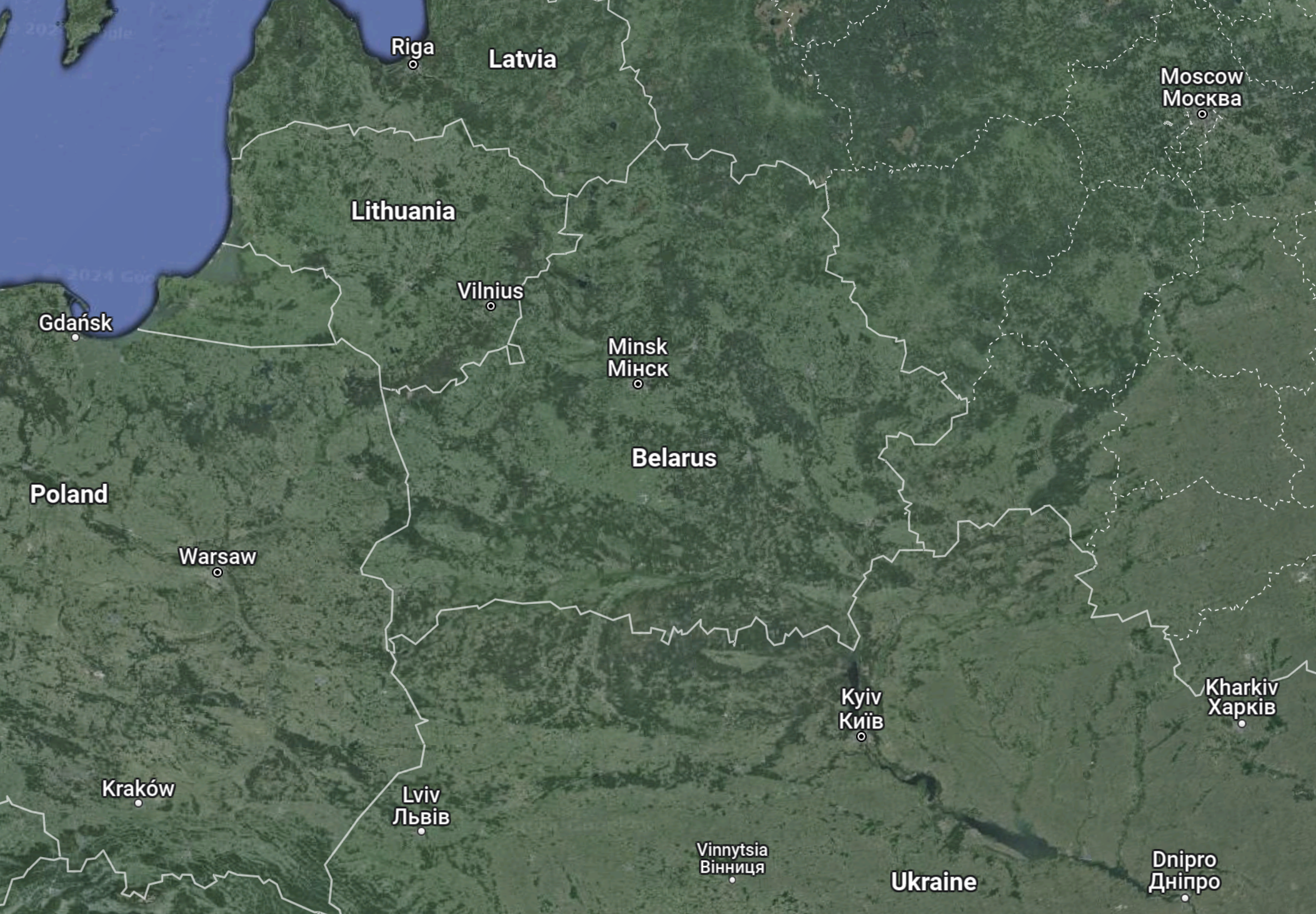
Note.
- Russia is in the North-East corner of the map, with Moscow clearly marked.
- Lithuania is in the North-West corner of the map.
- Klaipėda is on the Lithuanian coast.
- South-West of Lithuania is the Kaliningrad enclave, which is part of Russia.
- South of the Kaliningrad enclave is Poland, where Gdansk, Warsaw and Krakow are clearly marked.
- Belarus is in the middle of the map, with Minsk clearly marked.
- Ukraine is South of Russia and Belarus and East of Poland.
- Dnipro, Kharkiv, Kyiv and Lyiv in Ukraine are clearly marked.
It looks to me, that a possible route would be along the Eastern Polish Border avoiding both Belarus and the Kaliningrad enclave.
The Gauges
This Google Map shows the gauges between Klaipėda and Kyiv.
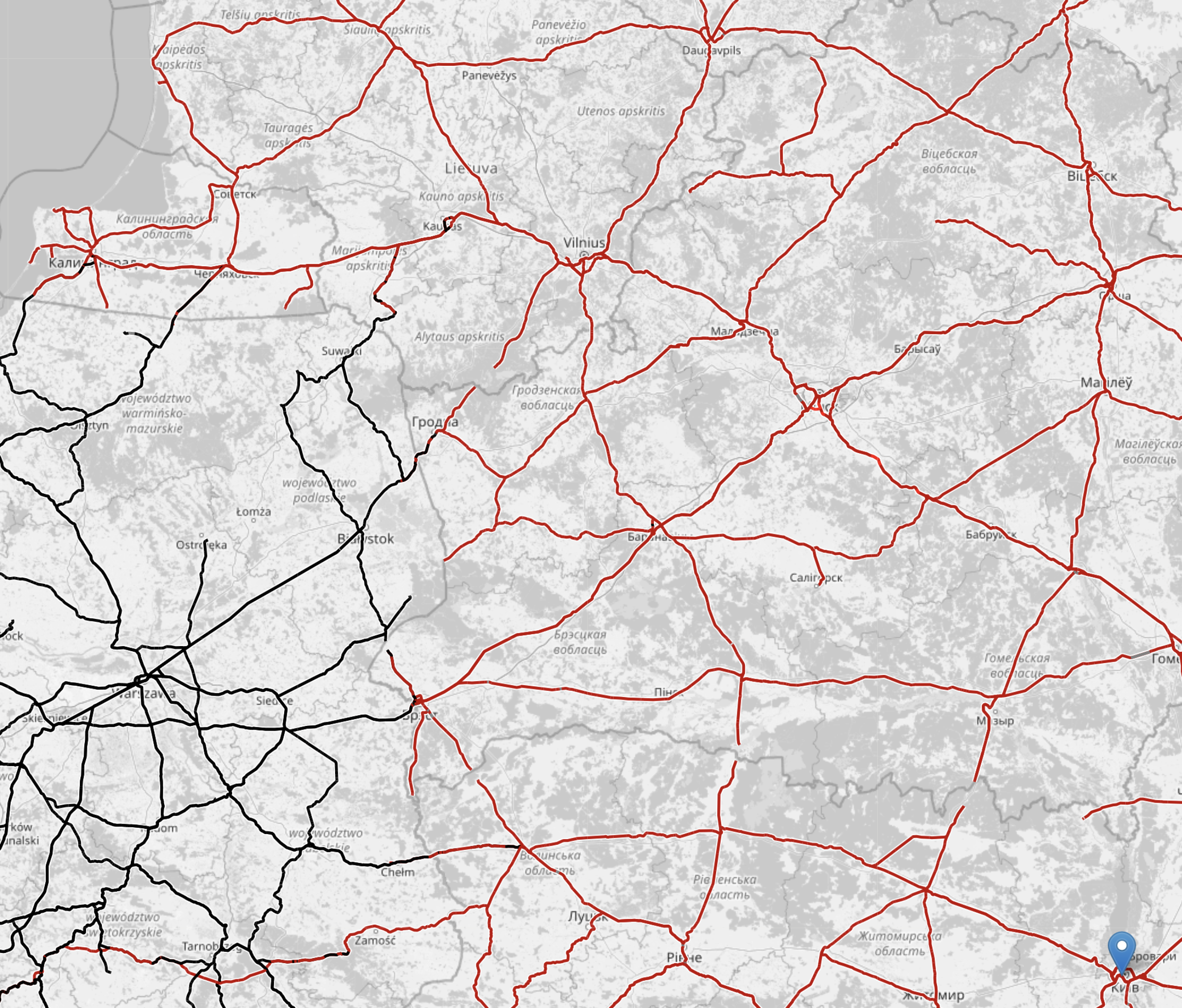
Note.
- Black tracks are Standard gauge of 1435 mm.
- Red tracks are Russian gauge of 1520 mm.
- Klaipėda is on the Lithuanian coast in the North-West corner of the map.
- Kviv is in the South-East corner of the map.
It looks to me, that although Lithuania and Ukraine are Russian gauge, the routes through Poland could be standard gauge.
So there may be a need for some rolling stock, that can run on both Russian and Polish gauges.
This article on Railway Gazette is entitled Ukrainian Railways Produces Cross-Border Grain Wagon.
These two paragraphs describe the wagons.
National railway Ukrzaliznytsia has used mostly domestic components to produce a grain hopper wagon which can operate on both the former USSR’s 1 520 mm broad gauge and the 1 435 mm standard gauge of neighbouring EU countries.
The Type 19-8005-U wagon has a capacity of 70 tonnes and 104 m3, with five loading and six unloading hatches. It is designed for operation at up to 120 km/h.
The wagon certainly looks professional in the pictures.
I don’t think that dual-gauge wagons for containers will be a serious engineering problem for the Ukrainians.
Rail Baltica
The Wikipedia entry for Rail Baltica has this introduction.
Rail Baltica is an under-construction rail infrastructure project that is intended to integrate the Baltic states in the European rail network. Its purpose is to provide passenger and freight service between participating countries and improve rail connections between Central and Northern Europe, specifically the area southeast of the Baltic Sea.
Note.
- As it is an EU-funded project, it is being built as standard gauge.
- It is being built with operating speeds of 145 mph for passengers and 75 mph for freight trains.
- There will be comprehensive connections to airports, freight terminals and major conurbations.
This page on the Rail Baltica web site has an interactive map of Rail Baltica.
It is thought that Putin is not pleased about Rail Baltica, as his extensive fleet of rail transporters for tanks and other military vehicles, are now built for the wrong gauge to invade the Baltic States.
Putin And Dual-Gauge Tracks And Wagons
As they could be used to bring war-related imports to Kyiv, I suspect Vlad the Genocider is against them.
How Will Ukraine Protect The Trains?
Consider.
- Being West of Kyiv will help.
- I suspect the UK have a few ideas for camouflage.
- Will a few brave Ukrainians ride the trains, with a sophisticated train protection missile?
- Drones probably won’t be as effective as ground attack aircraft at attacking trains.
I do suspect though that the Ukrainians have a plan.
Conclusion
This is going to be an interesting development.
Is This Better News For Offshore Wind Farm Developers?
Two months ago this article on offshoreWIND.biz was published, which was entitled Offshore Wind Developers Take A Pass On UK’s Fifth CfD Round As Maximum Bid Price Was Too Low.
This was the sub-heading.
The UK government has awarded 3.7 GW of renewable energy projects with Contracts for Difference (CfDs) in its fifth allocation round. Among the 95 new projects that secured CfDs are onshore wind, solar and tidal energy developments – and not a single megawatt of offshore wind.
These are the first three paragraphs of the article.
According to the government, the global rise in inflation and the impact on supply chains presented challenges for projects participating in this round. The government also noted that similar results have been seen in countries such as Germany and Spain.
The industry does not disagree, however, multiple players have voiced their disappointment that the government had not taken these pressures into account for this round and emphasised that the UK’s goal of having 50 GW of offshore wind and 5 GW of floating wind could now be jeopardised.
Last year, the UK awarded CfDs to 7 GW of offshore wind projects alone.
Today, articles with these titles and sub-headings were published on offshoreWIND.biz.
- 50 Developers Express Interest To Build Wind Farms Offshore Portugal
Fifty entities, including individual companies and consortia, from more than ten countries have submitted their expressions of interest to develop offshore wind projects in Portugal as the country prepares for its first auction.
2. Fugro To Survey Site For Lithuania’s First Offshore Wind Farm
Ignitis Renewables has awarded Fugro a contract to conduct a geophysical survey at Lithuania’s first offshore wind farm site.
3. Norway’s Offshore Wind Tender Attracts Seven Applications
Norway’s Ministry of Petroleum and Energy has received seven applications to participate in the tender for the Southern North Sea II offshore wind project area.
4. Project To Retrofit CTV With Hydrogen Fuel Cells Kicks Off
A project to retrofit a crew transfer vessel (CTV) with hydrogen fuel cells, to cut CO2 and NOx emissions while servicing offshore wind farms, has kicked off.
5.Terna Energy Secures Survey Permit for Wind Farm Sites Offshore Greece
Terna Energy has been granted one out of the two first exploration and survey licences issued for pilot offshore wind projects in Greece.
6. UK Increases Offshore Wind Strike Price Ahead Of Next Auction
The government of the United Kingdom has increased the maximum strike price for offshore wind projects in the next Contracts for Difference (CfD) auction by 66 per cent for fixed-bottom and by 52 per cent for floating wind projects.
All would appear to be positive stories.
- Story 1 is about success in Portugal. What are the Portuguese doing right?
- Stories 2 and 5 are about offshore wind development in new countries; Lithuania and Greece.
- Story 3 may not appear significant, but Terje Aasland, who is Norway’s Minister of Petroleum and Energy seemed pleased in the article.
- Story 4 is about development of new technology, which wouldn’t be done if the market was non-existent.
- Story 6 is surely good news for wind farm developers in the UK.
I did leave out three stories, one of which was negative and two were rather boring. But six out of nine isn’t bad.
Is it Getting Better All The Time, as The Beatles once sang?
Containerised Coal Overcomes The Break-Of-Gauge
The title of this post, is the same as that of this article on the Railway Gazette.
Innofreight containers are being transferred from broad to standard gauge trains as part of a through journey for the first time.
Russia’s attack on Ukraine has forced Poland to seek alternatives to Russian coal, but Polish ports have limited capacity to handle the required volumes.
As a result, coal is being imported via the Lithuanian port of Klaipėda. LTG Cargo’s 1 520 mm gauge trains are loaded with 60 Innofreight MonTainer XXL bulk goods containers of coal for transport to Kaunas or Šeštokai, where the containers are transferred to 15 standard gauge InnoWagons for onward transport to Braniewo in Poland.
It sounds like a simple solution, with advantages.
Innofreight says that this is faster than discharging the coal from one train and reloading it onto another, and also avoids creating dust.
On their home page, Innofreight describe themselves like this.
The focus of our corporate activity is the development of innovative wagons, containers and unloading systems for and in cooperation with our customers.
Certainly after the war in Ukraine is finished, there should be a large market for dual-gauge systems like that being used to get coal to Poland.
Lithuanian Gas Pipeline Hit By Large Explosion
The title of this post, is the same as that of this article on the BBC.
This is the sub heading.
A large blast has hit a gas pipeline in the Pasvalys region of northern Lithuania, near the Latvian border.
This Google Map shows the location of the explosion.
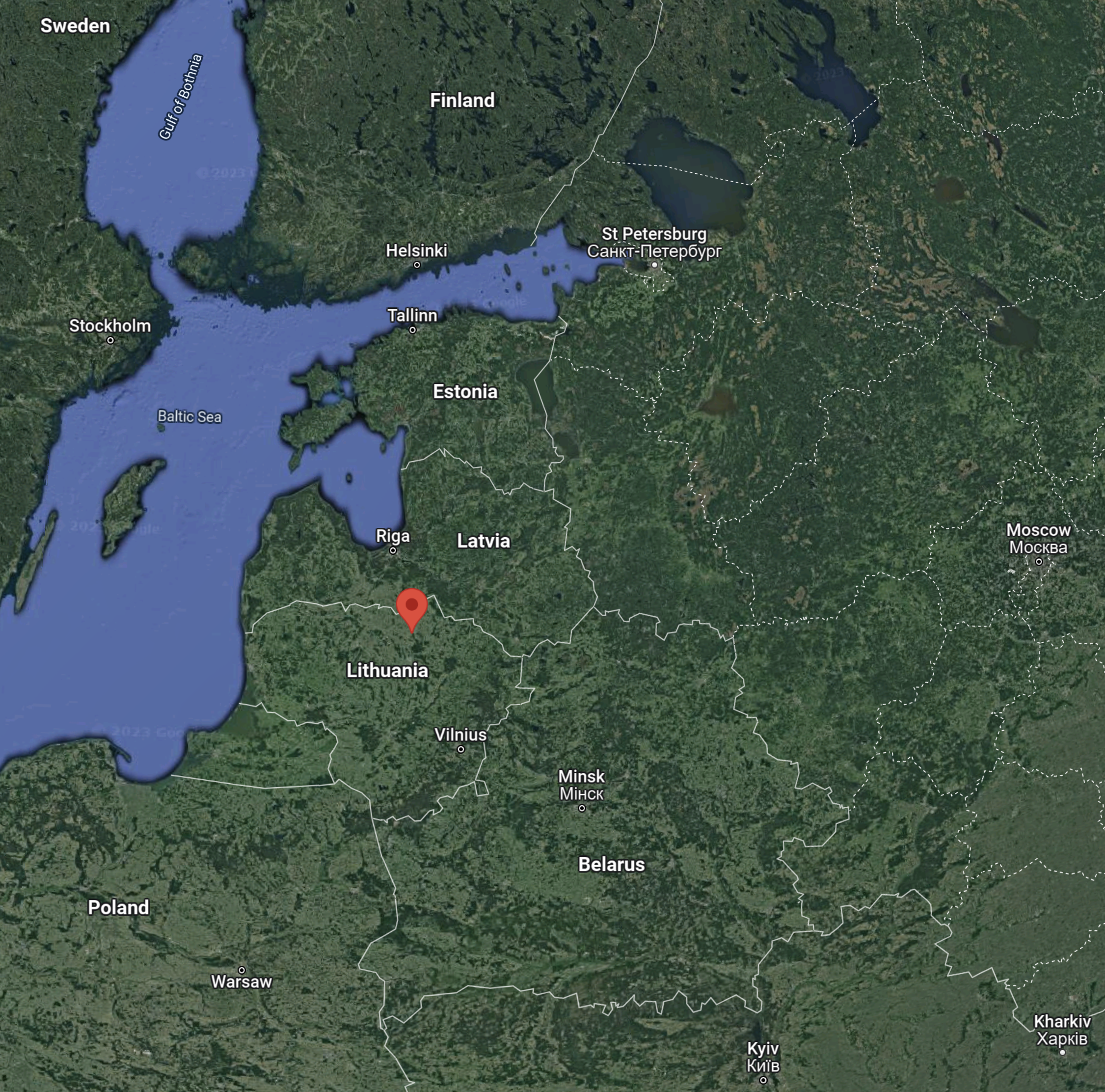
Note.
- Country borders are marked as white lines.
- The site of the explosion at Pasvalis Vienkiemii, is marked with a red arrow.
- Pasvalis Vienkiemii is about a hundred miles from Vilnius.
- About a hundred miles to the East of Pasvalis Vienkiemii, is the point, where Belarus, Latvia and Lithuania meet.
- Russian territory is about a hundred miles further to the East.
I have experience of the quality of borders in that area.
South-West of Lithuania and lying between that country and Poland, there is the small Russian enclave of Kaliningrad.
These pictures show the border between Poland and the Kaliningrad enclave of Russia.





If the borders between Belarus, Latvia and Lithuania are as secure as this, they are almost an open invitation to saboteurs to enter and do damage.
Rail Baltica Electrification Procurement Begins
The title of this post, is the same as that of this article on Railway Gazette.
These two paragraphs define the project.
Rail Baltica project promoter RB Rail has begun procurement of the electrification systems for the future standard gauge line between Poland, Lithuania, Latvia and Estonia, saying it will be the largest railway electrification scheme in Europe to be implemented as a single project.
The energy subsystem contract covers 870 km of double track line from the Polish border to Tallinn including the line from Kaunas to Vilnius, and includes design and construction of substations, connections to the public high voltage grids, control systems and more than 2 000 track-km of overhead equipment.
It looks like the procurement process will be finished by 2023.
Hopefully, Vlad the Mad won’t object to this standard gauge line going too close to lines with his beloved Russian gauge.
GB Railfreight Names Locomotive For Ukraine
The title of this post is the same as that of this article on Railnews.
This is the first paragraph.
GB Railfreight has unveiled a Class 66 locomotive bearing the nameplates ‘Glory to Ukraine’, and painted in a special livery using the Ukrainan colours. GBRf said it ‘stands with Ukraine, and this newly painted locomotive honours the people affected by the conflict as they continue to courageously defend their homeland’.
Perhaps not in the same class as this article from the Guardian, which is entitled Lithuania Names Road Leading To Russian Embassy ‘Ukrainian Heroes’ Street’.
But every little bit helps!
Lithuania To Germany Intermodal Service To Launch In April
duiThe title of this post, is the same as that of this article on Railway Gazette.
These are the first two paragraphs.
Lithuanian national railway’s freight business LTG Cargo is to launch a service carrying containers and semi-trailers from the Kaunas Intermodal Terminal to Duisburg in Germany on April 4.
Trains with a capacity of up to 36 semi-trailers and containers will run thrice-weekly on the 1 500 km route. This will be LTG Cargo’s first westward service operating in three countries, with operations in Poland and Germany handled by its LTG Cargo Polska subsidiary.tail
These are more information and my thoughts.
The Route
The route appears to follow a route from Kaunas to Warsaw via
- Marijampolė
- Šeštokai
- Mockava
- Suwalki
- Buchwalowo
- Bialystok
Note.
- The links on the names are to the town’s Wikipedia entry.
- The border between Lithuania and Poland is between Mockava ans Suwalki.
- There are freight yards and change of gauge facilities at Šeštokai and Mockava.
Some of these towns are probably worth a visit, especially if like me, you have Jewish ancestors from the area.
My father’s great-great-grandfather possibly came from Konigsberg in East Prussia and arrived in the UK around 1800.
The Russian And Standard Gauge Solution
Consider.
- Estonia, Latvia and Lithuania have Russian gauge railways which is 1520 mm.
- Poland, Germany, France, Italy and the UK have standard gauge railways, which is 1435 mm.
The solution has been to build between Kaunus and Šeštokai, to build Russian gauge and standard gauge tracks side by side.
Kaunas Intermodal Terminal
This Google Map may show the Kaunas Intermodal Terminal.
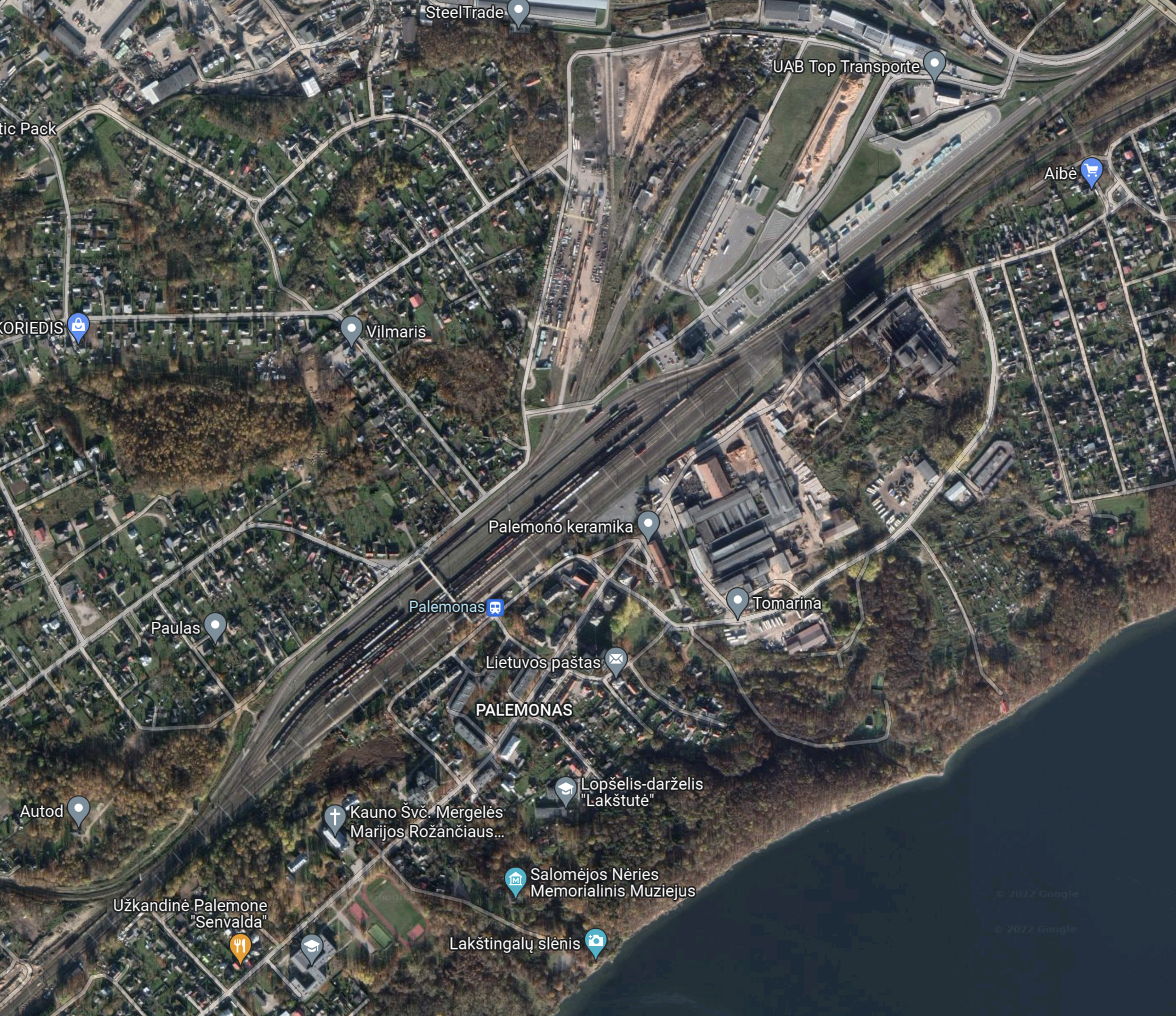
Note the rail yards in the middle of the map, have both Russian and standard gauge tracks.
Rail Baltica
The route taken is the standard gauge route of Rail Baltica, which is an EU project.
- It will run between Helsinki and Warsaw.
- Intermediate stops will be Pärnu, Riga, Riga International Airport, Panevėžys, Kaunas and Bialystok
- Vilnius will be served by a branch from Kaunus.
- The line will be double track.
- The line will be electrified with 25 KVAC overhead.
- Passenger trains will operate at up to 249 kph.
- Freight trains will operate at up to 120 kph.
- A tunnel will be built later between Helsinki and Tallinn.
Completion of the route between Warsaw and Tallinn is planned for 2026.
Rail Baltica I
Rail Baltica I is the first section of the route to be opened and is described like this in Wikipedia.
The name Rail Baltica is also sometimes used to mean the first phase of European gauge railway construction from the Poland-Lithuania border to Kaunas in Lithuania.
It opened in October 2016.
The new freight service will use this route to connect to Bialystok and Warsaw.
Conclusion
I have been on the roads in this area of Poland and rail freight services are needed to take the pressure off the roads.
 The Anonymous Widower