UK Set To Provide Record GBP 800 Million Support For Offshore Wind Projects
The title of this post, is the same as that of this article on offshoreWIND.biz.
This is the sub-heading.
The UK government has revealed the budget of over GBP 1 billion (approximately EUR 1.2 billion) for this year’s Contracts for Difference (CfD) Allocation Round 6 (AR6) with the majority of it, GBP 800 million (around EUR 936 million), earmarked for offshore wind.
These three paragraphs explain the three pots.
The Department for Energy Security and Net Zero (DESNZ) confirmed that over GBP 1 billion will be set aside for the budget, divided into three pots.
Within the overall budget, GBP 120 million is designated for established technologies like solar and onshore wind in Pot 1, while GBP 105 million is set aside for emerging technologies such as floating offshore wind and geothermal in Pot 2.
According to DESNZ, following an extensive review of the latest evidence, including the impact of global events on supply chains, the government has allocated a record GBP 800 million for offshore wind, making this the largest round yet, with four times more budget available to offshore wind than in the previous round.
I am glad to see the support for geothermal energy.
Whilst, these three paragraphs explain the pricing.
This follows the increase in the maximum price for offshore wind and floating offshore wind in November and will help to deliver the UK’s ambition of up to 50 GW of offshore wind by 2030, including up to 5 GW of floating offshore wind, according to the government.
Last year, CfD Round 5 attracted no investors with the former maximum strike prices set at GBP 44/MWh for offshore wind with fixed-bottom foundations, which was too low for the developers who were facing the consequences of inflation and supply chain challenges. The maximum bid price for floating wind was GBP 114/MWh.
Now, the maximum price available for offshore wind projects with fixed-bottom foundations has risen by 66 per cent, from GBP 44/MWh to GBP 73/MWh. The maximum strike price for floating offshore wind projects increased by 52 per cent, from GBP 116/MWh to GBP 176/MWh ahead of AR6 which will open on 27 March.
Prices have certainly risen, but this paragraph explains a limiting mechanism, which is straight out of the Control Engineer’s Toolbox.
The funding for the support will be sourced from energy bills rather than taxation. However, if the price of electricity surpasses the predetermined rate, additional charges will be applied to wind power, with the excess funds returned to consumers.
I would hope that extensive mathematical modelling has been applied to test the new pricing structure.
First Look Inside £2.2bn Silvertown Tunnel
The title of this post, is the same as that of this article on the BBC.
These are the first five paragraphs.
For the first time, Transport for London has invited journalists inside what is one of the most controversial infrastructure projects in the capital.
The Silvertown Tunnel is 1.4km (just under one mile) long and stretches from Silvertown in Newham to the Greenwich Peninsula.
Inside the tunnel, it is extremely wide. A lot bigger than other tunnels like the supersewer or Crossrail. Boring was finished a few weeks ago.
Transport for London (TfL) says the scheme will address queues at the Blackwall Tunnel and reduce pollution. But it has faced fierce opposition from those who think it will do the total opposite and increase pollution and congestion.
And the big question is – even with mitigation – can a road tunnel ever be green?
Note.
- There is a good picture, showing the width of the tunnel.
- It is very wide and can’t be much narrower than the four-lane Queensway Tunnel, which was opened under Mersey in 1934.
These are my thoughts.
I Am Against The Tunnel Being Built
My main reason I am against the Silvertown Tunnel is that Transport for London’s mathematical modelling of and rerouting of buses past my house has been some of the worst I’ve seen. I talk about the bus problems I now have in Is The Nightmare On The Buses Going To Get Worse?
So until the two tunnels; Blackwall and Silvertown are complete and open with tolling, I won’t trust any of Transport for London’s pronouncements.
I also feel that as the Silvertown Tunnel will allow trucks to pass though, there will be times, when they will cut through the East End to get to the Motorways going North.
But now, it’s more or less finished, we will probably need to use it.
How Is The Tunnel Being Paid For?
The Wikipedia entry for the Silvertown Tunnel has a section called Costs, where this is said.
In 2012, the cost was stated to be £600m. A consultation in 2015 stated that the cost of construction was estimated to be £1bn. In March 2020, the cost was increased again, to £1.2 billion. Operation, maintenance and financial costs of the tunnel over 25 years is expected to cost another £1bn.
The £2.2 billion will be repaid by tolls on both tunnels. Effectively, it’s a Private Finance Initiative or PFI.
Can A Road Tunnel Ever Be Green?
This is the question the BBC asked in the last paragraph of my extract.
Although, I am very much against this tunnel, I do believe this tunnel can be green.
- Suppose, the tunnels were made free for zero-carbon vehicles, that were powered by batteries, hydrogen or possibly ammonia.
- This might nudge vehicle owners and operations to go zero-carbon.
This extra number of zero-carbon vehicles would help to clean up London’s air.
I wonder which will be the preferred route for trucks associated with construction to go to and from sites in Central London?
- These trucks are major polluters in Central London.
- There are sensible moves to make construction sites zero-carbon.
If the Silvertown Tunnel didn’t have tolls for zero-carbon trucks, then surely this would nudge, this sizeable group of trucks to go zero-carbon to the benefit of everyone in Central London.
The only problem with making zero-carbon vehicles toll-free, is that it probably ruins the finances of the tunnels, from the point of view of the investors.
Conclusion
I can see lots of conflict starting over the operation of this tunnel.
The Economic Case For Hydrogen In Domestic Heating
The title of this post, is the same as that of this article on The Chemical Engineer.
The Wikipedia entry for The Chemical Engineer has this introductory paragraph.
The Chemical Engineer is a monthly chemical engineering technical and news magazine published by the Institution of Chemical Engineers (IChemE). It has technical articles of interest to practitioners and educators, and also addresses current events in world of chemical engineering including research, international business news and government policy as it affects the chemical engineering community. The magazine is sent to all members of the IChemE and is included in the cost of membership. Some parts of the magazine are available free online, including recent news and a series of biographies “Chemical Engineers who Changed the World”, although the core and the archive magazine is available only with a subscription. The online magazine also has freely available podcasts.
It is a source on the Internet, where anything non-scientifically correct will be unlikely to appear.
The article has two introductory sub-headings.
Despite its thermodynamic disadvantages, global energy technology specialist Thomas Brewer believes hydrogen has an economic and efficient role in domestic heating. It forced him to deviate from his usual mantra of ‘efficiency above all else’ to get there, though
The work of decarbonisation by chemical engineers is about how we can cost effectively enable our organisations’ transition away from fossil fuels. This requires foresight. A decision chemical engineers make on a project with a 20-year lifespan will still be operational in 2045, when in most global locations, internal combustion engine (ICE) vehicles will probably be in the minority and grid electricity will be mostly renewable.
This is the first actual paragraph.
It is unsurprising, therefore, that chemical engineers are researching and debating the prospects of the future of energy availability from renewables, and the likely role and cost of hydrogen. There is much public noise surrounding the conversation about heat pumps vs hydrogen for domestic heating. I have noticed how few articles are written from an unbiased perspective, how very few reports talk about the whole solution, and authors avoid quantifying the financial impact of their proposed solution. I couldn’t find an unbiased study with any financial logic, so, I built a model to assess the options, for my own interests. I found the results so intriguing that I wanted to share them.
In other words, let the data do the talking and accept what it tells you.
These are some extracts from the article.
On Curtailment
The article says this on curtailment of wind energy, because you are generating too much.
Efficient electrical energy storage is expensive, which has traditionally led renewable system designers to include curtailment as a part of their design. Curtailment involves oversizing the wind supply to be higher than the grid connection to reduce the need for as much energy storage, and deliberately wasting the occasional electrical excess. The system design becomes an economical balance between oversizing the renewable generation and paying for additional electrical storage. Within the UK grid in 2023, curtailment is a small factor. As electrification and wind power become more mainstream, the financial decision between investing in excess wind vs electrical storage will lead curtailment to become a more significant factor.
Curtailment is to me a practice, that should be consigned to the dustbin of history.
To eliminate it, as much storage as is needed storage must be provided.
Eliminate Naked Flames In The Kitchen
The article says this about eliminating naked gas flames (natural gas or hydrogen) in the kitchen.
Figure 1 shows that the recommended standard of hydrogen gas installation if removing kitchen gas cooking would result in less injuries than the existing natural gas installation if cooking were converted to induction heating. Kitchen leaks are more likely than boiler leaks due to the number of valves and connections, regardless of the gas type. NOx emissions in the home because of naked flames in the kitchen are also of concern to the health of the occupants and hydrogen naked flames have a higher NOx emission than natural gas; another reason to eliminate naked flame cooking.
When I was financing the development of what became the Respimat inhaler, I did my due scientific diligence and found research from a Russell Group University, that naked flames (including smoking) were a cause of asthma, especially in children.
My recommendation is that, at an appropriate time in the near future, you replace your gas cooker with an electric one. My ginger-haired Glaswegian friend, who is a chef, who’s had Michelin stars would recommend an electric induction cooker.
Pumped Storage
The article says this about building more pumped storage.
The pumped storage assumption is based on the SSE proposal for Coire Glas, a 30 GWh £1.5bn storage system in Scotland which will more than double the UK’s current pumped storage capacity. The capital cost of this pumped storage system is about £50/kWh which will be delivered at about 80% efficiency. Pumped storage is a good balance between low cost and high efficiency. However, it requires natural resources. The Mott MacDonald report, Storage cost and technical assumptions for BEIS (Department for Business, Energy and Industrial Strategy) suggests the equivalent of four Coire Glas-scale installations in the UK by 2050. The model optimistically assumes that ten more similar additional Coire Glas-size pumped storage schemes could be installed.
This page on the Strathclyde University web site, gives these GWh figures for the possible amounts of pumped-storage that can be added to existing hydroelectric schemes.
Strathclyde’s total for extra storage is over 500 GWh.
Distributed Batteries
The article says this about distributed batteries.
A distributed battery assumption could be configured with multiple 10 kWh batteries which typically cost about £3,000 installed, near or in homes with a heat pump. This could be coupled with larger battery storage systems like the £30m Chapel Farm 99 MWh battery installation near Luton, commissioned in 2023. The small battery systems at each home are similar to the proposed virtual power plants using electric vehicle battery capacity to help balance the grid. Placing these batteries at locations with grid limitations could reduce the costs of upgrading the grid system. This is a more expensive energy storage scheme than pump storage and for the purposes of the model it is assumed that battery storage schemes are limitless. In both cases cited, the cost is £300/kWh. Battery efficiency varies significantly with temperature, and typically ranges from about 90% to 97%. As the system design needs to be focused on the coldest periods, the model is optimistically assuming 93% efficiency, which would require many of the batteries to be in a heated environment.
New lower-cost alternative batteries are also being developed.
Hydrogen Generation
The article says this about hydrogen generation.
Alternatively, the electricity generated from wind energy could be used in the electrolysis of water to produce hydrogen. While the fully installed electrolysis equipment costs about £2,100/kW, hydrogen storage in specially built cylinders is relatively cheap at about £23/kWh. The model, however, assumes salt mine storage which the US DoE in their report, Grid Energy Storage Technology Cost, calculate at a total system cost for hydrogen of $2/kWh. Electrolysis is the least efficient energy storage option, with a conversion efficiency of 75%, including compression. The waste heat from this conversion loss is useful for industrial heating, or in a district heating system. This has been ignored for simplicity.
Pumped storage, distributed batteries and hydrogen electrolysers distributed all over the UK, will mop up all the spare electricity and release it to heat pumps and for charging cars as necessary.
The hydrogen will be used for heating, to decarbonise difficult-to-decarbonise industries and provide fuel for hydrogen-powered vehicles, railways and shipping.
Curtailment will be a thing of the past.
The UK Offshore Wind Potential
The article says this about the UK offshore wind potential.
The UK government target for wind generation by 2030 is 50 GW. The UK offshore wind potential is reliable and available and has been estimated to be as high as 2,200 GW. There are, however, a few low wind periods that can last for several days.
I am not going to argue with 2,200 GW, but I will say that a lot of that will be used to generate hydrogen offshore.
Conclusions
This is the article’s main conclusion.
A wind-based supply for heating will mean that large quantities of potentially unused electricity will be available for more than 90% of the year, for potentially very low cost. While this could appear wasteful, it provides further synergistical opportunities for the decarbonisation of other interruptible energy duties, such as production of hydrogen for road transport or supplying heat via heat pumps for interruptible industries.
The sensitivity analysis shows that these conclusions are robust even with significant variation in the assumptions on equipment cost, efficiency, and other electricity source options.
This is also said about the most cost-effective solution.
A cost-effective national heat pump-only solution is about £500bn (50%) more expensive than a hydrogen-only boiler solution. The most cost-effective system is a combination of the two, £100bn cheaper than the hydrogen-only solution, and £600bn cheaper than the heat pump-only solution.
A cost-effective national heat pump-only solution has a system efficiency 40% lower than the hydrogen-only solution, requiring more than 750 GW of installed wind capacity. A hydrogen boiler solution requires less than 500 GW but the most efficient system, however, is a combination of the two.
The conclusions mean that everybody will be able to use the most appropriate solution for their circumstances for both heating their housing or powering their vehicles, as there will be massive supplies of affordable electricity and hydrogen.
How Will Everything Be Paid For?
Just as Germany and others built its industry on cheap Russian gas, it will now choose to use the plentiful and reliable UK electricity and hydrogen to rebuild its industry.
Octopus Energy Creates GBP 3 Billion Offshore Wind Fund
The title of this post, is the same as that of this article on offshoreWIND.biz.
This is the sub-heading.
Octopus Energy’s generation arm has launched a dedicated fund with Japan’s Tokyo Gas to invest GBP 3 billion (approximately EUR 3.5 billion) in offshore wind globally by 2030.
This is the first paragraph.
The fund, set up with a GBP 190 million (about EUR 217 million) cornerstone investment from Tokyo Gas, will invest in the development, construction, and operational stage offshore wind farms, as well as companies creating new offshore wind, with a focus on Europe, said Octopus Energy.
It’s almost as if Octopus Energy are planning to do for offshore wind power, what Gore Street and Gresham House Energy Storage Funds have done for battery storage.
It strikes me that a detailed purpose-built financial model, as I have built several times could give a lot of insight into the wind farms and their financing.
There is also a lot of technology coming on stream, that will help this sort of wind fund.
- In-farm energy storage will happen and this will be the obvious place to use energy storage to smooth out the power from offshore wind farms.
- Floating wind farms are becoming mature technology and appear to offering higher capacity factors.
- Floating wind farms may offer lower maintenance costs.
- Multi-Purpose Interconnectors are starting to be installed and will allow power to be sent to more than one destination in different countries.
- Wind farms are increasingly being linked to battery storage to smooth out the power from offshore wind farms.
- Electrolysers are being built offshore.
- Data analysis is playing its part in improving operational efficiency.
Now could be the time to take the plunge and build that offshore wind farm.
Rolls-Royce Considering Switching From BEV To Hydrogen For Future Models
The title of this post, is the same as that of this article on INSIDEEVs.
This is the sub-heading
The luxury carmaker’s CEO rules out hydrogen combustion, but fuel cells are on the table.
This is the first paragraph.
Rolls-Royce is considering ditching all-electric powertrains in favor of fuel cell technology for its future zero-emissions models once the technology is mature enough and can be scaled to meet its demands, according to Autocar, quoting the luxury car brand’s CEO, Torsten Müller-Ötvös.
As the Rolls-Royce Spectre has a kerb weight of almost three tonnes, I suspect that the handling might make someone like Alec Issigonis, Colin Chapman or Stirling Moss have a good laugh.
But the smaller battery that the fuel cell technology would require, might give a better balance between acceleration, handling and performance.
It would be good fun to model the dynamics of such a heavy car.
I do think though that it is these dynamics, that have suggested a move to hydrogen.
Or Torsten Müller-Ötvös, may have made the statement to find out, what the sort of people, who would buy this car, might think!
Can ‘Enhanced Rock Weathering’ Help Combat Climate Change?
The title of this post, is the same as that of this article on the BBC.
This is the sub-heading.
In a quarry surrounded by the din of heavy machinery Jim Mann crouches down and picks up a handful of tiny black rocks.
These three sentences introduce Jim and his magic dust.
“This is my magic dust,” he says with a smile, gently rubbing them between his fingers.
He’s holding pieces of basalt. It’s a hard volcanic rock that is neither rare nor particularly remarkable.
But through a process known as ‘enhanced rock weathering’ it could help to cool our overheating planet.
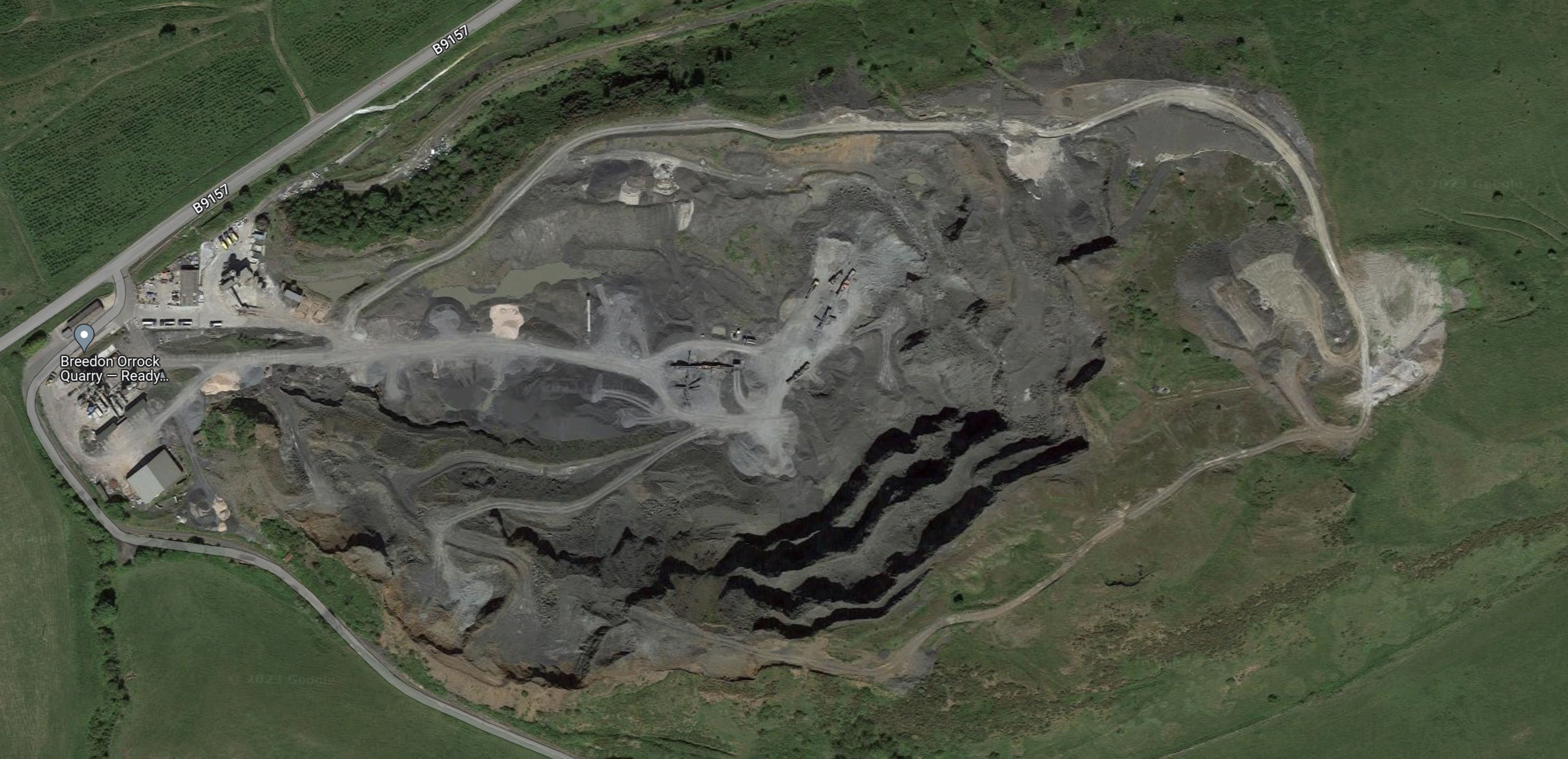
This Google Map shows Orrock Quarry, where the basalt is mined.
The article then gives a simple explanation of enhanced rock weathering.
When one of the companies, I’d backed won a green design award it was presented by David Bellamy. I remember having a very radical conversation with him, about some of the projects, where he’d been an advisor.
Some might have dismissive views about Jim Mann’s work as being too good to be true, but when I see the chemistry, I suspect,I’ll find it to be sound.
It would be a very interesting process to mathematically model!
SeaTwirl, Kontiki Winds To Explore Powering Oil & Gas Assets With Floating Wind
The title of this post, is the same as that of this article on offshoreWIND.biz.
This is the sub-heading.
The Sweden-headquartered SeaTwirl has signed a Memorandum of Understanding (MoU) with Kontiki Winds to identify and discuss the opportunities to electrify oil and gas assets and other offshore applications, with the use of SeaTwirl’s floating wind turbines.
And this is the first paragraph.
Under the MoU, the two companies will explore new opportunities in the market to implement offshore wind into new and existing oil and gas assets and microgrid applications such as the powering of fish farms, desalination plants and/or other small-scale applications that currently are based on fossil fuel electricity generation.
Note.
- The current turbines are only 1 MW.
- They appear to be mounted on a long monopole foundation.
- My mathematical modelling experience suggests to me, that these could be very stable devices.
- I suspect they could be built into specialist equipment like a buoy with a light to mark something.
I suspect that there will be large numbers of applications, especially if the manufacture and installation of Sea Twirl’s turbines is an efficient process.
Irish Floating Wind Tech Developer Unveils Pilot Project In Portugal
The title of this post, is the same as that of this article on offshoreWIND.biz.
This is the sub-heading.
Dublin-based floating wind technology company Gazelle Wind Power (Gazelle) has partnered with the Portuguese renewable energy developer WAM Horizon to accelerate the development of a pilot project in Aguçadoura, Portugal, which will use Gazelle’s floating wind platform.
And this is the first paragraph.
Within the partnership, WAM will provide Gazelle with strategic advisory to implement the pilot project.
There is also a picture, which does not look like any other float for a wind turbine, that I’ve seen.
Gazelle Wind Power’s home page, has a series of pictures and an explanation of how it works.
The web site claims the technology is Light, Agile and Fast and gives a few details in this paragraph.
Introducing Gazelle’s hybrid attenuated mooring platform, an evolutionary step-change in the design of floating platforms. Lighter, smaller and more agile than current designs, the Gazelle delivers unmatched stability and capacity. Moreover, our design benefits from modularisation, time-tested manufacturing processes, and can easily be assembled at port facilities worldwide.
From my experience of modelling floating structures in the 1970s, I believe that there a lot more permutations and combinations of components, that will work as floats for wind turbines.
Gazelle Wind Power’s design, is one of the first of a new generation of designs.
If anybody comes up with an unusual design and needs someone to criticise or model its floating behaviour, I’d be happy to help.
13 Offshore Wind Projects Selected In World’s First Innovation And Targeted Oil & Gas Leasing Round
The title of this post, is the same as that of this article on offshoreWIND.biz.
This is the sub-heading.
Crown Estate Scotland has selected 13 out of a total of 19 applications with a combined capacity of around 5.5 GW in the world’s first leasing round designed to enable offshore wind energy to directly supply offshore oil and gas platforms.
This paragraph outlines INTOG (Innovation and Targeted Oil & Gas) and its objectives.
INTOG, which has been designed in response to demand from government and industry to help achieve the targets of the North Sea Transition Sector Deal through decarbonising North Sea oil and gas operations, is also expected to further stimulate innovation in Scotland’s offshore wind sector, create additional supply chain opportunity, assist companies to enter the renewable energy market, and support net-zero ambitions.
This is undoubtedly the most important news of the day.
- When complete it will generate 5416 MW of electricity.
- 4068 MW will be used primarily to decarbonise oil and gas platforms with surplus electricity going to the grid.
- The amount of carbon dioxide released by oil and gas platforms in the North Sea will be reduced.
- The gas saved by decarbonising oil and gas platforms, will be transported to the shore and used in the UK gas grid.
- 449 MW will be generated in innovative ways in small wind farms, with a capacity of less than 100 MW.
One of the benefits of INTOG is that the UK will be able to reduce gas imports, which must increase energy security.
This map from this document from the Crown Estate Scotland, shows the INTOG wind farms.
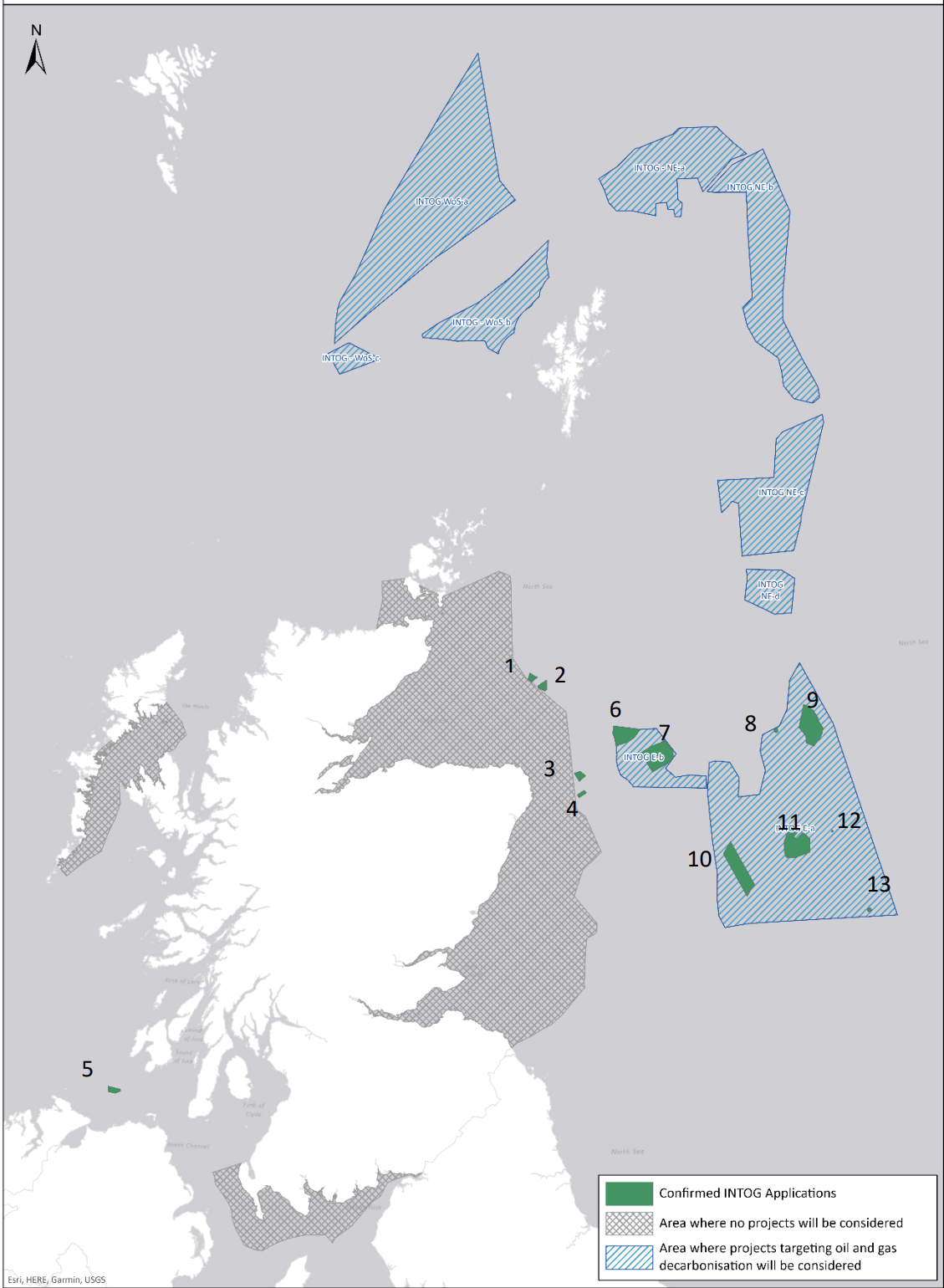
This is a list of the farms.
- 1 – Bluefloat Energy/Renantis Partnership – Innovation – Commercial – 99.45 MW
- 2 – Bluefloat Energy/Renantis Partnership – Innovation – Supply Chain – 99.45 MW
- 3 – Simply Blue Energy (Scotland) – Innovation – Supply Chain – 100 MW
- 4 – BP Alternative Energy Investments – Innovation – New Markets – 50 MW
- 5 – ESB Asset Development – Innovation – Cost Reduction – 100 MW
- 6 – Floatation Energy – Targeted Oil & Gas – 560 MW
- 7 – Cerulean Winds – Targeted Oil & Gas – 1008 MW
- 8 – Harbour Energy – Targeted Oil & Gas – 15 MW
- 9 – Cerulean Winds – Targeted Oil & Gas – 1008 MW
- 10 – Cerulean Winds – Targeted Oil & Gas – 1008 MW
- 11 – Floatation Energy – Targeted Oil & Gas – 1350 MW
- 12 – TotalEnergies – Targeted Oil & Gas – 3 MW
- 13 – Harbour Energy – Targeted Oil & Gas – 15 MW
Note.
- These total up to 5.42 GW.
- The five Innovation sites seem to be as close to the coast as is possible.
- I thought some Innovation sites would be closer, so supply difficult to reach communities, but they aren’t.
- Floatation Energy and Cerulean Winds seemed to have bagged the lion’s share of the Targeted Oil & Gas.
- Sites 6 and 7 sit either side of a square area, where Targeted Oil & Gas will be considered. Is that area, the cluster of oil and gas facilities around Forties Unity, shown on the map in this page on the BP web site?
- Harbour Energy have secured two 15 MW sites for Targeted Oil & Gas.
These are my thoughts on the various companies.
Bluefloat Energy
Bluefloat Energy has posted this press release on their web site, which is entitled Bluefloat Energy | Renantis Partnership Bid Success For Two 99mw Innovation Projects In Crown Estate Scotland’s INTOG Process.
The press release starts with these three bullet points.
- BlueFloat Energy | Renantis Partnership offered exclusivity rights to develop its Sinclair and Scaraben floating wind projects north of Fraserburgh – leveraging synergies via its 900MW Broadshore project.
- The projects seek to trial innovative floating wind technology solutions, kick-starting supply chain growth and job creation in Scotland and providing a ‘stepping-stone’ to the partnership’s ScotWind projects.
- Bid proposals include the intention to develop a scalable community benefit model – creating a potential blueprint for floating offshore wind in Scotland.
The first three paragraphs expand the bullet points.
The BlueFloat Energy and Renantis Partnership has been offered seabed exclusivity rights to develop two 99MW projects under the innovation arm of Crown Estate Scotland’s INTOG (Innovation and Targeted Oil & Gas) auction process. The auction saw ten projects bid to bring forward the development of small-scale innovation projects.
The Sinclair and Scaraben projects, located north of Fraserburgh and adjacent to the Partnership’s 900MW Broadshore project, seek to trial innovative foundation technologies, associated fabrication works and mooring systems with a view to maximising opportunities for the Scottish supply chain, driving local investment and job creation.
A key element of the bid proposals is the opportunity to test and adapt a community benefit model, governed independently, and directed by the communities in which the schemes will operate, through collaboration with our supply chain and project partners. The model could create a blueprint, shaping the future of community benefit from floating offshore wind throughout the whole of Scotland. This builds on Renantis’ successful track record of deploying similar schemes via its onshore wind farms in Scotland.
Note.
- Companies called Sinclair Offshore Wind Farm and Scaraben Offshore Wind Farm were registered a few months ago in Inverness.
- I couldn’t find the websites, so I suspect they’re still being created.
- These two projects appear to be pathfinders for the 900 MW Broadshore project, with regards to the supply chain and community involvement.
It certainly looks like the partnership are going about the development of these two projects in a professional manner.
BP Alternative Energy Investments
There has been no press release from BP as I write this, so I will have to deduce what BP are planning.
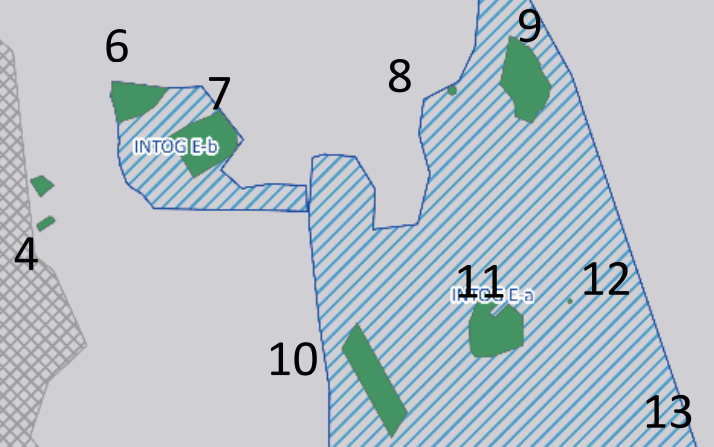
This map from this document from the Crown Estate Scotland, shows the Southern INTOG wind farms.
Note.
- Site 4 is the site of BP Alternative Energy Investments’s proposed wind farm.
- Sites 6 and 7 could be either side of the cluster of platforms around Forties Unity.
Consider.
- In the wider picture of wind in the North Sea, BP’s proposed 50 MW wind farm is a miniscule one. SSE Renewables’s Dogger Bank wind farm is over a hundred times as large.
- A cable to the shore and substation for just one 50 MW wind farm would surely be expensive.
- BP Alternative Energy Investments are also developing a 2.9 GW wind farm some sixty miles to the South.
- It would probably be bad financial planning to put large and small wind farms so close together.
For these are other reasons, I believe that there is no reason to believe that the proposed 50 MW wind farm is a traditional wind farm.
But if I’m right about sites 6 and 7 indicating the location the position of Forties Unity, it might open up other possibilities.
This document from INEOS, who own the Forties Pipeline System, explains how the pipeline works.
The Forties Pipeline System (FPS) is an integrated oil and gas transportation and processing system. It is owned and operated by INEOS and utilises more than 500 miles of pipeline to smoothly transport crude oil and gas from more than 80 offshore fields for processing at the Kinneil Terminal. At Kinneil the oil and gas are separated, with the oil returned as Forties Blend to customers at Hound Point or pumped to the Petroineos refinery at Grangemouth.
At the same time the gas goes to our LPG export facilities or is supplied to the INEOS petrochemical plant. FPS transports around 40% of the UK’s oil production supply and brings over 400,000 barrels ashore every day.
In Can The UK Have A Capacity To Create Five GW Of Green Hydrogen?, I said the following.
Ryze Hydrogen are building the Herne Bay electrolyser.
- It will consume 23 MW of solar and wind power.
- It will produce ten tonnes of hydrogen per day.
The electrolyser will consume 552 MWh to produce ten tonnes of hydrogen, so creating one tonne of hydrogen needs 55.2 MWh of electricity.
If BP were to pair the wind farm with a 50 MW electrolyser it will produce 21.7 tonnes of hydrogen per day.
Could it be brought to the shore, by linking it by a pipeline to Forties Unity and then using the Forties Pipeline System?
As the category on site 4, is New Markets, are BP and INEOS investigating new markets for hydrogen and hydrogen blends?
- Some of the latest electrolysers don’t need pure water and can use sea water. This makes them more affordable.
- Do BP and/or INEOS have the capability to extract the hydrogen as it passes through the Cruden Bay terminal, to provide the hydrogen for Aberdeen’s buses and other users?
- INEOS and BP probably have some of the best oil and gas engineers in the world.
- How many other places in the world have an offshore oil or gas field set in a windy sea, where floating wind- turbine/electrolysers could generate hydrogen and send it ashore in an existing pipeline?
- Several of these offshore oil and gas fields and the pipelines could even be owned by BP or its associates.
- Remember that hydrogen is the lightest element, so I suspect it could be separated out by using this property.
This BP site, is to me, one of the most interesting of the successful bids.
- BP probably have a large collection of bonkers ideas, that have been suggested during their long involvement with offshore oil and gas.
- Some ideas could be even suggested by employees, whose fathers worked for BP fifty years ago. I’ve met a few BP employees, whose father also did.
- Will the wind farm, be a floating electrolyser at the centre of a cluster of a few large floating turbines?
- Will each turbine have its own electrolyser and the substation only handle hydrogen?
- Will the floating electrolyser have hydrogen storage?
- Have BP got a floating or semi-submersible platform, that could either go to the breakers or be repurposed as the floating electrolyser?
- Repurposing a previous platform, would make all the right noises.
So many possibilities and so far, no clues as to what will be built have been given.
See also.
Further Thoughts On BP’s Successful INTOG Bid
Cerulean Winds
In What Is INTOG?, I said this about Cerulean Winds.
Cerulean sounds like it could be a sea monster, but it is a shade of blue.
This article on offshoreWind.biz is entitled Cerulean Reveals 6 GW Floating Offshore Wind Bid Under INTOG Leasing Round.
These are the two introductory paragraphs.
Green energy infrastructure developer Cerulean Winds has revealed it will bid for four seabed lease sites with a combined capacity of 6 GW of floating wind to decarbonise the UK’s oil and gas sector under Crown Estate Scotland’s Innovation and Targeted Oil and Gas (INTOG) leasing round.
This scale will remove more emissions quickly, keep costs lower for platform operators and provide the anchor for large-scale North-South offshore transmission, Cerulean Winds said.
Note.
-
- It is privately-funded project, that needs no government subsidy and will cost £30 billion.
- It looks like each site will be a hundred turbines.
- If they’re the same, they could be 1.5 GW each.
- Each site will need £7.5 billion of investment. So it looks like Cerulean have access to a similar magic money tree as Kwasi Kwarteng.
Effectively, they’re building four 1.5 GW power stations in the seas around us to power a large proportion of the oil and gas rigs.
For more on Cerulean Winds’s massive project see Cerulean Winds Is A Different Type Of Wind Energy Company.
So does it mean, that instead of 6 GW, they were only successful at three sites and the other or others were in the six unsuccessful applications?
There is a press release on the Cerulean Winds web site, which is entitled Cerulean Winds Wins Bid For Three INTOG Floating Wind Sites, where this is said.
Cerulean Winds and Frontier Power International have been awarded three lease options for the Central North Sea in the highly competitive INTOG leasing round, the results of which were announced by Crown Estate Scotland today.
The sites, in the Central North Sea, will enable the green infrastructure developer and its partners to develop large floating offshore windfarms to decarbonise oil and gas assets. The scale of the development will enable a UK wide offshore transmission system, that can offer green energy to offshore assets in any location and create a beneficial export opportunity.
Nothing about unsuccessful applications was said.
This map from this document from the Crown Estate Scotland, shows the Southern INTOG wind farms.
Note.
- Sites 7, 9 and 10 are Cerulean’s sites.
- Sites 6 and 11 are Floatation Energy’s sites.
- Site 4 is BP Alternative Energy Investments’s Innovation site.
- Sites 8, 12 and 13 are much smaller sites.
It looks like Cerulean and Floatation Energy are well-placed to power a sizeable proportion of the platforms in the area.
ESB Asset Development
ESB Asset Development appear to be a subsidiary of ESB Group.
The ESB Group is described like this in the first paragraph of their Wikipedia entry.
The Electricity Supply Board is a state owned (95%; the rest are owned by employees) electricity company operating in the Republic of Ireland. While historically a monopoly, the ESB now operates as a commercial semi-state concern in a “liberalised” and competitive market. It is a statutory corporation whose members are appointed by the Government of Ireland.
This press release, is entitled ESB Offered Exclusive Rights To Develop Innovative 100MW Floating Offshore Wind Project In The Malin Sea.
These two paragraphs outline the project.
ESB today welcomes the outcome of Crown Estate Scotland’s latest seabed leasing process which has resulted in the offer of exclusive development rights to ESB for a 100MW floating wind project in Scottish waters off the north coast of Northern Ireland. The successful project, Malin Sea Wind, is a collaborative bid between ESB and leading technology developers Dublin Offshore Technology and Belfast-based CATAGEN. The outcome underscores ESB’s growing capabilities and expanding presence in the offshore wind industry.
The Innovation and Targeted Oil and Gas (INTOG) seabed leasing process, run by Crown Estate Scotland, aims to drive cost reduction in the offshore wind sector by enabling the deployment of new and innovative technologies, and to harness wind energy to decarbonize the oil and gas sector. Malin Sea Wind aims to support the reduction of floating offshore wind costs by demonstrating Dublin Offshore’s patented load-reduction technology. Furthermore, the project will support decarbonisation of the aviation sector by powering sustainable aviation fuel (SAF) production technology currently under development by net-zero technology specialists, CATAGEN.
Note.
- I’ve just looked at the Technology page of the Dublin Offshore Technology web site.
- In the 1970s, I built large numbers of mathematical models of steel, concrete and water cylinders in my work with a Cambridge University spin-out called Balaena Structures.
- I believe, that an experienced mathematically modeller could simulate this clever system.
That would prove if it works or not!
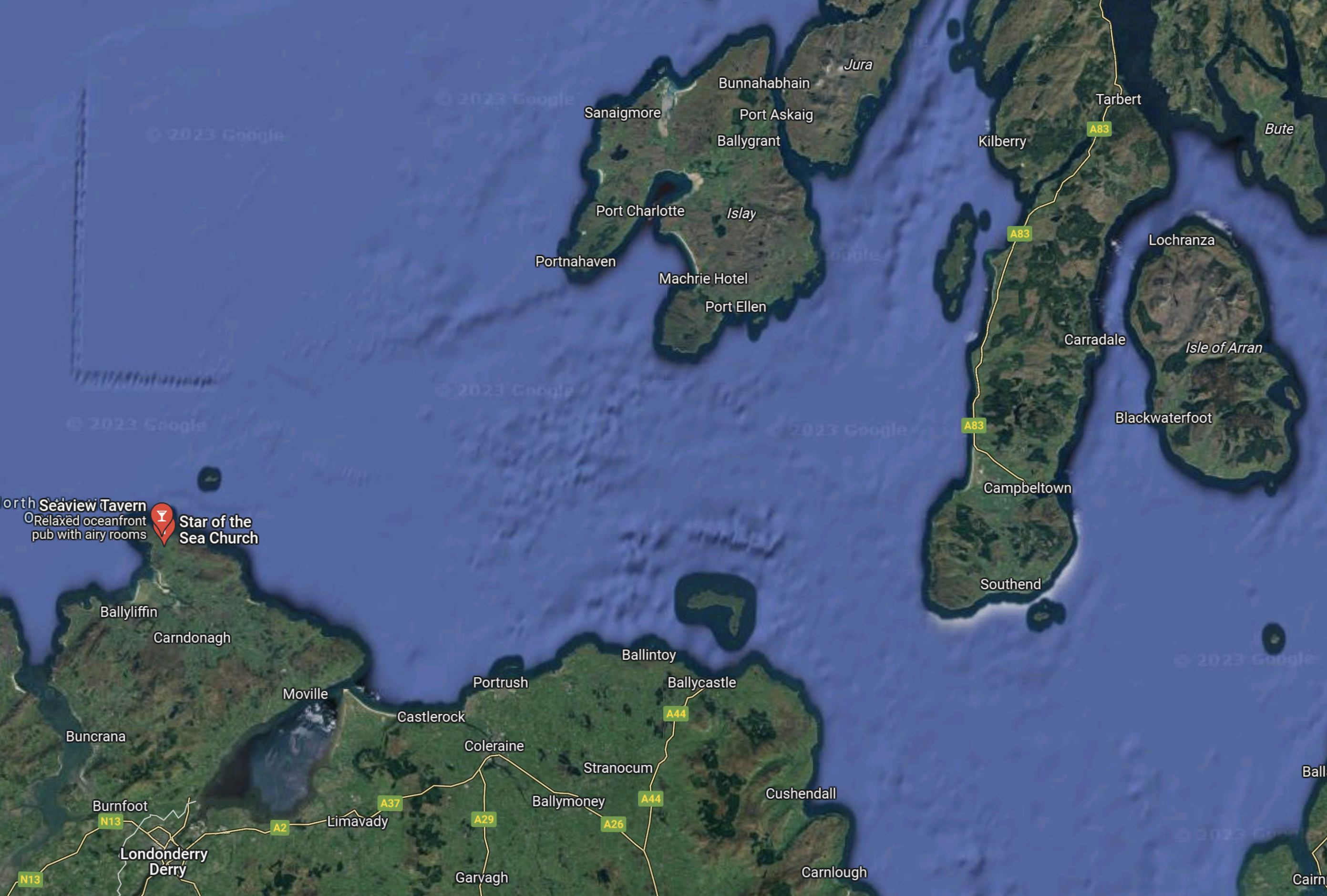
This Google Map shows the Malin Sea.
Note.
- Malin Head is marked by the red arrows on the Northern Irish coast.
- The most Westerly Scottish island is Islay and the most Easterly is the Isle of Arran.
- Between the two islands is the Kintyre peninsula.
- Portrush can be picked out on the Northern Irish coast.
By overlaying the two maps, I suspect the centroid of the wind farm will be North of Portrush about a few miles North of the Southern end of Arran.
I suspect that if all goes well, there could be a lot of floating wind turbines in the area.
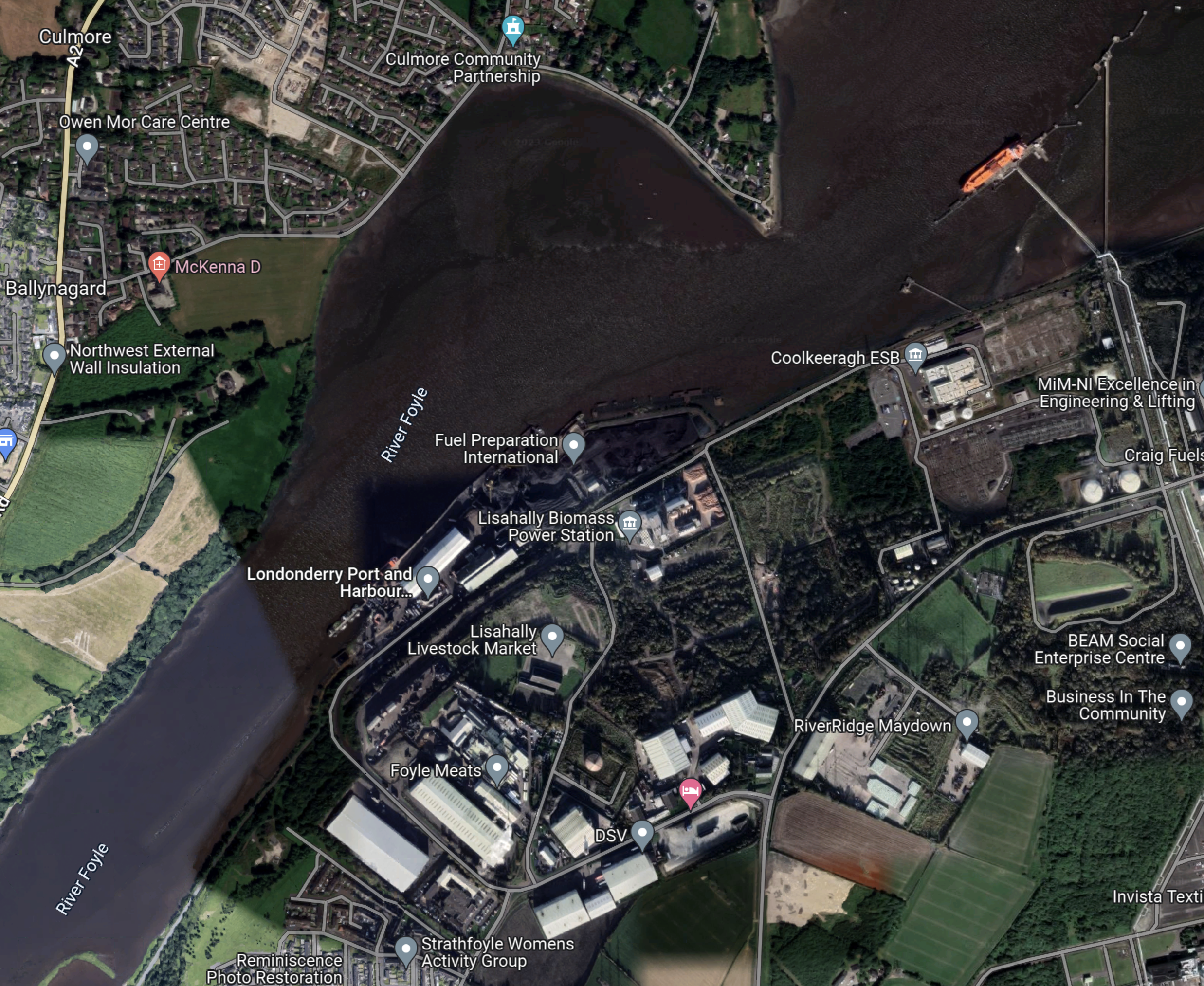
This Google Map shows the River Foyle estuary and Foyle Port to the North-East of Londonderry/Derry.
Note.
- Coolkeeragh ESB and Lisahally biomas power station on the South bank of the River Foyle.
- Lisahally biomas power station has a capacity of 16 MW.
- There appears to be a large substation at Coolkeeragh ESB.
- A tanker of some sort seems to be discharging.
Until told, I’ve guessed wrong, it looks to me like Coolkeeragh ESB could be the destination for the electricity generated by Malin Sea Wind. Given that this project’s aim is cost reduction, a 100 MW wind farm could make a difference.
In addition could Foyle Port be used to assemble and maintain the floating turbines?
Floatation Energy
Floatation Energy have posted this press release on their web site, which is entitled Flotation Energy and Vårgrønn Awarded Exclusivity To Develop Up To 1.9 GW Of Floating Offshore Wind In Scotland.
The first part of the press release, has a graphic.
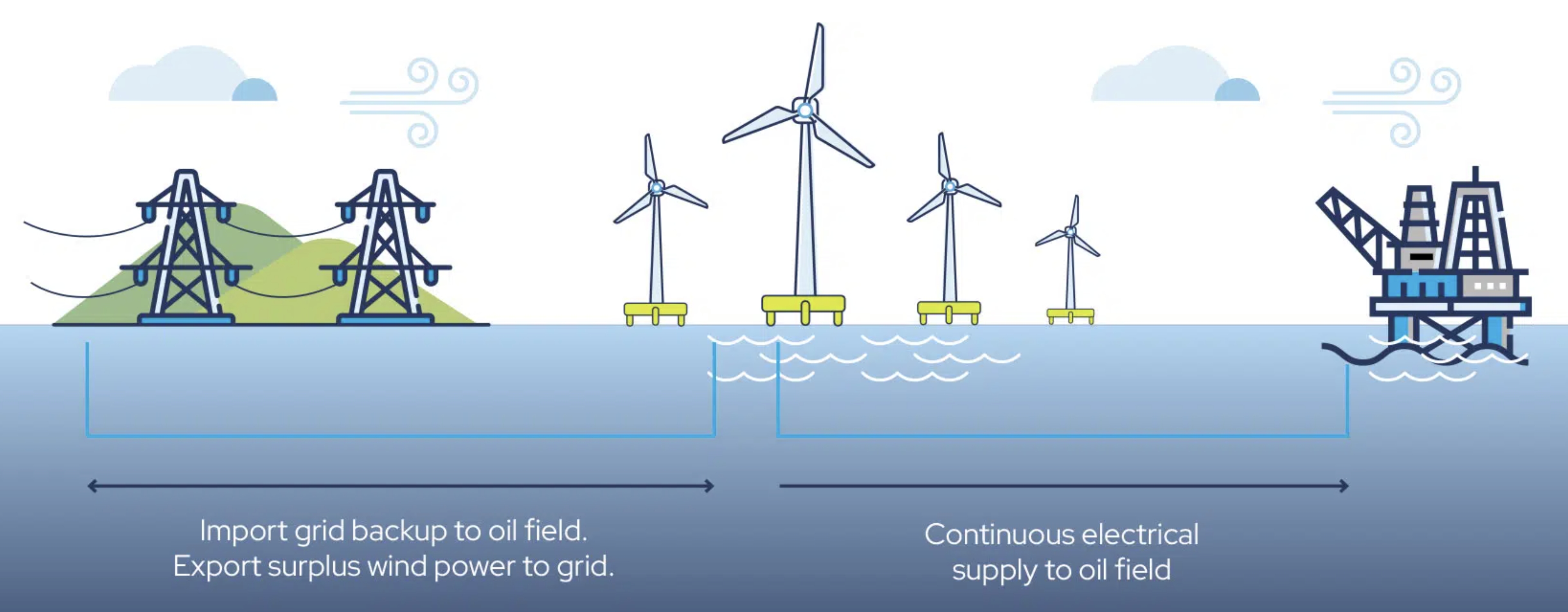
It shows how their proposed system will work.
- A floating wind farm will be placed between the shore and oil and gas platforms to be decarbonised.
- The wind farm will be connected to the shore by means of a bi-directional cable, so that the wind farm can export electricity to the grid and when the wind isn’t blowing the grid can power the platforms.
- A cable between the wind farm and the platforms completes the system.
It is a simple system, where all elements have been built many times.
Floatation Energy must have been fairly confident that their bids would be successful as they have already named the farms and set up web sites.
- Site 6 – Green Volt – 560 MW
- Site 11 – Cenos – 1350 MW
The websites are very informative.
The Timeline for 2019-2021 on the Green Volt web site describes the describes the progress so far on the project.
2019 – As construction of the Kindardine offshore floating wind farm kicks off, Flotation Energy identifies the Buzzard oil facility (a relatively new oil and gas platform with a long field life and high electrical load) as the optimal starting point for a significant contribution to the North Sea Transition Deal – the process of replacing large scale, inefficient gas-fired power generation with renewable electricity from offshore wind.
2020 – Flotation Energy begins environmental surveys on the Ettrick/Blackbird oil field, a redundant site nearby Buzzard, which is in the process of decommissioning. The “brownfield” site is confirmed as an exceptional opportunity to create an offshore floating wind farm, with water depths of 90-100m and high quality wind resource.
2021 – Flotation Energy works with regulators to understand the potential for project “Green Volt” to decarbonise offshore power generation for Buzzard. Flotation Energy completes and submits an Environmental Scoping report to Marine Scotland, reaching the first major milestone in the Marine Consent process. Crown Estate Scotland announces a new leasing round for Innovation and Targeted Oil and Gas Decarbonisation (INTOG).
On a section on the Cenos web site, there is a section called Efficient Grid Connection, where this is said.
The power generated by the wind turbines will be Alternating Current (AC) and routed to a substation platform. AC power will be exported to the oil and gas platforms.
For efficient export to the UK grid, the substation platform will include a converter station to change the AC power to Direct Current (DC) before the power is transported to shore. This is due to transporting AC power over long distances leading to much of the power being lost.
Cenos is working in partnership with the consented NorthConnect interconnector project, to utilise their DC cable routing where possible. Cenos will also use the NorthConnect onshore converter station planned for Fourfields near Boddam, which then has an agreed link into the Peterhead Substation. This collaboration minimises the need to construct additional infrastructure for the Cenos project.
That all sounds very practical.
Note.
- Floatation Energy delivered the Kincardine offshore floating wind farm.
- Both wind farms appear to use the same shore substation.
- Buzzard oil field is being expanded, so it could be an even more excellent oil field to decarbonise.
- NorthConnect is a bit of an on-off project.
Floatation Energy seem to have made a very professional start to the delivery of their two wind farms.
Harbour Energy
The Wikipedia entry for Harbour Energy describes the company like this.
Harbour Energy plc is an independent oil and gas company based in Edinburgh, Scotland. It is the United Kingdom’s largest independent oil and gas business. It is listed on the London Stock Exchange and is a constituent of the FTSE 250 Index.
But if you look at news items and the share price of the company, things could look better for Harbour Energy.
On their map of UK operations, I can count nearly twenty oil and gas fields.
As they have other oil and gas fields around the world, decarbonisation of their offshore operations could increase production by a few percent and substantially cut their carbon emissions.
That is a philosophy that could be good for profits and ultimately the share price.
So has the company gone for a very simple approach of two identical floating wind turbines?
They have been successful in obtaining leases for sites 8 and 13.
- Both have a capacity of 15 MW, so are the farms a single 15 MW wind turbine?
- I think this is likely, unless it is decided to opt for say a 16 MW turbine.
- Or even a smaller one, if the platform is in a bad place for wind.
- The wind turbine would be parked by the platform to be decarbonised and connected up, to a simple substation on the platform.
- I would recommend a battery on the platform, so that if the wind wasn’t blowing, power was still supplied to the platform.
- There would be no need for any cable between shore and wind farm and the only substation, would be a relatively simple one with a battery on the platform.
It could be a very efficient way of decarbonising a large number of platforms.
Once Harbour Energy have proved the concept, I could build a simple mathematical model in Excel, to work out any change in profitability and carbon emissions for a particular oil or gas platform.
Who Is Britannia Ltd?
In this document from the Crown Estate Scotland, there is a section that gives the partners in each project.
Listed for site 8 are Chrysaor (U.K.) and Britannia Limited and for site 13 is Chryasaor Petroleum Company UK Limited.
This page on the Harbour Energy web site gives the history of Chrysaor and Harbour Energy.
This is the heading.
Chrysaor was founded in 2007 with the purpose of applying development and commercial skills to oil and gas assets and to realise their value safely.
This is the history.
The Group grew rapidly over the years through a series of acquisitions. With backing from Harbour Energy – an investment vehicle formed by EIG Global Energy Partners – Chrysaor acquired significant asset packages in the UK North Sea from Shell (2017) and ConocoPhillips (2019) to become the UK’s largest producer of hydrocarbons.
In 2021, Chrysaor merged with Premier Oil to become Harbour Energy plc.
So that explains the use of the Chrysaor name or Chryasaor as someone misspelt it on the Crown Estate Scotland document.
I asked myself, if Britannia Ltd. could be a technology company, so I checked them out. The only company, I could find was a former investment trust, that was dissolved over ten years ago.
But Britannia is an oil and gas field in the North Sea, which is partially owned by Harbour Energy. It has a page on Harbour Enerrgy’s web site, which is entitled Greater Britannia Area.
This is said about the Britannia field.
Britannia in Block 16/26 of the UK central North Sea sits approximately 210-kilometres north east of Aberdeen. The complex consists of a drilling, production and accommodation platform, a long-term compression module of mono-column design and a 90-metre bridge connected to a production and utilities platform. Britannia is one of the largest natural gas and condensate fields in the North Sea. Commercial production began in 1998. Condensate is delivered through the Forties Pipeline to the oil stabilisation and processing plant at Kerse of Kinneil near Grangemouth and natural gas is transported through a dedicated Britannia pipeline to the Scottish Area Gas Evacuation (SAGE) facility at St Fergus.
Looking at the maps on the Crown Estate Scotland, Harbour Energy and others, it looks like site 8 could be close to the
Greater Britannia Area or even the Britannia field itself.
Simply Blue Energy
Simply Blue Energy are developing the 100 MW Salamander wind farm.
I wrote about this project in The Salamander Project.
Did it get chosen, as it was a project, where the design was at an advanced stage?
TotalEnergies
I wouldn’t be surprised to find out that TotalEnergies have gone a very similar route to Harbour Energy, but they are trying it out with a 3 MW turbine.
Conclusion
They are an excellent group of good ideas and let’s hope that they make others think in better and move innovative ways.
Politics will never save the world, but engineering and science just might!
How Sideshore Technology Can Optimise The Layout Of Your Offshore Wind Farm By Applying State-Of-The-Art Algorithms
The title of this post, is the same as that of this article on offshoreWIND.biz.
This is the sub-heading.
Smarter offshore wind farm layouts will accelerate the energy transition
These paragraphs outline the problem.
Wind farm layout optimisation is the art of defining the optimal locations of wind turbines, infield cables and substation structures. It presents a golden opportunity to increase project value.
The academic community has done extensive research into numerical wind farm layout optimization, however, in real projects, it is hardly ever applied. Wind farm layout optimisation is complex because it is multidisciplinary. A wind farm development is typically split into work packages (turbine, foundations, cables, substation). The location of each turbine influences the project cost across the various work packages. While wake effects are important, other aspects need to be considered as well. For example, water depth affects the foundation size. Turbulence levels need to be restricted. And cables, seabed preparation, and soil conditions are often neglected, while they too can have a substantial impact on costs. Fully optimising the turbine positions requires not only insight into wake interactions and the cost drivers across all work packages but also a way of linking everything together.
My project management software writing experience would take a system like this further and use the output pf their system to create the project network for a project management system.
The possibilities then are endless.
 The Anonymous Widower