Technology Behind Siemens Mobility’s British Battery Trains Hits The Tracks
This title of this post is the same as that of this news item from Siemens, which was published in December 2024.
These three bullet points introduce the news item.
- The Mireo Plus B battery train is rolled out in the East Brandenburg network, Germany, using the same technology as the British Desiro Verve project.
- The Desiro Verve would save £3.5 billion and 12 million tonnes in CO2 emissions for Britain’s railways over 35 years.
- The development marks the latest step of this technology’s journey to Britain’s railways.
No-one, including me, seemed to have spotted this news item, especially, since it is significant to both the UK and Germany.
But then parts of Siemens’s home country; Germany and Yorkshire, where they are building, a train factory to build London’s new Piccadilly Line trains have something big in common – There is a distinct shortage of electric trains and the overhead wires to power them.
So did German engineers, egged on by pints of British real ale, realise that their battery-electric technology for the Mireo Plus B battery-electric train, would turn a Desiro City multiple unit, like the Class 700, 707 or 717 into battery-electric trains.
These are three paragraphs from the Siemens news item.
The innovative technology behind Siemens Mobility’s British battery trains has been rolled out in the East Brandenburg network in Germany.
31 of the company’s Mireo Plus B trains are being phased in to the Berlin Brandenburg metropolitan region, beginning on Sunday (15 December) and is the latest proof point of the technology that underpins the Desiro Verve project in Britain. This follows the debut of this technology on 27 new trains in the Ortenau region of Germany in April, with more set to arrive in Denmark in 2025.
The British Desiro Verve trains would be assembled at Siemens Mobility’s new Train Manufacturing Facility in Goole, East Riding of Yorkshire, formally opened by the Transport Secretary and Mayor of London in October.
I’d always wondered, what Siemens would do with this factory, when it had finished making the Piccadilly Line trains.
It also should be noted, that the boss of Siemens UK, when the Goole factory was planned was Jürgen Maier, who according to his Wikipedia entry has Austrian, British and German citizenship and is now the boss of Great British Energy.
I believe that Siemens have big plans for the Goole factory.
One thing it has, that at the present time could be a problem in Germany, is large amounts of renewable electricity and hydrogen, so will energy-intensive components for trains be made at Goole?
It will be interesting to see how the Goole factory develops.
The Desiro Verve Train For The UK and Ireland
In the Siemens news item, their Joint CEO for the UK and Ireland; Sambit Banerjee, says this.
The Desiro Verve would be assembled at our state-of-the-art Goole Rail Village in Yorkshire and offers an integrated solution to replace Britain’s aging diesel trains without having to electrify hundreds of miles of track, saving the country £3.5 billion over 35 years and providing a practical path to decarbonising British railways.”
In June, Siemens Mobility identified how the Desiro Verve could save Britain’s railways £3.5 billion over 35 years compared with using diesel-battery-electric ‘tri-mode’ trains. This would support the Government’s aim of removing diesel-only trains from Britain’s railways by 2040.
The British trains would be powered by overhead wires on already electrified routes, then switch to battery power where there are no wires. That means only small sections of the routes and/or particular stations have to be electrified with overhead line equipment (OLE), making it much quicker and less disruptive to replace diesel trains compared to full electrification.
I agree with his philosophy.
The Rail Charging Converter
When I wrote Cameron Bridge Station – 15th May 2025, I described how a short length of overhead electrification could be erected at the station to charge passing trains, using their pantographs.
Cameron Bridge station is lucky in that there is already a 132,000 KVAC electricity connection to the distillery next door.
But at other places, where there is no connection, you could wait as long as seven years to be connected to the grid.
So Siemens have come up with the Rail Charging Converter, that provides a local electricity supply to support the charger.
It is described in this paragraph from the news item.
This OLE can also be installed much more quickly using Siemens Mobility’s innovative Rail Charging Converter (RCC), which makes it possible to plug directly into the domestic grid – potentially cutting delivery times for OLE from seven years to as little as 18 months.
This Siemens visualisation shows a Verve train and an RCC.
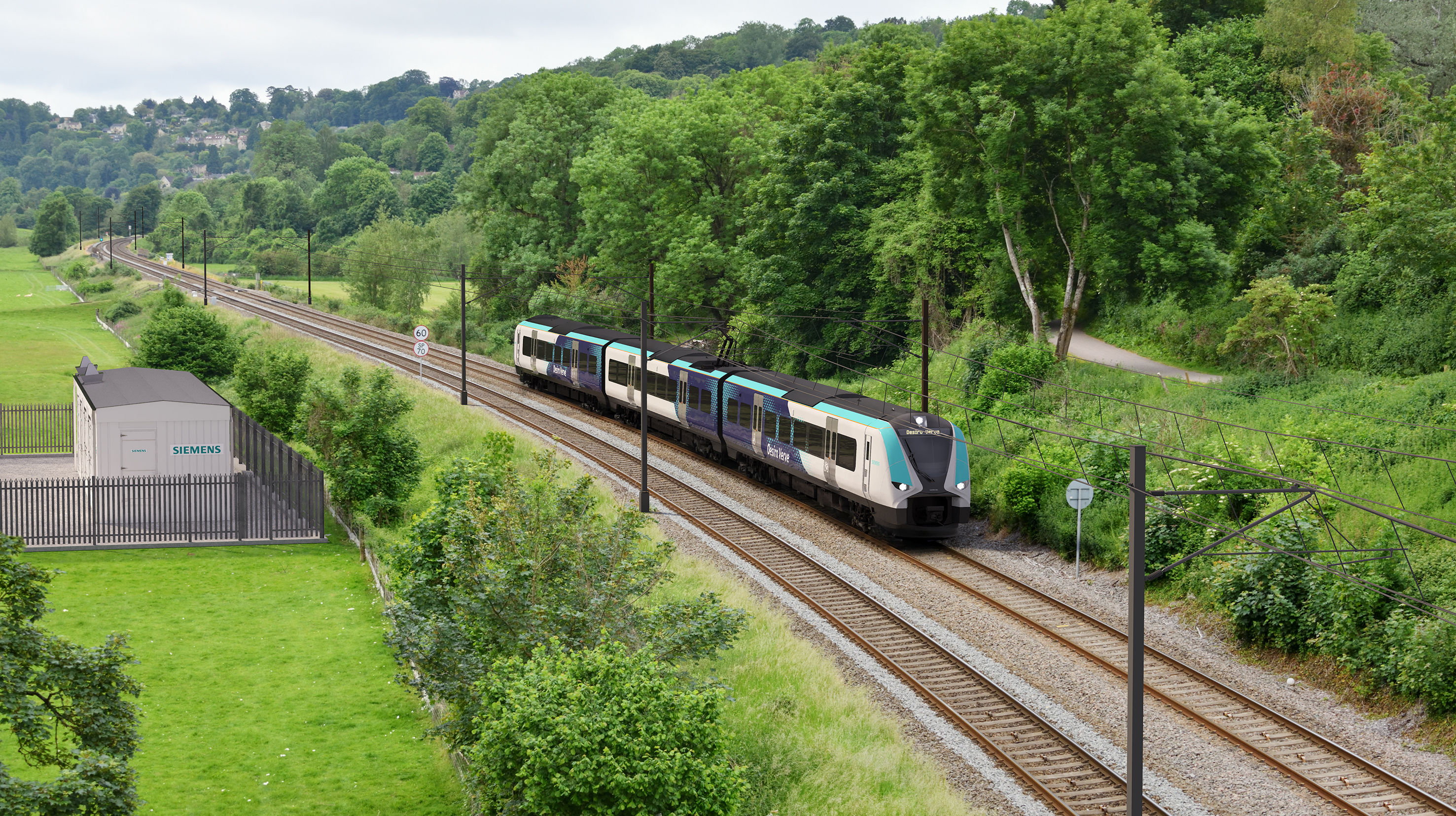
This arrangement could be used in sensitive countryside or close to historic buildings.
Modern Railways – June 2025
There is an article about the Siemens technology in the June 2025 Edition of Modern Railways.
It is called The Battery Revolution Starts In Long Marston for which this is part of the sub-heading.
New technology being installed by Siemens Mobility at Porterbrook’s test facility paves the way for widespread use of battery trains in the UK.
The article is a must-read.
Conclusion
Siemens appear to have the technology with their Rail Charging Converter and battery-electric trains like the Verve and the Mireo Plus B, to be able to decarbonise lines without electrification all over the world.
Would larger gauge trains be delivered from Germany and smaller gauge ones from Goole?
I wouldn’t be surprised that a version for a German S-Bahn could share more characteristics, with a small British train, than a large German one.
I can also see an underground railway, that was built without power in the tunnels. So if you were building the Waterloo and City Line today, would it be battery-electric and charged at each end of the line using a pantograph?
New Mobile Rail Charging Facility For Long Marston
The title of this post, is the same as that of this article from Rail Technology Magazine.
This is the sub-heading.
Porterbrook has signed a £1.7 million deal with Siemens Mobility to purchase an innovative Rail Charging Converter (RCC) for its Long Marston Rail Innovation Centre. The cutting-edge technology will make battery charging and 25kV power supply possible in areas of the UK railway where overhead line equipment is not currently available.
This first paragraph describes the system.
The RCC is a modular and containerised system that uses power electronics to provide a fully compliant, standard connection between the modern three-wire electricity grid and the single-wire railway. It essentially reduces the electrification infrastructure needed by being able to plug into existing power cables and deliver the ideal power supply for trains.
These two paragraphs describe how the RCC was designed and funded, and how it will be used in the future.
The original development of the RCC was supported by the Department for Transport through Innovate UK’s First of a Kind programme. The team will install the novel charging solution at Long Marston, enabling the charging of trains with batteries, fed from existing standard local power supply cables.
Compatible with all overhead line equipment powered trains, the small, low-cost design of the RCC enables the removal of diesel passenger train operation on routes without continuous electrification.
I suspect we’ll see other manufacturers like Hitachi ABB Power Grids and Furrer+Frey launch similar products.
This page gives full details of the award to Siemens Mobility.
Project Title: 25kV Battery Train Charging Station Demonstration
Lead Organisation: Siemens Mobility Ltd.
Project Grant: £59,910
Public Description:
The UK rail industry is committed to decarbonisation, including the removal of diesel trains by 2040.
Replacing diesel trains with electric, hydrogen or battery bi-mode rolling stock provides faster, smoother and more reliable journeys, as well as eliminating local pollution and greatly reducing carbon dioxide.
To enable clean, green electric bi-mode operation without continuous electrification requires enhancement of the power supply to existing electrification and novel charging facilities to support bi-mode trains.
No small, low-cost solution is currently available for charging facilities that are compatible with standard UK trains and locally available power supplies and space.
Siemens Mobility, working with ROSCO, TOCs and Network Rail, will deliver a novel AC charging solution enabling simple installation of small, low-cost rapid charging facilities fed from existing standard local power supply cables.
Compatible with all OLE-powered trains, the novel design enables the removal of diesel passenger train operation on non-electrified routes across the UK, while minimising land requirements and modifications required to existing station structures.
£59,910 seems to be good value for the helping with the design of a universal charging system for 25 KVAC battery-electric trains in the UK.
I have a few thoughts.
Will The Rail Charging Converter (RCC) Charge Third Rail Trains?
As new third-rail systems are effectively systems non grata, I suspect that third-rail trains will be charged by fitting a pantograph and the appropriate electrical gubbins.
Most modern third-rail electrical multiple units have a roof that is ready for a pantograph and can be converted into dual-voltage trains.
What Trains Will Be Able To Be Charged Using An RCC?
I suspect it will be any train with a battery, a pantograph and the appropriate electrical gubbins.
Battery-electric trains that could have a pantograph include.
- Alstom Electrostar and Aventra
- CAF Civity
- Hitachi Class 385 train
- Hitachi Class 800 train
- Siemens Desiro and Mireo
- Stadler Class 777 train
- Stadler Flirt and Akku
- Vivarail Class 230 train
I suspect it could charge all trains in the UK, where batteries have been proposed to be added.
What Is Meant By Mobile?
I suspect transportable and temporary would be a better description.
This gallery show Felixstowe station and a Class 755 train, which can be fitted with batteries.

Suppose that testing was to be done at Felixstowe of a battery-electric Class 755 train.
- The containerised electrical system would be placed somewhere convenient.
- A short length of overhead wire would be erected in the platform.
- The system would then be connected together and to the electrical supply.
- After testing, it could be used to charge a train.
It would be very convenient for operation of the railway, if it could be installed and taken out overnight.
Conclusion
It looks a well-designed system.
Battery Train Pilot Project On Challenging’ Westerwald Routes
The title of this post, is the same as that of this article on Railway Gazette.
It is only a small order for three Mireo Plus B battery-electric multiple-units from Siemens Mobility, but I feel, it is significant that engineers and managers are confident that a battery-electric multiple unit can handle a challenging route.
Siemens Bags First Fleet Order For Hydrogen Trains In Berlin-Brandenburg Region
The title of this post, is the same as that of this article on RailTech.com.
This is the first paragraph.
Niederbarnimer Eisenbahn (NEB) has ordered seven Mireo Plus H hydrogen trains from Siemens Mobility. Delivery is set for autumn 2024, with first operations on the Heidekrautbahn (RB27) network planned in December the same year.
It is a detailed article. about the Mireo Plus H.
Siemens Mobility and Deutsche Bahn Present New Hydrogen Train
The title of this post, is the same as that of this article on Global Railway Review.
This is the sub-title.
Deutsche Bahn and Siemens Mobility have presented the newly developed Mireo Plus H and a newly designed mobile hydrogen storage trailer.
It seems that Deutsche Bahn and Siemens Mobility have put together a well-thought out plan to use hydrogen on a lot of unelectrified lines.
The Germans have given the project, the catchy name of H2goesRail.
How does that translate into German?
H2goesRail
The title of this post, is the same as that of this page on the Deutsche Bahn web site.
These three paragraphs introduce the H2goesRail philosopher.
Deutsche Bahn is currently developing and implementing solutions that utilize hydrogen. One such endeavor is the H2goesRail project. In partnership with Siemens Mobility, we are breaking new ground and driving forward decarbonization of the transport sector for the good of the environment. Together we are developing an innovative hydrogen system for rail transport, which will comprise a refueling station, hydrogen train, and maintenance infrastructure.
We aim to replace diesel multiple units in regional service and thus further reduce carbon emissions in rail transport. To achieve this, with H2goesRail we are developing an innovative mobile refueling station whose smart control unit will allow fast refueling of hydrogen trains.
DB Energie GmbH will ensure the supply of hydrogen for the project, from production by means of renewable-powered electrolysis all the way through to storage and provision.
There is a lot of video.
Battery Trains Ordered For Hermann-Hesse-Bahn
The title of this post, is the same as that, of this article on Railway Gazette.
This article is yet another endorsement of battery-electric trains.
There is more about the history of the Hermann-Hesse-Bahn in Wikipedia entry for the Black Forest Railway.
Could the Germans be using a battery-electric railway to bring in the tourists?
Fuel Cell Mireo Plus H To Be Trialled In Baden-Württemberg
The title of this post, is the same as that of this article on Railway Gazette.
This is the opening paragraph.
Deutsche Bahn and Siemens Mobility are to trial a fuel cell powered regional trainset in revenue service between Tübingen, Horb and Pforzheim in 2024, along with a green hydrogen fuelling plant.
These two paragraphs describe the train.
Siemens Mobility is to supply a two-car Mireo Plus H trainset derived from its Mireo Plus regional multiple-unit family, equipped with a newly developed hydrogen fuel cell drive and a lithium-ion battery.
The 1·7 MW traction power rating is expected to offer a comparable performance to the electric version, with an acceleration rate of 1·1 m/s² and a maximum speed of 160 km/h. Sufficient hydrogen will be stored onboard to give an operating range of up to 600 km, with the promoters envisaging that a three-car variant could have a range of 1 000 km.
The article doesn’t say anything about, whether the train can use electrification, but as the train is based on a conventional electric train, I would assume it is possible.
First Order For Mireo Plus B Battery EMUs
The title of this post is the same as that of this article on Railway Gazette.
This is the introductory paragraph.
The Land of Baden-Württemberg’s rolling stock body SFBW has ordered 20 battery-equipped Mireo Plus B electric multiple-units from Siemens Mobility, which will then be responsible for their availability over a 29½-year operating life.
The Siemens Mireo Plus B Battery EMUs appear to have the following specification.
- Ability to use overhead electrification.
- Ability to use battery power for a range of eighty kilometres.
- Two underfloor lithium-ion battery packs.
- Batteries handle regenerative braking.
- 160 kph operating speed.
Delivery is by December 2023.
Baden-Württemberg Backs Battery Mireos
The title of this post, is the same as that of this article on Railway Gazette.
This is the first paragraph.
The Land of Baden-Württemberg has decided to order a fleet of 20 Mireo battery-electric multiple units from Siemens Mobility to operate the Netz 8 Ortenau package of regional lines, the state government announced on August 2.
Routes to be operated include.
- The electrified line between Offenburg and Freudenstadt/Hornberg
- Rench Valley Railway between Appenweier and Bad Griesbach – 29.1 km.
- , Acher Valley Railway between Achern and Ottenhöfen. – 10.4 km.
- Harmersbach Valley Railway between Biberach and Oberharmersbach-Riersbach – 10.6 km.
Reading about the area, it could be a nice place to go for an explore.
But it also could be the sort of area, that is ideal for battery-electric trains.
Germany Is Going Green In Local Rail Services
There have been other stories of hydrogen and battery-electric trains in Germany.
- Battery Answer To Schleswig-Holstein’s Diesel Replacement Question
- World’s Largest Fleet Of Fuel Cell Trains’ Ordered
- My First Ride In An Alstom Coradia iLint
- Bombardier Introduces Talent 3 Battery-Operated Train
- Flirt Akku Battery Multiple-Unit Unveiled
- Alpha Trains Commits To Hybrid Retrofit For Diesel Fleet
Manufacturers involved include Alstom, Bombardier, Rolls-Royce MTU, Siemens and Stadler.
Who will win the battle of zero-carbon technologies?
My money is on a new design of train, that is built specifically around battery or hydrogen technology.
- I’m sure Bombardier’s Aventras use battery technology, as an integral part of their excellent design.
- Stadler’s launch of the Class 755 train, shows they’ve got a top-of-the-range platform on which to install battery or hydrogen power.
Will Siemens battery-powered Mireo be another challenger.
 The Anonymous Widower