Rail Minister Marks Completion Of £150m Hope Valley Railway Upgrade
The title of this post is the same as that of this article on Rail Magazine.
These first two paragraphs summarise the work.
More reliable journeys are promised on the Hope Valley line between Manchester and Sheffield after a £150 million upgrade was completed in early April.
Over the last three years, the existing platform at Dore & Totley station on the south side of Sheffield has been extended to cope with six-coach trains. Meanwhile the second platform has been rebuilt and commissioned (after it was removed in the 1980s), two mechanical signal boxes have been abolished and a new one-kilometre freight loop laid in the Peak District. At Hathersage, a pedestrian crossing has also been removed and replaced with a footbridge.
These are my thoughts.
Dore And Totley Station
The Rail Magazine article says this about the improvements at Dore and Totley station.
Replacing two tracks through Dore & Totley removes a single-track bottleneck that often saw Sheffield to Manchester express services held up by slower stopping services and cement trains destined for Earles Sidings. A nine-day shutdown of the route in March was needed to finish the work.
The new platform sits between the Midland Main Line and the Hope Valley line, so can only be reached via the new footbridge or lifts. As well as the usual ‘blister paving’ slabs marking the edge of the platform, other tactile paving has been laid to help people with visual impairments find their way around the station.
This OpenRailwayMap shows the new layout of tracks at Dore and Totley station.

Note.
- The four tracks at the North of the map go to Sheffield station.
- The Eastern pair of tracks are the Midland Main Line and they go to the South-East corner of the map for Chesterfield and the South.
- The Western pair of tracks are the Hope Valley Line and they go to the South-West corner of the map for Manchester.
- The blue lettering in the middle of the map indicates Dore and Totley station.
- There is a single track curve between the Midland Main Line and the Hope Valley Line, which is mainly used by freight trains.
This secondOpenRailwayMap shows Dore and Totley station in greater detail.

The big improvement is that the Hope Valley Line is now double instead of single track, which must eliminate a lot of delays.
These pictures show the station in July 2020.
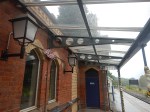


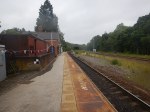


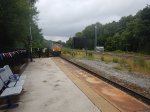
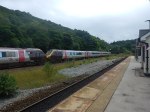
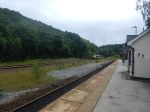

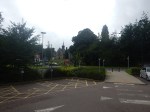
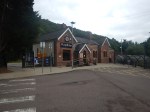
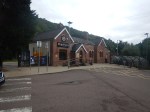


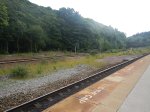
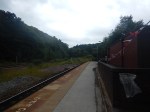
The pictures clearly show the single track and platform at Dore and Totley station.
Dore South Curve
Dore South Curve links the Southbound Midland Main Line with the Westbound Hope Valley Line.
This OpenRailwayMap shows the curve.

There is a crossover in the South-West corner of the map, so with careful signalling, trains can use the Dore South Curve in both directions.
Bamford Loop
This is a freight loop between Bamford and Hathersage stations.
This OpenRailwayMap shows the loop.

Note.
- The Hope Valley Line goes diagonally across the map.
- Manchester is to the North-West.
- Sheffield is to the South-East.
- Bamford station is in the North-West corner of the map.
- Hathersage station is just off the South-East corner of the map.
- The loop is on the Northern side of the Hope Valley Line.
The loop will most likely be used by trains going to Sheffield or Chesterfield.
Hathersage Footbridge
This Google Map shows Hathersage station.

Note.
- Dore Lane and the B 6001 appear to pass under the railway.
- There appears to be what could be foundations just to the West of the platforms at Hathersage station.
- From pictures found by Google the bridge appears to be a simple steel structure.
I shall have to go and take pictures.
Fast Trains Between Manchester And Nottingham
In the Wikipedia entry for the Hope Valley Line, this is said.
Nottinghamshire County Council and the Department for Transport have investigated the possibility of adding another service that does not call at Sheffield in order to improve the journey time between Nottingham and Manchester. Stopping (and changing direction) in Sheffield, the fastest journey is 110 minutes (in 2019), but the council has estimated bypassing Sheffield would cut the time to 85 minutes. Suggested improvements on a 2+1⁄2-mile (4 km) stretch near Stockport may reduce journey times by 2–3 minutes.
Consider.
- According to Google, the driving time between the two cities is 128 minutes and the motorway route is via the M1 and M62.
- If nearly half-an-hour could be saved between Manchester and Nottingham could be a big saving in journey time.
- Manchester Piccadilly is likely to be rebuilt for High Speed Two and a fast route via Nottingham could be a viable alternative.
- Both Manchester and Nottingham have good local tram and train networks.
- As the electrification of the Midland Main Line progresses, the route will be increasingly suitable for 100 mph battery-electric trains.
A Manchester and Nottingham express service looks to be an easy service to implement after the Hope Valley Line has been improved.
Hourly Stopping Trains Between Manchester And Sheffield
The Wikipedia entry for the Hope Valley Line gives these details for the stopping service between Manchester Piccadilly and Sheffield.
- Trains are hourly.
- Trains call at Reddish North, Brinnington, Bredbury, Romiley, Marple, New Mills Central, Chinley, Edale, Hope, Bamford, Hathersage, Grindleford and Dore & Totley.
- But some services do not call at some or all of Edale, Bamford, Hathersage, Grindleford and Dore & Totley giving some 2-hour gaps between services at these stations.
Let’s hope that some of the extra capacity is used to provide a regular service at all stations on the Hope Valley Line.
As in a few years, it will have electrification at both ends, this route could be very suitable for battery-electric trains.
Completion Date
It appears that the first day, when passengers will be able to use the new upgraded tracks and stations will be Thursday, the 2nd of May.
Conclusion
The improvements, certainly seem to allow extra and improved services through on the Hope Valley Line.
I also feel that in a few years, services will be run by battery-electric trains.
Vital Bridge Replacement Means No Trains On Liverpool Street – Chingford line For 16 Consecutive Days This Summer
The title of this post, is the same as that of this press release from Network Rail.
These four paragraphs outline the project to replace the bridge.
Trains will not be able to run for 16 straight days while Network Rail delivers a critical stage of a bridge replacement project between Saturday 20 July and Sunday 4 August.
The 150-year-old bridge over the railway is located to the south of Hackney Downs Park and carries the junction of Downs Park Road and Bodney Road. It backs directly onto a tunnel, which emerges further down the line towards Clapton.
The bridge is monitored closely to check it is safe, but its cast iron girders are in poor condition, and they are continuing to deteriorate. A replacement structure is needed to avoid an unplanned closure and keep passengers and road users moving in future.
Over the 16 consecutive days, engineers from Network Rail’s contractor, Murphy, will demolish the old bridge and start building the new one.
This Google Map shows Hackney Downs station and the location of the bridge to be replaced.

Note.
- Hackney Downs station at the bottom of the map.
- The tracks to Enfield Town and Cheshunt stations going to the North-West corner of the map.
- The tracks to Walthamstow and Chingford stations going to the North-East.
- Mossbourne Academy is between the two tracks.
- The bridge to be replaced is where the tacks to Chingford disappear into a tunnel.
This 3D Google Map shows the bridge in more detail.
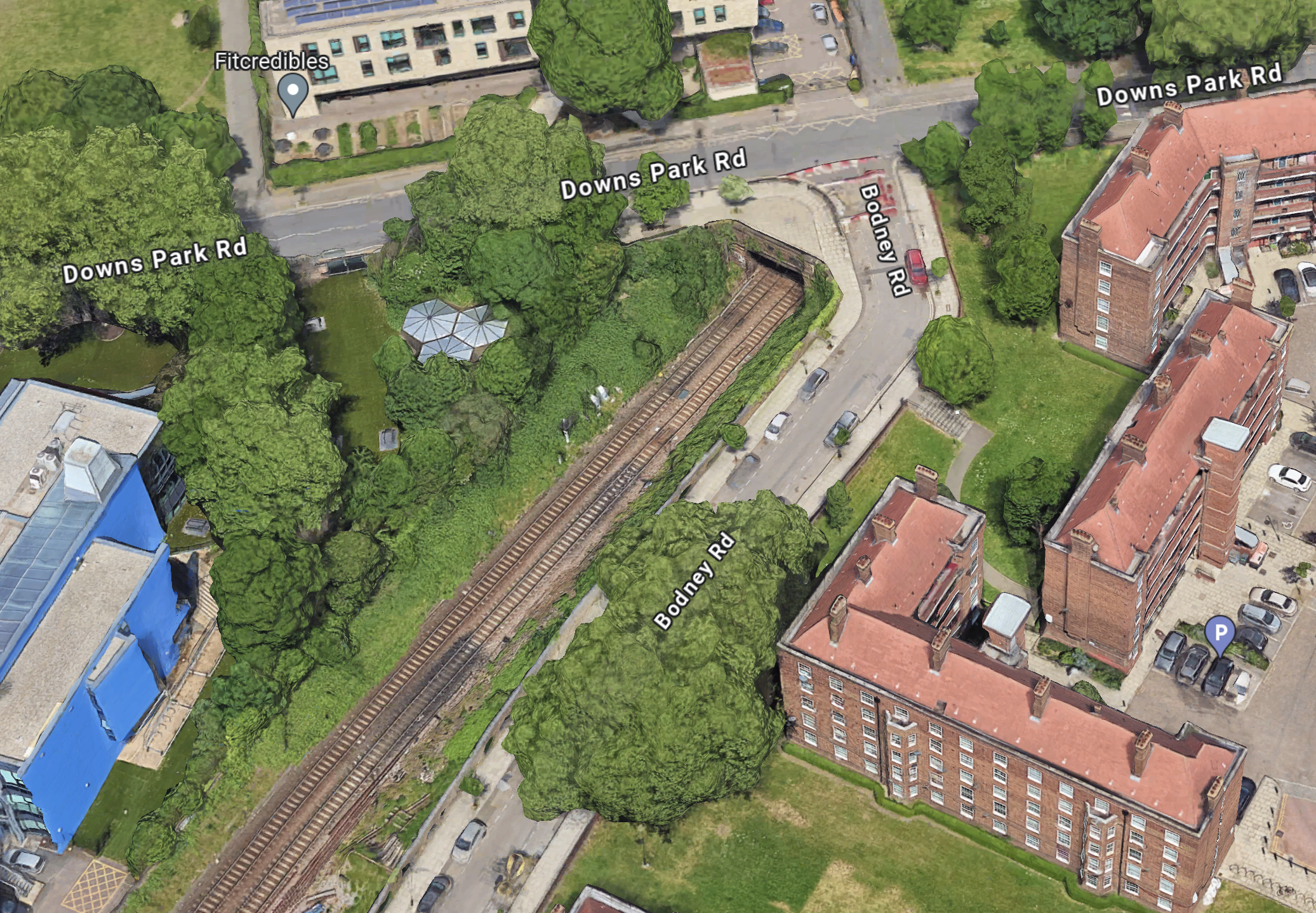
Note.
Downs Park Road running across the top of the map.
Bodney Road running down the side of the railway.
The blue building is Mossbourne Academy.
This Network Rail image shows the current bridge.

It certainly looks like it’s seen better days.
This Network Rail visualisation shows the how the new bridge will probably look from above.

It looks like the landscaping will be fairly simple.
I have some further thoughts.
The Disruption
Sixteen days is a long closure, but rebuilding the bridge before it possibly falls down, is probably prudent.
So make sure you read the full press release from Network Rail.
Hopefully, it will all go well!
Further Works
Hackney Downs and Clapton stations opened in 1872, so the bridge and the tunnel must be at least 150 years old.
So I wouldn’t be surprised, that when Network Rail do a full underground survey, they find other problems.
Rectification could delay the reopening.
Conclusion
It looks to be a well-prepared project.
But I do have my reservations about Network Rail finding something nasty.
Those naughty Victorians would cut corners and bodge things and then not write it down.
Sizewell C – South Park And Ride
This document on the Planning Inspectorate web site, is a description of the Southern Park and Ride for the Sizewell C Project.
This Google Map shows the area of the Park-and-Ride site.
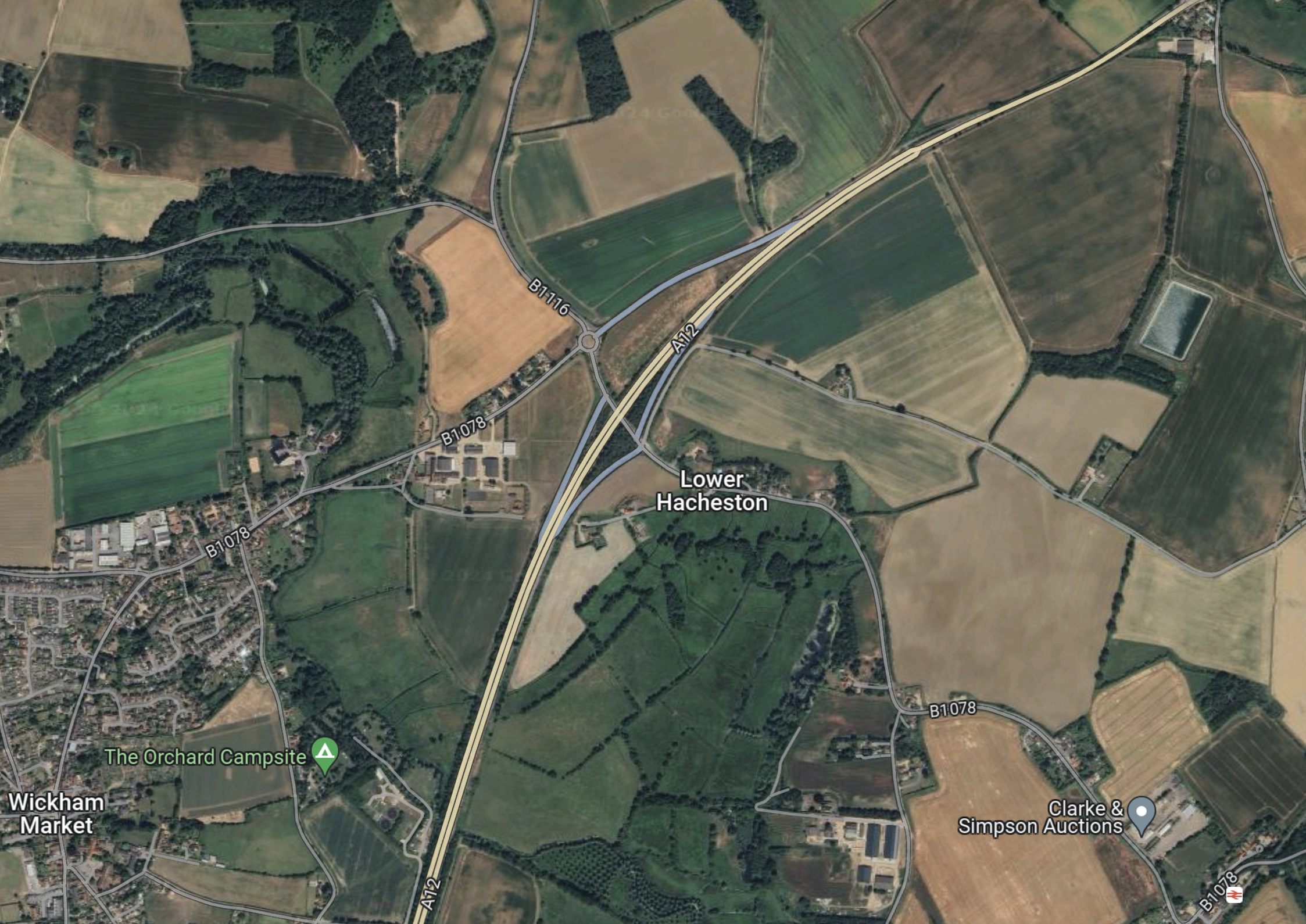
Note.
- Wickham Market is in the South-West corner of the map.
- The dual-carriageway is the Wickham Markey by-pass, which is part of the A12 between Ipswich and Lowestoft.
- Close to Lower Hacheston is the Northern junction of the by-pass which connects the B1116 and B 1078 roads to the A 12.
- If my memory serves me correctly, there is a small roundabout to the North of the A12, where the B 1116 and B 1078 cross, which is referred to as Fiveways Roundabout in some of the documentation.
- Wickham Market station is in the South-East corner of the map.
I know the area well, as I used to live less than ten miles to the West of Fiveways roundabout.
This shows the area to the North of Fiveways roundabout to a large scale.
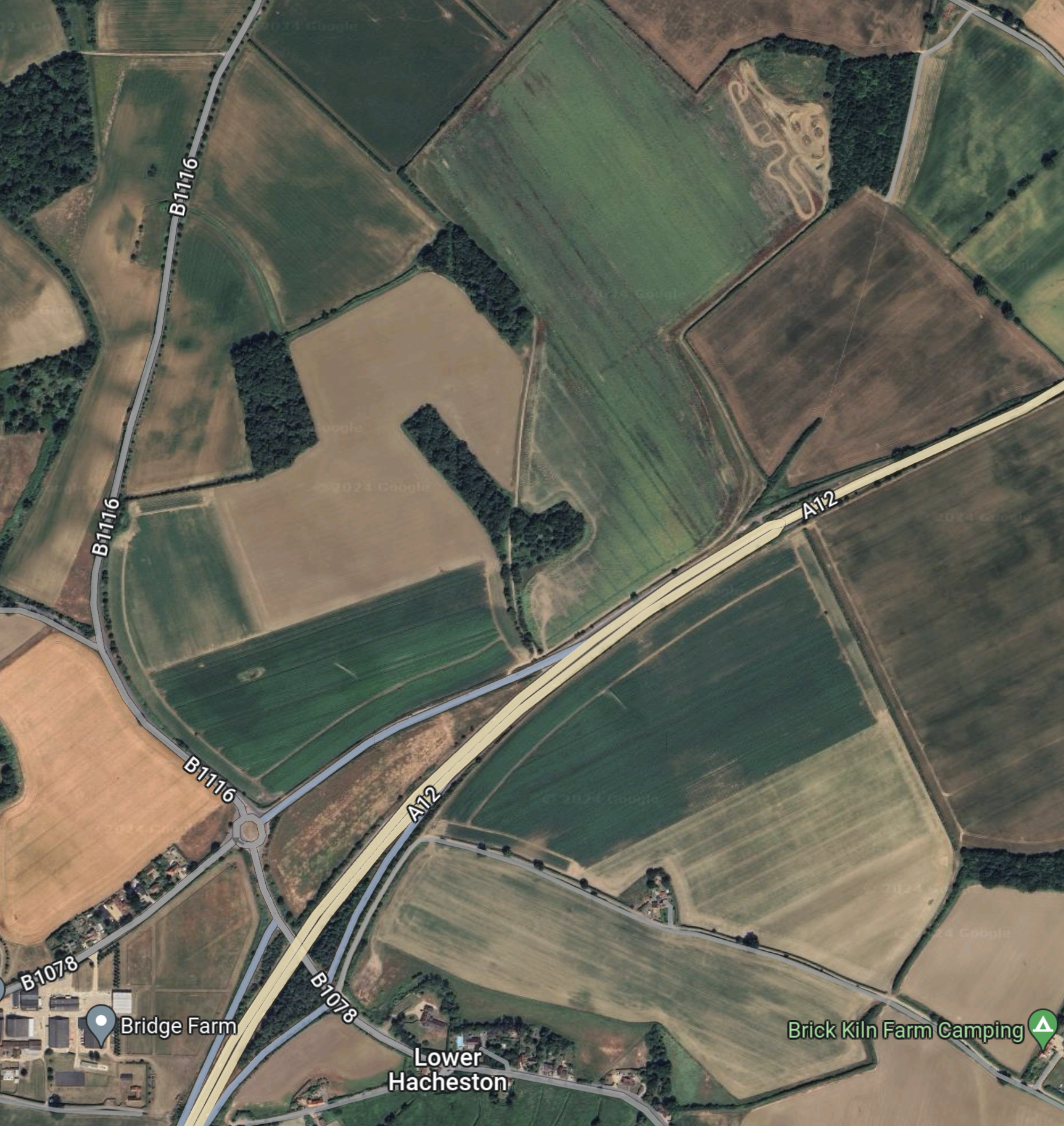
The document on the Planning Inspectorate says this about the site.
The site comprises approximately 26.4 hectares (ha) of predominantly
agricultural land and highway land located north-east of Wickham Market.
The part of the site which would contain the parking and buildings, postal
consolidation building and Traffic Incident Management Area (TIMA) is
approximately 18ha in size, and located to the east of the B1078/B1116, to
the north of the A12. The remainder of the site encompasses a section of
the A12, and an associated slip road where highway improvements are
proposed to form the site access, and associated signage and road
markings, see Chapter 1, Figure 1.1 of this volume.
These are my thoughts.
There Is No Rail Connection
I wrote about the Northern Park-and-Ride in Sizewell C – North Park And Ride and there is one big difference.
The Northern Park-and-Ride is an easy walk from Darsham station.
- Darsham station has an hourly four-car train to Lowestoft and Ipswich.
- Some or all trains could be doubled in capacity as Greater Anglia has enough stock to do this.
- If required, trains could be run to and from London and intermediate stations.
- In the past, Network Rail have developed plans to extend the service as far as Yarmouth.
I believe that a rail connection at the Southern Park-and-Ride could have added flexibility for workers in Ipswich travelling to the Sizewell site.
Bus Routes
The frequency and timing of park and ride buses would depend on the
working patterns adopted during construction of the Sizewell C main
development site, and the number of workers to be moved during the shift
changeover periods. More frequent services would operate during staff
changeover and shift start/end periods. It is anticipated that there would be
three to nine buses from the proposed development per hour during shift
changeover period, and an hourly service outside shift changeover periods.There would be a maximum of 100 daily bus arrivals and 100 daily bus
departures from the proposed development to the Sizewell C main
development site. These buses would use the A12, two village bypass and
Sizewell link road once operational to travel to and from the Sizewell C main development site.
This Google Map shows the A 12 between the South Park-and-Ride site and Yoxford.
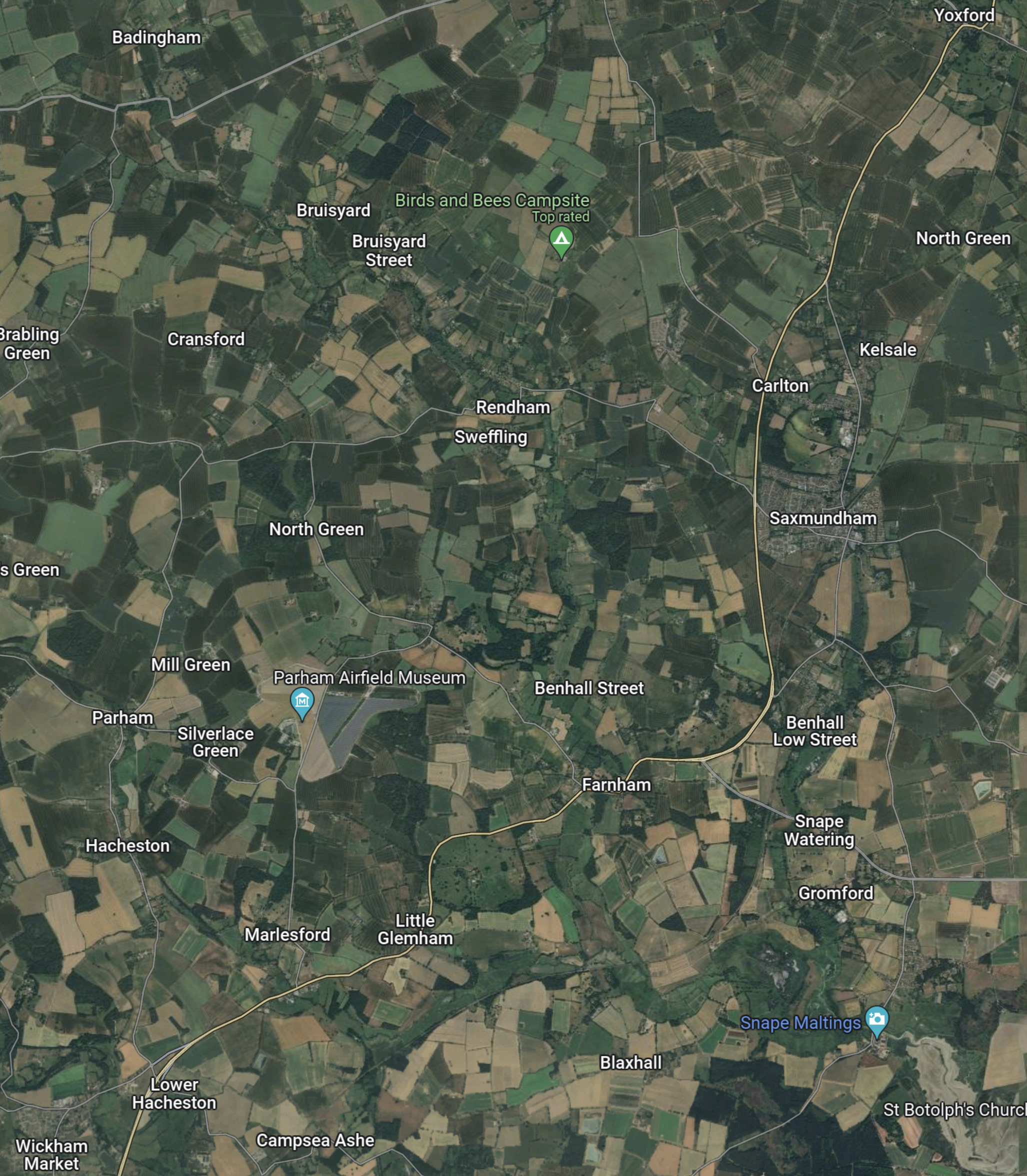
Note.
- Yoxford is in the North-East corner of the map.
- Wickham Market is in the South-West corner of the map.
- The A 12 is the cream road linking the two villages.
- The Southern Park-and-Ride will be to the North-East of Wickham Market.
- The Northern Park-and-Ride is a couple of miles North of Yoxford.
- Yoxford and Wickham Market are 11.8 miles apart.
This third Google Map shows the route between Yoxford and Sizewell.
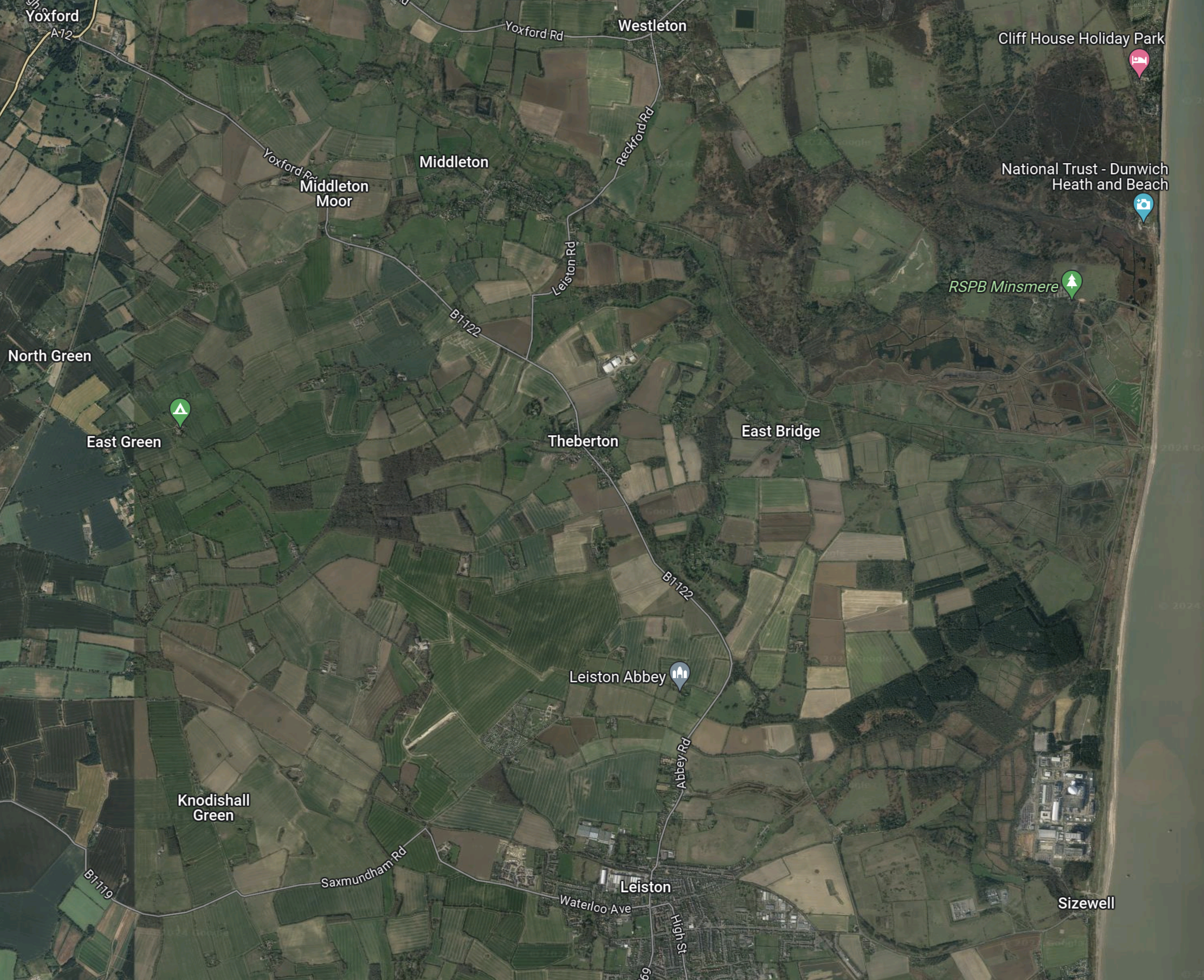
Note.
- Yoxford is in the North-West corner of the map.
- Sizewell is in the South-East corner of the map.
- Leiston Abbey is indicated by the arrow to the North of Leiston.
The B 1122 can be picked out through Middleton Moor and Theberton and then as it skirts Leiston Abbey.
It appears that both Park-and-Ride sites, use the same connection between the A 12 and Sizewell C.
Objections To The Park-and-Ride
This petition on change.org is entitled Stop Sizewell C Park and Ride at Wickham Market.
The petitioner is objecting on the following grounds.
- The size of the site.
- Spoiling of views.
- Disturbance to walkers and horse riders.
- Terrestrial ecology and ornithology will be affected by the site.
- Increase in traffic.
This was the petitioner’s conclusion.
In conclusion I oppose the Sizewell C southern park and ride site at Wickham Market and believe it should be sited further south on the A12 away from residential areas and near the A14.
The Ipswich Northern By-Pass
There is another large project scheduled for Ipswich in the next few years; the Ipswich Northern By-Pass.
This map clipped from the Ipswich Borough Council web site shows possible routes.

Note.
- Wickham Market is in the North-East corner of the map.
- One of the aims of the Northern by-pass is to open up land for housing.
- The railway between Ipswich and Darsham stations goes via Westerfield, Wiidbridge, Melton andWickham Market.
- Perhaps by phasing the developments, an area could be used for a Park-and-Ride, which has a road connection to the A 12.
- When the need for Park-and-Ride for Sizewell has decreased, the site could be handed over to housing.
It would certainly help, if the route of the Northern by-pass was settled soon.
Freightliner Partners With Zero To Decarbonise Critical Transport Operations
The title of this post, is the same as that of this news item from Freightliner.
This is the sub-heading.
Today, Freightliner and Zero, a breakthrough energy company that develops and manufactures whole-blend synthetic, non-biological fuels, announced a partnership to achieve a fossil-free locomotive operation by 2040 and overall Net Zero by 2050, representing a major evolution for one of the world’s oldest, safest and most reliable forms of freight transport. To successfully meet these ambitious emissions targets, Freightliner is exploring alternatives to diesel, such as Zero’s carbon-neutral synthetic diesel, which will eliminate fossil-carbon emissions and improve air quality and environmental wellbeing.
These are my thoughts.
Freightliner
Freightliner is a rail-freight company, that you see regularly hauling freight trains all over the UK.

The picture shows two of their Class 90 electric locomotives in their latest livery.
These posts talk about the company and lower or zero carbon operation.
- Clean Air Power Adds Hydrogen To Class 66 Fuel Mix
- Freightliner Continue Trials On New Low Carbon Fuel
- Freightliner Secures Government Funding For Dual-Fuel Project
- The Ultimate Bi-Mode
The current post fits that pattern.
Zero Petroleum
Zero Petroleum is one of those companies that gives Elon Musk nightmares.
But when you have backers like Babcock, Boeing, Intertek, Rolls-Royce and the Royal Air Force, you must be doing something right.
The Wikipedia entry for the company has this first paragraph.
Zero is a manufacturer of non-biological carbon-neutral synthetic fuel (also known as e-fuel) co-founded by former Formula One engineer Paddy Lowe. Its product has been developed as an alternative to fossil-based fuels and a more scalable sustainable alternative to waste and bio-fuels. The Royal Air Force used its fuel in November 2021 to achieve a World Record first flight powered by synthetic fuel. In July 2022, Zero entered a new partnership with the Royal Air Force to move towards mass production of sustainable aviation fuel.
The company is often known as just Zero.
These two and a half paragraphs from the Wikipedia entry describe the technology.
Zero uses Direct FT (a proprietary and specialised version of Fischer-Tropsch) to directly manufacture target fuels (gasoline, kerosene and diesel) at high yield and with no need for refinery upgrading.
When manufactured using renewable energy, synthetic fuel can be used as a carbon neutral or carbon negative direct drop-in replacement for fossil fuels, particularly for operations that require high energy densities – such as air travel, shipping and farming – and to ensure the continued use of legacy vehicles. It can also be used as a raw material to produce various forms of plastic.
It is manufactured using a process known as petrosynthesis, in which carbon dioxide and hydrogen are combined to create hydrocarbons. The process involves direct air capture of carbon dioxide from the atmosphere and the electrolysis of water to obtain hydrogen.
The Fischer-Tropsch process, despite its association in the past with dodgy regimes, seems to be at the heart of things, as it is with Velocys.
I describe the Velocys process and its link to Fischer-Tropsch in Grant Shapps Announcement On Friday.
Surely, the carbon-neutral fuel produced by Zero, are the ideal stop-gap fuel until true full zero-carbon fuels are available.
But Zero’s fuels will always be available for heritage and legacy trains, planes and automobiles and for applications, where older technology must be used.
As an example of older technology still being used on UK’s railways, Network Rail operate, the New Measurement Train to check all tracks in Great Britain.

The train may have been manufactured in the 1970s, but it has modern engines and is the ideal train to carry the wide variety of sophisticated equipment to ensure the safety of Britain’s railways.
Synthetic diesel like that produced by Zero could keep the New Measurement Train running for some years yet.
Freightliner Have Made A Pragmatic Decision
I believe that Freightliner have made a pragmatic decision, that allows them to go carbon neutral without without taking risks or spending millions on new equipment, that is not fully-developed.
As new zero-carbon technology is developed, like say hydrogen-electric hybrid locomotives, these may take over certain tasks, which will reduce some of the need for synthetic diesel.
But synthetic diesel from Zero will always be there as a fuel of last resort.
Scrap Rail Caused Train Derailment – Network Rail
The title of this post, is the same as that of this article on the BBC.
These three paragraphs introduce the story.
Scrap rail left on tracks following engineering works was the cause of a derailment in Surrey, according to Network Rail.
The company said a train hit the object at about 05:50 GMT on Monday in a 90mph area near Walton-on-Thames.
A Network Rail Wessex safety bulletin said it was the first train on the fast line following the weekend works.
I wrote about this incident before in Woking: Train Derailed On 90mph Line After Hitting Object On Track.
Someone is going to get their knuckles rapped or posterior spanked after this serious incident.
Lumo In Discussions To Operate Glasgow Services
The title of this post, is the same as that of this press release from FirstGroup.
These four paragraphs give more details.
FirstGroup, the leading private sector transport operator, today announces that its popular open access rail service Lumo is in discussions with Transport Scotland and Network Rail to extend some of its London-Edinburgh trains to and from Glasgow.
Having identified opportunities to extend a number of daily journeys to and from Glasgow in the timetables for 2025 and beyond, work will now continue with Transport Scotland and track infrastructure manager Network Rail to agree final route options and timings ahead of an application for access rights to the Office of Rail and Road (‘ORR’), the industry regulator.
If successful, the new services could be in operation from next summer.
Lumo’s proposed new offering will improve links for customers travelling between Newcastle and Glasgow, giving people a choice of services without needing to change trains. In addition, a significant number of users of Lumo’s current London-Edinburgh trains go on to travel through to Glasgow via other connections, and through this move, Lumo aims to offer a direct through service for these customers.
I have a few thoughts.
There Appears To Be A Need For An Affordable London And Glasgow Service
This is the last sentence of my extract from the press release.
In addition, a significant number of users of Lumo’s current London-Edinburgh trains go on to travel through to Glasgow via other connections, and through this move, Lumo aims to offer a direct through service for these customers.
This looks to be a service, that has been suggested by an analysis of passengers’ tickets.
Which Station Will Lumo Use In Glasgow?
Consider.
- The current LNER service between London King’s Cross and Glasgow, uses Glasgow Central station and it takes 66 minutes between Edinburgh and Glasgow Central stations.
- LNER’s service also calls at Haymarket and Motherwell.
- ScotRail services between Edinburgh and Glasgow Queen Street take about 49-50 minutes.
I suspect, that Lumo will take the faster route.
Newcastle And Glasgow Is A New Route
Currently, all passengers between Glasgow and Newcastle have to change at Edinburgh.
This will be the first direct train in my memory, except for LNER’s single daily service between London and Glasgow Central, which stops at Newcastle.
What About The Football?
Glasgow is very much about football.
Would it be possible to use Lumo to see a match starting at 15:00 on a Saturday afternoon, if you lived in London?
- The 05:48 train from King’s Cross on a Saturday arrives in Edinburgh at 10:07.
- Trains between Edinburgh and Glasgow take fifty minutes, so I feel it would be reasonable to be able to get to Glasgow by 10:57.
This time would be more than early enough to have a few swift halves and see the match if it started at 15:00.
But would it be possible to get back to London after the match?
- The last train leaves Edinburgh at 17:55 and arrives in King’s Cross at 22:26.
- Applying the fifty minute journey time between Edinburgh and Glasgow means it will leave at 17:05.
- It appears that from Ibrox and Celtic Park to Glasgow Central or Glasgow Queen Street station is about twenty minutes.
On the current timetable, it would appear to be possible, but tight.
One alternative would be to take the Caledonian Sleeper back to London. But it doesn’t appear to run on a Saturday night.
Coaches do run and an overnight coach costs around twenty pounds.
It looks like if Lumo ran a service about 18:00 on a Saturday to London, it wouldn’t run empty.
Will Lumo Need More Trains?
In the press release, FirstGroup plc Chief Executive Officer Graham Sutherland, is quoted as saying.
Once preferred route options and timings have been agreed, discussions will continue with Network Rail and the ORR to secure the required approvals. The journeys would be operated within the existing Lumo fleet of all-electric trains and it is anticipated that the additional services could begin in summer 2025.
That looks to me, that they will not be obtaining more trains before next summer.
In Ten-Car Hull Trains, I noted that some of Hull Trains services were now running as ten-car trains.
If the passenger demand is there for ten-car trains to Hull, which is almost exactly half the distance of Edinburgh, I would expect that in the future, Lumo will be running some services as ten-car trains.
In Extra Luggage Racks For Lumo, which is based on an article in the November 2023 Edition of Modern Railways, an alternative view on more trains is taken.
The Modern Railways article finishes with this paragraph.
Lumo celebrated its second birthday in late October and was also set to mark the carriage of its two-millionth passenger. It is understood Lumo is interested in augmenting its fleet, such has been the success of the service; while many operators favour bi-mode units, Lumo is proud of its all-electric credentials so straight EMUs are still preferred, although the possibilities of including batteries which could power the trains may be pursued (the ‘803s’ have on-board batteries, but only to provide power to on-board systems if the electricity supply fails).
I find this development very interesting.
As London King’s Cross and Edinburgh and Glasgow are all electric routes, in normal service batteries should not be needed, but sometimes trains have to use the diversion via Lincoln, which I have estimated is 86.5 miles.
As an electrical engineer, I’ve always believed that the emergency batteries in the Class 803 trains are very similar to the traction batteries that Hitachi are developing for the Class 802 trains.
A traction battery, that was capable of handling the diversion would stop Lumo having to cancel occasional services.
Conclusion
An extension to Glasgow looks like it could be a simple and profitable way to extend the current Lumo service.
But it might need some extra trains in the future.
A Lumo service to Glasgow, might be helped by a seven-day service on the Caledonian Sleeper, so passenger could go North on Lumo and South on the Sleeper to get a full day in Glasgow.
Mid-Cornwall Metro Presentation – 9th February 2024
On Friday, I went to the Mid-Cornwall Metro presentation in the Victoria Hotel in Newquay.
These pictures give a flavour of the excellent presentation.



One thing that is difficult to put on paper is the overall enthusiasm for the project shown by representatives of Cornwall Council, Great Western Railway and Network Rail.
I believe that if this enthusiasm can be translated into action in the next couple of years, them this project can be delivered on time and on budget.
This link will show all my Mid-Cornwall Metro posts.
West London Orbital: Line Could Be Reused For Passengers
The title of this post is the same as that of this article on the BBC.
This is the sub-heading.
A railway line that stopped serving passengers in 1902 could be brought back into use as a route called the West London Orbital.
These are the first three paragraphs.
The Dudding Hill loop runs from Acton to Cricklewood and currently only takes freight trains.
Transport for London (TfL) published a strategic document in 2021 saying it would be “a catalyst for relieving road congestion in west London”.
It is estimated by TfL more than 11 million people a year would use it.
This is also said.
Sharma Tatler, the deputy leader of Brent Council, called the plan “a no-brainer”.
I agree with that.
These are my thoughts.
Finding The Money
Money will be needed for the following.
- To build and update the stations on the route.
- To acquire the new trains needed.
- To bring the track and signalling up to the required standard.
Note.
- It appears that around a dozen freight trains use the route on a typical day.
- Hopefully, Network Rail can come up with an affordable plan for the track and signalling, as the route is used by freight trains at the present time.
- I would envisage that the trains used would be a version of the current Class 710 trains used on the Overground. These could probably be leased.
I wouldn’t be surprised that the cost of the stations, will be the major part of the building of the line.
Building the stations is probably, the easiest place to bring in private finance. Especially, if stations incorporated housing or other developments.
On a train going to the North a few years ago, I met two infrastructure funders from L & G (in Standard Class), who were going to lend a company 50 billion to develop a large residential housing site. We got talking and I asked them if they would develop a mythical branch line with a good station site at the end. (Think Felixstowe!) I asked if they’d fund housing and possibly the trains. They said yes!
So I suspect that the West London Orbital could also be funded in the same way, as there are a few stations to build and upgrade. Much needed housing could be built on top or nearby.
I would also deck-over Neasden Depot and build housing in town blocks on top.
I believe that the West London Orbital could be funded.
Electrification
The Wikipedia entry for the West London Orbital describes the route like this.
The route would run for approximately 11 miles (17 km) from West Hampstead and Hendon at the northern end to Hounslow at the western end via Brent Cross West, Neasden, Harlesden, Old Oak Common, South Acton and Brentford.
Note.
- There is 25 KVAC overhead electrification at the Northern end of the route between West Hampstead Thameslink and Hendon stations.
- The Dudding Hill Line between the Midland Main Line and Acton Wells Junction is not electrified.
- The North London Line between Acton Wells Junction and Acton Central station is electrified with 25 KVAC overhead wires.
South of Acton Central station, the electrification gets complicated as this OpenRailwayMap shows.
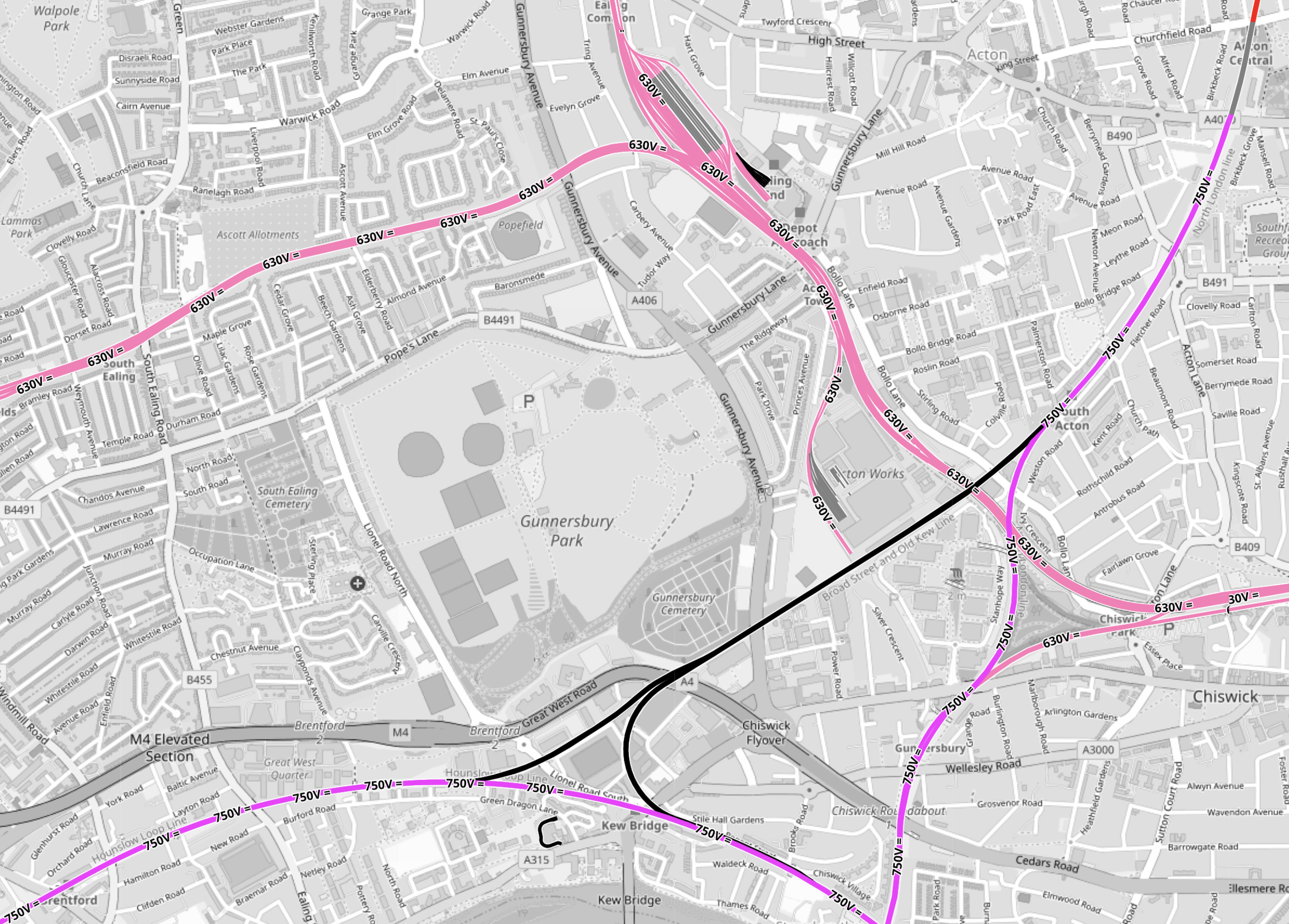
Note.
- Acton Central station is in the North-East corner of the map.
- Brentford station is in the South-West corner of the map.
- The red track is electrified with 25 KVAC overhead and it is used North of Acton Central station.
- Mauve track is electrified with British Rail third rail.
- Ptnk track is electrified with London Underground third rail.
- Black track is not electrified.
- West London Orbital trains between West Hampstead Thameslink and Hounslow will use the direct route between Acton Central and Brentford.
- West London Orbital trains between Hendon and Kew Bridge terminate at the South-Eastern point of the triangular junction.
It seems that trains will be needed that can use both types of electrification and none.
New Trains
Because of the requirement of the trains to be able to use both types of electrification and be self-powered, the trains will either have hydrogen or battery power to augment electric traction.
Hendon and Hounslow is 11.3 miles and this will be longer than any service distances, so I suspect that a battery-electric train could handle the route.
In this article in Global Rail News from 2011, which is entitled Bombardier’s AVENTRA – A new era in train performance, gives some details of the Aventra’s electrical systems. This is said.
AVENTRA can run on both 25kV AC and 750V DC power – the high-efficiency transformers being another area where a heavier component was chosen because, in the long term, it’s cheaper to run. Pairs of cars will run off a common power bus with a converter on one car powering both. The other car can be fitted with power storage devices such as super-capacitors or Lithium-ion batteries if required. The intention is that every car will be powered although trailer cars will be available.
Unlike today’s commuter trains, AVENTRA will also shut down fully at night. It will be ‘woken up’ by remote control before the driver arrives for the first shift
This was published over ten years ago, so I suspect Bombardier (or now Alstom) have refined the concept.
Bombardier have not announced that any of their trains have energy storage, but I have my suspicions, that both the Class 345 and Class 710 Aventra trains use super-capacitors or lithium-ion batteries, as part of their traction system design.
- I was told by a Bombardier driver-trainer that the Class 345 trains have an emergency power supply. When I said “Batteries?”, He gave a knowing smile.
- From the feel of riding on Class 710 trains, as a Control Engineer, I suspect there is a battery or supercapacitor in the drive system to give a smoother ride.
I also feel that the Aventra has been designed, so that it can accept power from a large variety of sources, which charge the battery, that ultimately drives the train.
New British Steel Rail Stocking Facility Will Boost Network Rail Supply Chain
The title of this post, is the same as that of this article on RailUK.
These four paragraphs outline the new facility and how it will work.
British Steel is building a new £10 million rail stocking facility, the biggest of its kind in the country.
The facility, at the company’s Scunthorpe site, is scheduled to be completed this summer and will stock around 25,000 tonnes of 108-metre finished rail.
The investment is part of our British Steel’s strategy to support the supply of 56E1 and 60E2 section rails for Network Rail, ensuring there is rail stock readily available for its supply chain.
Rails stocked in the new facility will all have undergone the stringent testing and quality assurance checks required to meet the specification to allow immediate dispatch or welding into 216-metre lengths to the customer.
With all the gloom in the steel industry, It’s good to see someone investing in new facilities.

