The Crown Estate Refines Plans For Celtic Sea Floating Wind
The title of this post, is the same as that of this press release from Crown Estate.
This is the first part of the press release.
The Crown Estate has set out further details on its plans for Offshore Wind Leasing Round 5, which aims to establish new floating offshore wind technology off the coast of Wales and South West England. The update includes details on the final planned locations for the new windfarms, as well as further information on a multi-million-pound programme of marine surveys.
Round 5 is expected to be the first phase of development in the Celtic Sea, with The Crown Estate working to catalyse and accelerate the UK’s energy transition, and to de-risk developments to speed up their deployment. This includes investing in an upfront Habitats Regulation Assessment, an extensive programme of marine surveys and working with the Electricity System Operator on a coordinated approach to grid design.
This latest update follows a period of engagement with developers and wider stakeholders on proposals set out in July over how to make best use of available space in the Celtic Sea. As a result of the feedback received, The Crown Estate has confirmed that:
- Three Project Development Areas (PDAs) of roughly equal size are expected to be made available to bidders, as opposed to the previously proposed four PDAs of varying sizes
- No bidder will be able to secure an Agreement for Lease for more than one PDA
- As a result of bringing forward three equal-sized PDAs – each with a potential capacity of up to 1.5GW – the overall capacity available through Round 5 has increased from a possible 4GW to up to 4.5GW, enough to power more than 4 million homes
Note.
- Another 4.5 GW of offshore wind should hit the queue.
- It sounds like they have been listening to developers.
To find out more of the potential of the Celtic Sea, I recommend this article on the Engineer, which is entitled Unlocking The Renewables Potential Of The Celtic Sea.
I’ll go along with what this article says and accept that 50 GW of wind capacity could be installed in the Celtic Sea.
Scottish Project To Explore Tugdock Tech Application To Accelerate Floating Wind Development
The title of this post, is the same as that of this article on offshoreWIND.biz.
This is the sub-heading.
The joint venture behind the Salamander floating wind project and the UK developer of marine buoyancy technology, Tugdock, have signed a memorandum of understanding (MOU) to collaborate on research and innovation related to the development of technologies and supply chain for floating wind energy in Scotland.
This is the introductory paragraph.
The 100 MW floating wind farm, developed jointly by Simply Blue Group and Ørsted, and Subsea7 as a minority partner, is one of the 13 projects selected in Scotland’s Innovation and Targeted Oil and Gas (INTOG) leasing round and one of the five INTOG innovation projects which signed exclusivity agreements with Crown Estate Scotland in May.
There is more about Tugdock on their web site.
I like the concept, but then I did a lot of simulation of floating structures in the 1970s, which I wrote about in The Balaena Lives.
Biggest Untapped UK Oil Field, Rosebank, Approved By Regulators
The title of this post, is the same as that of this article on the BBC.
This is the BBC’s summary so far.
- The UK’s largest untapped oil field has been approved by regulators
- Rosebank, 80 miles west of Shetland, is estimated to contain 500 million barrels of oil
- The UK government welcomes the decision, saying it will raise billions of pounds and “make us more secure against tyrants like Putin”
- But Scotland’s First Minister Humza Yousaf says he’s “disappointed”, while the Green Party calls the decision “morally obscene”
- Regulators said net zero considerations had been taken into account
This is my summary.
I have been reading Equinor’s web site on Rosebank.
Production will use what is known as a Floating Production Storage and Offloading Vessel or FPSO, which means, when they’ve finished, it can just sail away.
The FPSO will also be electrification-ready, so that all operations on the vessel will probably be powered by green electricity from a nearby wind farm, instead of by a gas turbine engine on the vessel, which burns gas.
This means that the offshore operations will be as carbon-free as is reasonably possible. But importantly, we will pipe the maximum amount of gas from the field for either our own use or selling to the gas-thirsty Germans.
We will need the gas for some time to back up wind and solar with gas-fired power stations.
But what about the emissions from the power stations?
Capturing carbon dioxide from a power station is getting easier, but more importantly, researchers are finding more and more innovative ways of using the carbon dioxide.
H & M and Zara are even selling clothes made from captured carbon dioxide.
Ways are also being developed using plasma electrolysis to strip the carbon out of natural gas to leave useful hydrogen.
Natural gas will be our friend for many decades yet, if we can turn it into a zero-carbon fuel, which I believe we can!
Fourth Phase Could Bring 2 GW More To World’s Already Largest Offshore Wind Farm Under Construction
The title of this post, is the same as that of this article on offshoreWIND.biz.
This is the sub-heading.
Dogger Bank D, the potential fourth phase of the Dogger Bank Wind Farm, whose first three phases totalling 3.6 GW are currently being built, is planned to have a generation capacity of around 2 GW. If built, the fourth phase would bring the total installed capacity of the UK project – already the world’s largest offshore wind farm under construction – to over 5.5 GW.
This is the introductory paragraph.
SSE Renewables and Equinor, which own the Dogger Bank A, B and C offshore wind farms through a consortium that also comprises Vårgrønn, have now launched a public consultation period on the Dogger Bank D proposals that runs until 7 November.
As RWE are developing the 3 GW Dogger Bank South, the Dogger Bank wind farm will be up to 8.5 GW in a few years.
Flotation Energy, Cobra File Onshore Planning Application For 100 MW Celtic Floater
The title of this post, is the same as that of this article on offshoreWIND.biz.
This is the sub-heading.
Flotation Energy and Cobra have submitted an onshore planning application to North Devon Council for their 100 MW White Cross floating offshore wind farm in the Celtic Sea.
These two paragraphs outline the project.
The proposed White Cross floating offshore wind farm will feature six to eight floating wind turbines installed some 52 kilometres off the North Devon coast.
The project’s associated cable route is proposed to make landfall at Saunton Sands, connecting to the electricity grid at the East Yelland substation.
The wind farm has its own web site.
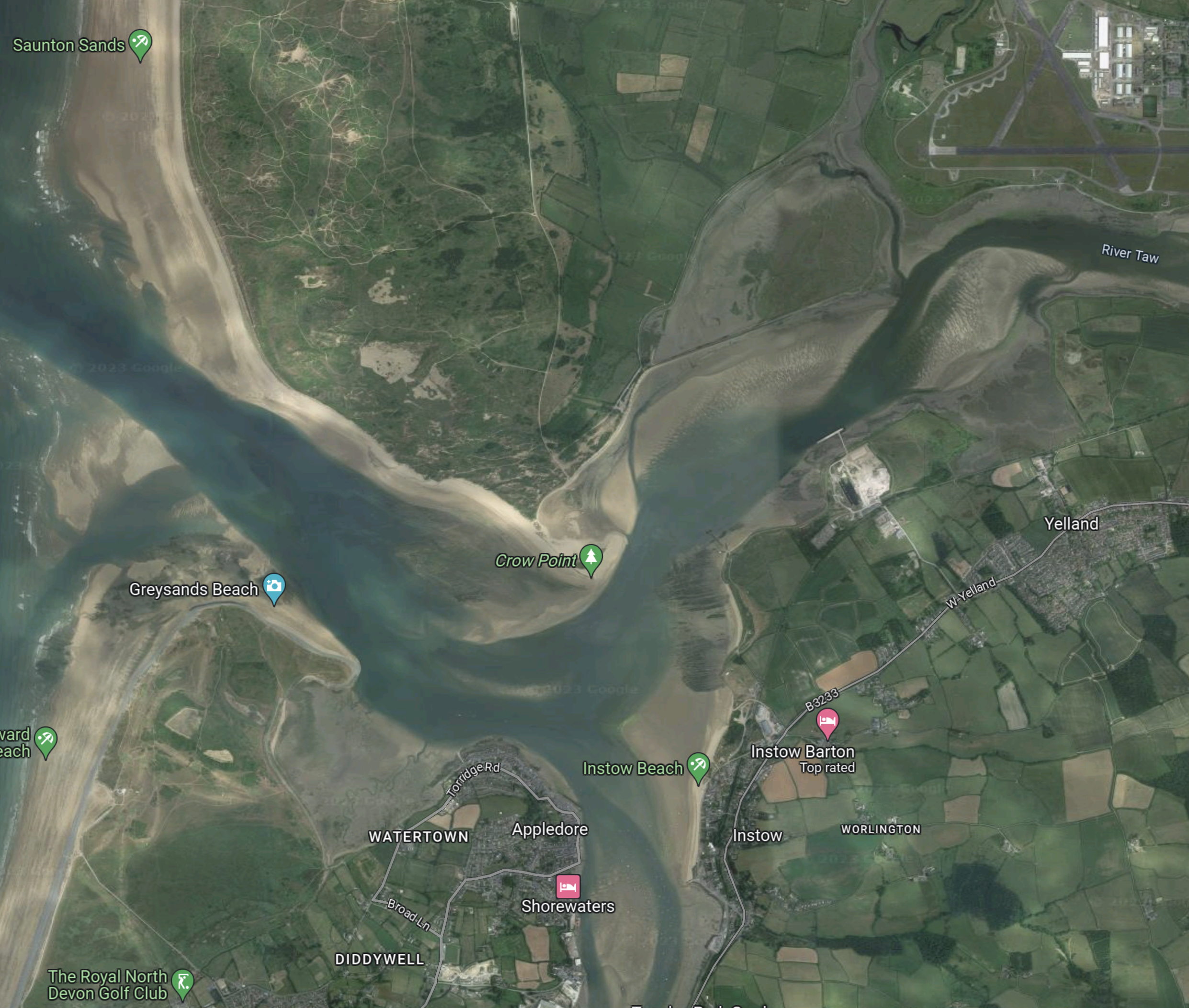
This Google Map shows Saunton Sands and the village of Yelland
Note.
- Saunton Sands is indicated by the green marker in North-West corner of the map.
- Yelland is in the middle of the Eastern side of the map.
- I suspect there are innovative ways to connect the White Cross wind farm to the substation at East Yelland.
- The town of Appledore is on the estuary at the bottom of the map.
This second Google Map shows the town of Appledore.
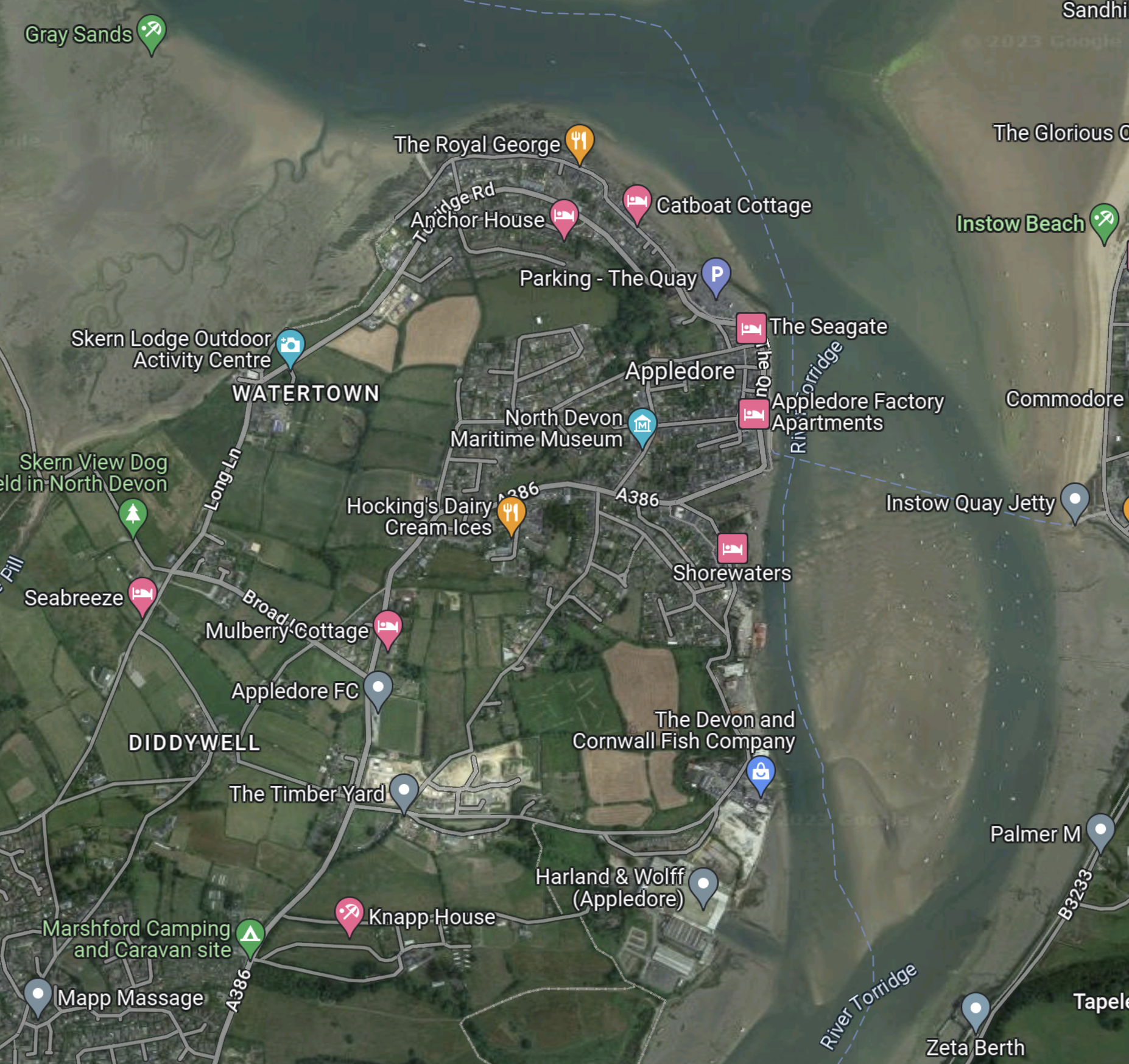
At the bottom of the map is a marker labelled Harland & Wolff (Appledore).
Harland & Wolff (Appledore) has a web site, with these introductory paragraphs.
Located in North Devon at the mouth of the River Torridge, Harland & Wolff (Appledore) has a rich history of shipbuilding. More than 300 vessels have been built here including military craft, bulk carriers, LPG carriers, superyachts, ferries, and oil-industry support vessels.
The site features a 119m long covered drydock as part of the main building yard as well as the adjacent repair, commissioning and outfitting quay.
The Appledore Yard was founded in 1855. It constructed elements of the two Queen Elizabeth class aircraft carriers, bow sections for HMS Queen Elizabeth and built two Róisín class patrol boats for the Irish Naval Service.
The web site then lists an impressive list of facilities, which it underlines with this statement.
An expert team that is perfectly positioned to support the needs of the shipping and offshore industry.
I wouldn’t be surprised to see that Harland & Wolff (Appledore) will bid for the eight floaters for White Cross wind farm.
RWE To Start Building Battery Storage That Will Support Dutch Offshore Wind Farm
The title of this post, is the same as that of this article on offshoreWIND.biz.
This is the sub-heading.
RWE has finalised its investment decision for a battery storage project in the Netherlands that will optimise the OranjeWind offshore wind farm’s integration into the Dutch energy system. The company plans to invest approximately EUR 24 million into the project.
This paragraph outlines the system.
The system, which will have an installed power capacity of 35 MW and a storage capacity of 41 MWh, will consist of a total of 110 lithium-ion battery racks that will be installed at RWE’s biomass plant in Eemshaven and will be virtually coupled with RWE’s power plants in the Netherlands.
There is also an explanatory infographic.
Note.
I visited Eemshaven in The Train Station At The Northern End Of The Netherlands.
- The wind farm has a capacity of 760 MW.
- Solar panels will float between the wind turbines.
- Surplus energy will be turned into hydrogen.
The OranjeWind wind farm has a web site, with a video that explains RWE’s philosophy.
The web site has a section, which is entitled Innovations At OranjeWind, where this is said.
In order to realise system integration and accelerate the energy transition, RWE is working together with a number of innovators on new developments in offshore wind farms. The company is realising and testing these innovations in the OranjeWind wind farm.
These innovations include offshore floating solar, a subsea lithium-ion battery, LiDAR power forecasting system and a subsea hydro storage power plant off-site.
Three innovations are discussed in a bit more detail, with links to more information.
- Subsea pumped hydro storage power plant – Ocean Grazer – More…
- Floating solar – SolarDuck – More…
- Intelligent Subsea Energy Storage – Verlume – More…
Big companies should always support innovation.
Is Sizewell C Needed?
I am generally pro-nuclear, but I am not sure if building a large nuke at Sizewell is the right action.
Consider.
- East Anglia has 3114 MW of offshore wind in operation.
- East Anglia has 6772 MW of offshore wind under construction, with Contracts for Difference or proposed.
- Vattenfall are considering abandoning development of their large wind farms off the Norfolk coast, which are proposed to have a capacity of 3196 MW.
- If the two Vattenfall wind farms don’t get built, it is likely that East Anglia will have around 6700 MW of offshore wind capacity.
- Sizewell C has a proposed nameplate capacity of 3260 MW. Some might argue, that to back up East Anglia’s offshore wind power, it needs to be larger!
- Norfolk and Suffolk no large electricity users, so are Vattenfall finding they have a product no one wants to buy.
- National Grid is developing four interconnectors to bring power from Scotland to the Eastern side of England, which will back up wind power in the East with the massive Scottish pumped storage, that is being developed.
- National Grid and their Dutch equivalent; TenneT are developing LionLink to connect the UK and the Netherlands to clusters of wind farms between our countries in the North Sea.
- Kent and East Anglia have several gas and electric interconnectors to Europe.
- Sizewell is well-connected to England’s grid.
These are my thoughts.
Energy Storage At Sizewell
Consider.
- Sizewell is well connected to the grid.
- It has the sea on one side.
- It could easily be connected to the large offshore wind farms, thirty miles out to sea.
If large energy storage could be built on the Sizewell site or perhaps under the sea, then this energy could be recovered and used in times of low wind.
Perhaps the technology of the STORE Consortium, which I discussed in UK Cleantech Consortium Awarded Funding For Energy Storage Technology Integrated With Floating Wind, could be used.
In this system, energy is stored in 3D-printed concrete hemispheres under the sea.
A Small Nuclear Reactor Cluster At Sizewell
Rolls-Royce are proposing that their small modular reactors will have a capacity of 470 MW.
Perhaps a cluster of seven small modular reactors at Sizewell, with a building schedule matched to the need to back up wind farms would be better and easier to finance.
I also feel a cluster of SMRs would have less risk and would be less likely to be delayed.
Where Is Generating Capacity Needed In The UK?
These areas already have large amounts of offshore wind in operation or proposed to be built before 2030.
- Celtic Sea
- North Wales
- Liverpool Bay
- Cumbria
- Scotland
- Scotland’s Offshore Islands
- North East England
- Humberside
- Lincolnshire
- East Anglia
- Thames Estuary
- Kent
- Sussex
Amongst the back up for these wind farms, there are only two modern nuclear stations; Sizewell B and the still-to-open Hinckley Point C.
If you look at a map of England and its power generation, there is a tremendous gap of capacity South of a line between Hinckley Point and Brighton, with little or no offshore wind and no nuclear.
There is probably a need for a large nuke near Weymouth.
Alternatively, perhaps several SMRs could be built underneath places like Salisbury Plain, Dartmoor and Exmoor!
Conclusion
We probably need the nuclear electricity from another Hinckley Point C-sized nuclear power station, so that we have adequate back-up for offshore wind.
But I am not sure that Sizewell is the right place to build it.
AI Tech Tracking Seabirds At Aberdeen Bay Offshore Wind Farm
The title of this post, is the same as that of this article on offshoreWIND.biz.
This is the sub-heading.
Vattenfall, Norwegian AI technology start-up Spoor, and British Trust for Ornithology have teamed up on a project that will test AI technology in tracking 3D flight paths of seabirds flying near the wind turbine blades at the Aberdeen Bay Offshore Wind Farm in Scotland.
This is the first paragraph.
The project has already started, with four cameras already installed and collecting data on birds’ 3D flight paths throughout the wind farm and in the immediate vicinity of the turbine blades. Data on seabird movements has already started coming in and validation trials have been completed both offshore, with an observer present, and onshore, with a drone, according to Vattenfall.
This looks like a very neat piece of technology, that hopefully will solve how birds interact with wind turbines.
From my experience of landing and taking off light aircraft at the old Ipswich Airport, where there were a lot of seabirds, my money would be on that birds will learn to use their AI (Avian Intelligence) to avoid the blades of wind turbines.
RWE Applies For Rampion 2 Development Consent, Reduces Number Of Offshore Wind Turbines
The title of this post, is the same as that of this article on offshoreWIND.biz.
This is the sub-heading.
Last month, RWE and its project partners submitted an application for the development consent order (DCO) for the Rampion 2 offshore wind farm in the UK. The Planning Inspectorate accepted the application for examination on 7 September and will start the examination process within three months.
RWE and other major wind developers may well have taken a pass in acquiring new offshore wind leases in the Contracts for Difference Allocation Round 5 last week, but RWE seem to be carrying on with the projects they already have.
Dates for the 1200 MW Rampion 2 wind farm include.
- Development Consent – Early 2025
- Construction Start – Late 2026 or Early 2027
- Fully Operational – End of the decade.
I wouldn’t be surprised to see Rampion 2 being earlier, as it is the only wind farm in the development queue in the South of England.
Two UK Offshore Wind Farm Extension Projects Sign ‘Good Neighbour Agreement’
The title of this post, is the same as that of this article on offshoreWIND.biz.
This is the sub-heading.
The North Falls and Five Estuaries offshore wind projects, both extensions to existing offshore wind farms, have signed what is called a “good neighbour agreement” with regard to their connections to the UK grid.
I have flagged up this article as it shows the benefits that can accrue if infrastructure developers listen to the locals and cooperate with all stakeholders.
This paragraph describes the agreement,
The agreement enables closer liaison, information sharing and joint planning, and is a result of feedback gathered through public consultation, which has shown a preference for more cooperation and coordination between the two projects on the landfall location, onshore corridor route, substation location and stakeholder engagement.
It is probably helpful that RWE is involved in both projects.
North Falls wind farm is a 504 MW wind farm being developed by SSE Renewables and RWE.
Five Estuaries wind farm is under development by RWE and the size doesn’t seem to have been decided yet.
This is all good project management.
Let’s hope ur all goes well!

