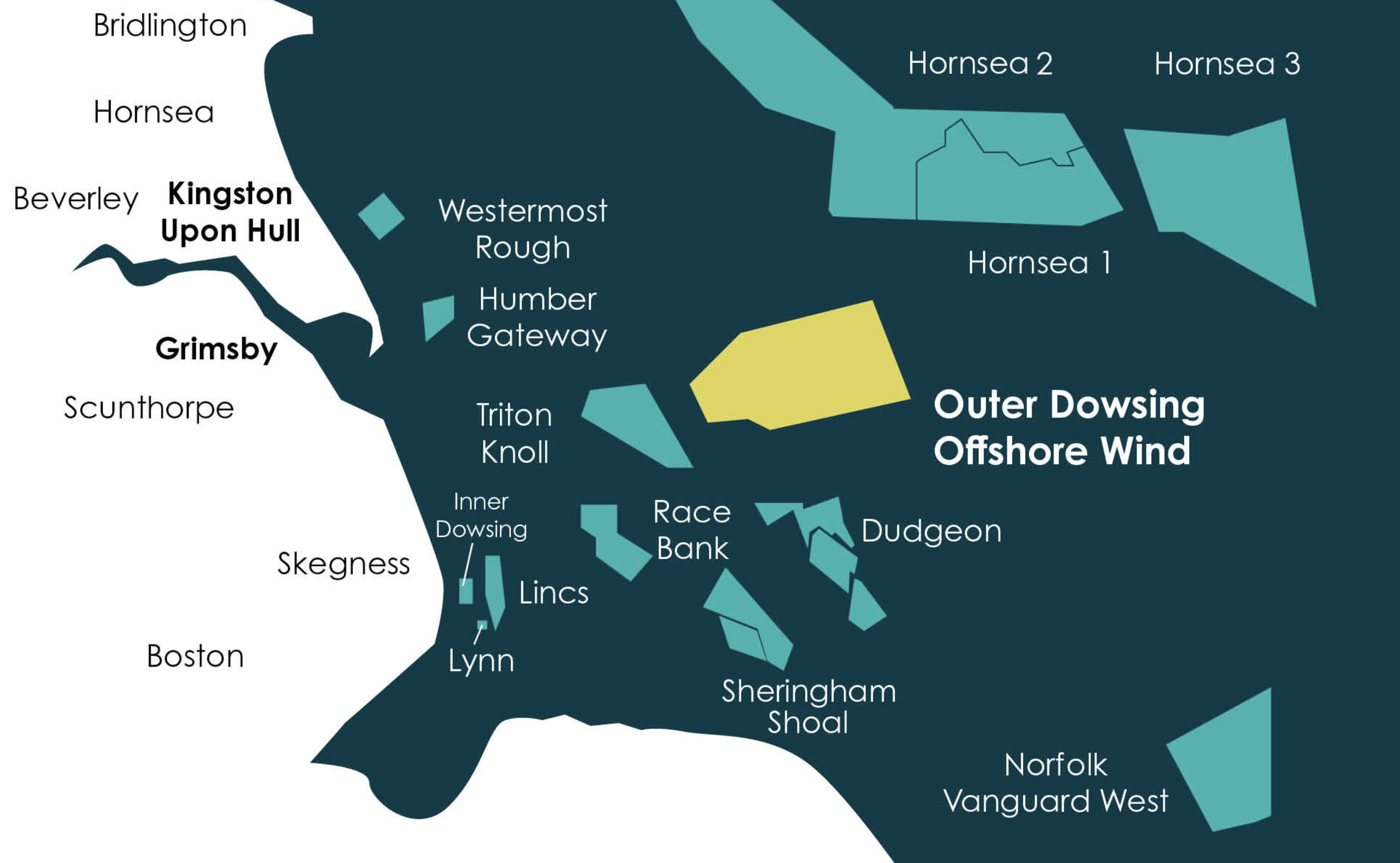
Plans Emerge For 8 GW Of Offshore Wind On Dogger Bank
Wikipedia has an entry, which is a List Of Offshore Wind Farms In The United Kingdom.
The totals are worth a look.
- Operational – 13279 MW
- Under Construction – 4125 MW
- Proposed Under The UK Government’s Contracts For Difference Round 3 – 2412 MW
- Proposed Under The UK Government’s Contracts For Difference Round 4 – 7026 MW
- Exploratory Phase, But No Contract for Difference – Scotland – 24,826 MW
- Exploratory Phase, But No Contract for Difference – England – 14,500 MW
Note.
- That gives a Grand Total of 66,168 MW or 66.168 GW.
- The government’s target is 50 GW of offshore wind by 2030.
- The typical UK power need is around 23 GW, so with nuclear and solar, we could be approaching three times the electricity generation capacity that we currently need.
The figures don’t include projects like Berwick Bank, Cerulean Wind, Norfolk Vanguard or Northern Horizons, which are not mentioned in Wikipedia’s list.
I regularly look at the list of wind farms in this Wikipedia entry and noticed that the number of Dogger Bank wind farms had increased.
They are now given as.
- Dogger Bank A – 1200 MW – Completion in 2023/24
- Dogger Bank B – 1200 MW – Completion in 2024/25
- Dogger Bank C – 1200 MW – Completion in 2024/25
- Dogger Bank D – 1320 MW – No Completion Given
- Dogger Bank South – 3000 MW – No Completion Given
Note, that gives a Grand Total of 7920 MW or 7.920 GW.
This article on offshoreWIND.biz is entitled BREAKING: SSE, Equinor Plan 1.3 GW Dogger Bank D Offshore Wind Project.
It was published on the October 6th, 2022 and starts with this summary.
SSE Renewables and Equinor are looking into building what would be the fourth part of Dogger Bank Wind Farm, the world’s largest offshore wind farm, whose three phases (A, B and C) are currently under construction. Surveys are now underway at an offshore site where the partners want to develop Dogger Bank D, which would bring Dogger Bank Wind Farm’s total capacity to nearly 5 GW if built.
Obviously, there are a few ifs and buts about this development, but it does look like SSE Renewables and Equinor are serious about developing Dogger Bank D.
More Dogger Bank Gigawatts for UK As RWE Moves Forward With Two 1.5 GW Projects
This subheading describes, the 3 GW wind farm, that I listed earlier as Dogger Bank South.
These three paragraphs describe the projects.
RWE is now moving forward with two new offshore wind farms in the Zone, each with a 1.5 GW generation capacity, after the company obtained approval from the UK Secretary of State for Business, Energy and Industrial Strategy (BEIS) to enter into an Agreement for Lease with The Crown Estate this Summer, following the Round 4 leasing process.
The wind farms will be built at two adjacent sites located just southwest of the Dogger Bank A offshore wind farm and are dubbed Dogger Bank South (DBS) East and Dogger Bank South (DBS) West.
RWE has also started with geophysical seabed surveys within the wind turbine array areas for its two new projects.
It appears that they have already got the leasing process started.
When Will Dogger Bank D And Dogger Bank South Be Operational?
Consider.
- In How Long Does It Take To Build An Offshore Wind Farm?, showed that a lot of offshore wind farms have gone from planning permission to first operation in six years.
- I don’t think that there will be planning permission problems on the Dogger Bank.
- The two wind farms are a continuation of Dogger Bank A, B and C and the Sofia wind farms.
- A lot of the construction, would be more of the same.
With average luck, I can see Dogger Bank D and Dogger Bank South in full production before the end of 2028.
Is There A Virtuous Circle In The Installation Of Wind Farms?
Because we are developing so much offshore wind turbine capacity, this will result in two things.
- A big demand for steel for the foundations and floats for wind turbines.
- A large amount of electricity at a good price.
In my view the UK would be the ideal country to develop an integrated steel and wind turbine foundation/float capability.
There will also be a strong demand for deep water ports and sea lochs to assemble the floating turbines.
Our geography helps in this one. We also have Milford Haven, which is just around the corner from Port Talbot. Scunthorpe is on the River Trent, so could we assemble floats and foundations and take them by barge for assembly or installation.
We probably need an integrated capability in Scotland.
Conclusion
It looks to me, that there is a virtuous circle.
- The more offshore wind turbine capacity we install, the more affordable electricity we will have.
- This will in turn allow us to make more steel.
- If this steel was produced in an integrated factory producing foundations and floats for wind farms, this would complete the circle.
- It would also be inefficient to make the foundations thousands of miles away and tow them to UK waters.
Any improvements in costs and methods, would make the system more efficient and we would have more wind turbines installed.
It looks to be a good idea.
Do All Wind Turbines Have To Be Similar?
I feel this is a reasonable question to ask.
But do all wind turbines have to look like those in this picture?
Wikipedia lists three main types.
- Horizontal Axis – Those in the picture are of this type, as are all the large wind turbines I’ve seen in operation.
- Vertical Axis – Wikipedia shows several examples.
- Unconventional Types
Recently, I have come across some which would be placed in the last group.
Hybrid Offshore Wind And Wave Energy Systems
This article on the Journal of Physics is entitled Review of Hybrid Offshore Wind and Wave Energy Systems, is a study from serious academics.
This is the abstract.
Hybrid wind wave systems combine offshore wind turbines with wave energy on a shared platform. These systems optimize power production at a single location by harnessing both the wind and the waves. Wave energy is currently at an earlier development stage than offshore wind. Research in this area is focused in wave energy converters being used for platform motion suppression of floating offshore wind turbines. Wave energy converters can passively shelter offshore wind turbines from waves and can also be actively controlled to reduce the system loads. Additionally, a small amount of supplemental power may be generated, which can be used for offshore wind turbine local power needs. There may be future benefits to these hybrid systems, but at this stage wave energy may increase the project cost and risk of offshore wind turbines. Hybrid wind wave system research and development is discussed, with a focus on floating offshore wind turbines. Additionally, two ocean demonstration scale hybrid wind and wave systems are discussed as case studies: the Poseidon Wave and Wind system and the W2Power system. Hybrid wind wave systems show potential to be part of the future of offshore wind energy.
Note.
- Wave energy development is at an earlier stage than offshore wind.
- Wave energy converters can passively shelter offshore wind turbines from waves and can also be actively controlled to reduce the system loads.
- There is more about Poseidon on this page on the Tethys web site.
- There is more about W2Power on the Pelagic Power web site.
The last sentence of the abstract is significant and I believe that hybrid offshore wind and wave energy will play a significant part in the future of offshore energy.
Wind Turbines With Added Storage
Critics and cynics of wind power always ask, what happens, when the wind doesn’t blow.
It is generally accepted, that the best thing to do is to pair a wind farm with some form of energy storage.
Technologies and solar and/or wind farms with energy storage are starting to be proposed and/or installed.
- In Cleve Hill Solar Park, I wrote about a solar farm, a wind farm and a battery sharing a grid connection.
- In First Ever Gravity Green Energy Storage System Set For North Yorkshire Town, I wrote about a battery being installed where two massive wind farms connect to the grid.
- In How To Store Excess Wind Power Underwater, I describe a Dutch system called an Ocean Battery.
- In UK Cleantech Consortium Awarded Funding For Energy Storage Technology Integrated With Floating Wind, I wrote about adding Marine Pumped Hydro to offshore wind farms.
More energy storage will be added in the future in or near to wind and solar farms.
Twin Turbines
This document from the Department of Business, Industry and Industrial Strategy lists all the Contracts for Difference Allocation Round 4 results for the supply of zero-carbon electricity.
One of the projects allocated a Contract for Difference, was the 32 MW TwinHub wind turbine, which I wrote about in Hexicon Wins UK’s First Ever CfD Auction For Floating Offshore Wind.
A full scale twin turbine hasn’t been built yet, but it does seem promising and the visualisations are impressive.
Scroll down on the TwinHub home page to see a video.
World Wide Wind
I’ll let the images on the World Wide Wind web site do the talking.
But who would have thought, that contrarotating wind turbines, set at an angle in the sea would work?
This is so unusual, it might just work very well.
Conclusion
There will be other unusual concepts in the future.
Ørsted Signs Two ‘Industry First’ Monopile Contracts For Hornsea 3 Foundations
The title of this post, is the same as that of this press release from Ørsted.
This is the introductory paragraph.
Ørsted, the world’s most sustainable energy company, has signed two ‘industry first’ contracts for the fabrication of XXL monopile foundations for the Hornsea 3 offshore wind farm.
I have a few thoughts about the press release.
XXL Monopile Foundations
These four paragraphs describe Hornsea 3’s XXL monopile foundations.
Subject to Ørsted taking a Final Investment Decision on Hornsea 3, the contracts have been finalised with Haizea Wind Group, through its subsidiary Haizea Bilbao, and SeAH Wind Limited, a UK-based subsidiary of SeAH Steel Holdings (SeAH).
Ørsted will be the first major customer at SeAH Wind’s new monopile facility in Teesside, and the agreement with Haizea marks the company’s first XXL monopile contract with Ørsted.
The deal with SeAH represents the single largest offshore wind foundations contract secured by any UK company. Haizea’s agreement is the largest single contract ever secured by Haizea Wind Group.
Each of the huge foundation structures for Hornsea 3 will weigh between 1,300 and 2,400 tonnes and measure in at between 83 and 111 metres in length. Monopile production is expected to start in 2024.
Note
- These are huge steel structures.
- But then the water depth appears to be between 36 and 73 metres.
- It looks like the orders are shared between Spanish and Korean companies
This article on offshoreWIND.biz, is entitled Beyond XXL – Slim Monopiles For Deep-Water Wind Farms.
These are some points from the article.
- XXL-Monopiles have been successfully used for water depths of up to 40 metres. Now wind farm developers need monopiles “beyond XXL”.
- The extension of the range is needed, mainly to enable the use of larger turbines, deeper water, and harsher environmental situations.
- These monopiles will allow turbines of up to 15 megawatts with rotor diameters of up to 230 metres.
- This monopile design automatically induces the idea of design and fabrication optimisation to ensure that monopiles continue to lead the ranking of most economical foundation systems.
In the 1970s, I was involved with a Cambridge University spin-out company called Balaena Structures, who were using similar much larger structures to support oil and gas production platforms.
I was just doing calculations, but I do wonder if these XXL monopile foundations, owe things in their design to work done by structural engineers, like those I met at Cambridge fifty years ago.
Ørsted Completes 50% Stake Sale In Hornsea 2 To French Team
The title of this post, is the same as that of this article on Renewables Now.
This sale was outlined in this press release from Ørsted in March, where this is the first paragraph.
Ørsted has signed an agreement to divest a 50 % ownership stake in its 1.3 GW Hornsea 2 Offshore Wind Farm in the UK to a consortium comprising AXA IM Alts, acting on behalf of clients, and Crédit Agricole Assurances.
Insurance companies must like wind power, as Aviva backed Hornsea 1 wind farm. I wrote about this in World’s Largest Wind Farm Attracts Huge Backing From Insurance Giant.
It looks like the French feel the same way as Aviva about Ørsted’s Hornsea wind farms.
There is no safer mattress in which to stash your cash.
Accelerating The Delivery Of Offshore Wind Farms
It is one of Kwasi Kwarteng’s ambitions to accelerate the delivery of offshore wind farms.
In The Growth Plan 2022, these groups of wind farms are mentioned.
- Remaining Round 3 Projects
- Round 4 Projects
- Extension Projects
- Scotwind Projects
- INTOG Projects
- Floating Wind Commercialisation Projects
- Celtic Sea Projects
My thinking in this post, will probably apply to all of these groups.
These are my thoughts.
Accelerating Delivery Of A Wind Farm
This will have these positive effects.
- Electricity will be delivered earlier.
- Customers will have a more secure supply of electricity.
- The wind farm owner will start to be paid for their electricity.
- The Crown Estate will start to be paid for their leases. Although, these might start at signing.
- National Grid will be paid for the transmission of the electricity.
- An energy storage company could be paid for storing surplus electricity.
- Construction teams and engineers can move on to the next project.
- Expensive construction hardware like ship-mounted cranes will no longer be needed.
- I also suspect that the government will raise some taxes from the various companies involved.
It looks like it’ll be winners all round.
How Will Delivery Be Accelerated?
These are some thoughts.
Overall Project Time
In How Long Does It Take To Build An Offshore Wind Farm?, I came to these conclusions.
- It will take six years or less from planning consent to commissioning.
- It will take two years or less from the start of construction to commissioning.
I suspect that as we have been building offshore wind farms for some years, that it will be very difficult to reduce these times significantly.
But as some wind farms take quite a few years to progress from the initial proposal to planning consent, I suspect that improvements to the planning process may speed up the overall construction time of a wind farm.
Project And Resource Management
Good project and resource management will always help.
Better Design And Construction Methods
I always remember in the early days of North Sea Oil, being told by a very experienced project manager that construction of production platforms was accelerated by the availability of larger and more powerful cranes.
Are we approaching the design of the ultimate wind farm? I doubt it, as in the last few months, I’ve seen two very radical new designs.
In Hexicon Wins UK’s First Ever CfD Auction For Floating Offshore Wind, I show this image of one of their TwinHub turbine installations being towed into place.
The TwinHub home page has a title of The First Floating Offshore Wind Project in The Celtic Sea.
This is the description on the page.
The TwinHub offshore wind demonstration project intends to prove how Hexicon’s innovative design with two turbines on one floating foundation can further reduce the Levelized Cost of Energy (also referred to as LCoE) before large scale commercialisation. The TwinHub project is a stepping stone to help kick-start floating wind in the Celtic Sea, an area identified as a hotspot for floating wind by the UK Government. It will pave the path for larger and larger projects to help support The Crown Estates’ ambitious target of 4GW of floating wind in the Celtic Sea.
Scroll the page down and there is a fascinating short video of a pair of wind turbines in operation.
- It appears that when there is no wind, it automatically goes into a safe parked mode.
- As the wind rises, one turbine starts up.
- The second turbine starts up and the float turns so they face the wind.
It appears to be a classic example of disruptive innovation.
I have a feeling that this type of installation might have generation, assembly and cost advantages over a single turbine mounted on a single float.
RCAM Technologies are also creating interesting designs for mounting turbines and energy storage using 3D-printed concrete.
What Ts The UK Government Doing To Accelerate Projects?
This article on offshoreWIND.biz, was published in late September 2022 and is entitled BREAKING: UK Puts Massive Amount Of New Offshore Wind Capacity On Fast Track and this is the first paragraph.
The UK will speed up planning and development consent processes for projects from the recently completed, currently ongoing, and upcoming (floating) offshore wind leasing rounds to bring new energy capacity online faster and facilitate economic growth and job creation.
The article is based on what Kwasi Kwateng said on the 23rd of September about speeding up projects in the 2022 Growth Plan.
A Quick Summary Of Our Wind Energy
The article has this paragraph, which summarises our wind energy.
For the UK, which currently has around 14 GW of offshore wind capacity in operation and 8 GW under construction, the projects from the listed auction rounds could bring well beyond the targeted capacity for 2030, which was recently raised to 50 GW.
I can see the target being raised again to at least 60 GW.
An Update To Will We Run Out Of Power This Winter?
My Methods
Project Timescales For Wind Farms
In How Long Does It Take To Build An Offshore Wind Farm?, I came to these conclusions.
- It will take six years or less from planning consent to commissioning.
- It will take two years or less from the start of construction to commissioning.
I shall use these timescales, as any accelerations by the government, will only reduce them.
Dates
If a date is something like 2024/25, I will use the latest date. i.e. 2025 in this example.
The Update
In Will We Run Out Of Power This Winter?, which I wrote in July this year, I did a calculation of how much renewable energy would come on stream in the next few years.
I summarised the amount of new renewable energy coming on stream like this.
- 2022 – 3200 MW
- 2023 – 1500 MW
- 3024 – 2400 MW
- 2025 – 6576 MW
- 2026 – 1705 MW
- 2027 – 7061 GW
This totals to 22442 MW.
But I had made two omissions.
- Hornsea 3 wind farm will add 2582 MW in 2026/27.
- Hinckley Point C nuclear power station will add 3260 MW in 2027.
Ørsted have also brought forward the completion date of the Sofia wind farm to 2023, which moves 1400 GW from 2024 to 2023.
The new renewables summary figures have now changed to.
- 2022 – 3200 MW
- 2023 – 2925 MW
- 3024 – 1326 MW
- 2025 – 6576 MW
- 2026 – 1705 MW
- 2027 – 13173 MW
This totals to 28554 MW.
Note.
- The early delivery of the Sofia wind farm has increased the amount of wind farms coming onstream next year, which will help the Winter of 2023/2024.
- It will also help the Liz Truss/Kwasi Kwarteng government at the next election, that should take place in early 2025.
- Hornsea 3 and Hinckley Point C make 2027 a big year for new renewable energy commissioning.
By 2027, we have more than doubled our renewable energy generation.
The Growth Plan 2022
In this document from the Treasury, the following groups of wind farms are listed for acceleration.
- Remaining Round 3 Projects
- Round 4 Projects
- Extension Projects
- Scotwind Projects
- INTOG Projects
- Floating Wind Commercialisation Projects
- Celtic Sea Projects
I will look at each in turn.
Remaining Round 3 Projects
In this group are the the 1200 MW Dogger Bank B and Dogger Bank C wind farms, which are due for commissioning in 2024/25.
Suppose that as with the Sofia wind farm in the same area, they were to be able to be brought forward by a year.
The new renewables summary figures would change to.
- 2022 – 3200 MW
- 2023 – 2925 MW
- 3024 – 3726 MW
- 2025 – 5076 MW
- 2026 – 1705 MW
- 2027 – 13173 MW
This totals to 28554 MW.
It looks like if Dogger Bank B and Dogger Bank C can be accelerated by a year, it has four effects.
- The renewables come onstream at a more constant rate.
- SSE and Equinor, who are developing the Dogger Bank wind farms start to get paid earlier.
- The UK gets more electricity earlier, which helps bridge the gap until Hornsea 3 and Hinckley Point C come onstream in 2027.
- The UK Government gets taxes and lease fees from the Dogger Bank wind farms at an earlier date.
Accelerating the remaining Round 3 projects would appear to be a good idea.
Round 4 Projects
According to Wikipedia’s list of proposed wind farms, there are six Round 4 wind farms, which total up to 7026 MW.
Accelerating these projects, is probably a matter of improved government regulations and pressure, and good project management.
But all time savings in delivering the wind farms benefits everybody all round.
This document from the Department of Business, Industry and Industrial Strategy lists all the Contracts for Difference Allocation Round 4 results for the supply of zero-carbon electricity.
Many of these projects are smaller projects and I suspect quite a few are shovel ready.
But as with the big wind farms, there are some projects that can be brought forward to everybody’s benefit.
Norfolk Boreas
Norfolk Boreas wind farm is one of the Round 4 projects.
The wind farm is shown as 1400 MW on Wikipedia.
On the web site, it now says construction will start in 2023, which could mean a completion by 2025, as these projects seem to take about two years from first construction to commissioning, as I showed in How Long Does It Take To Build An Offshore Wind Farm?.
The new renewables summary figures would change to.
- 2022 – 3200 MW
- 2023 – 2925 MW
- 3024 – 3726 MW
- 2025 – 6476 MW
- 2026 – 1705 MW
- 2027 – 11773 MW
This still totals to 28554 MW.
This acceleration of a large field would be beneficial, as the 2025 figure has increased substantially.
I would suspect that Vattenfall are looking hard to accelerate their Norfolk projects.
Extension Projects
I first talked about extension projects in Offshore Wind Extension Projects 2017.
The target was to add 2.85 GW of offshore wind and in the end seven projects were authorised.
- Sheringham Shoal offshore wind farm – 719 MW with Dudgeon
- Dudgeon offshore wind farm – 719 MW with Sheringham Shoal
- Greater Gabbard offshore wind farm
- Galloper offshore wind farm
- Rampion offshore wind farm – 1200 MW
- Gwynt y Môr offshore wind farm – 1100 MW
- Thanet offshore wind farm – 340 MW
These are the best figures I have and they add up to an interim total of 3359 MW.
I suspect that these projects could be easy to accelerate, as the developers have probably been designing these extensions since 2017.
I think it is reasonable to assume that these seven wind farms will add at least 3000 MW, that can be commissioned by 2027.
The new renewables summary figures would change to.
- 2022 – 3200 MW
- 2023 – 2925 MW
- 3024 – 3726 MW
- 2025 – 6476 MW
- 2026 – 1705 MW
- 2027 – 14773 MW
This now totals to 31554 MW.
Accelerating the extension projects would be a good idea, especially, as they were awarded some years ago, so are probably well into the design phase.
ScotWind Projects
I first talked about ScotWind in ScotWind Offshore Wind Leasing Delivers Major Boost To Scotland’s Net Zero Aspirations.
It was planned to do the following.
- Generate 9.7 GW from six wind farms with fixed foundations.
- Generate 14.6 GW from ten floating wind farms.
But since then three more floating wind farms with a total capacity of 2800 MW have been added, as I wrote about in Three Shetland ScotWind Projects Announced.
I suspect that some of these projects are ripe for acceleration and some may well be generating useful electricity by 2030 or even earlier.
INTOG Projects
I wrote about INTOG in What Is INTOG?.
I can see the INTOG Projects contributing significantly to our fleet of offshore wind turbines.
I have already found a 6 GW/£30 billion project to decarbonise oil and gas rigs around our shores, which is proposed by Cerulean Winds and described on this web page.
If the other large INTOG projects are as good as this one, then we’ll be seeing some sensational engineering.
Floating Wind Commercialisation Projects
This page on the Carbon Trust website is entitled Floating Wind Joint Industry Programme (JIP).
They appear to be very much involved in projects like these.
The page has this description.
The Floating Wind Joint Industry Programme is a world leading collaborative research and development (R&D) initiative dedicated to overcoming technological challenges and advancing commercialisation of floating offshore wind.
This graphic shows the partners and advisors.
Most of the big wind farm builders and turbine and electrical gubbins manufacturers are represented.
Celtic Sea Projects
The Celtic Sea lies between South-East Ireland, Pembrokeshire and the Devon and Cornwall peninsular.
The Crown Estate kicked this off with press release in July 2022, that I wrote about in The Crown Estate Announces Areas Of Search To Support Growth Of Floating Wind In The Celtic Sea.
This map shows the five areas of search.
One Celtic Sea project has already been awarded a Contract for Difference in the Round 4 allocation, which I wrote about in Hexicon Wins UK’s First Ever CfD Auction For Floating Offshore Wind.
Other wind farms have already been proposed for the Celtic Sea.
In DP Energy And Offshore Wind Farms In Ireland, I said this.
They are also developing the Gwynt Glas offshore wind farm in the UK sector of the Celtic Sea.
- In January 2022, EDF Renewables and DP Energy announced a Joint Venture partnership to combine their knowledge and
expertise, in order to participate in the leasing round to secure seabed rights to develop up to 1GW of FLOW in the Celtic Sea. - The wind farm is located between Pembroke and Cornwall.
The addition of Gwynt Glas will increase the total of floating offshore wind in the UK section of the Celtic Sea.
- Blue Gem Wind – Erebus – 100 MW Demonstration project – 27 miles offshore
- Blue Gem Wind – Valorus – 300 MW Early-Commercial project – 31 miles offshore
- Falck Renewables and BlueFloat Energy – Petroc – 300 MW project – 37 miles offshore
- Falck Renewables and BlueFloat Energy – Llywelyn – 300 MW project – 40 miles offshore
- Llŷr Wind – 100 MW Project – 25 miles offshore
- Gwynt Glas – 1000 MW Project – 50 miles offshore
This makes a total of 2.2 GW, with investors from several countries.
It does seem that the Celtic Sea is becoming the next area of offshore wind around the British Isles to be developed.
How do these wind farms fit in with the Crown Estate’s plans for the Celtic Sea?
I certainly, don’t think that the Crown Estate will be short of worthwhile proposals.
Conclusion
More and more wind farms keep rolling in.
Offshore Wind Extension Projects 2017
Surely this is old news from five years ago.
This page on the Crown Estate web site, starts with this statement.
Extensions to operational wind farms have proven to be a successful way of efficiently developing more offshore generating capacity.
I can accept that as a sensible policy.
In Wikipedia’s list of UK offshore wind farms, there are three farms; Beatrice Extension, Burbo Bank Extension and Walney Extension with Extension in their name, producing 1.5 GW of electricity.
The page then explains what the Crown Estate did in 2017 and what has happened since.
In February 2017 The Crown Estate launched an opportunity for existing wind farms to apply for project extensions. This opportunity closed in May 2018, with eight project applications received, all of which met our specified application criteria.
Since then, The Crown Estate has undertaken a plan level Habitats Regulations Assessment (HRA), to assess the possible impact of the proposed windfarm extensions on relevant nature conservation sites of European importance. Throughout the assessment process, The Crown Estate was supported by expert independent advisors, and consulted with the statutory marine planning authorities, the statutory nature conservation bodies and a number of non-governmental stakeholders.
In August 2019, The Crown Estate announced the conclusion of the HRA, confirming that seven of the 2017 extension application projects, representing a total generating capacity of 2.85GW, would progress to the award of development rights.
Note.
- They did a lot of consulting.
- Seven projects, which total 2.85 GW or about 400 MW per extension have received development rights.
The projects are.
- Sheringham Shoal offshore wind farm – 719 MW with Dudgeon
- Dudgeon offshore wind farm – 719 MW with Sheringham Shoal
- Greater Gabbard offshore wind farm
- Galloper offshore wind farm
- Rampion offshore wind farm – 1200 MW
- Gwynt y Môr offshore wind farm – 1100 MW
- Thanet offshore wind farm – 340 MW
Note.
- Where I have a figure, it’s on the right.
- They already seem to have exceeded the Crown Estate’s figure.
- But then if they go large or accelerate the project, the developers will make more money. The upside of that is we get more electricity earlier.
These seven Extension projects are being accelerated by the Government in the 2022 Growth Plan.
How Long Does It Take To Build An Offshore Wind Farm?
These are some timescales and costs for the construction of some wind farms.
East Anglia One
East Anglia One is a 714 MW offshore wind farm, which consists of 102 turbines on fixed foundations, in a maximum water depth of 53 metres.
- Planning consent – June 2014.
- Contracts – April 2016
- Offshore construction – June 2018
- Commissioned – July 2020
It is expected to cost £2.5 billion.
Hornsea One
Hornsea One is a 1200 MW offshore wind farm, which consists of 174 turbines on fixed foundations, in a maximum water depth of 30 metres.
- Planning consent – April 2014.
- Contracts – March/April 2016
- Offshore construction – January 2018
- Commissioned – March 2020
It is expected to cost £4.2 billion.
Hornsea Two
Hornsea Two is a 1400 MW offshore wind farm, which consists of 165 turbines on fixed foundations, in a maximum water depth of 30 metres.
- Planning consent – August 2016.
- Offshore construction – 2020
- Commissioned – August 2022
I can’t find any costs.
Moray East
Moray East is a 950 MW offshore wind farm, which consists of 100 turbines on fixed foundations, in a maximum water depth of 50 metres.
- Planning consent – 2014.
- Financial Close – December 2018
- Offshore construction – July 2020
- Commissioned – July 2022
It is expected to cost £2.6 billion.
Keadby Wind Farm
Keadby Wind Farm is a 68 MW onshore wind farm, which consists of 34 turbines.
SSE says this about its construction timescale.
After receiving planning permission in 2008, construction began in 2012 and the first turbine foundation was complete in February 2013. The final turbine was assembled on 11 December 2013 and the project was completed in summer 2014.
I can’t find any costs.
Can I Deduce Anything?
Two things are similar on the four fixed-foundation offshore wind farms.
Planning Consent To Commissioning Seems To Take About Six To Eight Years
Moray East took eight years and the other three took six.
In addition Keadby onshore wind farm took six years.
This indicates to me, that any improvements to the planning process for wind farms could shorten the planning process for many wind farms and allow offshore construction of these wind farms to start earlier.
The Start Of Offshore Construction To commissioning Seems To Take About Two Years
It surprised me that it takes twice as long to go from planning to the start of offshore construction, than to actually build and commission the offshore components of the project.
In addition Keadby onshore wind farm took two years.
How will these two observations affect floating wind farms, which could be more numerous in the future?
The home page of the Principle Power web site, shows a floating wind turbine being constructed and floated out.
- The turbine and its float are assembled in a deep water dock, using a large crane mounted on the dock.
- This dockside assembly must be less dependent on good weather, than doing assembly onto a fixed foundation forty miles or more out to sea.
I wouldn’t be surprised to find that floating wind farms may have substantial health and safety, and construction advantages, but I doubt they’d save much time on the current two years of offshore construction.
But I suspect, they would be one of these types of project that would only rarely be late.
Assembly And Project Management Issues
As with many types of construction, I suspect good project management will be key to building both fixed-foundation and floating offshore wind farms.
For fixed-foundation wind farms, a steady stream of turbines, foundations, substations and connecting cables would need to be delivered to a tight schedule to the assembly point offshore, where turbines, foundations, substations and connecting cables would be lifted into place by a crane mounted on a barge or ship.
For floating wind farms, a steady stream of turbines, floats and probably some connecting cables would need to be delivered to a tight schedule to the assembly dock in a convenient port, where turbines would be lifted onto floats by a crane mounted on the dock. Once complete, the floating wind turbines would be towed into position, anchored and connected to the offshore sub-station.
- No large offshore crane would be needed.
- The dockside crane could be sized for the largest turbines.
- Floating turbines would be brought back to the dockside for major serving and updating.
- One assembly dock could serve several wind farms during construction and operation.
Given that in the latest ScotWind leasing round, there was 17.4 GW of floating wind farms and 9.7 GW of fixed-foundation wind farms, which is 64/36 % split, I can see that the proportion of floating wind farms will increase.
Good project management, with particular attention to the rate of the production of critical components will be needed for both fixed-foundation and floating offshore wind farms.
Perhaps it would help, if we reduced the numbers of types of each components?
Would it be too far to imagine a British Standard float, that could handle any manufacturer’s turbine with a standard connecting cable? This is Plug-and-Play at the very heavy end.
Conclusion
Consider.
- As the floating wind technology matures, I can see the designs getting more affordable and the proportion of floating wind farms increasing dramatically.
- I also believe that in the future, it will take a shorter time to install, connect up and commission a wind farm.
This leads me to think, that in future, it is reasonable to make the following assumptions.
- It will take six years or less from planning consent to commissioning.
- It will take two years or less from the start of construction to commissioning.
Note.
- I’m assuming that better project management and improved government legislation, will tend to level down the times.
- Floating or fixed foundations doesn’t seem to make much difference.
The UK will become Europe’s zero-carbon power station.
UK Cleantech Consortium Awarded Funding For Energy Storage Technology Integrated With Floating Wind
The title of this post, is the same as that of this page on the UK Government’s Catapult Offshore Renewable Energy Web Site.
This is the introductory paragraph.
STORE, a UK-based cleantech consortium led by RCAM Technologies Limited, has been awarded £150,000 of funding to develop an advanced subsea energy storage technology manufactured using 3D printed concrete that could help offshore wind farms produce a steady and predictable energy output to the electricity grid.
This paragraph talks of the concept of Marine Pumped Hydro.
STORE is assessing the feasibility of integrating Marine Pumped Hydro (MPH) technology, which stores energy using hollow concrete spheres fitted with a hydraulic turbine and pump, with floating offshore wind plants in UK waters. In addition, the project advances the design of MPH systems and plans a prototype demonstration in the UK.
Note.
- The hollow concrete spheres are 3D-printed in concrete using the technology of RCAM Technologies.
- Spheres are structurally very strong.
- 3D printing of concrete is now mainstream technology and has been extensively used on the Elizabeth Line as I wrote about in The Story Behind The Concrete Panels On The Elizabeth Line.
- There is a visualisation on the Catapult web page, which shows several floating turbines, a floating sub station and several concrete hemispheres sitting on the seabed.
- The energy storage medium is sea water and air, which must be environmentally-friendly.
The technology is described in detail on this page of the STORE consortium web site.
- The spheres are fifteen metres across.
- The spheres can be installed at depths between 150 and 2000 metres.
- The system has a round-trip efficiency is up to 70%, which is similar to pumped storage hydro.
- The design life is 50 to 80 years.
I think that this system has possibilities.
This last paragraph in the Catapult web page gives a look into the future.
As well as improving the reliability and predictability of energy to the electricity grid, the project will support the cross sector transfer of UK offshore expertise and port infrastructure for use in renewable energy and create high-value UK jobs in engineering, construction, and operations and maintenance. This energy storage solution is ideally suited to coupling with floating wind plants and for powering offshore oil and gas assets from renewable energy. The 3D printed concrete also facilitates localized manufacturing and enables low cost fabrication of new and complex shapes that were previously not practical.
I also feel that if the concrete sphere energy storage can be made to successfully work, then the technology can surely be fitted to any offshore wind farm, by just adding the right number of spheres and connecting them to the offshore sub station.
The STORE Consortium
The STORE consortium has a web site, which has a heading of Innovative Subsea Energy Storage.
It describes the technology in this paragraph.
STORE is advancing a subsea energy storage technology called Marine Pumped Hydro (MPH). MPH uses large hollow concrete spheres on the seafloor to store mechanical energy in the form of pressure. MPH charges when seawater is pumped out of the spheres and releases energy to the grid when high-pressure water flows back into the spheres through a turbine. MPH features a patent-pending multi-sphere pod to increase the amount of energy stored and uses efficient 3D concrete printing to reduce manufacturing costs.
It sounds like an engineer with children, has been playing with them and their plastic toys in a bath and has had an Archimedes moment.
The project and its funding is described in this paragraph.
STORE was awarded £150,000 from the Department for Business, Energy & Industrial Strategy Longer Duration Energy Storage Demonstration (LODES) competition. Phase 1 will deliver a Feasibility Study focused on the design and analyses for the UK. Phase 2, if awarded, will design, manufacture, and operate a prototype system at TRL 6.
Note that TRL 6 is Technology Readiness Level 6 and is fully defined on this NASA web page, as having a fully functional prototype or representational model.
There is also an interesting link to the ScotWind N3 wind farm. that I wrote about in ScotWind N3 Offshore Wind Farm.
- This is an unusual floating wind farm with a floating substation.
- Technip and Loch Kishorn port are involved in both the wind farm and STORE.
- Loch Kishorn has a history of building immense concrete structures.
I wouldn’t be surprised if this wind farm would be the location of the prototype system.
Conclusion
This is a brilliant concept.
- It is the ideal energy storage system for offshore wind, as it can turn a wind farm with a variable output into one with a much more constant output.
- It can be retrofitted to existing offshore wind farms.
- It will work with both fixed and floating wind farms.
- The concrete storage spheres can be fully assembled with all their electrical gubbins on shore and towed out, before sinking in the required position.
It also looks like the Department for Business, Energy & Industrial Strategy have got involved and helped with the funding. Someone there seems to know a good idea, when they see it!