Footage Released Of East West Rail’s First Commercial Freight Train
The title of this post, is the same as that of this news item from Network Rail.
These four paragraphs give detail to the story.
The inaugural journey was part of a dual first, as it also saw the entry into service of Maritime Transport’s Northampton Gateway Terminal.
This Easter Network Rail completed its work there to join the 35-acre freight facility directly to the West Coast Main Line via the Northampton Loop.
The modern junction design allows freight trains to enter and exit the site at speeds of up to 40mph, which is eight times faster than conventional freight connections.
Clearing the railway junction much faster will significantly improve both passenger and freight journeys – as it reduces the impact on other services running on the main line.
This OpenRailwayMap shows the location of Maritime Transport’s Northampton Gateway Terminal.
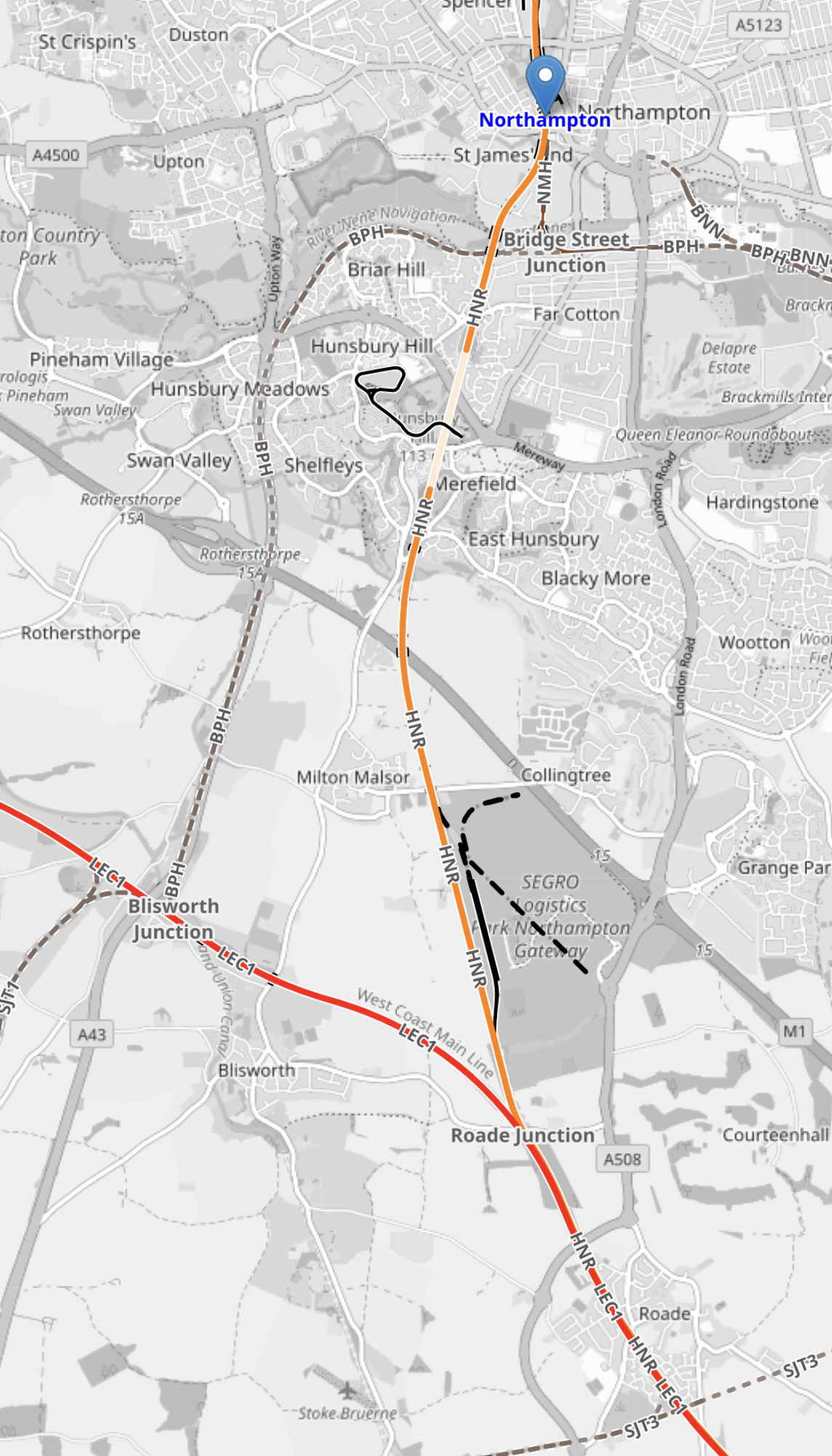
Note.
- The red track running diagonally across the bottom half of the map is the West Coast Main Line.
- The orange track running North-South is the Northampton Loop of the West Coast Main Line.
- The blue arrow indicates Northampton station.
- The grey line running diagonally across the map, vaguely parallel to the West Coast Main Line is the M1 Motorway.
- The SEGRO Logistics Park Northampton Gateway is indicated between the Northampton Loop and the M1 Motorway.
This Google Map shows the layout of the logistics park to a larger scale.
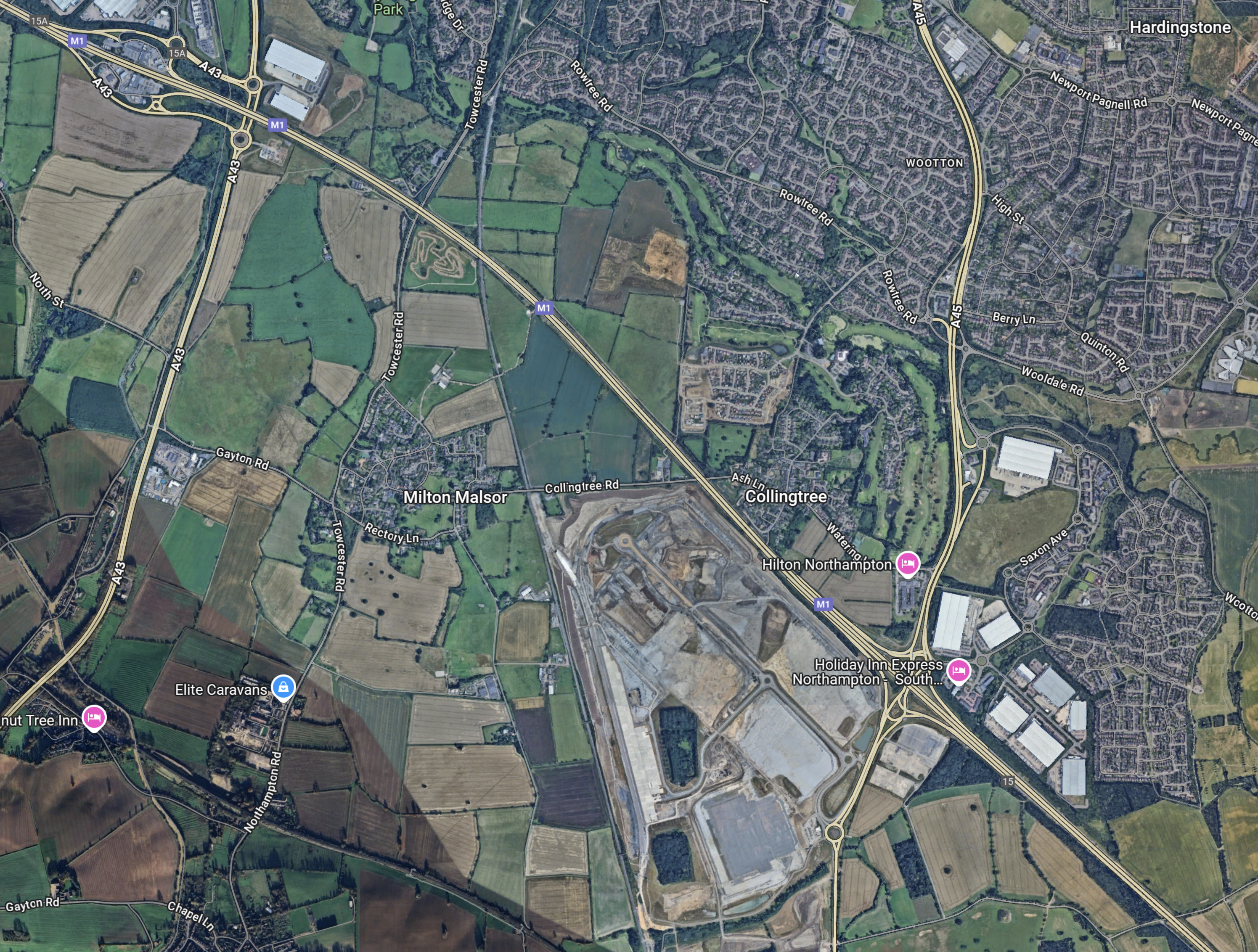
Note.
- The Northampton Loop of the West Coast Main Line running North-South across the map.
- The M1 Motorway running between the North-West and South-East corners of the map.
- Junction 15 is the M1 junction in the South-East corner of the map which connects the logistics park and the A45 to the M1.
- Junction 15A is the M1 junction in the North-West corner of the map which connects the A43 and Northampton services to the M1.
- There is probably space to add more warehouses and other facilities.
The logistics park is well connected to both rail and road.
This second Google Map shows the rail connection to the logistics park in more detail.
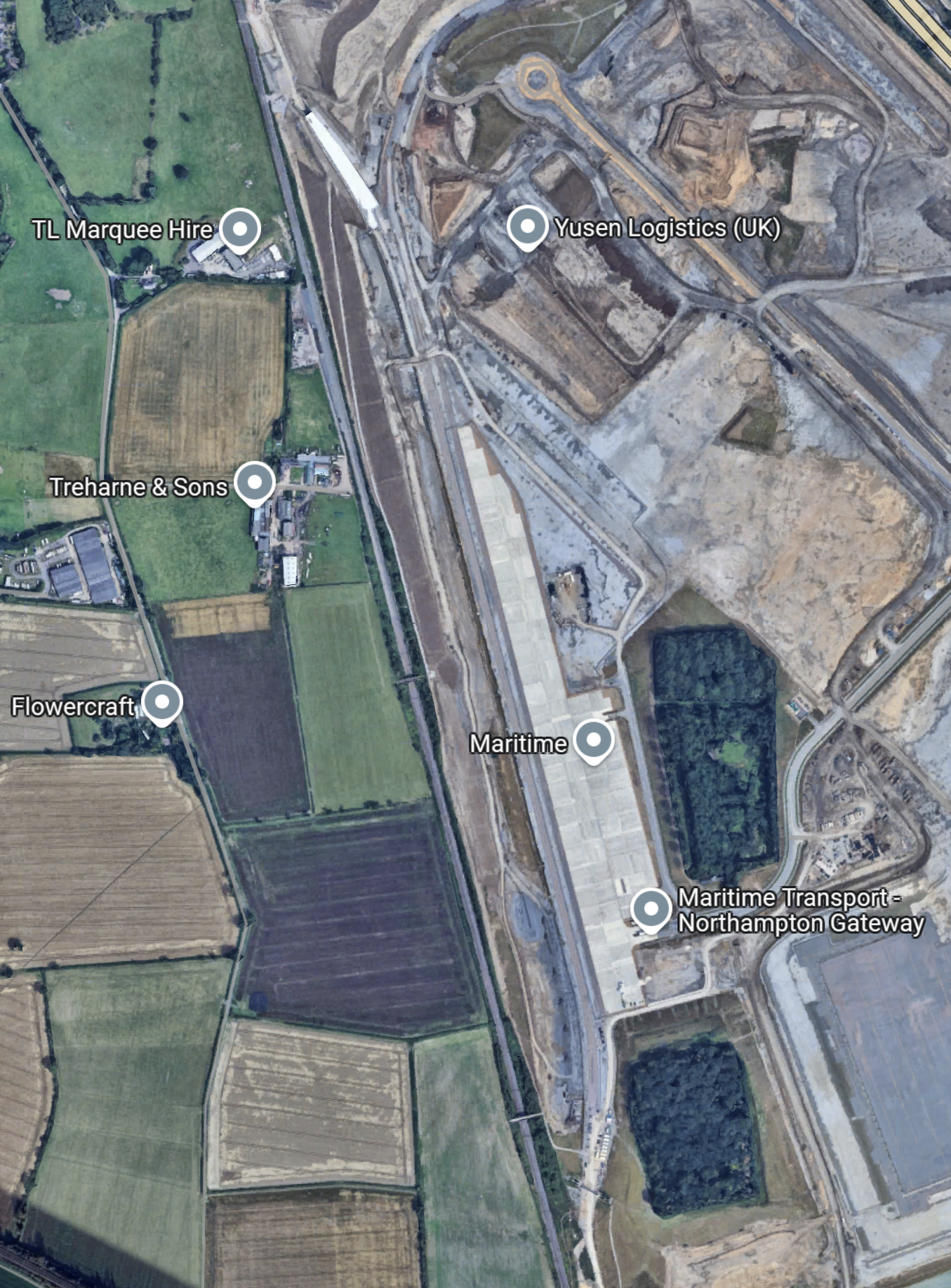
From this map, it appears that Network Rail have met their objective outlined in this paragraph of the news item.
The modern junction design allows freight trains to enter and exit the site at speeds of up to 40mph, which is eight times faster than conventional freight connections.
As only freight trains and slower passenger trains use the Northampton Loop, I would expect that freight trains should be able to enter and leave the logistics park with the minimum of disruption to traffic on the Northampton Loop.
The Route Of Yesterday’s Train
These three paragraphs from the Network Rail news item describe the route.
The first commercial freight train has travelled along the East West Rail line as part of its journey into a new strategic rail freight interchange in Northampton.
Shortly after 13:00 yesterday (Monday 16 June) the service* from Didcot came onto the new infrastructure at Oxford, travelling the 35 miles to Milton Keynes to connect with the West Coast Main Line.
It marked the first time East West Rail infrastructure has been used for commercial freight, after many months of signaller training and train driver learning since the £1.2bn railway was completed in October 2024.
This OpenRailwayMap shows the route from Didcot to Milton Keynes.
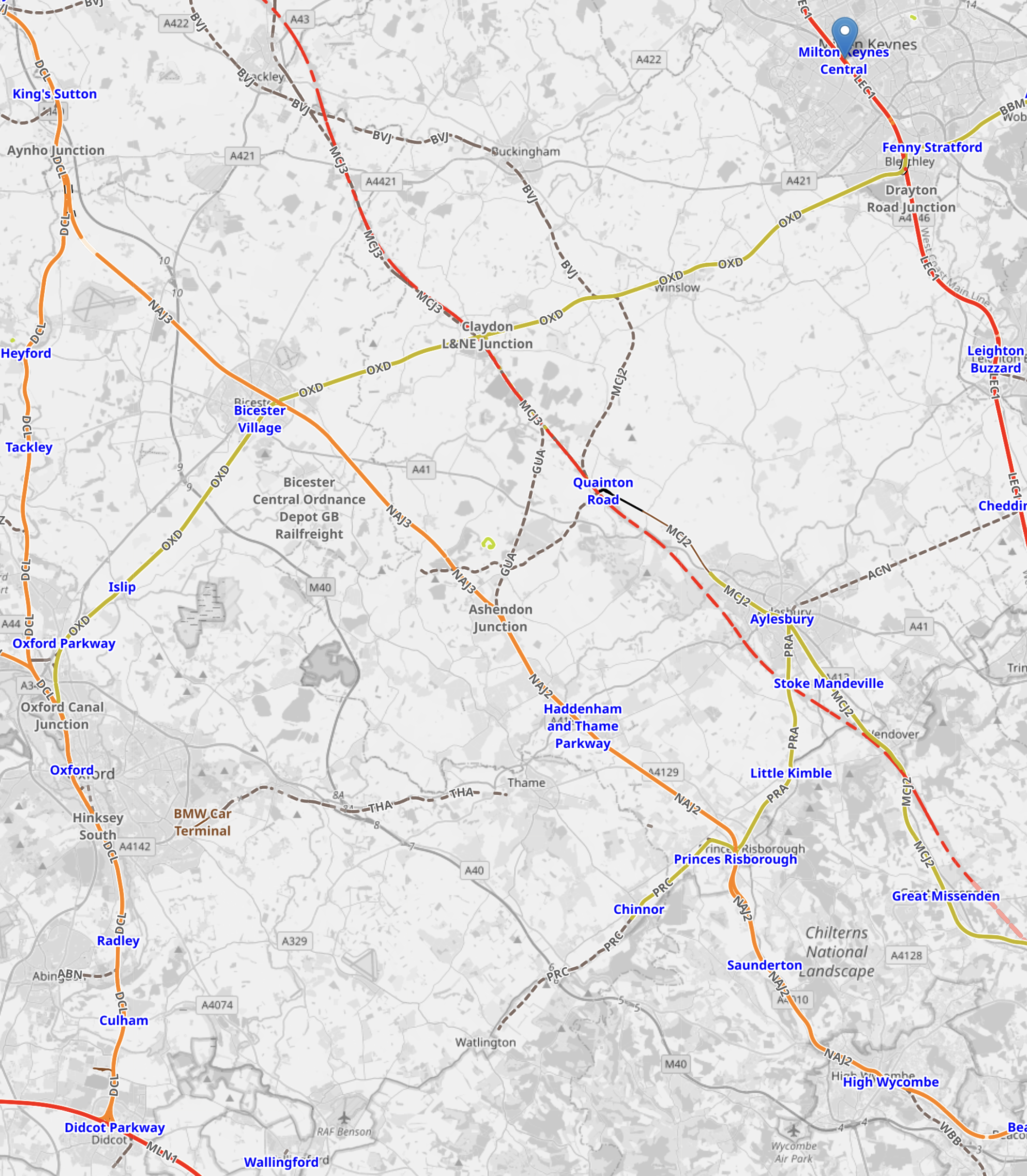
Note.
Didcot Parkway station is in the South-West corner of the map.
Milton Keynes Central is in the North-East corner of the map and marked with a blue error.
The route is via Oxford, Oxford Parkway, Bicester Village, Winslow and Bletchley.
This video shows the train passing Winslow.
Arriva Group Submits Open Access Rail Application To Connect Newcastle And Brighton, Via London Gatwick
The title of this post, is the same as that of this press release from Arriva Group.
These three bullet points act as sub-headings.
- New services operated by Arriva’s Grand Central would introduce a direct rail connection between the Northeast and Midlands to London Gatwick and the South Coast.
- Making better use of available network capacity, the proposed route would connect underserved communities in the UK and enhance long-distance connectivity without the need to interchange through London.
- The application reflects Arriva’s wider European strategy to connect people and places through sustainable transport solutions, strengthening regional economies and supporting modal shift.
This introductory paragraph provides more details.
Arriva Group has today announced it is submitting an open access application to the Office of Rail and Road (ORR) to introduce a new direct rail service between Newcastle and Brighton, via London Gatwick, providing vital connectivity for underserved communities along the route.
Other points to note include.
- There will be five trains per day in each direction.
- The proposed service would call at Durham, Darlington, Northallerton, York, Doncaster, Sheffield, Derby, Burton-on-Trent, Birmingham New Street, Warwick Parkway, Banbury, Oxford, Reading, Wokingham, Guildford, Redhill, London Gatwick and Haywards Heath.
- The service would be operated by Grand Central.
- The service could be introduced from December 2026.
It will be the be the first direct service between Newcastle and Brighton.
This final paragraph outlines where the service fits in Arriva’s wider philosophy.
The plans are part of Arriva Group’s broader commitment to strengthening regional connectivity and making better use of available rail capacity. By opening up new travel corridors, Arriva is helping to connect more people to jobs, education and leisure opportunities – and to encourage a greater shift from private cars to public transport.
There are certainly plenty of places in Europe, that could use a service like this one between Brighton and Newcastle.
In The Ultimate Open Access Service, I describe a possible open access service between Amsterdam and Hamburg, which is about the same distance as Brighton and Newcastle, which is 372.8 miles by Arriva’s proposed route.
These are some of my thoughts in no particular order.
A High-Class Service Between Oxford And Brighton Could Be An Interesting Development In Its Own Right
Governments, rail operators and passenger groups of all persuasions and flavours have warmly welcomed the planned reopening of the rail route between Oxford and Cambridge.
I suspect an Oxford and Brighton service would be equally welcomed.
Brighton may not be an academic powerhouse yet, but it does have one thing that Oxford and Cambridge lack ; the sea.
Gatwick Airport Will Surely Welcome The Extra Connectivity
Gatwick Airport will expand and extra rail services will do the following for the airport.
- Make it easier to get the planning permission for the second runway.
- Make it easier for passengers and airport and airline staff to get to the airport.
- Surely, the more direct rail connections the airport has, will increase the likelihood, that families and other groups, will choose to fly from Gatwick.
- More train services could cut the amount of car parking per flight needed at the airport.
Gatwick Airport station has recently rebuilt and added extra capacity, so I doubt there will be trouble accommodating another ten trains per day.
Would The Army Welcome The New Service?
Two of the British Army’s main training areas are in North Yorkshire and in Surrey.
Would they find a train service between the two areas useful?
What Trains Will Grand Central Trains Use For The New Service?
In Arriva Group Invests In New Battery Hybrid Train Fleet In Boost To UK Rail Industry, I talked about how Grand Central will be acquiring Hitachi trains for their routes between London and Bradford and Sunderland.
- These will be Hitachi tri-mode trains.
- The trains will have a range of over forty miles on batteries.
- They will probably be serviced in Yorkshire or the North-East.
- The trains will be built by Hitachi at Newton Aycliffe, with batteries from Turntide Technologies in Sunderland.
- The first trains will be delivered in 2028.
As Arriva intend to start services from December 2026, they would probably use diesel trains to start with.
I would expect that Grand Central would go for a unified fleet, which would mean more Hitachi tri-mode trains.
For convenience, they could all be serviced at Doncaster, which all Grand Central services will pass through.
What Sections Will Not Be Electrified Between Brighton and Newcastle?
As far as I can see from OpenRailwayMap, the following sections of the route are not electrified.
- Two sections of the North Downs Line – 29 miles.
- Didcot and Birmingham New Street – 80.9 miles
- Birmingham New Street and Derby – 41.3 miles
- Derby and Sheffield – 36.4 miles
- Sheffield and Doncaster – 18.4 miles
Note.
- Electrification South of Reading will be third rail, so some trains will need to have third-rail shoes.
- The length without electrification is a total of 206 miles.
- As Newcastle and Doncaster, Redhill and Brighton, Reading and Didcot, and Birmingham New Street station are all electrified, the longest sections the trains would run without electrification would be between Didcot and Birmingham New Street and between Birmingham New Street and Doncaster.
- The planned electrification between Derby and Sheffield would make life easier.
It appears that trains capable of handling a hundred miles of unelectrified railway are needed.
Hitachi have shown that a five-car train with one battery will travel 70 km (43.5 miles) on a full battery, so one with three batteries should be able to manage the hundred miles needed in a few years.
Will Any Extra Electrification Be Needed?
I think Birmingham New Street station will be the critical point.
- The next electrification on the route to the South of Birmingham New Street is at Didcot, which is 80.9 miles away.
- The next electrification on the route to the North of Birmingham New Street is at Doncaster, which is 96.1 miles away.
These battery ranges should be possible, but an alternative would be to provide an electrified platform at one or more intermediate stations to be safe.
Stations that could be equipped to the South would include Oxford and Banbury and to the North would include Burton-on-Trent, Derby and Sheffield.
Perhaps electrifying a single platform at these stations, should be the first thing to be done, so that battery-electric trains can run on some useful routes as soon as they are delivered and approved.
Electric Trains, Even Battery-Electric Ones, Will Be Quick Off The Mark
Electric trains have good acceleration and I wonder, if this acceleration will enable stops, that are not feasible with diesel trains to be fitted in with electric trains, without having to take the same time penalty.
This might allow useful stops to be added to the service.
- Chesterfield is not mentioned, but most trains passing through stop.
- As I said, Farnborough North could be a useful stop for the Army.
- There might be a case for selective stopping patterns.
Battery-electric trains stop without any noise or pollution.
Connection To The Ivanhoe Line At Burton-on-Trent
The proposed Ivanhoe Line is intended to link Burton-on-Trent and Leicester.
As it is intended that the Newcastle and Brighton service will call ten times per day at Burton-on-Trent station, this must surely improve the economics of the Ivanhoe Line.
Are there any other new or reopened rail schemes, that will be helped by the proposed Brighton and Newcastle service?
Updated Frequencies At Sheffield
Currently, trains at Sheffield have these daily frequencies to the towns and cities on the proposed Newcastle and Brighton route.
- Newcastle – 18
- Durham – 16
- Darlington – 15
- Northallerton – 0
- York – 19
- Doncaster – 64
- Derby – 58
- Burton-on-Trent – 9
- Birmingham New Street – 21
- Warwick Parkway – 0
- Banbury – 0
- Oxford – 3
- Reading – 4
- Wokingham – 0
- Guildford – 0
- Redhill – 0
- London Gatwick – 0
- Haywards Heath – 0
- Brighton – 0
Note.
- Sheffield gets five trains per day (tpd) direct connections to nine new destinations.
- Other useful destinations will get five more tpd.
- Reading is a useful interchange for Wales and the West.
- Guildford is a useful interchange for Portsmouth, Southampton and West Surrey.
- Reading and Guildford have coach services to Heathrow.
There are also a large number of universities along the route.
Hitachi Can Offer A One-Supplier Battery-Electric Train Solution
It should be noted that Hitachi can offer a complete package including battery-electric trains and all the electrification, transformers and other electrical gubbins needed.
So perhaps for the Chiltern Main Line, which is used for part of the route between Didcot and Birmingham, Hitachi could deliver a one-supplier solution, that would also electrify Chiltern’s services between Marylebone and Birmingham Moor Street.
Remember, Chiltern are another Arriva Group company.
If Hitachi get this right, I can see other lines being electrified in this way.
Could This One-Supplier Battery-Electric Solution Be Exported?
I discussed this in Arriva Group Invests In New Battery Hybrid Train Fleet In Boost To UK Rail Industry, where I suggested that the United States could be a market.
- Arriva Group are ultimately American-owned.
- Hitachi’s battery technology is also American-owned.
In these days of Trump’s tariffs, these could prove useful facts.
As Arriva Group used to be owned by Deutsche Bahn, they may be another interested party, especially as they have a lot of lines, where I believe Hitachi’s solution would work.
Conclusion
A battery-electric railway service of nearly four hundred miles would certainly attract the passengers.
Debenhams Oxford – May 27th, 2024
These pictures show the current state of the Debenhams store in Oxford.
















This will be the first development of those, that I talked about in Crown Estate To Spend £1.5bn On New Laboratories.
- I have deliberately shown pictures of the Junction, where the Debenhams building occupies the North-West corner.
- There is a Waterstones opposite the Debenhams building, on a busy junction between George and Magdalen Streets.
- There is a bus information display on the corner.
- There are a lot of chain eateries and a pub; the Wig & Pen.
These are a few thoughts.
Does the Debenhams Building Have Any Car Parking?
I would doubt it, but there may be a need to bring in large equipment.
Taxis To And From The Station
Note.
- I took a black taxi from the station to just outside the Debenhams building and it cost me the princely sum of £5,20.
- I also noted there was a rank at the rear of the building.
- In both locations, taxis were ready to roll.
That looked reasonable.
Buses To And From The Station
Staff at Oxford station, assured me that buses were available, but due to all the road works and Bank Holiday chaos, I suspect it could be improved, when the station upgrade is complete.
Walking To The Station
I took this second set of pictures as I walked from the Debenhams building back to the station.












Note.
- I walked from the junction by Debenhams, along George Street.
- It was a fairly straight line and level.
- There were no signposts between Debenhams and the station.
- There was quite a bit of blocked traffic.
- The route could do with some improvement like refurbished pavements and a few direction signs.
It took me about twenty-four minutes and at 76, I walked it easily.
On entering the station, I walked straight on to the platform for my train back to Reading, which was two minutes late.
Cycling
I suspect that many will cycle to work in the Debenhams building, as it is in Oxford.
But then, I suspect the Crown Estate, their architects and builders will know the appropriate provision to make.
Is The Debenhams Building At A Good Location?
When I was around 23, I used to reverse commute to ICI in Welwyn Garden City.
This involved.
- A ten-minute walk from St. John’s Wood to Chalk Farm tube station.
- A Northern Line train to King’s Cross station.
- A suburban train to Welwyn Garden City station.
- A fifteen-minute walk to my place of work.
St. John’s Wood to Oxford would involve.
- A fourteen-minute bus ride to St. Paddington station.
- A suburban train to Oxford station.
- A twenty-minute walk to my place of work.
A Brompton bicycle would help.
Knowing Cambridge as I do, the Debenhams building would be very well-located, if it were in Cambridge in a similar location, with respect to the railway station.
I feel that the Debenhams building passes the location test.
Crown Estate To Spend £1.5bn On New Laboratories
The title of this post, is the same as that of this article on The Times.
These three paragraphs introduce the Crown Estate’s plan.
The Crown Estate is to spend £1.5 billion over the next decade building more laboratories nationwide and will start by redeveloping the old Debenhams store in Oxford city centre.
The King’s property company, which looks after the royal family’s £16 billion historic land portfolio, will invest £125 million to buy the former department store and will turn it into laboratory space.
The building has been empty for omore than three years, having closed down in early 2021 after Debenhams collapsed during the pandemic. The Crown has bought a long leasehold of the store from DTZ Investors, the freeholder, which is keeping the street-level retail units. Subject to planning, construction is expected to start at the site next year, with the labs expected to be fully operational in 2027 or 2028.
This looks very much like a smaller version of British Land’s plan for the Euston Tower, which I wrote about in British Land Unveils Plans To Transform London’s Euston Tower Into A Life Sciences And Innovation Hub.
These are my thoughts.
Helping Start-Ups
I have been involved with perhaps half a dozen start-up ventures. Two were very successful and the others generally scraped along or just failed.
One common theme, was the lack of small convenient premises, where perhaps up to a dozen people could work.
- I don’t know Oxford well, but I would assume that the Debenhams site, is good for public transport and cycle parking.
- I also hope there’s a good real ale pub nearby, for some productive group thinking!
If this venture from Crown Estate helps start-ups to get over the first difficult hurdle, then it will be a development to be welcomed.
Location, Location, Location
It has been said, that the three most important things in property development are location, location and location.
This 3D Google Map shows the approximate location of the Debenhams building.

Note.
- The red arrow indicates a pub called the Wig and Pen , which is on the opposite side of George Street to the Debenhams building.
- The railway with its excellent connections runs North-South down the Western edge of the map.
- I estimate that walking distance to the station is about 500-600 metres.
I shall be going to Oxford in the next couple of days to take some pictures of the building and the walk.
We Can’t Have Too Many Laboratories
The British and the sort of people we attract to these isles seem to be born innovators and inventors.
My father’s male line is Jewish and my paternal great-great-great-grandfather had to leave his home city of Königsberg in East Prussia for the sole reasons he was eighteen, male and Jewish. As both Königsberg and London, were on the trading routes of the Hanseatic League, he probably just got on a ship. As he was a trained tailor, he set up in business in Bexley.
My mother’s male line is Huguenot and somewhere in the past, one of her ancestors left France for England. My grandfather was an engraver, which is a common Huguenot craft. Intriguingly, my mother had very French brown eyes.
Why did my ancestors come here?
It was probably a choice between escape to the UK or die!
This Wikipedia entry, which us entitled History of the Jews in Königsberg, gives a lot of detail.
Note.
- My ancestor left Königsberg around 1800.
- He probably brought my coeliac disease with him.
- In 1942, many of the Jews remaining in Königsberg were sent to the Nazi concentration camps.
- About 2,000 Jews remain in Königsberg, which is now Kaliningrad in Russia.
I am an atheist, but some years ago, I did a computing job for a devout Orthodox Jewish oncologist and he felt my personal philosophy was very much similar to his.
This Wikipedia entry, which is entitled Huguenots, gives a brief history of the Huguenots.
Whatever you’re attitude to immigration, you can’t deny these facts.
- Immigration increases the population.
- As the population increases, we’re going to need more innovation to maintain a good standard of living.
- Just as we need more places to house immigrants, we also need more places, where they can work.
- Immigration brings in those with all types of morals, sexualities and intelligences.
- Like the Jews and Huguenots of over two centuries ago, some emigrants will dream of using their skills and intelligence to start a successful business.
- It is likely, that some immigrants, who came here to study, might also want to stay on and seek employment here, using the skills they’ve learned and acquired. Some may even start successful businesses.
I also wonder, if immigration is difficult, does this mean, that the intelligent and resourceful are likely to be successful migrants. I heard this theory from a Chinese lady, who started her immigration to the UK, by swimming from mainland China to Hong Kong.
I feel, that unless we are prepared to ban immigration completely, not allow students to come here and study and be prepared to accept our current standard of living for the future, then we will need more laboratories and suitable places for entrepreneurs to start new businesses.
Conclusion
The Crown Estate appears to be getting more entrepreneurial.
In UK Unveils GBP 50 Million Fund To Boost Offshore Wind Supply Chain, I describe how they6 are using funds to accelerate the building of wind farms in theCetic Sea.
Has the King changed the boss or the rules?
Or have they employed a world-class mathematical modeller?
It is my experience, that modelling financial systems, can bring surprising results.
Leisure Market Boom? GWR’s Vision For Direct Bristol-Oxford Services
The title of this post, is the same as that of this article on Rail Magazine.
This is the first paragraph.
Great Western Railway has hopes on running direct services between Bristol Temple Meads and Oxford from September 14, subject to approval of its new trial proposal by the Department for Transport and Network Rail. The move is a test of growth in demand for leisure travel by train.
It is an interesting idea.
These are some points about the service, given in the article.
- The route will be via Swindon, Chippenham and Bath Spa.
- Fastest journey time would be 71 minutes.
- The route will be aimed at the leisure market.
- There will be two trains per day (tpd) in each direction on Saturdays.
This is GWR’s handy route map.

These are my thoughts.
Will The Trains Call At Didcot Parkway?
This OpenRailwayMap shows Didcot Parkway station and the large triangular junction, that connects Oxford to the Great Western Main Line.
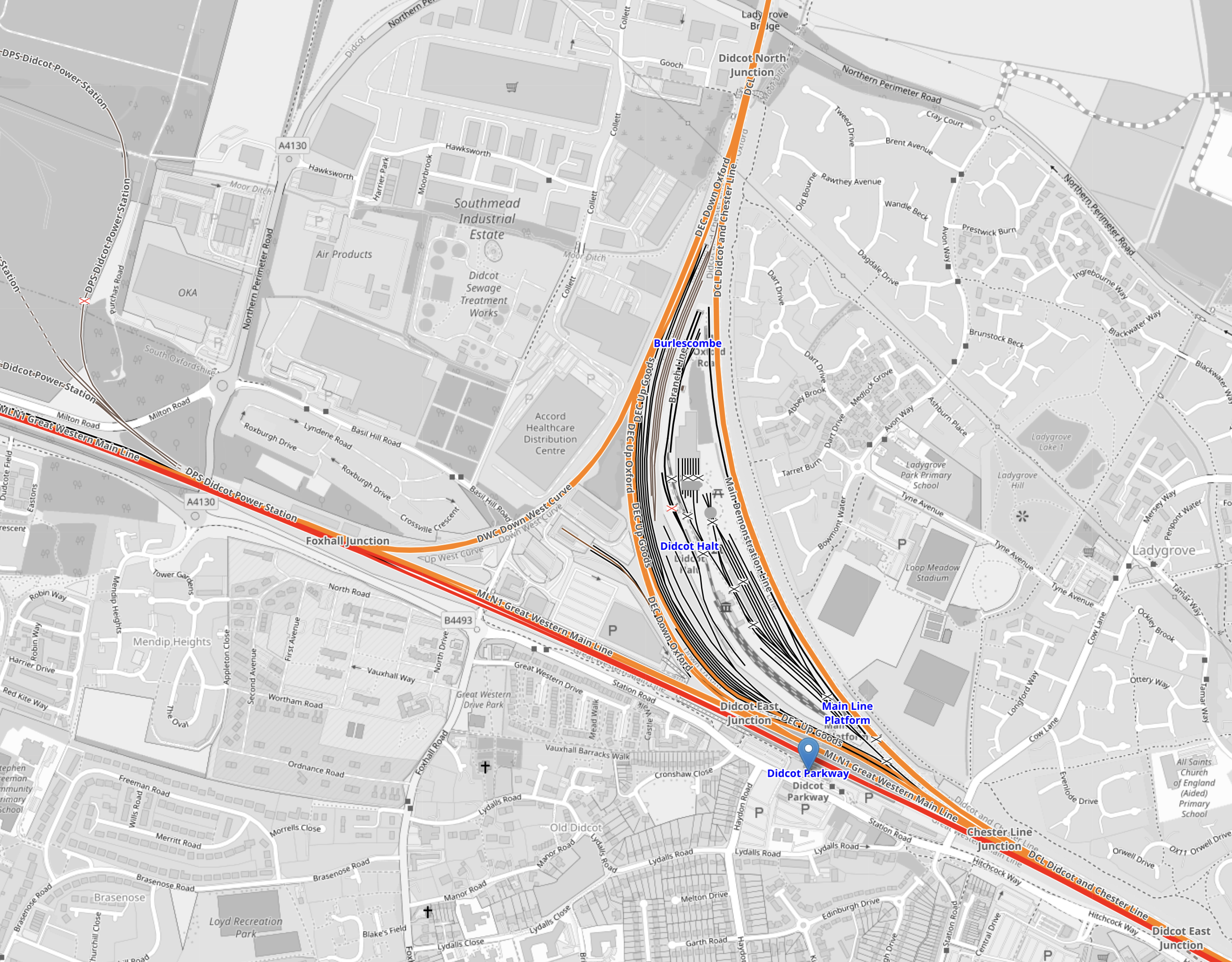
Note.
- The red tracks are the Great Western Main Line.
- The blue arrow indicates Didcot Parkway station.
- Oxford station is about ten miles to the North.
- Chords in the junction allow trains to go between Oxford and Paddington and Oxford and Swindon, with or without a stop at Didcot Parkway station.
The article says that GWR has asked to run the following services.
- 1018 Bristol Temple Meads-Oxford – Would arrive at Oxford at 1129.
- 1155 Oxford-Bristol Temple Meads (via Didcot) – Would arrive at Bristol Temple Meads at 1306.
- 1518 Bristol Temple Meads-Oxford – Would arrive at Oxford at 1629.
- 1712 Oxford-Bristol Temple Meads – Would arrive at Bristol Temple Meads at 1823.
Note.
- I suspect that the 1155 will reverse at Didcot Parkway station.
- There is a two train per hour (tph) service between Didcot Parkway and London Paddington stations.
- It looks like the four services could be run by a single train shuttling up the Great Western Main Line.
Would it be sensible if all Oxford and Bristol trains called at Didcot Parkway station, so that travellers could use the London service to their advantage?
But, calling at Didcot Parkway station would slow the service as there would need to be a reverse.
What Class Of Train Would Be Used?
Consider.
- A Bristol and Didcot Parkway via Bath Spa service takes 55 minutes.
- This is an average speed of 71.1 mph over a distance of 65.2 miles.
- 24.4 miles at the Bristol end of the route is not electrified.
- 10.3 miles at the Oxford end of the route is not electrified.
- The four services can be run by a single train shuttling up the Great Western Main Line.
It looks to me, that a bi-mode train with good performance is needed.
So I suspect that a five-car Class 800 or Class 802 train will be used.
Will The Train Be Battery-Electric Powered?
This is an interesting possibility.
- An ideal route for a battery electric train, is surely one with a long electrified section in the middle, which can be used to fully charge the train’s batteries.
- The train would have to run for 48.8 miles on its own power at the Bristol end of the route.
- The train would have to run for 20.6 miles on its own power at the Oxford end of the route.
The data sheet for a battery-electric Class 800/802 train can be downloaded from this page on the Hitachi web site.
In a section on the page, which is entitled Intercity Battery Trains, this is said.
A quick and easy application of battery technology is to install it on existing or future Hitachi intercity trains. Adding just one battery reduces emissions by more than 20% and offers cost savings of 20-30%.
Our intercity battery powered trains can cover 70km on non-electrified routes, operating at intercity speeds at the same or increased performance. Hitachi Rail’s modular design means this can be done without the need to re-engineer or rebuild the train and return them to service as quickly as possible for passengers.
The range of 70 km is 43.5 miles, which would appear to be a little bit short to go from the end of the electrification at Chippenham to Bristol Temple Meads and back.
But various measures could be taken to make sure the train can handle the route.
- The regenerative braking strategy could be used to conserve battery power.
- A second battery could be added to the train.
- Methods to charge the train at Bristol Temple Meads could be installed.
As London Paddington and Bristol Temple Meads is an important route, I suspect that Hitachi and Great Western Railway have a strategy to handle trains from Chippenham and sending them back.
Could This Route Be A Trial Route For Battery-Electric Trains?
Consider.
- Hitachi and Great Western Railway wouldn’t want to introduce an unreliable train without full full testing.
- Trains can probably limp to either Stoke Gifford or Reading depots, after a battery failure.
- Great Western Railway could test a new route.
- A full test only needs one train.
- Passenger reaction to a battery-electric train can be assessed.
- Staff need to be trained.
- The route can be run by a standard bi-mode if required.
- It could be the world’s first high-speed battery-electric train.
- Enthusiasts would flock to have a ride.
Could this be a trial service to make sure everything goes right?
‘Rollercoasters In My Back Yard’: Welcome To Universal Studios Bedford
The title of this post, is the same as that of this article on The Times.
This is the sub-heading.
Britain’s answer to Orlando could be a 480-acre world boasting big rides, bigger films and 7m visitors a year. Some locals are far from enchanted
These three paragraphs introduce the story.
Picture the scene: It’s a snowy Christmas Eve, 2030, at King’s Cross station. Dozens of families from across the UK and Europe gather as the station speakers announce: “The train now leaving platform 9¾ is the Hogwarts Express, calling at the Wizarding World of Harry Potter. And Bedford.”
The stuff of JK Rowling’s fiction? Perhaps not.
For, if all goes to plan, a featureless 480 acres of industrial and agricultural land a short broomstick’s ride from downtown Bedford will, by the end of the decade, become one of the world’s most spectacular theme parks.
I have a few thoughts.
Eden Project Morecambe
Eden Project Morecambe will be the first of a new generation of theme parks in the UK.
The new Eden Project is to be developed at Morecambe, which is close to Lancaster. As Lancaster will be an High Speed Two terminus, Eden Project North could be connected to HS2 by a high tech shuttle like the Luton DART. So the Eden Project North will also attract day trippers from a large proportion of England and the South of Scotland.
I believe increasingly we will see theme parks, bringing in their visitors on futuristic public transport systems.
The Location Of Universal Studios Bedford
This map from Universal Destinations & Experiences shows the location of the site of the proposed Universal Studios Bedford.
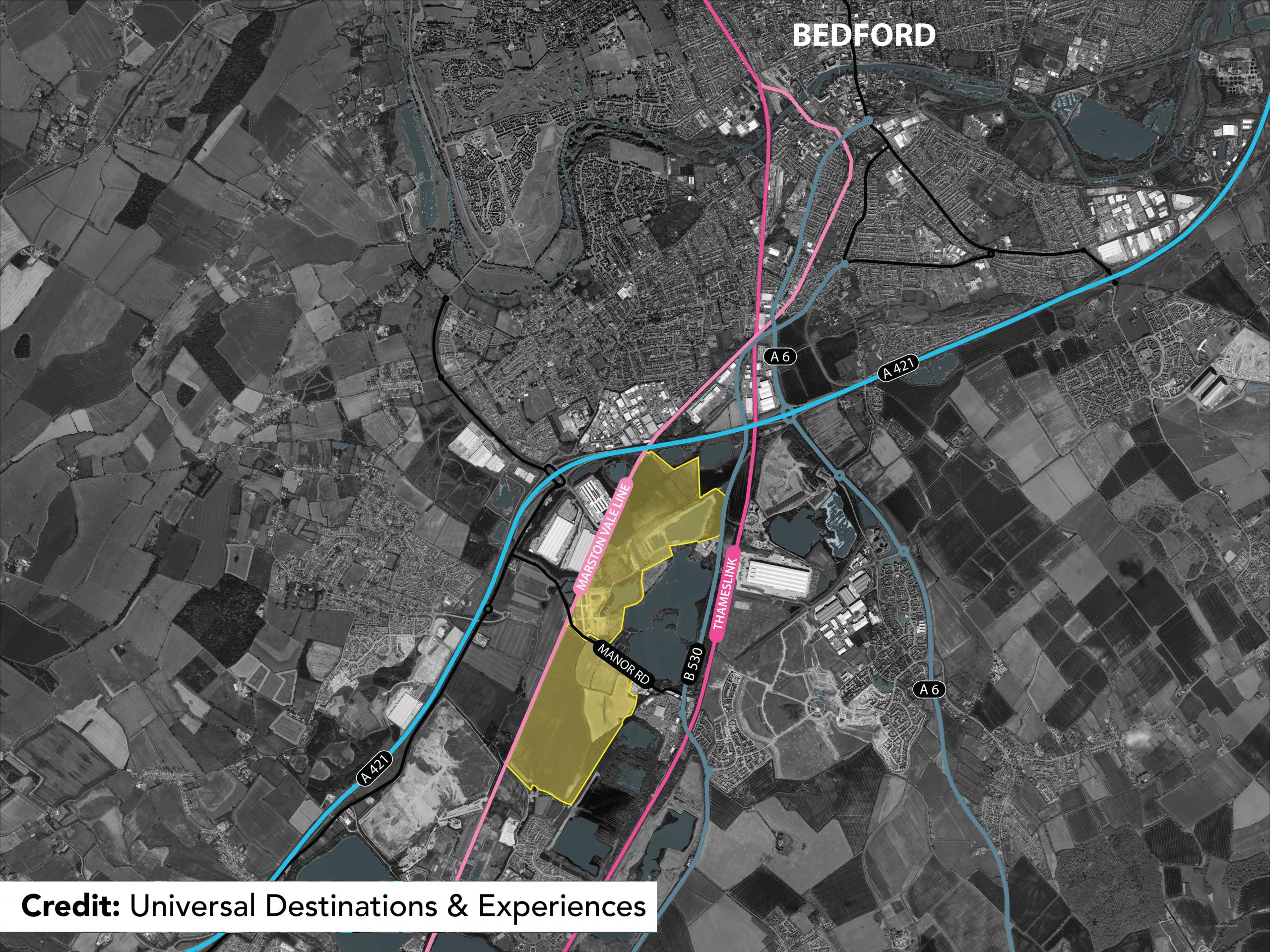
Note.
- The site is shown by yellow shading.
- The blue lines are major roads.
- The pink lines are railways.
- The rail link running to the West of the site is currently the Marston Vale Line, which is being developed into the East West Railway between Oxford and Cambridge via Milton Keynes.
- The East West Railway will also connect to Ipswich, Norwich and Reading.
- The rail link running to the East of the site is the Midland Main Line, which links St. Pancras station with Derby, Nottingham and Sheffield.
The site certainly has excellent transport connections.
Expanding Rail Connections At Universal Studios Bedford
I believe that in these days of climate change, that theme parks and other attractions like sports stadia and shopping centres will develop their rail connections.
Universal Studios Bedford could have two stations.
- Kempston Hardwick on the East West Railway.
- Their own station on the Midland Main Line.
Note.
- Both stations could be connected by a futuristic people mover transporting visitors around the site.
- Using current train times, trains would take thirty minutes between the theme park and St. Pancras for Eurostar to and from Europe.
- Thameslink’s trains could shuttle visitors to and from Luton Airport.
It should also be noted that several of Southern England’s most visited sites are just a train ride away.
Easy Places To Visit
These attractions would be easy to visit.
- Bicester Village – Direct train from Kempston Hardwick after 2024.
- Cambridge – Direct train from Kempston Hardwick after 2030.
- London – Direct train from the new station after it’s built.
- Oxford – Direct train from Kempston Hardwick after 2024.
- Woburn Safari Park – Direct train from Kempston Hardwick after 2024.
Note.
All trains would be electric or battery-electric powered.
I have assumed that rail services between Oxford and Bedford open in 2024.
I have assumed that rail services between Oxford and Cambridge open in 2030.
Conclusion
This is an interesting idea, which is at an excellent location. But will the locals like it?
British Land Unveils Plans To Transform London’s Euston Tower Into A Life Sciences And Innovation Hub
The title of this post, is the same as that of this press release from British Land.
The Wikipedia entry for the Euston Tower gives this paragraph of history.
The site was developed by Joe Levy who bought properties along the north side of Euston Road to enable him to build a complex of two tower blocks with office shops and apartments. The building, which was designed by Sidney Kaye Eric Firmin & Partners in the International style and built by George Wimpey, was completed in 1970. It is 36-storeys and 124 metres (407 ft) high. Early tenants included Inmarsat and Capital Radio.
When you get to over fifty years old, various parts of your body get tired and I suspect it is the same with buildings.
These are the two bullet points of the press release.
- Euston Tower represents a major retrofit and redevelopment opportunity at the heart of London’s Knowledge Quarter
- Proposals aim to transform the building into a world-class net zero home for world-leading life science and innovation occupiers
These two paragraphs then add a bit more vision.
Leading property company British Land has unveiled plans to redevelop Euston Tower through an innovative combination of retention, re-use and an ultra-low carbon new structure. The plans would transform the building into a pioneering, modern, net zero workspace for cutting-edge businesses of all sizes, including new world-class, lab-enabled spaces at the heart of London’s Knowledge Quarter.
Currently under discussion with Camden Council and other local stakeholders, the vision for Euston Tower will lead the way in low carbon retrofit and construction techniques, using inclusive design which creates high quality workspaces and continues to support the local community and economy. The current proposals will bring forward lab-enabled spaces for start-up and scale-up innovation businesses, as well as spaces for the local community to support education and training opportunities.
These are points from the press release.
- Leading the design are award-winning Danish architecture practice 3XN.
- They are supported by London-based architecture and landscape studio DSDHA who re-designed much of Broadgate’s public realm, including Exchange Square.
- In line with British Land’s longstanding commitment to net zero development, the design’s sustainability strategy is based on retaining, re-using and re-cycling existing material, specifying low carbon and recycled materials where new is required and only using certified carbon offsets as an action of last resort.
- This multi-layered approach to net zero development aims to create a blueprint for the sustainable redevelopment of challenging, inflexible old buildings that can be used in the future.
British Land has owned and operated Regent’s Place for nearly 40 years, which means they must have a lot of knowledge about how best to develop the building and its surroundings.
They certainly seem to be applying a modern net-zero approach to a building that was iconic and modern in the 1970s.
This afternoon I walked down the Euston Road between Euston and Great Portland Street stations and took these pictures.












































Note.
- Euston Station is a shadow of its former self.
- Euston Tower is the boxy tower on the North side of Euston Road.
- University College London Hospital (UCLH) is the tower on the South side of Euston Road.
- I believe the glass-fronted building opposite the hospital and Euston Tower contains a lot of BT infrastructure.
I have some thoughts.
Traffic Along The Euston Road
I took the pictures around 1400 in a Friday and they show how busy the Euston Road is most of the time.
According to the Wikipedia entry for the Euston Road, there was a plan to remove the underpass.
In the early-21st century, the Greater London Authority commissioned a plan to improve the road from the architectural firm, Terry Farrell and Partners. The original study proposed removing the underpass (which was subsequently cancelled) and providing a pedestrian crossing and removing the gyratory system connecting the Tottenham Court Road and Gower Street. The scheme was approved by the Mayor of London, Ken Livingstone as “the start of changing the Marylebone to Euston road from a highway into a series of linked public spaces.” The pedestrian crossing opened in March 2010. Livingstone’s successor, Boris Johnson, favours keeping the Euston Road underpass and declared it to be a good place to test his nerves when cycling around London.
Nothing is said about, where the traffic would have gone, if the underpass had been closed.
I walked along the South side of the Euston Road past the hospital and the air couldn’t be considered clean. As I write this, this website rates it Hazardous.
If we ignore the pollution for pedestrians and cyclists, is it really a road, that is fit for the purpose of moving traffic between King’s Cross and Baker Street, and vice-versa? I don’t think so!
The UK Needs More Lab Space
Cambridge innovators and developers were always saying they needed more lab space.
I also suspect, they are moaning in Oxford too!
So building high-quality space in London could reduce the pressure.
In Canary Wharf Boosts Its Science Ambitions, I talked about the ambitions of Canary Wharf to be a life sciences hub.
The Euston Tower Is Well-Connected
Consider.
- The Euston Tower is within walking distance of Euston, King’s Cross and St. Pancras stations, with all their long distance connections.
- The Euston Tower is within walking distance of Euston Square, Great Portland Street, King’s Cross St. Pancras and Warren Square stations, with all their Underground connections.
- There are buses everywhere.
But that’s not to say, that these links cannot be improved.
Euston High Speed Two Station Could Be Euston Tower’s Sister?
This Google Map shows the location of Euston Town and the proposed Euston High Speed Two station.
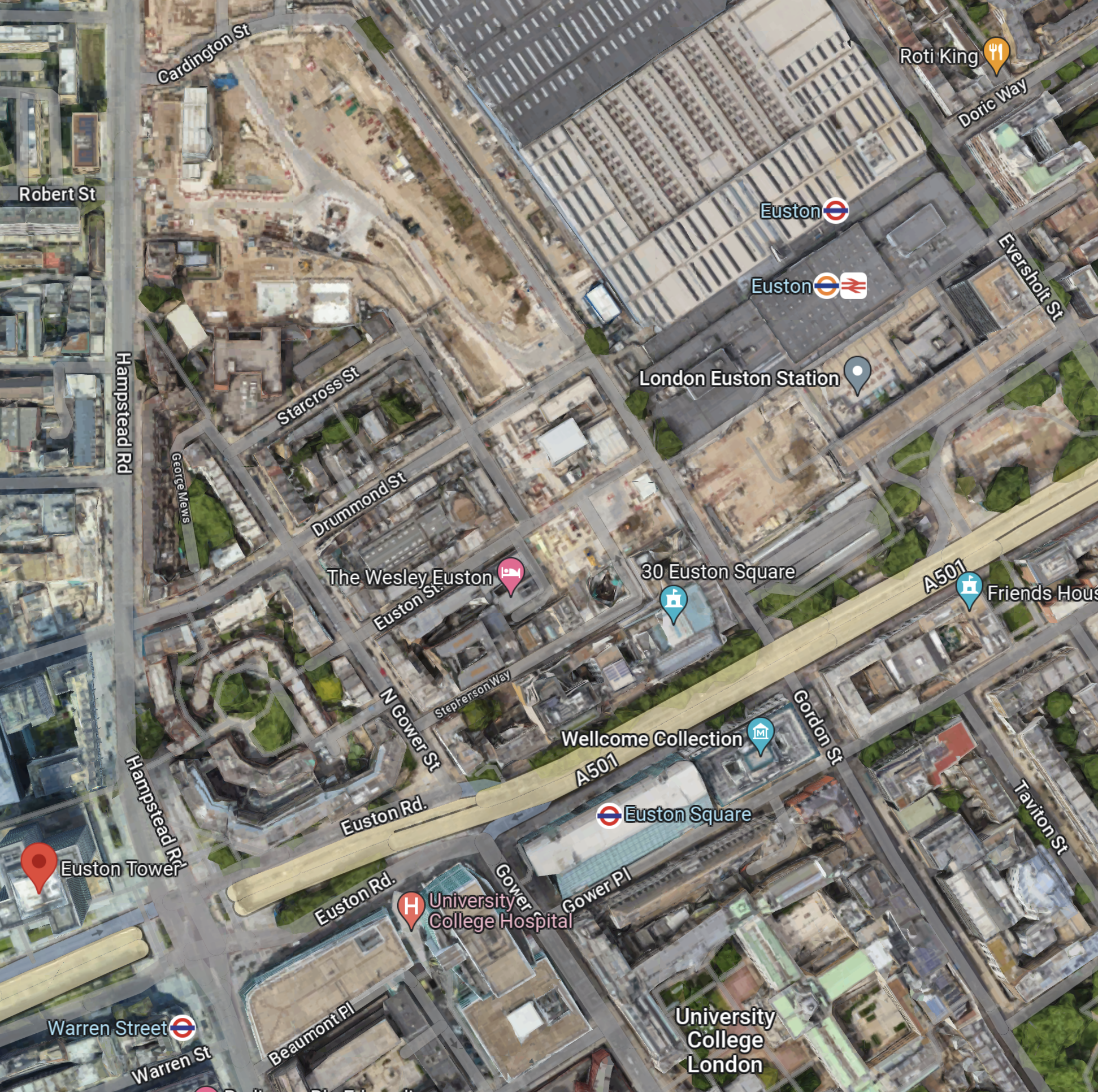
Note.
- Euston Tower is marked by a red arrow in the South-West corner of the map.
- The existing Euston station is in the North-East corner of the map.
- The High Speed Two station will be built along the Western side of the existing station.
With good landscaping, an excellent walking route, and perhaps a people mover Euston Tower could have superb connections to the rest of the UK.
Cycling And Walking Could Be A Possibility!
This Google Map shows the wider area around Euston Tower.
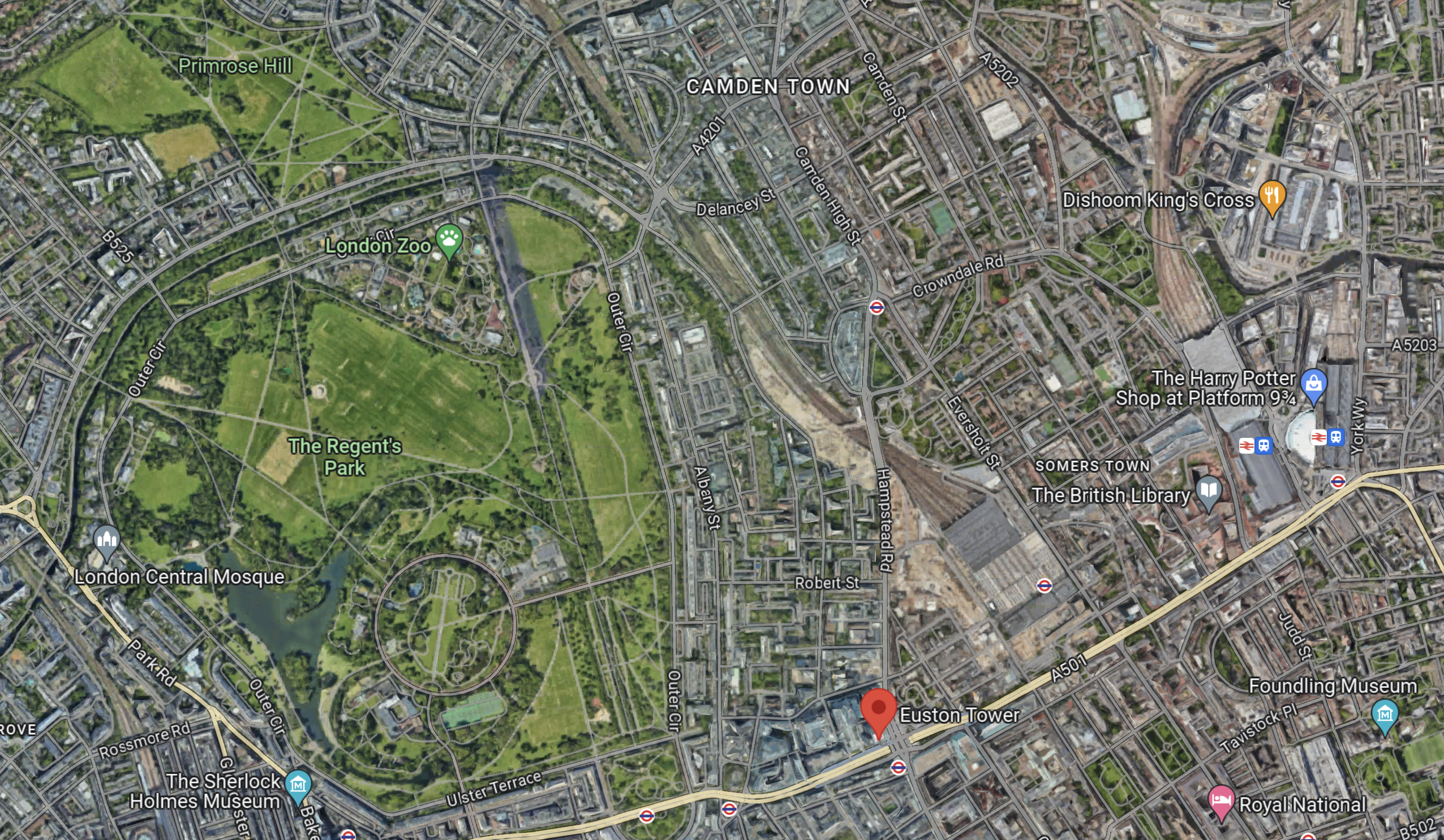
Note.
- Euston Tower is marked by the red arrow towards the bottom of the map.
- To its West lies the cycling- and walking-friendly spaces of Regents Park and Primrose Hill.
In the 1970s, I regularly walked or cycled across the park from where we lived near Primrose Hill to a client in Great Portland Street.
I also suspect other cycling and walking routes could be developed to Euston Tower from Euston, King’s Cross, St. Pancras and other stations.
Crossrail 2
Crossrail 2 would certainly help travelling to the Euston Tower, by linking Euston, King’s Cross and St.Pancras to North-East and South-West suburbs of London, with trains at frequencies of up to 30 thirty trains per hour (tph) in the central tunnel.
But.
- The new line will cost at least £31.2 billion. Who can afford it?
- The Elizabeth Line took sixteen years from approval to full opening.
- Crossrail 2 would still be a walk from Euston Tower.
So Crossrail 2 is unlikely to be any help to the redevelopment of Euston Tower.
Improving The Sub-Surface Lines
The Euston Tower is close to two stations on the sub-surface lines; Euston Square and Great Portland Street.
Services through these stations are currently as follows.
- Circle Line – 6 tph – In both directions all day.
- Hammersmith & City Line – 6 tph – In both directions all day.
- Aldgate and Amersham- 2 tph – In both directions all day.
- Aldgate and Chesham – 2 tph – In both directions all day.
- Aldgate and Uxbridge – 6 tph Peak – 8 tph – Off-Peak
- Aldgate and Watford – 4 tph – Peak
Note.
- In the Peak there are 26 tph through Great Portland Street and Euston Square stations.
- In the Off Peak there are 24 tph through Great Portland Street and Euston Square stations.
- In this article on Modern Railways,it is said that after digital signalling is installed on the sub-surface lines, the capacity on the lines, will be 32 tph in the Peak and 27 tph in the Off-Peak.
These figures give a 33 % capacity increase in the Peak and a 28 % increase in the Off Peak.
Both Great Portland Street and Euston Square stations are cramped and not fully step-free stations and could struggle with a 28 % and upwards increase in passenger numbers.
In The New Step-Free Entrance At Euston Square Station, I detailed TfL’s plans to put a new full step-free entrance South of Euston Road at Euston Square station.
This would not directly help travellers going between Euston Tower and Euston station, but hopefully, it would help to make Euston station less crowded and more passenger-friendly.
It would certainly ease walking between University College and the hospital, and the station.
This map from cartometro shows the Underground lines at Great Portland Street station.

Note.
- The yellow and mauve tracks are the sub-surface lines.
- The black tracks are the Northern Line.
- The blue tracks are the Victoria Line.
This Google Map shows the Euston Tower, Great Portland Street and Warren Street stations.
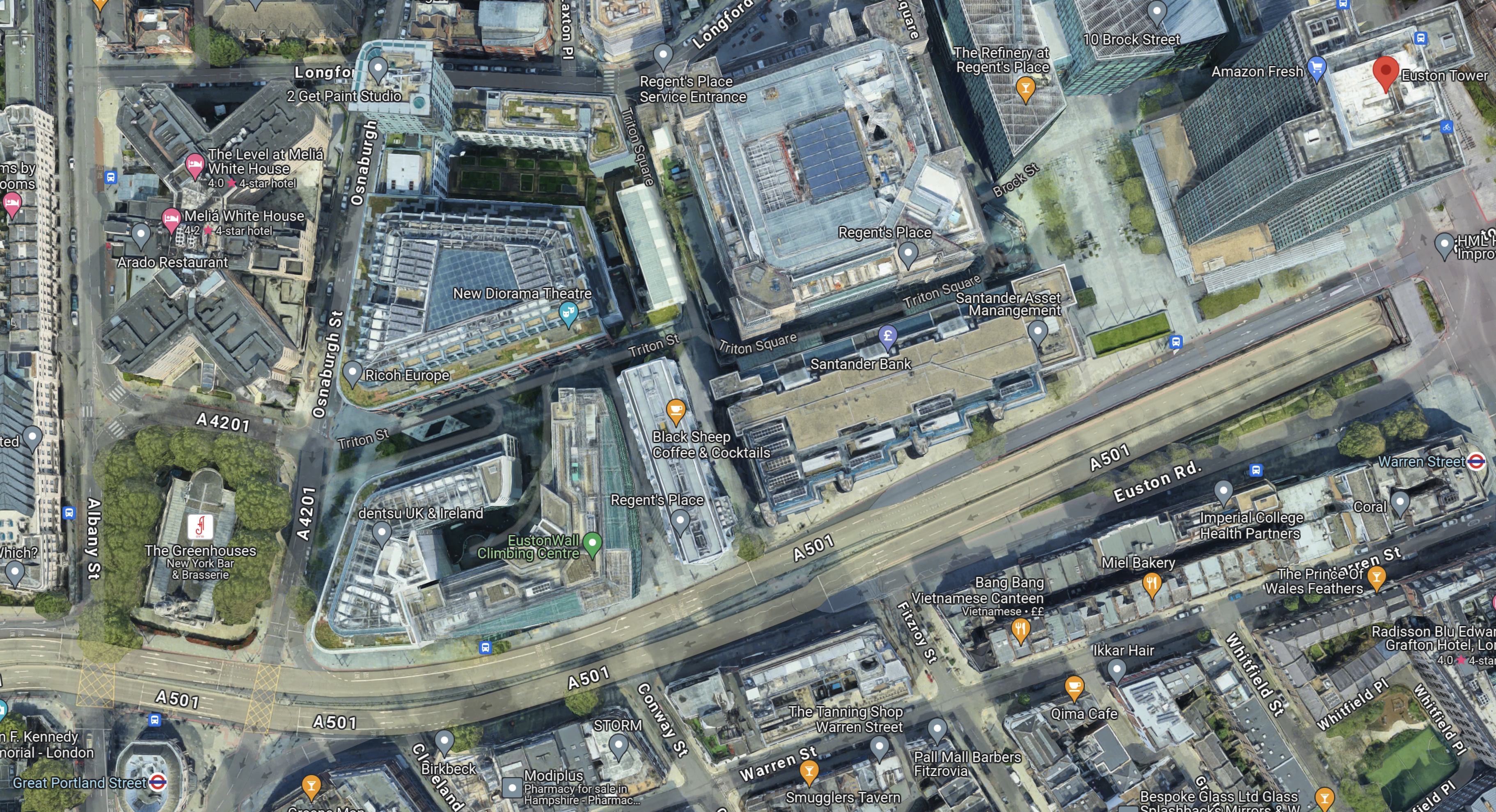
Note.
- The Euston Tower is indicated by a red arrow in the top-right corner of the map.
- Great Portland Street station is in the bottom-left corner of the map.
- Warren Street station is at the left of the map.
I wonder if the platforms were to be extended Eastwards at Great Portland Street station, that a new entrance to the station could be created perhaps fifty metres from Euston Tower.
I am convinced that the extra passenger traffic created by the life sciences and innovation hub can be handled by an augmented transport infrastructure, which would rely mainly on planned improvements to the sub-surface lines, which are approaching their final stages.
Conclusion
Converting Euston Tower into a life sciences and innovation hub is a plan that I believe can work well!
I would recommend the following improvements to public transport.
- The planned extra step-free entrance to Euston Square station on Gordon Street is constructed.
- An extra fully step-free entrance is built at the Eastern ends of the platforms at Great Portland Street station, which would be about halfway between Euston Tower and the station.
As improvements to the signalling of the sub-surface lines will deliver an upwards of 27 % capacity on the sub-surface lines, the life sciences and innovation hub might as well take advantage.
Coeliac Journey Through Covid-19 – Oxford And Cambridge Compared
Oxford And Cambridge Compared
In May 2020, I had been looking at the statistics of the two cities and the country around them and found that the numbers of Covid-19 cases were twice as high in Oxford, when related to population.
In Oxford And Cambridge Compared On COVID-19, I give my reasons for why Cambridge has lower levels of Covid-19.
Consider.
- Both cities and surrounding counties have a similar character.
- Both have well-respected hospitals, medical schools and medical research.
- Air pollution appears to be low in both areas.
- Both cities probably have a similar ethnic mix and large student populations.
As I used to live near Cambridge, I have my own mad personal theory.
Addenbrooke’s Hospital
I have used several hospitals in my life, but only two changed my life totally.
- I had my vasectomy in the old Hackney Hospital.
- Addenbrooke’s, who with a simple blood test decided I was probably coeliac.
So perhaps, I’m biased.
But consider these possible facts.
- My coeliac consultant at Addenbrooke’s told me, that he had more patients with the disease than any other in the UK.
- The manager at Carluccio’s in Cambridge, told me that they sold more gluten-free food, than any other restaurant in the group.
- In 1997, I was diagnosed fast, because Addenbrooke’s were using a new genetic test. I was later checked using an endoscopy.
Could it be that someone at Addenbrooke’s had decided they wanted to find all the coeliacs in and around Cambridge?
What would be the effects of diagnosing as many coeliacs as you could find in an area?
- A doctor of my acquaintance talked of coeliac disease as the many-headed hydra, as it led to so many other medical problems. So extra diagnosed coeliacs might improve health statistics in an area.
- Personally, I have said good-bye to migraines, nail-biting and lots of joint pains, after going gluten-free.
- I also haven’t had a serious dose of flu since diagnosis. Since 2005, I’ve probably had the flu jab.
- Joe West at Nottingham University, has shown that coeliacs on a gluten-free diet have lower cancer rates than the general population.
Consider.
- Immunotherapy is a medical technique, where the patient’s immune system is activated or suppressed to help them fight a disease.
- Coeliac disease is an autoimmune disease, where gluten causes damage to the gut.
So could coeliacs on a gluten-free diet have a more powerful immune system?
Undiagnosed Coeliacs
Coeliac disease is genetic, with mine coming from an Ashkenazi Jewish ancestor from Konigsberg in the Baltic.
- Other roots of coeliac disease are Irish, Italian and black people, who have slaves as ancestors.
- There was no test for coeliac disease in children until 1960.
- There was no genetic test for coeliac disease until the late 1990s.
- Research has shown that coeliacs are at least 1-in-100 of the UK population, but could be higher.
- The NHS quotes the 1-in-100 figure on this web page, which also says reported cases of coeliac disease are higher in women than men.
If coeliacs on a gluten-free diet have a good immune system, do undiagnosed coeliacs have a poorer one?
Oxford And Cambridge Compared
Is the large number of diagnosed coeliacs around Cambridge, the reason the area has a lower COVID-19 rate than Oxford?
Conclusion
What do I know?
I’m just a mad engineer and mathematician with coeliac disease.
Canary Wharf Boosts Its Science Ambitions
The title of this post, is the same as that of this article on The Times.
This are the introductory paragraphs.
Genomics England is to move its headquarters to Canary Wharf in east London this year as the financial quarter aims to become a life sciences hub.
The government-run DNA sequencing group will move in the autumn into One Canada Place, where its neighbours will include Brookfield, a Canadian property fund, and Reach, publisher of the Daily Express and OK! magazine.
Owned by the Department of Health and Social Care, Genomics England sequences the genomes of people with rare diseases and cancers to help doctors to treat them more effectively. With consent, some of that data is passed to researchers trying to develop new drugs and treatments.
If you type “Canary Wharf Science Hub into Google”, you find some serious articles.
This article in the FT is entitled Canary Wharf Proposes £500mn Lab Project To Reinvent Financial Hub.
This is a good idea, as scientist friends are always complaining about a lack of lab space in Cambridge and Oxford. Because of the Elizabeth Line, both these cities are not much more than an hour from Canary Wharf.
It should also fill the cafes and shops with scientists and engineers, who would replace some of those working from home because of the pandemic.
I wonder whether this model will work elsewhere?
Should The NHS Adopt A Whack-A-Coeliac Policy?
The Wikipedia entry for Whac-a-Mole, says this about the colloquial use of the name of an arcade game.
In late June 2020, Boris Johnson based the UK’s COVID-19 strategy on the game.
Because of the high number of diagnosed coeliacs in the Cambridge area, I believe that I was diagnosed to be coeliac, by possible use of a Whack-a-Coeliac policy at Addenbrookes Hospital in Cambridge, in the last years of the Twentieth Century.
- I was suffering from low B12 levels and my GP sent me to the hospital to see a consultant.
- It was only a quick visit and all I remember, is the speed with which the nurse took my blood.
- A couple of days later, I received a letter from the hospital, saying it was likely I was a coeliac and it would be confirmed by an endoscopy.
- A point to note, is that I had my endoscopy with just a throat spray and this must have increased the efficiency and throughput and reduced the cost of the procedure.
The only way, I could have been diagnosed so quickly would have been through an analysis of my genes and blood. But I was never told, what method was used.
I have a few further thoughts.
My Health Since Diagnosis
It has undoubtedly improved.
Cancer And Diagnosed Coeliacs On A Gluten-Free Diet
Joe West of Nottingham University has shown, that diagnosed coeliacs on a gluten-free diet have a 25% lower risk of cancer compared to the general population.
That is certainly a collateral benefit of being a coeliac. But is it being a coeliac or the diet?
I’m no medic, but could the reason be, that diagnosed coeliacs on a gluten-free diet have a strong immune system?
Coeliac Disease Is A Many-Headed Hydra
I have heard a doctor describe coeliac disease or gluten-sensitivity as a many-headed hydra, as it can turn up in so many other illnesses.
Type “coeliac disease many-headed hydra” into Google and this article on the NCBI , which is entitled Gluten Sensitivity: A Many Headed Hydra, is the first of many.
This is the sub-title of the article.
Heightened responsiveness to gluten is not confined to the gut
My son; George was an undiagnosed coeliac, who had a poor diet consisting mostly of Subways, cigarettes and high-strength cannabis. He died at just thirty-seven of pancreatic cancer.
Did George have a poor immune system, which was useless at fighting the cancer?
Undiagnosed Coeliac Disease In The Over-Sixty-Fives
In A Thought On Deaths Of The Elderly From Covid-19, I used data from Age UK and Coeliac UK to estimate the number of coeliacs in the UK over the age of sixty-five. I said this.
Age UK has a figure of twelve million who are over 65 in the UK. If 1-in-100 in the UK are coeliac, that is 120,000 coeliacs over 65.
But some research shows that the number of coeliacs can be as high as 1-in-50.
If that 120,000 were all diagnosed, I would have several coeliacs amongst my over-65 friends. I have just one and she is self-diagnosed.
Are all these undiagnosed coeliacs out there, easy targets for diseases like cancer and COVID-19?
The Ease Of Testing For Coeliac Disease
I was worried that my granddaughter was coeliac and I asked my GP, how difficult a test is to perform.
He said, that a genetic test is usually quick and correct and only a few borderline cases need to be referred to a consultant.
Diagnosis has moved on a lot in twenty years.
Cambridge, Oxford and Covid-19
Six weeks ago I wrote Oxford And Cambridge Compared On COVID-19, to try to find out why the number of Covid-19 cases are so much lower in Cambridge than Oxford.
Checking today, the rate of lab-confirmed cases of COVID-19 per 100,000 residents is as follows.
- Cambridge 336.6
- Oxford 449
So why the difference?
In the related post, this was my explanation.
Is the large number of diagnosed coeliacs around Cambridge, the reason the area has a lower COVID-19 rate than Oxford?
It sounds a long shot, but it could be a vindication of a possible Whack-a-Coeliac policy at Addenbrooke’s in the last years of the Twentieth Century.
Or were the hospital testing the genetic test for coeliac disease? Perhaps, in conjunction with Cambridge University and/or the Sanger Centre.
Conclusion
I believe the NHS should seriously look at a Whack-a-Coeliac policy!
- The health of a large number of people would improve.
- There would be less cancer in the UK.
- A better combined National Immune System might help in our fight against the next virus to follow COVID-19.
It would be a very simple testing program, that would be mainly in the hands of the GPs, their nurses and the testing laboratories.
 The Anonymous Widower