Councils Rely On Diesels While Charging Drivers Who Use Them
The title of this post, is the same as that of this article in The Times.
Some points from the article.
- Ninety-two percent of council vehicles are diesel-powered.
- Only three percent are the greenest electric models.
- Sivty-two council fleets are totally diesel.
- Twelve councils are thinking of restricting or charging diesel or petrol vehicles to cut pollution, but all of these councils are reliant on diesel.
It looks like a case of politicians saying “Do as I say, but not as I do!”
A Walk Along Shaftesbury Avenue
These are some pictures I took as I walked up Shaftesbury Avenue at around lunchtime.







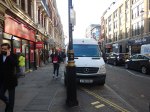


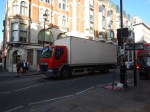









This is a summary of what I saw and my views.
- I only saw one electric vehicle; a black taxi.
- It was a horrendous collection of diesel trucks and vans. And an ambulance!
- As someone, who suffers in polluted air, I say two words – Stop It!
- All deliveries should be done at night!
- No vehicle should be allowed through unless it is zero carbon.
Note the lack of private cars and I only saw a couple of buses, both of which were New Routemasters.
Conclusion
Shaftesbury Avenue is the heart of London’s Theatreland. And a downright disgrace!
I am lucky, in that if I want to go, I walk round the corner from my house and get a 38 bus direct to the Avenue.
But look at any map and you’ll see there is no Underground station in the area and you have to walk from Leicester Square, Piccadilly Circus or Tottenham Court Road stations.
Crossrail 2 has a plan to build a station in the area, but as it would involve demolishing the Curzon Cinema, all the usual suspects are against that plan. They were also against the demolition of a theatre at the site of the expanded Tottenham Court Road station. Crossrail are doing the obvious and building a new bigger one!
Surely, the same thing would work for Crossrail 2!
Is The East-West Rail Link Going For The Freight Market?
I will deal with question in two main sections; West and East.
Freight In The West
In Shapps Supports Beeching Axe Reversals, I talked about the reopening of the Northampton and Marketharborough Line to connect the West Coast and Midland Main Lines..
- Passenger services could run between Market Harborough or Leicester and Marylebone, Milton Keynes, Oxford or Reading.
- Multi-modal services could run between freight terminals in the North Midlands and Yorkshire and Southampton Docks.
- With electrification, it could create the Electric Spine, that was cancelled a few years ago.
Judging by Grant Shapps comments, I do wonder if this scheme is part of the East-West Rail Link.
Look at freight trains between Sheffield or South Yorkshire and Southampton Docks.
- Currently, they seem to use a route via Chesterfield, Ilkeston, Toton, Burton-on-Trent, Bordesley, Solihull, Warwick Parkway, Banbury, Oxford, Reading and Basingstoke.
- After the East-West Rail Link and the Northampton and Market Harborough Line are opened, the trains would go via Chesterfield, Ilkeston, East Midland Parkway, Loughborough, Leicester, Market Harborough, Northampton, Milton Keynes, Bletchley, Bicester, Oxford, Reading and Basingstoke.
The advantages of the new second route would appear to be.
- It doesn’t involve a Grand Tour of Birmingham.
- It only involves the next phase of the East-West Rail Link.
- It is partially-electrified.
- It would be relatively easy to electrify between Didcot and Bletchley.
- Innovative locomotives like the Class 93 locomotive might be ideal for the route.
I do suspect that the new route will be substantially quicker.
Freight In The East
If the East-West Rail Link will improve freight services in the West, what will it do in the East?
I wrote about freight at the Eastern end of the route in Roaming Around East Anglia – Freight Trains Through Newmarket.
This was the introduction to that article.
The East West Rail Consortium plan to change the route of freight trains to and from Haven Ports; Felixstowe, Harwich and Ipswich to the West of Kennett station.
In this document on the East-West Rail Consortium web site, this is said.
Note that doubling of Warren Hill Tunnel at Newmarket and
redoubling between Coldham Lane Junction and Chippenham Junction is included
in the infrastructure requirements. It is assumed that most freight would operate
via Newmarket, with a new north chord at Coldham Lane Junction, rather than
pursuing further doubling of the route via Soham.How would these changes affect Newmarket and the horse-racing industry in the town?
I then examined the affects in detail.
My conclusions were that it will be a difficult project to get approved, as Newmarket won’t like a double-track freight railway through the centre.
Summary Of Freight Routes Using The East-West Rail Link
As far as I can see, these will be the major freight routes using the link.
Felixstowe and Birmingham
Ipswich, Newmarket, Cambridge, Bletchley, Nuneaton and Castle Bromwich
Felixstowe and Bristol
Ipswich, Newmarket, Cambridge, Bletchley, Oxford and Swindon
Felixstowe and Cardiff
Ipswich, Newmarket, Cambridge, Bletchley, Oxford, Swindon and Newport
Felixstowe and Glasgow
Ipswich, Newmarket, Cambridge, Bletchley, Stafford, Crewe, Preston and Carlisle
Felixstowe and Liverpool
Ipswich, Newmarket, Cambridge, Bletchley, Stafford, Crewe and Runcorn
Felixstowe and Trafford Park
Ipswich, Newmarket, Cambridge, Bletchley, Stafford Crewe, Manchester Piccadilly and Manchester Oxford Road
Southampton and Birmingham
Basingstoke, Oxford, Bletchley, Nuneaton and Castle Bromwich
Southampton and Glasgow
Basingstoke, Oxford, Bletchley, Stafford, Crewe, Preston and Carlisle
Southampton and Liverpool
Basingstoke, Oxford, Bletchley, Stafford, Crewe and Runcorn
Southampton and Sheffield
Basingstoke, Oxford, Bletchley, Northampton, Market Harborough, Leicester, East Midlands Parkway, Ilkeston and Chesterfield
Southampton and Trafford Park
Basingstoke, Oxford, Bletchley, Stafford Crewe, Manchester Piccadilly and Manchester Oxford Road
Note, that I have ignored routes like Felixstowe and Leeds or London Gateway and Trafford Park, which will avoid the East-West Rail Link.
Conclusion
The East-West Rail Link is going to be a very important freight route.
Winners And Losers
Will there be objections in places like Cambridge, Market Harborough and Newmarket, which will see a large increase in freight traffic?
On the other hand, some places like Banbury, Birmingham and North London will see a reduction in freight traffic.
Others like Oxford would see little difference in the numbers of trains.
Electrification
The East-West Rail Link connects to five electrified main lines at Oxford, Bletchley, Bedford, Sandy and Cambridge.
For freight’s sake, I think it should be electrified to make the most of new motive power, like the Class 93 locomotive and reduce pollution and carbon emissions.
Bristol Poised For Seven-Day Ban On Diesel Cars
The title of this post is the same as that of this article in The Times.
This is the introductory paragraph.
Bristol is set to become the first city in Britain to ban diesel cars under the toughest measures yet seen to combat air pollution.
A few points.
- It will apply to all diesels.
- It will apply in part the City Centre.
- Petrol cars will be exempt.
Although, I agree with the need to improve air quality, I doubt the measure will be passed. Selfish interests will prevail!
Pollution Charge For Diesels Has Cut City’s Toxic Fumes By A Third
The title of this post is the same as that of this article on Page 4 of today’s copy of The Times.
The only applies to London at the moment.
Surely other cities should follow the capital’s lead.
PM Backs Clean Air Law
The title of this post is the front page headline on today’s copy of The Times.
This is the sub-heading of the article on The Times web site.
PM promises binding targets to reduce pollution and praises Times campaign
In a separate box in the paper, which is entitled Our Manifesto, this is said.
- A new Clean Air Act to confer a legal right to unjpolluted air for everyone in the UK.
- A ban on new diesel and petrol cars from 2030 and cuts to green car grants to be traversed.
- Temporary traffic bans outside schools at drop-off and pick-up times.
- The extension of pre-2016 diesel and pre-2006 petrol pay zones to more cities.
- Pollution monitors in every postcode to empower people to take action.
How far will Boris Johnson go to meet the manifesto of The Times in the Queen’s Speech on Monday?
Fire Up The Quattro: My Other Car Is An Energy Supplier
An article with this title is on Page 3 of the Business Section in today’s Sunday Times.
This is the first paragraph.
Car companies could be encouraged to become electricity suppliers under an overhaul of the energy market being explored by the government and the regulator.
This is an excellent idea.
These are a few of my ideas.
All-In-One Deals
It would open up the scope for all-in-one deals for the purchase of electric cars.
The cost of the car, servicing and electricity would all be included.
A cost per mile could be guaranteed, which might rise with distance.
Most importantly, he car company would handle all the hassle and give the customers appropriate training.
It Could Be A Range Anxiety Solution
Some articles in the media, are saying that range anxiety is holding back sales of electric cars, as no-one wants to get stuck in remote locations with flat batteries.
Up market brands already have their own rescue service and I can envisage a network of electric trucks, which can rescue stranded vehicles, by giving them sufficient charge to get to the nearest charger.
These trucks could even be in a common fleet with video screens informing everybody they were a particular car company’s Electric Vehicle Rescue Truck. So when rescuing an Audi, they would say Audi’s El;ectric Vehicle Rescue Truck.
If a prospective punter, saw a rescue truck, with their favourite make on the side, it might persuade them to pop in to a showroom.
Free Or Reduced Cost Parking In Electric-Only Car Parks
In Airport Plans World’s Biggest Car Parks For 50,000 Cars, I outlined how a massive car park like this could hold electric cars with a total battery capacity of 1.35 GWh.
This storage capacity could be used to store surplus energy, whilst cars were parked.
I can see a consortium being put together to provide electric-only car parks.
- National Grid to provide and distribute the electricity.
- The car companies to provide the customers.
- Airports and rail stations, local authorities to provide the land.
But not all car parks would be large!
I can imagine new housing developments bringing in an electric vehicle-only rule.
I wouldn’t mind living in one of that type of development.
There would be various charges in these electric vehicle-only car parks.
- An hourly or contract charge for the actual parking.
- A charge for the electricity used to charge the vehicle.
There would also be a payment from Nation Grid based on the amount of energy stored in the vehicle’s battery.
Billing would be automatic, based on when you were connected to the charger and the various energy flows.
\suppose you were flying away from Heathrow for a week, National Grid would have use of your vehicle’s battery to store electricity for seven days.
The car companies would be in a unique position to enable this deal.
- They have the customers.
- They can make their cars compatible with the car parks.
- They can handle the complex billing, as part of an All-In-One deal.
- \drivers would probably prefer to deal with BMW, Jaguar etc., than an energy company.
I would expect this model of car-parking to multiply.
- Many drivers would only use public transport on pain of death, so buying an electric car is the lesser of two evils.
- It would cut emissions in the centre of towns and cities.
- It would appeal to High Streets and Town Centres, as it could attract shoppers and visitors.
- For those with home chargers, it must surely reduce range anxiety
The only disadvantage, is that it might increase the use of cars for short journeys and increase traffic congestion.
But at least the extra vehicles would be non-polluting electric ones.
Conclusion
Used creatively, the proposal of allowing car companies to be energy suppliers, would appear to have possibilities.
.
What Will Boris Do About The Proposed Third Runway At Heathrow?
I have tackled this before in October 2016 in a post called Changing Sides.
This was how I started that post.
There is an interesting article in The Sunday Times today, entitled Boris Retreats In Fight Against Third Runway.
Boris is apparently saying he won’t oppose a third runway at Heathrow, so if anything he’s being consistent in changing horses, just as he did with Michael Gove.
But perhaps more surprisingly, Willie Walsh, the Chief Executive of IAG, who own BA, is quoted as calling Heathrow a fantasy project, which has been gold-plated and inflated by the owners to maximise their returns, at the expense of the airlines.
The paper also says that Gatwick will build a new runway anyway.
Remember, it was written before Theresa May’s government decided to allow Heathrow’s Third Runway.
Since the decision to allow Heathrow to build a Third Runway was made nearly three years ago in October 2016, there have been a lot of changes.
Notably, Boris has gone from Foreign Secretary and an MP in a Heathrow Expansion-opposing constituency to Prime Minister.
As Prime Minister he is supposed to look at the bigger picture.
Unless he’s totally stupid he must have noted the following.
Brexit Has Changed From A Simple Quick Exit Into A Slow And Very Tortuous Process
I would expect an opinion poll would show that the UK population thinks that sorting out Brexit is a much more important problem, than the decision on a new runway in the South East of England.
So will Boris put Heathrow’s Third Runway on the back burner, given the following factors
Gatwick Will Build A Second Runway Anyway
In the Wikipedia entry for Gatwick Airport, there is a section entitled Expansion Proposals, where this is the first paragraph.
Gatwick has been included in a number of reviews of airport capacity in southeastern England. Expansion options have included a third terminal and a second runway, although a 40-year agreement not to build a second runway was made in 1979 with West Sussex County Council. Expanded operations would allow Gatwick to handle more passengers than Heathrow does today, with a new terminal between two wide-spaced runways. This would complement or replace the South Terminal, depending on expected future traffic.
My project management knowledge tells me, that Gatwick could add a second runway and upgrade the terminals in a shorter time, than Heathrow can build a third runway.
But more importantly, Gatwick Airport could build the extra runway and terminal without disruption to airport passengers, aircraft and road traffic on the nearby M23.
Boris’s only problem with Gatwick expansion, is the amount of post he’ll get from Disgusted of Tunbridge Wells.
Disruption Must Be Avoided
Recent timetabling and construction fiascoes on Thameslink and Northern Rail should have sent a message to politicians, that large infrastructure projects must be created without disrupting train or air passengers and road traffic.
Can Heathrow Be Built Without Disrupting Traffic On The M25?
It is interesting to look back at the basic facts at the construction of Heathrow Terminal 5.
- A public enquiry into the project lasted 525 days.
- The terminal sits on a 260 hectare site.
- Construction started in 2002.
- The terminal opened in 2008.
- Construction finisged in 2011.
- The terminal cost £4.2billion.
The construction of Terminal 5, also needed the M25 to be widened and linked to the terminal.
This Google Map shows Heathrow Terminal 5 and its relationship to Heathrow’s current two runways and the M25.
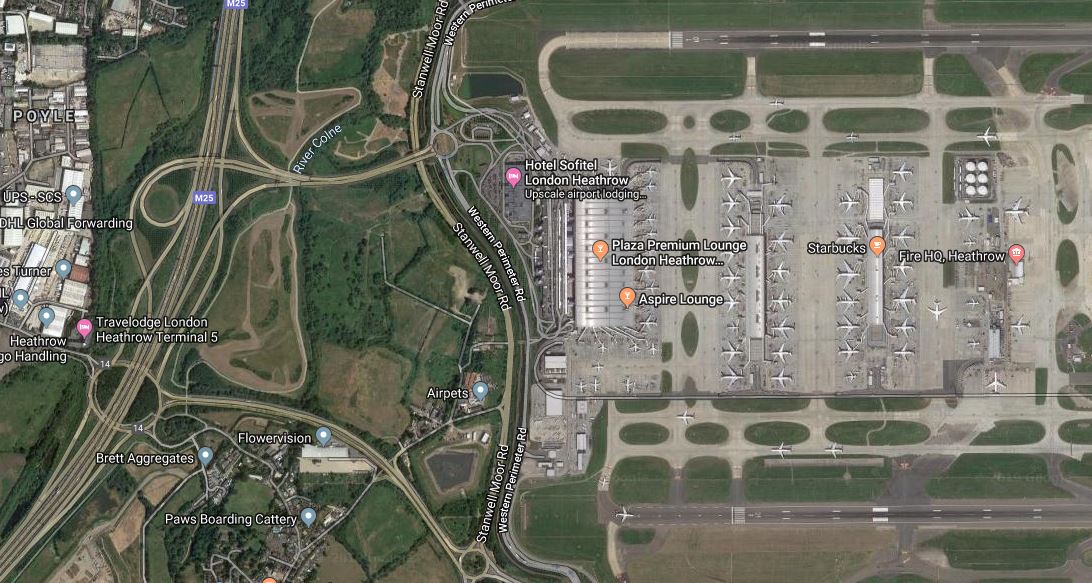
I remember the construction of Terminal 5 well, if only because, I was stuck in or moving slowly along that section of the M25 so many times.
As this immense construction project, is probably in living memory of much of the population of West London, how will they react to the thought of all the disruption, that building the third runway will cause.
Would Uxbridge, throw Boris out, if he approved the building of a third runway at Heathrow?
Heathrow Is A Pollution Blackspot
Various factors mean, that the surroundings of Heathrow are a pollution blackspot, mainly caused by the large number of diesel vehicles on the M4 and M25 motorways and others bringing passengers and goods to the airport.
I believe that any Planning Permission for the third runway, will require Heathrow to do something about the pollution. This could be easier than anybody thinks, as more of us will be using electric vehicles by the time the runway opens.
Heathrow are already proposing their ULEZ or Ulta Low Emission Zone.
Heathrow Rail Access Will Improve
Crossrail will eventually serve Heathrow in a year or so and this will improve rail access to the Airport significantly.
Other rail links are also in prospect.
- The Western Rail Approach to Heathrow could be open by 2024.
- Heathrow Southern Railway could be built.
- The West London Orbital could be built.
The first two would be privately financed.
This better rail access may reduce the traffic and pollution around the airport, but it will make it easier, for passengers to use the airport and traffic will grow.
High Speed Rail
Increasingly, Heathrow and the other London airports, will come under competition from High Speed Rail.
Eurostar has upwards of seventy percent of the London-Paris and London-Brussels passenger markets.
I have travelled a few times from London to Amsterdam on Eurostar and feel that four hours is my limit for comfortable train travel.
I estimate the following journeys would be possible on Eurostar.
- London and Cologne via Brussels in four hours
- London and Bordeaux via Paris in four and a half hours.
- London and Frankfurt in Five hours.
Another competitor to air services out of London will be London and Edinburgh services on the East Coast Main Line, which are being updated with new faster trains and journey times under four hours.
Air Cargo And Heathrow
I looked up air cargo in Wikipedia and these points are there.
- Fifty-percent of all air frieght is belly-cargo on airlines.
- An industry expert estimates that 15-20 tonnes of air cargo is worth 30-40 economy passenger seats, when both are on passenger planes.
- In 2017, the IATA observed a 9% rise in freight tonne kilometres
- Boeing is doubling its 767F production since 2016 to three per month in 2020.
Heathrow dominates the air cargo traffic into and out of the UK and last year it handled 1,788,815 tonnes of cargo, which was a 5.3% increase in tonnage on 2017.
However, it does appear that the second largest cargo airport in the UK; East Midlands, handled about the same amount of freight as Heathrow in April 2018.
There is also the East Midlands Gateway close to that airport, which will be a massive logistics park., with a rail connection.
Perhaps the pressures of the congested Heathrow, with some nudging from the Government could remove the cargo aircraft from the airport to more suitable airports like East Midlands and Doncaster Sheffield.
Manchester Airport Is The Most Important Airport North Of London
Manchester Airport is the busiest Airport after Heathrow and Gatwick and over the next few years it will catch up to a certain extent.
In Changes Signalled For HS2 Route In North, I said this about Manchester Airport’s rail connectivity if High Speed Two and Northern Powerhouse Rail are combined across the Pennines.
If High Speed Two and Northern Powerhouse Rail are developed as laid out in the Transport for the North report, the following cities will be connected to Manchester Airport.
- Birmingham – High Speed Two
- Blackpool – Northern Powerhouse Rail/West Coast Main Line
- Bradford – High Speed Two/Northern Powerhouse Rail
- Carlisle – Northern Powerhouse Rail/West Coast Main Line
- Edinburgh – Northern Powerhouse Rail/East Coast Main Line
- Glasgow – Northern Powerhouse Rail/West Coast Main Line
- Hull – High Speed Two/Northern Powerhouse Rail
- Leeds – High Speed Two/Northern Powerhouse Rail
- London – High Speed Two
- Newcastle -High Speed Two/Northern Powerhouse Rail
- Preston – Northern Powerhouse Rail/West Coast Main Line
- Sheffield – Northern Powerhouse Rail
- Sunderland – Northern Powerhouse Rail
- York – High Speed Two/Northern Powerhouse Rail
Manchester Airport will probably become the most important station in the North with High Speed connections to a large part of England and Scotland.
Heathrow and Gatwick will find they have a very big and well-connected Northern competitor.
Extinction Rebellion And Other Environmental Protesters
Most of the environmental protesters like Extinction Rebellion seem to have focused their attention on Heathrow, where airports are concerned.
They will fight tooth and nail to stop Heathrow’s third runway.
Will Heathrow Get The Planning Permission They Need?
I think that this is the sort of planning decision, that will end up with the Secretary of State for Environment, Food and Rural Affairs; Theresa Villiers.
Her Wikipedia entry says this.
Villiers favours construction of a high-speed rail link from London to Birmingham and Manchester, arguing that flyers could use capacity at airports such as Birmingham International and Manchester International Airport.
She is also quoted as being against a third runway at Heathrow, when she was a member of Davisd Cameron’s cabinet.
Grant Schapps, who is the current Secretary of State for Transport, could be more supportive to Heathrow’s application.
The Mood Of The UK About The Environment
The view of the average UK voter on the environment has changed markedly in the last few years, driven by documentaries, events and politics from around the world.
Boris’s father; Stanley Johnson has written books on the environment and received the Greenpeace Award for Outstanding Services to the Environment, so this could fit with his opposition to a third runway at Heathrow, when he was Mayor of London.
Do Heathrow Airport Have A Plan B?
In Heathrow Plans Runway Over M25 In 30-Year Expansion, I outlined how I thought the runway would be built.
The Times says this about the construction program.
Only the runway would be built by the opening date of early 2026.
Other facilities such as new terminals, car parks, hotels and transit systems would open from 2030, with an expansion of Terminal 5 the priority
This means that the extra runway capacity can be used initially to better accommodate the same number of flights.
Perhaps Plan B would mean changing the order of construction, leaving a space for the third runway and getting Planning Permission to build it in perhaps starting in 2028.
Conclusion
This is a tough one to call and I know what I would do. I would just let it fester until the decision was forced by another factor.
But Boris is the Prime Minister and will have to make a decision!
D
Nissan Refuses To Improve Qashqai’s Toxic Emissions
The title of this post is the same as that of this article on Tuesday’s copy of The Times.
This is the first paragraph.
Nissan has refused a government request to carry out adjustments to thousands of highly polluting diesel cars to make them less toxic.
The car is called the Nissan Qashqai, which I wouldn’t recognise, unless it reversed into me on the street and I could see the name badge on the boot.
Today, there is this article on the BBC, which is entitled Nissan Workers Braced For Job Cuts.
As they say in Private Eye, could the two stories be related?
Especially, as Nissan seem to have had problems with a CEO recently, who seemed to find enhancing his lifestyle more important, than good stewardship of the company.
Mountains, Moors And Heaths Offer £20bn In Green Benefits
The title of this post is the same as that of this article on page 2 of today’s copy of The Times.
This is the first paragraph.
Britain’s mountains, moorlands and heaths are worth £20.1 billion for their ability to absorb carbon, remove air pollution and provide recreational activities, according to the Office for National Statistics.
It certainly make you think.
If you think twenty billion pounds is a large number, then this is another two paragraphs.
Natural accounts are required by the European Union but Theresa May has also made them a feature of the 25 Year Environment Plan that she unveiled last year.
The plan is focused on “protecting and enhancing [natural landscapes and habitats] for the next generation”. It follows work by the World Bank, which has estimated the value of the world’s untouched ecosystems at $33.7 trillion (£27.2 trillion).
Surely, this means that if you burn the rain forest, you are literally burning money!
 The Anonymous Widower