British Land Unveils Plans To Transform London’s Euston Tower Into A Life Sciences And Innovation Hub
The title of this post, is the same as that of this press release from British Land.
The Wikipedia entry for the Euston Tower gives this paragraph of history.
The site was developed by Joe Levy who bought properties along the north side of Euston Road to enable him to build a complex of two tower blocks with office shops and apartments. The building, which was designed by Sidney Kaye Eric Firmin & Partners in the International style and built by George Wimpey, was completed in 1970. It is 36-storeys and 124 metres (407 ft) high. Early tenants included Inmarsat and Capital Radio.
When you get to over fifty years old, various parts of your body get tired and I suspect it is the same with buildings.
These are the two bullet points of the press release.
- Euston Tower represents a major retrofit and redevelopment opportunity at the heart of London’s Knowledge Quarter
- Proposals aim to transform the building into a world-class net zero home for world-leading life science and innovation occupiers
These two paragraphs then add a bit more vision.
Leading property company British Land has unveiled plans to redevelop Euston Tower through an innovative combination of retention, re-use and an ultra-low carbon new structure. The plans would transform the building into a pioneering, modern, net zero workspace for cutting-edge businesses of all sizes, including new world-class, lab-enabled spaces at the heart of London’s Knowledge Quarter.
Currently under discussion with Camden Council and other local stakeholders, the vision for Euston Tower will lead the way in low carbon retrofit and construction techniques, using inclusive design which creates high quality workspaces and continues to support the local community and economy. The current proposals will bring forward lab-enabled spaces for start-up and scale-up innovation businesses, as well as spaces for the local community to support education and training opportunities.
These are points from the press release.
- Leading the design are award-winning Danish architecture practice 3XN.
- They are supported by London-based architecture and landscape studio DSDHA who re-designed much of Broadgate’s public realm, including Exchange Square.
- In line with British Land’s longstanding commitment to net zero development, the design’s sustainability strategy is based on retaining, re-using and re-cycling existing material, specifying low carbon and recycled materials where new is required and only using certified carbon offsets as an action of last resort.
- This multi-layered approach to net zero development aims to create a blueprint for the sustainable redevelopment of challenging, inflexible old buildings that can be used in the future.
British Land has owned and operated Regent’s Place for nearly 40 years, which means they must have a lot of knowledge about how best to develop the building and its surroundings.
They certainly seem to be applying a modern net-zero approach to a building that was iconic and modern in the 1970s.
This afternoon I walked down the Euston Road between Euston and Great Portland Street stations and took these pictures.












































Note.
- Euston Station is a shadow of its former self.
- Euston Tower is the boxy tower on the North side of Euston Road.
- University College London Hospital (UCLH) is the tower on the South side of Euston Road.
- I believe the glass-fronted building opposite the hospital and Euston Tower contains a lot of BT infrastructure.
I have some thoughts.
Traffic Along The Euston Road
I took the pictures around 1400 in a Friday and they show how busy the Euston Road is most of the time.
According to the Wikipedia entry for the Euston Road, there was a plan to remove the underpass.
In the early-21st century, the Greater London Authority commissioned a plan to improve the road from the architectural firm, Terry Farrell and Partners. The original study proposed removing the underpass (which was subsequently cancelled) and providing a pedestrian crossing and removing the gyratory system connecting the Tottenham Court Road and Gower Street. The scheme was approved by the Mayor of London, Ken Livingstone as “the start of changing the Marylebone to Euston road from a highway into a series of linked public spaces.” The pedestrian crossing opened in March 2010. Livingstone’s successor, Boris Johnson, favours keeping the Euston Road underpass and declared it to be a good place to test his nerves when cycling around London.
Nothing is said about, where the traffic would have gone, if the underpass had been closed.
I walked along the South side of the Euston Road past the hospital and the air couldn’t be considered clean. As I write this, this website rates it Hazardous.
If we ignore the pollution for pedestrians and cyclists, is it really a road, that is fit for the purpose of moving traffic between King’s Cross and Baker Street, and vice-versa? I don’t think so!
The UK Needs More Lab Space
Cambridge innovators and developers were always saying they needed more lab space.
I also suspect, they are moaning in Oxford too!
So building high-quality space in London could reduce the pressure.
In Canary Wharf Boosts Its Science Ambitions, I talked about the ambitions of Canary Wharf to be a life sciences hub.
The Euston Tower Is Well-Connected
Consider.
- The Euston Tower is within walking distance of Euston, King’s Cross and St. Pancras stations, with all their long distance connections.
- The Euston Tower is within walking distance of Euston Square, Great Portland Street, King’s Cross St. Pancras and Warren Square stations, with all their Underground connections.
- There are buses everywhere.
But that’s not to say, that these links cannot be improved.
Euston High Speed Two Station Could Be Euston Tower’s Sister?
This Google Map shows the location of Euston Town and the proposed Euston High Speed Two station.
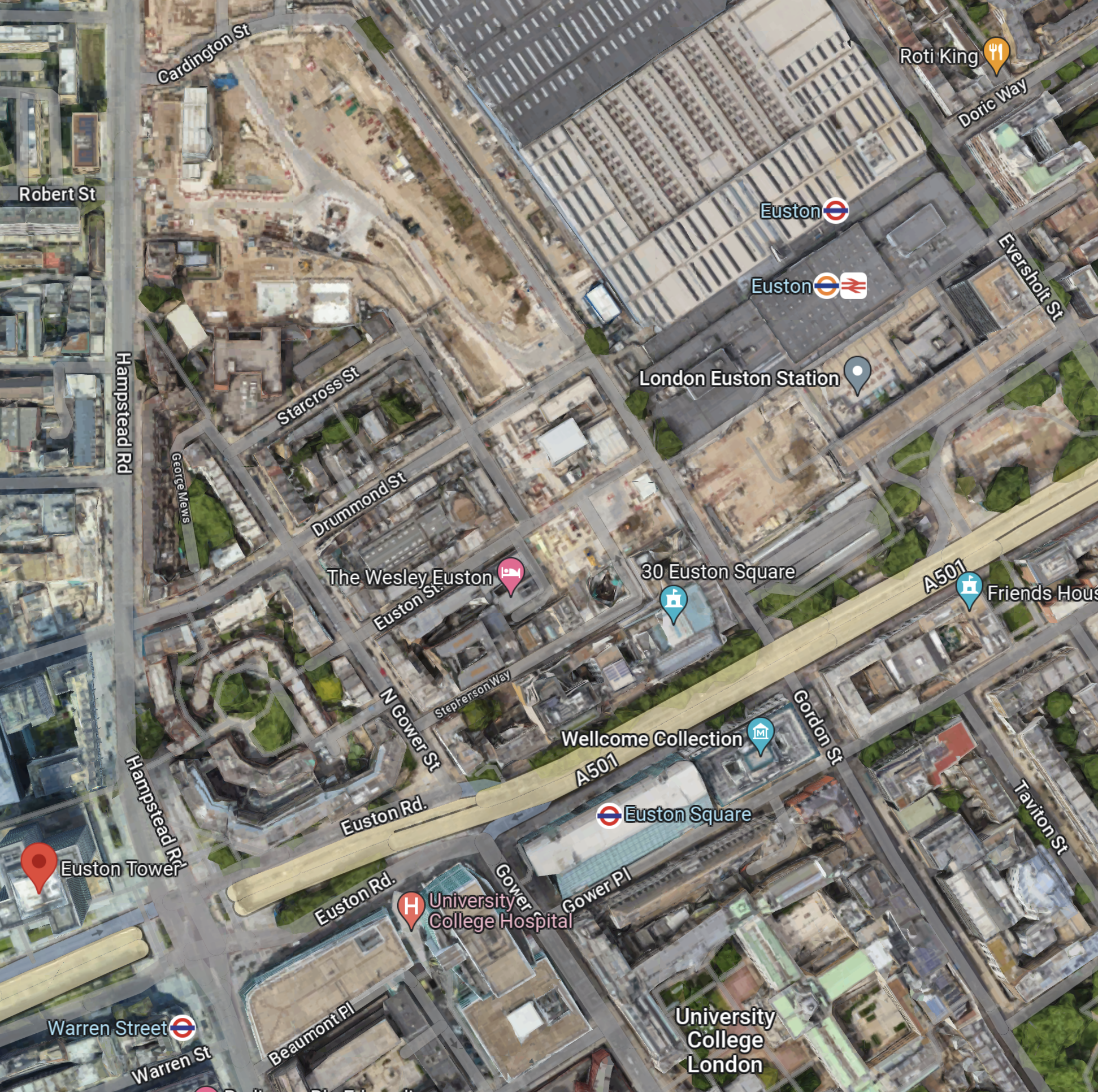
Note.
- Euston Tower is marked by a red arrow in the South-West corner of the map.
- The existing Euston station is in the North-East corner of the map.
- The High Speed Two station will be built along the Western side of the existing station.
With good landscaping, an excellent walking route, and perhaps a people mover Euston Tower could have superb connections to the rest of the UK.
Cycling And Walking Could Be A Possibility!
This Google Map shows the wider area around Euston Tower.
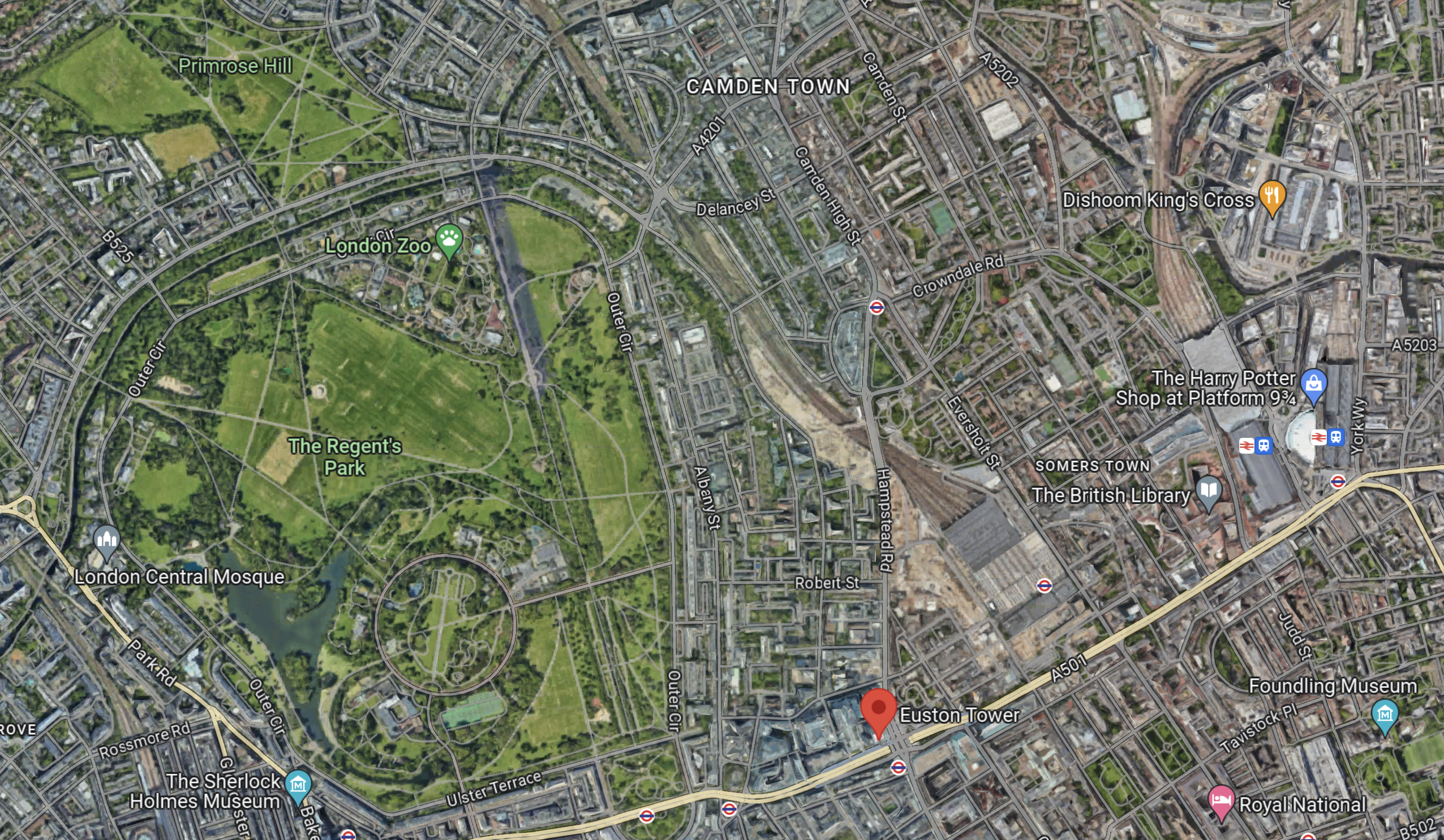
Note.
- Euston Tower is marked by the red arrow towards the bottom of the map.
- To its West lies the cycling- and walking-friendly spaces of Regents Park and Primrose Hill.
In the 1970s, I regularly walked or cycled across the park from where we lived near Primrose Hill to a client in Great Portland Street.
I also suspect other cycling and walking routes could be developed to Euston Tower from Euston, King’s Cross, St. Pancras and other stations.
Crossrail 2
Crossrail 2 would certainly help travelling to the Euston Tower, by linking Euston, King’s Cross and St.Pancras to North-East and South-West suburbs of London, with trains at frequencies of up to 30 thirty trains per hour (tph) in the central tunnel.
But.
- The new line will cost at least £31.2 billion. Who can afford it?
- The Elizabeth Line took sixteen years from approval to full opening.
- Crossrail 2 would still be a walk from Euston Tower.
So Crossrail 2 is unlikely to be any help to the redevelopment of Euston Tower.
Improving The Sub-Surface Lines
The Euston Tower is close to two stations on the sub-surface lines; Euston Square and Great Portland Street.
Services through these stations are currently as follows.
- Circle Line – 6 tph – In both directions all day.
- Hammersmith & City Line – 6 tph – In both directions all day.
- Aldgate and Amersham- 2 tph – In both directions all day.
- Aldgate and Chesham – 2 tph – In both directions all day.
- Aldgate and Uxbridge – 6 tph Peak – 8 tph – Off-Peak
- Aldgate and Watford – 4 tph – Peak
Note.
- In the Peak there are 26 tph through Great Portland Street and Euston Square stations.
- In the Off Peak there are 24 tph through Great Portland Street and Euston Square stations.
- In this article on Modern Railways,it is said that after digital signalling is installed on the sub-surface lines, the capacity on the lines, will be 32 tph in the Peak and 27 tph in the Off-Peak.
These figures give a 33 % capacity increase in the Peak and a 28 % increase in the Off Peak.
Both Great Portland Street and Euston Square stations are cramped and not fully step-free stations and could struggle with a 28 % and upwards increase in passenger numbers.
In The New Step-Free Entrance At Euston Square Station, I detailed TfL’s plans to put a new full step-free entrance South of Euston Road at Euston Square station.
This would not directly help travellers going between Euston Tower and Euston station, but hopefully, it would help to make Euston station less crowded and more passenger-friendly.
It would certainly ease walking between University College and the hospital, and the station.
This map from cartometro shows the Underground lines at Great Portland Street station.

Note.
- The yellow and mauve tracks are the sub-surface lines.
- The black tracks are the Northern Line.
- The blue tracks are the Victoria Line.
This Google Map shows the Euston Tower, Great Portland Street and Warren Street stations.
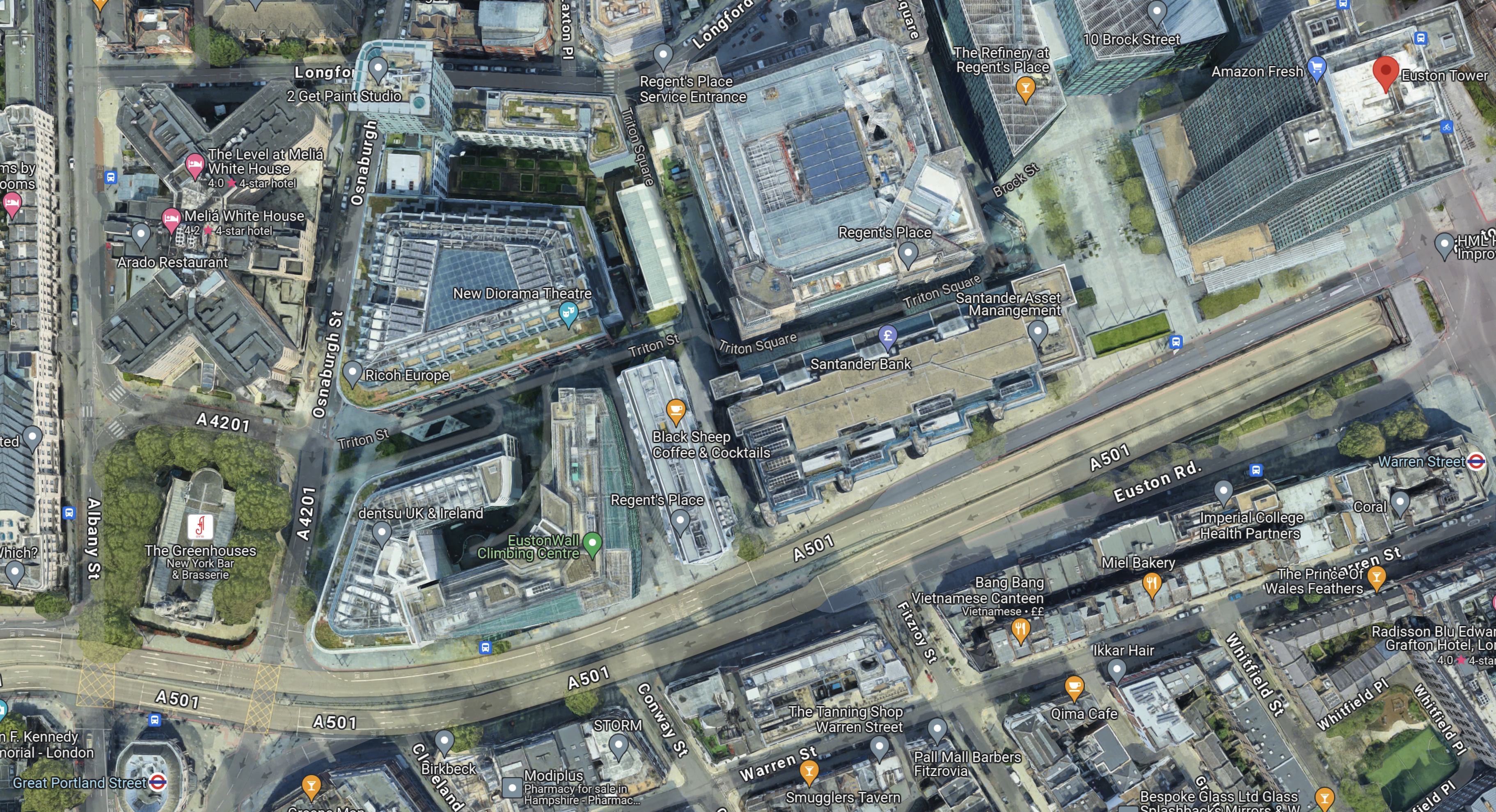
Note.
- The Euston Tower is indicated by a red arrow in the top-right corner of the map.
- Great Portland Street station is in the bottom-left corner of the map.
- Warren Street station is at the left of the map.
I wonder if the platforms were to be extended Eastwards at Great Portland Street station, that a new entrance to the station could be created perhaps fifty metres from Euston Tower.
I am convinced that the extra passenger traffic created by the life sciences and innovation hub can be handled by an augmented transport infrastructure, which would rely mainly on planned improvements to the sub-surface lines, which are approaching their final stages.
Conclusion
Converting Euston Tower into a life sciences and innovation hub is a plan that I believe can work well!
I would recommend the following improvements to public transport.
- The planned extra step-free entrance to Euston Square station on Gordon Street is constructed.
- An extra fully step-free entrance is built at the Eastern ends of the platforms at Great Portland Street station, which would be about halfway between Euston Tower and the station.
As improvements to the signalling of the sub-surface lines will deliver an upwards of 27 % capacity on the sub-surface lines, the life sciences and innovation hub might as well take advantage.
Silvertown Tunnel: Cracks In Mayoral Policies
The title of this post is the same as that of this article on the BBC.
This is the sub-heading.
It is an infrastructure project that is well-underway with the boring almost completed — but it has a very low profile.
These are the first three paragraphs.
Every step of the Crossrail tunnelling, the media were invited along. Not so with this project.
This is Silvertown Tunnel. It is more than 1km long and will be London’s first road tunnel in over 30 years.
Perhaps one of the reasons it isn’t being pushed publicity-wise, is it is very controversial.
Tom Edwards gives a detailed outline of why the tunnel is controversial.
Under a heading of HGVs Using Bus Lanes, this is said.
Instead of using the Dartford Crossing, larger HGVs will be able to use the tunnel — and its bus lane.
Campaigners said that will mean more HGVs going through Newham and Greenwich.
I’ve also never heard this before.
Sheila Keeble, of the Greenwich Society, said the tunnel “will be magnet for bigger traffic than we’ve got at the moment”.
“One of the issues we have is all the developers are now looking at building distribution centres,” she said.
“At the moment the Blackwall Tunnel protects us from bigger traffic… Silvertown won’t.”
That is all very logical and I suspect we’ll see larger trucks in Hackney and Waltham Forest too!
There was also this bit of nonsense from Transport for London.
TfL says the tunnel will lead to an overall improvement in air quality.
How will all those trucks through the two tunnels reduce pollution?
In 2024, London must vote for a Mayor, who understands hydrogen, mathematics and science!
UK’s Nuclear Fusion Site Ends Experiments After 40 Years
The title of this post, is the same as that of this article on the BBC.
I have followed fusion research since ZETA at Harwell was started up in 1957.
These first few paragraphs from the BBC article, sum up up fusion research.
For the next four decades, the European project pursued nuclear fusion and the promise of near-limitless clean energy.
But on Saturday the world’s most successful reactor will end its last test.
Nuclear fusion was “discovered” in the 1920s and the subsequent years of research focused on developing fusion for nuclear weapons.
In 1958, when the United States’ war research on fusion was declassified, it sent Russia, UK, Europe, Japan and the US on a race to develop fusion reactions for energy provision.
Fusion is considered the holy grail of energy production as it releases a lot of energy without any greenhouse gas emissions.
It is the process that powers the Sun and other stars. It works by taking pairs of light atoms and forcing them together – the opposite of nuclear fission, where heavy atoms are split apart.
Four decades of research, loads of money and some of the best brains in the world have produced very little, except about knowing what doesn’t work.
It doesn’t seem that anybody is getting any value from fusion research any more.
It’s almost as if, we’ve hit a brick wall and we can’t go any farther.
It must be terribly demoralising for everybody involved.
Would the scientists and engineers be better employed on other research?
I wouldn’t totally abandon fusion research, but put it more on a watching brief, so that if anything positive happens elsewhere, the UK might be able to take advantage.
Could we even do what we have recently done with High Speed Two and scrap it, before using the money on other energy projects?
My priorities would be.
Floating Wind Research
Because we are surrounded by sea, offshore floating wind is likely to be our major energy source by the end of the decade.
Energy Network Control Research
Our energy network will be getting more complex and we need better algorithms to control it.
Storage Research
We need lots of energy storage, that is affordable to install, that can be placed everywhere in the UK.
Project Management Research
I believe that some of the energy ideas will need advanced project management techniques, that may or may not have been invented yet.
Small Modular Reactor Research
SMRs are one way to go, but is the backup research in place?
Tidal Research
Places in the UK have high tidal ranges and we should exploit them.
The Government And Research
The government is funding a lot of energy research.
Much of the funding is going for short term projects, which is good in that we have an urgent need for improvement in our energy performance, but is bad in that it ignores the future.
Diamond 2
The Diamond Light Source has been an unqualified success. I am convinced that we need Diamond 2 in the North, which I wrote about in Blackpool Needs A Diamond.
Canary Wharf Move Means Expansion For Drug Trials Operator
The title of this post, is the same as that of this article on The Times.
These three paragraphs outline the story.
An Aim-listed company that tests infectious and respiratory disease products on volunteers is preparing to move its operations to Canary Wharf.
Amid booming demand for its services, hVIVO, which infects volunteers with safe doses of virus agents, then quarantines them before testing the efficacy of vaccines and antivirals — in so-called human challenge trials — will move from its clinics in Whitechapel, east London, to a new larger facility near by owned by Canary Wharf Group early next year.
Canary Wharf is aiming to attract businesses from the life sciences and health sectors in a drive to become a sciences hub and less reliant on the financial services industry.
This is the second story about life science companies moving to Canary Wharf after Canary Wharf Boosts Its Science Ambitions.
I have my thoughts.
Canary Wharf Is A Transport Hub
Canary Wharf is served by the following transport links.
- Buses
- Docklands Light Railway
- Elizabeth Line
- Jubilee Line
- Thames Clipper
It is very well-connected, which means that staff and volunteers can get there easily.
Canary Wharf Is A Leisure Destination
Canary Wharf is very much more than a collection of expensive offices.
There are shops, bars, restaurants, a museum and a cinema complex.
There Is A Shortage Of Lab-Rats
I volunteer for medical research and regularly, I’m called in to help with the recruitment of more volunteers.
I suspect, that many would prefer to volunteer at Canary Wharf, rather than some parts of London.
Conclusion
I suspect that we’ll see an expansion of medical research of all kinds at Canary Wharf.
13 Offshore Wind Projects Selected In World’s First Innovation And Targeted Oil & Gas Leasing Round
The title of this post, is the same as that of this article on offshoreWIND.biz.
This is the sub-heading.
Crown Estate Scotland has selected 13 out of a total of 19 applications with a combined capacity of around 5.5 GW in the world’s first leasing round designed to enable offshore wind energy to directly supply offshore oil and gas platforms.
This paragraph outlines INTOG (Innovation and Targeted Oil & Gas) and its objectives.
INTOG, which has been designed in response to demand from government and industry to help achieve the targets of the North Sea Transition Sector Deal through decarbonising North Sea oil and gas operations, is also expected to further stimulate innovation in Scotland’s offshore wind sector, create additional supply chain opportunity, assist companies to enter the renewable energy market, and support net-zero ambitions.
This is undoubtedly the most important news of the day.
- When complete it will generate 5416 MW of electricity.
- 4068 MW will be used primarily to decarbonise oil and gas platforms with surplus electricity going to the grid.
- The amount of carbon dioxide released by oil and gas platforms in the North Sea will be reduced.
- The gas saved by decarbonising oil and gas platforms, will be transported to the shore and used in the UK gas grid.
- 449 MW will be generated in innovative ways in small wind farms, with a capacity of less than 100 MW.
One of the benefits of INTOG is that the UK will be able to reduce gas imports, which must increase energy security.
This map from this document from the Crown Estate Scotland, shows the INTOG wind farms.
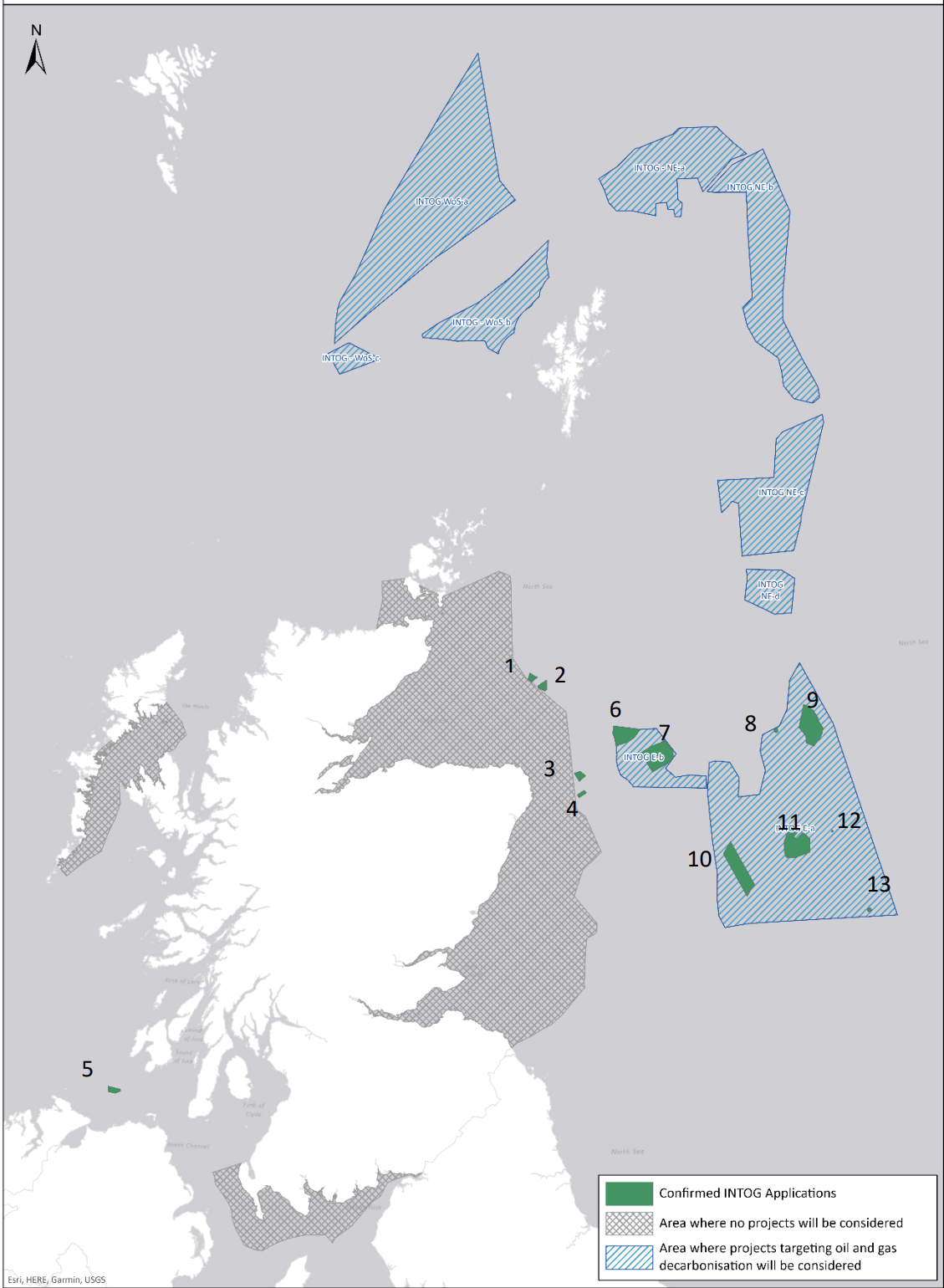
This is a list of the farms.
- 1 – Bluefloat Energy/Renantis Partnership – Innovation – Commercial – 99.45 MW
- 2 – Bluefloat Energy/Renantis Partnership – Innovation – Supply Chain – 99.45 MW
- 3 – Simply Blue Energy (Scotland) – Innovation – Supply Chain – 100 MW
- 4 – BP Alternative Energy Investments – Innovation – New Markets – 50 MW
- 5 – ESB Asset Development – Innovation – Cost Reduction – 100 MW
- 6 – Floatation Energy – Targeted Oil & Gas – 560 MW
- 7 – Cerulean Winds – Targeted Oil & Gas – 1008 MW
- 8 – Harbour Energy – Targeted Oil & Gas – 15 MW
- 9 – Cerulean Winds – Targeted Oil & Gas – 1008 MW
- 10 – Cerulean Winds – Targeted Oil & Gas – 1008 MW
- 11 – Floatation Energy – Targeted Oil & Gas – 1350 MW
- 12 – TotalEnergies – Targeted Oil & Gas – 3 MW
- 13 – Harbour Energy – Targeted Oil & Gas – 15 MW
Note.
- These total up to 5.42 GW.
- The five Innovation sites seem to be as close to the coast as is possible.
- I thought some Innovation sites would be closer, so supply difficult to reach communities, but they aren’t.
- Floatation Energy and Cerulean Winds seemed to have bagged the lion’s share of the Targeted Oil & Gas.
- Sites 6 and 7 sit either side of a square area, where Targeted Oil & Gas will be considered. Is that area, the cluster of oil and gas facilities around Forties Unity, shown on the map in this page on the BP web site?
- Harbour Energy have secured two 15 MW sites for Targeted Oil & Gas.
These are my thoughts on the various companies.
Bluefloat Energy
Bluefloat Energy has posted this press release on their web site, which is entitled Bluefloat Energy | Renantis Partnership Bid Success For Two 99mw Innovation Projects In Crown Estate Scotland’s INTOG Process.
The press release starts with these three bullet points.
- BlueFloat Energy | Renantis Partnership offered exclusivity rights to develop its Sinclair and Scaraben floating wind projects north of Fraserburgh – leveraging synergies via its 900MW Broadshore project.
- The projects seek to trial innovative floating wind technology solutions, kick-starting supply chain growth and job creation in Scotland and providing a ‘stepping-stone’ to the partnership’s ScotWind projects.
- Bid proposals include the intention to develop a scalable community benefit model – creating a potential blueprint for floating offshore wind in Scotland.
The first three paragraphs expand the bullet points.
The BlueFloat Energy and Renantis Partnership has been offered seabed exclusivity rights to develop two 99MW projects under the innovation arm of Crown Estate Scotland’s INTOG (Innovation and Targeted Oil & Gas) auction process. The auction saw ten projects bid to bring forward the development of small-scale innovation projects.
The Sinclair and Scaraben projects, located north of Fraserburgh and adjacent to the Partnership’s 900MW Broadshore project, seek to trial innovative foundation technologies, associated fabrication works and mooring systems with a view to maximising opportunities for the Scottish supply chain, driving local investment and job creation.
A key element of the bid proposals is the opportunity to test and adapt a community benefit model, governed independently, and directed by the communities in which the schemes will operate, through collaboration with our supply chain and project partners. The model could create a blueprint, shaping the future of community benefit from floating offshore wind throughout the whole of Scotland. This builds on Renantis’ successful track record of deploying similar schemes via its onshore wind farms in Scotland.
Note.
- Companies called Sinclair Offshore Wind Farm and Scaraben Offshore Wind Farm were registered a few months ago in Inverness.
- I couldn’t find the websites, so I suspect they’re still being created.
- These two projects appear to be pathfinders for the 900 MW Broadshore project, with regards to the supply chain and community involvement.
It certainly looks like the partnership are going about the development of these two projects in a professional manner.
BP Alternative Energy Investments
There has been no press release from BP as I write this, so I will have to deduce what BP are planning.
This map from this document from the Crown Estate Scotland, shows the Southern INTOG wind farms.
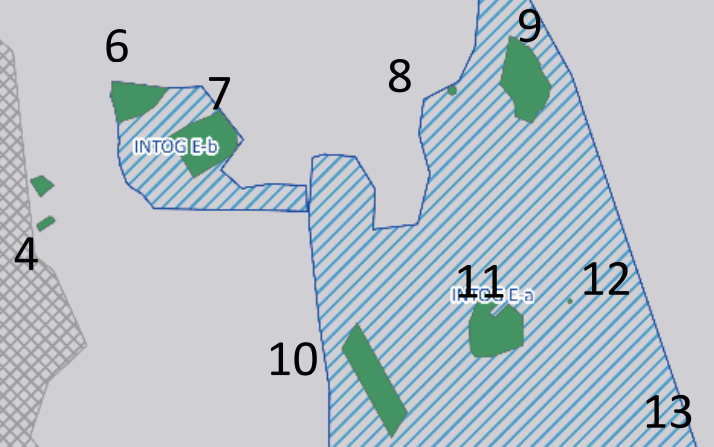
Note.
- Site 4 is the site of BP Alternative Energy Investments’s proposed wind farm.
- Sites 6 and 7 could be either side of the cluster of platforms around Forties Unity.
Consider.
- In the wider picture of wind in the North Sea, BP’s proposed 50 MW wind farm is a miniscule one. SSE Renewables’s Dogger Bank wind farm is over a hundred times as large.
- A cable to the shore and substation for just one 50 MW wind farm would surely be expensive.
- BP Alternative Energy Investments are also developing a 2.9 GW wind farm some sixty miles to the South.
- It would probably be bad financial planning to put large and small wind farms so close together.
For these are other reasons, I believe that there is no reason to believe that the proposed 50 MW wind farm is a traditional wind farm.
But if I’m right about sites 6 and 7 indicating the location the position of Forties Unity, it might open up other possibilities.
This document from INEOS, who own the Forties Pipeline System, explains how the pipeline works.
The Forties Pipeline System (FPS) is an integrated oil and gas transportation and processing system. It is owned and operated by INEOS and utilises more than 500 miles of pipeline to smoothly transport crude oil and gas from more than 80 offshore fields for processing at the Kinneil Terminal. At Kinneil the oil and gas are separated, with the oil returned as Forties Blend to customers at Hound Point or pumped to the Petroineos refinery at Grangemouth.
At the same time the gas goes to our LPG export facilities or is supplied to the INEOS petrochemical plant. FPS transports around 40% of the UK’s oil production supply and brings over 400,000 barrels ashore every day.
In Can The UK Have A Capacity To Create Five GW Of Green Hydrogen?, I said the following.
Ryze Hydrogen are building the Herne Bay electrolyser.
- It will consume 23 MW of solar and wind power.
- It will produce ten tonnes of hydrogen per day.
The electrolyser will consume 552 MWh to produce ten tonnes of hydrogen, so creating one tonne of hydrogen needs 55.2 MWh of electricity.
If BP were to pair the wind farm with a 50 MW electrolyser it will produce 21.7 tonnes of hydrogen per day.
Could it be brought to the shore, by linking it by a pipeline to Forties Unity and then using the Forties Pipeline System?
As the category on site 4, is New Markets, are BP and INEOS investigating new markets for hydrogen and hydrogen blends?
- Some of the latest electrolysers don’t need pure water and can use sea water. This makes them more affordable.
- Do BP and/or INEOS have the capability to extract the hydrogen as it passes through the Cruden Bay terminal, to provide the hydrogen for Aberdeen’s buses and other users?
- INEOS and BP probably have some of the best oil and gas engineers in the world.
- How many other places in the world have an offshore oil or gas field set in a windy sea, where floating wind- turbine/electrolysers could generate hydrogen and send it ashore in an existing pipeline?
- Several of these offshore oil and gas fields and the pipelines could even be owned by BP or its associates.
- Remember that hydrogen is the lightest element, so I suspect it could be separated out by using this property.
This BP site, is to me, one of the most interesting of the successful bids.
- BP probably have a large collection of bonkers ideas, that have been suggested during their long involvement with offshore oil and gas.
- Some ideas could be even suggested by employees, whose fathers worked for BP fifty years ago. I’ve met a few BP employees, whose father also did.
- Will the wind farm, be a floating electrolyser at the centre of a cluster of a few large floating turbines?
- Will each turbine have its own electrolyser and the substation only handle hydrogen?
- Will the floating electrolyser have hydrogen storage?
- Have BP got a floating or semi-submersible platform, that could either go to the breakers or be repurposed as the floating electrolyser?
- Repurposing a previous platform, would make all the right noises.
So many possibilities and so far, no clues as to what will be built have been given.
See also.
Further Thoughts On BP’s Successful INTOG Bid
Cerulean Winds
In What Is INTOG?, I said this about Cerulean Winds.
Cerulean sounds like it could be a sea monster, but it is a shade of blue.
This article on offshoreWind.biz is entitled Cerulean Reveals 6 GW Floating Offshore Wind Bid Under INTOG Leasing Round.
These are the two introductory paragraphs.
Green energy infrastructure developer Cerulean Winds has revealed it will bid for four seabed lease sites with a combined capacity of 6 GW of floating wind to decarbonise the UK’s oil and gas sector under Crown Estate Scotland’s Innovation and Targeted Oil and Gas (INTOG) leasing round.
This scale will remove more emissions quickly, keep costs lower for platform operators and provide the anchor for large-scale North-South offshore transmission, Cerulean Winds said.
Note.
-
- It is privately-funded project, that needs no government subsidy and will cost £30 billion.
- It looks like each site will be a hundred turbines.
- If they’re the same, they could be 1.5 GW each.
- Each site will need £7.5 billion of investment. So it looks like Cerulean have access to a similar magic money tree as Kwasi Kwarteng.
Effectively, they’re building four 1.5 GW power stations in the seas around us to power a large proportion of the oil and gas rigs.
For more on Cerulean Winds’s massive project see Cerulean Winds Is A Different Type Of Wind Energy Company.
So does it mean, that instead of 6 GW, they were only successful at three sites and the other or others were in the six unsuccessful applications?
There is a press release on the Cerulean Winds web site, which is entitled Cerulean Winds Wins Bid For Three INTOG Floating Wind Sites, where this is said.
Cerulean Winds and Frontier Power International have been awarded three lease options for the Central North Sea in the highly competitive INTOG leasing round, the results of which were announced by Crown Estate Scotland today.
The sites, in the Central North Sea, will enable the green infrastructure developer and its partners to develop large floating offshore windfarms to decarbonise oil and gas assets. The scale of the development will enable a UK wide offshore transmission system, that can offer green energy to offshore assets in any location and create a beneficial export opportunity.
Nothing about unsuccessful applications was said.
This map from this document from the Crown Estate Scotland, shows the Southern INTOG wind farms.
Note.
- Sites 7, 9 and 10 are Cerulean’s sites.
- Sites 6 and 11 are Floatation Energy’s sites.
- Site 4 is BP Alternative Energy Investments’s Innovation site.
- Sites 8, 12 and 13 are much smaller sites.
It looks like Cerulean and Floatation Energy are well-placed to power a sizeable proportion of the platforms in the area.
ESB Asset Development
ESB Asset Development appear to be a subsidiary of ESB Group.
The ESB Group is described like this in the first paragraph of their Wikipedia entry.
The Electricity Supply Board is a state owned (95%; the rest are owned by employees) electricity company operating in the Republic of Ireland. While historically a monopoly, the ESB now operates as a commercial semi-state concern in a “liberalised” and competitive market. It is a statutory corporation whose members are appointed by the Government of Ireland.
This press release, is entitled ESB Offered Exclusive Rights To Develop Innovative 100MW Floating Offshore Wind Project In The Malin Sea.
These two paragraphs outline the project.
ESB today welcomes the outcome of Crown Estate Scotland’s latest seabed leasing process which has resulted in the offer of exclusive development rights to ESB for a 100MW floating wind project in Scottish waters off the north coast of Northern Ireland. The successful project, Malin Sea Wind, is a collaborative bid between ESB and leading technology developers Dublin Offshore Technology and Belfast-based CATAGEN. The outcome underscores ESB’s growing capabilities and expanding presence in the offshore wind industry.
The Innovation and Targeted Oil and Gas (INTOG) seabed leasing process, run by Crown Estate Scotland, aims to drive cost reduction in the offshore wind sector by enabling the deployment of new and innovative technologies, and to harness wind energy to decarbonize the oil and gas sector. Malin Sea Wind aims to support the reduction of floating offshore wind costs by demonstrating Dublin Offshore’s patented load-reduction technology. Furthermore, the project will support decarbonisation of the aviation sector by powering sustainable aviation fuel (SAF) production technology currently under development by net-zero technology specialists, CATAGEN.
Note.
- I’ve just looked at the Technology page of the Dublin Offshore Technology web site.
- In the 1970s, I built large numbers of mathematical models of steel, concrete and water cylinders in my work with a Cambridge University spin-out called Balaena Structures.
- I believe, that an experienced mathematically modeller could simulate this clever system.
That would prove if it works or not!
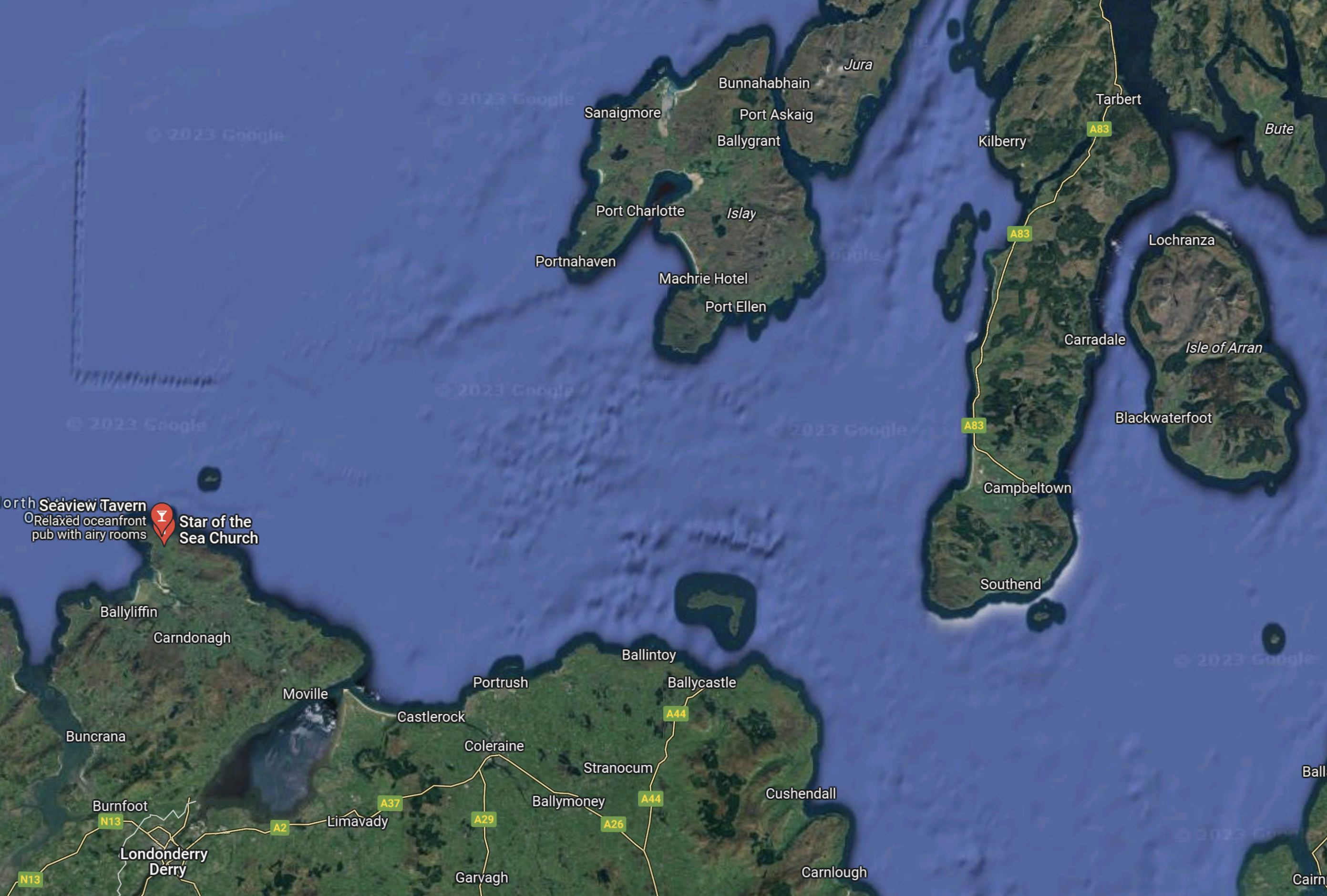
This Google Map shows the Malin Sea.
Note.
- Malin Head is marked by the red arrows on the Northern Irish coast.
- The most Westerly Scottish island is Islay and the most Easterly is the Isle of Arran.
- Between the two islands is the Kintyre peninsula.
- Portrush can be picked out on the Northern Irish coast.
By overlaying the two maps, I suspect the centroid of the wind farm will be North of Portrush about a few miles North of the Southern end of Arran.
I suspect that if all goes well, there could be a lot of floating wind turbines in the area.
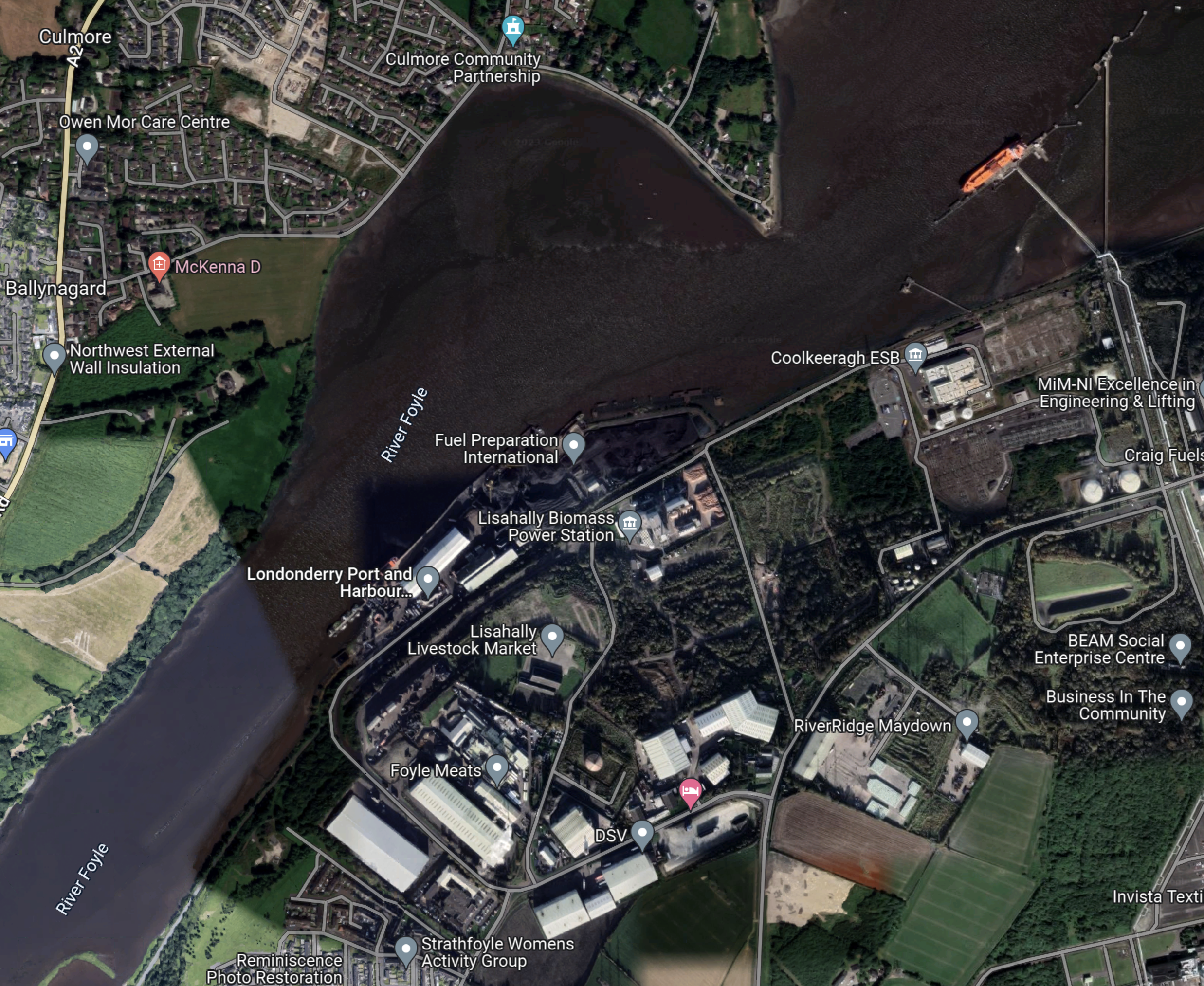
This Google Map shows the River Foyle estuary and Foyle Port to the North-East of Londonderry/Derry.
Note.
- Coolkeeragh ESB and Lisahally biomas power station on the South bank of the River Foyle.
- Lisahally biomas power station has a capacity of 16 MW.
- There appears to be a large substation at Coolkeeragh ESB.
- A tanker of some sort seems to be discharging.
Until told, I’ve guessed wrong, it looks to me like Coolkeeragh ESB could be the destination for the electricity generated by Malin Sea Wind. Given that this project’s aim is cost reduction, a 100 MW wind farm could make a difference.
In addition could Foyle Port be used to assemble and maintain the floating turbines?
Floatation Energy
Floatation Energy have posted this press release on their web site, which is entitled Flotation Energy and Vårgrønn Awarded Exclusivity To Develop Up To 1.9 GW Of Floating Offshore Wind In Scotland.
The first part of the press release, has a graphic.
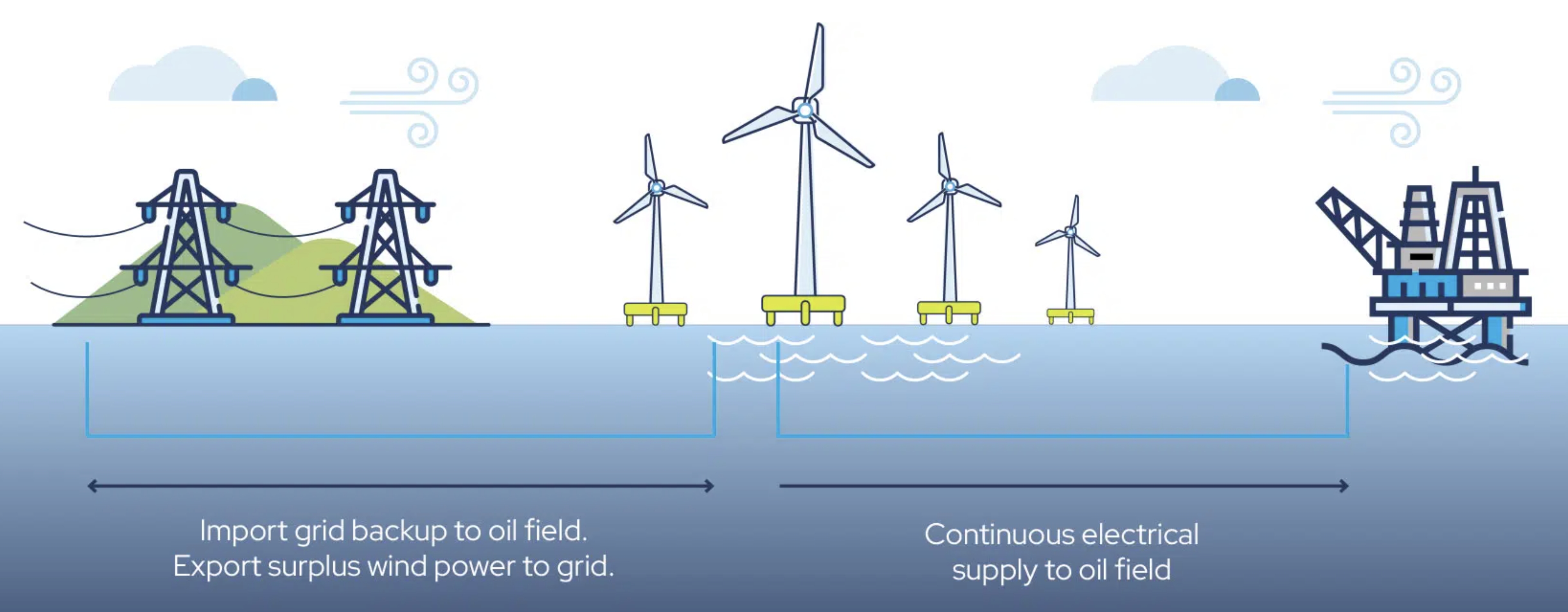
It shows how their proposed system will work.
- A floating wind farm will be placed between the shore and oil and gas platforms to be decarbonised.
- The wind farm will be connected to the shore by means of a bi-directional cable, so that the wind farm can export electricity to the grid and when the wind isn’t blowing the grid can power the platforms.
- A cable between the wind farm and the platforms completes the system.
It is a simple system, where all elements have been built many times.
Floatation Energy must have been fairly confident that their bids would be successful as they have already named the farms and set up web sites.
- Site 6 – Green Volt – 560 MW
- Site 11 – Cenos – 1350 MW
The websites are very informative.
The Timeline for 2019-2021 on the Green Volt web site describes the describes the progress so far on the project.
2019 – As construction of the Kindardine offshore floating wind farm kicks off, Flotation Energy identifies the Buzzard oil facility (a relatively new oil and gas platform with a long field life and high electrical load) as the optimal starting point for a significant contribution to the North Sea Transition Deal – the process of replacing large scale, inefficient gas-fired power generation with renewable electricity from offshore wind.
2020 – Flotation Energy begins environmental surveys on the Ettrick/Blackbird oil field, a redundant site nearby Buzzard, which is in the process of decommissioning. The “brownfield” site is confirmed as an exceptional opportunity to create an offshore floating wind farm, with water depths of 90-100m and high quality wind resource.
2021 – Flotation Energy works with regulators to understand the potential for project “Green Volt” to decarbonise offshore power generation for Buzzard. Flotation Energy completes and submits an Environmental Scoping report to Marine Scotland, reaching the first major milestone in the Marine Consent process. Crown Estate Scotland announces a new leasing round for Innovation and Targeted Oil and Gas Decarbonisation (INTOG).
On a section on the Cenos web site, there is a section called Efficient Grid Connection, where this is said.
The power generated by the wind turbines will be Alternating Current (AC) and routed to a substation platform. AC power will be exported to the oil and gas platforms.
For efficient export to the UK grid, the substation platform will include a converter station to change the AC power to Direct Current (DC) before the power is transported to shore. This is due to transporting AC power over long distances leading to much of the power being lost.
Cenos is working in partnership with the consented NorthConnect interconnector project, to utilise their DC cable routing where possible. Cenos will also use the NorthConnect onshore converter station planned for Fourfields near Boddam, which then has an agreed link into the Peterhead Substation. This collaboration minimises the need to construct additional infrastructure for the Cenos project.
That all sounds very practical.
Note.
- Floatation Energy delivered the Kincardine offshore floating wind farm.
- Both wind farms appear to use the same shore substation.
- Buzzard oil field is being expanded, so it could be an even more excellent oil field to decarbonise.
- NorthConnect is a bit of an on-off project.
Floatation Energy seem to have made a very professional start to the delivery of their two wind farms.
Harbour Energy
The Wikipedia entry for Harbour Energy describes the company like this.
Harbour Energy plc is an independent oil and gas company based in Edinburgh, Scotland. It is the United Kingdom’s largest independent oil and gas business. It is listed on the London Stock Exchange and is a constituent of the FTSE 250 Index.
But if you look at news items and the share price of the company, things could look better for Harbour Energy.
On their map of UK operations, I can count nearly twenty oil and gas fields.
As they have other oil and gas fields around the world, decarbonisation of their offshore operations could increase production by a few percent and substantially cut their carbon emissions.
That is a philosophy that could be good for profits and ultimately the share price.
So has the company gone for a very simple approach of two identical floating wind turbines?
They have been successful in obtaining leases for sites 8 and 13.
- Both have a capacity of 15 MW, so are the farms a single 15 MW wind turbine?
- I think this is likely, unless it is decided to opt for say a 16 MW turbine.
- Or even a smaller one, if the platform is in a bad place for wind.
- The wind turbine would be parked by the platform to be decarbonised and connected up, to a simple substation on the platform.
- I would recommend a battery on the platform, so that if the wind wasn’t blowing, power was still supplied to the platform.
- There would be no need for any cable between shore and wind farm and the only substation, would be a relatively simple one with a battery on the platform.
It could be a very efficient way of decarbonising a large number of platforms.
Once Harbour Energy have proved the concept, I could build a simple mathematical model in Excel, to work out any change in profitability and carbon emissions for a particular oil or gas platform.
Who Is Britannia Ltd?
In this document from the Crown Estate Scotland, there is a section that gives the partners in each project.
Listed for site 8 are Chrysaor (U.K.) and Britannia Limited and for site 13 is Chryasaor Petroleum Company UK Limited.
This page on the Harbour Energy web site gives the history of Chrysaor and Harbour Energy.
This is the heading.
Chrysaor was founded in 2007 with the purpose of applying development and commercial skills to oil and gas assets and to realise their value safely.
This is the history.
The Group grew rapidly over the years through a series of acquisitions. With backing from Harbour Energy – an investment vehicle formed by EIG Global Energy Partners – Chrysaor acquired significant asset packages in the UK North Sea from Shell (2017) and ConocoPhillips (2019) to become the UK’s largest producer of hydrocarbons.
In 2021, Chrysaor merged with Premier Oil to become Harbour Energy plc.
So that explains the use of the Chrysaor name or Chryasaor as someone misspelt it on the Crown Estate Scotland document.
I asked myself, if Britannia Ltd. could be a technology company, so I checked them out. The only company, I could find was a former investment trust, that was dissolved over ten years ago.
But Britannia is an oil and gas field in the North Sea, which is partially owned by Harbour Energy. It has a page on Harbour Enerrgy’s web site, which is entitled Greater Britannia Area.
This is said about the Britannia field.
Britannia in Block 16/26 of the UK central North Sea sits approximately 210-kilometres north east of Aberdeen. The complex consists of a drilling, production and accommodation platform, a long-term compression module of mono-column design and a 90-metre bridge connected to a production and utilities platform. Britannia is one of the largest natural gas and condensate fields in the North Sea. Commercial production began in 1998. Condensate is delivered through the Forties Pipeline to the oil stabilisation and processing plant at Kerse of Kinneil near Grangemouth and natural gas is transported through a dedicated Britannia pipeline to the Scottish Area Gas Evacuation (SAGE) facility at St Fergus.
Looking at the maps on the Crown Estate Scotland, Harbour Energy and others, it looks like site 8 could be close to the
Greater Britannia Area or even the Britannia field itself.
Simply Blue Energy
Simply Blue Energy are developing the 100 MW Salamander wind farm.
I wrote about this project in The Salamander Project.
Did it get chosen, as it was a project, where the design was at an advanced stage?
TotalEnergies
I wouldn’t be surprised to find out that TotalEnergies have gone a very similar route to Harbour Energy, but they are trying it out with a 3 MW turbine.
Conclusion
They are an excellent group of good ideas and let’s hope that they make others think in better and move innovative ways.
Politics will never save the world, but engineering and science just might!
National Ignition Facility Achieves Fusion Ignition
The title of this post, is the same as that of this press release from the Lawrence Livermore National Laboratory.
This is the introductory paragraph.
The U.S. Department of Energy (DOE) and DOE’s National Nuclear Security Administration (NNSA) today announced the achievement of fusion ignition at Lawrence Livermore National Laboratory (LLNL) — a major scientific breakthrough decades in the making that will pave the way for advancements in national defense and the future of clean power. On Dec. 5, a team at LLNL’s National Ignition Facility (NIF) conducted the first controlled fusion experiment in history to reach this milestone, also known as scientific energy breakeven, meaning it produced more energy from fusion than the laser energy used to drive it. This first-of-its-kind feat will provide unprecedented capability to support NNSA’s Stockpile Stewardship Program and will provide invaluable insights into the prospects of clean fusion energy, which would be a game-changer for efforts to achieve President Biden’s goal of a net-zero carbon economy.
BBC Radio Five is giving the story a high profile.
The breakthrough is also featured in this article on The Telegraph, which is entitled Nuclear Fusion: Scientists Announce Major Breakthrough That ‘Could Bring Limitless Clean Energy’.
I am 75 and ever since my teens there have been regular stories about limitless fusion energy.
But the history of nuclear fusion seems to be a continuing tale of one step forward and four steps back.
I can remember ZETA at Harwell, being announced with a similar fanfare in 1957.
Blackpool Needs A Diamond
Every year there are more and more depressing reports about Blackpool and there was another today.
Something dramatic needs to be done.
One of the successful scientific weapons that has been deployed on any number of problems, including the Covid-19 and malaria, has been the impressive Diamond Light Source at Harwell.
When I talk to researchers at universities in the North, they would love to able to use it more, but it is fully booked and getting access is difficult. There is also the travel problem.
I believe that the solution is to build Diamond 2 in the North. And what better place to build it than Blackpool. The city has good rail and tram links and plenty of accommodation.
Now, that’s what I call levelling-up.
Canary Wharf Boosts Its Science Ambitions
The title of this post, is the same as that of this article on The Times.
This are the introductory paragraphs.
Genomics England is to move its headquarters to Canary Wharf in east London this year as the financial quarter aims to become a life sciences hub.
The government-run DNA sequencing group will move in the autumn into One Canada Place, where its neighbours will include Brookfield, a Canadian property fund, and Reach, publisher of the Daily Express and OK! magazine.
Owned by the Department of Health and Social Care, Genomics England sequences the genomes of people with rare diseases and cancers to help doctors to treat them more effectively. With consent, some of that data is passed to researchers trying to develop new drugs and treatments.
If you type “Canary Wharf Science Hub into Google”, you find some serious articles.
This article in the FT is entitled Canary Wharf Proposes £500mn Lab Project To Reinvent Financial Hub.
This is a good idea, as scientist friends are always complaining about a lack of lab space in Cambridge and Oxford. Because of the Elizabeth Line, both these cities are not much more than an hour from Canary Wharf.
It should also fill the cafes and shops with scientists and engineers, who would replace some of those working from home because of the pandemic.
I wonder whether this model will work elsewhere?
Omicron I Can Understand, But Arwen Is Surely A Funny Name For A Storm!
This article on the Birmingham Mail is entitled Storm Arwen: What Does The Name Arwen Mean And Who Chooses Storm Names?.
It says this about Arwen.
The name Arwen is believed to be of ancient Welsh origin and means “fair” or “good”. It is most commonly a female name.
Arwen was made famous by J.R.R Tolkein’s Lord of the Rings book series, which sees the name translated to “noble maiden” in Sindarin.
I’ve never read any of Tolkein’s books or seen any of the films, but I have played real tennis several times with one of his cousins.
He is or was a man who was involved with high-vacuum scientific equipment. He had some interesting tales about selling the equipment to the Soviet Bloc. He said that he always had a few of his cousin’s books handy, as they made excellent presents to oil the wheels of Soviet bureaucracy.
I hope everybody reading this, has been untroubled by the wrath of Arwen.
I
The Diamond Light Source And PETase
When I was writing Diamond Synchrotron Sparkles And Shows Its Value To UK Economy, I came across a reference to PETase, in an article in Chemistry World, where this was said about the Diamond Light Source.
‘It is the facilities in the UK that really make the difference and make us a world leader,’ comments John McGeehan, professor of structural biology at the University of Portsmouth.
His team has used Diamond to study the bacterial enzyme PETase, which digests plastic. ‘Diamond’s I23 [long-wave macromolecular crystallography] beamline is unique in the world. It allowed us to solve the 3D structure of the PET-degrading enzyme, first found in plastic dumps in Japan in 2016. Three years ago it was the highest resolution image of the enzyme measured and remains so today. Having this information allows us to understand how the enzyme works, and how to make it work faster and better.’
As a result, the team has been able to visualise the active site of the enzyme and how it consumes plastic. The researchers discovered that the active site was slightly wider than cutinase, a similar enzyme that bacteria use to break down natural plant polyesters. ‘The technology leading from this research means plastic waste can be broken down and put back together into bottles (infinite recycling), or can be made into higher value products such as resins for wind turbine blades,’ says McGeehan. Patents are pending.
Note, that PET is polyethylene terephthalate, which is a very common plastic used to make fabric (Terylene/Dacron) and packaging.
Now that is what I call recycling!
 The Anonymous Widower