Consultation Opens For Ferrybridge Next Generation Power Station
The title of this post, is the same as that of this press release from SSE.
These three bullet points act as sub-headings.
- Ferrybridge Next Generation sets out plans for continuing the legacy of power generation at the site, with the potential to bring significant investment to the region.
- Statutory consultation phase launched, inviting communities and stakeholders to have their say on project proposals.
- Hydrogen-enabled project could support the security of supply and offer a clear route to decarbonisation.
These three paragraphs add more detail.
Members of the public are being invited to have their say on plans for a proposed new power station in development, Ferrybridge Next Generation Power Station.
The station is being designed so that it can run on hydrogen, as a lower-carbon alternative to natural gas. It would also be able to operate using natural gas or a blend of hydrogen and natural gas until a technically and commercially viable hydrogen supply becomes available to the site.
With a proposed capacity of up to 1.2GW, Ferrybridge Next Generation Power Station could play an important role in supporting the UK’s energy system in the short term – providing reliable flexible back-up power during periods of peak demand and balancing the system when the wind doesn’t blow or the sun doesn’t shine, while delivering a route to decarbonised power generation in the longer term.
Note.
- A 150 MW/300 MWh Battery Electric Storage System is being developed on the site, which I wrote about in SSE Renewables Announces Construction Of Second Utility-Scale Battery Storage System.
- The last Ferrybridge power station; C had a capacity of just over 2 GW.
- This will be SSE Renewable’s second hydrogen-fired power station after Keadby, which I wrote about in Consultation On Plans For Keadby Hydrogen Power Station To Begin.
- As the press releases says, Ferrybridge Hydrogen-Fired Power Station will be West Yorkshire’s backup for when the wind doesn’t blow and the sun doesn’t shine.
How similar will the two hydrogen-fired power stations be?
Will SSE Be Building Any More In The First Wave Of Hydrogen-Fired Power Station?
This is a paragraph from SSE’s press release.
The station is being designed so that it can run on hydrogen, as a lower-carbon alternative to natural gas. It would also be able to operate using natural gas or a blend of hydrogen and natural gas until a technically and commercially viable hydrogen supply becomes available to the site.
It would appear that the availability of the hydrogen fuel may be a problem.
But places like Aberdeen, Bradford, Brighton, Humberside and Merseyside, do seem to be planning for hydrogen, so all is not lost.
AI Forecast To Fuel Doubling In Data Centre Electricity Demand By 2030
The title of this post, is the same as that as this article in The Times.
This is the sub-heading.
International Energy Agency predicts that artificial intelligence could help reduce total greenhouse gas emissions
These are the first two paragraphs.
Data centres will use more than twice as much electricity by 2030 than they do today as artificial intelligence drives demand, the International Energy Agency predicts.
The agency forecast that all data centres globally will use about 945 terawatt-hours of electricity each year by 2030, roughly three times as much as the UK’s total annual demand of 317 terawatt-hours in 2023.
I am very much an optimist, that here in the UK, we will be able to satisfy demand for the generation and distribution of electricity.
- Our seas can accommodate enough wind turbines to provide the baseload of electricity we will need.
- Roofs and fields will be covered in solar panels.
- SSE seem to be getting their act together with pumped storage hydro in Scotland.
- I am confident, that new energy storage technologies like Highview Power with the packing of companies like Centrica, Goldman Sachs, Rio Tinto and others will come good, in providing power, when the wind doesn’t blow and the sun doesn’t shine.
- Hopefully, Hinckley Point C and Sizewell C will be online and soon to be joined by the first of the new small modular nuclear reactors.
- Hopefully, Mersey Tidal Power will be operating.
- There will be innovative ideas like heata from Centrica’s research. The economical water heater even made BBC’s One Show last week.
The only problem will be the Nimbies.
SSE Files Plans For 100 MW Pumped Hydro Scheme
The title of this post is the same as that of this article on reNews.biz.
This is the sub-heading.
Proposal aims to convert iconic Sloy Power Station into storage facility by end of 2030
These three paragraphs outline the proposals.
SSE has submitted plans to the Scottish Government for the 100MW Sloy pumped storage hydro scheme.
The plans would see the existing Sloy Power Station – a conventional hydro power station – on the banks of Loch Lomond converted into a pumped storage hydro scheme with a pumping capacity of up to 100MW.
If given the green light, the converted Sloy scheme would be capable of delivering up to 16GWh of long-duration electricity storage capacity.
SSE intend to make an investment decision by late 2027 and this is said about increasing capacity.
As part of the planning application, SSE Renewables is also proposing to upgrade the existing 32.5MW G4 turbine to match its sister units, which would increase the station’s generating output by 7.5MW to 160MW.
This appears to be a world-class example of canny Scottish engineering.
The project would turn the current 152.5 MW hydroelectric power station into a 160 MW/16 GWh pumped storage hydroelectric power station.
Not a bad transformation, that was opened three years after I was born.
SSE And Gilkes Energy Submit Plans For Pumped Hydro Storage Project
The title of this post, is the same of this article in Solar Power Portal.
This is the sub-heading.
SSE Renewables and Gilkes energy have submitted a planning consent application to Scottish Ministers for a proposed Pumped Storage Hydro (PSH) project.
These two paragraphs add more detail.
The Fearna PSH project is proposed as a 50:50 joint venture project between SSE and Gilkes Energy, with Gilkes Energy leading the development under a developer services agreement with SSE Renewables. The scheme will have an installed capacity of 1.8GW and a stored capacity of up to 36GWh, providing 20 hours of storage. If approved, the project would be the largest pumped hydro scheme in the UK.
The proposed site is located around 25km from Invergarry in the Scottish Highlands and adjoins SSE Renewables’ existing Loch Quoich reservoir, which forms part of the Great Glen hydro scheme. The development will include the construction of tunnels and a new power station that will connect the existing Loch Quoich reservoir to an upper reservoir at Loch Fearna.
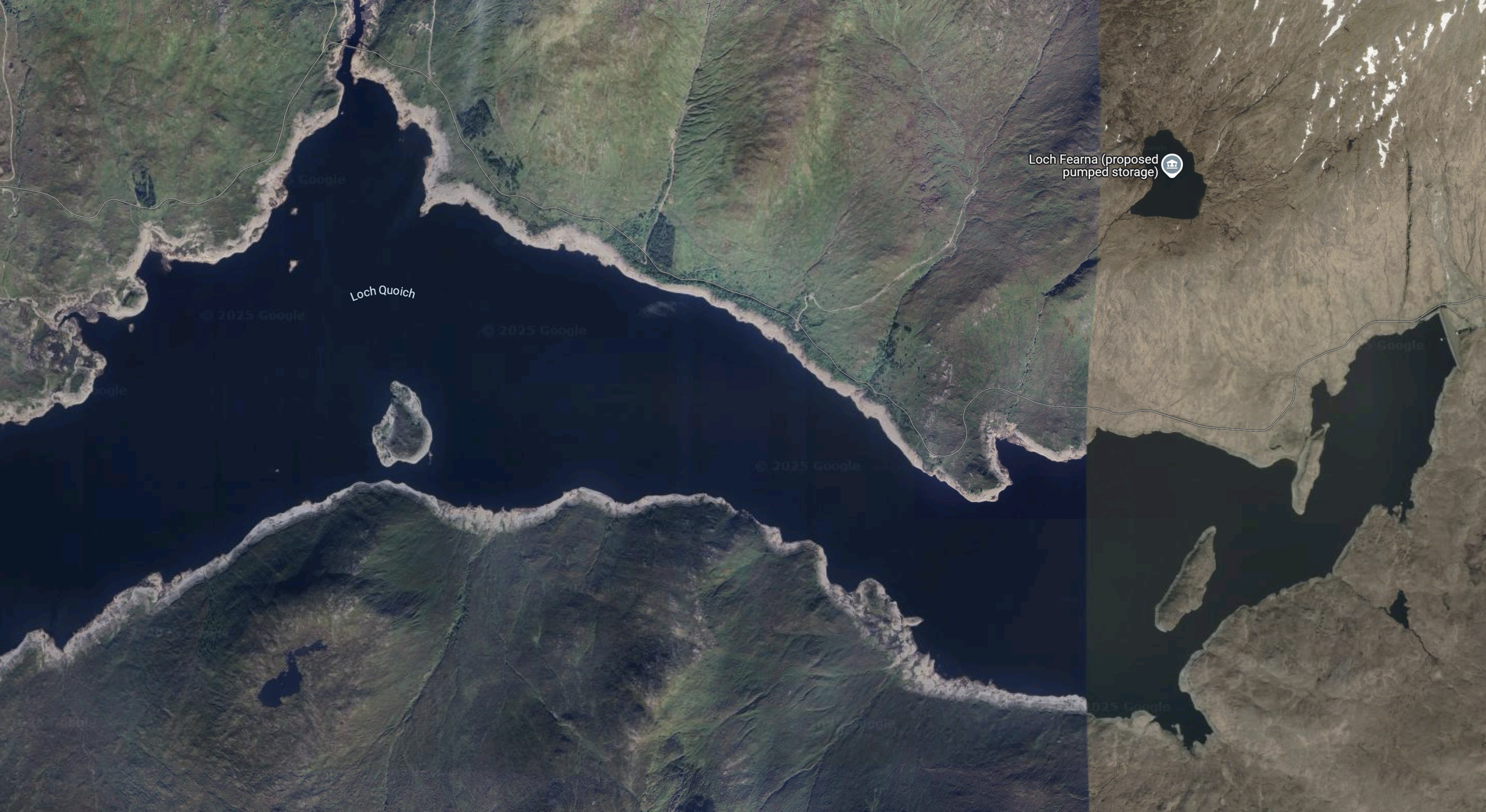
This Google Map shows the location of Invergarry and Loch Quoich.

Note.
Loch Quoich is the dolphin-shaped loch at the West of the image.
Invergarry is indicated by the red dot at the East of the image.
This second Google Map shows the location of Loch Fearna to the North-East of Loch Quoich.
These are my thoughts.
It Will Be A Large Scheme
With an installed capacity of 1.8GW and a stored capacity of up to 36GWh, providing 20 hours of storage, this is not a small scheme.
Wikipedia’s Description Of Loch Quoich
This is the first two paragraphs of the Wikipedia entry for Loch Quoich.
Loch Quoich (Scottish Gaelic: Loch Chuaich) is a loch and reservoir situated west of Loch Garry approximately 40 km northwest of Fort William, Lochaber, Scotland. The name means “loch of the quaich”. In 1896, it was listed as six miles long and three-quarters of a mile in width, belonging to Mrs. Ellice of Glenquoich, within the parish of Kilmonivaig.
Both lochs form part of the Glen Garry hydroelectricity project commissioned by the North of Scotland Hydro-Electric Board in the 1950s.
So is the Loch Fearna scheme, a massive repurposing of the existing Glen Garry hydroelectricity project?
I wrote about this before in Repurposing The Great Glen Hydro-Electric Scheme?
This map from the SSE Renewables web site shows the layout of the dams and power stations between Loch Quoich and Invergarry..
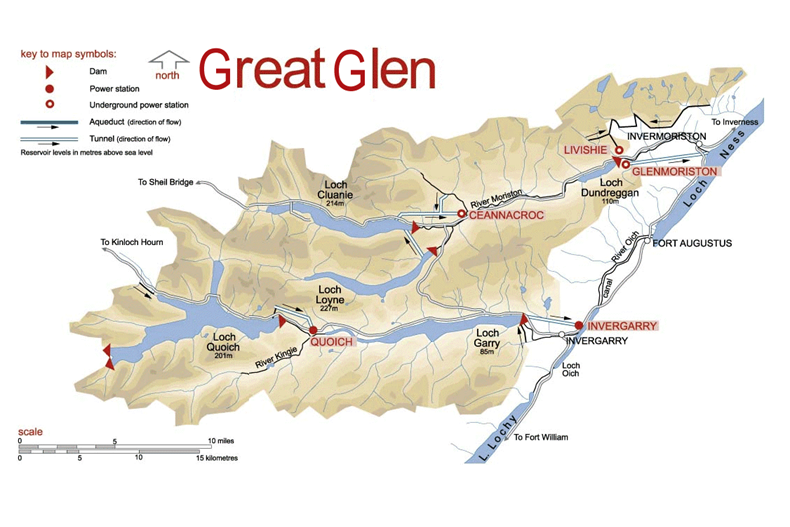
The sizes of the power stations in the scheme are as follows.
- Ceannacroc – 20 MW
- Livishie – 15 MW
- Glenmoriston- 37 MW
- Quoich – 18 MW
- Invergarry – 20 MW
- Mucomir – 1.7 MW
This gives a total power of 112.7 MW.
112.7 MW to 1.8 GW (1800 MW) is a colossal increase in power.
It should be noted that 1.8 GW is half the power of Hinckley Point C nuclear power station.
How To Keep The Lights On When The Wind Doesn’t Blow
The title of this post, is the same as that of this article in The Times.
This is the sub-heading.
Britain came close to a blackout this month. Gas is being phased out and renewables are intermittent, so can energy storage stop us going dark?
These are the first two paragraphs.
It was 8.29pm on the first Tuesday in January when the alert was issued by the electricity control room. Freezing temperatures had coincided with unusually low wind speeds, and it was making the National Energy System Operator (Neso) jittery.
Engineers forecast a 1.6GW shortfall — the requirement for about 1.5 million homes — for a three-hour period from 4pm the following afternoon. “System operators are requested to notify Neso of any additional megawatt capacity,” the message said.
Luckily, the plea worked.
The article then goes on to describe the various technologies that are being deployed.
The article starts by talking about pumped storage hydroelectricity.
This paragraph gives a superb illustration about how things have changed in energy and energy storage in the UK in the last few decades.
In the past, when coal provided the bulk of British power, this system was used to meet fluctuating demand levels. But now it is also required to meet fluctuating supply levels from renewable sources. Martin Pibworth, chief commercial officer at SSE, started with the company as a trainee in 1998. “Back then, at our Foyers pumped storage plant [at Loch Ness] we would switch modes, from pumping to not pumping and back again, maybe 600 to 700 times a year. Last year we switched modes there 6,500 times. It’s an insight into how the market has changed and how much more flexibility is needed, and how responsive that has to be.”
We have to be more agile, with our handling of storage to back up the various methods of generation.
SSE Launches £10m Hydro Community Benefit Fund
The title of this post, is the same as that of this article on Project Scotland.
This is the sub-heading.
SSE has launched a new £10 million hydro community benefit fund aimed at supporting projects within areas that host its existing hydro power infrastructure across Scotland.
These paragraphs fill in some detail.
The launch comes following the 80th anniversary of the hydro-electric development (Scotland) act of 1943, which enabled the North of Scotland Hydro-Electric Board (NoSHEB) to transform the way people lived and worked through the build of 54 power stations, 78 dams, and over 300km of underground tunnels.
SSE Renewables recently commissioned a report by Biggar Economics which found that the capital investment in hydro over the 80-year period since 1943 is £7.5 billion, supporting over 10,000 jobs annually in Scotland including 5,519 in the Highlands and Islands.
The new hydro community fund will see investment in local communities continue, with SSE Renewables having consulted with community council areas to establish key priorities.
Priorities include improvements to sustainable community transport, affordable housing, growth of small businesses and social enterprises, improvement of community assets and infrastructure, and a focus on community physical and mental well-being through community arts, culture, sports, and recreation.
If the new fund is as successful as the first, I can’t see thee being many complaints.
SSE Announces Construction Of Aberarder Wind Farm
The title of this post, is the same as that as an advert on my online edition of The Times.
Click the advert and you get this page, with the title of this post.
This is the sub-heading.
Aberarder secured 15-year CfD in UK Allocation Round 5
These three paragraphs give more details of the wind farm.
SSE has taken a final investment decision to proceed with Aberarder Wind Farm in the Scottish Highlands, in a circa £100m investment boost for its onshore wind portfolio.
Construction of the 12 turbine, 50MW wind farm, which is wholly owned by SSE Renewables, will begin before the end of the year with completion scheduled for the end of 2026. The Aberarder project was successful in September 2023 in the UK’s fifth Contract for Difference (CfD) Allocation round, securing a 15-year contract for low-carbon power generation.
Located at Strathnairn near Inverness, on a natural plateau at an average of 700m above sea level, the Aberarder project site sits directly adjacent to the operational 94MW Dunmaglass Wind Farm, which is jointly owned by SSE Renewables and Greencoat UK Wind.
It would appear that a £100m investment in the Scottish Highlands will get you a fully-operational 50 MW wind farm.
These are my observations and thoughts.
SSE’s Project Overview Of Aberarder Wind Farm
These four paragraphs are SSE’s project overview from this page on the SSE Renewables web site.
The Aberarder Wind Farm project is located in Strathnairn near Inverness, on a natural plateau at an average of 700m above sea level. It will sit directly adjacent to the operational 94MW Dunmaglass Wind Farm, which is jointly owned by SSE Renewables and Greencoat UK Wind.
The project was developed by RES and consented by The Highland Council in April 2017. The consent allows for the construction of a 12-turbine onshore wind farm, with each turbine having a maximum tip height of up to 130m and is expected to have an export capacity of 49.9MW. SSE Renewables reached an agreement with RES to acquire Aberarder in October 2022.
In September 2023 Aberarder was successful in the UK’s fifth Contract for Difference (CfD) Allocation Round and was awarded a 15-year contract for low carbon power generation. SSE took a final investment decision to proceed with Aberarder Wind Farm, in a circa £100m investment in May 2024, construction is scheduled to begin before the end of 2024 with completion scheduled for the end of 2026.
Our focus is now on building strong and meaningful relationships with the local community surrounding the Aberarder Wind Farm. As a responsible developer and operator, we are looking forward to working closely with the community in surrounding area to fully realise the benefits of this exciting project.
Construction has now started and it would appear that in two years, the twelve-turbine wind farm will be producing power.
SSE’s Description Of Dunmaglass Wind Farm
These four paragraphs are SSE’s description from this page on the SSE Renewables web site.
Located to the south east of Inverness, on a natural plateau at an average of 700m above sea level, Dunmaglass is SSE’s highest wind farm to be constructed.
SSE acquired the project from RES in May 2013 and initial enabling works began in the summer of 2013 which included the upgrading of 11km of tracks and the construction of two timber deck bridges.
Highland contractor RJ McLeod was awarded the £16m main civil works contract in summer 2014.
Dunmaglass became fully operational in 2017.
This paragraph also illustrates the challeges of the It looks like the construction of the larger Dunmaglass wind farm.
The height at which Dunmaglass is located presented its challenges during construction and the winter months brought high winds and plenty of snow. The site was fully completed and handed to the operations team in 2017.
Surprisingly, the legendary Highland midges didn’t get a mention.
The Sale Of 49.9 % Of Dunmaglass Wind Farm To Greencoat UK Wind
This sub-heading outlines the sale.
In February 2019, SSE sold 49.9% of Dunmaglass to Greencoat UK Wind PLC as part of a deal in which Greencoat acquired a 49.9% stake in both Dunmaglass and the nearby Stronelairg wind farm.
This paragraph gives more details of the sale.
In February 2019, SSE signed agreements for the sale of 49.9% of Dunmaglass wind farm to Greencoat UK Wind Plc (“UKW”). This sale was part of a £635m deal in which Greencoat acquired a 49.9% stake in both Stronelairg and Dunmaglass wind farms. The stakes equate to 160.6MW (megawatts) of capacity, with an average valuation for the two wind farms of around £4m per MW. This valuation demonstrates SSE’s ability develop quality, low carbon assets and infrastructure vital to the GB energy market.
The interesting figure is that SSE was paid £4m per MW for the interest of 160.6 MW, that they sold.
Aberarder wind farm is a 50 MW wind farm and it appears that it will cost £100 million to build.
If after a couple of years of operation, the wind farm is worth £4 million per MW, then SSE have doubled their money.
Does this illustrate, why the professionals like SSE and Greencoat UK Wind invest in wind farms?
- SSE would have taken the risk, that they could build the wind farm.
- SSE have the engineering skillsto do an excellent job.
- Greencoat UK Wind are buying into a producing asset, with a known cash flow.
SSE also get more money to build more wind farms.
Where Are Aberarder And Dunmaglass?
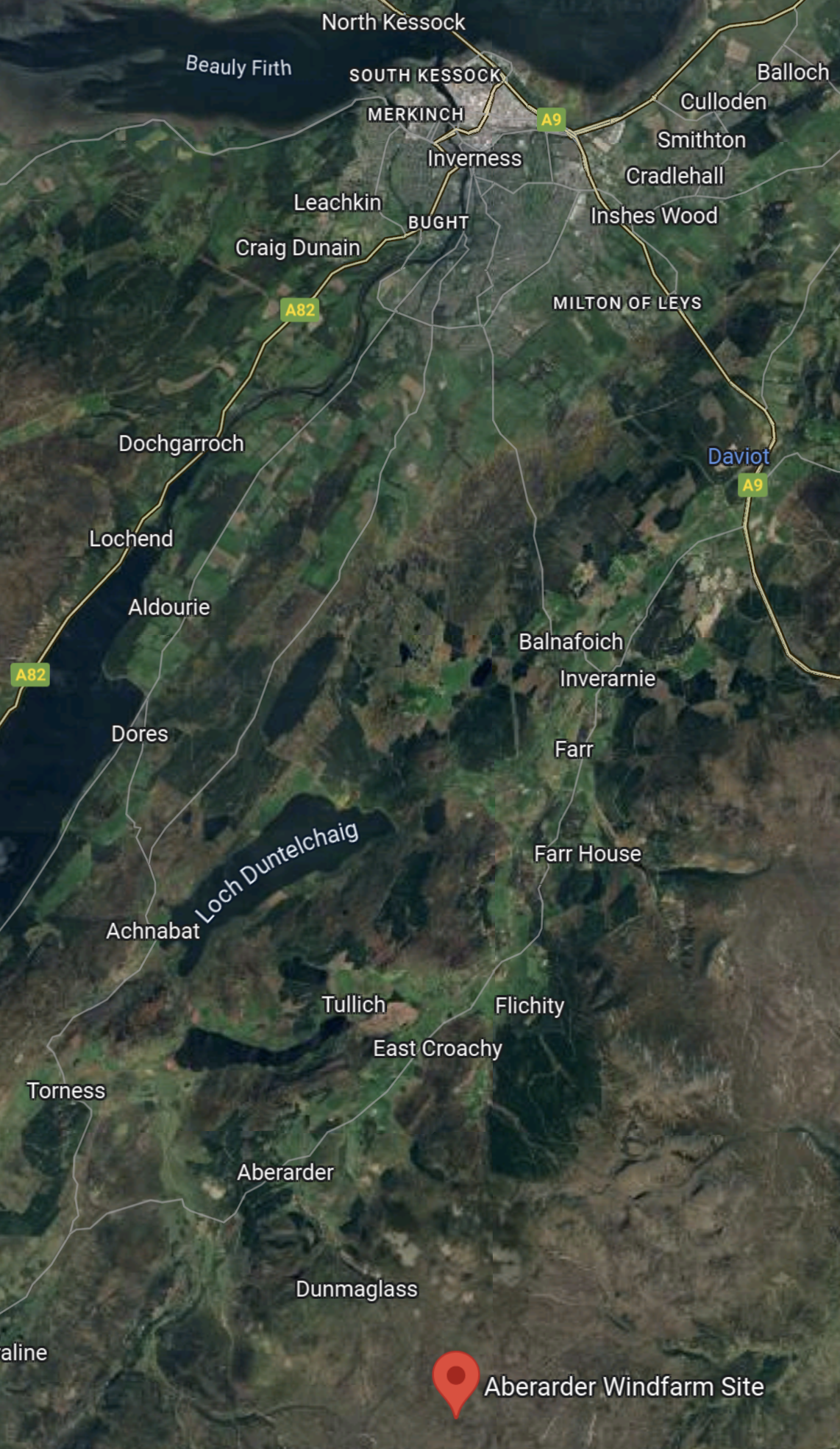
This Google Map shows the site of Aberarder wind farm with respect to Inverness.
Note.
- Inverness is at the top of the map on the waters of the Solway Firth.
- Aberarder wind farm is marked by the red arrow.
- Aberarder is a hamlet to the North-West of the wind farm.
- Drumnaglass is a shooting estate to the North-West of the wind farm.
- Loch Duntelchaig is the main reservoir for Inverness.
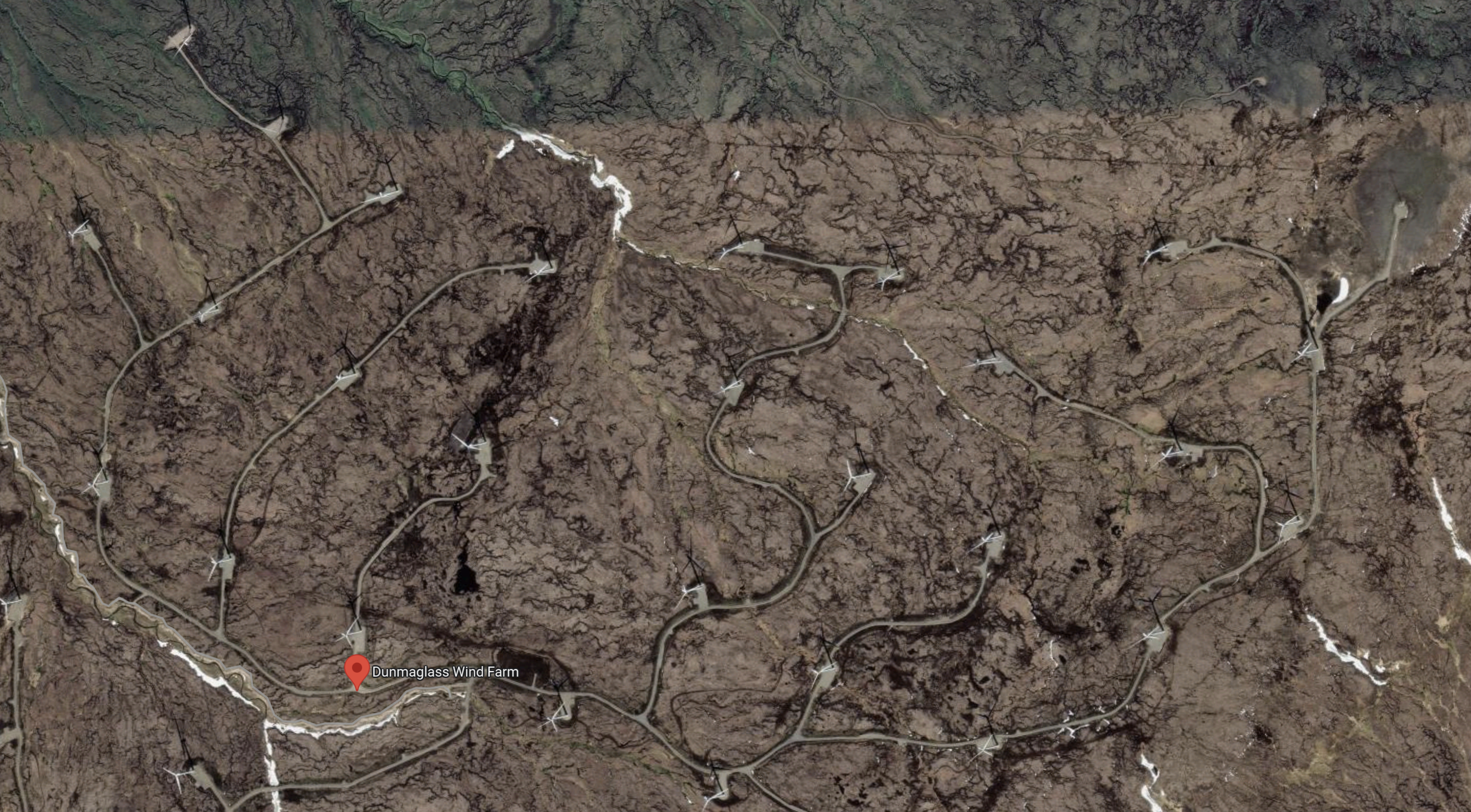
This second Google Map shows the Drumnaglass wind farm.
Note.
- Drumnaglass wind farm has 33 turbines and a capacity of 94.05 MW.
- There is a track network of 11 km. linking all the turbines.
- A good proportion of the turbines can be picked out on the map.
It would appear that Aberarder wind farm will lie to the South-East of this wind farm.
Aberarder Wind Farm To Fort Augustus
In Cloiche Onshore Wind Farm, I talked about the 130.5 MW Cloiche wind farm and its future construction to the East of Fort Augustus and Stronelairg wind farm.
This Google Map shows the position of Aberarder wind farm with respect to Ford Augustus.
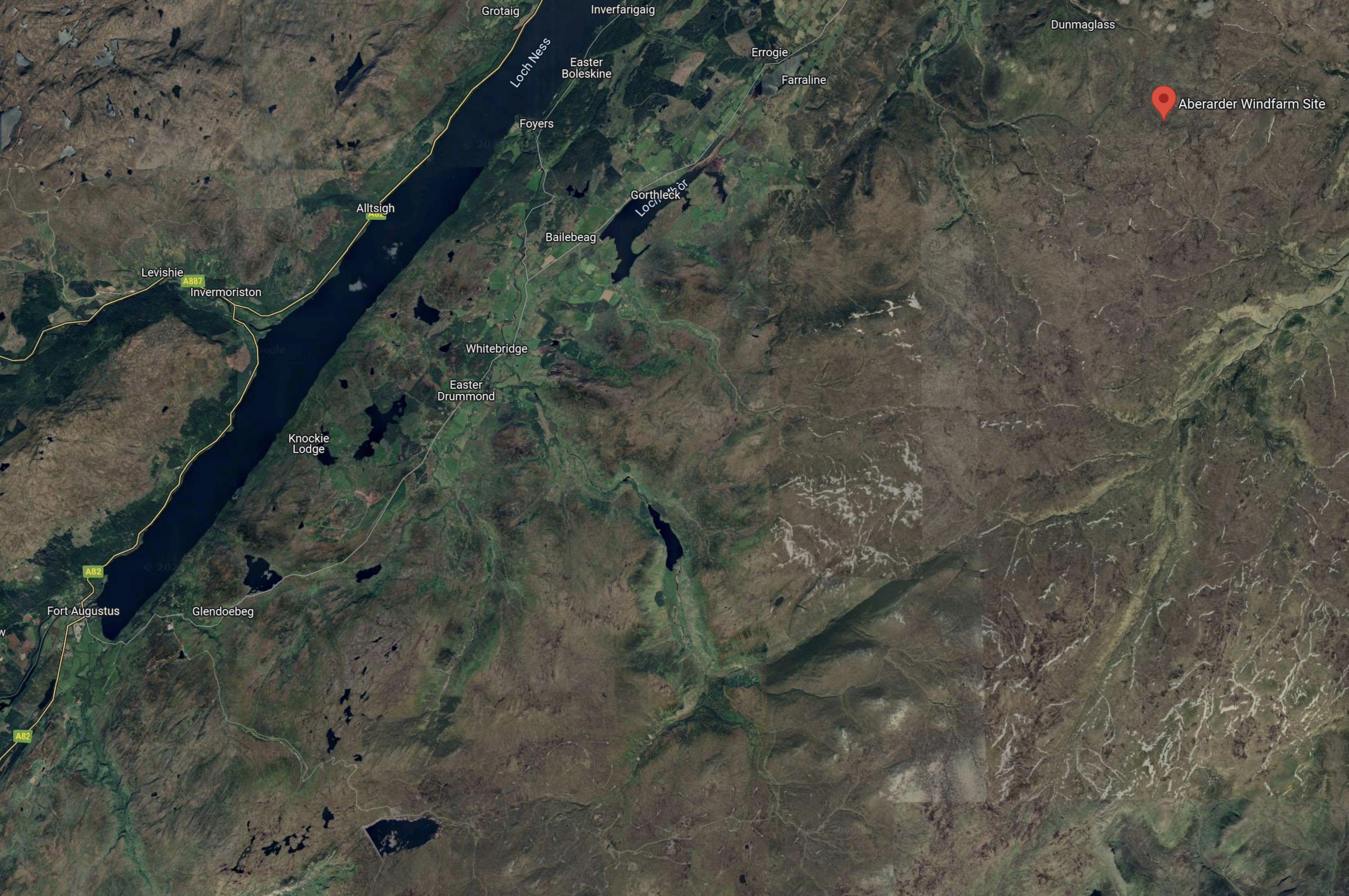
Note.
- Loch Ness runs across the North-West corner of the map.
- Fort Augustus and Stronelairg wind farm, are at the Southern end of the loch.
- The red arrow shows Aberarder wind farm.
- Foyers pumped hydro is on the Eastern bank of Loch Ness, at about the same latitude as the Aberarder wind farm.
- The lake at the bottom of the map, to the South-East of Ford Augustus, is the Glendoe Reservoir, that powers the Glendoe hydroelectric scheme.
There are certainly, a lot of SSE-owned and/or SSE-controlled assets in the area and I wouldn’t be surprised, if SSE integrated them more closely, or added a few more wind farms.
Why Are SSE Advertising The Start Of Construction?
SSE have been advertising for some time on The Times web site.
As they are not a retail energy company anymore, as they sold their retail business to OVO, the advertising, is probably about spreading a good corporate message and getting their strategy broadcast.
Cloiche Onshore Wind Farm
This document from the Department of Business, Industry and Industrial Strategy lists all the Contracts for Difference Allocation Round 6 results for the supply of zero-carbon electricity.
The largest onshore wind farm in the Allocation Round, is the Cloiche wind farm, which has this web page,which is entitled Onshore Wind Projects , on the SSE Renewables web site.
It is the only project on the page and these two paragraphs describe its location and capacity.
The proposed 29 turbine Cloiche Wind Farm is located on the Glendoe and Garrogie Estates, adjacent to the operational Stronelairg Wind Farm and Glendoe Hydroelectric Scheme and approximately 11 kilometres (km) to the south-east of Fort Augustus in the Great Glen, in the Monadhliath mountain range.
It is anticipated that the wind farm will generate approximately 130.5MW.
This Google Map shows the location.
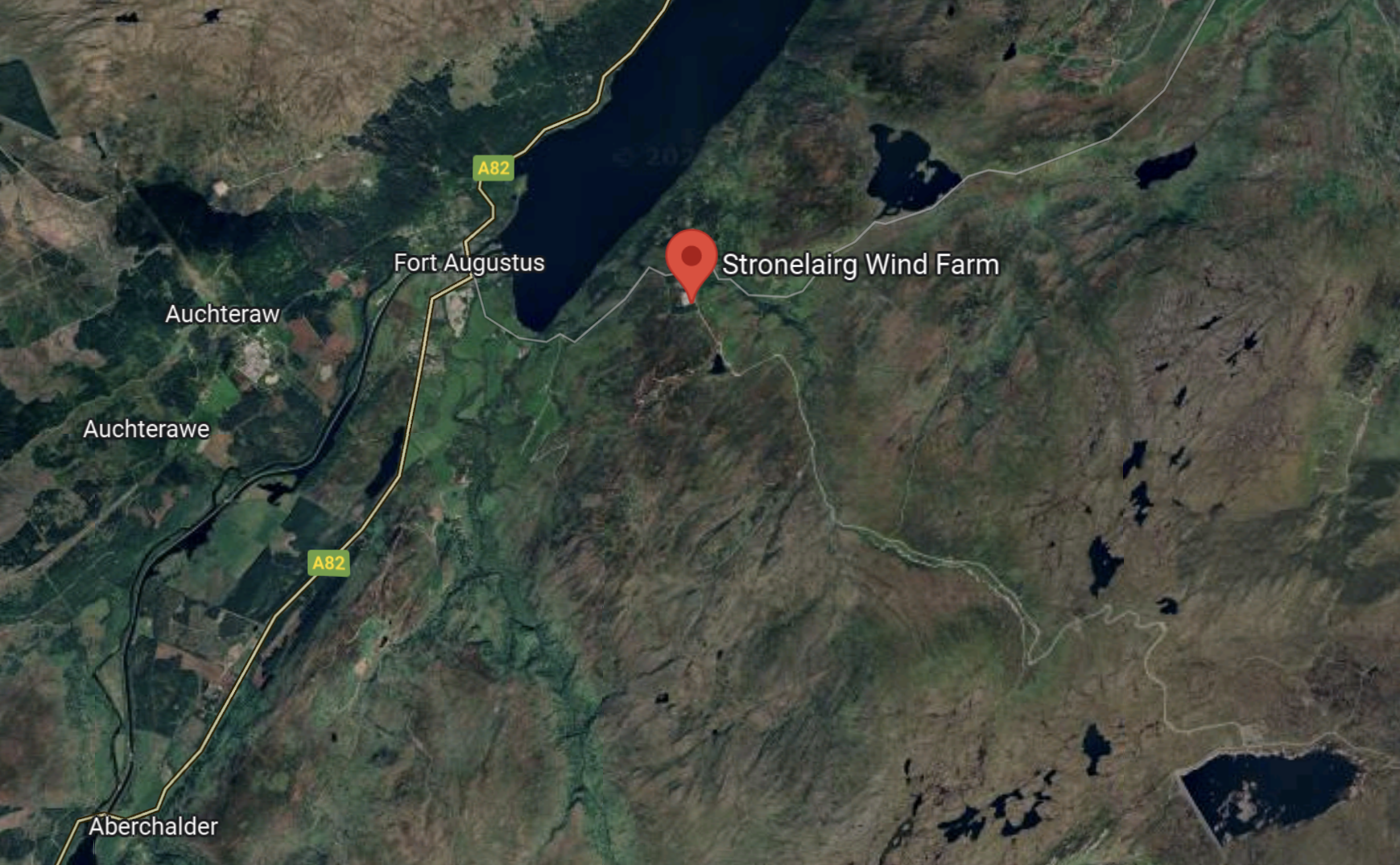
Between the village of Fort Augustus and the Stronelairg wind farm, lies the Southern end of Loch Ness.
In the South-East corner of the map, there is a large lake, which is shown in more detail in this Google Map.
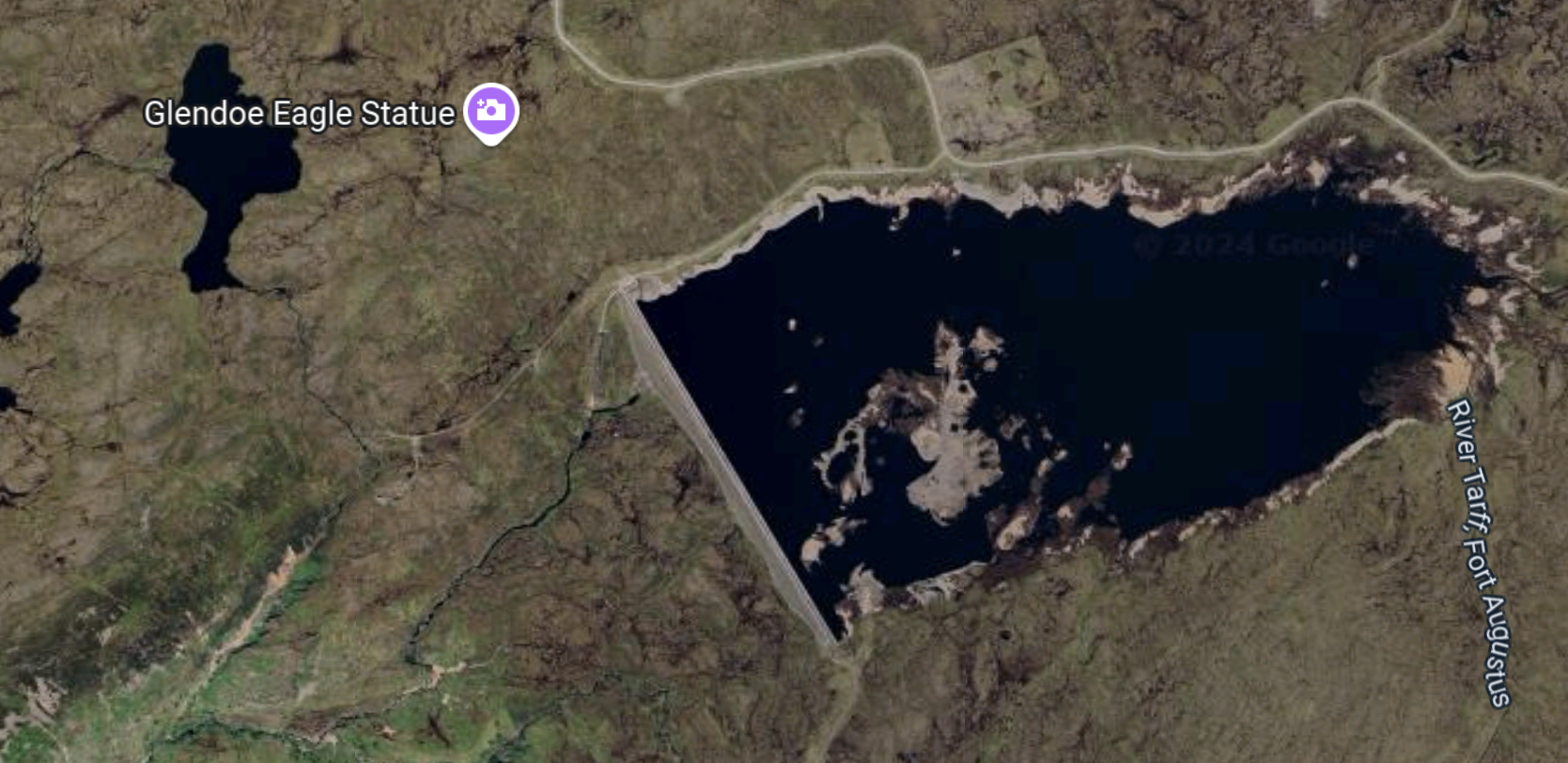
This is the Glendoe Reservoir for the Glendoe Hydro Scheme, that was built in the early years of this century, by damming the River Tarff.
The dam is clearly visible at the Western end of the Reservoir.
The Glendoe Hydro Scheme was opened in 2009 and has a generation capacity of 106.5 MW.
The planning and building of the scheme are described in this Wikipedia entry and the entry is well worth a read.
Stronelairg Wind Farm
Stronelairg wind farm, Cloiche wind farm and the Glendoe Hydro Scheme are all projects, that were or will be developed by SSE Renewables.
Stronelairg wind farm has 66 turbines and a total installed capacity of 228 MW.
It has a web page on the SSE Renewables web site.
These two paragraphs describe the location of Stronelairg wind farm.
Stronelairg sits at an elevation of around 600m above sea level in the Moadhliath Mountain range making it one of our windiest wind farms.
It sits within a natural bowl on a plateau, set well back from Loch Ness meaning that no turbines are visible from the main tourist routes in the area. Stronelairg is also located adjacent to our 100MW Glendoe hydro scheme and so the construction teams were able to use the hydro infrastructure as do our operational teams now.
Stronelairg wind farm appears tobe a powerful asset, hidden in the mountains.
Three Co-located Assets
As Cloche wind farm, will be adjacent to the operational Stronelairg Wind Farm and Glendoe Hydroelectric Scheme, these three energy producing assets, will be close together.
- Cloiche wind farm – 130.5 MW
- Stronelairg wind farm – 228 MW
- Glendoe Hydroelectric Scheme – 106.5 MW
Note.
- This is a total power of 465 MW.
- This would be equivalent to a medium-sized gas-fired power station.
- All three assets could use the same grid grid connection and other facilities.
It could be considered a 358.5 MW wind farm, backed by a 106.5 MW hydro power station.
When there is a shortage of wind, the Glendoe Hydroelectric Scheme could step in, if required.
Conclusion
Onshore wind, backed up by hydroelectric schemes would appear to be a good way to create reliable hybrid power stations.
Do any other schemes in Allocation Round 6, involve combining onshore wind with existing hydro schemes?
SSE And Gilkes Energy Announce Joint Plans To Progress Loch Fearna Pumped Storage Hydro Project
The title of this post, is the same as that of this press release from SSE Renewables.
These five paragraphs from the press release outline the scheme.
SSE has announced plans to progress a new pumped storage hydropower scheme at Loch Fearna in Scotland’s Great Glen, in a 50:50 development joint venture with a consortium led by Gilkes Energy.
The proposed co-development is located at the western end of Glengarry around 25km west of Invergarry and adjoins SSE Renewables’ existing Loch Quoich reservoir in the Great Glen hydro scheme.
SSE Renewables already operates the largest fleet of hydro-electric power and pumped storage hydro assets in Scotland. It is now progressing development plans for new pumped storage hydropower projects in the Highlands to complement its existing fleet and deliver the large-scale, long-duration electricity storage (LDES) needed as part of Britain’s future energy mix.
The Fearna Pumped Storage Hydro (PSH) project envisages the development of tunnels and a new power station connecting SSE Renewables’ existing reservoir at Loch Quoich with an upper reservoir at Loch Fearna.
Under the terms of the joint venture being announced today, Gilkes Energy will lead the project’s development under a development services agreement with SSE Renewables.
I wrote about the Great Glen hydro scheme in Repurposing The Great Glen Hydro-Electric Scheme, where I included this map, from the SSE Renewables web site shows the layout of the dams and power stations.
The sizes of the power stations in the scheme are as follows.
- Ceannacroc – 20 MW
- Livishie – 15 MW
- Glenmoriston- 37 MW
- Quoich – 18 MW
- Invergarry – 20 MW
- Mucomir – 1.7 MW
This gives a total power of 112.7 MW.
This five paragraph from the press release details the size of the scheme.
It is envisaged the proposed development would be up to 1.8GW in generating capacity and capable of producing around 37GWh of stored energy capacity. The project has already secured a grid connection offer totalling 1,795MW.
The 1.8 GW/37 GWh Fearna pumped hydro scheme will dwarf the Great Glen hydro scheme.
it is now seventy years since some of these hydro-electric systems were built in Scotland.
As an engineer, I wouldn’t be surprised to a see a fair amount of updating in the Highlands to upgrade Scotland’s hydro-electricity.
RWE Goes For An Additional 10 GW Of Offshore Wind In UK Waters In 2030
This press release from RWE is entitled RWE And Masdar Join Forces To Develop 3 Gigawatts Of Offshore Wind Projects Off The UK Coast.
This is the last paragraph.
The UK plays a key role in RWE’s strategy to grow its offshore wind portfolio RWE is a leading partner in the delivery of the UK’s Net Zero ambitions and energy security, as well as in contributing to the UK build-out target for offshore wind of 50 GW by 2030. RWE already operates 10 offshore wind farms across the UK. Following completion of the acquisition of the three Norfolk offshore wind projects from Vattenfall announced at the end of 2023, RWE is developing nine offshore wind projects in the UK, representing a combined potential installed capacity of around 9.8 GW, with RWE’s pro rata share amounting to 7 GW. Furthermore, RWE is constructing the 1.4 GW Sofia offshore wind project in the North Sea off the UK’s east coast. RWE’s unparalleled track record of more than 20 years in offshore wind has resulted in 19 offshore wind farms in operation, with a goal to triple its global offshore wind capacity from 3.3 GW today to 10 GW in 2030.
Note.
- Nine offshore wind projects in the UK, representing a combined potential installed capacity of around 9.8 GW
- RWE are saying they intend to add 6.7 GW in 2030.
The eight offshore wind farms, that RWE are developing in UK waters would appear to be.
- Sofia – 1,400 MW
- Norfolk Boreas – 1380 MW
- Norfolk Vanguard East – 1380 MW
- Norfolk Vanguard West – 1380 MW
- Dogger Bank South – 3000 MW
- Awel y Môr – 500 MW
- Five Estuaries – 353 MW
- North Falls – 504 MW
This is a total of 9897 MW, which ties in well with RWE’s new capacity figure of 9.8 GW.
The Location Of RWE’s Offshore Wind Farms
RWE’s wind farms seem to fit in groups around the UK.
Dogger Bank
This wind farm is on the Dogger Bank.
- Dogger Bank South – 3000 MW – Planned
This wind farm would appear to be rather isolated in the middle of the North Sea.
RWE could have plans to extend it or even link it to other wind farms in the German area of the Dogger Bank.
Lincolnshire Coast
This wind farm is along the Lincolnshire Coast.
- Triton Knoll – 857 MW – 2022
As there probably isn’t much heavy industry, where Triton Knoll’s power comes ashore, this wind farm can provide the power needed in the area.
But any excess power in the area can be exported to Denmark through the Viking Link.
Norfolk Coast
These wind farms are along the Norfolk Coast.
- Norfolk Boreas – 1380 MW – Planned
- Norfolk Vanguard East – 1380 MW – Planned
- Norfolk Vanguard West – 1380 MW – Planned
These three wind farms will provide enough energy to provide the power for North-East Norfolk.
North Wales Coast
These wind farms are along the North Wales Coast.
- Awel y Môr – 500 MW – Planned
- Gwynt y Môr – 576 MW – 2015
- Rhyl Flats – 90 MW – 2009
- North Hoyle – 60 MW – 2003
These wind farms will provide enough energy for the North Wales Coast.
Any spare electricity can be stored in the 1.8 GW/9.1 GWh Dinorwig pumped storage hydroelectric power station.
Electric Mountain may have opened in 1984, but it is surely a Welsh giant decades ahead of its time.
Suffolk Coast
These wind farms are along the Suffolk Coast.
- Five Estuaries – 353 MW – Planned
- Galloper – 353 MW – 2018
- North Falls – 504 MW – Planned
These wind farms will provide enough energy for the Suffolk Coast, which except for the Haven Ports, probably doesn’t have many large electricity users.
But if the area is short of electricity, there will be Sizewell B nuclear power station to provide it.
Teesside
This wind farm is along the Teesside Coast
- Sofia – 1,400 MW – Planned
Teesside is a heavy user of electricity.
These six areas total as follows.
- Dogger Bank – 3,000 MW
- Lincolnshire Coast – 857 MW
- Norfolk Coast – 4140 MW
- North Wales Coast – 1226 MW
- Suffolk Coast – 1210 MW
- Teesside – 1,400 MW
Backup for these large clusters of wind farms for when the wind doesn’t blow will be provided as follows.
- Dogger Bank – Not provided
- Lincolnshire Coast- Interconnectors to Denmark and Scotland
- Norfolk Coast – Not provided
- North Wales Coast – Stored in Dinorwig pumped storage hydroelectric power station
- Suffolk Coast – Sizewell B and Sizewell C
- Teesside – Interconnectors to Norway and Scotland and Hartlepool nuclear power stations
Note.
- The interconnectors will typically have a 2 GW capacity.
- The 1.9 GW/9.1 GWh Dinorwig pumped storage hydroelectric power station must be one of the best wind farm backups in Europe.
There is a very solid level of integrated and connected assets that should provide a reliable power supply for millions of electricity users.
How Will Dogger Bank And The Norfolk Coast Wind Clusters Work Efficiently?
The Dogger Bank and the Norfolk Coast clusters will generate up to 3 and 4.14 GW respectively.
So what purpose is large amounts of electricity in the middle of the North Sea?
The only possible purpose will be to use giant offshore electrolysers to create hydrogen.
The hydrogen will then be transported to point of use by pipeline or tanker.
Feeding H2ercules
I described H2ercules in H2ercules.
H2ercules is an enormous project that will create the German hydrogen network.
The H2ercules web site, shows a very extensive project, as is shown by this map.

Note.
- Hydrogen appears to be sourced from Belgium, the Czech Republic, The Netherlands and Norway.
- RWE’s Dogger Bank South wind farm will be conveniently by the N of Norway.
- RWE’s Norfolk cluster of wind farms will be conveniently by the N of Netherlands.
- The Netherlands arrow points to the red circles of two hydrogen import terminals.
For Germany to regain its former industrial success, H2ercules will be needed to be fed with vast amounts of hydrogen.
And that hydrogen could be in large amounts from the UK sector of the North Sea.
Uniper’s Wilhelmshaven Hydrogen Hub
This page on the Uniper web site is entitled Green Wilhelmshaven: To New Horizons
This Uniper graphic shows a summary of gas and electricity flows in the Wilhelmshaven Hydrogen Hub.

Note.
- Ammonia can be imported, distributed by rail or ships, stored or cracked to provide hydrogen.
- Wilhelmshaven can handle the largest ships.
- Offshore wind energy can generate hydrogen by electrolysis.
- Hydrogen can be stored in underground salt caverns.
I suspect hydrogen could also be piped in from an electrolyser in the East of England or shipped in by a hydrogen tanker.
All of this is well-understood technology.
Sunak’s Magic Money Tree
Rishi Sunak promised a large giveaway of tax in his manifesto for the 2024 General Election.
As we are the only nation, who can provide the colossal amounts of hydrogen the Germans will need for H2ercules, I am sure we will be well paid for it.
A few days ago we celebrated D-Day, where along with the Americans and the Canadians, we invaded Europe.
Now eighty years later, our hydrogen is poised to invade Europe again, but this time for everybody’s benefit.
This document on the Policy Mogul web site is entitled Rishi Sunak – Conservative Party Manifesto Speech – Jun 11.
These are three paragraphs from the speech.
We don’t just need military and border security. As Putin’s invasion of Ukraine has shown, we need energy security too. It is only by having reliable, home-grown sources of energy that we can deny dictators the ability to send our bills soaring. So, in our approach to energy policy we will put security and your family finances ahead of unaffordable eco zealotry.
Unlike Labour we don’t believe that we will achieve that energy security via a state-controlled energy company that doesn’t in fact produce any energy. That will only increase costs, and as Penny said on Friday there’s only one thing that GB in Starmer and Miliband’s GB Energy stands for, and that’s giant bills.
Our clear plan is to achieve energy security through new gas-powered stations, trebling our offshore wind capacity and by having new fleets of small modular reactors. These will make the UK a net exporter of electricity, giving us greater energy independence and security from the aggressive actions of dictators . Now let me just reiterate that, with our plan, we will produce enough electricity to both meet our domestic needs and export to our neighbours. Look at that. A clear, Conservative plan not only generating security, but also prosperity for our country.
I believe that could be Rishi’s Magic Money Tree.
Especially, if the energy is exported through electricity interconnectors or hydrogen or ammonia pipelines and tankers.
Will This Be A Party Anyone Can Join?
Other wind farm clusters convenient for the H2ercules hydrogen import terminals on the North-West German coast include.
- Dogger Bank – SSE, Equinor – 5008 MW
- East Anglian – Iberdrola – 3786 MW
- Hornsea – Ørsted – 8056 MW
That totals to around 16.5 GW of wind power.
I can see offshore electrolysers producing hydrogen all around the coasts of the British Isles.
What Happens If Sunak Doesn’t Win The Election?
RWE and others have signed contracts to develop large wind farms around our shores.
They didn’t do that out of the goodness of their hearts, but to make money for themselves and their backers and shareholders.
Conclusion
I believe a virtuous circle will develop.
- Electricity will be generated in the UK.
- Some will be converted to hydrogen.
- Hydrogen and electricity will be exported to the highest bidders.
- European industry will, be powered by British electricity and hydrogen.
- Money will be paid to the UK and the energy suppliers for the energy.
The more energy we produce, the more we can export.
In the future more interconnectors, wind farms and electrolysers will be developed.
Everybody will benefit.
As the flows grow, this will certainly become a Magic Money Tree, for whoever wins the election.
 The Anonymous Widower