SSE Renewables Calls For More Use Of Non-Price Criteria In Offshore Wind Auctions
The title of this post, is the same as that of this article on offshoreWIND.biz.
This is the sub-heading.
SSE Renewables is calling on European governments and regulators and internationally to make greater use of non-price criteria (NPC) in offshore wind energy auctions, whether for seabed or for contracts for difference (CfD).
This is the first paragraph.
The renewable energy company said that the use of non-price criteria in auctions for new offshore wind can help support a sustainable renewable energy sector that delivers long-term value for society.
This document on the SSE Renewables web site is entitled Non-Price Criteria In Renewables Auctions and these are the points from the Executive Summary from the document.
- Use of non-price criteria (NPC) in auctions is important to deliver renewables projects which are deliverable, on time and on budget, and provide long term value to society and the environment.
- NPC must be well-designed, carefully implemented, with transparent assessment and monitoring of commitments to avoid overcomplication and risk of legal challenges.
- Seabed leasing auctions for offshore wind are best suited for use of NPC, as it is early enough in the development stage for commitments to be delivered; and avoids having to rely on purely financial bidding which risks adding to the cost of offshore wind.
- The most appropriate NPC are track record and deliverability of projects. Beyond that, criteria related to sustainability (circularity; workforce and skills); ecological protection and enhancement; and supply chain development.
- NPC in new offshore wind markets should be focused on deliverability and track record, and included as a pre-requisite to participate, rather than a point of competition.
- More diverse non-price criteria are best suited to mature offshore wind markets where there will generally be more competition from developers to build a project.
- It is more complicated to apply non-price criteria into offtake (CfD) auctions, with re-ranking of bidders the best approach to properly incentivise the right behaviour.
- It is important that there is transparency of how successful bidders were scored against NPC; what commitments have been made and how they will be held accountable for delivery at different milestones.
Note.
- It is good to see phrases like “track record and deliverability of projects” being embedded in this list of points.
- As a designer of successful project management software, I know the importance of this.
- I believe, that SSE Renewables are right to desire wider criteria for offshore wind energy auctions.
I suspect too, that there are software ideas in my past, that would make the development of offshore wind easier and more predictable.
SSE Unveils Redevelopment Plans For Sloy Hydro-Electric Power Station
The title of this post, is the same as that of this news item from SSE Renewables.
These are the two bullet points of the news item.
- Scotland First Minister Humza Yousaf welcomes plans to convert conventional hydro plant to new, flexible pumped hydro storage facility
- If approved for delivery Sloy could provide firm, flexible renewable energy for up to 160 hours non-stop, enough to power 90,000 homes for one week
This is the introductory paragraph.
SSE Renewables, as part of SSE plc, has unveiled plans to convert its 152.5MW Sloy Power Station, Britain’s largest conventional hydro power plant, into a new pumped hydro storage facility to bolster energy security and help provide the large-scale and flexible renewable energy back-up needed in a future UK net zero power system.
And this describes the output and storage capacity.
Subject to final design, the converted Sloy scheme would be capable of delivering up to 25GWh of long-duration electricity storage capacity. At the flick of a switch, the converted Sloy scheme could provide firm, flexible renewable energy for up to 160 hours non-stop, enough to power around 90,000 homes for up to one week.
The Loch Sloy Scheme
In A Lower-Cost Pumped Hydro Storage System, I described the Loch Sloy scheme, as it currently exists.
Whilst writing some of the posts recently about pumped storage I came across the Loch Sloy Hydro-Electric Scheme.
This is the introductory sentence in Wikipedia.
The Sloy/Awe Hydro-Electric Scheme is a hydro-electric facility situated between Loch Sloy and Inveruglas on the west bank of Loch Lomond in Scotland.
This page on the Greenage web site gives comprehensive details of the power station and is well worth a read.
This Google Map shows the Lochs Sloy and Lomond.
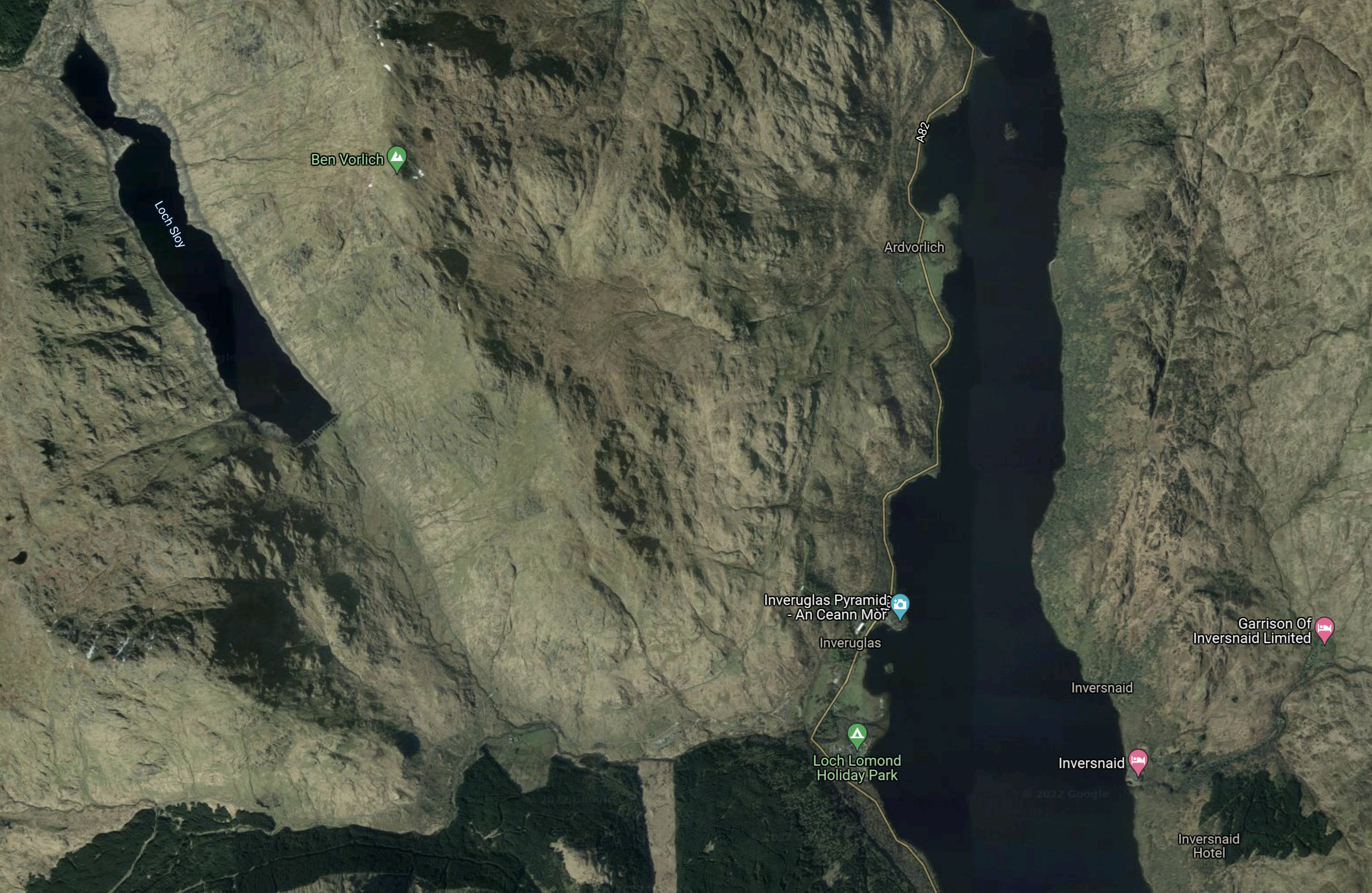
Note.
- Loch Sloy is in the North-West corner of the map.
- The page on Greenage says that Loch Sloy can store 14 GWh of electricity
- Loch Lomond is the body of water towards the Eastern side of the map.
- Inverglas is on the West bank of Loch Lomond to the North of the Loch Lomond Holiday Park, which is indicated by the green arrow with a tent.
This second Google Map shows the power station and Inverglas.
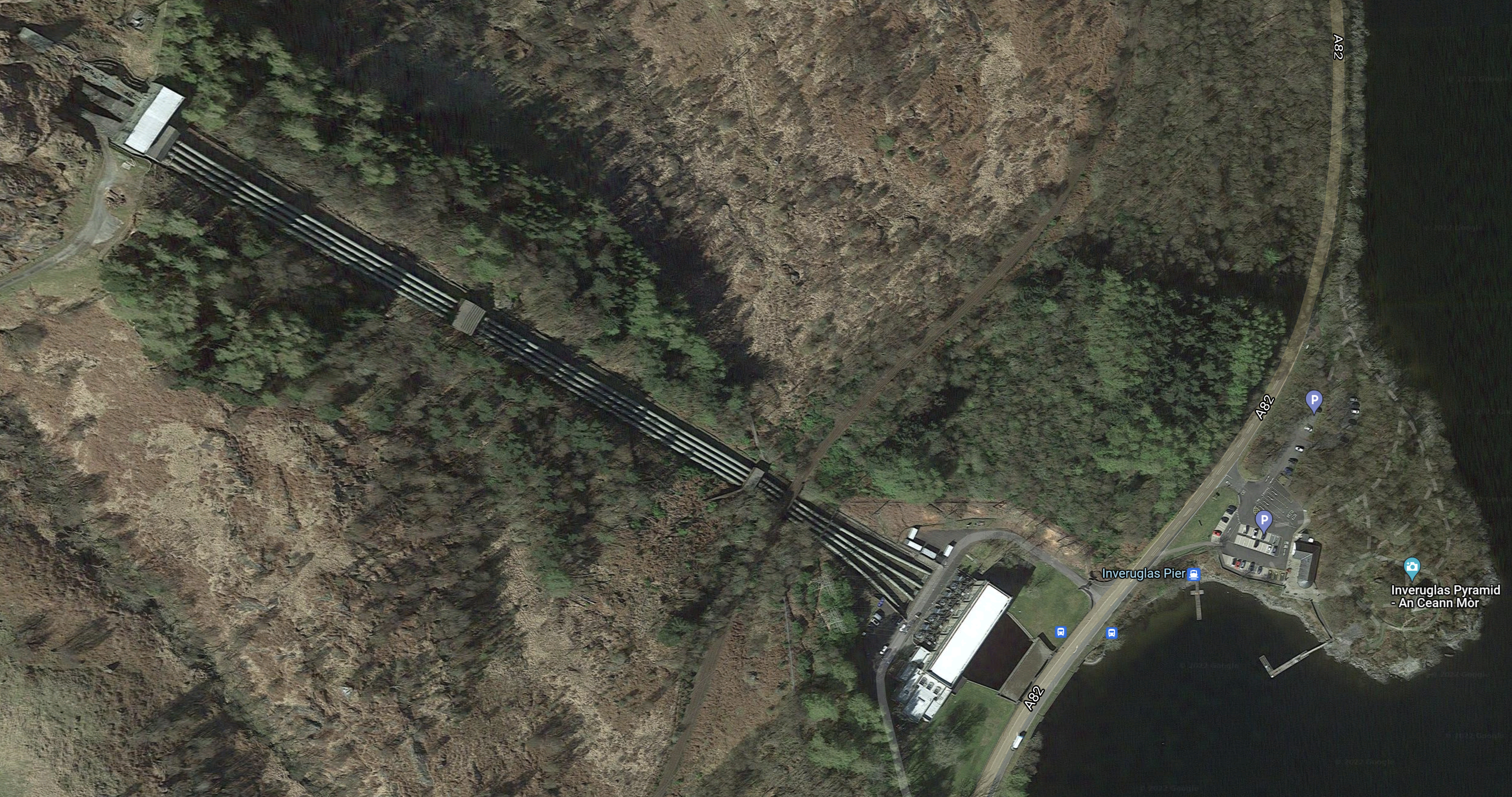
Note.
- It is a classic layout for a hydro-electric power station.
- In the North West corner of the map is the valve house, which is connected to Loch Sloy by a three kilometre tunnel.
- The valve house controls the water flows to the power station by Loch Lomond.
- There are four two-metre pipes running down the hill, one for each of the four turbines.
- According to the page on Greenage, the power station has three 40 MW turbines and one 32 MW turbine, which gives a total output of 152 MW.
- The water discharges into Loch Lomond after doing its work in the power station.
Loch Sloy is the largest conventional hydroelectric power plant in the UK.
The 2010 Plan To Add Pumped Storage To The Loch Sloy Hydro-Electric Scheme
This page on Hydro Review, which is dated the 10th of November 2010, is entitled SSE Gets Government Consent For Sloy Pumped-Storage Hydropower Project.
These are the first paragraph.
SSE Generation Ltd., the wholly owned generation business of Scottish and Southern Energy, has received consent from the Scottish Government to develop a 60-MW pumped-storage hydro project at its existing Sloy hydropower station at Loch Lomond, SSE reported.
Note.
- Two 30 MW pumps will be added to the power station to pump water up the hill from Loch Lomond to Loch Sloy.
- According to the page on Greenage, if the two pumps worked together for six hours, they would transfer 432,000 m3 of water. Note that a cubic metre of water weighs a tonne.
- Water would be transferred, when there was a surplus of energy being generated over the demand.
It would appear to be a simple scheme, as it is just adding two pumps to pump the water up the hill.
- As pumps rather than pump/turbines as at Foyers are used, there is no corresponding increase in generating capacity.
- Water also appears to be pumped up to the valve house in the existing pipes.
- Loch Sloy and Loch Lomond would not need major works to enable the scheme..
The page on Greenage gives the cost at just £40 million.
Originally, the project was supposed to have started in 2012, but as there are environmental problems with the fish, the work has not started.
These problems are detailed on the page on Greenage.
It looks like this scheme would have had an output of 152.5 MW and a storage capacity of 14 GWh.
Expanding Loch Sloy
Yesterday’s press release says this about the proposed capacity of the proposed Loch Sloy pumped storage scheme.
Subject to final design, the converted Sloy scheme would be capable of delivering up to 25GWh of long-duration electricity storage capacity.
This Google Map shows Loch Sloy.
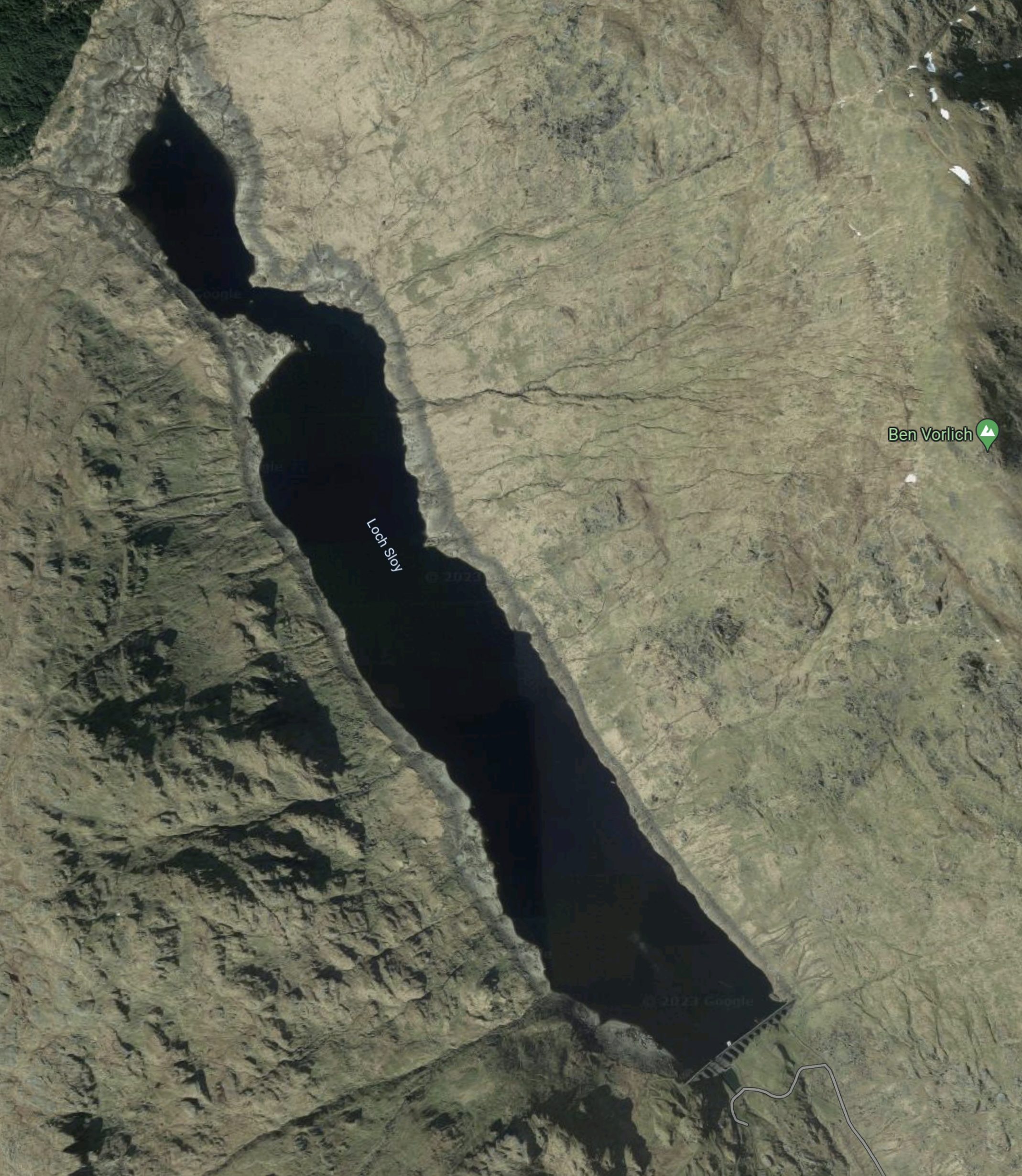
This second Google Map shows the dam at the Southern end.
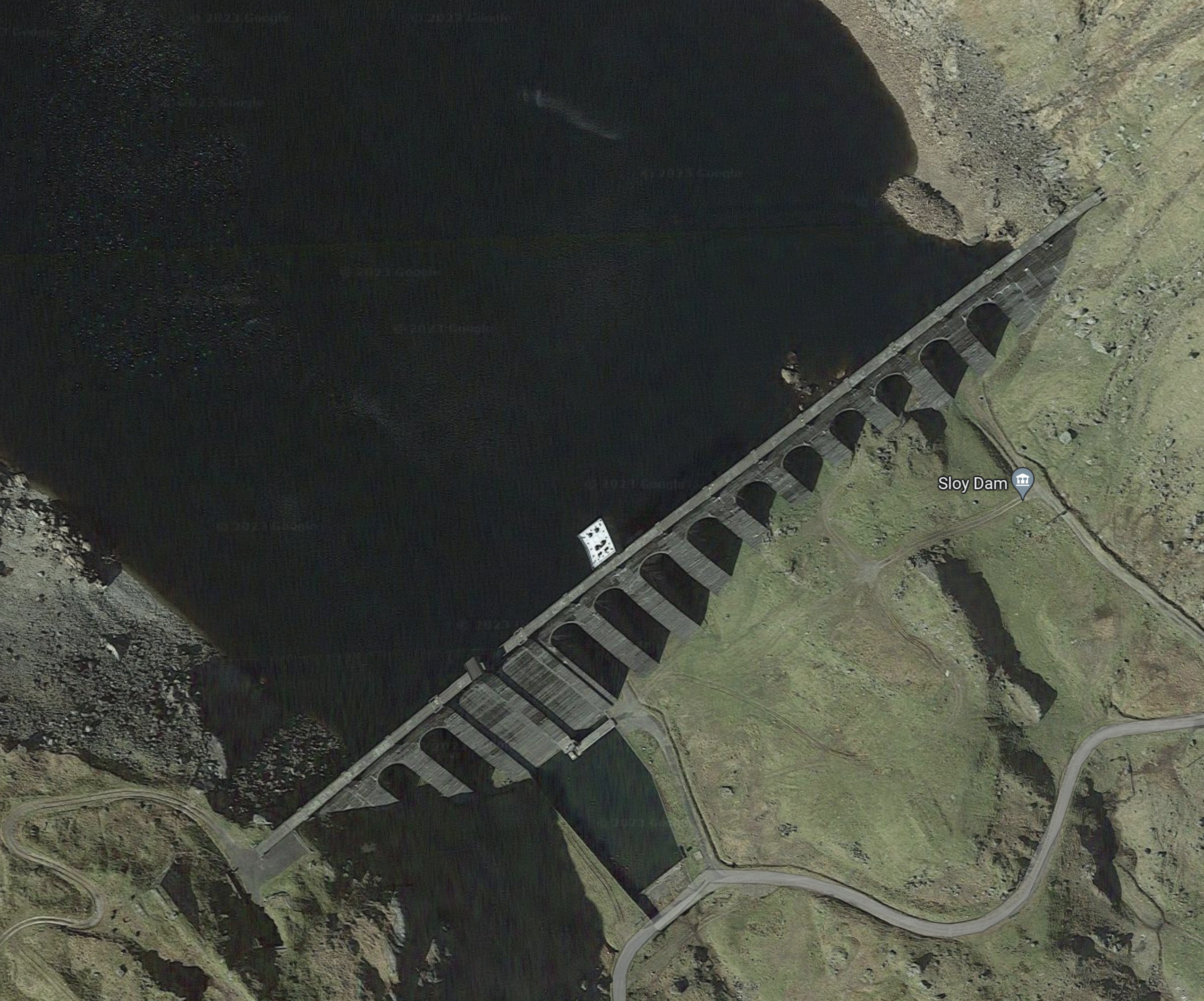
Note.
- Earlier, I said that Loch Sloy can store 14 GWh of electricity.
- To be able to store 25 GWh would need a 78 % increase in capacity.
This could be possible to be obtained by enlarging the dam and perhaps reprofiling the banks of the loch.
Expanding Loch Slow Power Station
This Google Map shows the Loch Sloy dam and the power station.
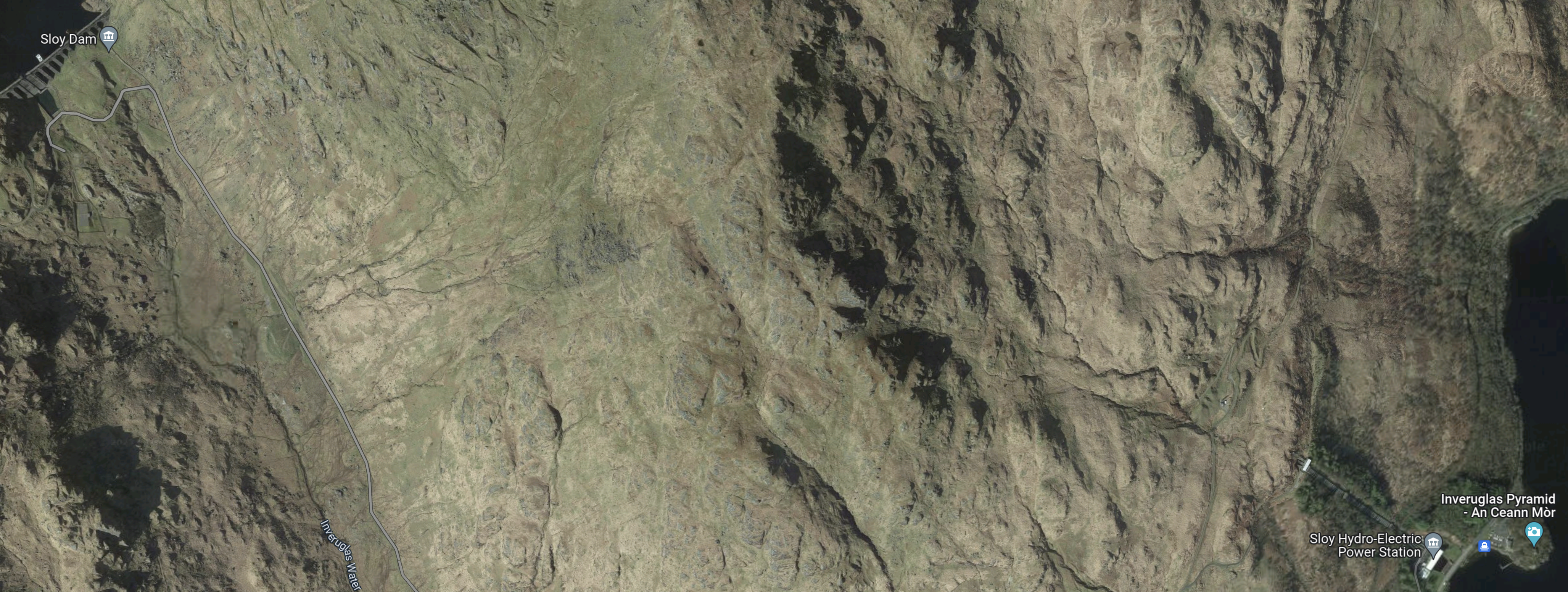
Note.
The dam is in the North-West corner of the map.
The power station is in the South-East corner of the map.
This repeat of the second Google Map shows the power station in more detail.
There appears to be plenty of space for more turbines, pumps and other electrical gubbins.
Building The Scheme
There may be enlarged buildings and extra pipes up the mountain, but hopefully the major problem of digging more tunnels through the rock may be avoided.
For these reasons, it could be a relatively easy construction project costing tens of millions.
The 14 GWh scheme from 2010 was costed at £40 million, so this 25 GWh scheme would probably cost no more than double or £80 million.
Conclusion
This is a sensible and affordable scheme, that provides a lot of energy storage
SSE Renewables Announces Construction Of Second Utility-Scale Battery Storage System
The title of this post, is the same as that of this news item from SSE Renewables.
These three paragraphs outline the project and its current status.
SSE Renewables has taken a Final Investment Decision to proceed with, and entered into contracts to deliver, its second battery energy storage system (BESS). The 150MW project is located at the site of SSE’s former Ferrybridge coal-fired power station in West Yorkshire, England.
The investment is part of SSE’s £12.5bn Net Zero Acceleration Programme and means construction will now commence later this month at the iconic site.
For decades the Ferrybridge coal-fired power station was a prominent feature of the West Yorkshire landscape, before being decommissioned by SSE in 2016. Now SSE Renewables’ plans to build a new 150MW battery storage project at Ferrybridge will provide flexible generation for Britain’s national grid and a new era for the site.
This Google Map shows the site.
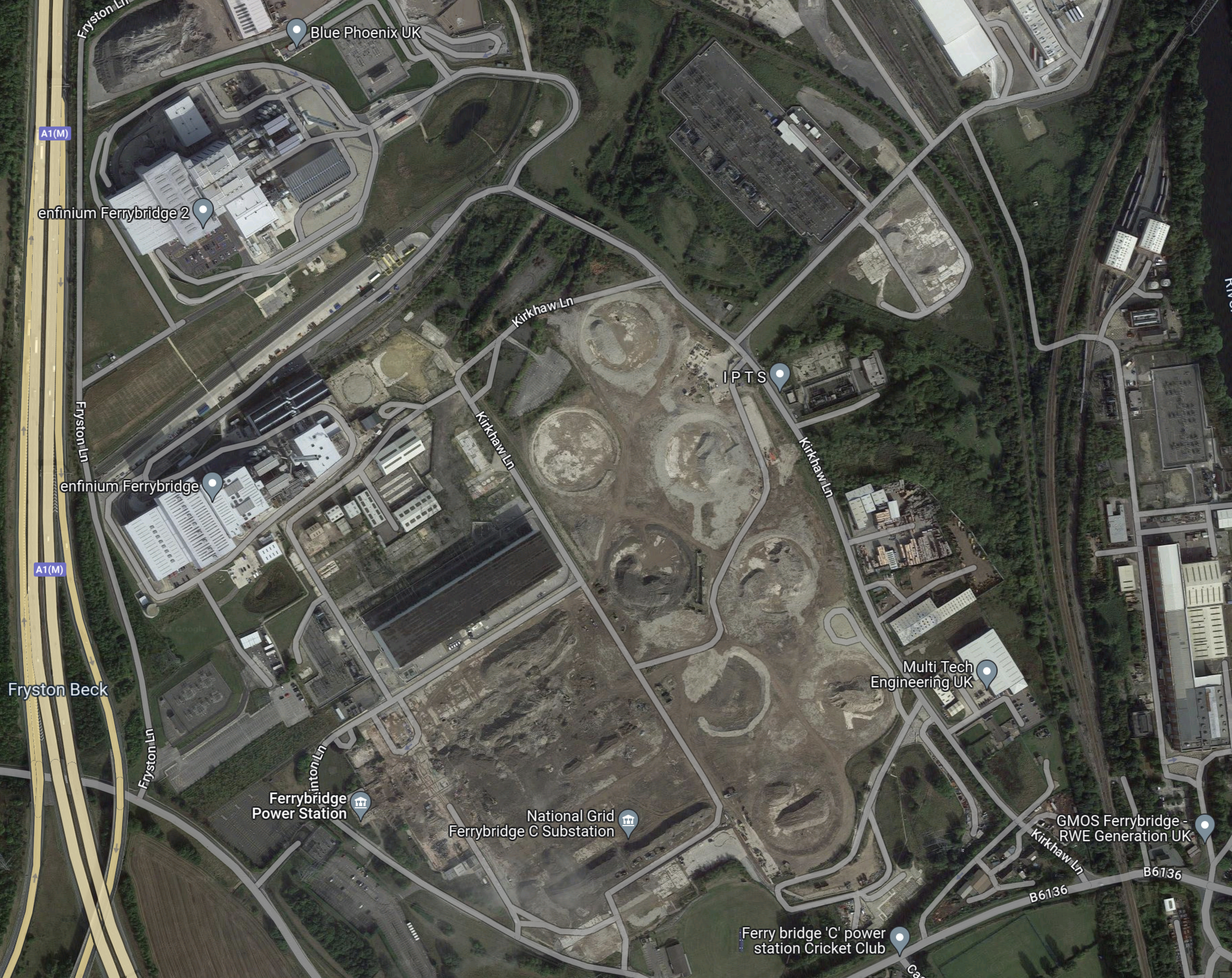
Note.
- The A1(M) runs up the West side of the map, with the East Coast Main Line going up the East.
- The circular structures in the middle of the map appear to be the bases and remains of the eight cooling towers.
- There are a lot of labels saying Ferrybridge power station.
- One existing and one demolished sub-stations can be located.
- The last Ferrybridge power station; C had a capacity of just over 2 GW.
The Wikipedia entry for Ferrybridge C, is worth a read, as it details the struggles of various owners and their engineers to generate electricity efficiently and with regard to the regulations.
The site’s use since 2016 seems to have been varied with two multi-fuel power stations, that were designed to burn mixed fuel including biomass, general waste and waste wood, a carbon capture experiment for Chris Huhne and now the 150 MW battery, which other sources give as having a storage capacity of 300 MWh.
It looks to me that SSE still own the large site and I wonder what their plans envisage for the site.
- A large electrolyser to produce hydrogen could be invaluable for decarbonising the heavy industry in the area.
- According to Wikipedia, there was a plan to build the gas-fired Ferrybridge D and a gas pipeline to connect it to the gas transmission system, but neither were built.
- So could the gas pipeline be built to distribute the hydrogen?
- Or could a large hydrogen store and a small hydrogen-powered power-station be built at Ferrybridge to back up the renewables
- Alternatively, more batteries could be added to the site.
The size of the site, gives lots of possibilities.
Ireland To Develop National Industrial Strategy For Offshore Wind
The title of this post, is the same as that of this article on offshoreWIND.biz.
This is the sub-heading.
Ireland’s Minister for Enterprise, Trade and Employment, Simon Coveney, has announced plans to develop a National Industrial Strategy for Offshore Wind which will set out how Ireland can maximise the economic opportunity arising from the production of offshore wind energy
Ireland’s current objectives for offshore wind are.
- To deliver 5 GW of offshore wind by 2030.
- A further 2 GW of floating wind to be in development by 2030.
- The target for offshore wind could rise to at least 37 GW by 2050.
- There is a target to provide 80 per cent of the country’s electricity to be from renewable sources by 2030.
The government appears to recognise collaborative approach between state and industry is needed.
Nothing is said about co-operation with Northern Ireland or the UK.
This is despite.
- UK and Irish companies like ESB, Flotation Energy, Simply Blue Group and SSE have projects in both countries.
- Irish company; ESB is developing the Malin Sea Wind wind farm in Scottish waters and landing the electricity near Derry City.
- Scottish company; SSE is building biomass power stations in Ireland.
- Some promising waters for wind power are shared between the two countries.
- There are three interconnectors between the two main islands.
I would expect that there could be some multi-purpose interconnectors across the Irish and Celtic Seas.
These would connect windfarms between the islands to both the UK and Ireland. National Grid and TenneT are building the LionLink between England and The Netherlands, which I wrote about in World’s Largest-Of-Its-Kind Power Line To Deliver Clean Power To 1.8m UK Homes And Boost Energy Security.
I very much feel, that there will be a lot of co-operation between the UK and Irish governments as if they work together, the development of Ireland’s offshore wind and that of the West Coast of the UK could be more efficient.
Angus Peter Campbell: I’m In Two Minds About The Renewable Energy Revolution
The title of the post, is the same as that of this article in the Aberdeen Press and Journal.
This is the sub-heading.
The debate (argument) between development and environmentalism is as old as the hills.
In the article, Campbell puts all sides of the arguments over the Coire Glas pumped storage hydro-electric scheme, and the article is very much a must read.
I feel that this 1500 MW/30 GWh scheme should be built, as like Hinckley Point C and Sizewell C, it takes a large bite out of the new energy storage capacity that is needed.
But if we do build this large project, we should think very hard about how we do it.
These are a few thoughts.
Low Carbon, Disturbance And Noise During Construction
High Speed Two are doing this and I wrote about it in HS2 Smashes Carbon Target.
I do subject though, that increasingly large construction projects can go this way.
Electric Trucks, Cranes And Other Equipment
High Speed Two and big mining companies are increasingly using electric mining trucks, cranes and other equipment.
As this sort of equipment, also provides a better environment for workers, I suspect we’ll see more electric equipment.
Hydrogen Trucks And Construction Equipment
Hydrogen could play a big part and rightly so.
It is ideal for heavier equipment and one of its biggest advocates and developers is JCB.
I wouldn’t be surprised to see a decision about an onsite electrolyser being made soon.
Low Carbon Concrete
There are various methods of making low- and zero-carbon concrete, some of which incorporate carbon dioxide into the material.
Use Of Loch Lochy And The Caledonian Canal
I wouldn’t be surprised if just as the Thames in London was used in the construction of Crossrail and the Northern Line extension, Loch Lochy and The Caledonian Canal will be used to take out construction spoil.
There’s certainly a lot of ways to be innovative in the movement of men and materials.
Conclusion
The construction of Coire Glas will make an epic documentary.
SSE Renewables Unveils Plans For Wind Farm Offshore Ireland’s Atlantic Coast
The title of this post, is the same as that of this article on offshoreWIND.biz.
This is the sub-heading.
SSE Renewables is seeking an investigative foreshore licence to facilitate survey work for a possible new offshore wind farm in the Atlantic Ocean off the coast of Tarbert, Co. Kerry, Ireland.
This Google Map shows the approximate location of Tarbert.
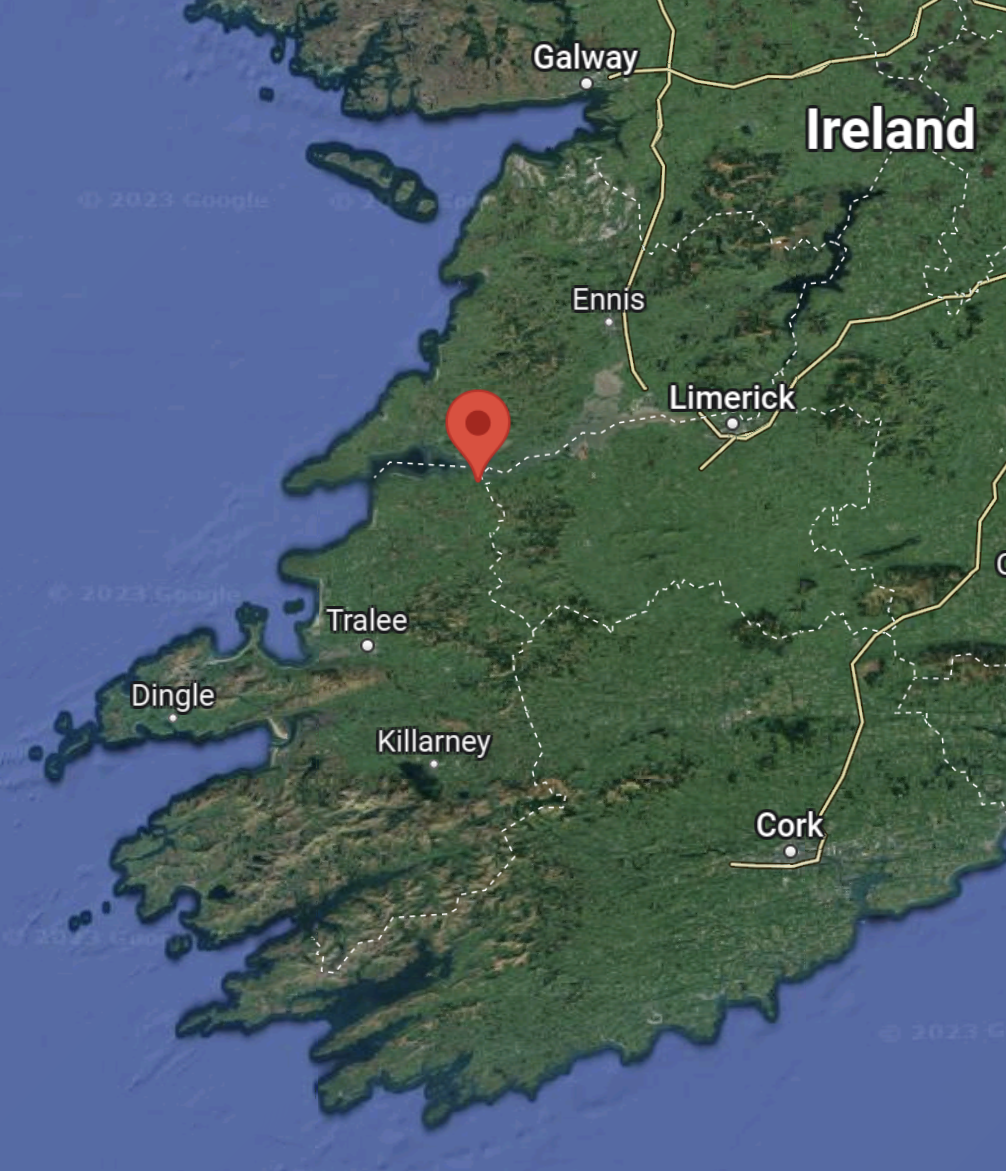
These two paragraphs outline the project.
SSE Renewables has recently submitted an application for an investigative foreshore licence to Ireland’s Department of Housing, Local Government and Heritage and is seeking approval for investigative surveys of the seabed for an offshore wind project which could generate up to 1 GW of energy.
These geophysical, geotechnical, and environmental surveys are required to inform the renewable energy developer’s understanding of the prevailing environmental and met-ocean conditions at the foreshore investigative array area, which is a minimum of 13 kilometres offshore.
This is SSE Renewables’ first licence application for an offshore wind project off the west coast of Ireland.
In SSE Thermal Secures 10-year Contracts For Two New Low-Carbon Power Stations In Ireland, I talked about two biomass power stations at Tarbert in Co. Kerry and Platin in Co. Meath.
It looks like the Tarbert wind farm and power station will work as a team and back each other up.
We Mustn’t Forget Platin!
This Google Map shows Dublin and its position relative to the North Wales coast.
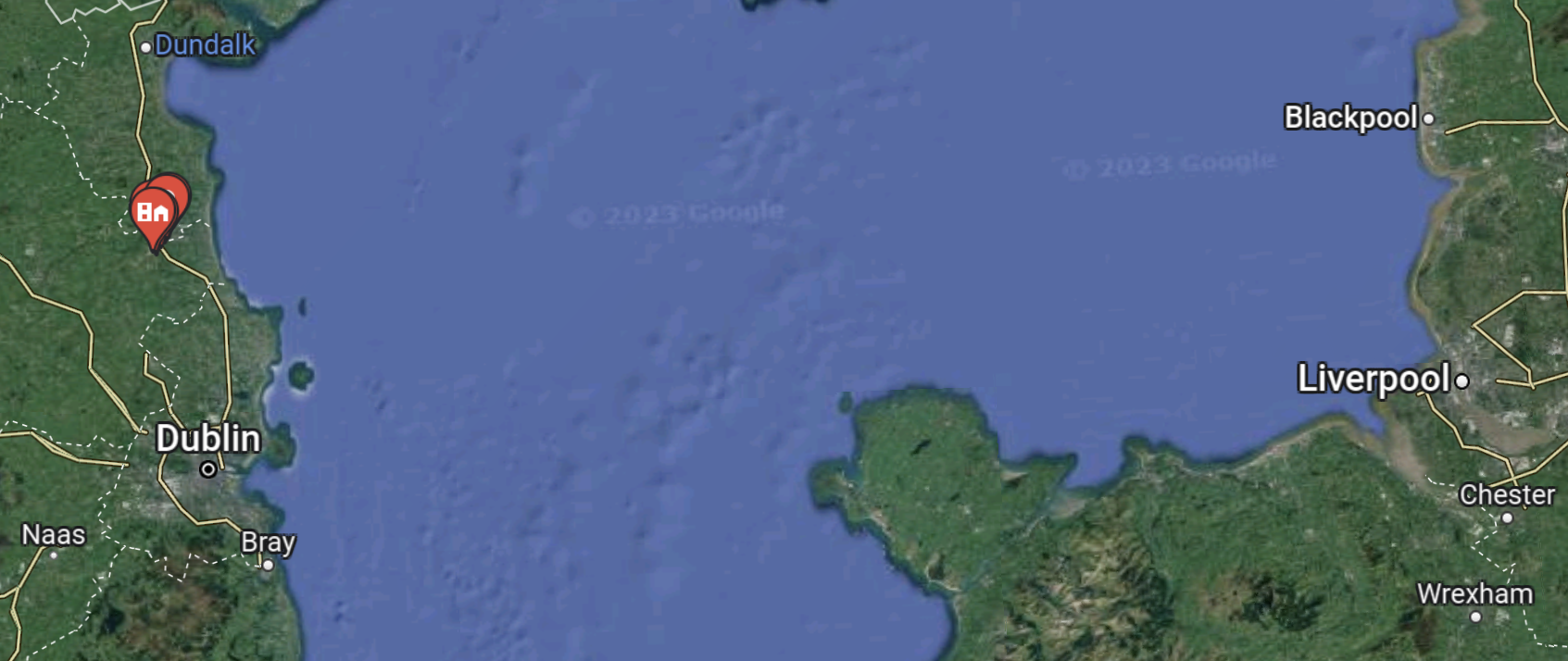
Note.
- Platin is marked by the red arrows to the North of Dublin.
- Platin also appears to be the head office and a manufacturing site of Irish Cement, who probably are a large user of energy.
- The sea between Blackpool, Liverpool, Anglesey and the Isle of Man is full of wind turbines.
These wind farms are located in this area of UK waters.
- Barrow – 30 MW
- Burbo Bank – 90 MW
- Burbo Bank Extension – 258 MW
- Gwynt y Môr – 576 MW
- Ormonde – 150 MW
- Rhyl Flats – 90 MW
- Walney – 367 MW
- Walney Extension – 650 MW
- West Of Duddon Sands – 389 MW
- Mona – 1500 MW – Being Planned
- Morecambe – 480 MW – Being Planned
- Morgan – 1500 MW – Being Planned
- Awel y Môr – 500 MW – Being Planned
Note.
- 2600 MW has been commissioned.
- 3980 MW is being planned.
I would not be surprised to see SSE or one of their friends, build a GW-scale wind farm between Anglesey, Dublin and Dundalk.
Is Ireland apparently lagging behind the UK, because the waters near the Irish coast are deeper and would need still-developing floating wind technology?
Conclusion
It looks like the Irish government and SSE are planning a low-carbon electricity system for Ireland.
Largest Offshore Wind Project In UK Reaches Development Milestone
The title of this post, is the same as that of this article on offshoreWIND.biz.
This is the sub-heading.
An application to build the up to 4.1 GW Berwick Bank, the UK’s largest offshore wind farm, capable of providing enough electricity to power more than five million homes, has commenced determination, SSE Renewables said.
These two paragraphs outline the current status of the project.
Located roughly 38 kilometers off the East Lothian coast of Scotland, Berwick Bank is the largest offshore wind farm planning application to be submitted in the UK to date and one of the largest globally.
The consent process for the onshore elements of the project has now opened, which is being considered by East Lothian Council.
This process runs alongside the offshore consent process, which kicked off in December 2022 and is being considered by the Scottish Government. A final decision by authorities is expected later in 2023.
SSE Renewables hope to deliver first power by 2027.
Further Thoughts On BP’s Successful INTOG Bid
I have been searching the web and I feel BP’s successful INTOG bid may be different.
In 13 Offshore Wind Projects Selected In World’s First Innovation And Targeted Oil & Gas Leasing Round, I decided that BP’s bid, which only was for 50 MW of offshore wind would generate hydrogen and send it to shore through the Forties Pipeline System, which is owned by INEOS.
My reasons for feeling that it would generate hydrogen were as follows.
- In the wider picture of wind in the North Sea, BP’s proposed 50 MW wind farm is a miniscule one. SSE Renewables’s Dogger Bank wind farm is over a hundred times as large.
- A cable to the shore and substation for just one 50 MW wind farm would surely be expensive.
- BP Alternative Energy Investments are also developing a 2.9 GW wind farm some sixty miles to the South.
- It would probably be bad financial planning to put large and small wind farms so close together.
I still believe for these and other reasons, that there is no reason to believe that the proposed 50 MW wind farm is a traditional wind farm and most likely it will be paired with an appropriately-sized electrolyser producing around twenty tonnes of hydrogen per day.
But instead of being sent ashore by using the Forties Pipeline System, could this hydrogen be sent directly to the coast near Aberdeen, in its own personal hydrogen pipeline?
- Using a variety of maps, I have estimated the distance at only around twenty miles.
- With all the experience from BP and their suppliers, there must be a solution for a relatively short hydrogen pipeline.
I also found this scientific paper on ScienceDirect, which is entitled Dedicated Large-Scale Floating Offshore Wind To Hydrogen: Assessing Design Variables In Proposed Typologies, which talks about three different layouts.
- Centralised Onshore Electrolysis
- Decentralised Offshore Electrolysis
- Centralised Offshore Electrolysis
All would appear to be feasible.
There is a lot of information in the scientific paper and it leads me to the conclusion, that hydrogen could be generated offshore and transferred by pipeline to storage on the shore.
The paper shows a design for a submarine hydrogen pipeline and schematics of how to design a system.
I believe that BP’s proposed system could deliver around twenty tonnes of hydrogen per day to the shore.
The system could be as simple as this.
- A few large floating wind turbines would be positioned offshore, perhaps twenty miles from shore.
- Perhaps 5 x 10 MW, 4 x 12 MW turbines or 3 x 16 MW could be used. Deciding would be one of those calculations, that combines accountancy, data, engineering and finance, which are great fun.
- The offshore distance would be carefully chosen, so that complaints about seeing them from the shore would be minimised.
- The generated electricity would be collected at a floating electrolyser, where hydrogen would be created.
- The hydrogen would be pumped to the shore.
- The floating electrolyser could also contain hydrogen storage.
I think there is large scope for innovation.
- I can imagine drones and helicopters delivering equipment and personnel to service the electrolyser.
- Underwater hydrogen storage could be developed.
- A standard system could be developed for rolling out anywhere.
- It could be placed in the sea, by a steelworks or other large hydrogen user.
In its own right the concept would develop new markets, which is one of the wind farm’s aims.
Could This Be The Route To Create Affordable Hydrogen For All?
BP would be failing their customers, employees and shareholders, if they weren’t developing a zero-carbon alternative to diesel and petrol.
Offshore hydrogen electrolysers strategically placed along the coastline, could provide a reliable hydrogen supply to a that sizeable proportion of the world’s population, who live near to the coast.
Could The Technology Be Adapted To Motorway And Large Service Stations?
This document on the UK Government web site, gives the mileage statistics of lorries (HGVs) and has this sub-heading.
In 2019 lorries travelled 17.4 billion vehicle miles, remaining broadly stable (increasing slightly by 0.3%) compared with 2018.
It breaks this figure down, by the class of road.
- Motorways – 8.0 – 46 %
- A Roads – 6.3 – 36 %
- Rural Minor Roads – 0.9 – 5 %
- Urban A Roads – 1.5 – 9 %
- Urban Minor Roads – 0.7 – 4 %
Note that 82 % of HGV mileage is on Motorways or A roads. Anybody, who has ever driven a truck bigger than a Ford Transit over a distance of upwards of fifty miles, knows that trucks and vans regularly need to be fuelled up on the road. And that applies to the drivers too, who also by law must take a break, away from the cab.
Charging an electric truck could be a lengthy business and would require service stations to be connected directly to the nation grid and be fitted with a substantial number of heavy duty chargers.
One thing, that would be difficult with an electric truck, would be a Splash-and-Dash, if a truck was nearing the destination and needed a small amount of charging to meet delivery schedules.
Because of the distances involved, the driving rules, the often tight schedules and the fast filling, I am convinced that there will be a large proportion of hydrogen-powered trucks and vans on the road and these will need a network of service stations where hydrogen is available.
Look at these overhead view of South Mimms Services, where the M25 and the A1(M) cross to the North of London.
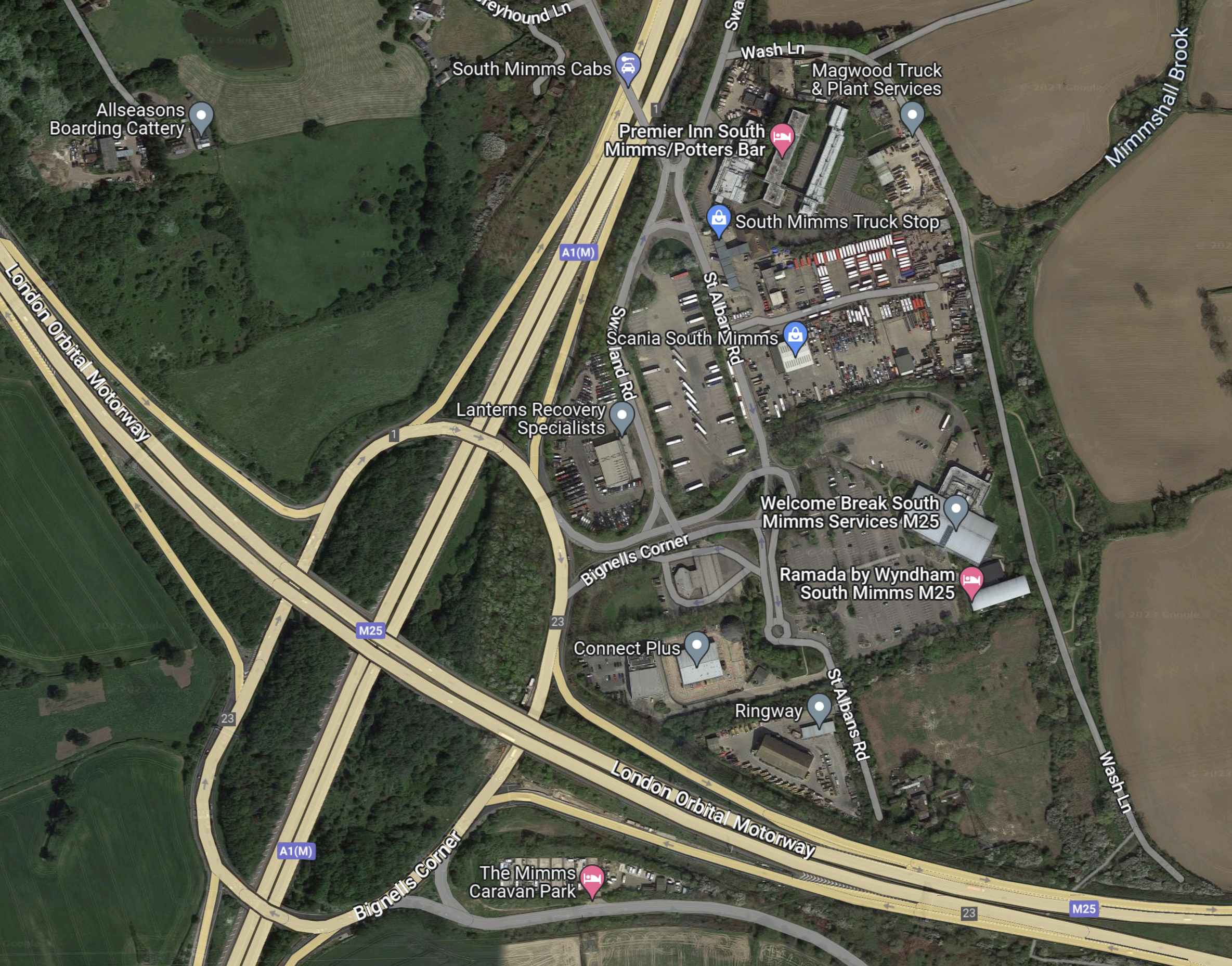
I would envisage that at least four 10 MW wind turbines, which have a rotor diameter of around 160-190 metres could be dotted around and inside the site including inside the roundabout.
- The electrolyser would be slightly smaller than that which would be used at Aberdeen.
- Perhaps fifteen tons per day of hydrogen could be generated.
- No hydrogen needed on the site would ever be brought in by truck.
- Wind-generated electricity could also power the hotels, restaurants and the service station.
- As the percentage of vehicles running on fossil fuels decreased, the air quality in the area of the service station, should increase.
- How many people, who lived locally would switch to a hydrogen-powered runabout and fill it up perhaps once a week, when they passed?
Much of the technology needed to add a hydrogen option to a typical large service station has already been developed and some would also be needed to build BP’s 50 MW offshore wind farm with an electrolyser.
13 Offshore Wind Projects Selected In World’s First Innovation And Targeted Oil & Gas Leasing Round
The title of this post, is the same as that of this article on offshoreWIND.biz.
This is the sub-heading.
Crown Estate Scotland has selected 13 out of a total of 19 applications with a combined capacity of around 5.5 GW in the world’s first leasing round designed to enable offshore wind energy to directly supply offshore oil and gas platforms.
This paragraph outlines INTOG (Innovation and Targeted Oil & Gas) and its objectives.
INTOG, which has been designed in response to demand from government and industry to help achieve the targets of the North Sea Transition Sector Deal through decarbonising North Sea oil and gas operations, is also expected to further stimulate innovation in Scotland’s offshore wind sector, create additional supply chain opportunity, assist companies to enter the renewable energy market, and support net-zero ambitions.
This is undoubtedly the most important news of the day.
- When complete it will generate 5416 MW of electricity.
- 4068 MW will be used primarily to decarbonise oil and gas platforms with surplus electricity going to the grid.
- The amount of carbon dioxide released by oil and gas platforms in the North Sea will be reduced.
- The gas saved by decarbonising oil and gas platforms, will be transported to the shore and used in the UK gas grid.
- 449 MW will be generated in innovative ways in small wind farms, with a capacity of less than 100 MW.
One of the benefits of INTOG is that the UK will be able to reduce gas imports, which must increase energy security.
This map from this document from the Crown Estate Scotland, shows the INTOG wind farms.
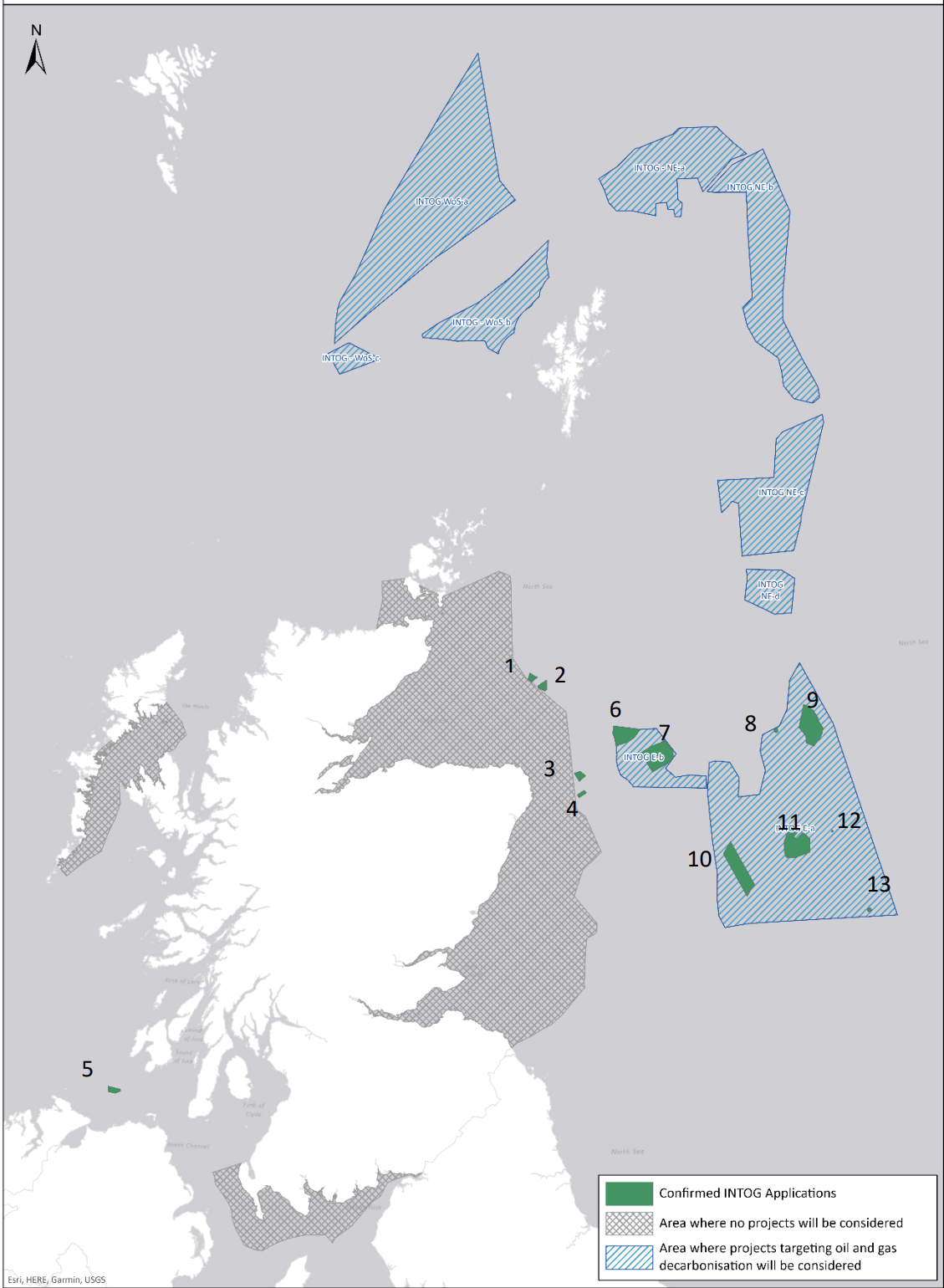
This is a list of the farms.
- 1 – Bluefloat Energy/Renantis Partnership – Innovation – Commercial – 99.45 MW
- 2 – Bluefloat Energy/Renantis Partnership – Innovation – Supply Chain – 99.45 MW
- 3 – Simply Blue Energy (Scotland) – Innovation – Supply Chain – 100 MW
- 4 – BP Alternative Energy Investments – Innovation – New Markets – 50 MW
- 5 – ESB Asset Development – Innovation – Cost Reduction – 100 MW
- 6 – Floatation Energy – Targeted Oil & Gas – 560 MW
- 7 – Cerulean Winds – Targeted Oil & Gas – 1008 MW
- 8 – Harbour Energy – Targeted Oil & Gas – 15 MW
- 9 – Cerulean Winds – Targeted Oil & Gas – 1008 MW
- 10 – Cerulean Winds – Targeted Oil & Gas – 1008 MW
- 11 – Floatation Energy – Targeted Oil & Gas – 1350 MW
- 12 – TotalEnergies – Targeted Oil & Gas – 3 MW
- 13 – Harbour Energy – Targeted Oil & Gas – 15 MW
Note.
- These total up to 5.42 GW.
- The five Innovation sites seem to be as close to the coast as is possible.
- I thought some Innovation sites would be closer, so supply difficult to reach communities, but they aren’t.
- Floatation Energy and Cerulean Winds seemed to have bagged the lion’s share of the Targeted Oil & Gas.
- Sites 6 and 7 sit either side of a square area, where Targeted Oil & Gas will be considered. Is that area, the cluster of oil and gas facilities around Forties Unity, shown on the map in this page on the BP web site?
- Harbour Energy have secured two 15 MW sites for Targeted Oil & Gas.
These are my thoughts on the various companies.
Bluefloat Energy
Bluefloat Energy has posted this press release on their web site, which is entitled Bluefloat Energy | Renantis Partnership Bid Success For Two 99mw Innovation Projects In Crown Estate Scotland’s INTOG Process.
The press release starts with these three bullet points.
- BlueFloat Energy | Renantis Partnership offered exclusivity rights to develop its Sinclair and Scaraben floating wind projects north of Fraserburgh – leveraging synergies via its 900MW Broadshore project.
- The projects seek to trial innovative floating wind technology solutions, kick-starting supply chain growth and job creation in Scotland and providing a ‘stepping-stone’ to the partnership’s ScotWind projects.
- Bid proposals include the intention to develop a scalable community benefit model – creating a potential blueprint for floating offshore wind in Scotland.
The first three paragraphs expand the bullet points.
The BlueFloat Energy and Renantis Partnership has been offered seabed exclusivity rights to develop two 99MW projects under the innovation arm of Crown Estate Scotland’s INTOG (Innovation and Targeted Oil & Gas) auction process. The auction saw ten projects bid to bring forward the development of small-scale innovation projects.
The Sinclair and Scaraben projects, located north of Fraserburgh and adjacent to the Partnership’s 900MW Broadshore project, seek to trial innovative foundation technologies, associated fabrication works and mooring systems with a view to maximising opportunities for the Scottish supply chain, driving local investment and job creation.
A key element of the bid proposals is the opportunity to test and adapt a community benefit model, governed independently, and directed by the communities in which the schemes will operate, through collaboration with our supply chain and project partners. The model could create a blueprint, shaping the future of community benefit from floating offshore wind throughout the whole of Scotland. This builds on Renantis’ successful track record of deploying similar schemes via its onshore wind farms in Scotland.
Note.
- Companies called Sinclair Offshore Wind Farm and Scaraben Offshore Wind Farm were registered a few months ago in Inverness.
- I couldn’t find the websites, so I suspect they’re still being created.
- These two projects appear to be pathfinders for the 900 MW Broadshore project, with regards to the supply chain and community involvement.
It certainly looks like the partnership are going about the development of these two projects in a professional manner.
BP Alternative Energy Investments
There has been no press release from BP as I write this, so I will have to deduce what BP are planning.
This map from this document from the Crown Estate Scotland, shows the Southern INTOG wind farms.
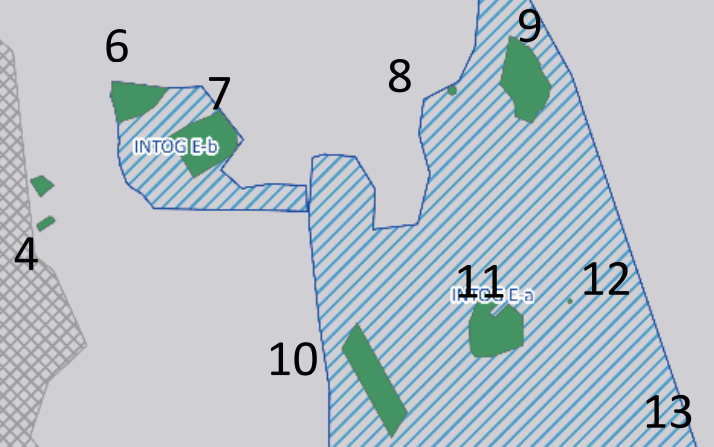
Note.
- Site 4 is the site of BP Alternative Energy Investments’s proposed wind farm.
- Sites 6 and 7 could be either side of the cluster of platforms around Forties Unity.
Consider.
- In the wider picture of wind in the North Sea, BP’s proposed 50 MW wind farm is a miniscule one. SSE Renewables’s Dogger Bank wind farm is over a hundred times as large.
- A cable to the shore and substation for just one 50 MW wind farm would surely be expensive.
- BP Alternative Energy Investments are also developing a 2.9 GW wind farm some sixty miles to the South.
- It would probably be bad financial planning to put large and small wind farms so close together.
For these are other reasons, I believe that there is no reason to believe that the proposed 50 MW wind farm is a traditional wind farm.
But if I’m right about sites 6 and 7 indicating the location the position of Forties Unity, it might open up other possibilities.
This document from INEOS, who own the Forties Pipeline System, explains how the pipeline works.
The Forties Pipeline System (FPS) is an integrated oil and gas transportation and processing system. It is owned and operated by INEOS and utilises more than 500 miles of pipeline to smoothly transport crude oil and gas from more than 80 offshore fields for processing at the Kinneil Terminal. At Kinneil the oil and gas are separated, with the oil returned as Forties Blend to customers at Hound Point or pumped to the Petroineos refinery at Grangemouth.
At the same time the gas goes to our LPG export facilities or is supplied to the INEOS petrochemical plant. FPS transports around 40% of the UK’s oil production supply and brings over 400,000 barrels ashore every day.
In Can The UK Have A Capacity To Create Five GW Of Green Hydrogen?, I said the following.
Ryze Hydrogen are building the Herne Bay electrolyser.
- It will consume 23 MW of solar and wind power.
- It will produce ten tonnes of hydrogen per day.
The electrolyser will consume 552 MWh to produce ten tonnes of hydrogen, so creating one tonne of hydrogen needs 55.2 MWh of electricity.
If BP were to pair the wind farm with a 50 MW electrolyser it will produce 21.7 tonnes of hydrogen per day.
Could it be brought to the shore, by linking it by a pipeline to Forties Unity and then using the Forties Pipeline System?
As the category on site 4, is New Markets, are BP and INEOS investigating new markets for hydrogen and hydrogen blends?
- Some of the latest electrolysers don’t need pure water and can use sea water. This makes them more affordable.
- Do BP and/or INEOS have the capability to extract the hydrogen as it passes through the Cruden Bay terminal, to provide the hydrogen for Aberdeen’s buses and other users?
- INEOS and BP probably have some of the best oil and gas engineers in the world.
- How many other places in the world have an offshore oil or gas field set in a windy sea, where floating wind- turbine/electrolysers could generate hydrogen and send it ashore in an existing pipeline?
- Several of these offshore oil and gas fields and the pipelines could even be owned by BP or its associates.
- Remember that hydrogen is the lightest element, so I suspect it could be separated out by using this property.
This BP site, is to me, one of the most interesting of the successful bids.
- BP probably have a large collection of bonkers ideas, that have been suggested during their long involvement with offshore oil and gas.
- Some ideas could be even suggested by employees, whose fathers worked for BP fifty years ago. I’ve met a few BP employees, whose father also did.
- Will the wind farm, be a floating electrolyser at the centre of a cluster of a few large floating turbines?
- Will each turbine have its own electrolyser and the substation only handle hydrogen?
- Will the floating electrolyser have hydrogen storage?
- Have BP got a floating or semi-submersible platform, that could either go to the breakers or be repurposed as the floating electrolyser?
- Repurposing a previous platform, would make all the right noises.
So many possibilities and so far, no clues as to what will be built have been given.
See also.
Further Thoughts On BP’s Successful INTOG Bid
Cerulean Winds
In What Is INTOG?, I said this about Cerulean Winds.
Cerulean sounds like it could be a sea monster, but it is a shade of blue.
This article on offshoreWind.biz is entitled Cerulean Reveals 6 GW Floating Offshore Wind Bid Under INTOG Leasing Round.
These are the two introductory paragraphs.
Green energy infrastructure developer Cerulean Winds has revealed it will bid for four seabed lease sites with a combined capacity of 6 GW of floating wind to decarbonise the UK’s oil and gas sector under Crown Estate Scotland’s Innovation and Targeted Oil and Gas (INTOG) leasing round.
This scale will remove more emissions quickly, keep costs lower for platform operators and provide the anchor for large-scale North-South offshore transmission, Cerulean Winds said.
Note.
-
- It is privately-funded project, that needs no government subsidy and will cost £30 billion.
- It looks like each site will be a hundred turbines.
- If they’re the same, they could be 1.5 GW each.
- Each site will need £7.5 billion of investment. So it looks like Cerulean have access to a similar magic money tree as Kwasi Kwarteng.
Effectively, they’re building four 1.5 GW power stations in the seas around us to power a large proportion of the oil and gas rigs.
For more on Cerulean Winds’s massive project see Cerulean Winds Is A Different Type Of Wind Energy Company.
So does it mean, that instead of 6 GW, they were only successful at three sites and the other or others were in the six unsuccessful applications?
There is a press release on the Cerulean Winds web site, which is entitled Cerulean Winds Wins Bid For Three INTOG Floating Wind Sites, where this is said.
Cerulean Winds and Frontier Power International have been awarded three lease options for the Central North Sea in the highly competitive INTOG leasing round, the results of which were announced by Crown Estate Scotland today.
The sites, in the Central North Sea, will enable the green infrastructure developer and its partners to develop large floating offshore windfarms to decarbonise oil and gas assets. The scale of the development will enable a UK wide offshore transmission system, that can offer green energy to offshore assets in any location and create a beneficial export opportunity.
Nothing about unsuccessful applications was said.
This map from this document from the Crown Estate Scotland, shows the Southern INTOG wind farms.
Note.
- Sites 7, 9 and 10 are Cerulean’s sites.
- Sites 6 and 11 are Floatation Energy’s sites.
- Site 4 is BP Alternative Energy Investments’s Innovation site.
- Sites 8, 12 and 13 are much smaller sites.
It looks like Cerulean and Floatation Energy are well-placed to power a sizeable proportion of the platforms in the area.
ESB Asset Development
ESB Asset Development appear to be a subsidiary of ESB Group.
The ESB Group is described like this in the first paragraph of their Wikipedia entry.
The Electricity Supply Board is a state owned (95%; the rest are owned by employees) electricity company operating in the Republic of Ireland. While historically a monopoly, the ESB now operates as a commercial semi-state concern in a “liberalised” and competitive market. It is a statutory corporation whose members are appointed by the Government of Ireland.
This press release, is entitled ESB Offered Exclusive Rights To Develop Innovative 100MW Floating Offshore Wind Project In The Malin Sea.
These two paragraphs outline the project.
ESB today welcomes the outcome of Crown Estate Scotland’s latest seabed leasing process which has resulted in the offer of exclusive development rights to ESB for a 100MW floating wind project in Scottish waters off the north coast of Northern Ireland. The successful project, Malin Sea Wind, is a collaborative bid between ESB and leading technology developers Dublin Offshore Technology and Belfast-based CATAGEN. The outcome underscores ESB’s growing capabilities and expanding presence in the offshore wind industry.
The Innovation and Targeted Oil and Gas (INTOG) seabed leasing process, run by Crown Estate Scotland, aims to drive cost reduction in the offshore wind sector by enabling the deployment of new and innovative technologies, and to harness wind energy to decarbonize the oil and gas sector. Malin Sea Wind aims to support the reduction of floating offshore wind costs by demonstrating Dublin Offshore’s patented load-reduction technology. Furthermore, the project will support decarbonisation of the aviation sector by powering sustainable aviation fuel (SAF) production technology currently under development by net-zero technology specialists, CATAGEN.
Note.
- I’ve just looked at the Technology page of the Dublin Offshore Technology web site.
- In the 1970s, I built large numbers of mathematical models of steel, concrete and water cylinders in my work with a Cambridge University spin-out called Balaena Structures.
- I believe, that an experienced mathematically modeller could simulate this clever system.
That would prove if it works or not!
This Google Map shows the Malin Sea.
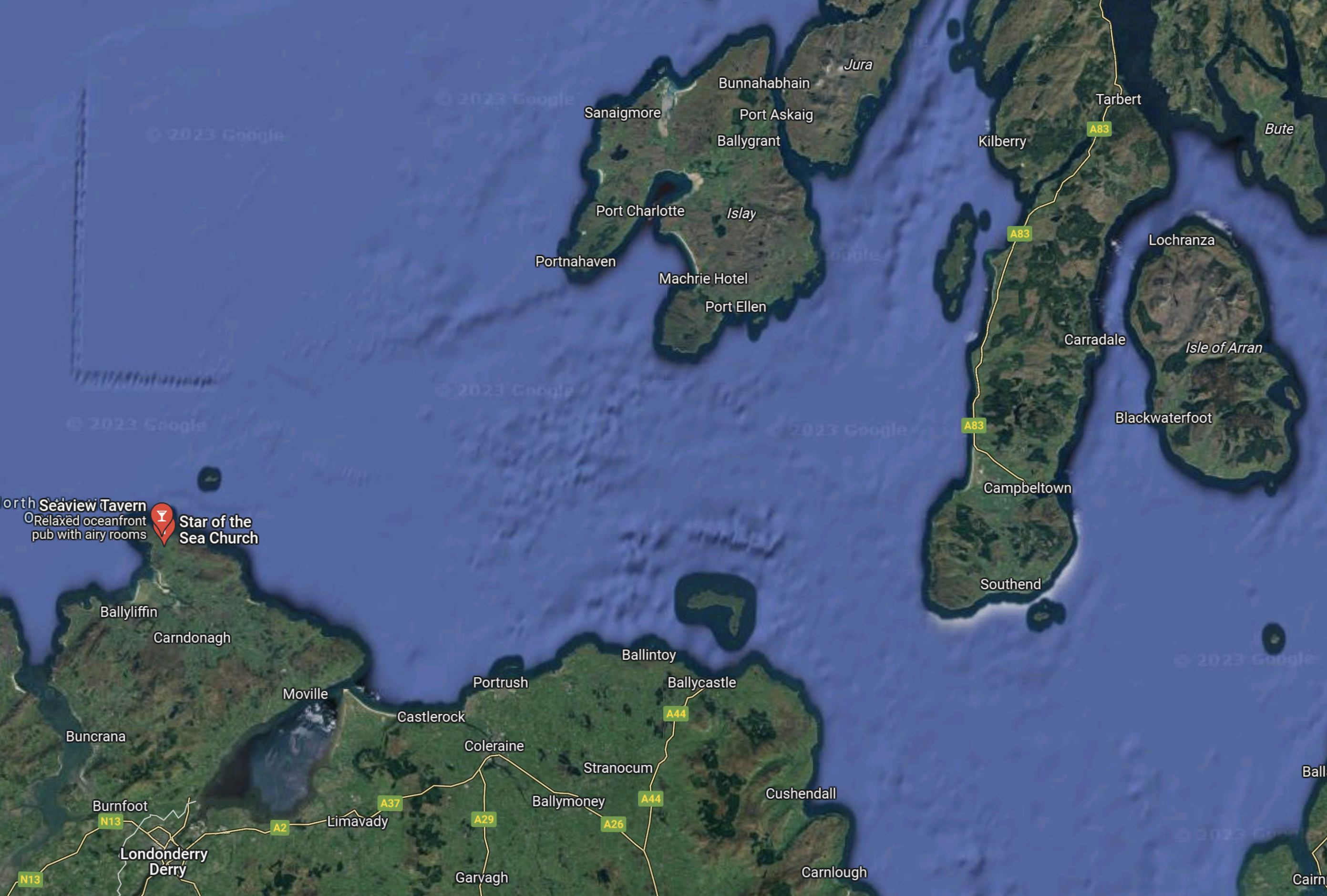
Note.
- Malin Head is marked by the red arrows on the Northern Irish coast.
- The most Westerly Scottish island is Islay and the most Easterly is the Isle of Arran.
- Between the two islands is the Kintyre peninsula.
- Portrush can be picked out on the Northern Irish coast.
By overlaying the two maps, I suspect the centroid of the wind farm will be North of Portrush about a few miles North of the Southern end of Arran.
I suspect that if all goes well, there could be a lot of floating wind turbines in the area.
This Google Map shows the River Foyle estuary and Foyle Port to the North-East of Londonderry/Derry.
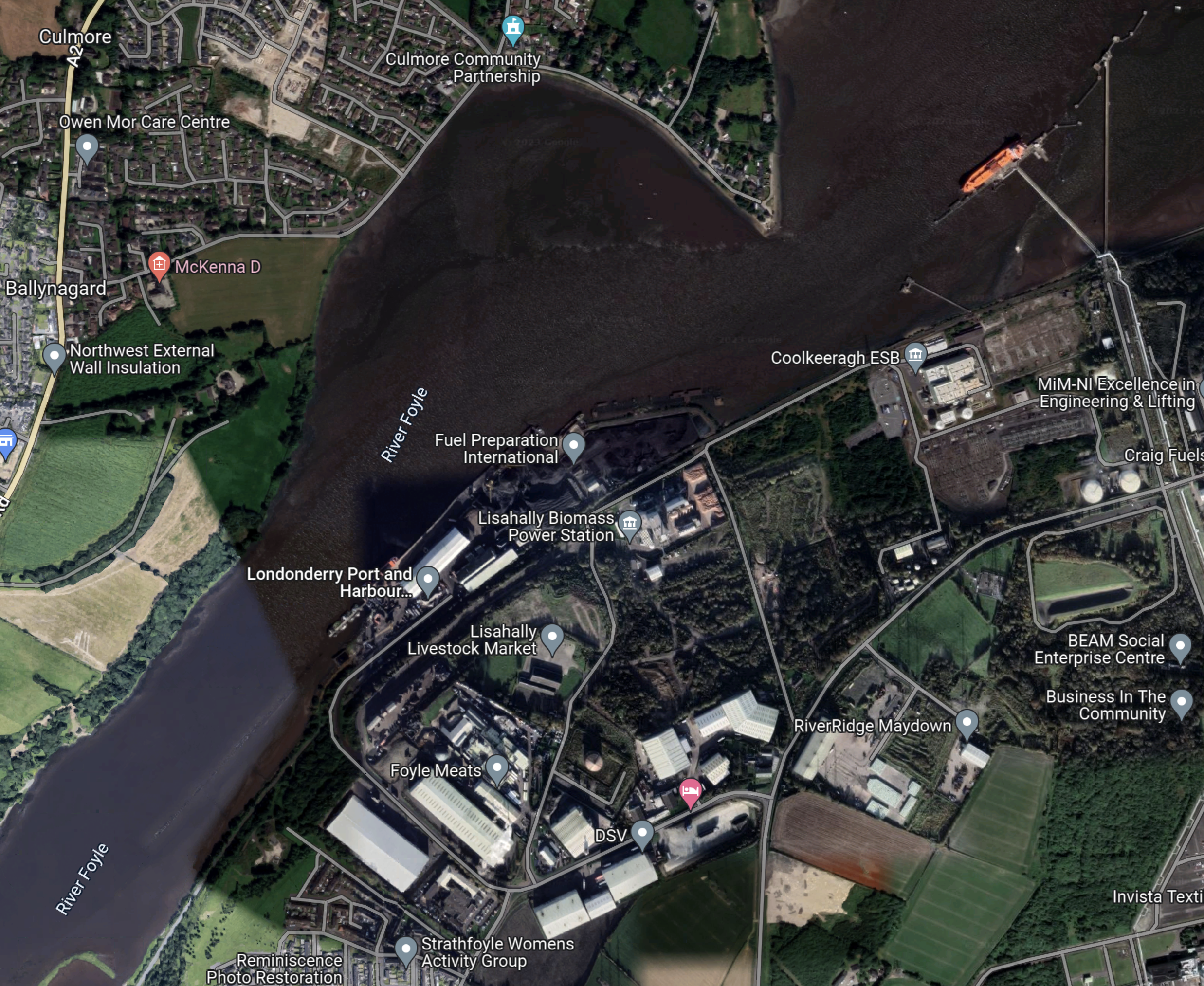
Note.
- Coolkeeragh ESB and Lisahally biomas power station on the South bank of the River Foyle.
- Lisahally biomas power station has a capacity of 16 MW.
- There appears to be a large substation at Coolkeeragh ESB.
- A tanker of some sort seems to be discharging.
Until told, I’ve guessed wrong, it looks to me like Coolkeeragh ESB could be the destination for the electricity generated by Malin Sea Wind. Given that this project’s aim is cost reduction, a 100 MW wind farm could make a difference.
In addition could Foyle Port be used to assemble and maintain the floating turbines?
Floatation Energy
Floatation Energy have posted this press release on their web site, which is entitled Flotation Energy and Vårgrønn Awarded Exclusivity To Develop Up To 1.9 GW Of Floating Offshore Wind In Scotland.
The first part of the press release, has a graphic.
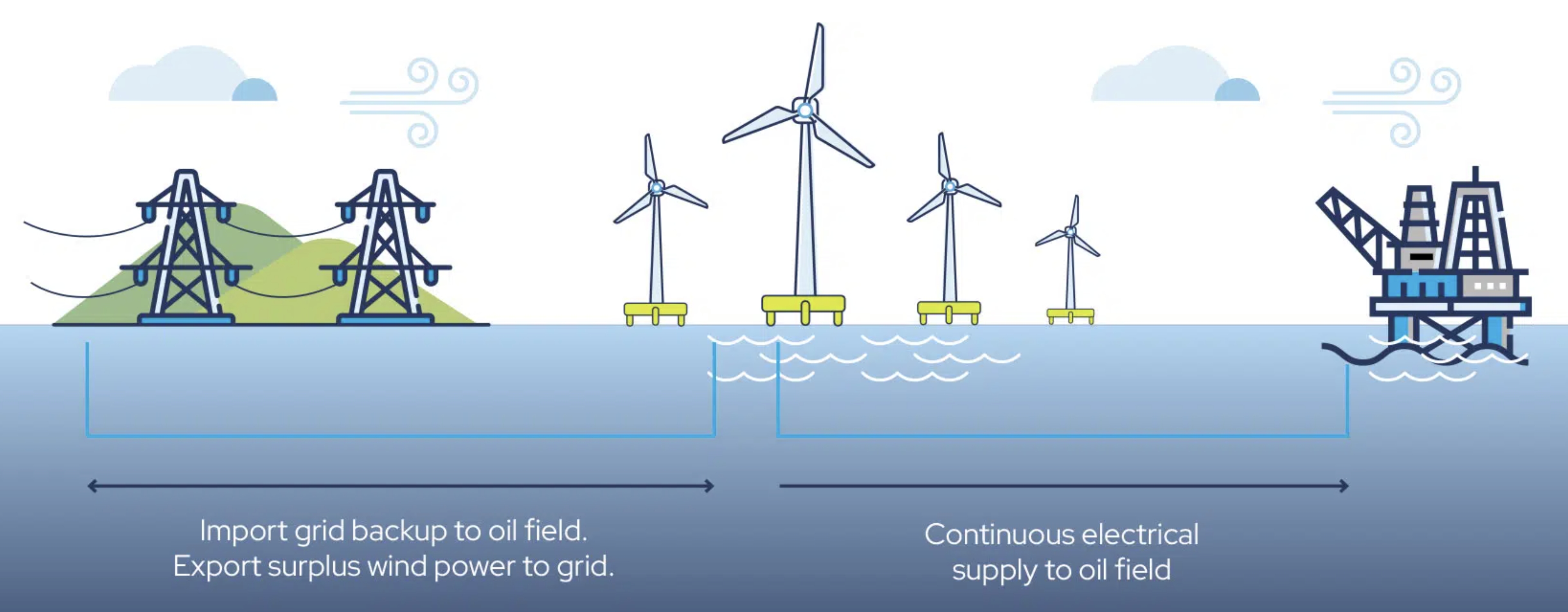
It shows how their proposed system will work.
- A floating wind farm will be placed between the shore and oil and gas platforms to be decarbonised.
- The wind farm will be connected to the shore by means of a bi-directional cable, so that the wind farm can export electricity to the grid and when the wind isn’t blowing the grid can power the platforms.
- A cable between the wind farm and the platforms completes the system.
It is a simple system, where all elements have been built many times.
Floatation Energy must have been fairly confident that their bids would be successful as they have already named the farms and set up web sites.
- Site 6 – Green Volt – 560 MW
- Site 11 – Cenos – 1350 MW
The websites are very informative.
The Timeline for 2019-2021 on the Green Volt web site describes the describes the progress so far on the project.
2019 – As construction of the Kindardine offshore floating wind farm kicks off, Flotation Energy identifies the Buzzard oil facility (a relatively new oil and gas platform with a long field life and high electrical load) as the optimal starting point for a significant contribution to the North Sea Transition Deal – the process of replacing large scale, inefficient gas-fired power generation with renewable electricity from offshore wind.
2020 – Flotation Energy begins environmental surveys on the Ettrick/Blackbird oil field, a redundant site nearby Buzzard, which is in the process of decommissioning. The “brownfield” site is confirmed as an exceptional opportunity to create an offshore floating wind farm, with water depths of 90-100m and high quality wind resource.
2021 – Flotation Energy works with regulators to understand the potential for project “Green Volt” to decarbonise offshore power generation for Buzzard. Flotation Energy completes and submits an Environmental Scoping report to Marine Scotland, reaching the first major milestone in the Marine Consent process. Crown Estate Scotland announces a new leasing round for Innovation and Targeted Oil and Gas Decarbonisation (INTOG).
On a section on the Cenos web site, there is a section called Efficient Grid Connection, where this is said.
The power generated by the wind turbines will be Alternating Current (AC) and routed to a substation platform. AC power will be exported to the oil and gas platforms.
For efficient export to the UK grid, the substation platform will include a converter station to change the AC power to Direct Current (DC) before the power is transported to shore. This is due to transporting AC power over long distances leading to much of the power being lost.
Cenos is working in partnership with the consented NorthConnect interconnector project, to utilise their DC cable routing where possible. Cenos will also use the NorthConnect onshore converter station planned for Fourfields near Boddam, which then has an agreed link into the Peterhead Substation. This collaboration minimises the need to construct additional infrastructure for the Cenos project.
That all sounds very practical.
Note.
- Floatation Energy delivered the Kincardine offshore floating wind farm.
- Both wind farms appear to use the same shore substation.
- Buzzard oil field is being expanded, so it could be an even more excellent oil field to decarbonise.
- NorthConnect is a bit of an on-off project.
Floatation Energy seem to have made a very professional start to the delivery of their two wind farms.
Harbour Energy
The Wikipedia entry for Harbour Energy describes the company like this.
Harbour Energy plc is an independent oil and gas company based in Edinburgh, Scotland. It is the United Kingdom’s largest independent oil and gas business. It is listed on the London Stock Exchange and is a constituent of the FTSE 250 Index.
But if you look at news items and the share price of the company, things could look better for Harbour Energy.
On their map of UK operations, I can count nearly twenty oil and gas fields.
As they have other oil and gas fields around the world, decarbonisation of their offshore operations could increase production by a few percent and substantially cut their carbon emissions.
That is a philosophy that could be good for profits and ultimately the share price.
So has the company gone for a very simple approach of two identical floating wind turbines?
They have been successful in obtaining leases for sites 8 and 13.
- Both have a capacity of 15 MW, so are the farms a single 15 MW wind turbine?
- I think this is likely, unless it is decided to opt for say a 16 MW turbine.
- Or even a smaller one, if the platform is in a bad place for wind.
- The wind turbine would be parked by the platform to be decarbonised and connected up, to a simple substation on the platform.
- I would recommend a battery on the platform, so that if the wind wasn’t blowing, power was still supplied to the platform.
- There would be no need for any cable between shore and wind farm and the only substation, would be a relatively simple one with a battery on the platform.
It could be a very efficient way of decarbonising a large number of platforms.
Once Harbour Energy have proved the concept, I could build a simple mathematical model in Excel, to work out any change in profitability and carbon emissions for a particular oil or gas platform.
Who Is Britannia Ltd?
In this document from the Crown Estate Scotland, there is a section that gives the partners in each project.
Listed for site 8 are Chrysaor (U.K.) and Britannia Limited and for site 13 is Chryasaor Petroleum Company UK Limited.
This page on the Harbour Energy web site gives the history of Chrysaor and Harbour Energy.
This is the heading.
Chrysaor was founded in 2007 with the purpose of applying development and commercial skills to oil and gas assets and to realise their value safely.
This is the history.
The Group grew rapidly over the years through a series of acquisitions. With backing from Harbour Energy – an investment vehicle formed by EIG Global Energy Partners – Chrysaor acquired significant asset packages in the UK North Sea from Shell (2017) and ConocoPhillips (2019) to become the UK’s largest producer of hydrocarbons.
In 2021, Chrysaor merged with Premier Oil to become Harbour Energy plc.
So that explains the use of the Chrysaor name or Chryasaor as someone misspelt it on the Crown Estate Scotland document.
I asked myself, if Britannia Ltd. could be a technology company, so I checked them out. The only company, I could find was a former investment trust, that was dissolved over ten years ago.
But Britannia is an oil and gas field in the North Sea, which is partially owned by Harbour Energy. It has a page on Harbour Enerrgy’s web site, which is entitled Greater Britannia Area.
This is said about the Britannia field.
Britannia in Block 16/26 of the UK central North Sea sits approximately 210-kilometres north east of Aberdeen. The complex consists of a drilling, production and accommodation platform, a long-term compression module of mono-column design and a 90-metre bridge connected to a production and utilities platform. Britannia is one of the largest natural gas and condensate fields in the North Sea. Commercial production began in 1998. Condensate is delivered through the Forties Pipeline to the oil stabilisation and processing plant at Kerse of Kinneil near Grangemouth and natural gas is transported through a dedicated Britannia pipeline to the Scottish Area Gas Evacuation (SAGE) facility at St Fergus.
Looking at the maps on the Crown Estate Scotland, Harbour Energy and others, it looks like site 8 could be close to the
Greater Britannia Area or even the Britannia field itself.
Simply Blue Energy
Simply Blue Energy are developing the 100 MW Salamander wind farm.
I wrote about this project in The Salamander Project.
Did it get chosen, as it was a project, where the design was at an advanced stage?
TotalEnergies
I wouldn’t be surprised to find out that TotalEnergies have gone a very similar route to Harbour Energy, but they are trying it out with a 3 MW turbine.
Conclusion
They are an excellent group of good ideas and let’s hope that they make others think in better and move innovative ways.
Politics will never save the world, but engineering and science just might!
£100m Boost For Biggest UK Hydro Scheme In Decades
The title of this post, is the same as that of this article on the BBC.
This is the sub-heading.
A giant hydro scheme which would double the UK’s ability to store energy for long periods is taking a leap forward with a £100m investment by SSE.
These are the first three paragraphs.
The proposed 92m-high dam and two reservoirs at Coire Glas in the Highlands would be Britain’s biggest hydroelectric project for 40 years.
Scottish ministers approved the 1.5 GW pumped storage facility in 2020.
But power giant SSE wants assurances from the UK government before finally signing it off.
There are two major problems with this scheme.
Why The Forty Year Wait?
I am an Electrical and Control Engineer and it is a scandal that we are waiting forty years for another pumped storage scheme like the successful Electric Mountain or Cruachan power stations to arrive.
Petrol or diesel vehicles have batteries for these three main purposes.
- To start the engine.
- To stabilise the output of the generator or alternator.
- To provide emergency power.
As to the latter, I can’t be the only person, who has dragged a car out of a ford on the starter motor. But think of the times, you’ve used the hazard warning lights, after an accident or an engine failure.
The nightmare of any operator of a complicated electricity network like the UK’s is a black start, which is defined by Wikipedia like this.
A black start is the process of restoring an electric power station or a part of an electric grid to operation without relying on the external electric power transmission network to recover from a total or partial shutdown.
Hydro electric power stations and especially those that are part of pumped storage schemes are ideal for providing the initial power, as they are often easy to start and have water available. Cruachan power station has a black start capability, but at 440 MW is it big enough?
Over the last few years, many lithium-ion batteries have been added to the UK power network, which are used to stabilise the grid, when the sun isn’t shining and the wind isn’t blowing.
There are four pumped storage hydro-electric schemes in the UK.
- Cruachan – 440 MW/7 GWh – 1965
- Dinorwig (Electric Mountain) – 1800 MW/9.1 GWh -1984
- Ffestiniog – 360MW/1.44 GWh – 1963
- Foyers – 300 MW/6.3 GWh – 1974
Note.
- I always give the power output and the storage capacity for a battery, if it is known.
- According to Wikipedia, Scotland has a potential for around 500 GWh of pumped storage.
- The largest lithium-ion battery that I know, that is being planned in the UK, is Intergen’s 320 MW/640 MWh battery at Thames Gateway, that I wrote about in Giant Batteries Will Provide Surge Of Electricity Storage. It’s smaller than any of the four current pumped storage schemes.
- The Wikipedia entry for Coire Glas says that it is a 1.5 GW/30 GWh pumped storage hydro-electric power station.
I very much feel that even one 1.5 GW/30 GWh pumped storage hydro-electric power station must make a big difference mathematically.
Why have we had to wait so long? It’s not as though a pumped storage hydro-electric power station of this size has suffered a serious disaster.
Drax Needs Assurances Too?
The BBC article says this.
Scotland’s only other pumped storage scheme, operated by Drax Group, is housed within a giant artificial cavern inside Ben Cruachan on the shores of Loch Awe in Argyll.
The North Yorkshire-based company plans to more than double the generating capacity of its facility, nicknamed Hollow Mountain, to more than 1GW, with the construction of a new underground power station.
But both Drax and SSE have been reluctant to press ahead without assurances from Whitehall.
It looks like the right assurances would open up at least two pumped storage hydro-electric power station projects.
But it could be better than that, as there are other projects under development.
- Balliemeanoch – 1.5GW/45 GWh
- Corrievarkie – 600 MW/14.5 GWh
- Loch Earba – 900 MW/33 GWh
- Loch Kemp – 300 MW/9 GWh
- Red John – 450 MW/2.8 GWh
This totals to 3750 MW/104.3 GWh or 5850 MW/134.3 GWh with the addition of Coire Glas and the extension to Cruachan.
Getting the assurances right could result in large amounts of construction in Scotland!
What Assurances Do Power Giants SSE And Drax Want Before Signing Off?
This news item on SSE Renewables, which is dated 18th March 2022, is entitled Ministerial Roundtable Seeks To Unlock Investment In UK Energy Storage.
These three paragraphs gives details of the meeting.
Business leaders have met with UK Energy Minister the Rt Hon Greg Hands MP to discuss how the government could unlock significant investment in vital energy storage technologies needed to decarbonise the power sector and help ensure greater energy independence.
The meeting was organised by the Long-Duration Electricity Storage Alliance, a new association of companies, progressing plans across a range of technologies to be first of their kind to be developed in the UK for decades.
Representatives from Drax, SSE Renewables, Highview Power and Invinity Energy Systems met with The Rt Hon Greg Hands MP, Minister of State for Business, Energy and Clean Growth [yesterday].
But they still don’t seem to have come up with a funding mechanism.
- In this case, it seems that multiple politicians may not be to blame, as Greg Hands was the Minister of State for Business, Energy and Clean Growth until the 6th of September 2022, when he handed over to Graham Stuart, who is still the incumbent.
- Could it be that civil servants for this problem need to be augmented by a Control Engineer with mathematical modelling skills from a practical university?
It is the sort of problem, I would love to get my teeth into, but unfortunately my three mentors in accountancy and banking; Bob, Brian and David, who could have helped me, have all passed on to another place to help someone else with their problems.
I’ve just had a virtual meeting with all three and they told me to look at it like a warehousing system.
Consider.
- It would be very easy to measure the amount of water stored in the upper reservoir of a pumped storage hydro-electric power station.
- It would also be easy to measure the electricity flows to and from the pumped storage hydro-electric power station.
- A monetary value could be placed on the water in the upper reservoir and the flows, depending on the current price for electricity.
So it should be possible to know that a pumped storage hydro-electric power station, was perhaps storing energy as follows.
- 10 GWh for SSE
- 8 GWh for RWE
- 6 GWh for Scottish Power
- 6 GWh is not being used
And just as in a warehouse, they would pay a fee of so much for storing each GWh for an hour.
- The system would work with any type of storage.
- Would competition between the various storage sites bring down prices for storing electricity?
- Pumped storage operators would get a bonus when it rained heavily.
- Just as they do now, electricity generators would store it when prices are low and retrieve it when prices are high.
A lot of the rules used to decide where electricity goes would still work.
 The Anonymous Widower