Vestas Unveils Plans For V236-15.0 MW Nacelle Factory In Scotland
The title of this post, is the same as that of this article on offshoreWIND.biz.
This is the sub-heading.
Vestas plans to build a nacelle and hub assembly facility in Scotland to support offshore wind projects in the UK and across Europe.
These four paragraphs give what looks to be a full outline of a more or less comprehensive plan.
The proposed factory would require a capital investment of more than EUR 250 million and is planned to manufacture nacelles and hubs for the company’s V236-15.0 MW offshore wind turbine. The new facility is expected to create up to 500 direct jobs, with additional employment across the supply chain.
According to Vestas, the plan to set up the factory follows the results of the Contracts for Difference Allocation Round 7 (AR7) in January 2026, the company’s growing offshore wind order book in the UK, and strategic discussions with the UK and Scottish governments on the next steps to develop and co-invest in the facility.
The plan also includes the potential co-location of suppliers producing other major turbine components, as part of a broader manufacturing setup.
The final investment decision (FID) on the new factory will depend on Vestas securing sufficient UK-based orders for the AR7 projects and those from the upcoming AR8. Subject to the timing of those results and the planning process, the facility could begin production by 2029 or 2030, Vestas said on 25 March.
- V236-15.0 turbines are 15 MW turbines, for which Vestas have 256 orders in the UK for Inchcape, Norfolk Vanguard East and Norfolk Vanguard West.
- In addition to new wind farms, will these large turbines be used for refitting to older wind farms?
- If other manufacturers or components could be involved, this would surely be sensible.
The picture in the original article shows the large size of these nacelles, which would suggest a site with good access to water might be good to ease transport.
Did The Help For Steel, Six Days Ago Help?
On the 19th March, I wrote UK Steel Industry Backed By Major New Trade Measure And Strategy. Did this help for steel to formulate Vestas’s plans? I wouldn’t be surprised, if the steel can be taken to the site Vesta chooses by rail or water.
UK Continues Offshore Wind Expansion With 6 GW Leasing Round Planned For Early 2027
The title of this post, is the same as that of this article on offshoreWIND.biz.
This is the sub-heading.
The Crown Estate has unveiled plans for the UK’s Offshore Wind Leasing Round 6 to be held in the first half of 2027, targeting the development of at least 6 GW of new capacity.
These three paragraphs add some details.
The upcoming leasing process will focus on areas primarily located in the northeast of England. The sites are expected to be suitable for fixed-bottom offshore wind projects and will be brought forward following market and stakeholder engagement, including the National Energy System Operator’s (NESO) strategic plans for energy and for electricity networks, which will inform the exact capacity of the upcoming leasing round and refine specific site details and locations.
The Crown Estate said on 26 March that it had begun a programme of market engagement ahead of the official launch of a new leasing round, and is seeking market views on commercial approaches to the leasing round “to understand the potential viability and market appetite.”
The UK seabed manager said that it had also identified other areas of seabed opportunity across the South West, Wales and other regions which may form the basis of subsequent leasing rounds through the Crown Estate’s new seabed management tool, the Marine Delivery Routemap, which is being used for the first time in Round 6.
In Renewable Power By 2030 In The UK, I calculated how much offshore wind could be commissioned up to 2030.
These were my results.
This gives these yearly totals, if I use pessimistic dates.
- 2025 – 1,235 MW
- 2026 – 4,807 MW
- 2027 – 5,350 MW
- 2028 – 4,998 MW
- 2029 – 9,631 MW
- 2030 – 15,263 MW
This adds up to a total of 58,897 MW.
But This Doesn’t Include Round 5 Or Round 6!
But the article on offshoreWIND.biz does, say this about Round 5.
The Crown Estate’s previous leasing round, Round 5, focused on floating offshore wind in the Celtic Sea, covering areas off South Wales and South West England and targeting up to 4.5 GW of capacity. The round awarded seabed rights to Equinor, Gwynt Glas, and Ocean Winds, with individual project development areas of up to 1.5 GW. Agreements for lease were recently signed for all three Round 5 sites.
The article also indicates that 6 GW can be expected from Round 6.
Which gives a total of 69,397 MW or 69.4 GW.
No wonder the UK Government can back the steel industry, with press releases like this UK Steel Industry Backed By Major New Trade Measure And Strategy.
Lots of renewable energy, is the new rich!
UK Steel Industry Backed By Major New Trade Measure And Strategy
The title of this post, is the same as that of this press release from UK Government.
These three bullet points act as sub-headings.
-
Landmark new Steel Strategy sets ambition for up to 50% of steel used in the UK to be made in the UK, boosting production from 30%.
-
UK will introduce new trade measure to support national security by preserving vital steel production for critical national infrastructure and defence.
-
Steel import quotas will be reduced with higher tariffs of 50% outside of quotas, ensuring the UK steel sector’s future in the face of global overcapacity.
These three paragraphs add details.
On a visit to Tata Steel Port Talbot to meet steelworkers and launch the Strategy, the Business and Trade Secretary Peter Kyle announced the Government’s ambition to boost domestic production so that it can meet up to 50% of our domestic demand for steel, and secure the industry’s role in supporting vital UK sectors like infrastructure, defence and clean energy.
Building on the direct financial support the government has made so far, the National Wealth Fund will be the government’s main mechanism for providing up to £2.5 billion of financing for investment in the steel sector this Parliament. The Steel Strategy forms a vital part of the Government’s activist and strategic approach to British industry, taking decisive action to give businesses the certainty and support they need in uncertain times and bolstering the UK’s resilience.
Today, the UK also announces that from 1 July 2026, overall quota levels for steel imports will be significantly reduced by 60% compared to current arrangements, and steel coming into the UK above these levels will be subject to a 50% tariff.
US Judge Overturns Trump’s Ban On Wind Energy Project Permits
The title of this post, is the same as that of this article on offshoreWIND.biz.
This is the sub-heading.
A federal judge has struck down the US President Donald Trump’s indefinite halt of all federal approvals and permitting for new wind energy projects.
Trump is obviously very strong in his opposition to wind power, as he issued the ”Wind Order” on his first day back in office.
He received this robust reply from Oceantic Network CEO Liz Burdock.
Today’s decision is welcome news, not just for the thousands of American workers and businesses across 40 states supporting offshore wind in the U.S., but also for the critical relief the wind industry will provide to lower skyrocketing electricity prices for millions of American families with reliable, affordable power.
Overturning the unlawful blanket halt to offshore wind permitting activities is needed to achieve our nation’s energy and economic priorities of bringing more power online quickly, improving grid reliability, and driving billions of new American steel manufacturing and shipbuilding investments. We thank the Attorneys General and the Alliance for Clean Energy New York for taking this case forward to protect American business interests against the politicization of our energy sector.
I don’t think we’ve heard the last of this legal argument.
DeepForm
On Wednesday I went to the TDAP Wave 8 Demo Day, which was organised by the Advanced Propulsion Centre.
One of the cohort of companies there was DeepForm, who were described like this.
DeepForm is transforming sheet metal pressing with its patented cold-shear press design, which reduces blank sizes by up to 45 % and trimming waste by up to 85%. This drop-in technology lowers material costs and embodied CO2 in existing press lines without compromising performance, quality or speed. Spun out of the University of Cambridge in 2022, DeepForm enables OEMs and Tier 1 suppliers to adopt the breakthrough through IP licensing, simulation and design support.
The company have an impressive web site, which deserves a very full read.
In their presentation, they showed two products, that could benefit from their innovation; a large steel component for Jaguar Land Rover and a humble aluminium drink can.
As I walked home ntoday, I saw this advert displayed on a bus stop.
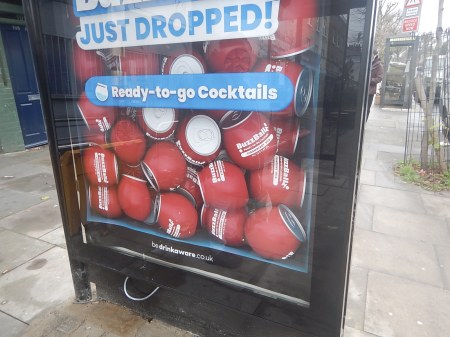
The cans for BuzzBallz are also shown on the company’s web site.
But these products are are only the start.
For instance, I can see lots of small plastic items and components, that can’t be recycled, could be made from aluminium, which is easy to be recycle.
I also think companies like IKEA will love the design freedom, the technology will give.
UK Breakthrough Could Slash Emissions From Cement
The title of this post. is the same as that of this article on the BBC.
This is the sub-heading.
Scientists say they’ve found a way to recycle cement from demolished concrete buildings.
These five paragraphs outline, why cement is such an environmental problem.
Cement is the modern world’s most common construction material, but it is also a huge source of planet-warming gas emissions.
That is because of the chemical reactions when you heat limestone to high temperatures by burning fossil fuels.
Recycling cement would massively reduce its carbon footprint. Researchers say that if they switched to electric-powered furnaces, and used renewable energy like wind and solar rather than fossil fuels, that could mean no greenhouse gases would be released at all.
And that would be a big deal. Cement forms the foundation of the modern economy, both literally and metaphorically.
It is what binds the sand and aggregate in concrete together, and concrete is the most widely used material on the planet after water.
If cement was a country, it would be the third biggest source of emissions after China and the US, responsible for 7.5% of human-made CO2.
This article shows how by applying chemical magic to two effectively unrelated processes; the recycling of steel and the recycling of concrete to make new cement, very high rewards are possible.
Cambridge University are calling their new product electric cement.
As large amounts of electricity are used in an arc furnace, to produce the two products
These paragraphs outline the innovative Cambridge process.
Cement is made by heating limestone to up 1600 Celsius in giant kilns powered by fossil fuels.
Those emissions are just the start. The heat is used to drive carbon dioxide from the limestone, leaving a residue of cement.
Add both these sources of pollution together and it is estimated that about a tonne of carbon dioxide is produced for every tonne of cement.
The team of scientists,, has found a neat way to sidestep those emissions.
It exploits the fact that you can reactivate used cement by exposing it to high temperatures again.
The chemistry is well-established, and it has been done at scale in cement kilns.
The breakthrough is to prove it can be done by piggybacking on the heat generated by another heavy industry – steel recycling.
When you recycle steel, you add chemicals that float on the surface of the molten metal to prevent it reacting with the air and creating impurities. This is known as slag.
The Cambridge team spotted the composition of used cement is almost exactly the same as the slag used in electric arc furnaces.
They have been trialling the process at a small-scale electric arc furnace at the Materials Processing Institute in Middlesbrough.
These are my thoughts.
The Only Inputs Are Steel Scrap, Green Electricity And Used Cement
Consider.
- We probably need to increase the percentage of steel scrap we collect.
- Gigawatts of green electricity in a few years, will be available in those places like Port of Ardersier, Port Talbot, Scunthorpe and Teesside, where large amounts of steel will be needed.
- I can envisage large steel users having their own hybrid electric cement/electric arc furnace plants.
- Used cement would be collected and brought to the plants.
- Years ago, I used to live next door to an old World War II airfield. The farmer who owned the airfield, told me, that the concrete was his pension, as when he needed money, he called a company, who crushed it up for aggregate.
I can see a whole new integrated industry being created.
Conclusion
This could be one of the best inventions since sliced bread.
Ørsted Secures Exclusive Access To Lower-Emission Steel From Dillinger
The title of this post, is the same as that of this article on offshoreWIND.biz.
This is the sub-heading.
Ørsted will be offered the first production of lower-emission steel from German-based Dillinger, subject to availability and commercial terms and conditions. The steel plates are intended to be used for offshore wind monopile foundations in future projects.
These three paragraphs outline the deal.
Under a large-scale supply agreement entered into in 2022, Ørsted will procure significant volumes of regular heavy plate steel from 2024, giving the company access at scale to and visibility of the most crucial raw material in offshore wind while supporting Dillinger to accelerate investments in new lower-emission steel production, according to Ørsted.
The Danish renewable energy giant expects to be able to procure lower-emission steel produced at Dillinger’s facility in Dillingen, Germany, from 2027-2028.
Taking the current technology outlook into account, the reduction of the process-related carbon emissions from production is expected to be around 55-60 per cent compared to conventional heavy plate steel production, Ørsted said.
Increasingly, we’ll see lower emission steel and concrete used for wind turbine foundations.
This press release on the Dillinger web site is entitled Historic Investment For Greater Climate Protection: Supervisory Boards Approve Investment Of EUR 3.5 billion For Green Steel From Saarland.
These are two paragraphs from the press release.
Over the next few years leading up to 2027, in addition to the established blast furnace route, the new production line with an electric arc furnace (EAF) will be built at the Völklingen site and an EAF and direct reduced iron (DRI) plant for the production of sponge iron will be built at the Dillinger plant site. Transformation branding has also been developed to visually represent the transformation: “Pure Steel+”. The message of “Pure Steel+” is that Saarland’s steel industry will retain its long-established global product quality, ability to innovate, and culture, even in the transformation. The “+” refers to the carbon-neutrality of the products.
The availability of green hydrogen at competitive prices is a basic precondition for this ambitious project to succeed, along with prompt funding commitments from Berlin and Brussels. Local production of hydrogen will therefore be established as a first step together with the local energy suppliers, before connecting to the European hydrogen network to enable use of hydrogen to be increased to approx. 80 percent. The Saarland steel industry is thus laying the foundation for a new hydrogen-based value chain in the Saarland, in addition to decarbonizing its own production. In this way, SHS – Stahl-Holding-Saar is supporting Saarland on its path to becoming a model region for transformation.
It sounds to me, that Tata Steel could be doing something similar at Port Talbot.
- Tata want to build an electric arc furnace to replace the blast furnaces.
- There will be plenty of green electricity from the Celtic Sea.
- RWE are planning a very large hydrogen electrolyser in Pembroke.
- Celtic Sea offshore wind developments would probably like a supply of lower emission steel on their door-step.
I would suspect, that Welsh steel produced by an electric arc furnace will match the quality of the German steel, that is made the same way.
New British Steel Rail Stocking Facility Will Boost Network Rail Supply Chain
The title of this post, is the same as that of this article on RailUK.
These four paragraphs outline the new facility and how it will work.
British Steel is building a new £10 million rail stocking facility, the biggest of its kind in the country.
The facility, at the company’s Scunthorpe site, is scheduled to be completed this summer and will stock around 25,000 tonnes of 108-metre finished rail.
The investment is part of our British Steel’s strategy to support the supply of 56E1 and 60E2 section rails for Network Rail, ensuring there is rail stock readily available for its supply chain.
Rails stocked in the new facility will all have undergone the stringent testing and quality assurance checks required to meet the specification to allow immediate dispatch or welding into 216-metre lengths to the customer.
With all the gloom in the steel industry, It’s good to see someone investing in new facilities.
H2 Green Steel Raises More Than €4 billion In Debt Financing For The World’s First Large-Scale Green Steel Plant
The title of this post, is the same as that of this press release from H2 Green Steel.
This is the sub-heading.
H2 Green Steel signs definitive debt financing agreements for €4.2 billion in project financing and increases the previously announced equity raised by €300 million. Total equity funding to date amounts to €2.1 billion. The company has also been awarded a €250 million grant from the EU Innovation Fund. H2 Green Steel has now secured funding of close to €6.5 billion for the world’s first large-scale green steel plant in Northern Sweden.
These three paragraphs describe the company and outlines the financing.
H2 Green Steel is driving one of the largest climate impact initiatives globally. The company was founded in 2020 with the purpose to decarbonize hard-to-abate industries, starting by producing steel with up to 95% lower CO2 emissions than steel made with coke-fired blast furnaces. The construction of the flagship green steel plant in Boden, with integrated green hydrogen and green iron production, is well under way. The supply contracts for the hydrogen-, iron- and steel equipment are in place. A large portion of the electricity needed has been secured in long-term power purchase agreements, and half of the initial yearly volumes of 2.5 million tonnes of near zero steel have been sold in binding five- to seven-year customer agreements.
Today H2 Green Steel announces a massive milestone on its journey to accelerate the decarbonization of the steel industry, which is still one of the world’s dirtiest. The company has signed debt financing of €4.2 billion, added equity of close to €300 million and been awarded a €250 million grant from the Innovation Fund. Funding amounts to €6.5 billion in total.
H2 Green Steel has signed definitive financing documentation for €3.5 billion in senior debt and an up-to-€600 million junior debt facility:
Note.
- I first wrote about H2 Green Steel about three years ago in Green Hydrogen To Power First Zero Carbon Steel Plant.
- The Wikipedia entry for Boden in Northern Sweden, indicates it’s a coldish place to live.
- In that original post, H2 Green Steel said they needed €2.5 billion of investment, but now they’ve raised €4 billion, which is a 60 % increase in financing costs in just three years.
Is this Sweden’s HS2?
The Future Of Green Steelmaking
The finances of H2 Green Steel look distinctly marginal.
I have a feeling that green steel, as the technology now stands is an impossible dream.
But I do believe that perhaps in five or ten years, that an affordable zero carbon method of steel production will be developed.
You have to remember, Pilkington developed float glass in the 1950s and completely changed an industry. Today, we’d call that a classic example of disruptive innovation.
The same opportunity exists in steelmaking. And the rewards would be counted in billions.
Nucor Introduces Elcyon(TM), First Sustainable Steel Product Engineered Specifically For Offshore Wind Energy Applications
The title of this post, is the same as that of this press release from Nucor Corporation.
This is the first paragraph.
Nucor today introduced Elcyon™, the Company’s new sustainable heavy gauge steel plate product made specifically to meet the growing demands of America’s offshore wind energy producers building the green economy and its necessary infrastructure. Nucor will manufacture Elcyon at the company’s new, $1.7 billion state-of-the-art Nucor Brandenburg steel mill in Kentucky , which produced its first steel plate at the end of December 2022.
It sounds impressive, but it should be if $1.7 billion has been spent.
This paragraph, says more about the process.
Elcyon is a clean, advanced steel product made using Nucor’s recycled scrap-based electric arc furnace manufacturing process. Nucor’s circular steelmaking route has a greenhouse gas emissions intensity that is one fifth the global blast furnace extractive steelmaking average, based on Scope 1 and 2 emissions. Utilizing Thermo-Mechanical Controlled Processing (TMCP) at the new mill, Elcyon, the only steel of its kind in the United States was created specifically to meet the rigorous quality standards of offshore wind energy designers, manufacturers and fabricators. Along with meeting Euronorm specs, Elcyon is characterized by larger plate dimensions, improved weldability and excellent fracture toughness, as compared to competing products.
What more can a steelmaker want?
- It uses steel scrap to make new steel.
- The process could be powered by green electricity.
- The process cuts emissions to twenty per cent.
- The steel is what customers want.
- The steel has better properties than competing products.
These two paragraphs talk about the prospects for Elcyon.
Nucor Steel Brandenburg is the first steel plant in the world to pursue certification under LEED v4 from the U.S. Green Building Council, the highest standard for sustainable building design, construction, and operation. The new mill is located in the middle of the largest steel plate-consuming region in the country and will be able to produce 97% of plate products consumed domestically, with a potential output of 1.2 million tons of steel annually.
Elcyon and the Brandenburg mill both draw upon Nucor’s 50 years of industry leadership in sustainable steel production. From last year’s launch of Econiq™, the world’s first net-zero steel available at scale, to recently becoming the first major industrial company to join the United Nations 24/7 Carbon-Free Energy Global Compact, Nucor has consistently worked to meet the needs of its customers and other stakeholders while protecting the well-being of our planet.
Nucor have certainly done their market research and appear to be very scientifically green.
In the About Nucor section of the press release, this is the last sentence.
Nucor is North America’s largest recycler.
This is some statement to make, if it weren’t true! Wikipedia says this about the company.
Nucor operates 23 scrap-based steel production mills. In 2019, the company produced and sold approximately 18.6 million tons of steel and recycled 17.8 million tons of scrap.
The home page of the Nucor web site also makes this claim.
North America’s Most Sustainable Steel And Steel Products Company
Perhaps, the UK government needs to ask Nucor to build one or more of their scrap-based steel production mills in the country to produce all the steel plate we will need for our growing offshore wind industry.
We certainly have the GW to power the arc furnaces.
Conclusion
Nucor is a big beast to watch!
 The Anonymous Widower