Do British And German Offshore Wind Farm Generate Maximum Power At Different Times
In National Grid, TenneT Germany Launch GriffinLink, A First Of A Find Project To Maximise Offshore Wind, I discussed GriffinLink, which will be an offshore link between British and German offshore wind farms.
Somebody has asked me if wind farms are in phase with each other, as obviously this would effect how they perform and are are controlled.
So I asked Google AI, the question in the title of this post and received this reply.
Yes, British and German offshore wind farms often generate their maximum power at different times, although they are both located in the North Sea and share similar peak seasons. The variations in generation are driven by localized weather patterns, specifically the movement of low-pressure systems.
Key Differences in Generation Times:
Regional Weather Patterns: While North Sea wind farms are often closely correlated, significant differences arise when weather systems move from west to east. Wind often hits the UK’s North Sea sites first, meaning they may hit maximum generation capacity hours before German or Danish sites, which are further east.
Time of Day (Diurnal Differences): Because UK wind farms are located in the Irish Sea, the Scottish coast, and the North Sea, they can exhibit different diurnal (daily) peak times compared to German sites in the North Sea and Baltic Sea.
Seasonal Peaks: Both countries experience the highest output during winter months (e.g., December). However, during specific, localized, long-lasting high-pressure systems (“Dunkelflaute”), one country might experience a complete drop in wind while the other continues to produce, or vice versa.
Why They Differ:
Geography: The UK’s extensive, spread-out coastline (Irish Sea, Atlantic coast, North Sea) offers a different wind profile than the more concentrated German offshore projects in the North Sea and Baltic Sea.
Correlation Challenges: Research shows that while North Sea countries have similar wind profiles, there is not 100% correlation. Meteorological differences in how wind speeds behave across the North Sea allow for complementary production.
This difference is highly advantageous for European energy security, as it allows for the balancing of intermittent wind power across the region.
The conclusion from Google AI, is almost predicting that GriffinLink will be developed. From my experience of mathematical modelling the cost and financial benefits should be fairly easy to predict.
Will The UK And The Republic Of Ireland Link Their Offshore Wind Farms To Improve Efficiency?
This may seem an obvious idea, especially as UK and Republic of Ireland are heavily interconnected.
So I asked Google AI, the question in the title of this section and received this reply.
Yes, the United Kingdom and the Republic of Ireland are taking significant, active steps to link their offshore wind farms and electricity grids to improve efficiency, increase renewable energy production, and enhance energy security. Following a Memorandum of Understanding (MoU) signed in September 2023, the two countries are collaborating on developing subsea energy infrastructure in the Irish and Celtic Seas.
Here are the key details regarding this cooperation:
Deepened Collaboration: As of March 2025, the UK and Ireland are working on a new data-sharing arrangement to lay the groundwork for directly connecting offshore wind farms to each other’s national energy networks.
Offshore Hybrid Assets (OHAs): The plans include developing offshore hybrid assets, which are subsea cables that directly link offshore wind farms to both countries’ grids, reducing infrastructure costs and maximizing efficiency.
Subsea Mapping & Interconnection: Both nations are mapping the Celtic Sea to identify optimal locations for interconnectors and to improve the interoperability of their grids.
Existing & New Projects: While Ireland’s current interconnection to the UK is limited (approx. 500MW), capacity is planned to increase significantly. Specific projects like Mares Connect (linking North Wales and Ireland) are being developed to provide750MW of additional capacity.
Regional Cooperation: Ireland is also participating in the “Hamburg Declaration” (signed Jan 2026), joining the UK and other North Sea countries to commit to 300GW of offshore wind by 2050 through shared, regional infrastructure.
This cooperation aims to allow Ireland to export its surplus renewable energy during high generation, while benefiting from the UK’s robust grid during lower wind conditions.
Will The UK AndNorway Link Their Offshore Wind Farms To Improve Efficiency?
As we have interconnectors with Norway, I asked Google AI, the question in the title of this section and received this reply.
Yes, the UK and Norway are actively planning and implementing initiatives to link their offshore wind farms and electricity grids to improve efficiency, energy security, and grid balancing. Following a series of agreements, including a major pact in January 2026, the two countries are collaborating on “hybrid” projects that connect offshore wind sites directly to multiple countries.
It does look like that the co-operations between the UK and Germany, Norway and the Republic of Ireland are setting examples that should be copied all over the world.
But then, you should always follow the mathematics.
But somehow, I can’t see President Trump signing any windmill co-operation with his neighbours.
‘Mobilising EUR 1 Trillion in Investments’ | North Sea Countries, Industry, TSOs to Ink Offshore Wind Pact
The title of this post, is the same as that of this article on offshoreWIND.biz.
This is the sub-heading.
Government officials from Belgium, Denmark, France, Germany, Ireland, Luxembourg, the Netherlands, Norway and the UK are set to sign a declaration confirming the ambition to build 300 GW of offshore wind in the North Seas by 2050, and an investment pact with the offshore wind industry and transmission system operators (TSOs) that is said to mobilise EUR 1 trillion in economic activity.
These three paragraphs add a lot of powerful detail.
Under the Offshore Wind Investment Pact for the North Seas, to be signed today (26 January) at the North Sea Summit in Hamburg, governments of the nine North Sea countries will commit to building 15 GW of offshore wind per year from 2031 to 2040.
The heads of state and energy ministers will also vow to de-risk offshore wind investments through a commitment to provide two-sided Contracts for Difference (CfDs) as the standard for offshore wind auction design. The pact also commits governments to remove any regulatory obstacles to power purchase agreements (PPAs), according to WindEurope, which will sign the pact on behalf of the industry.
On the industry’s side, the commitment is to drive down the costs of offshore wind by 30 per cent towards 2040, mobilise EUR 1 trillion of economic activity for Europe, create 91,000 additional jobs and invest EUR 9.5 billion in manufacturing, port infrastructure and vessels.
These two paragraphs say something about cost reductions.
The cost reduction of offshore wind is planned to be achieved through scale effects, lower costs of capital and further industrialisation supported by clarity and visibility on the project pipeline.
The transmission system operators (TSOs) will identify cost-effective cooperation projects in the North Sea, including 20 GW of promising cross-border projects by 2027 for deployment in the 2030s.
I hope there is a project management system, that can step into this frenzy, just as Artemis did in the 1970s with North Sea Oil and Gas.
The BBC has reported the story under a title of UK To Join Major Wind Farm Project With Nine European Countries.
this is the sub-title.
The UK is set to back a vast new fleet of offshore wind projects in the North Sea alongside nine other European countries including Norway, Germany and the Netherlands.
These six paragraphs add more detail.
The government says the deal will strengthen energy security by offering an escape from what it calls the “fossil fuel rollercoaster”.
For the first time, some of the new wind farms will be linked to multiple countries through undersea cables known as interconnectors, which supporters say should lower prices across the region.
But it could prove controversial as wind farm operators would be able to shop around between countries to sell power to the highest bidder – potentially driving up electricity prices when supply is tight.
Energy Secretary Ed Miliband will sign a declaration on Monday at a meeting on the future of the North Sea in the German city of Hamburg, committing to complete the scheme by 2050.
Jane Cooper, deputy CEO of industry body RenewableUK, said the deal would “drive down costs for billpayers” as well as increasing “the energy security of the UK and the whole of the North Sea region significantly”.
But Claire Countinho, shadow energy secretary, warned “we cannot escape the fact that the rush to build wind farms at breakneck speed is pushing up everybody’s energy bills.”
Claire Coutinho, as an outsider at present and a member of a party out of Government had to say something negative, but her negotiations when she was UK Energy Minister with her German opposite number, which I wrote about in UK And Germany Boost Offshore Renewables Ties, seem very much a precursor to today’s agreement.
UK And Germany To Upgrade Some Sea Kings For Ukraine
Yesterday, the UK government issued a press release, which is entitled Landmark UK-Germany Defence Agreement To Strengthen Our Security And Prosperity.
This is the sub-heading.
A landmark defence agreement will be signed by Defence Secretary John Healey MP and German Defence Minister Boris Pistorius in London today in a major moment for NATO, and European security and prosperity. It is the first-of-its-kind agreement between the UK and Germany on defence.
This introductory paragraph, lays down the tone and objectives of the agreement.
The signing of the Trinity House Agreement marks a fundamental shift in the UK’s relations with Germany and for European security. This agreement between Europe’s two biggest defence spenders will strengthen national security and economic growth in the face of growing Russian aggression and increasing threats.
It is a wide-ranging document, but in this post, I will concentrate on one topic; Sea King helicopters, which are talked about in this paragraph.
New Ukraine support – new joint work to enable German Sea King helicopters to be armed with modern missile systems as well as work on capability coalitions.
As Ukraine is a mainly landlocked company, I do think it must be a compliment to the Sea Kings’ capabilities that the Ukrainians find the naval helicopters useful.
These three paragraphs from the Wikipedia entry for the Westland Sea King, document the history of operations of the Sea King in the Ukrainian Naval Aviation.
In November 2022, in response to the 2022 Russian invasion of Ukraine the United Kingdom announced they were donating three former Royal Navy Sea Kings to Ukraine. In January 2023, the first Sea King was videoed being used by the Ukrainian Naval Aviation.
In April 2023, the BBC did an interview with one of the co-pilots of a UK donated Sea King to Ukraine. These helicopters served in the Falklands War so they are at least some 40 years old. The co-pilot has said that the Sea King is used for rescuing pilots who have ejected, delivering soldiers, and conducting reconnaissance, among other tasks. One engineer also told the BBC: “They are old…but they have gone through modernisation, and we need them very much. I believe this is just the start of our work together.” The BBC also reports that a third Sea King is being prepared to be sent to Ukraine in the “coming weeks”. The third Sea King HU.5 was delivered to Ukraine in May 2023.
In January 2024, Germany agreed to send 6 further Sea Kings to Ukraine.
I feel the Ukrainians, with their initiative, will find the elderly Sea Kings very useful.
Businesses Back Hydrogen Trials To Accelerate Net Zero Ambitions
The title of this post, is the same as that of this news item on Centrica.
These are the three main findings of a business survey, to ascertain attitudes to hydrogen.
- Three quarters (77%) of businesses back hydrogen as part of their energy improvement strategy with a quarter (27%) intending to trial or implement it in the next two years.
- Almost one in ten (8%) respondents say they have already installed hydrogen-ready combined heat and power (CHP) units.
- A third (33%) of firms say energy costs are motivating them to adopt hydrogen.
This paragraph details who were surveyed.
We surveyed 500 executives in December 2022 and January 2023 across food and beverage manufacturing, healthcare, hospitality and travel, pharmaceutical manufacturing, heavy industry, horticulture and light industry. 24% of respondents were from the UK, 16% Ireland, 20% Netherlands, 20% Italy, 20% Hungary.
It certainly looks to be a well-constructed survey, with a wide range of respondents.
I have some thoughts.
Centrica And Combined Heat And Power
I was initially surprised that eight percent of respondents had already installed hydrogen-ready combined heat and power units.
But according to Centrica Announces Hydrogen Ready Combined Heat And Power Partnership With 2G, Centrica are preparing themselves for selling systems in this area.
Businesses Are Certainly Looking At Hydrogen
A figure of 77 % of businesses are looking at hydrogen and 27 % are investing in hydrogen.
But I don’t think the average man on the Clapham Omnibus would be so enthusiastic.
Costs Are Motivating Firms To Adopt Hydrogen
I would be surprised if costs didn’t have an effect.
But if costs are driving them towards hydrogen, then hydrogen must be more affordable.
Which is one in eye for hydrogen deniers, who always tell me it is more expensive.
Are Centrica Working To Drop Their Costs?
These posts would suggest they are.
- Centrica And Ryze Agree To Develop Hydrogen Pathway
- Centrica Announces Hydrogen Ready Combined Heat And Power Partnership With 2G
- Centrica Partners With Hull-Based HiiRoc For Hydrogen Fuel Switch Trial At Humber Power Plant
- Centrica Plan Green Energy Hub At Former Gas Power Plant
- Centrica Re-Opens Rough Storage Facility
- Lhyfe And Centrica To Develop Offshore Renewable Green Hydrogen In The UK
They are doing deals with start-ups and repurposing old plants and pipelines.
Conclusion
Centrica seem to be leading the charge to hydrogen in the UK.
NeuConnect Awards Two Major Contracts
This page on the NeuConnect web site is entitled NeuConnect Awards Over £1.5 billion Of Major Contracts As First Ever UK-German Energy Link Moves An Important Step Closer.
NeuConnect is a proposed interconnector between England and Germany.
- It will have a capacity of 1.4 GW.
- The interconnector will be around 450 miles long.
- It will be HVDC, like many similar undersea power cables.
- As the title says, it will be the first-ever UK-German energy link.
Wikipedia describes the route like this.
The cable will run between the Greystones substation on the Isle of Grain, in Kent in England to the new Fedderwarden substation in Wilhelmshaven in the Lower Saxony region of Germany. Landfall will be next to Grain Coastal Park, in Kent, and at Hooksiel, near Wilhemshaven in Germany.
Two contracts have been awarded.
- The contract to design, manufacture, install, test and commission the 725km interconnector has been awarded to Prysmian Group.
- The contract to design and build two converter stations in the UK and Germany has been awarded to Siemens Energy.
This sounds like a very simple plan to add an important interconnector between the UK and Germany.
I have some observations and thoughts.
The Isle Of Grain
The Isle of Grain is described in Wikipedia like this.
Isle of Grain (Old English Greon, meaning gravel) is a village and the easternmost point of the Hoo Peninsula within the district of Medway in Kent, south-east England. No longer an island and now forming part of the peninsula, the area is almost all marshland and is a major habitat for diverse wetland birds. The village constitutes a civil parish, which at the 2011 census had a population of 1,648, a net decrease of 83 people in 10 years.
Apart for the birds, over the last few decades it has been home to the following.
- Until 1982, it was the location of a BP oil refinery.
- In the 1990s, the isle was used to make the segments for the lining of the Channel Tunnel.
- Following completion of the Channel Tunnel, the site is now part-occupied by Thamesport, the UK’s third largest container port.
- Next to the former BP site is Grain Power Station, built in the 1970s, which previously burnt oil.
- This power station was demolished in the 2015 and replaced with a 1.275 GW gas-fired power station.
- Another major installation is a new Grain Liquefied Natural Gas (LNG) import facility, which takes heat from the gas-fired power station.
- The Isle of Grain is the landing point for the BritNed undersea power cable between The Netherlands and the UK.
The Google Map shows the Isle of Grain.
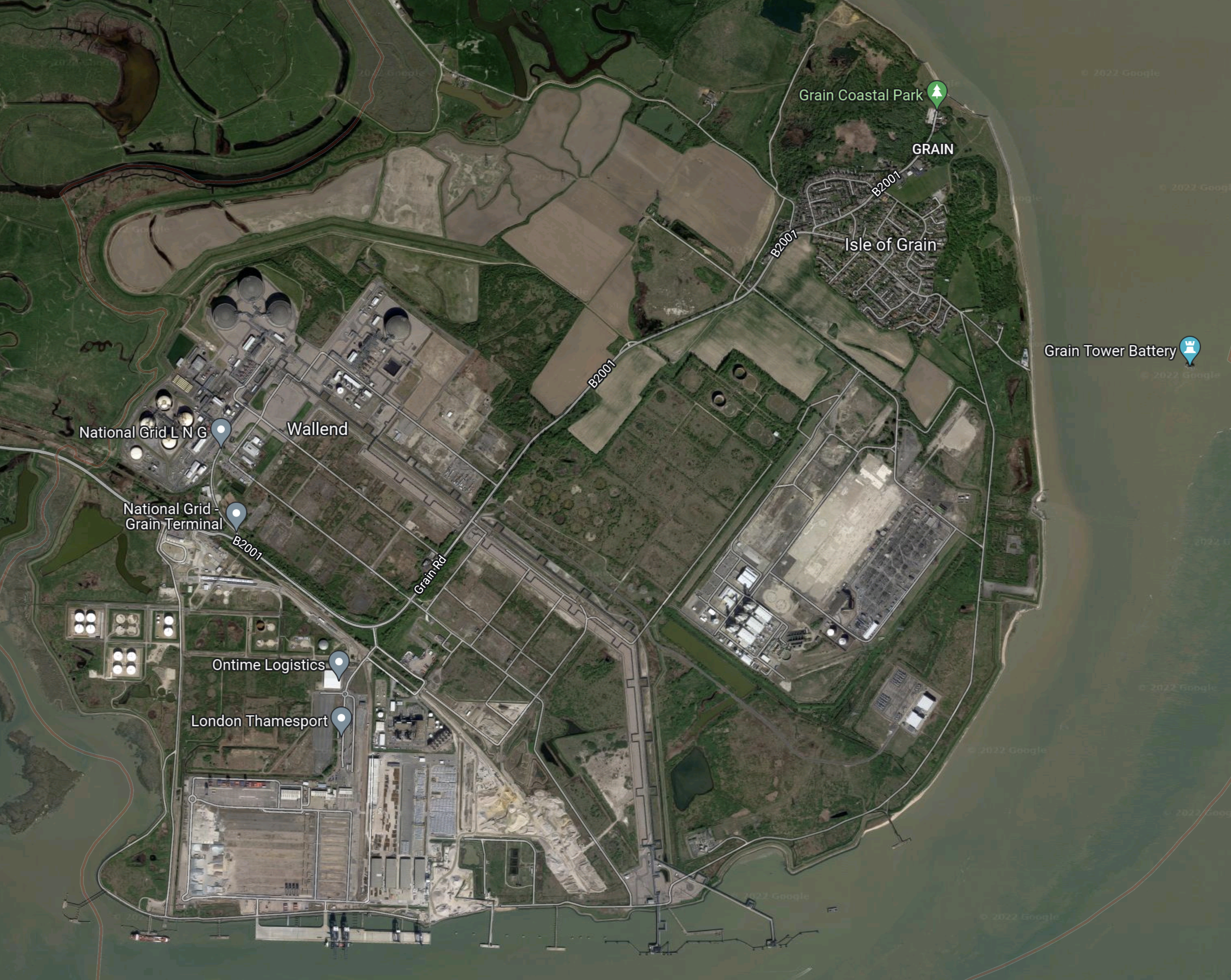
Note.
- Thamesport is in the South-West corner
- To its North is the LNG import facility.
- To the North-East of Thamesport is the 735 MW Medway power station.
- There is a rail connection to Hoo Junction on the North Kent Line.
This second Google Map shows the Eastern side of the Isle.
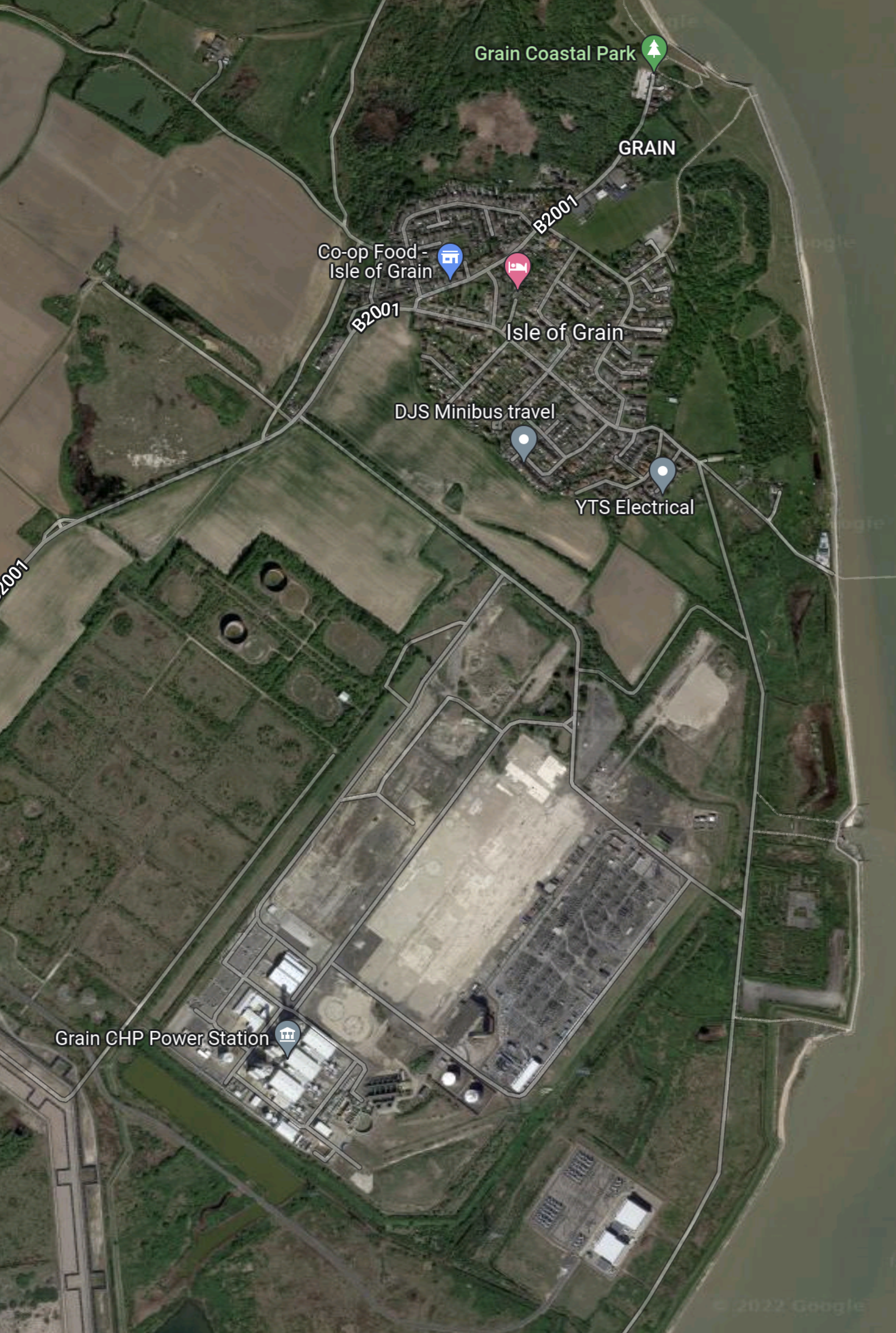
Note.
- Grain Coastal Park, where NeuConnect will make landfall, is marked by the green arrow at the top of the map.
- Towards the South-Eastern corner of the map is the 1.275 GW Grain gas-fired power station.
- To the East of the power station, there is more switchgear than you see in a bad Frankenstein film.
- The smaller square at the bottom with the two white squares could be the converter station for the BritNed interconnector.
I am sure there is space on the island for a connection for NeuConnect.
There is also a total of 2.01 GW of gas-fired power stations on the Isle of Grain.
Wind Power In The Thames Estuary
This Google Map shows the Thames Estuary.
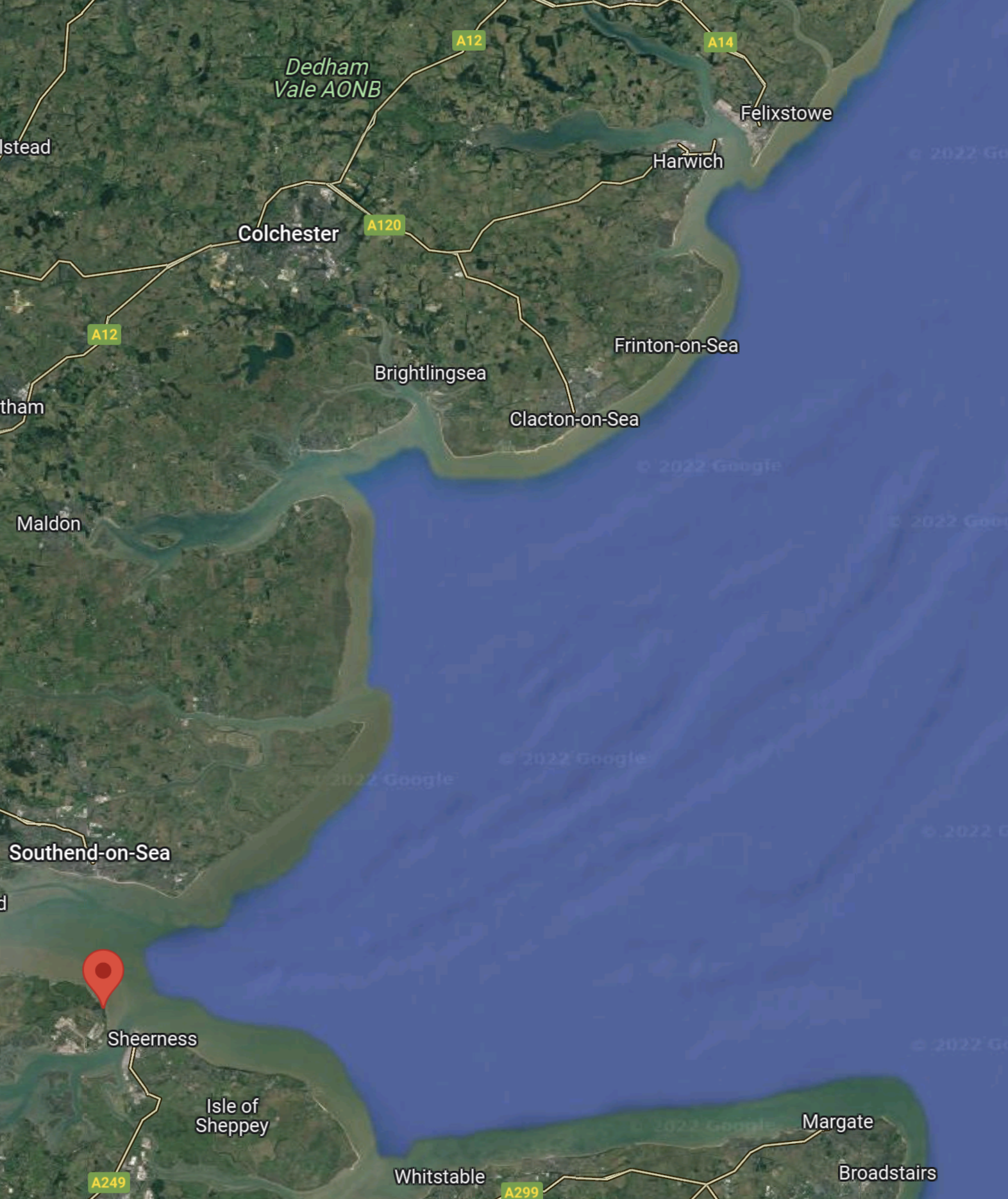
Note that the red arrow indicates the Isle of Grain.
This map from Wikipedia shows the wind farms in the area.
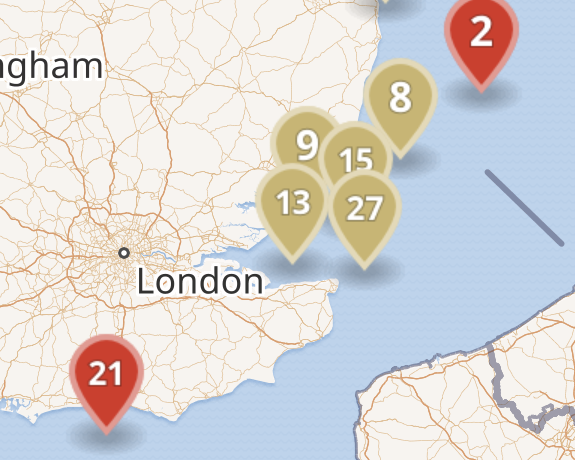
These are the ones that are operational.
- 2 – East Anglia Array – 714 MW
- 8 – Greater Gabbard – 504 MW
- 9 – Gunfleet Sands – 184 MW
- 13 – Kentish Flats – 140 MW
- 15 – London Array – 630 MW
- 27 – Thanet – 300 MW
Note.
- The Isle of Grain is just above the second o in London.
- I have ignored the Ramplion wind farm (21!), as it is too far from the Isle of Grain.
- This is a total of nearly 2.5 GW.
Planned extensions in the area include.
- East Anglia Array – 3.1 GW – Completion date of 2026
But the Wikipedia entry for the East Anglia Array says this about the wind farm.
The target capacity for the entire East Anglia Zone is 7200 MW which could require up to 1200 turbines.
Could we see one of the following?
- A connector from the East Anglia Array to the Isle of Grain.
- One or more new wind farms in the Thames Estuary connected to the Isle of Grain.
- German investment in a wind farm or farms connected to the Isle of Grain.
The Isle of Grain could become an island of energy providing power for London, the South-East of England, Germany and The Netherlands.
An Electrolyser On The Isle Of Grain
Consider.
- There will be plenty of renewable electricity.
- As there is a liquified natural gas terminal, there is plenty of gas storage.
- One or both of the gas-fired power stations can be converted to run on hydrogen.
- As more and more trucks are converted to hydrogen, there will be a large demand for hydrogen for heavy transport.
This must surely make a large electrolyser on the Isle of Grain a possibility.
The BritNed Interconnector
The BritNed interconnector is described like this in Wikipedia.
BritNed is a 1,000 MW high-voltage direct-current (HVDC) submarine power cable between the Isle of Grain in Kent, the United Kingdom; and Maasvlakte in Rotterdam, the Netherlands.
The BritNed interconnector would serve as a link for the foreseeable European super grid project.
Up to now, most of the electricity flow has been to the UK.
But surely, as more wind farms are developed power will flow the other way.
Wilhelmshaven Will Be A German Hub For Green Hydrogen
In Uniper To Make Wilhelmshaven German Hub For Green Hydrogen; Green Ammonia Import Terminal, I described plans by the Germans for a hydrogen hub at Wilhelmshaven.
The original story came from an article with the same name on Green Car Congress.
This is the first two paragraphs.
Under the name “Green Wilhelmshaven,” Germany-based international energy company Uniper plans to establish a German national hub for hydrogen in Wilhelmshaven and is working on a corresponding feasibility study.
Plans include an import terminal for green ammonia. The terminal will be equipped with an ammonia cracker for producing green hydrogen and will also be connected to the planned hydrogen network. A 410-megawatt electrolysis plant is also planned, which—in combination with the import terminal—would be capable of supplying around 295,000 metric tons or 10% of the demand expected for the whole of Germany in 2030.
As I said in the original post, I’m not happy about green ammonia, but the 1.4 GW NeuConnect interconnector has more than enough power to run a 410 MW electrolyser plant at full capacity.
It could even run three electrolysers of this size.
Hooksiel And Wilhelmshaven
NeuConnect will make landfall at Hooksiel.
This Google Map shows Hooksiel and Wilhelmshaven.
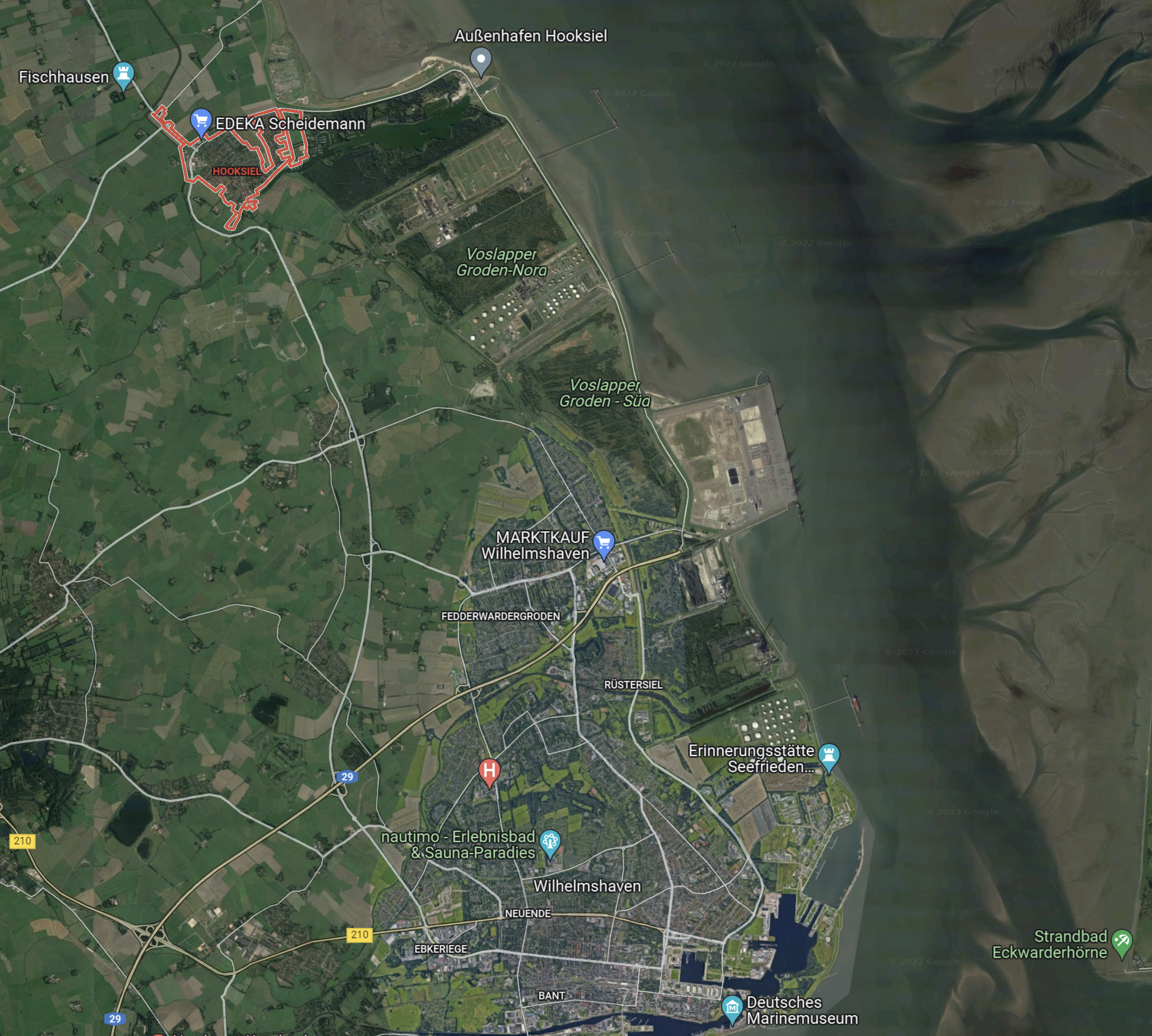
Note.
- Hooksiel is the village outlined in red.
- The water to the right of the map is the Jade Bight.
- The square block sticking out into the bight appears to be a container port.
- There appears to be chemical works or oil refineries North of the port.
- Wilhelmshaven is the town to the South of the port.
There would appear to be plenty of space for Uniper to construct Green Wilhelmshaven.
German And UK Wind Power Production
According to this page on Wikipedia, which is entitled Wind Power By Country, in 2020, these were installed wind power in various countries.
- Germany – 62,184 MW
- Spain – 27,089 MW
- UK – 24,665 MW
- France – 17,382 MW
- Italy – 10,389 MW
- Netherlands – 6,600 MW
In 2020 we were 37.5 GW behind Germany.
It looks like we’ll commission 3.3 GW this year and 6.1 in 2023, with Wikipedia saying that 12.9 GW is under development, which should close the gap to a certain extent.
In ScotWind Offshore Wind Leasing Delivers Major Boost To Scotland’s Net Zero Aspirations, I described how Scotland will add 15.1 GW of floating and 9.7 GW of fixed foundation offshore wind.
It looks like initially, we’ll be buying German wind-generated electricity, but in the future the direction could easily change around.
Boris And Olaf
There were mumblings from Boris, that energy was talked about in their meeting in Downing Street last week.
It does appear there is a lot of ways that the UK and Germany can co-operate in the future with respect to energy.
- German finance can be used to build wind farms in UK waters.
- German companies can build the turbines and the interconnectors we need to develop vast offshore wind farms.
- We can supply surplus energy to Germany through the NeuConnect interconnector.
I wouldn’t be surprised if Boris and Olaf had signed a very comprehensive energy co-operation agreement.
The FAA Has Begun To Recognize Electric Propulsion During Certification
The title of this post, is the same as that of this article on Simple Flying.
The article also has this sub title.
The FAA has set out its Part 33 certification requirements for MagniX’s electric propulsion units, providing high hopes for the future of electric aircraft
Reading the whole article , indicates that the FAA is taking electric aircraft seriously.
These are my random thoughts on electric flying in the UK and Ireland.
- The UK and Ireland could be one of the heaviest users of electric aircraft.
- There will be electric routes between the UK and Ireland.
- One of the first electric routes will be between London and New quay.
- Smaller cities and towns will develop electric airfields.
Without doubt here in the UK and Ireland, where the two largest of many islands can fit within a five hundred mile circle, electric aviation will be seriously developed for island hopping, longer mainland flights and short flights to the Continent.
 The Anonymous Widower