First US Hydrogen-Fueled Ferry Okayed For Commercial Operation
The title of this post, is the same as this of this article on OffshoreEnergy.biz.
This is the sub-heading.
US-based shipping company SWITCH Maritime has received approval from the U.S. Coast Guard for its hydrogen-powered ferry Sea Change to enter commercial operations.
This is the first paragraph.
As informed, the company was presented with the signed Certificate of Inspection (COI) by Captain Taylor Q. Lam, the U.S. Coast Guard Sector San Francisco commander and Captain of the Port, for its flagship hydrogen ferry.
This paragraph gives more details of the ferry.
Built and launched at All American Marine shipyard in Bellingham, Washington, Sea Change is a 75-passenger catamaran ferry featuring an integrated hydrogen power system from Zero Emission Industries (ZEI), with 360kW of fuel cells from Cummins and 600kW of electric motor propulsion from BAE Systems.
As the electric motor propulsion is 600 kW and there are only 360 kW of hydrogen fuel cells, I suspect there is a battery in there somewhere.
The Orkney Islands have their own hydrogen ferry project called HySeasIII.
The Orkney ferry uses 600 kW of Ballard fuel cells.
There is no news this year about what is happening to the Orkney project.
Stadler’s FLIRT H2 Sets World Record For Hydrogen Powered Train
The title of this post, is the same as that of this article on Rail Technology Magazine.
These three paragraphs introduce the article.
Stadler’s FLIRT H2 has set the Guinness World Record for the longest distance achieved by a hydrogen-powered passenger train without refuelling or recharging.
The record attempt began on the evening of 20th March 2024 at the ENSCO test centre in Pueblo, Colorado, and concluded 46 hours later, with the train completing 2803 kilometres on a single tank filling.
A team of engineers from Stadler and ENSCO drove the vehicle in shifts during the attempt.
The journey is about the same distance as the crow flies between Edinburgh and Athens.
Stadler have also published this video.
The train appears to be a a Flirt, like Greater Anglia’s Class 755 trains or Transport for Wales’s Class 231 trains, with a power unit in the middle.

Note.
- The picture shows a Class 231 train at Cardiff Queen Street station.
- A Greater Anglia driver told me, these trains are 125 mph trains.
- The Flirt H2 has only two passenger cars, but UK Flirts are have three or four cars.
Perhaps we should buy a few of these trains for long routes like Liverpool and Norwich or Cardiff and Holyhead!
They would surely be ideal for CrossCountry
SolarDuck, Green Arrow Capital And New Developments S.R.L. Sign Collaboration Agreement For A Grid-Scale Offshore Hybrid Wind-Solar Project In Italy
The title of this post, is the same as that of this press release from SolarDuck.
These three bullet points, act as sub-headings.
- 540 MW hybrid offshore wind-solar farm offshore Corigliano, Calabria
- Milestone project to accelerate scaling of Offshore Floating Solar Photovoltaic (OFPV)
- Strategic collaboration proves the potential of the technology in Italy and the wider
Mediterranean region
These three paragraphs outline the project.
SolarDuck, leader in OFPV technology, Green Arrow Capital, leading Italian Independent Asset
Manager in the alternative investment world, and New Developments s.r.l., one of Italy’s
most experienced developers, have agreed to collaborate on the development of a landmark
120MWp OFPV farm integrated with 420MW Floating Offshore Wind (FOW).The project will install SolarDuck’s unique elevated platform technology that allows PV panels
to be deployed in significant wave heights whilst maintaining a safe working environment for
access and maintenance and minimizing environmental impact. In addition, the collaboration
will also allow the harnessing of the complementarity of wind and solar energy resources.“With the current momentum, we believe this is a unique opportunity for the offshore
renewable energy industry to help shape a favorable regulatory framework and facilitate the
scaling of OFPV. This is not just important for Italy, but also for other countries in the
Mediterranean. Our collaboration with New Developments and Green Arrow Capital can also
serve as a catalyst for OFPV in Italy”, says SolarDuck CEO, Koen Burgers.
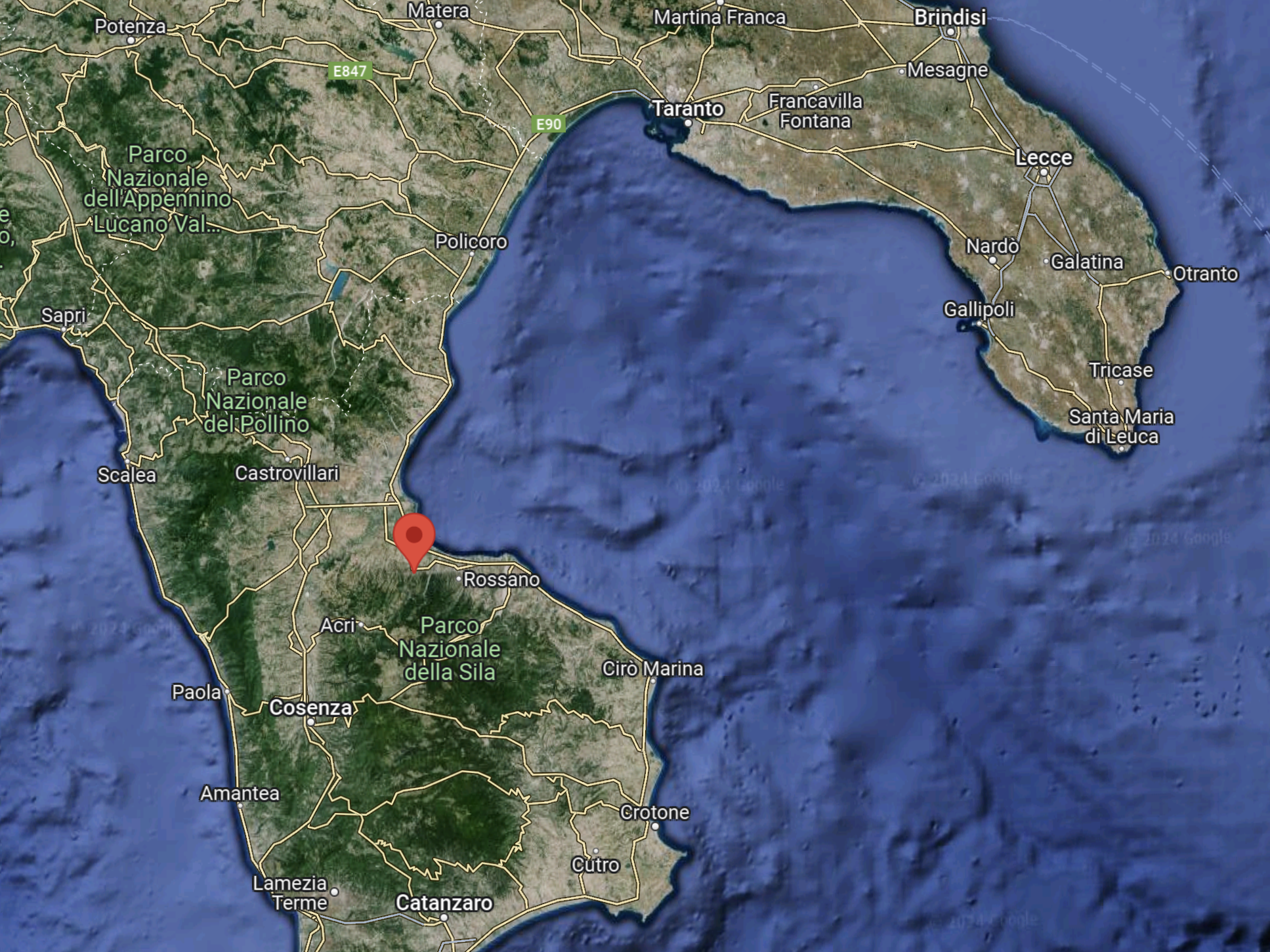
This Google Map shows the location of Corigliano at the foot of Italy.
Note.
- Corigliano is indicated by the red arrow.
- There is an explanatory video of their technology on SolarDuck’s web site.
Opposite Corigliano on the other side of the can be seen the Italian Naval Base of Taranto, which was the scene of the Battle of Taranto, which was one of the most significant naval battles of Second World War, if not the most significant.
- This web page has the Fleet Air Arm’s account of the battle.
- I have a book, that shows the Japanese visiting Taranto after the battle.
- Did the Japanese use what they learned to plan their successful raid on Pearl Harbor?
- Without Pearl Harbor, would the Americans have stayed out of the Second World War?
I visited Taranto in the 1980s and stood on the Dockside. Perhaps, it is time to go again?
Conclusion
I have a feeling that a hybrid offshore wind-solar farm can generate more electricity in a given area, by making better use of the space available.
It will be interesting to see how this hybrid wind farm performs.
In an area with plenty of sun and wind, it could be a better solution.
Only the mathematics will tell.
Global First For Formula 1: CEVA Logistics Transports Ferrari Equipment By Rail
The title of this post is the same as that of this article on Container News.
This is the sub-heading.
CEVA Logistics, CMA CGM-owned third-party logistics provider, recently designed an innovative rail transport solution for Scuderia Ferrari’s F1 racing team in North America
These paragraphs outline the transport.
In a global first for Formula 1, Ferrari equipment is being transported by rail between three North American F1 grand prix races as part of the two companies’ efforts to cut carbon emissions.
Since the start of their cooperation in 2022, CEVA has been altering the Scuderia Ferrari logistics programme. As CEVA guarantees that the equipment reaches each of the 23 Grand Prix racing venues on schedule, the flow of the six different 45-ton equipment kits that travel the world has shifted away from air freight and toward a primary combination of ocean and road freight.
Carbon savings were 90 % compared to flying and 32 % compared to an all-road route.
But as the containers appeared to have travelled 4,000 miles between Montreal to Las Vegas via Austin, probably hauled by a diesel locomotive, how much extra carbon savings could have been achieved if a hydrogen-powered locomotive had been used?
Southern Baptists Expel US Churches With Female Pastors
The title of this post, is the same as that of this article on the BBC.
This is the sub-heading.
The US’s largest Baptist denomination has voted to expel two churches for having female pastors.
These paragraphs outline the article.
A vote by Southern Baptist Convention (SBC) members found Southern Californian megachurch Saddleback and Kentucky’s Fern Creek Baptist Church were “not in friendly cooperation” with SBC, the Baptist Press reported.
SBC’s mission statement says the office of pastor should be “limited to men.”
Fern Creek’s pastor told CBS News it was a “sad day for Southern Baptists”.
I must admit I’m not religious and only enter rarely enter a church, cathedral or other place of worship.
I suspect that the last few religious services, that I have attended have been funerals and I can’t remember one with a male celebrant.
In the parish, where I live, we used to have a female vicar but she has been promoted and we now have a male vicar.
Should the change either way matter to anyone? It’s surely about the quality of the work they do!
Battery Wagons To Lower Mining Railway Emissions
The title of this post, is the same as that of this article on Railway Gazette.
These two paragraphs introduce the concept of the wagons.
Intramotev is to supply three ReVolt battery wagons to enable regenerative braking on a industrial railway.
The battery and automation technology company said this would be the first deployment of self-propelled battery-electric wagons in a traditional freight train, with regenerative braking and battery technology used to reduce locomotive diesel consumption and thus costs and emissions.
It may seem an unusual concept, but it’s one of those ideas, where if the maths and the costs stack up, it will work.
Intramotev’s web site gives more details on their Product & Technology page, where this is said.
Combining the low energy usage of steel wheels on steel rails with the efficiency of electric drivetrains to create the most energy-efficiency overland transport.
This article on electrek is entitled A Company Is Developing Self-Propelled, Battery-Electric Railcars You Can Control With Your Phone has two paragraphs, which describe their two current products.
In a few short years, the company has been able to develop unique freight solutions using software and battery-electric propulsion technology. This includes the TugVolt battery electric railcar (seen above and below), which can decouple from the consist (the group of railcars as a whole) and operate independently for first and last mile legs.
The company has also developed a ReVolt railcar that can be positioned to stay within the train’s consist and capture energy using regenerative braking to reduce diesel consumption from the line’s locomotive.
As a Control Engineer, I feel strongly, that this technology would work very well in the UK.
UK Offshore Wind Pipeline Now At 98 GW, Second Only To China – Report
The title of this post, is the same as that of this article on offshoreWIND.biz.
This is the sub-heading.
The UK’s pipeline of offshore wind projects has reached 97,944 MW, up from 91,287 MW a year ago, while the global pipeline topped 1.23 TWh, an increase of nearly 400 GW in the last year, according to RenewableUK’s latest EnergyPulse market intelligence data report.
These are the first two paragraphs.
The pipeline includes projects at every stage of development, including operational, under construction, consented, or planned.
The UK total pipeline was second globally at 98 GW, second only to China with 157 GW, followed by the USA in third place with 82 GW, Sweden is fourth with 75 MW, and Brazil fifth with 63 GW.
These is also a pie-chart saying in which part of the UK, wind energy is being developed.
- North Sea (Scotland) – 41,977 MW
- North Sea (England) – 33,845 MW
- Irish Sea – 8,659 MW
- North Atlantic Ocean – 7,435 MW
- Celtic Sea – 4,428 MW
- English Channel – 1,600 MW
As Cilla would say. “What a lorra, lorra lot of wind!”
DOE Announces 7 Awards To Cut Heliostat Costs
The title of this post, is the same as that of this article on Solar Paces.
I haven’t talked about heliostats much before and can only find these two posts; one about Australia and one about Spainspain
- ‘Unique’ Solar-Storage Solution Providers Plot 300MW / 3.6GWh Australia Project
- Spanish Govt Approves Energy Storage Strategy, Sees 20 GW In 2030
I feel it is good that the Americans are backing this technology.
These are a summary of the projects.
- SunRing: Advanced Manufacturing and Field Deployment: This project by Solar Dynamics LLC and partners will develop processes to maximize cost-competitiveness, performance, and reliability of Solar Dynamics’ existing SunRing heliostat design.
- HELIOCOMM: A Resilient Wireless Heliostats Communication System: This components-and-controls project by the University of New Mexico will model a resilient wireless communication system based on the principles of integrated access and backhaul (IAB) technology, entropy-based routing, dynamic spectrum management, and interference mitigation.
- An Educational Program on Concentrating Solar Power and Heliostats for Power Generation and Industrial Process: This project by Northeastern University will develop an educational program focused on concentrating solar power (CSP) and heliostats for power generation and industrial processes.
- Demonstration of a Heliostat Solar Field Wireless Control System: Solar Dynamics LLC, with partners Remcom and Vanteon Corporation, will carry out a project aimed at demonstrating the reliable operation of a wireless heliostat solar field control system using commercially available products and developing analytical tools to de-risk the large-scale deployment of the wireless technology to solar fields with tens of thousands of heliostats.
- Twisting Heliostats With Closed-Loop Tracking: This project will design, manufacture, and test a new type of heliostat and study its application for high-concentration CSP.
- Digital Twin and Industry 4.0 in Support of Heliostat Technology Advancement: The Tietronix project aims to leverage technologies from the Fourth Industrial Revolution (Industry 4.0) to enhance the CSP industry and achieve the cost reduction experienced by other industries that have already adopted such advancements.
- Robotic-Assisted Facet Installation (RA-FI): Sarcos Technology and Robotics Corp., in collaboration with Heliogen, will investigate the feasibility of a novel mobile robotic system capable of supporting the installation of mirror facets onto a heliostat.
Governments and institutions and individuals with money should support this sort of research and development.
Joule Battery Loco Unveiled Ahead Of Trial
The title of this post, is the same as that of this article on Railway Gazette.
These three paragraphs outline the trial and the locomotive.
Pacific Harbor Line has unveiled a Progress Rail EMD SD40JR Joule battery electric locomotive ahead of a one-year trial.
Anacostia Rail Holdings subsidiary PHL provides shunting services and dispatches all BNSF and Union Pacific trains within the ports of Los Angeles and Long Beach. It currently operates a fleet of EPA Tier 3 Plus and Tier 4 locomotives using 100% renewable diesel fuel.
The 3·2 MW six-axle SD40JR locomotive was rebuilt from a SD40-2. It has a lithium-ion battery, AC traction motors and individual axle control. It is charged using an EMD Joule Charging Station, and features regenerative braking.
I have some thoughts and more information.
Pacific Harbor Line – PHL
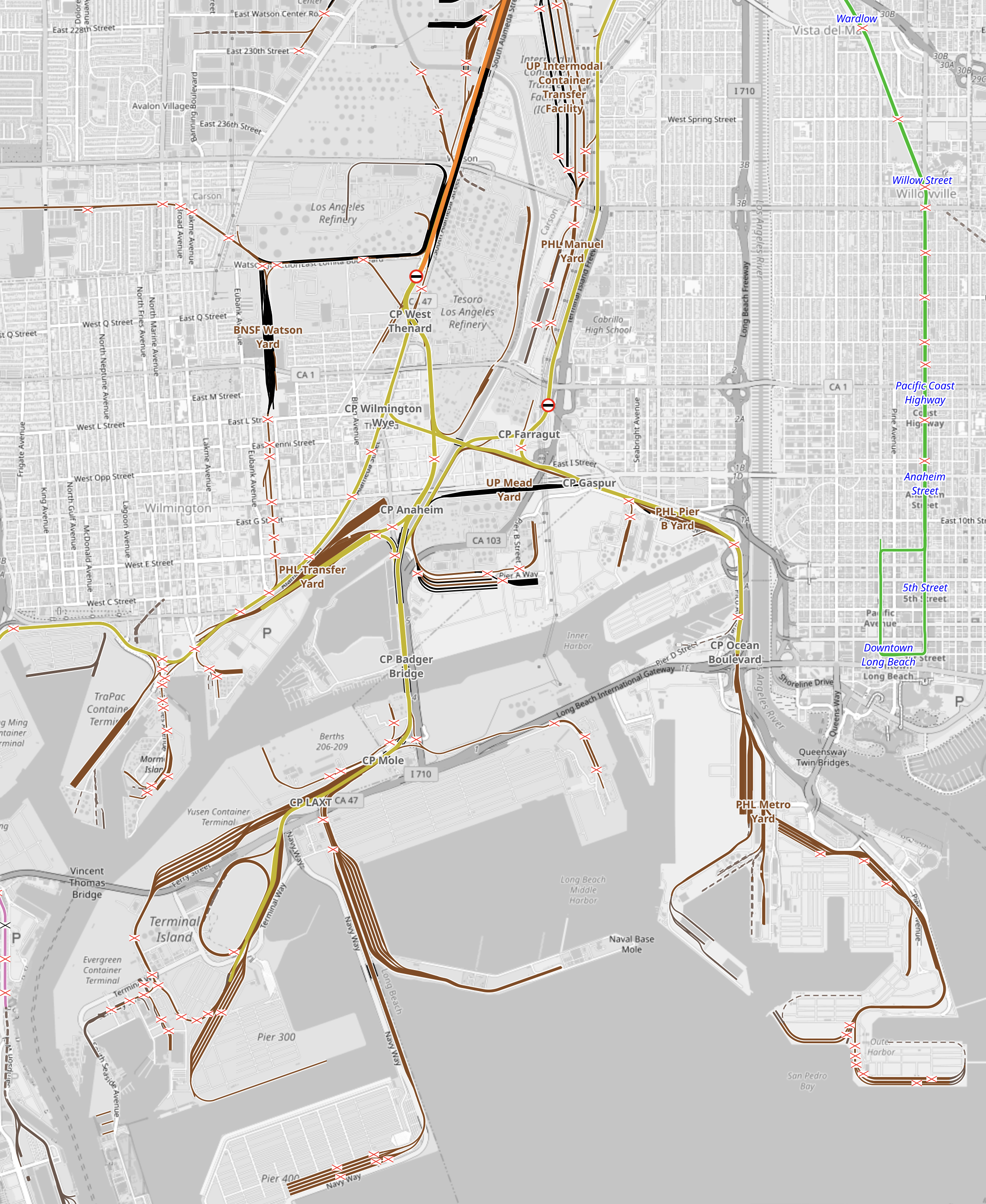
This map from OpenRailwayMap shows the area in the ports of Los Angeles and Long Beach, where it will be working.
Note.
Los Angeles is to the West and Long Beach is to the East.
Most of the lines in brown are rail tracks, where PHL moves containers between ships and trains that bring them to and from the ports.
The Union Pacific Intermodal Container Transfer Facility is at the North of the map.
It is a very comprehensive system.
The Pacific Harbor Line web site gives more details and starts with this paragraph.
Pacific Harbor Line, Inc. (PHL) provides rail transportation, maintenance and dispatching services to both Ports of Long Beach and Los Angeles, which together form top intermodal gateways in the United States. Through its inception, PHL’s mission has been to offer neutral services to all its business partners: two ports, two Class I railroads, nine intermodal terminals and numerous carload customers. PHL connects with BNSF and UP.
It then gives these details.
- Location: Ports of Long Beach and Los Angeles
- Employees: 189
- Railroad Mileage: 19 route miles, 96 track miles
- Port Facility Served: Port of Los Angeles, Port of Long Beach
- Connecting Railroads: BNSF and UP
- Sustainability: Contact Pacific Harbor Line to discover the low carbon solutions we can provide for your freight needs.
- Number of Customers: 9 on-dock marine terminals, more than 30 carload customers
Later the web site states that PHL is proud of its role as an industry leader for environmental sustainability and as owner of the greenest locomotive fleet in the country.
The new locomotive would appear to fit fit that philosophy.
Progress Rail EMD SD40JR Joule Battery Electric Locomotive
This page on the Progress Rail web site gives more details of their Joule battery electric locomotives.
- The SD40JR locomotive has a power output of 2.1 MW and a 4 MWh battery.
- For comparison, a Class 66 locomotive, of which there are 480 in the UK, has a power output of 1.85 MW at the rail.
- Strangely, the UK locomotive is 1.7 metres longer.
As both locomotive classes were originally built by EMD, I do wonder how similar the components of the two locomotives are.
Would A Battery Electric Class 66 Locomotive Be Any Use?
If we assume that conversion of a Class 66 locomotive to battery power is possible would it find uses in the UK?
I am fairly certain, if you live in any of the villages on the Felixstowe branch line, you will sometimes get annoyed, at the streams of Class 66 locomotives passing with long freight trains between Ipswich and Felixstowe.
I have just looked at the 11:13 freight train from Felixstowe North to Trafford Park.
- It leaves Felixstowe North hauled by a Class 66 locomotive.
- Felixstowe North to Ipswich takes just 35 minutes.
- At Ipswich, the motive power is changed to an electric locomotive, which is probably a Class 90 locomotive.
- The train then uses an all-electric route to Trafford, where it arrives at 23:39.
A rough calculation based on the time running on electric, shows that the current hybrid method of operation, saves 95.3% of the carbon emissions compared to an all-diesel trip.
It would be carbon-free, if a battery-electric Class 66 locomotive could be developed. with sufficient range.
So that’s one application!
There must be other applications, where a battery can supply enough power for the journey.
Conclusion
Given the number of Class 66 locomotives to decarbonise or replace, a fleet of battery electric Class 66 locomotives could be a good start.
US Offshore Wind Pipeline Blows Past 51 GW, Report Says
The title of this post, is the same as that of this article on offshoreWIND.biz.
This is the sub-heading.
The American Clean Power Association (ACP) has released a report on the US offshore wind market, outlining a rapidly growing pipeline of projects across 32 leases totaling 51,377 MW of expected capacity which is enough to power the equivalent of more than 20 million homes.
The American wind market seems to be powering ahead.
If the pattern of offshore oil and gas from the last century, repeats itself, there’s going to be a lot of money made and jobs created.
The report talks of the following.
- 83,000 jobs by 2030.
- $25 billion of economic output.
- Thirty new ships built in domestic shipyards.
Are we geared up for proportionate numbers in the UK?
 The Anonymous Widower