Fischer–Tropsch technology has a chequered history, as it has been used by regimes like Nazi Germany and South Africa under apartheid to create the fuel they need.
But now Oxford University spin-out company; Velocys have improved the process, so that it can turn rubbish destined for landfill into sustainable aviation fuel.
This is the last paragraph from the article.
The developer says its FT reactor can enable the production of SAF from household waste and woody biomass. The end product is a high-quality version of existing fuels, requiring no changes to engines or infrastructure, Velocys says on its website.
This is surely a viable alternative to keep airlines flying, until hydrogen-powered planes are developed.
I stated my views on disposable nappies in this post called Disposable Nappies, where this was the first sentence.
From a scientifically green point of view, in many places I’m against using disposable nappies, as they clog sewers, end up in landfill and I’ve even seen them in litter bins in parks. We used real nappies for all our three children in the seventies, washing them ourselves in a machine for the first and then using a nappy service for the last two.
But dirty nappies contain a lot of the ingredients, that can be used to make hydrocarbons.
These are the first two paragraphs of The Times article.
With their packed cabins and recycled air, long-haul passenger jets are the last place where you would want to encounter the whiff of a dirty nappy.
However, old nappies are to be used — along with other non-recyclable waste such as meal packaging and takeaway coffee cups — to power British Airways planes.
Syngas is a mixture of hydrogen, carbon monoxide and some carbon dioxide. Some countries without access to petroleum or diesel created syngas and then used the Fischer–Tropsch process to create the fuels they needed. The process doesn’t have a good reputation as the two main countries to use the process were Germany under the Nazis and South Africa during apartheid.
Why is the use of this process being revived to produce aviation biofuel or sustainable aviation fuel for British Airways?
According to Wikipedia, it can save between 20 and 98 % of carbon emissions compared to conventional jet fuel.
The same process can also make biodiesel for buses, trains and trucks
It’s certainly an area, where a lot of research is going on! Just type “syngas nappies” or “syngas diapers” into Google and you’ll get a lot of serious hits.
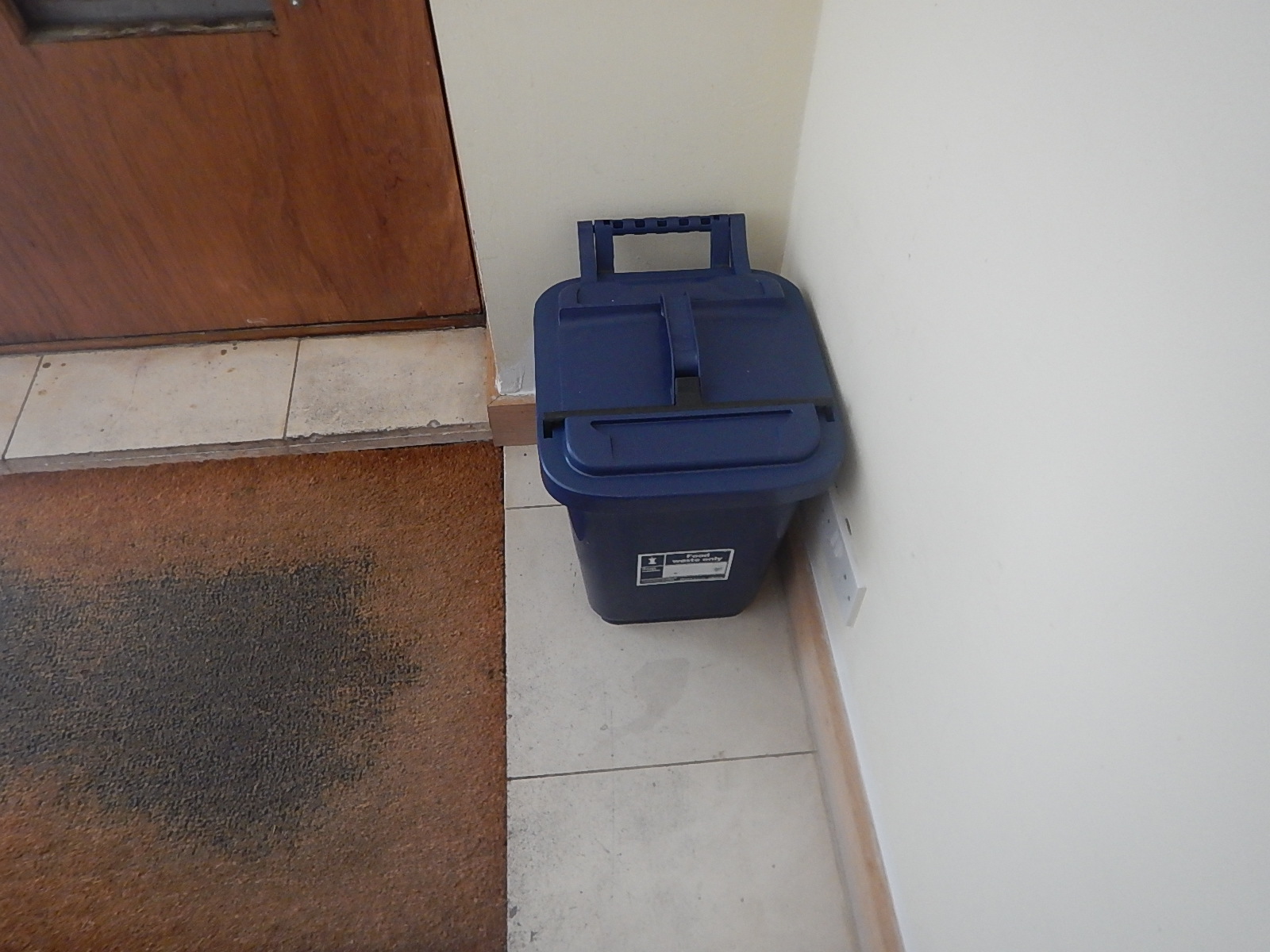
By my front door I have a well-designed blue bin.
This is for my food waste bin, which is collected once a week.
This page on the Hackney web site is entitled Food Waste Recycling, and this is said about where the food waste goes.
Food waste from households in Hackney is sent to an anaerobic digestion facility in south east England, where it’s turned into renewable energy to power homes and biofertiliser to be spread on local farmland to grow crops.
A similar bin of an appropriate size could be used for nappies.
The nappies would go to an appropriate recycling site, instead of down the toilet or into landfill.
A technology company that has developed technology to turn household waste and forest waste into aviation fuel says it has signed an agreement that will help it produce 30 million gallons of fuel in Mississippi every year.
Velocys officials announced this week that they have signed a framework agreement with Koch Project Solutions to develop their biorefinery project which produces standard aviation fuel, in Natchez.
That all sounds good for the spin-out of Oxford University,
Some may feel that the future of supersonic aviation is about as rosy, as an empty glass of tap water.
But!
A flight across the Atlantic in three-and-a-half hours, as is promised by the Boom Overture, is below the four-hour travel limit, where average people start to get anxious about being banged up!
Not for nothing do UK train companies want to get London and Edinburgh services below, the magic four-hour time.
Technology will get better to reduce the noise and carbon emissions of all aircraft and not just supersonic ones!
I don’t put it outside the genius of engineers to by 2050, be able to create a supersonic, almost noise-free aircraft.
These are comparisons of the Boom Overture to Concorde.
Engines – Three as opposed to four.
Length – Similar
Wingspan – 71 % of Concorde
Passengers – 75 % of Concorde
It’s almost as if the Boom Overture is a three-quarter scale model of Concorde.
The Wing/Airframe
When I left Liverpool University in 1968, I wasn’t totally sure, what I wanted to do. So I visited a lot of engineering and aerospace companies including both BAC and Hawker Siddeley. Including my own University, I must have visited about four or five large wind tunnels in that period and every one had a Concorde-like model for the wind tunnel.
Every company had their own ideas on what a supersonic wing, should look like.
And surprise-surprise they were all very similar!
Take the advertising off Formula One cars and paint them all silver and very few could tell them apart.
Aerodynamics defines the shape so strongly, they all look the same.
It’s the same with supersonic aircraft and I’m not surprised that wing planform of the Boom Overture appears to be similar to Concorde, but narrower.
Perhaps the more dart-like shape significantly reduces the drag? It should be noted that drag is proportional to cross-sectional area.
In Concorde’s Wikipedia entry there is a section called Development, which explains how the Royal Aircraft Establishment developed the slender delta wing planform, used by Concorde and now likely to be used by Boom.
Although, it would be different inside the wing, as Concorde was mainly made from metal and the Overture is a composite aircraft.
Perhaps composite construction helps with creating the perfect aerodynamic shape. I don’t have any experience of composites, but they surely mean more aerodynamic shapes and they are regularly used for airframes.
I suspect that Concorde was a nightmare to build, but that the challenge helped develop a large number of machining and fabrication techniques.
The Fuselage
As I said earlier, the length of the plane is similar to Concorde, but the wingspan is 29 % smaller and the number of passengers is around 25 % less.
But if you look at the picture of the aircraft in the Times article, where it is emerging from the hangar, it’s almost as if the fuselage has a square cross section than Concorde.
I wonder about this square cross section. I remember an interview on the radio with Barnes Wallis, where he talked about his latest idea for a fast supersonic aircraft capable of flying between the UK and Australia.
This paragraph is from Barnes Wallis’s Wikipedia entry.
In the late 1950s, Wallis gave a lecture entitled “The strength of England” at Eton College, and continued to deliver versions of the talk into the early 1970s, presenting technology and automation as a way to restore Britain’s dominance. He advocated nuclear-powered cargo submarines as a means of making Britain immune to future embargoes, and to make it a global trading power. He complained of the loss of aircraft design to the US, and suggested that Britain could dominate air travel by developing a small supersonic airliner capable of short take-off and landing.
It sounds to me that he would have been a Brexiteer.
Could this supersonic airliner, be what I heard him talking about?
I distinctly remember that he was advocating a fuselage with a square cross section for supersonic flight.
It would have given more space inside for passengers.
Concorde was a bit pokey with small windows!
The picture in The Times of the interior of the Boom Overture is certainly spacious.
Have Boom, been looking through Barnes Wallis’s ideas?
One quote I heard Barnes Wallis say, in an interview with Chris Brasher was this.
There is no greater thrill in life, than proving something is impossible and then showing how it can be done.
Boom may not have been able to develop a small supersonic airliner capable of short take-off and landing, but it does sound, they’ve developed a smaller supersonic airliner capable of shorter take-off and landing.
The Engines
In the Boom Overture’s Wikipedia entry there is a section called Engines, where this is the last sentence.
In July 2020, the company announced that it had entered into an agreement with Rolls-Royce to collaborate on engine development.
As Rolls-Royce built the engines for Concorde, they probably have some experience locked away.
The engines were fitted with afterburners, as the extra thrust was needed for take-off.
According to Wikipedia the engines had a high thermal efficiency in supersonic cruise.
According to Wikipedia, there was an engine without afterburning for a longer range Concorde under development.
Over the years, there have been various proposals for supersonic aircraft, in military, commercial and business fields, so I suspect Rolls-Royce have done significant work in powering supersonic flight.
But then other engine companies would have gone down similar routes!
Rolls-Royce though probably have all the data on the engine ideas for Concorde that failed.
I wouldn’t be surprised, if one of the major aero-engine companies has a solution to the powerplant for the Boom Overture, based on the chase for supersonic speeds forty and fifty years ago.
But Rolls-Royce because of the Concorde experience could be closer to a successful development.
So I think signing with Rolls-Royce could be a very sensible move.
The Afterburners
The Wikipedia entry for the Boom Overture says this about afterburners.
Boom wants to use moderate bypass turbofans without afterburners, unlike Concorde’s Rolls-Royce/Snecma Olympus.
Could that be one piece of complication, that improvements in technology has eliminated?
The Engine Intakes
The Wikipedia entry for the Olympus 593 engines has a section called Intakes.
They were thought to be clever in the 1960s, but they just look complicated to me, with all my extra experience.
The intakes seem to have used very comprehensive digital control systems, but these days controls like these will be even more comprehensive and a lot more sophisticated, as computing has moved on.
I very much feel that if the Boom Overture needed sophisticated variable-geometry engine intakes like Concorde, we have the knowledge to create them and the computer expertise to make them act as needed.
The Exhaust Nozzle
The Wikipedia entry for the Olympus 593 engines has a section called Exhaust Nozzle.
These too are complicated and a lot of what I said for the intakes, would apply to the nozzles.
The Fuel
The Wikipedia entry for the Boom Overture says
The aircraft is intended to run on Sustainable Aviation Fuel.
It is likely, that Sustainable Aviation Fuel will be used for commercial aviation until there is a significant move to hydrogen.
In the UK, a company called Altalto is building a large plant to make the fuel at Immingham from household and industrial waste.
One idea being pursued by some companies is to create the fuel from used disposable nappies.
Wikipedia indicates that the fuel could cut CO2 emissions by between 20-98%.
Altalto is backed by British Airways and Velocys, who are a spin-out from Oxford University.
There is certainly a lot of money and technology being thrown behind Sustainable Aviation Fuel to make it a net-zero alternative for the powering of aircraft.
The Noise
This Youtube video shows Concorde’s last take-off from New York.
It was certainly a noisy aircraft.
Concorde’s engines had afterburners.
It also needed a long take-off run, so it made more noise on the ground.
It used to take off with a high angle of attack with the nose high.
All of these factors would have increased real and perceived noise levels.
I feel that if the Boom Overture is going to have significantly lower noise levels than Concorde, then its design will need to be radically different.
The lack of afterburners will make some difference.
It carries only about 75 % of the passengers of Concorde.
It is roughly, the same length as Concorde, but the wingspan is nearly thirty percent smaller.
Bioenergy with carbon capture and storage (BECCS) offers a more cost-effective, readily available solution for decarbonizing the steel industry in Europe than clean hydrogen, steel producer ArcelorMittal’s head of strategy David Clarke said May 17.
So what do they mean by bioenergy?
To make iron from iron ore, you need a reducing agent like carbon or hydrogen.
The carbon is usually some form of coal, which produces large amounts of carbon dioxide with the oxygen from the iron oxides.
Hydrogen produces lots of water with the oxygen.
David Clarke of ArcelorMittal explains the process in the article.
“We know biomass worked as a replacement for coal,” he said. “We’ve been using it in our operations in Brazil and other places for many, many years. We have a project in Belgium that we’ll be starting up next year using waste wood, using that to make bio-coal,” with a project to take the emissions from the bio-coal to produce bioethanol.
Is this a case of Back-To-The-Future? If I remember my history, didn’t Iron Age men use charcoal to smelt iron and other metal ores?
If those scientists from Velocys can make Sustainable Aviation Fuel and biodiesel from household waste and used disposable nappies, can they apply their magic to make bio-coal?
I see great cost advantages with this process, as surely it would enable existing blast furnaces to be used, provided they were fitted with carbon capture and storage.
International Airlines Group has announced a commitment to operate 10 per cent of its flights with sustainable aviation fuel (SAF) by 2030.
The owner of Aer Lingus, British Airways, Iberia and Vueling says it will purchase one million tonnes of sustainable jet fuel per year, enabling it to cut its annual emissions by two million tonnes by 2030.
It is a welcome development.
My feeling is that although a lot of greens, think that sustainable aviation fuel (SAF) is a cop-out, it is the only way we have to cut aviation’s carbon emissions in the short-term.
It would not need any expensive modifications to aircraft.
SAF can also be delivered to airports using existing infrastructure like pipelines or rail tankers.
SAF can be made from household and industrial waste, disposable nappies and other materials like scrap wood and unwanted clothes, most of which will otherwise end up in landfill.
I also think that SAF could be a way to decarbonise existing rail locomotives by replacing the diesel engines with gas turbines.
So will IAG commitment give a boost to the production of SAF? I certainly hope it does, as we’ll all benefit.
Hydrogen-Powered Aircraft
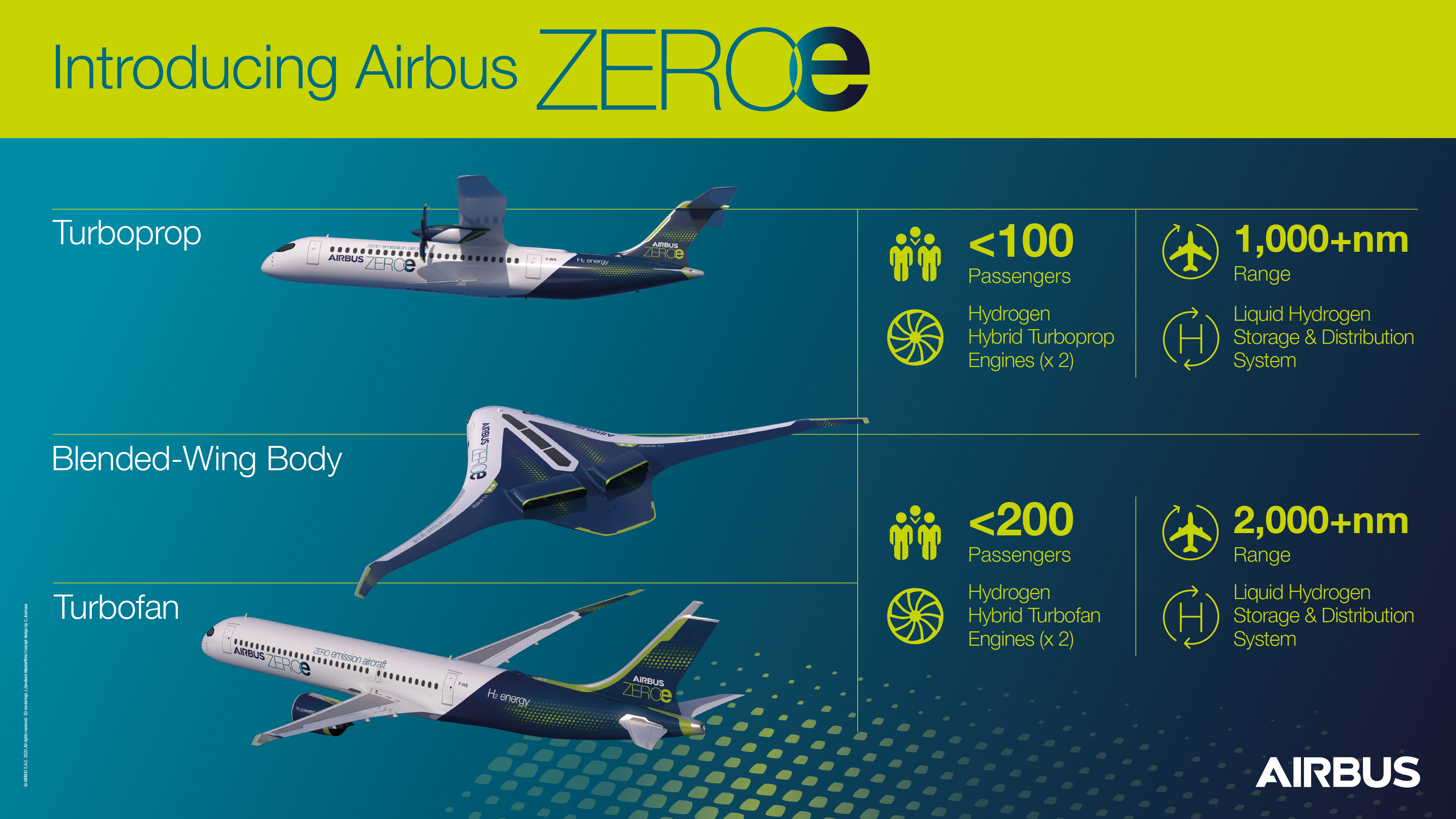
This infographic from Airbus shows three of their proposed designs for hydrogen-powered aircraft.
Discover the three zero-emission concept aircraft known as ZEROe in this infographic. These turbofan, turboprop, and blended-wing-body configurations are all hydrogen hybrid aircraft.
Two of the designs; the ZEROe Turboprop and ZEROe Turbofan appear to have been designed by re-engineering current technology and designs.
The one I like is the Turbofan, which I feel is based on the airframe of the current A 320 neo.
Much of the wing, cockpit and fuselage appear very similar to that of the A 320 neo
There is a hydrogen tank in the rear fuselage.
The engines are probably modern turbofans, adjusted to run on hydrogen.
Range and passenger capacity are very similar to the current aircraft.
The ZEROe Turbofan would fit current airport infrastructure like tugs and terminals.
Aircrew would need little retraining between current A 320s and ZEROe Turbofans.
There might even be the possibility of being able to convert an A 320 neo into a ZEROe Turbofan!
But there is a flaw in my reasoning.
IAG have placed a large order for Boeing 737 MAX aircraft. Wikipedia says this in the entry for IAG.
In June 2019, IAG signed a letter of intent to purchase 200 Boeing 737 MAX aircraft even though at the time of the signing the 737 MAX was still grounded worldwide following the two fatal crashes likely caused by the design of the MCAS system. Aviation analysts have questioned IAG’s leadership in making such an order when the 737 MAX design is still being rectified. IAG CEO Willie Walsh, shrugged off the plane’s uncertain future. “We’re partnering with the Boeing brand”, he said. “That’s the brand that I’m doing business with. That’s the brand that I’ve worked with for years. And it’s a brand that I trust”
Could Boeing have offered a 737 MAX, that can be converted to hydrogen?
I certainly feel that both a 737 MAX and an A 320 neo can be converted to hydrogen.
The visualisations from Airbus of the A 320 neo and the ZEROe Turbofan are remarkably similar.
The 737 MAX is a traditional aluminium aircraft, so may be easier to convert.
As Boeing probably need a winner more urgently than Airbus, perhaps they can deliver a hydrogen-powered aircraft around the middle of the decade.
Both aircraft are a bit like Lego and can be shortened or lengthened as required.
Perhaps one or other of the planemakers have come up with a technique for storing environmentally-friendly liquid ammonia in the wings.
As my mother used to say. “It’ll all come out in the wash!”
But I do feel by 2030, we’ll be seeing zero-carbon airlines on short-haul routes. So IAG’s aim of getting ten percent of planes powered by SAF by 2030, is probably a stop-gap that will continue with older planes for some years.
I am very hopeful about Velocys, who are a UK public company, that were spun out of Oxford University and do clever things in the area of chemical catalysts.
Velocys’ Fischer-Tropsch technology does seem to be a good way of creating sustainable aviation fuel from household rubbish and biomass.
The title of this post, is the same as that of this article on Green Car Congress.
This is the first paragraph.
British Airways will power future flights with sustainable aviation fuel produced from sustainably-sourced ethanol, as part of a new partnership with sustainable jet fuel company LanzaJet. British Airways will invest in LanzaJet’s first commercial-scale Freedom Pines Fuels facility in Georgia and acquire cleaner burning sustainable aviation fuel from the plant.
Other points from the article.
Flights using the sustainable aviation fuel (SAF) could start in 2022.
LanzaJet have their own process that can use inputs like wheat straw and recycled pollution.
This agreement would be in addition to BA’s partnership with Velocys in the Altalto plant at Immingham.
British Airways also appear to have set themselves a target of being carbon net-zero by 2050.
The article is certainly on any list of must-reads.
One day, in the very near future, commercial aircraft will be fuelled by household rubbish. Yes, seriously.
It then goes on to describe the Velocys process for producing sustainable aviation fuel from household rubbish.
This paragraph explains, how it will change rubbish disposal.
Interestingly, Velocys won’t have to pay to obtain the waste. “We don’t buy it. We get paid to take it,” says Hargreaves. He explains how the supply chain starts with councils and businesses that are obliged to pay waste contractors to dispose of their waste. Those waste contractors then pay to incinerate the waste or send it to landfill sites. Velocys’s plant will simply act as an alternative disposal route.
The article is a very good explanation of one of the developments, that will shape the future of the world.
What this blog will eventually be about I do not know.
But it will be about how I’m coping with the loss of my wife and son to cancer in recent years and how I manage with being a coeliac and recovering from a stroke. It will be about travel, sport, engineering, food, art, computers, large projects and London, that are some of the passions that fill my life.
And hopefully, it will get rid of the lonely times, from which I still suffer.
 The Anonymous Widower