ScottishPower Renewables Picks Port For East Anglia Two Pre-Assembly
The title of this post, is the same as that of this article on offshoreWIND.biz.
This is the sub-heading.
ScottishPower Renewables, Iberdrola’s UK arm, has selected Peel Ports Great Yarmouth as the staging ground for pre-assembly works for its 960 MW East Anglia Two offshore wind project.
This is the introductory paragraph.
The companies have signed a reservation agreement that will see the Siemens Gamesa turbine components and sections come together for assembly at the Norfolk site before installation in the southern North Sea in 2028.
Note.
- The Port of Great Yarmouth was used for this task with East Anglia One.
- The turbine blades will be manufactured at Siemens Gamesa’s offshore wind blade factory in Hull.
- The monopiles will come from Sif in Rotterdam.
This is the first sentence of the Wikipedia entry for the East5 Anglia Array.
The East Anglia Array is a proposed series of offshore wind farms located around 30 miles off the east coast of East Anglia, in the North Sea, England. It has begun with the currently operational East Anglia ONE, that has been developed in partnership by ScottishPower Renewables and Vattenfall. Up to six individual projects could be set up in the area with a maximum capacity of up to 7.2 GW.
These articles on offshoreWIND.biz indicate that ScottishPower Renewables has been busy signing contracts for East Anglia Two.
- December 4th, 2024 – Nexans Lands Export Cable Contract For East Anglia Two Offshore Wind Farm.
- November 28th, 2024 – Hitachi Energy to Integrate 960 MW East Anglia Two Wind Farm into UK Grid.
- November 12th, 2024 – Siemens Gamesa Bags GBP 1 Billion Turbine Contract For East Anglia Two.
- November 6th, 2024 – Seaway7 Wins East Anglia Two Inter-Array Cable Contract.
- October 31st, 2024 – Sif, Smulders to Deliver Monopiles and TPs For ScottishPower’s East Anglia Two Offshore Wind Farm.
They must have employed lawyers on roller skates to get five contracts signed in just over a month.
Conclusion
East Anglia Two appears to be definitely under way and the Wikipedia extract says there could be a lot more, if all the other wind farms are developed in the same way using the Port of Great Yarmouth.
A total capacity in the East Anglia Array of 7.2 GW will surely be good for both East Anglia and the UK as a whole, but will the natives be happy with all the onshore infrastructure?
I wouldn’t be surprised to see further wind farm developed to generate hydrogen offshore, which will be either brought ashore to the Bacton gas terminal, using existing or new pipelines or distributed using tanker ships to where it is needed.
Where Will Lumo Strike Next?
Yesterday, First Group reported that they had added more possible services to their network of open-access services.
I gave my view in FirstGroup Acquires London – South Wales Open Access Business And Plans Lumo To Devon.
Their list of possible services and destinations include.
- Hull Trains – London King’s Cross and Beverley via Stevenage, Grantham, Retford, Doncaster, Selby, Howden, Brough, Hull Paragon and Cottingham
- Hull Trains – London King’s Cross and Hull Paragon via Stevenage, Grantham, Retford, Doncaster, Selby, Howden and Brough
- Hull Trains – London King’s Cross and Sheffield via Worksop and Woodhouse
- Lumo – London Euston and Rochdale via Warrington Bank Quay, Newton-le-Willows, Eccles and Manchester Victoria
- Lumo – London King’s Cross and Edinburgh/Glasgow via Stevenage, Newcastle and Morpeth
- Lumo – London Paddington and Carmarthen via Bristol Parkway, Newport, Severn Tunnel Junction, Cardiff Central, Gowerton and Llanell
- Lumo – London Paddington and Paignton via Bath Spa, Bristol Temple Meads, Taunton, Exeter St David’s and Torquay
I believe that all services could be run by identical versions of Hitachi’s high speed Intercity Battery Electric Train, which are described in this page on the Hitachi web site.
The London Paddington and Paignton service would require the longest running without electrification at 210 km. and I don’t believe First Group would have put in a bid, unless they were certain zero-carbon trains with sufficient performance would be available.
Other possible open access services could be.
Hull And Blackpool Airport
Note.
- This could be the first half of a Green Route between the North of England and the island of Ireland, if zero-carbon aircraft can fly from Blackpool Airport.
- Trains would call at Selby, Leeds, Bradford, Huddersfield, Manchester Victoria, Blackburn and Preston.
- Blackpool Airport has good access from Squires Gate station and tram stop, which could be improved.
- Blackpool Airport could be well supplied with green electricity and hydrogen from wind power.
These are distances to possible airports.
- Belfast City – 111 nm.
- Belfast International – 114 nm.
- Cardiff – 143 nm.
- Cork – 229 nm.
- Donegal – 200 nm.
- Derry/Londonderry – 163 nm.
- Dublin – 116 nm.
- Inverness – 228 nm
- Ireland West Knock – 204 nm.
- Kerry – 253 nm.
- Ronaldsway, IOM – 59 nm.
- Shannon – 220 nm.
Note.
- The Wikipedia entry for the all-electric Eviation Alice, gives the range with reserves as 250 nm.
- The Belfast and Dublin airports could be within range of a round trip from Blackpool without refuelling.
- ,Cork, Kerry and Shannon airports may need to go by another airport, where a small battery charge is performed.
- The Isle of Man is surprisingly close.
Blackpool has reasonably good coverage for the island of Ireland.
London Euston And Holyhead
This could be the first half of a Green Route to Dublin, if the trains met a high speed hydrogen-powered catamaran to speed passengers across to Dun Laoghaire.
London King’s Cross And Aberdeen Or Inverness
Why not? But these routes would probably be best left to LNER.
London King’s Cross And Grimsby Or Cleethorpes
In Azuma Test Train Takes To The Tracks As LNER Trials Possible New Route, I talked about how LNER had run a test train to Grimsby and Cleethorpes.
The Government might prefer that an open access operator took the risk and got all the blame if the route wasn’t worth running.
Humberside is very much involved in the energy industry, with several gas-fried power-stations at Keadby.
It might be more efficient in terms of trains and infrastructure, if this service was an extension of the Lincoln service.
London King’s Cross And Scarborough Via Beverley
This would probably be one for Hull Trains, but it would also serve Bridlington and Butlin’s at Filey.
The BBC was running a story today about how holiday camps are making a comeback. Surely, one on a direct train from London wouldn’t be a bad thing. for operators, train companies or holidaymakers.
London King’s Cross And Middlesbrough, Redcar Or Saltburn
As with the Grimsby and Cleethorpes service, the government might think, that this might be a better service for an open access operator.
Teesside is heavily involved in the offshore wind industry and may add involvement in the nuclear industry.
London Paddington And Fishguard, Haverfordwest, Milford Haven Or Pembroke Dock
Note.
- This could be the first half of a Green Route to Southern Ireland, if the trains met a high speed hydrogen-powered catamaran to speed passengers across to Rosslare or an electric or hydrogen-powered aircraft from Haverfordwest Airport.
- These three ports and one airport will feature heavily in the development of offshore wind power in the Celtic Sea.
- RWE are already planning a hydrogen electrolyser in Pembrokeshire, as I wrote about in RWE Underlines Commitment To Floating Offshore Wind In The Celtic Sea Through New ‘Vision’ Document.
- According to the Wikipedia entry for Fishguard Harbour station, it was built as a station to handle ship passengers and is now owned by Stena Line, who run the ferries to Rosslare in Ireland.
- I can see a tie-up between FirstGroup and Stena Line to efficiently transfer passengers between Lumo’s planned service to Carmarthen and Stena Line’s ships to Ireland.
All four secondary destinations would be a short extension from Carmarthen.
Summing Up
Note how energy, a Green Route to Ireland and other themes keep appearing.
I do wonder if running a budget train service to an area, is an easy way of levelling up, by attracting people, commuters and industry.
Have the budget airlines improved the areas they serve?
They’ve certainly created employment in the transport, construction and hospitality industries.
Zero-Carbon Ferries And Short-Haul Aircraft
These will be essential for Anglo-Irish routes and many other routes around the world.
I will deal with the ferries first, as to create a zero-carbon ferry, only needs an appropriate power unit to be installed in a ship design that works.
But with aircraft, you have to lift the craft off the ground, which needs a lot of energy.
This article on Transport and Environment is entitled World’s First ‘Carbon Neutral’ ship Will Rely On Dead-End Fuel, with this sentence as a sub-heading.
The Danish shipping giant Maersk announced it will operate the world’s first carbon-neutral cargo vessel by 2023. The company had promised a carbon-neutral container ship by 2030 but now says it will introduce the ship seven years ahead of schedule following pressure from its customers. While welcoming Maersk’s ambition, T&E says the company is betting on the wrong horse by using methanol which may not be sustainable and available in sufficient amounts.
Note.
- I’d not heard of this ship.
- Pressure from customers brought the date forward by seven years.
- As always, it appears that the availability of enough green hydrogen and methanol is blamed.
Perhaps, Governments of the world should put more teeth in green legislation to ensure that companies and governments do what they say they are gong to do?
But worthwhile developments in the field of shipping are underway.
For instance, I estimate that this Artemis Technologies hydrofoil ferry could take passengers across the 54 nautical miles between Dun Laoghaire and Holyhead in around 90 minutes.
This ferry is being designed and built in Northern Ireland and I can’t believe, it is the only development of its type.
A Fast Green Route To Ireland
I have talked about this before in High-Speed Low-Carbon Transport Between Great Britain And Ireland and I am certain that it will happen.
- Air and sea routes between the UK and the island of Ireland carry a lot of traffic.
- Some travellers don’t like flying. Especially in Boeings, which are Ryanair’s standard issue.
- It is the sort of trip, that will appeal to a lot of travellers and most probably a lot with Irish connections.
- An electric or hydrogen-powered aircraft or a fast surface craft will be able to cross the Irish Sea in a quick time.
- High speed trains and then High Speed Two will consistently reduce the travel times on the UK side of the water.
Cross-water travel routes, be they by aircraft, ferries, bridges or tunnels are generally popular and successful.
Conclusion
Given the opportunity at Fishguard, I can see that FirstGroup next move would be to extend the Carmarthen service to Fishguard Harbour.
Thousands Of Lobsters Settle At Triton Knoll Offshore Wind Farm
The title of this post, is the same as that of this article on offshoreWIND.biz.
This is the sub-heading.
RWE and the Whitby Lobster Hatchery have released 2,500 juvenile lobsters at the Triton Knoll offshore wind farm in the UK in what the wind farm developer says is an industry-first project, through which more than 15,000 lobsters are planned to be released at Triton Knoll.
These are the first two paragraphs.
The first batch of 2,500 juvenile lobsters was settled at the offshore wind farm in November and a further 2,500 are expected to arrive at the site early next year.
According to RWE, which said last month that the project’s goal was to help increase biodiversity in the North Sea, there is the potential for a further 10,000 lobsters to be released over the next two years, in 2025 and 2026.
The objective seems to be to introduce 100,00 juvenile lobsters into the sea.
First Commercial-Scale Seaweed Farm Between Wind Turbines Fully Operational In Netherlands
The title of this post, is the same as that of this article on offshoreWIND.biz.
This is the sub-heading.
The world’s first commercial-scale seaweed farm within the Hollandse Kust Zuid offshore wind farm in the Netherlands is fully operational.
These initial three paragraphs fill out the details.
According to the non-profit organisation North Sea Farmers (NSF), the final deployment step was completed one week ago by deploying the seeded substrate.
North Sea Farm 1, initiated by NSF with funding from Amazon’s Right Now Climate Fund, is a floating farm located in the open space between wind turbines where seaweed production can be tested and improved.
The seaweed farm is located within the Hollandse Kust Zuid wind farm, nearly 22 kilometres off the coast of Scheveningen. The 1.5 GW project is owned by Vattenfall, BASF, and Allianz.
I find this an interesting concept.
I can remember reading in the Meccano Magazine in the 1950s, about the production of alginates from seaweed in Scotland.
Surprisingly, Wikipedia has very little on alginates, except for this illuminating Wikipedia entry for alginic acid.
This is the opening paragraph.
Alginic acid, also called algin, is a naturally occurring, edible polysaccharide found in brown algae. It is hydrophilic and forms a viscous gum when hydrated. When the alginic acid binds with sodium and calcium ions, the resulting salts are known as alginates. Its colour ranges from white to yellowish-brown. It is sold in filamentous, granular, or powdered forms.
But it does appear that the Scottish production of alginates is very much of the past. Unless someone else can enlighten me!
Perhaps Scottish seaweed farming can be revived to produce alginates, which appear to have a surprising number of uses, as this section of the Wikipedia entry shows.
Alginates do appear to be remarkably useful.
These are a few uses.
- As of 2022 alginate had become one of the most preferred materials as an abundant natural biopolymer.
- Sodium alginate is mixed with soybean protein to make meat analogue.
- They are an ingredient of Gaviscon and other pharmaceuticals.
- Sodium alginate is used as an impression-making material in dentistry, prosthetics, lifecasting, and for creating positives for small-scale casting.
- Sodium alginate is used in reactive dye printing and as a thickener for reactive dyes in textile screen-printing.
- Calcium alginate is used in different types of medical products, including skin wound dressings to promote healing,
Alginates seem to have some rather useful properties.
Four years ago, I tripped over in my bedroom, which I wrote about in An Accident In My Bedroom. I wonder if the Royal London Hospital used calcium alginate skin dressings to restore my hand to its current condition.



Paul Daniels would have said, “It’s magic!”
In the future these dressings may be produced from UK-produced seaweed.
German Firm Plans To Build Britain’s Biggest Solar Farm
The title of this post, is the same as that as this article on The Times.
These three paragraphs outline the project.
The developers behind a controversial solar power project in Oxfordshire have submitted a planning application for what is thought will be the largest such scheme in western Europe.
The site in Botley West is being developed by Photovolt, a German company, and could generate 840 megawatts (MW) of electricity, enough to power about 330,000 homes.
However, the project has sparked a backlash among some local residents, who argue the scheme will blight the landscape.
A map shows the site and it is certainly a large one.
- The Botley West site will cover a total of about 3,200 acres.
- It will pass through 15 villages.
- About 1,235 acres will not be covered with solar panels.
- It has a web site, which gives more information.
- There is also a Stop Botley West web site.
I can certainly understand the opposition.
These are my thoughts.
I Would Add A Battery To The Panels
An added battery would undoubtedly smooth the output of the solar panels. Especially, when the sun is not out to play!
A total capacity of 840 MW is planned for Botley West and in my opinion as a Control Engineer, a sizeable battery is needed.
I would not use a Battery Energy Storage System or BESS based on lithium-ion batteries, as I believe that Highview Power’s liquid air batteries and others offer cost and environmental advantages. But that is one for the accountants and the environmentalists!
I Might Add A Few Appropriately-Sized Wind Turbines To The Farm
In Skegness Wind Turbine Trial To Light Up Pier In UK First, I discuss using small, vertical wind turbines from a Norwegian company called Ventum Dynamics.
This picture shows a Ventum Dynamics turbine on Skegness Pier.
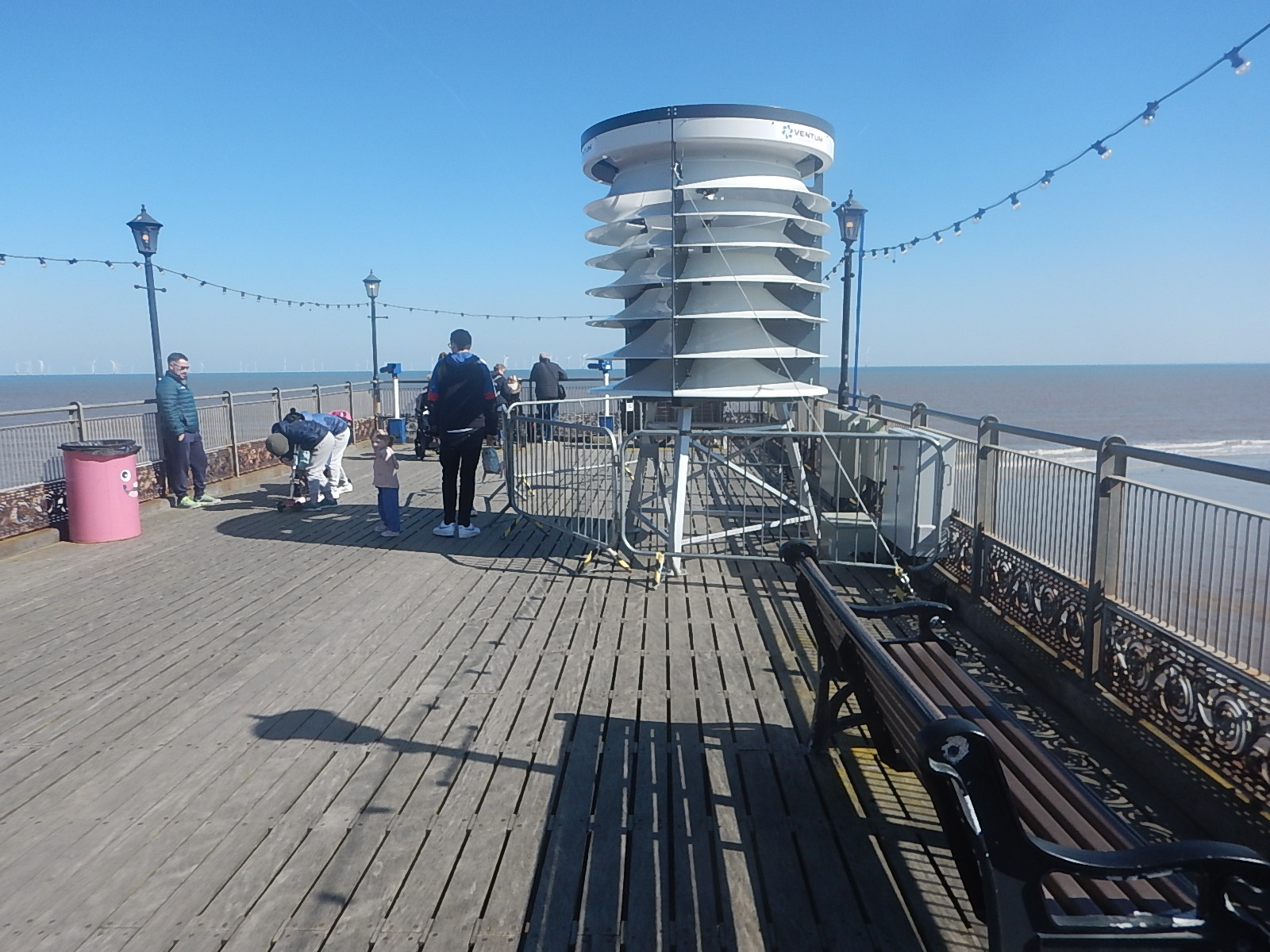
On the Ventum Dynamics web site, there are several pictures of buildings with flat roofs, that have several turbines on each.
Surely, if you’re installing a comprehensive electrical network, then it should be used to collect all the electricity it can.
I believe that Ventum’s turbines could be alternated in a line with trees, so that they merged more into the countryside. Some experiments need to be done.
I Would Also Fit Solar Roofs To Suitable Buildings
Every little helps!
Conclusion
When mixing solar panels and wind turbines into the countryside, you need to be bold and discard preconceived ideas.
9.58 GW of Renewable Energy Contracts Signed In UK’s Latest CfD Auction
The title of this post, is the same as that of this article on offshoreWIND.biz.
This is the sub-heading.
The Low Carbon Contracts Company (LCCC), a UK government-owned company, has signed 130 contracts for a total of 9.58 GW of renewable energy generation, covering the projects that were successful in the country’s latest Contracts for Difference (CfD) allocation round 6 (AR6).
These three paragraphs give more detail.
AR6 secured a broad range of technologies from wind and solar to emerging, innovative projects like tidal and floating offshore wind.
Offshore wind developers were awarded contracts for approximately 5.3 GW of capacity.
In the Round 6 auction, nine contracts for fixed-bottom projects were awarded, totalling 4.9 GW, while a single contract was granted for a floating wind project to Green Volt Offshore Windfarm, a consortium of Flotation Energy and Vårgrønn.
Once operational, AR6 projects will see 9.58 GW of renewable generation coming online, bringing the total CfD capacity to 34.74 GW. According to LCCC, this is the highest number of contracts ever signed in a single round.
Note that this will add nearly a third to the UK’s current renewable capacity.
South Korean Firm To Supply Power Equipment For Ørsted’s Hornsea 4 Offshore Wind Farm
The title of this post, is the same as that of this article on offshoreWIND.biz.
This is the sub-heading.
Denmark’s Ørsted has awarded a contract to Hyosung Heavy Industries for the supply of ultra-high voltage power equipment for the Hornsea 4 offshore wind farm in the UK
These two paragraphs add a bit of detail.
Under the contract, the South Korean company will supply 400 kV ultra-high voltage transformers and reactors, essential components for improving power quality for the 2.4 GW Hornsea 4 offshore wind project.
The most recent contract further strengthens the company’s presence in Europe, where it has accumulated over 1 trillion won (about EUR 667 million) in orders this year, as reported by the company.
Hyosung Heavy Industries seem to be doing rather well at supplying electrical gubbins in Europe.
But then Korean companies seem to be doing well in Europe and especially the UK, after the state visit of the Korean President and his wife in November 2023.
In the last century, we did very well dealing with Korean companies with Artemis; the project management computer system, that I wrote.
In Hyundai Heavy Sets Sights On Scottish Floating Offshore Wind, I describe some of our dealings there.
Conclusion
From other posts, I have written, it looks like the UK and Korea are building a strong partnership with offshore wind, and a secondary one with tidal power might be emerging. We also shouldn’t forget the partnership in North London over football.
RWE Gets Go-Ahead For 100 MW Electrolyzer For Offshore Wind-to-Hydrogen Project
The title of this post, is the same as that of this article on offshoreWIND.biz.
This is the sub-heading.
German energy company RWE has secured construction and environmental permits to build a 100 MW electrolyzer in Eemshaven, the Netherlands. The electrolyzer is part of system integration solutions associated with OranjeWind, an offshore wind project RWE is jointly developing with TotalEnergies in the Dutch North Sea.
These first threee paragraphs gove more information.
RWE described the permits as an important step in developing 100 MW of green hydrogen production at Eemshaven which, if built, will contribute to the onshore energy system integration plans associated with the 795 MW OranjeWind offshore wind project.
To remind, in July this year, TotalEnergies entered into an agreement with RWE to acquire a 50 per cent stake in the OranjeWind and said it would use its share of the electricity from the offshore wind project to power 350 MW electrolyzer projects that will produce about 40,000 tonnes of green hydrogen annually.
With the necessary permits in place, RWE stated it will be able to develop a 100 MW electrolyzer on a plot adjacent to the Magnum Power Station in Eemshaven.
I went to Eemshaven in The Train Station At The Northern End Of The Netherlands. The area looks like it will be the centre of the Dutch hydrogen industry.
This post is called The Dutch Plan For Hydrogen. The Dutch appear to want to be big in hydrogen.
A 100 MW offshore electrolyser is a good start.
BOEM Links Up With US Department of Defense On Offshore Wind
The title of this post, is the same as that of this article on offshoreWIND.biz.
This is the sub-heading.
The US Bureau of Ocean Energy Management (BOEM) and the Department of Defense (DOD) have signed a memorandum of understanding (MoU) to support the coordinated development of offshore wind on the US Outer Continental Shelf (OCS).
These three paragraphs give more details of the agreement.
The agreement calls for DOD and BOEM to find mutual solutions that support renewable energy in a manner compatible with essential military operations.
The MoU also requires the organizations to collaborate early in the offshore wind leasing process and maintain regular communication at all levels.
Additionally, the agreement calls for DOD and BOEM to determine what areas should be deferred from leasing to enable the performance of DOD activities on the OCS.
I feel this is a very sensible agreement, as time progress, I’m sure that the co-operation will lead to several joint projects.
- Support boats ensuring safety, like the deal between Ørsted and the RNLI, that I talked about in Ørsted Evolves Long-Standing Partnership With RNLI,
- Offshore structures like electrolysers and substations could have a secondary use as military training facilities.
- Smaller ships, like minehunters, coastguard cutters and fishery protection vessels could go electric and the wind farms could provide charging facilities.
If the United States Navy are hanging around the wind farms, it might discourage Putin’s friends.
Wind farms and the US military could be good neighbours.
Brendan Owens, who is the Assistant Secretary of Defense for Energy, Installations, and Environment, said this.
We will continue to work with BOEM and our other interagency partners, to find solutions that enable offshore wind development while ensuring long-term compatibility with testing, training, and operations critical to our military readiness.
Other nations with large amounts of continental shelf and ambitions to install large amounts of offshore wind like Australia, Belgium, Canada, Denmark, France, Germany, the Netherlands, Portugal, Spain and the UK could do worse that follow the American strategy.
Iarnród Éireann Looks At Diesel Loco Replacement Options
The title of this post, is the same as that of this article on Railway Gazette.
These three paragraphs introduce the article.
The Stadler Class 99 electro-diesel locomotive for UK operator GB Railfreight was receiving close scrutiny from Iarnród Éireann at InnoTrans in Berlin, with the Irish national operator confirming to Railway Gazette International that it had discussed with the manufacturer how the type might be adapted for operation in Ireland.
Iarnród Éireann Chief Executive Jim Meade told Railway Gazette International ‘we will eventually need to replace our aging diesel fleet with dual-mode locomotives because our freight strategy will take us down that direction after we complete our electrification programme.
‘The replacement for the class 071s and 201s eventually will have to be a bi-mode electric with some form of HVO [renewable diesel fuel] traction in the long term; even the Class 201s are beyond mid-life already.
The Class 99 locomotive is a version of the Stadler Eurodual locomotive, which is described in this Stadler data sheet.
The Wikipedia entry for the Stadler Euro Dual is also informative and lists a dozen different versions of the locomotive, that have been sold to various countries and operators.
This paragraph summarises how the design can handle different gauges and electrical voltages.
The Euro Dual was designed from the onset as a highly modular platform, allowing it to be offered to customers in various different configurations, covering various gauges and voltage systems.
I doubt Stadler would have great difficulty producing an Irish gauge locomotive capable of running on whatever electrification, the Irish erect.
Will The Irish Class 99 Have Enough Power?
The power of the various diesel locomotives are as follows.
- Current Irish Class 071 – 1.68 MW
- Current Irish Class 201 – 2.4 MW
- UK Class 66 – 2.4 MW
- UK Class 99 – 1.79 MW
It would appear that the Class 99 is less powerful than the Irish Class 201 and the UK Class 66, but the Wikipedia entry for the Class 99 says this.
The chief executive of GBRf, John Smith, reports that the Class 99, despite having a less powerful diesel engine than the Class 66, will outperform the Class 66 at low speeds. The greater tractive effort means that the Class 99 on diesel power can deliver more power at the rail than the 66.
But as the Class 99 has 6.17 MW in electric mode, the solution must be to electrify the difficult sections.
I have just looked at the Felixstowe Branch Line, which will be very much Class 99 territory. I am fairly sure, that with some short lengths of electrification on the single-track sections, any performance problems with the Class 99 on the branch could be solved.
Could The Irish Class 99 Use Hydrogen As Secondary Power?
This OpenRailwayMap shows all the railways on the island of Ireland.
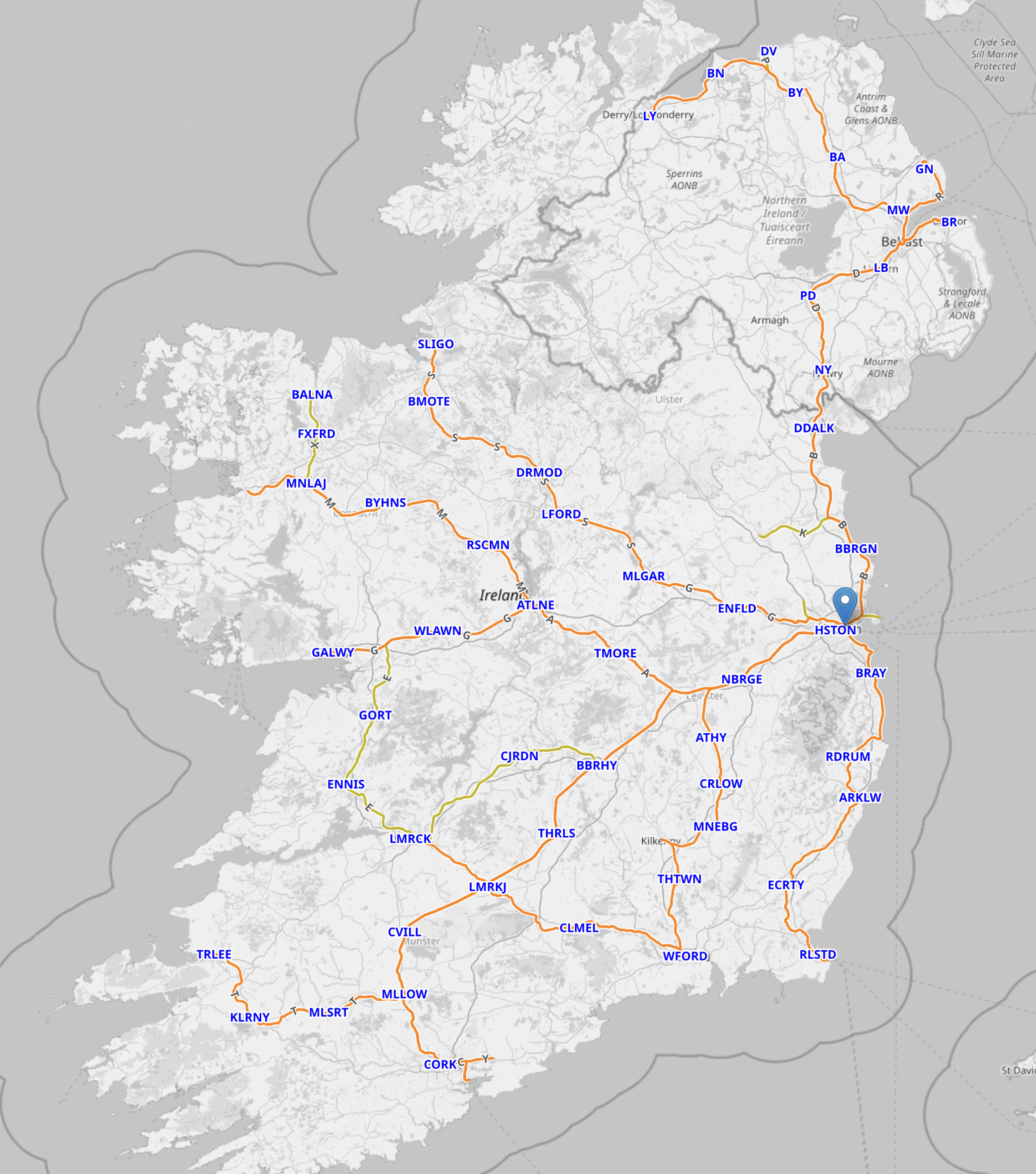
Note.
- All railways on the island of Ireland have an Irish gauge of 1.6 m.
- Only the DART in Dublin is electrified with 1,500 VDC overhead.
- There are 2,733 km. of track.
- New lines are still being added and old ones have been reopened in recent years.
- There will surely be pressure for the Irish to decarbonise their railways, both North and South of the Northern Irish border.
- There are no rail connections to another country, except for the link between Northern Ireland and the Republic of Ireland, which is between two similar systems.
- It is unlikely, that there will ever be a rail link between the Irish gauge railways on the island of Ireland and the standard gauge railways of Europe.
Effectively, the island of Ireland has an isolated network of tracks on which they could build a zero-carbon railway system.
- Signalling could be an off-the-shelf digital system.
- Zero-carbon traction power could be trains powered by either electricity and/or hydrogen.
- Both electricity and hydrogen would need substantial amounts of new rolling stock.
- Electricity would require electrification at €1,000,000 per single track kilometer, which could be around €5.5 billion for the electrification alone.
- Electrification would also need many bridges, stations and tunnels to be modified or rebuilt.
- Hydrogen would need a refuelling infrastructure and could go anywhere that diesel can.
- Hydrogen locomotives and trains, would be one-to-one replacements for diesel locomotives and trains.
It would appear that because of their geographic isolation, hydrogen could be an ideal zero-carbon fuel for the railways of Ireland.
In Do Cummins And Stadler Have a Cunning Plan?, I speculated that the electro-diesel Class 99 locomotive could be converted into an electro-hydrogen Class 99 locomotive, as Cummins are building diesel engines that can be converted into hydrogen ones.
Ireland with its unusual network could change to a zero-carbon railway in the following way.
- Purchase a fleet of diesel locomotives and trains that can run on Hydrotreated Vegetable Oil (HVO) and be convertible to hydrogen.
- A version of the Class 99 with or without the electrical gubbins would satisfy the locomotive replacement.
- A version of the tri-mode Stadler FLIRT like a Class 745 train, would satisfy the train replacement.
- All new trains and locomotives would replace the current stock and run on HVO.
- The hydrogen infrastructure would be built.
- The new trains and locomotives would be gradually converted to run on green hydrogen.
Within a few years, the island of Ireland would have a zero-carbon railway.
Advantages Of A Fully-Hydrogen Railway
These are a few advantages.
- One fuel for all trains.
- All trains and locomotives would be one manufacturer.
- No expensive electrification.
- Hydrogen trains and locomotives have a long range.
- No infrastructure modification for gauge clearance.
- Ireland has plenty of onshore and offshore wind for hydrogen.
- Standard fuelling systems are being developed.
- There would be no disruption as the trains changed to HVO and little disruption as they changed to hydrogen.
I believe that there would be a large increase in train usage both from locals and visitors, which can only be good for the Irish economy.
Managing The Project
This could be one of those rare projects that flows well.
- The changeover to hydrogen could involve very little rail infrastructure work.
- The hydrogen filling stations could be more-or-less independent of the rail infrastructure.
- Trains and locomotives could go into service, when they are accepted and the staff have been trained.
- Trains and locomotives would only be converted to hydrogen, as routes are made hydrogen-capable.
- There should be no gauging problems with the new trains and locomotives.
- There is only one train manufacturer.
Hopefully, it will all be delivered on time and on budget.
 The Anonymous Widower