How Sideshore Technology Can Optimise The Layout Of Your Offshore Wind Farm By Applying State-Of-The-Art Algorithms
The title of this post, is the same as that of this article on offshoreWIND.biz.
This is the sub-heading.
Smarter offshore wind farm layouts will accelerate the energy transition
These paragraphs outline the problem.
Wind farm layout optimisation is the art of defining the optimal locations of wind turbines, infield cables and substation structures. It presents a golden opportunity to increase project value.
The academic community has done extensive research into numerical wind farm layout optimization, however, in real projects, it is hardly ever applied. Wind farm layout optimisation is complex because it is multidisciplinary. A wind farm development is typically split into work packages (turbine, foundations, cables, substation). The location of each turbine influences the project cost across the various work packages. While wake effects are important, other aspects need to be considered as well. For example, water depth affects the foundation size. Turbulence levels need to be restricted. And cables, seabed preparation, and soil conditions are often neglected, while they too can have a substantial impact on costs. Fully optimising the turbine positions requires not only insight into wake interactions and the cost drivers across all work packages but also a way of linking everything together.
My project management software writing experience would take a system like this further and use the output pf their system to create the project network for a project management system.
The possibilities then are endless.
Project Launches To Pair Offshore Wind With Sustainable Food Production
Note that it’s a little over a fortnight to April Fool’s Day!
The title of this post, is the same as that of this article on offshoreWIND.biz.
This is the sub-heading.
Win@Sea, a new collaboration between Vattenfall and Danish universities and companies, will investigate how to produce offshore wind power and sustainable food – all while improving the marine environment and biodiversity in the same marine area.
This is the first paragraph.
The partners will look into whether an offshore wind farm could simultaneously produce fossil-free electricity and sustainable food while also contributing positively to biodiversity in the same area.
But this report is not alone, in using the sea as a farm.
- Amazon Finances First-Ever Commercial-Scale Seaweed Farm Located Between Offshore Wind Turbines
- Brown Seaweed Could Remove 550 Million Tons Of Carbon
- The Plans For Giant Seaweed Farms In European Waters
- Oysters Get New Home At Eneco Luchterduinen Offshore Wind Farm
It sounds to me like a case of great minds thinking alike.
RWE Conducting Seabed Habitat Survey For 3 GW Offshore Wind Farm In UK
The title of this post, is the same as that of this article on offshoreWIND.biz.
This is the sub-heading.
RWE is performing a benthic survey off the northeast coast of the UK, where the company plans to build its 3 GW Dogger Bank South (DBS) Offshore Wind Farm.
That sounds like another 3 GW will soon be on its way.
In How Long Does It Take To Build An Offshore Wind Farm?, I said that six years from planning permission to commissioning was typical, so as this wind farm is applying for planning permission in 2024, I would expect that a completion date of 2030 is possible.
Dogger Bank Wind Farm Officially Celebrates Its Operations And Maintenance Base Opening
The title of this post is the same as that of this news item on the Dogger Bank wind farm web site.
These bullet points introduce the item.
- 150 guests and employees gathered to celebrate the official opening.
- The state-of-the-art base will be the hub for operations and monitor 5% of UK electricity from its control room.
- Over 400 long-term jobs have been created locally to support Operations and Maintenance from South Tyneside for the 35-year life of the wind farm.
- The world-class facility will be operated in line with the UK Green Building Council’s (UKGBC) Net Zero Carbon Buildings Framework
This Google Map shows the location of the base.
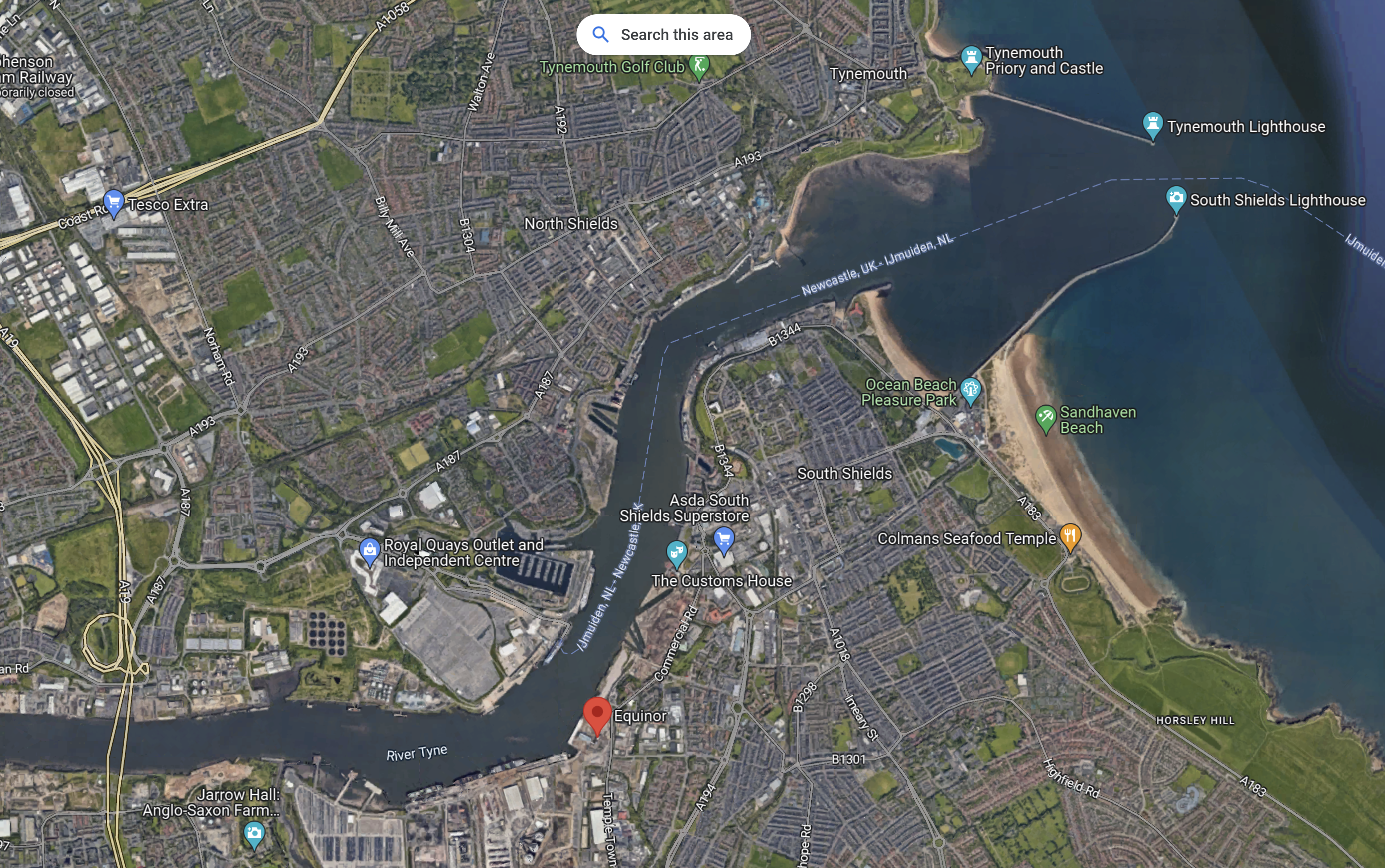
The red arrow indicates the base, which appears to be convenient for the North Sea.
This second Google Map shows a close up if the site.
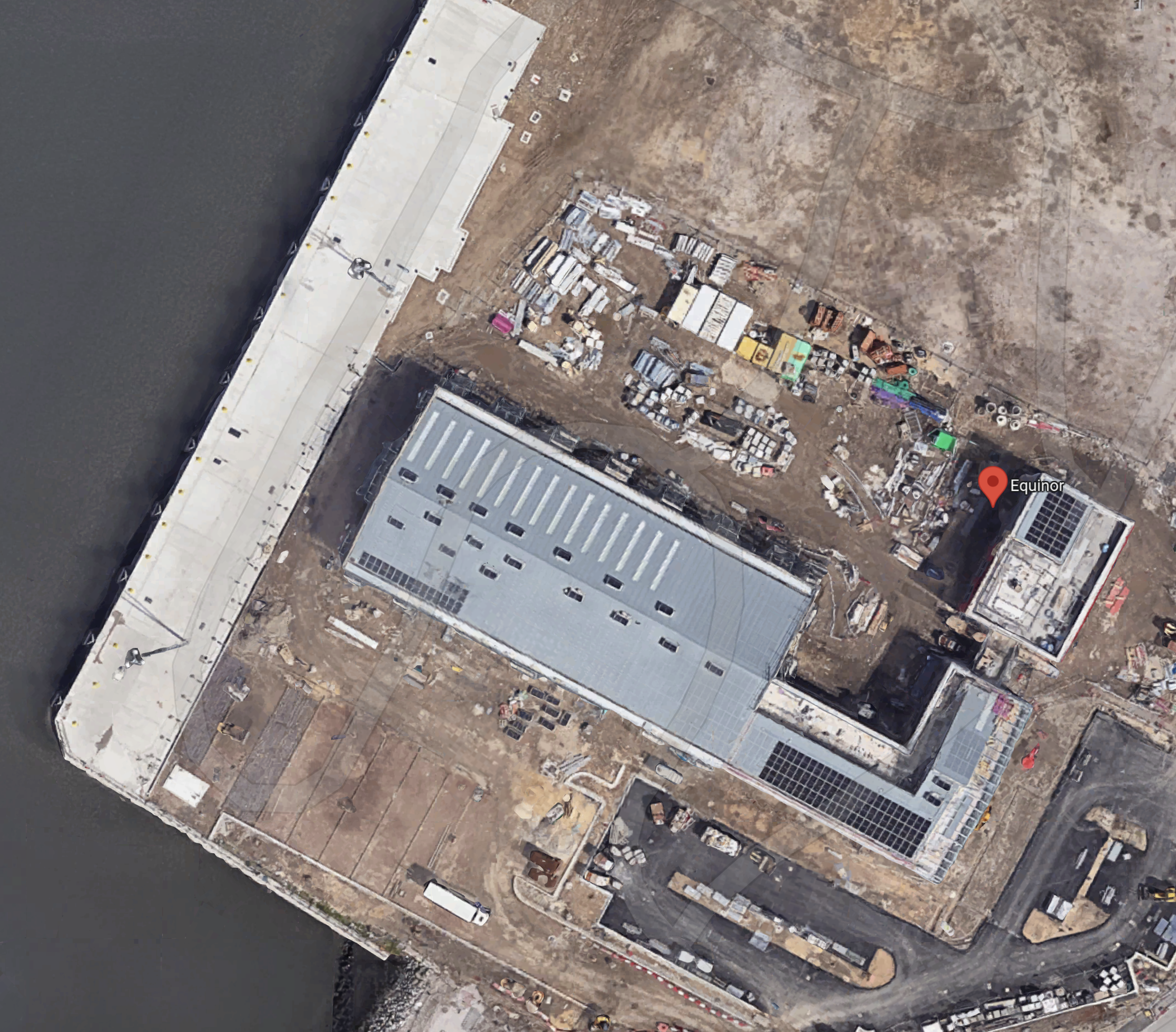
There is a nice long quayside, which in the future could be large enough to assemble floating turbines.
This third image is a Google Map 3D visualisation of the site from across the Tyne.
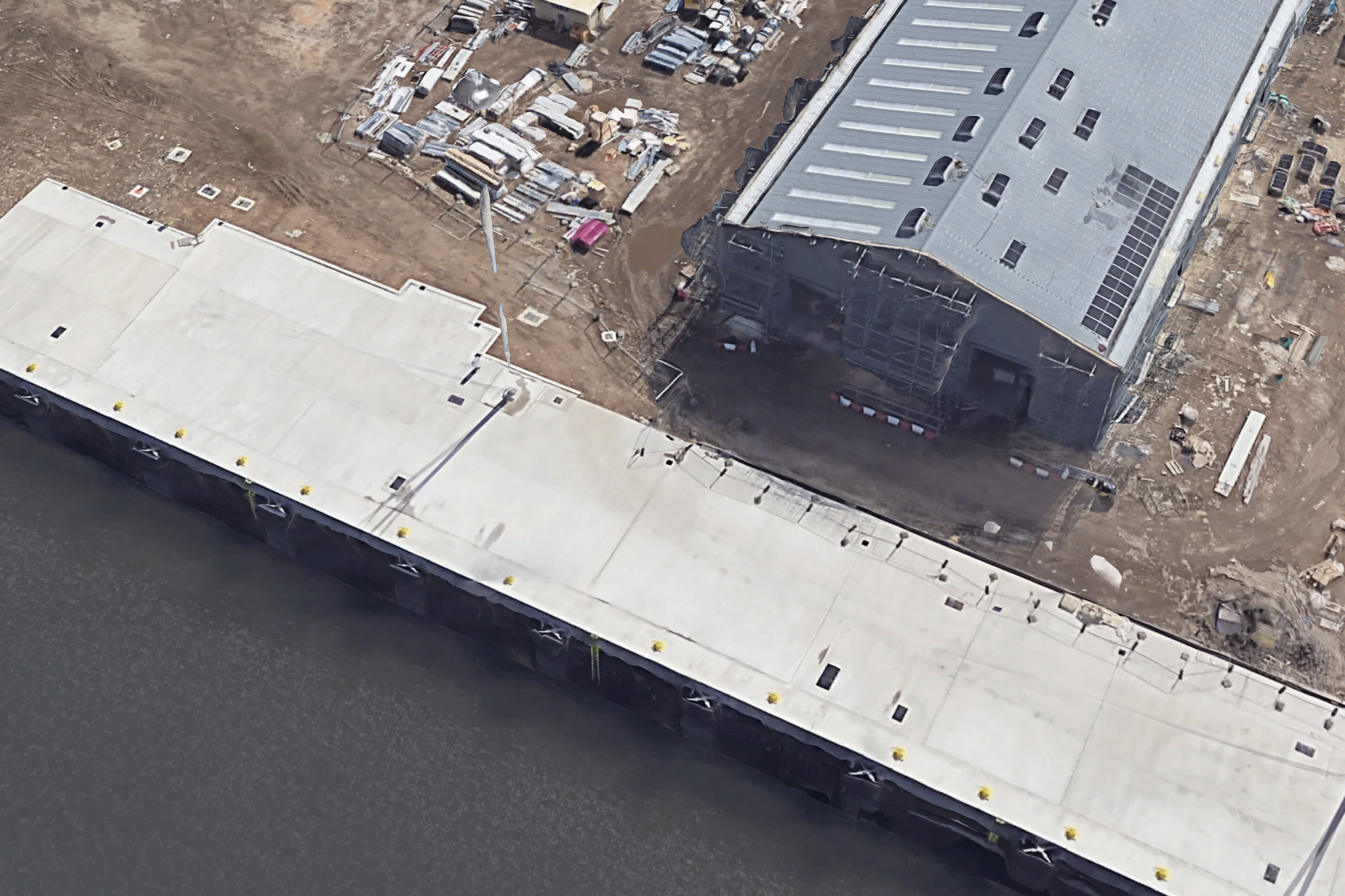
The news item says this about the ownership and operation of the Dogger Bank wind farm.
Dogger Bank Wind Farm is a joint venture between SSE Renewables (40%), Equinor (40%) and Vårgrønn (20%). SSE Renewables is lead operator for the development and construction of Dogger Bank Wind Farm. Equinor will be lead operator of the wind farm on completion for its expected operational life of around 35 years.
Initially, the Port of Tyne base will operate and maintain these wind farms.
- Dogger Bank A – 1235 MW
- Dogger Bank B – 1235 MW
- Dogger Bank C – 1218 MW
This gives a total of 3688 MW.
Note.
- SSE Renewables and Equinor are also developing the 1500 MW Dogger Bank D wind farm.
- This would bring the total up to 5188 MW.
- RWE are also developing the 3000 MW Dogger Bank South wind farm.
Leases were signed for both the Dogger Bank D and Dogger Bank South wind farms in January 2023.
I doubt all of these wind farms will be operated and maintained from the Port of Tyne base, due to the different ownership of Dogger Bank South.
But, I do hope that the facility can be expanded to handle Dogger Bank D.
GE Developing 18 MW Haliade-X Offshore Wind Turbine
The title of this post, is the same as that of this article on offshoreWIND.biz.
This is the sub-heading.
GE could soon join the list of wind turbine manufacturers who have passed the current 15 MW “threshold” by producing and/or announcing more powerful models. According to information recently shared with investors, the US-headquartered company is likely to climb up the offshore wind turbine output ladder, currently led by Chinese OEMs, with an up to 18 MW Haliade-X turbine.
Note.
- GE’s current largest turbine is a 14.7 MW example.
- GE are supplying the 3.7 GW of turbines for the Dogger Bank wind farms.
It does look like GE intend to put the Chinese in their place.
Welsh Government Greenlights Erebus Floating Offshore Wind Farm
The title of this post, is the same as that of this article on offshoreWIND.biz.
This is the sub-heading.
The Welsh Government has granted consent for the country’s first floating offshore wind farm located 40 kilometres off the coast of Pembrokeshire
This is the first paragraph.
Project Erebus will feature seven next-generation 14 MW turbines on floating platforms, providing enough renewable energy to power 93,000 homes.
This near 100 MW project is the first in the Celtic Sea, where there 4 GW are to be installed in the next decade.
This is another paragraph.
Future phases of the development could realise an additional 20 GW of renewable energy, according to the Government.
Wales is not going to be short of energy!
Drax Moves Forward With 600MW Scottish Hydro Scheme
The title of this post, is the same as that of this article on reNEWS.BIZ.
This is the sub-heading.
Studio Pietrangeli has been appointed as owner’s engineer for the project
It looks like this 600 MW project, which will turn Drax’s 440 MW pumped storage hydroelectric power station into 1 GW power station, is finally on its way.
Reading about this project on the Internet, there are still some hurdles to be overcome before the power station is upgraded.
- Planning permission is needed.
- Both the UK and Scottish Governments need to give permission.
- Argyle and Bute Council are not totally behind the project.
My view as a Control Engineer, is that we need it to help balance the grid and allow wind power to play its full part.
Irish Green Hydrogen Could Be Europe’s Cheapest In 2030, Aurora Finds
The title of this post, is the same as that of this article on Renewables Now.
These two paragraphs outline the story.
Ireland could produce the cheapest green hydrogen in Europe by 2030, achieving a levelised cost of EUR 3.50 (USD 3.73) per kg under optimal conditions, Aurora Energy Research said on Tuesday.
This would be 8% below optimal production costs in Spain and 35% below those in Germany, with Ireland’s cost advantage driven by the country’s high wind speeds and rising grid congestion.
Aurora also sees the possibility of exports to Germany before 2030.
X1 Wind’s Floating Prototype Delivers First Power Offshore Canary Islands
The title of this post, is the same as that of this article on offshoreWIND.biz.
This is the sub-heading.
X1 Wind has announced that its floating offshore wind turbine prototype delivered first power to PLOCAN’s smart grid in the Canary Islands, Spain.
The article is based on this news item from X1 Wind, which is entitled X1 Wind’s X30 Floating Wind Prototype Delivers First kWh, which starts with these two paragraphs.
X1 Wind has announced today (MARCH 07) that its X30 floating wind prototype, installed in the Canary Islands, successfully produced its first kWh.
The milestone marks the world’s only floating wind platform currently installed with a TLP mooring system, which dramatically reduces the environmental footprint and improves compatibility with other sea uses. It further heralds Spain’s first floating wind prototype to export electricity via a subsea cable.
Note.
- TLP is short for tension leg platform, which is described in this Wikipedia entry.
- The TLP Wikipedia entry contains a section, which describes their use with wind turbines.
- TLPs have been in use for over forty years, with the first use in the Hutton field in the North Sea.
- TLPs work well for water depths of between 300 and 1,500 metres.
I also suspect there’s a lot of experience from the oil and gas industry around the world about how to deploy TLPs.
The X1 Wind news item also has this paragraph.
The novel X30 platform is equipped with a specially adapted V29 Vestas turbine and ABB power converter. Another key design feature, developed through the EU-backed PivotBuoy Project, combines advantages of SPM and TLP mooring systems. The proprietary SPM design enables the floater to ‘weathervane’ passively and maximise energy yields, with an electrical swivel ensuring electricity transfer without cable twisting. The TLP mooring system also dramatically reduces the seabed footprint, compared to traditional designs proposing catenary mooring lines, minimizing environmental impact while maximizing compatibility with other sea uses, in addition to its suitability to move into deeper waters.
SPM is short for single point mooring, which is described in this Wikipedia entry, where this is the first sentence.
A Single buoy mooring (SrM) (also known as single-point mooring or SPM) is a loading buoy anchored offshore, that serves as a mooring point and interconnect for tankers loading or offloading gas or liquid products. SPMs are the link between geostatic subsea manifold connections and weathervaning tankers. They are capable of handling any tonnage ship, even very large crude carriers (VLCC) where no alternative facility is available.
Note.
- The use of the weathervane in both paragraphs.
- If an SPM can handle a VLCC, it surely can handle a well-designed floating structure with a wind turbine mounted on top.
- I suspect that an SPM used for a wind turbine will be much simpler than one used to load or unload a gas or oil tanker.
As with TLPs, I also suspect there’s a lot of experience from the oil and gas industry, from around the world about how to deploy SPMs.
It looks to me, that X1 Wind have used the proven attributes of SPMs and TLPs to create a simple mooring for a wind turbine, that is designed to align itself with the wind.
X1 Wind Are Open With Their Technology
Today’s news item from X1 Wind also links to two other useful documents.
- X1 Wind Adaptation Of A Vestas V29 Turbine To Downwind Configuration
- X1 Wind Successfully Installs Floating Wind Platform In Spain
They are certainly open with their information.
The news item, also includes this video.
Thoughts
These are some thoughts.
Capacity Factor
The capacity factor of this wind turbine could be an interesting figure.
As the turbine constantly will turn to be downwind, this should maximise the amount of electricity produced over a period of time.
Tetrahedrons
The design is effectively a tetrahedron.
Alexander Graham Bell knew a lot about the properties of tetrahedrons and invented the tetrahedral kite.
This document details Bell’s involvement with tetrahedrons and says this.
Bell found the tetrahedron to have a very good strength to weight ratio.
Put more simply this means that an object is structurally very strong but at the same time very lightweight.
So X1 Wind’s design is probably extremely strong for its weight.
Large Turbines
X1 Wind’s prototype uses a wind turbine of only 225 KW.
Manufacturers are building 15 or 16 MW turbines now and talking of 20 MW in the next few years.
Given the strength of the tetrahedron, I wonder, if it will be possible to build a PivotBuoy, that is capable of hosting a 20 MW wind turbine?
Conclusion
Although it appears radical, it uses proven technology to generate power in an innovative way.
In some ways the thinking behind the design of this floating technology, is a bit like that of Issigonis in his design for the first Mini, where he took proven technology and arranged it differently to perform better.
Ørsted Joins Global Offshore Wind Alliance
The title of this post, is the same as that of this article on offshoreWIND.biz.
This is the sub-heading.
Ørsted has become the first energy company to join the Global Offshore Wind Alliance (GOWA) to support a faster deployment of offshore wind and create a global community of action.
These two paragraphs outline GOWA.
GOWA is a new global organisation that brings together governments, the private sector, international organisations, and other stakeholders to accelerate the deployment of offshore wind power.
The alliance was launched last year at COP27 by the International Renewable Energy Agency (IRENA), the Global Wind Energy Council (GWEC), and the Danish government.
For more information look at the GOWA web-site.

