Ireland’s First Green Hydrogen Project To Come On Stream ‘In Weeks’
The title of this post, is the same as that of this article on the Irish Times.
This is the first two paragraphs.
Belfast is set to receive Ireland’s first hydrogen-powered double-decker buses in coming weeks using fuel coming from wind energy generated in nearby north Antrim.
The initiative is the first “green hydrogen” project on the island of Ireland and the first step to decarbonise Northern Ireland’s public transport by 2040, according to Mark Welsh, energy services manager with Energia, which is generating the hydrogen at its wind farm near Ballymena.
Green hydrogen is produced by an electrolyser powered by renewable electricity.
The article gives a good summary of the use of hydrogen in Ireland in the future.
But isn’t all hydrogen created and used on the island of Ireland green?
Could A Gravitricity Energy Storage System Be Built Into A Wind Turbine?
On Thursday, I watched the first programme in a BBC series called Powering Britain. This programme was about wind power.
The program had close-up views of the inside of a turbine tower in the Hornsea Wind Farm in the North Sea. The spacious tower enclosed a lift for engineers to access the gubbins on the top.
In the Wikipedia entry for wind turbine, there is a section, with is entitled Most Powerful, Tallest, Largest And With Highest 24-Hour Production, where this is said.
GE Wind Energy’s Haliade-X is the most powerful wind turbine in the world, at 12MW. It also is the tallest, with a hub height of 150 m and a tip height of 260m. It also has the largest rotor of 220 m and largest swept area at 38000 m2. It also holds the record for the highest production in 24 hours.
Two certainties about wind turbines are that they will get larger and more powerful, if the progress over the last few years is continued.
So could a Gravitricity energy storage system be built into the tower of the turbine?
A lot would depend on the structural engineering of the combination and the strength of the tower to support a heavy weight suspended from the top, either inside or even outside like a collar.
To obtain a MWh of storage, with a height of 150 metres, would need a weight of 2,500 tonnes, which would be over three hundred cubic metres of wrought iron.
Gravitricity are talking of 2,500 tonnes in their systems, but I suspect the idea of a wind turbine, with a practical level of storage inside the tower, is not yet an engineering possibility.
Are Floating Wind Farms The Future?
Boris Johnson obviously thinks so, as he said this about floating wind farms at the on-line Tory conference today.
We will invest £160m in ports and factories across the country, to manufacture the next generation of turbines.
And we will not only build fixed arrays in the sea; we will build windmills that float on the sea – enough to deliver one gigawatt of energy by 2030, 15 times floating windmills, fifteen times as much as the rest of the world put together.
Far out in the deepest waters we will harvest the gusts, and by upgrading infrastructure in such places as Teesside and Humber and Scotland and Wales we will increase an offshore wind capacity that is already the biggest in the world.
Just because Boris said it, there is a large amount of comment on the Internet, describing everything he said and floating wind turbines as utter crap.
Wikipedia
The Wikipedia entry for floating wind turbines is particularly informative and gives details on their history, economics and deployment.
This is a paragraph from the Wikipedia entry.
Hywind Scotland has 5 floating turbines with a total capacity of 30 MW, and operated since 2017. Japan has 4 floating turbines with a combined 16 MW capacity.
Wikipedia also has an entry for Hywind Scotland, which starts with this sentence.
Hywind Scotland is the world’s first commercial wind farm using floating wind turbines, situated 29 kilometres (18 mi) off Peterhead, Scotland. The farm has five 6 MW Hywind floating turbines with a total capacity of 30 MW. It is operated by Hywind (Scotland) Limited, a joint venture of Equinor (75%) and Masdar (25%)
Wikipedia, also says this about the performance of Hywind Scotland.
In its first two years of operation the facility has averaged a capacity factor in excess of 50%.
That is good performance for a wind farm.
Hywind
There is more about Hywind on this page of the Equinor web site, which is entitled How Hywind Works.
This is the opening paragraph.
Hywind is a floating wind turbine design based on a single floating cylindrical spar buoy moored by cables or chains to the sea bed. Its substructure is ballasted so that the entire construction floats upright. Hywind combines familiar technologies from the offshore and wind power industries into a new design.
I’ve also found this promotional video on the Equinor web site.
Note that Statoil; the Norwegian government’s state-owned oil company, was renamed Equinor in 2018.
Balaena Structures
In the early 1970s, I did a lot of work for a company called Time Sharing Ltd.
At one point, I ended up doing work for a company in Cambridge started by a couple of engineering professors at the University, which was called Balaena Structures.
They had designed a reusable oil platform, that was built horizontally and then floated out and turned vertically. They couldn’t work out how to do this and I built a mathematical model, which showed how it could be done.
This is said about how the Hywind turbines are fabricated.
Onshore assembly reduces time and risk of offshore operations. The substructures for Hywind Scotland were transported in a horizontal position to the onshore assembly site at Stord on the west coast of Norway. There, the giant spar-structures were filled with close to 8000 tonnes of seawater to make them stay upright. Finally, they were filled with around 5500 tonnes of solid ballast while pumping out approximately 5000 tonnes of seawater to maintain draft.
It sounds like Statoil and Equinor have followed the line of thinking, that I pursued with the Cambridge team.
My simulations of oil platforms, involved much larger structures and they had some other unique features, which I’m not going to put here, as someone might give me a nice sum for the information.
Sadly, in the end Balaena Structures failed.
I actually proposed using a Balaena as a wind power platform in Could a Balaena-Like Structure Be Used As a Wind Power Platform?, which I wrote in 2011.
I believe that their designs could have transformed the offshore oil industry and could have been used to control the Deepwater Horizon accident. I talked about this in The Balaena Lives, which again is from 2011.
Conclusion
It is my view, that floating wind farms are the future.
But then I’ve done the mathematics of these structures!
Did Boris’s advisors, as I doubt he knows the mathematics of oblique cylinders and how to solve simultaneous differential equations, do the mathematics or just read the brochures?
I will predict, that today’s structures will look primitive to some of those developed before 2030.
Ulstein Designs Hydrogen Powered Wind Turbine Installation Vessel
The title of this post, is the same as that of this article on 4c Offshore.
This is the introductory paragraphs.
Ulstein has revealed its second hydrogen hybrid design for the offshore wind industry, the ULSTEIN J102 zero emission wind turbine installation vessel (WTIV). The shipbuilders claim the vessel can operate 75% of the time in zero emission mode. Using readily available technology, the additional cost is limited to less than 5% of the total CAPEX.
Most new jack-up designs are featuring a battery hybrid system in addition to diesel gen sets, with a future option for hydrogen powered fuel cell system. Ulstein stated that the down side of a high-power battery energy storage system (BESS) is its heavy weight and cost.
The article shows how hydrogen could be the power source for large specialist equipment.
Ulstein are a Norwegian company.
New Transmission Technology Is Helping UK Offshore Wind Farms Go Bigger, Farther
The title of this post, is the same as that of this article on Reve.
It is rather technical, but it describes how the electricity is brought onshore from the 1.4 GW Sofia wind-farm, which is being built 220 kilometres out in the North Sea on the Dogger Bank. where upwards of 5 GW of capacity is proposed.
New lighter equipment is being used to convert the electricity to and from DC to bring it ashore at Lazenby, on Teesside. Note that sub-sea electricity links usually use high-voltage direct current or HVDC, The equipment has been designed and built by GE in Stafford.
It looks like the North East of England will have enough power.
The North Sea Wind Power Hub
The North Sea Wind Power Hub, will lie to the East of the UK capacity on the Dogger Bank in European territorial waters. This is the introductory paragraph from Wikipedia.
North Sea Wind Power Hub is a proposed energy island complex to be built in the middle of the North Sea as part of a European system for sustainable electricity. One or more “Power Link” artificial islands will be created at the northeast end of the Dogger Bank, a relatively shallow area in the North Sea, just outside the continental shelf of the United Kingdom and near the point where the borders between the territorial waters of Netherlands, Germany, and Denmark come together. Dutch, German, and Danish electrical grid operators are cooperating in this project to help develop a cluster of offshore wind parks with a capacity of several gigawatts, with interconnections to the North Sea countries. Undersea cables will make international trade in electricity possible.
So will the connection to Lazenby, also be used to bring electricity from the North Sea Wind Power Hub to the UK, when we need it? And will electricity from our part of the Dogger Bank be exported to Europe, when they need it?
The North Sea Intranet of electricity is emerging and it could be one of the biggest factors in the decarbonisation of Western Europe.
The technology developed at Stafford, will be needed to support all this zero-carbon electricity.
Gresham House Energy Storage Fund Has Staying Power
The title of this post, is the same as that of this article in the Tempus column of The Times.
It is a good explanation of how energy storage funds like Gresham House work.
I believe they are very much the future.
Some of the new forms of energy storage, that I talk about on this blog tick all of the boxes and may even satisfy an extreme supporter of Extinction Rebellion.
- Extremely environmentally friendly.
- Higher energy-density than lithium-ion
- Lower cost per GWh, than lithium-ion
- Much longer life than lithium-ion.
- Safe to install in built up areas.
- GWh-scale storage in a football pitch space or smaller.
The UK’s largest battery is the 9.1 GWh Electric Mountain pumped storage system in Snowdonia and there is talk about over 100 GW of offshore wind turbines in UK waters. There will be masses of energy storage built in the UK in the next forty years to support these wind turbines.
Conclusion
Companies like Gresham House Energy Fund seem to have developed a model, that could provide the necessary energy storage and a safe reliable home for the billions of pounds in the UK, that is invested in pension funds.
Lithium-ion batteries will be reserved for mobile applications.
Germany Builds The World’s First Hydrogen Train Filling Station
The title of this post, is the same as that of this article on electrek.
Hydrogen Trains In Germany
The hydrogen filling station for trains is described under this heading.
This is the introductory paragraph.
The town of Bremervörde in Lower Saxony, Germany, has broken ground on the world’s first hydrogen filling station for passenger trains. Chemical company Linde will construct and operate the hydrogen filling station for the Lower Saxony Regional Transport Company.
It will provide approximately 1600 Kg of hydrogen per day.
The Supergroup Of ‘Green Energy’
This is a second section, which I find an interest sting concept.
These are the introductory paragraphs.
Oil giant Shell and Dutch utility Eneco have won the tender to build a super-hybrid offshore wind farm in the Netherlands. It will consist of two sites located 11.5 miles (18.5 km) off the west coast, near the town of Egmond aan Zee.
The Shell/Eneco consortium, CrossWind, will build the Hollandse Kust (noord) project. They will pair the offshore wind farms with floating solar facilities and short-duration batteries. It will also generate green hydrogen via an electrolyzer, according to GreenTech Media.
It will be operational in 2023 and have an output of 759 MW.
Beeching Reversal – South Fylde Line Passing Loop
This is one of the Beeching Reversal projects that the Government and Network Rail are proposing to reverse some of the Beeching cuts.
The Project
This project is described on this page on the web site of the Fylde MP; Mark Menzies, which is entitled Improving The South Fylde Rail Line.
The page lists that these improvements are needed.
Track And Stations
These improvements are listed for track and stations.
The bid involves laying around three miles of track between Lytham and St Annes stations, the creation of a new rail platform at Ansdell and Fairhaven Station, the installation of signalling along the line, and potential platform changes at Preston Station. There is scope for improvements to St Annes and Lytham Stations, should Network Rail decide it would rather include those stations within the passing loop – but that would be decided further along the process.
Services
The objective is to be able to run two trains per hour (tph) between Preston and Blackpool South stations.
Trains
Better trains are needed.
It certainly looks like the Pacers have already gone.
The Route
I shall describe the current route in this section.
Blackpool South Station
The Google Map shows Blackpool South station.
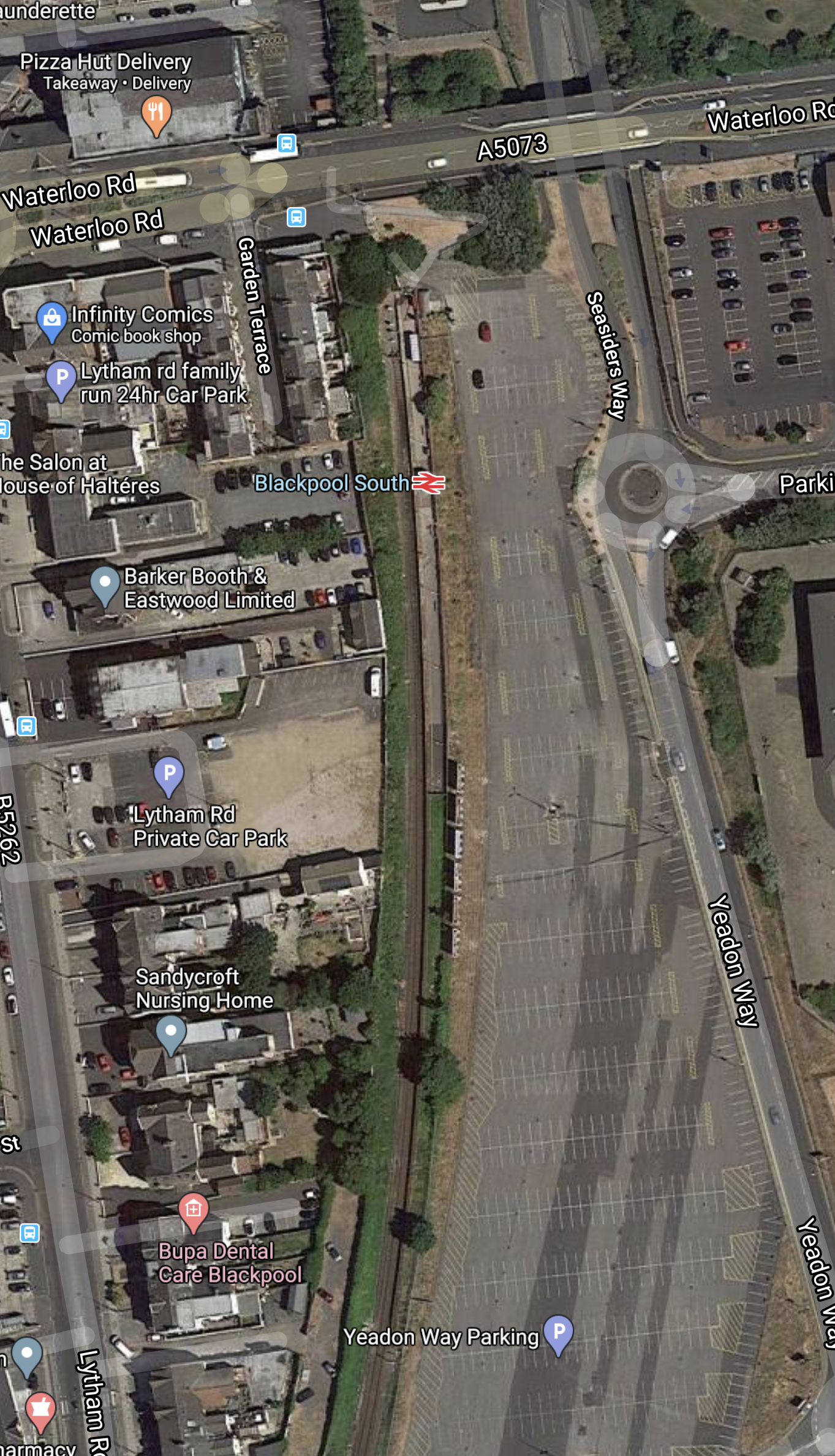
Note.
- Entrance to the station is from Waterloo Road, which runs East-West across the map.
- There are a pair of bus stops by the station entrance.
- There is a lot of car parking close to the station.
- I suspect that the single platform can hold a modern eighty-metre four-car train.
- This seventy-year-old has no difficulty waking to the football ground or the Blackpool trams from the station.
With two tph and some updated facilities, this would be a very useful station.
I suspect there is even space to add a second platform in the future, if that were felt to be necessary.
Blackpool Pleasure Beach Station
This Google Map shows Blackpool Please Beach station and the nearby Pleasure Beach.
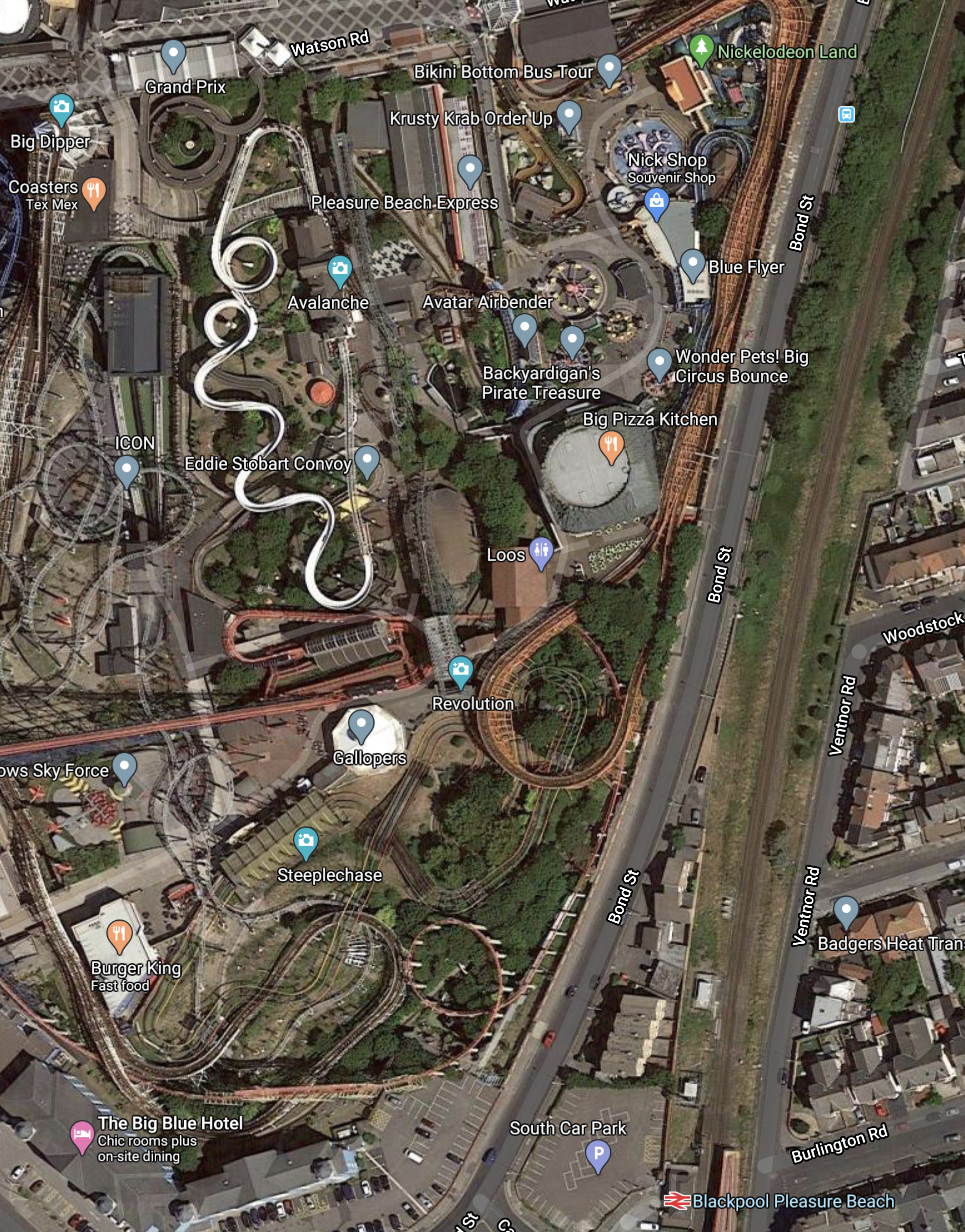
We shouldn’t underestimate the importance of this station. One beautiful late summer Saturday, I was going to see Ipswich play at Blackpool and out of curiosity I had explored the train to Colne station. In those days a decade ago, Colne and Blackpool South was one service and the train from Colne was full of families, by the time it got to Preston. A large proportion, left the train at the Pleasure Beach.
The conductor told me, that the crowds, I had witnessed weren’t untypical.
Squires Gate Station and Blackpool Airport
This Google Map shows Squires Gate station and the nearby Blackpool Airport.
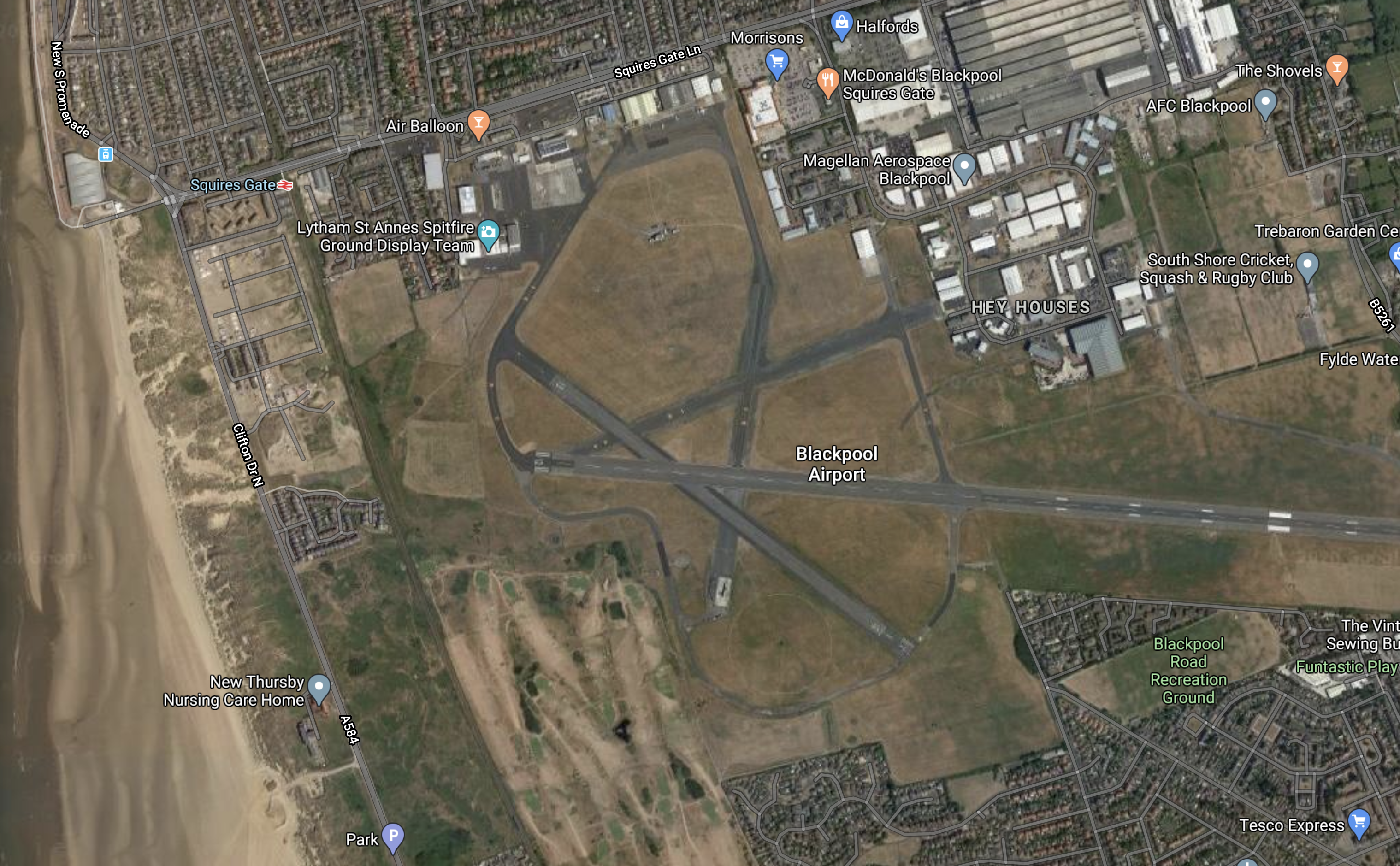
Blackpool Airport after a troubled few years seems to be finding a niche market, with a few business, commercial, offshore and training flights.
But I believe that airports like Blackpool in the future can develop another large niche – electric aviation.
Getting to places like Ireland, Northern Ireland, the Isle of Man and Wales by a nineteen-seat electric airliner will need the following.
- As short a flight as possible.
- Close to the coast would help.
- Good public transport links. Blackpool Airport has both tram and train.
- Space for aircraft to be parked, whilst charging.
- Plentiful supplies of renewable electricity. The over-300 MW Burbo Bank Wind Farm is not far away in Liverpool Bay and it will only be joined by more and larger wind farms.
- Frequent public transport.
Blackpool Airport could tick all these boxes, with a thick green marker.
Some example direct distances from Blackpool include
- Aberdeen – 238 miles
- Amsterdam Schipol – 340 miles
- Belfast City – 128 miles
- Cardiff – 165 miles
- Dublin – 134 miles
- Edinburgh – 150 miles
- Exeter – 211 miles
- Geneva – 661 miles
- Glasgow – 155 miles
- London Gatwick – 220 miles
- London Heathrow – 192 miles
- London Southend – 219 miles
- Newcastle – 89 miles
- Paris Orly – 422 miles
- Isle of Man Ronaldsway – 68 miles
- Southampton – 208 miles
These distances fit nicely with the range of the nine-seater Eviation Alice electric aircraft, which is predicted to be 620 miles.
St. Annes-on-the-Sea Station
This Google Map shows St. Annes-on-the-Sea station.
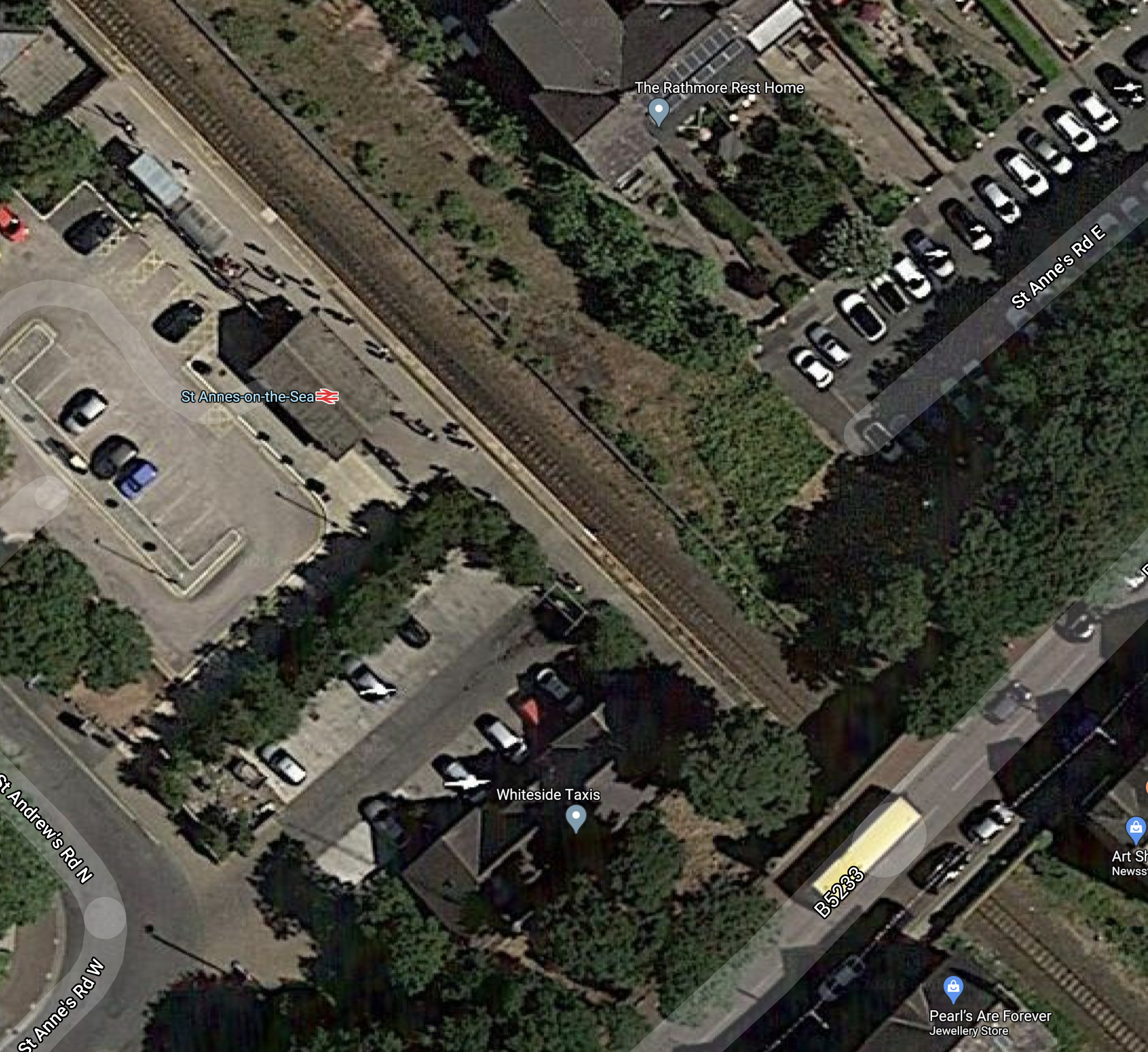
Note.
- Blackpool is to the North-West and Preston is to the South-East
- St. Annes-on-the-Sea is one of those convenient single-platform stations, where you just walk in-and-out on the level.
- The passing loop would start on the Preston side of the bridge.
There would need to be no major infrastructure work at the station, although I would expect the facilities could do with a makeover.
Ansdell And Fairhaven Station
In Should The Blackpool South Branch Be Electrified?, I said this about improvements to Ansdell and Fairhaven station.
Ansdell and Fairhaven station is nearest to the course at Royal Lytham.
-
- The Open Championship is a very important event on the golfing calendar.
- Other important golfing events are also held on the course
- Royal Lytham and St.Annes, last held the Open in 2012 and 2001. So it might come back to Royal Lytham in the mid-2020s.
Ansdell and Fairhaven station used to have two platforms, as described in Wikipedia.
The station was set out as an island platform with tracks on both faces until the singling of the line in the 1980s. Trains now only use the southern face. A disabled access ramp now covers the northern part of the station.
So could a rebuild of the station do the following?
-
- Restore two platforms on an island at the station.
- Put in full disabled access.
- Create a passing loop.
- Longer platforms might be a good idea.
This Google Map shows the station.
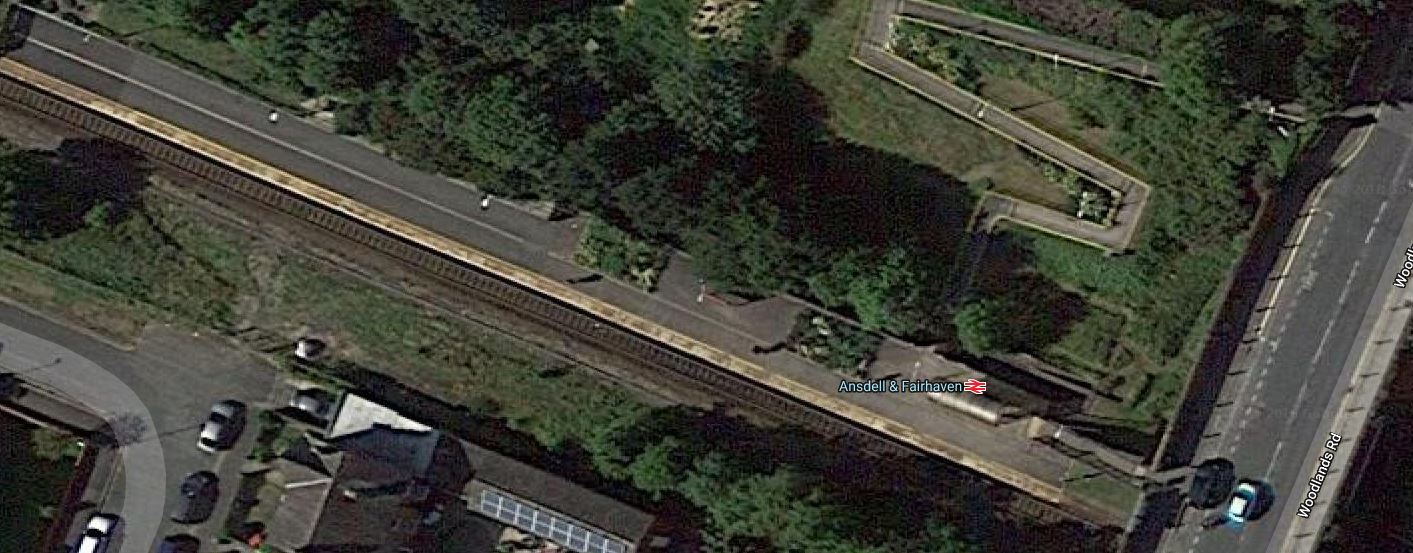
Note.
-
- The disabled ramp winding away.
- The platform is probably about a hundred metres long.
- It would appear that there is space at the far end to extend the platform.
I suspect that an ambitious architect with vision, could design a station that met all objectives.
It could be the best Championship Golf Course railway station in the world.
Lytham Station
This Google Map shows Lytham station.
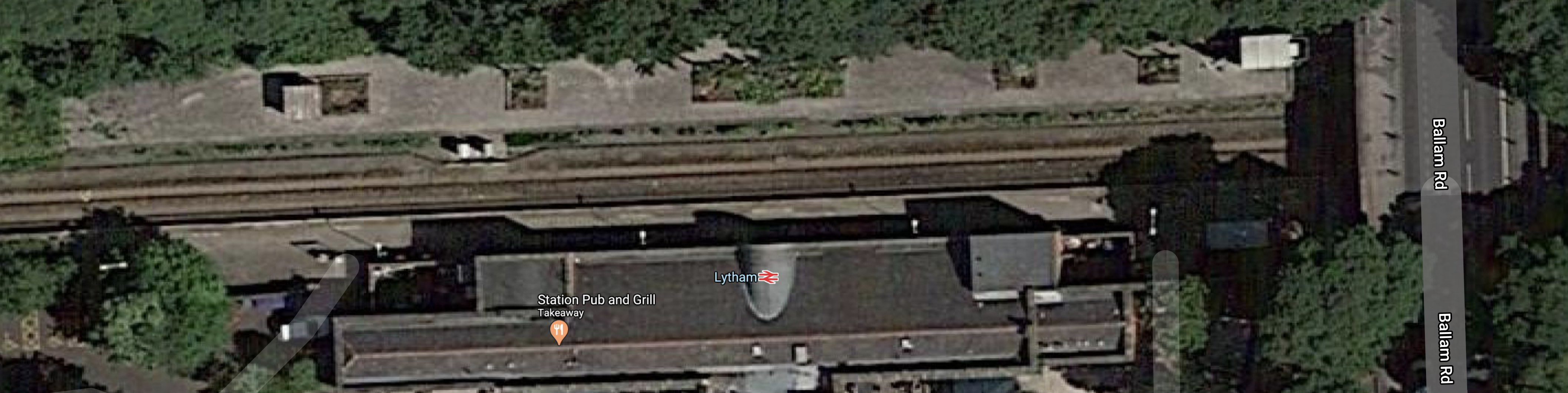
Lytham station will be the Eastern end of the loop and it is likely, that the single-track will change to double at the Western end of the station.
As with St. Annes-on-the-Sea station, I suspect that a good makeover, will be all that will be needed.
Moss Side Station
This Google Map shows Moss Side station.
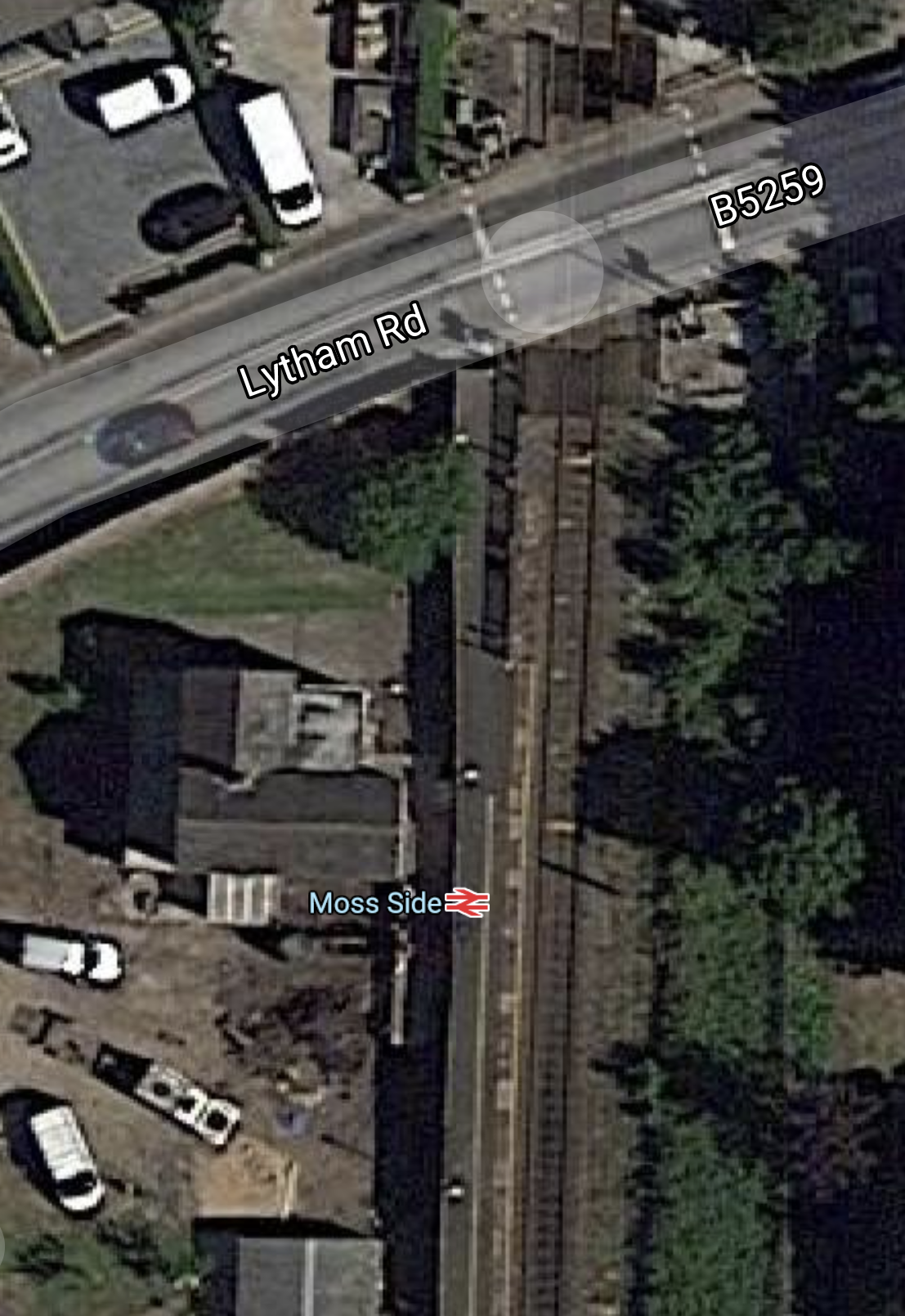
The only problem here is the level crossing, so do Network Rail want to remove it?
Kirkham And Wesham Station
This Google Map shows Kirkham and Wesham station.
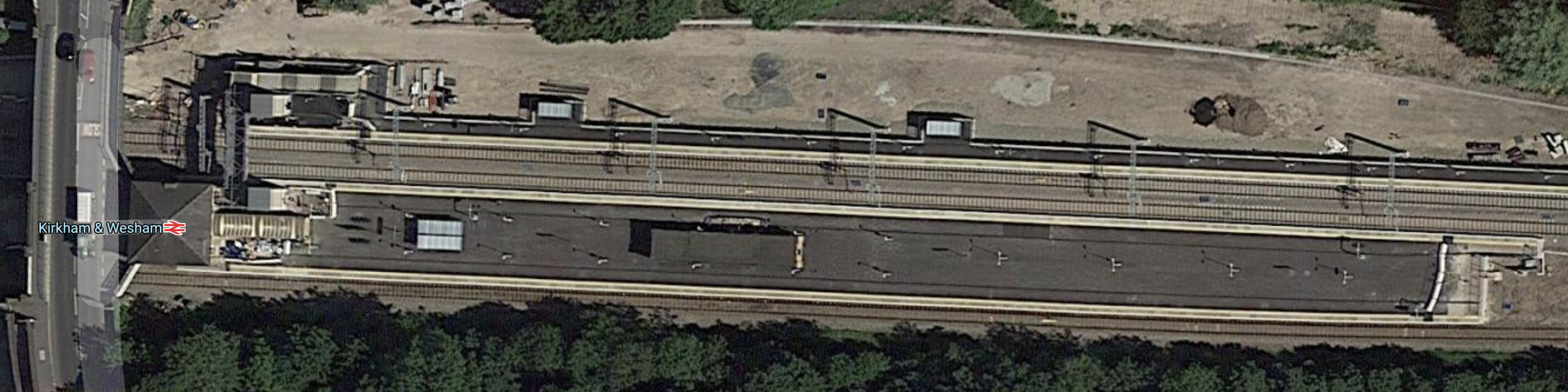
There are three platforms, which from bottom to top on the map are.
- Platform 1 – Trains to Blackpool South
- Platform 2 – Trains to Blackpool North
- Platform 3 – Trains to Preston
All platforms seem to be being electrified in these pictures. that I took during construction.
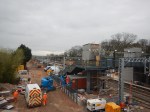
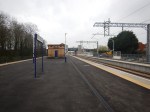





Note.
- It can’t be described as a station, built down to a small budget.
- In the captions to the pictures, I’ve numbered the platforms from left to right.
- The last picture looks down Platform 1 and there is an electrification gantry at the Preston end.
Could this comprehensive electrification be so that trains to Blackpool North can use both Platforms 1 and 2?
- This would allow overtaking of say a local train by a London express.
- Trains could also be turned back in Platform 1, before the end of its journey, if there was a problem.
- The electrification is also substantial enough for the longest Class 390 trains.
- It could even accommodate a classic compatible High Speed Two train.
So does the last point, mean that Blackpool North station is a possible High Speed Two destination? Provided, the platforms at Blackpool North station are long enough, I think it does!
This Google Map shows Kirkham West Junction, where trains to Blackpool North and Blackpool South stations diverge.
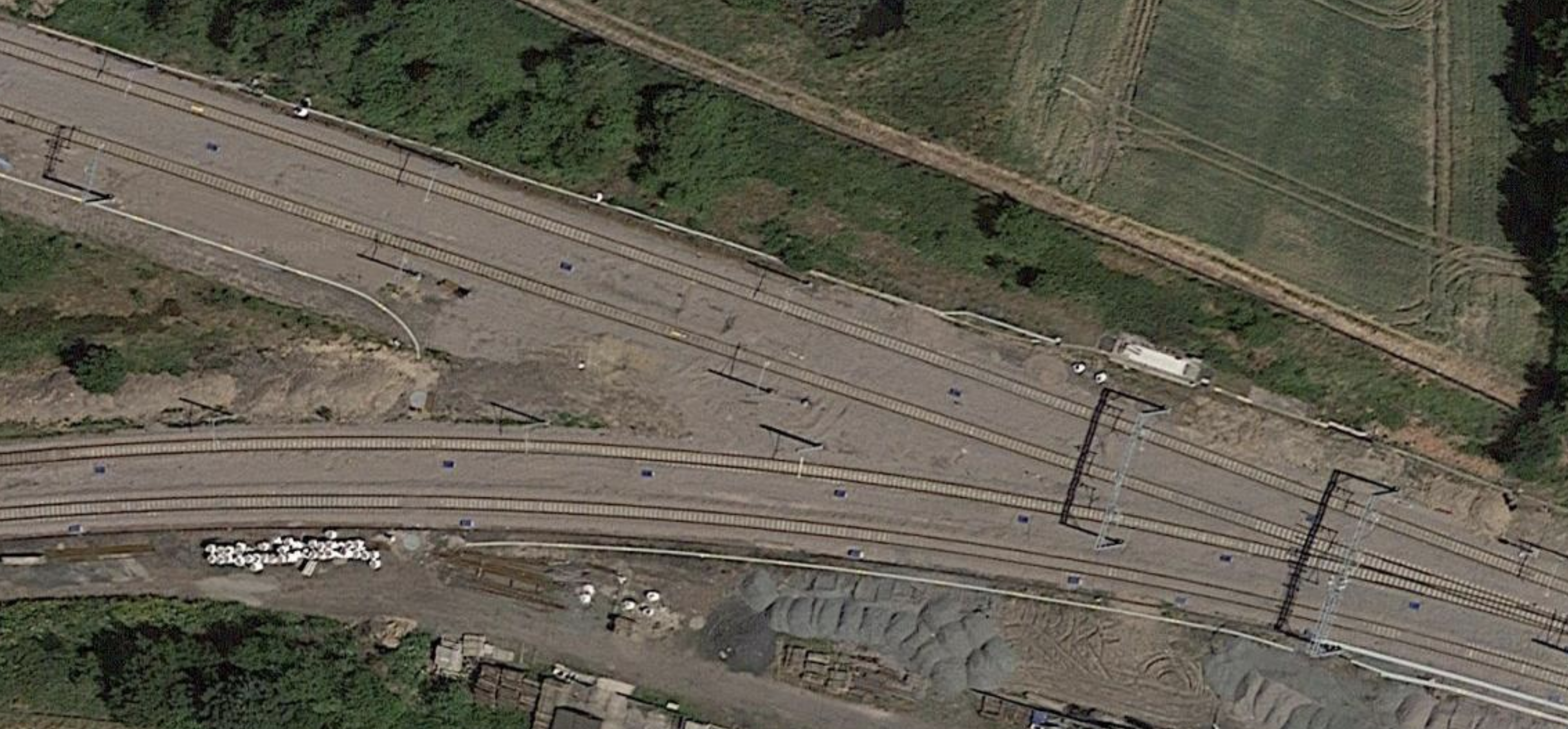
Note.
- The electrification gantries and their shadows can be seen.
- Preston is to the South-East and the route is fully-electrified.
- Blackpool North is to the North-West and the route is fully-electrified.
- Blackpool South is to the West. The double-track becomes single before Moss Side station.
This picture shows the route going off to Blackpool South.
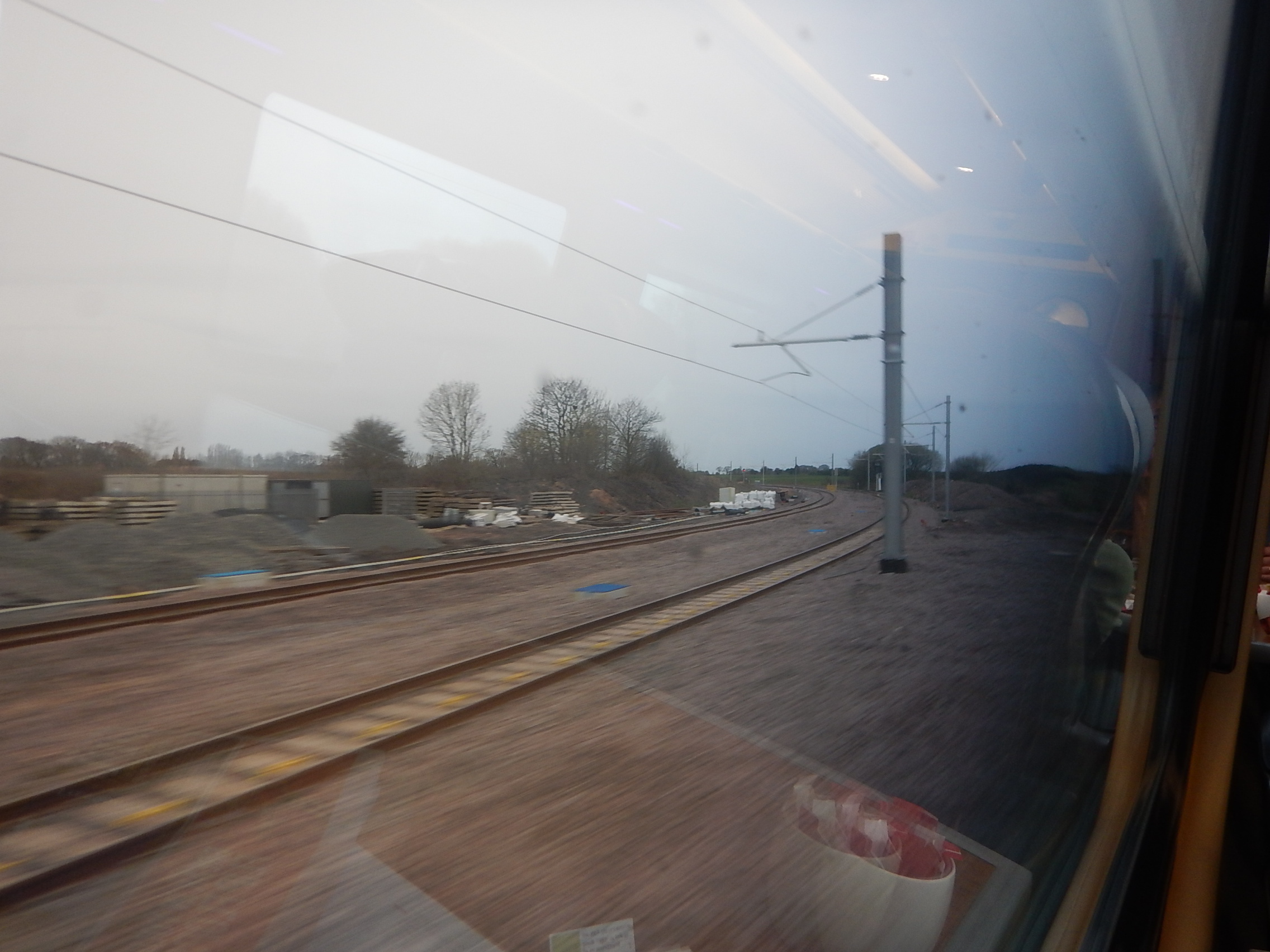
I took the picture from a train going to Blackpool North station.
So why are wires being run along the first few hundred metres of the Blackpool South Branch?
The Timetable
Currently, trains take the following times to do these journey legs.
- Run between Ansdell and Fairhaven and Blackpool South stations – 12 minutes
- Turnback at Blackpool South station – 3 minutes
- Run between Blackpool South and Ansdell and Fairhaven stations – 11 minutes
As the trains will be running every thirty minutes and the three legs total twenty-six minutes, that means there’s four minutes float.
So hopefully, it should be easily stainable, by an experienced rail timetable creator.
The Trains
I have remarked that I find the electrification at Kirkham & Wesham station, both comprehensive and slightly unusual.
Could The Electrification Have Been Designed For Battery Electric Trains To Blackpool South Station?
But there is one very plausible reason for the electrification layout – The Blackpool South Branch has been designed, so that services on the branch can be rum using battery trains.
- The distance between Kirkham & Wesham and Blackpool South stations is just over eleven miles.
- So for a round trip a range of perhaps twenty-five miles on battery power would suffice.
- There would also be a need for a few minutes of hotel power, whilst waiting at Blackpool South station.
These power needs are well within the capabilities of the average battery train.
- Trains could be charged on the nine minute run between Preston and Kirkham & Wesham stations.
- Changeover between electrification and battery power would take place in Kirkham & Wesham station.
An ideal train would surely be CAF’s four-car battery electric version of the Class 331 train, which I wrote about in Northern’s Battery Plans.
- According to an article in the March 2020 Edition of Modern Railways, with the same name, these trains will be working between Manchester Airport and Windermere.
- Class 331 trains without batteries will be running to and from Blackpool North station.
- Four-car trains are probably the right size for the route.
There would also probably be no need for a charging station at Blackpool South station, if trains could leave Kirkham & Wesham station with a full battery.
Where Would The Trains Terminate In The East?
These would be the obvious choices.
- Blackburn – Where there is a convenient bay platform.
- Colne – Where they used to terminate!
- Liverpool – Merseyrail has the trains and Liverpool has lots of punters and the imagination.
- Preston – Where they do now!
- Skipton – If the Skipton-Colne Link is built!
My money would be on Skipton, using a new Skipton-Colne Link, for the following reasons.
- Politicians of all colours and roses are in favour.
- Skipton has an electrified route to Leeds.
- Skipton-Colne would be a valuable by-pass route during the building of Northern Powerhouse Rail.
- Battery-powered trains would be ideal for Skipton-Colne.
Would A Battery Electric Train Be Feasible Between Blackpool South And Liverpool?
Consider.
- An all-stations service would complement the fast service between Liverpool Lime Street and Blackpool North stations via St. Helens, Wigan North Western and Preston.
- The service could either go between Liverpool and Preston via Ormskirk or Southport and a reinstated Burscough Chord.
- The Ormskirk route is 15 miles of unelectrified line and the Southport route is just four miles further.
- A service via Southport would need to reverse at Southport station.
- The service would be run using dual-voltage Class 777 trains fitted with batteries.
- 25 KVAC overhead electrification, is already installed between Preston and Kirkham & Wesham stations,
- Using existing electrification, trains would leave Kirkham & Wesham, Ormskirk, Preston and Southport stations with full batteries.
- A coastal service between Blackpool and Liverpool would surely attract visitors.
- Liverpool and Blackpool are the two biggest urban areas on the coast.
- There are several golf courses on the route, including three courses that have held the Open; Royal Birkdale, Royal Liverpool and Royal Lytham & St. Annes.
It may be a bit fanciful. But.
- Merseyrail will have the trains.
- Liverpool has the potential passengers.
- I believe the route could handle a two tph service.
- In Reopen Midge Hall Station, I showed that it was possible to run a two tph service between Liverpool and Preston, with one tph via each of Ormskirk and Southport.
Liverpool also has bags of ambition and imagination.
Would A Battery Electric Train Handle Preston And Skipton?
I estimate that this route is forty-one miles, with a stiff rise from Rose Grove to Colne station.
So would a battery electric train be able to handle this distance?
Hitachi are talking 56 miles for their Regional Battery Train, so I suspect CAF would want and need to be competitive with a similar specification.
Perhaps the logical service would be to run between Leeds and Blackpool South.
- The service would go via Preston, Blackburn, Burnley Central, Colne and Skipton.
- Leeds and Skipton is electrified.
- Preston and Kirkham & Wesham is electrified.
- No extra chargers for trains would be needed.
The only new infrastructure needed would be the Skipton and Colne Link.
Electrification Between Preston And Blackburn
Consider.
- In Colne – Skipton Reopening Moves Closer, I talked about the proposed Huncoat Rail Fright Terminal, that could be built North of Blackburn on the East Lancashire Line.
- Blackburn is a major hub for passenger services.
- An electrified Blackburn would allow Manchester and Clitheroe to be run by battery electric trains. Clitheroe is ten miles and Bolton is thirteen.
- An electrified Blackburn would allow Blackburn and Manchester Victoria via the Todmorden Curve to be run by battery electric trains. The whole route is 39.5 miles.
- It may be possible for battery electric trains to reach Leeds via Hebden Bridge, as it is only fifty miles away, which is within Hitachi’s range.
- As the Blackburn area grows, there will be more pressure for a daily London service.
- Some think, the Calderdale route should be electrified.
- Preston and Blackburn stations are just twelves miles apart.
- There is a multiple unit depot at Blackburn.
- I also feel that battery electric trains fanning out from Blackburn, wouldn’t do the town’s image any harm.
For all these reasons, I wouldn’t be surprised to see a short stretch of electrification added between Preston and Blackburn.
Conclusion
I like this proposal and it could be a big asset to trains across the Pennines.
Keadby 3 Low-Carbon Power Station
This article on Business Live is entitled Huge Green Power Station Proposed By SSE As It Embraces Hydrogen And Carbon Capture.
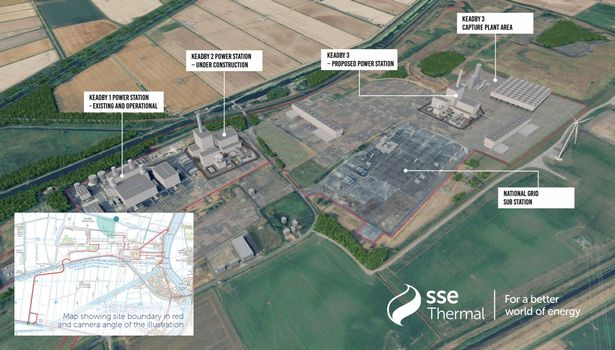
SSE Thermal is working on a low-carbon 910 MW gas-fired power station to join Keadby and Keadby 2 power stations in a cluster near Scunthorpe.
A spokesman for SSE is quoted as saying they will not build the plant without a clear route to decarbonisation.
On this page of their web site, SSE Thermal, say this about Keadby 3.
As part of our commitment to a net zero emissions future, Keadby 3 will only be built with a clear route to decarbonisation, either using hydrogen as a low-carbon fuel, or equipping it with post-combustion carbon capture technology. The project is at the early stages of development and no final investment decision has been made.
It should also be noted that SSE Renewables have also built a wind farm at Keadby. The web site describes it like this.
Keadby Wind Farm is England’s largest onshore wind farm. This 68MW renewable energy generation site can power approximately 57,000 homes.
There are a lot of good intentions here and I think that SSE haven’t disclosed the full picture.
It would seem inefficient to use hydrogen to power a gas-fired power station to achieve zero-carbon power generation.
- If you are using hydrogen created from steam reforming of methane, this creates a lot of carbon-dioxide.
- If you are using green hydrogen produced by electrolysis, then, why don’t you store the electricity in a battery?
Perhaps, SSE are trying out a new process?
This Google Map shows the area of Keadby to the West of Scunthorpe.
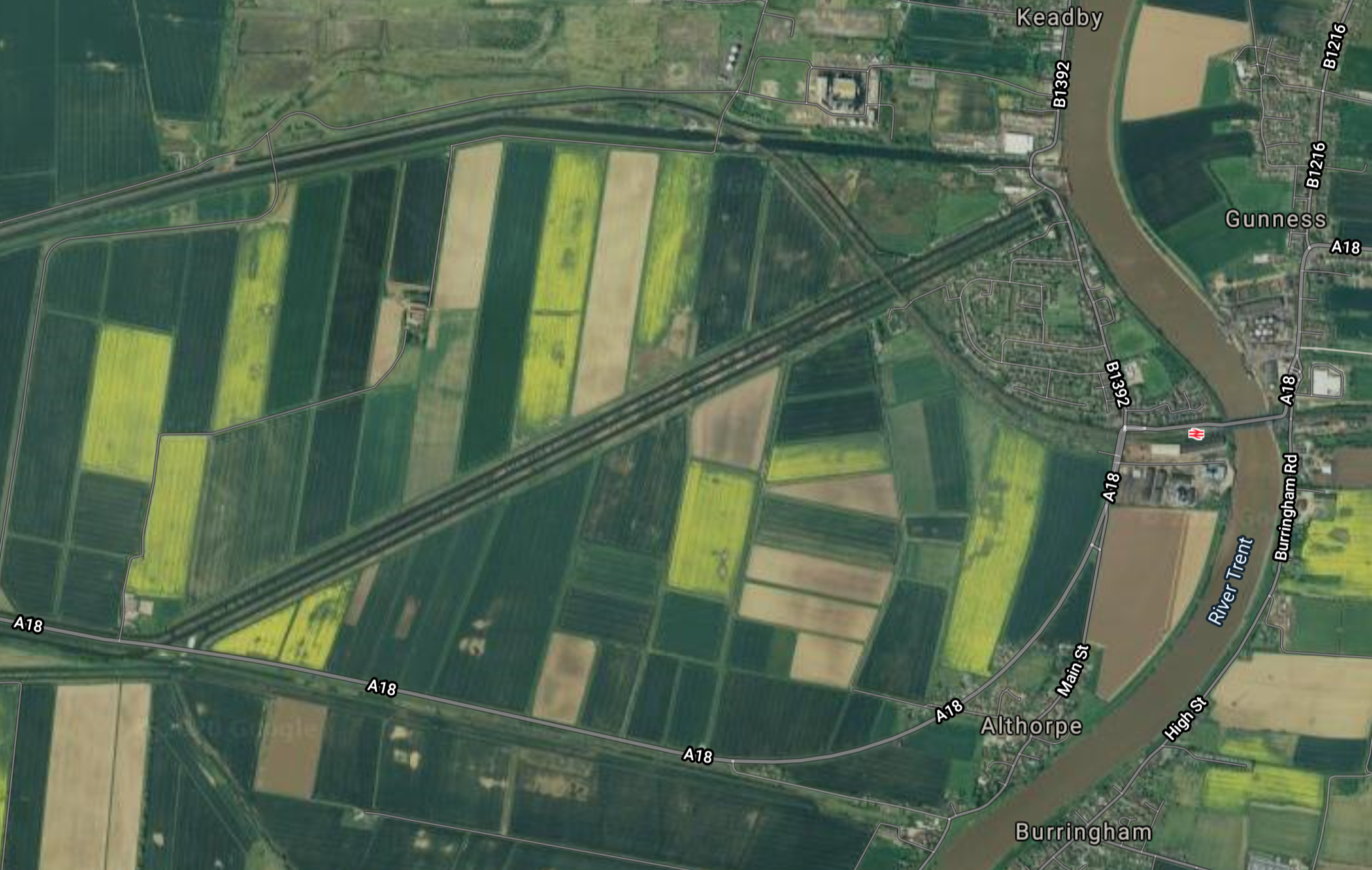
Note.
- The River Trent meandering through the area.
- Althorpe station is in the bend of the River,
- I’m fairly certain, that I remember an old airfield in the area.
- Keadby power station is a bit to the North of the waterway running West from the River and close to where the railway crosses the waterway.
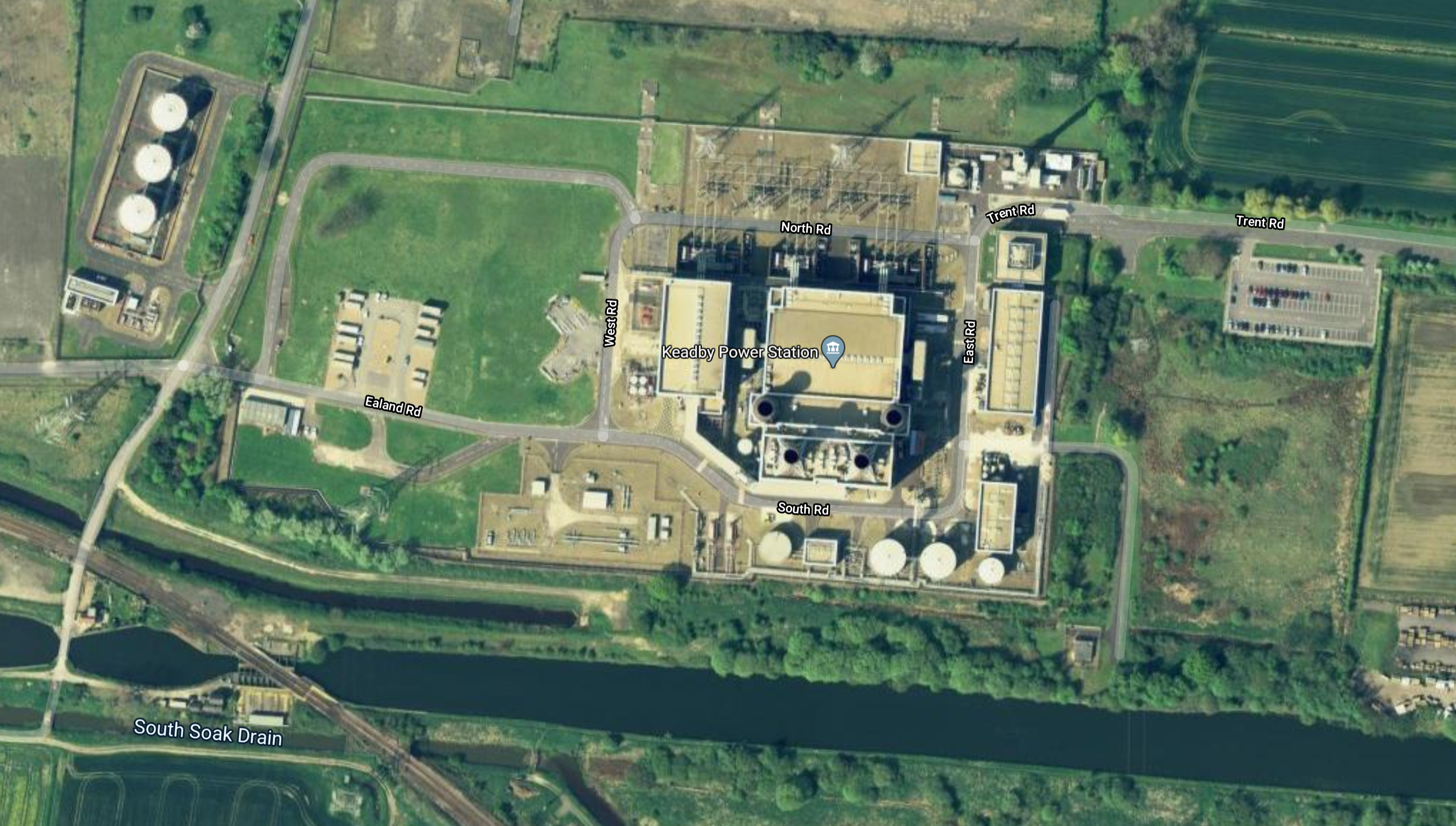
This second Google Map shows a close-up of the power station.
This visualisation from SSE Thermal shows how the site might look in the future.
For me the interesting location is the village of Althorpe, where C and myself had friends.
They were always getting tourists arriving in the village looking for Princess Diana’s grave!
Carbon Capture And Storage At Keadby
If SSE have three large power stations at Keadby, a shared carbon capture and storage system could be worthwhile.
- There are numerous gas fields in the area and a big gas terminal at Theddlethorpe, to where they all connect.
- I was surprised to see, that one of thee fields; Saltfleetby is owned by President Putin’s favourite gas company; Gazprom.
- Some of these fields are actually on-shore.
- The power stations probably get their gas from the same terminal.
Some of these gas fields that connect to Theddlethorpe could be suitable for storing the carbon dioxide.
As there is masses of space at Keadby, I can see more gas-fired power stations being built at Keadby.
All would feed into the same carbon capture and storage system.
If gas was needed to be imported in a liquified form, there is the Port of Immingham nearby.
Absorption Of Carbon Dioxide By Horticulture
Consider.
- Increasingly, horticulture is getting more automated and efficient.
- Automatic harvesters are being developed for crops like tomatoes and strawberries.
- Instead of storing the carbon-dioxide in worked-out gas fields, it can also be fed directly to fruit and vegetables that are being grown in greenhouses.
- Keadby is surrounded by the flat lands of Lincolnshire.
How long will it be before we see tomatoes, strawberries, peppers and cucumbers labelled as British zero-carbon products?
Offshore Hydrogen
I’ll repeat what I said in ITM Power and Ørsted: Wind Turbine Electrolyser Integration.
This is from a press release from ITM Power, which has the same title as the linked article.
This is the introductory paragraph.
ITM Power (AIM: ITM), the energy storage and clean fuel company, is pleased to share details of a short project sponsored by the Department for Business, Energy & Industrial Strategy (BEIS), in late 2019, entitled ‘Hydrogen supply competition’, ITM Power and Ørsted proposed the following: an electrolyser placed at the wind turbine e.g. in the tower or very near it, directly electrically connected to the DC link in the wind turbine, with appropriate power flow control and water supplied to it. This may represent a better design concept for bulk hydrogen production as opposed to, for instance, remotely located electrolysers at a terminal or platform, away from the wind turbine generator, due to reduced costs and energy losses.
Some points from the remainder of the press release.
- Costs can be saved as hydrogen pipes are more affordable than under-water power cables.
- The proposed design reduced the need for AC rectification.
After reading the press release, it sounds like the two companies are performing a serious re-think on how wind turbines and their links to get energy on-shore are designed.
- Will they be using redundant gas pipes to bring the hydrogen ashore?
- Will the hydrogen come ashore at Theddlethorpe and use the existing gas network to get to Keadby?
It sounds inefficient, but then the steelworks at Scunthorpe will probably want masses of hydrogen for carbon-free steel making and processing.
Boosting Power Station Efficiency
There is also a section in the Wikipedia entry for Combined Cycle Power Plant called Boosting Efficiency, where this is said.
The efficiency of CCGT and GT can be boosted by pre-cooling combustion air. This is practised in hot climates and also has the effect of increasing power output. This is achieved by evaporative cooling of water using a moist matrix placed in front of the turbine, or by using Ice storage air conditioning. The latter has the advantage of greater improvements due to the lower temperatures available. Furthermore, ice storage can be used as a means of load control or load shifting since ice can be made during periods of low power demand and, potentially in the future the anticipated high availability of other resources such as renewables during certain periods.
So is the location of the site by the Trent, important because of all that cold water?
Or will they use surplus power from the wind farm to create ice?
The Proposed North Sea Wind Power Hub
The North Sea Wind Power Hub is a proposed energy island complex on the Eastern part of the Dogger Bank.
- The Dutch, Germans and Danes are leading the project.
- Along with the Belgians, we have been asked to join.
- Some reporting on the Hub has shown, airstrips in the middle of the complex to bring the workforce to the site.
- A Dutch report, says that as much as 110 GW of wind power could be developed by 2050.
- We are also looking at installing wind farms on our section of the Dogger Bank.
Geography says, that one of the most convenient locations to bring all this electricity or hydrogen gas ashore is North Lincolnshire
A Very Large Battery
I would also put a very large battery on the site at Keadby.
One of Highview Power‘s proposed 1 GWh CRYOBatteries would be a good start. This will be four times the size of the 250 MWh CRYOBattery, which the company is currently designing and building at Carrington in Greater Manchester.
Conclusion
The three power stations at Keadby are the following sizes
- Keadby 1 – 734 MW
- Keadby 2 – 803.7 MW
- Keadby 3 – 010 MW
This adds up to a total of 2447.7 MW. And if they fit carbon capture and storage it will be zero-carbon.
Note.
- Hinckley Point C is only 3200 MW and will cost around £20 billion or £6.25 billion per GW.
- Keadby 2 power station is quoted as costing £350 million. or £0.44 billion per GW.
These figures don’t include the cost of carbon capture and storage, but they do show the relatively high cost of nuclear.
61GW Renewables And Storage Pipeline Could Bring In £125bn To Economy
I did think about calling this post something like.
- Do You Like Large Numbers?
- My Calculator Just Blew Up!
- I Don’t Believe It!
- No Wonder Rishi Sunak Has A Smile On His Face!
But I’ll use my normal introduction for this type of post!
The title of this post, is the same as that on this article of Current News.
This is the introductory paragraph.
The UK currently has a pipeline of 61GW of renewables and storage that if developed could bring in £125 billion to the UK economy.
The article also says that this pipeline could provide 200,000 jobs.
So where will this massive 61 GW of electricity come from?
- Off-shore Wind – 31.7 GW
- On-shore Wind – 11.9 GW
- Solar PV – 8.6 GW
- Storage – 8.5 GW
Where is the Nuclear Option?
iThe article also says that 18 GW of these projects are Shovel-Ready.
The figures come from UK trade association; Regen, whose Chief |Executive is the appropriately named; Merlin Hyman.
The page on the Regen web site, which is entitled Unlock Renewables For A Green Recovery, is the original document on which the Current News article is based.
Regen want three things from the Government, in return for creating all this renewable electricity capacity.
- Publish an Energy White Paper putting the UK on course for a flexible power system based on renewables and storage.
Commit to annual Contracts for Difference auctions to give investors confidence.
End the anti onshore wind policies in the English planning regime.
Some will not like the third condition.
I must go now, as I must go down the Chinese-owned Lucky Electronics Shop on Dalston Kingsland High Street to get a calculator with more digits to replace the one that blew up!

