Environmental Humour On Euston Road
I took this picture on the Euston Road outside Euston station.

It’s an area, where I don’t walk very often, so I don’t know how long it’s been there.
Euston Station – 8th May, 2020
I had walked to Euston station from Kings Cross along the back roads, which is a much better route than along the polluted Euston Road.










Note, that the train part of the station seemed to be functioning normally.
The Abandoned Tube Entrance At Euston
These pictures show the abandoned tube entrance at Euston station.


The station was built to serve the Charing Cross, Euston and Hampstead Railway, which is now part of the Northern Line.
- It opened in 1907.
- The building will now be demolished to make way for High Speed Two.
- I can’t ever remember using the entrance.
It looks to be a station, which are typical of many, that were created by Leslie Green.
- Wikipedia has a list of over forty stations, that were designed by Leslie Green.
- Many are Grade II Listed
- His designs inspired the look of the fictional Walford East Underground station in EastEnders.
I would reckon, the one I use most is Oxford Circus.
Will The Real Form Energy Please Stand Up!
Form Energy appears to be a start-up, that claims it has the solution to low-cost long-term energy storage.
The home page of their web site is little more than this headline.
We are developing long duration energy storage systems to enable a fully renewable, affordable and reliable electric system.
And a few links to press releases and a link marked See How.
I clicked it and got this page, with this mission statement.
We are going about this by developing a new kind of battery that would eliminate the need for coal and gas entirely, and allow for a 100% renewable, carbon free grid.
They say this about the technology.
Form Energy has identified and is developing a novel approach that is low-cost, safe, and scalable. This battery would allow for a 100% renewable, carbon free grid.
And this about the software.
Form Energy offers a software solution to the industry that models the efficiency and cost-saving benefits of using Form’s long duration storage and identifies value to the entire electricity ecosystem.
Now that I can understand.
When I was writing software, I wrote any number of models in project management, finance and engineering systems and I don’t doubt, that they have developed a sophisticated software system, that can model a large electricity network.
It would allow the following.
- Predictions to be made for the future, based on historic data and schedules for new plant coming on stream.
- It would have a graphical interface, so that changes to the power network could be performed quickly and easily.
- It would predict the size and capacities of Form Energy’s batteries, that would be needed.
- It could be used to model ways out of a serious breakdown in part of the grid.
I suspect that National Grid in the UK, EDF in France and other national equivalents, have been running such software systems for many years.
A Deal With Great River Energy
Does this press release on their web site, which is entitled Form Energy Announces Pilot with Great River Energy to Enable the Utility’s Transition to an Affordable, Reliable and Renewable Electricity Grid, give any more details about Form Energy’s technology?
This paragraph lays out the basics of the deal with Great River Energy.
Form Energy, a company developing ultra-low-cost, long-duration energy storage for the grid, today announced it signed a contract with Minnesota-based utility Great River Energy to jointly deploy a 1MW / 150MWh pilot project to be located in Cambridge, MN. Great River Energy is Minnesota’s second-largest electric utility and the fifth largest generation and transmission cooperative in the U.S.
The next paragraph gives a few details of the battery.
This system will be the first commercial deployment of Form Energy’s proprietary long-duration energy storage system. Form Energy’s aqueous air battery system leverages some of the safest, cheapest, most abundant materials on the planet and offers a clear path to transformationally low-cost, long-duration energy storage. The project with Great River Energy will be a 1-MW, grid-connected storage system capable of delivering its rated power continuously for 150 hours, far longer than the two to four hour usage period common among lithium-ion batteries being deployed at utility-scale today. This duration allows for a fundamentally new reliability function to be provided to the grid from storage, one historically only available from thermal generation resources.
A battery capable of storing 150 MWh and capable of delivering 1 MW for 150 hours is certainly impressive.
More About The Deal
This article on Green Tech Media is entitled Long Duration Breakthrough? Form Energy’s First Project Tries Pushing Storage To 150 Hours.
A few points from the article.
- Bill Gates, Macquarie Capital and Eni are backers of Form Energy.
- The aim is to have the plant online in 2023.
- Great River Energy depends heavily on Coal Creek power station, which is a 1151 MW lignite-fired power station, which is to be shut down in the second half of 2022.
- Form expect their battery to be competitive with lithium-ion on a per KW basis.
- A battery takes up about an acre.
- Batteries have a twenty-year life.
The article also says that Form is not sharing many details of its technology.
Can Great River Energy Replace The Power From Coal Creek With Wind Turbines And A 150 MWh Battery?
Consider these points from the Green Tech Media article and Wikipedia.
- Coal Creek power station provides half of Great River Energy’s needs.
- Coal Creek power station is rated at 1151 MW,
- Coal Creek power station will shut in 2022.
- Great River Energy intends to add 1,100 MW of wind turbines.
- North Dakota, South Dakota and Minnesota seem to be states where it is worth reaping the wind.
So can all this power and the disruption of shutting Coal Creek power station be balanced by one relatively small 180 MWh battery?
I have modelled systems as complex as this in finance, project management and process engineering and if Form Energy have done their modelling to a very detailed level and they say that a 1MW/180 MWh system will be big enough, then I’ll go along with that!
In my long experience of mathematical modelling of complex systems, the answer at the end, is often not what many expect.
So the answer must be extensively tested.
What Technology Are Form Using?
The press release about the deal with Great River Energy mentions an aqueous air battery system!
Water and air are not exotic materials and are readily available in most parts of the world. I would suspect that the only way to store large amounts of energy in air is to liquify it, as Highview Power is doing in their CRYOBattery. But where does the water come in?
Could both companies be following different routes using similar properties of two of the greenest and most abundant substances on the planet?
I also know from a very beneficial personal financial experience, that aqueous-air mixes have unusual properties.
Highview Power liquify air and then use a turbine to recover the energy.
Are Form also using liquified air and then using a different method based on the unusual properties of aqueous-air mixes to recover the energy?
I can’t wait for the secret of their technology to emerge!
A Comparison Of Form Energy And Highview Power
The Wikipedia entry for Highview Power, says this about their capabilities and what they are proposing to deliver.
It has permission for a commercial-scale 50 Megawatt/250 Megawatt-hour plant in England, building upon its earlier 5 Megawatt and 350 Kilowatt pilot plants. It plans to develop a 50MW plant/400MWh (eight hours of storage) in Vermont
Is 5 MW for eight hours more impressive than 1 MW for one hundred and fifty hours?
- Highview Power’s proposed Vermont battery is not far short of three times the size of Form’s Great River battery.
- Highview Power’s battery can supply five times the maximum current, than Form’s.
- Liquid air storage is very scalable, as you just add more tanks. I wouldn’t be surprised to see systems storing around a GWh of electricity.
- Could Highview’s battery supply 2 MW for two hundred hours? I suspect it could!
If it was a relay race, I would think that Highview Power are ahead after the first leg.
The following legs will be interesting.
- Both companies have backers with enormous pockets.
- Form have disclosed they have sophisticated modelling software.
- Form seem to have a firm order.
- Highview Power are in a country, that in the next couple of years will bring vast amounts of wind power on-line.
- Great River will have a power shortage, when Coal Creek lignite-fired power station is closed.
But above all the world needs terra-watt hours of affordable, zero-carbon energy storage.
A Hydrogen Mobility Roadmap For North-West England
In the last few days, the North West Hydrogen Alliance has published a document entitled A Hydrogen Mobility Roadmap.
Some information from a well-written and very informative document.
Vehicle Types Covered In The Roadmap
A composite picture at the start of the document shows the following hydrogen-powered vehicles.
- A double-deck bus.
- A heavy goods vehicle.
- A passenger car.
- A passenger train.
Other vehicles, which exist or are under development, could have been added.
- A refuse truck.
- A high capacity fork lift or dump truck.
- A freight locomotive.
- The availability of hydrogen fuel in an area, must encourage the use of hydrogen-powered vehicles.
Comparison Of Electric And Hydrogen
The document gives a comparison between electric and hydrogen power.
Speed Of Refuelling
- Electric – The current long duration of battery recharges rules out many forms of transport
- Hydrogen – Hydrogen refuelling speed is largely similar to current petrol and diesel fuelling
Distance On Single Charge/Tank
- Electric – At the present time, cars will travel 150-250 miles per charge, but current battery weight means they are unsuitable for HGVs
- Hydrogen – Vehicles can travel 500+ miles on a single tank of hydrogen, which can be scaled up to suit vehicle size
Availability Of Fuel
- Electric – Growing network of charge points, but this is creating problems for power networks
- Hydrogen – Only 12 refuelling stations in the UK
Availability Of Vehicles
- Electric – Various cars to choose from, buses and trains readily available, with HGVs and ships in development
- Hydrogen – Cars, buses and trains largely available. HGVs and ships in development
Note.
- The speed of refuelling and the range for hydrogen.
- The need for more hydrogen refuelling stations.
- Both battery and hydrogen ships are in development.
I think their points are fair.
Road, Rail And Marine
The document discusses the various modes of transport and how hydrogen can help, with respect to both carbon-emissions and pollution.
The Alstom Breeze Trains
This picture is a visualisation of the Alston Breeze.
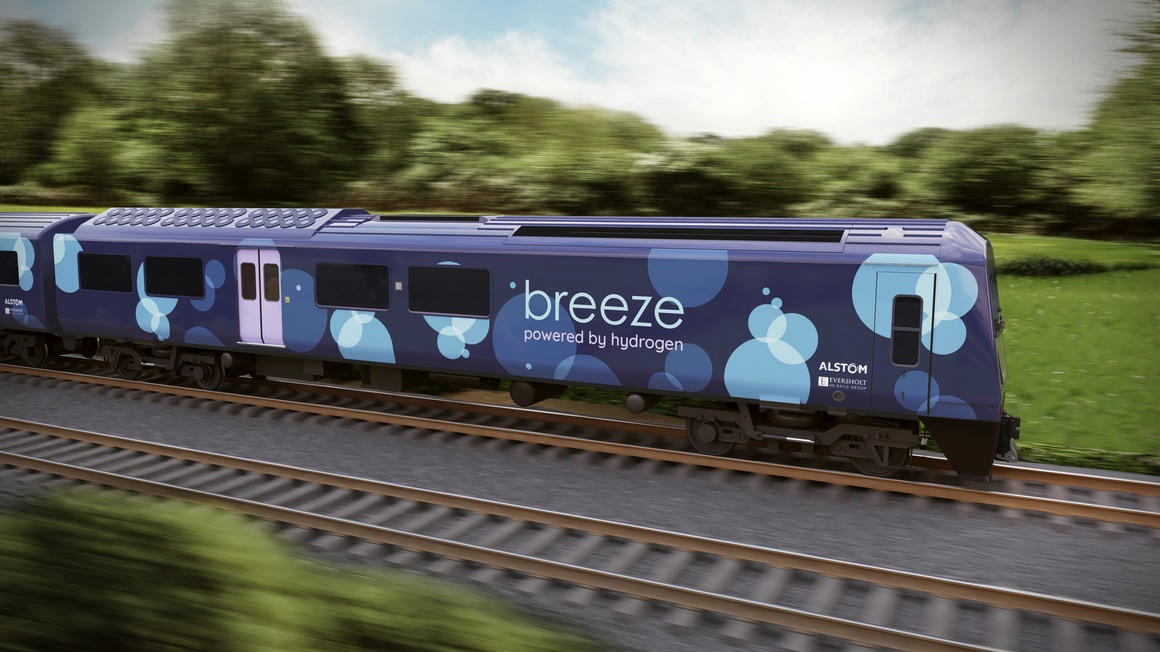
This is said about the Alstom Breeze trains.
Alstom in Widnes is ready to deploy its new Breeze trains and is working with Northern Rail to identify routes that are suitable for conversion to hydrogen.
A map also shows hydrogen train symbols on the Liverpool and Manchester Line, that goes via Widnes and Warrington and conveniently passes the Alstom factory at Widnes.
I wonder, if we’ll see an acceleration of this project?
Consider.
- Northern Rail is now directly controlled by the Government.
- Some Class 321 trains for conversion, will surely be available this summer.
- The updating of the trains, except for the hydrogen system has been developed in the Renatus project.
- Alstom have the experience of the successful hydrogen-powered Alstom Coradia iLint from Germany.
- Supplying the Alstom factory with hydrogen, shouldn’t be too difficult.
- I doubt any extra infrastructure is needed to run the trains.
- Alstom have sold two or three fleets of iLints on the back of a successful introduction into service of two prototype trains.
I don’t think, Alstom and all the various partners and stakeholders would object if the project were to be accelerated.
What’s Already Happening In The North West?
These hydrogen-powered projects are mentioned.
- Twenty double-deck buses for Liverpool City Centre.
- Alstom Breeze trains.
- storengy refuse trucks for Cheshire.
- ULEMCo are converting trucks and ferries.
- Port of Liverpool air quality.
It does seem to be that if you give an area a hydrogen network, possible users will find ways to use it to their advantage.
Rising To The Challenge
This section answers these questions.
Where Will The Hydrogen Come From?
Initially from INEOS at Runcorn, where I used to work around 1970 and BOC at St. Helens.
How Will It Be Transported?
Mainly by innovative use of new and existing pipelines.
How Do We Get To Critical Mass?
It looks like they’ll start slowly with hydrogen from Runcorn and St. Helens and build from there.
I would add a further question.
Will They Be Adding Hydrogen Filling Stations To The Network?
The North West needs them!
Hydrogen Storage
This is said about storing hydrogen.
Geologically, Cheshire is one of the few places in the UK where major underground gas storage in salt caverns has been delivered, paving the way for potential hydrogen storage, which is already done at scale elsewhere.
When I worked at ICI, I was given a tour of one of salt caverns. One is rumoured to be large enough to enable a full-size replica of Salisbury cathedral to be built inside.
Research
This is said about research.
Esteemed universities, and a wealth of innovative research companies, mean the region can deliver new hydrogen technologies. With academia working side-by-side with industry, the North West’s institutions can equip the next generation of skilled workers to support the hydrogen economy.
As a graduatev of one of those esteemed universities, how can I disagree?
Carbon Capture And Storage
This is said about carbon capture and storage.
Offshore reservoirs in the East Irish Sea can store carbon dioxide (CO2) produced from hydrogen production. Carbon Capture Utilisation and Storage (CCUS) is essential technology to help the UK in its fight against climate change. CCUS can capture up to 95% of the CO2 emissions associated with producing hydrogen from natural gas.
Whether you want to produce hydrogen this way is another matter. But the oil refineries and chemical plants along the Mersey are surely prime candidates for CCUS.
An Alliance
Not for nothing is the project called the North West Hydrogen Alliance!
Sixteen partners are mentioned at the end of the document.
Braving The London Underground
I took these pictures today, in a short Underground trip between Angel and Kings Cross St. Pancras tube stations.








It’s not very busy! Is it?
- There was no-one else in the tunnel as I walked between the escalators at Angel station.
- There was only two other people in my carriage on the train.
- There were few people in the tunnels at Kings Cross.
Isuspect that I travelled during lunchtime helped.
Germany’s 83rd Hydrogen Station Opens
The title of this post, is the same as that of this article on H2 View.
This is the introductory paragraph.
H2 Mobility, along with its partners Shell and Air Liquide, has opened Germany’s 83rd hydrogen refuelling station in Dortmund in the North Rhine-Westphalia region.
The Germans now have eighteen hydrogen stations in Dortmund alone, which is more than we have in the whole of the UK.
What Percentage Of Over 65s In England Have Tested Positive For COVID-19?
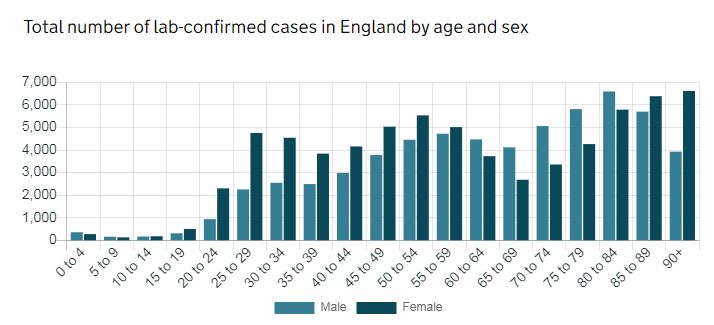
On the official government web site, they now give a breakdown of lab-confirmed cases in England by age and sex.
This is their graph.
Note.
- From 0-60, there ae more female cases.
- From 60-85, there are more male cases.
- Over 85, there are more female cases.
I do find this unusual. Could it be that more healthcare, teachers, nursery and care home workers are women under sixty.
I’ll now look at the individual figures.
Male
- 0-4 – 356
- 5-9 – 157
- 10-14 – 167
- 15-19 – 310
- 20-24 – 938
- 25-29 – 2256
- 30-34 – 2549
- 35-39 – 2493
- 40-44 – 2986
- 45-49 – 3782
- 50-54 – 4457
- 55-59 – 4725
- 60-64 – 4473
- 65-69 – 4121
- 70-74 – 5064
- 75-79 – 5816
- 80-84 – 6598
- 85-89 – 5703
- 90+ – 3929
Under-65 – 29649
Over-65 – 31231
Over-75 – 22046
Female
- 0-4 – 274
- 5-9 – 129
- 10-14 – 178
- 15-19 – 501
- 20-24 – 2303
- 25-29 – 4756
- 30-34 – 4546
- 35-39 – 3842
- 40-44 – 4160
- 45-49 – 5038
- 50-54 – 5538
- 55-59 – 5018
- 60-64 – 3729
- 65-69 – 2684
- 70-74 – 3359
- 75-79 – 4266
- 80-84 – 5792
- 85-89 – 6387
- 90+ – 6622
Under-65 – 40012
Over-65 – 29110
Over-75 – 23067
Total Under-65 – 69661
Total Over-65 – 60341
Total Over-75 – 45113
Note.
- In an earlier analysis, I thought these were UK figures, so discount those.
- There are no figures for other parts of the UK.
I can now calculate the percentage of Over-65s, who have had lab-confirmed cases in England.
- According to Age UK, there are 11,989,322 who are over 65 in the UK.
- As England is 84.3 % of the UK population according to Wikipedia, that means there are 10,106,998, who are over 65 in England.
Using the total number of over 65 cases in England, this gives a figure of 0.6%.
I can now calculate the percentage of Over-75s, who have had lab-confirmed cases in England.
According to Age UK, there are 5,400,000, who are over 75 in the UK.
As England is 84.3 % of the UK population according to Wikipedia, that means there are 4,552,200, who are over 75 in England.
Using the total number of over 75 cases in England, this gives a figure of 0.99%.
I can now calculate the percentage of Under-65s, who have had lab-confirmed cases in England.
- Using the previous figures, there are 45,870,180, who are under 65 in England.
Using the total number of under-65 cases in England, this gives a figure of 0.15%.
Plans For Brandon Rail Station Upgrade Deemed Lawful By Local Council
The title of this post, is the same as that of this article on Rail Advent.
This is the introductory paragraph.
Train operator Greater Anglia has been allowed to press ahead with plans to complete £1m of improvements at Brandon railway station.
Work at Brandon station will include.
- Demolishing of redundant buildings, that are not in the best of condition.
- Install new shelters, LED lights, CCTV cameras and better drainage.
- Increase car parking spaces from six to a hundred.
- It looks like accessible car parking will be provided.
- Provide a new bat roost.
The overall cost will be a million pounds.
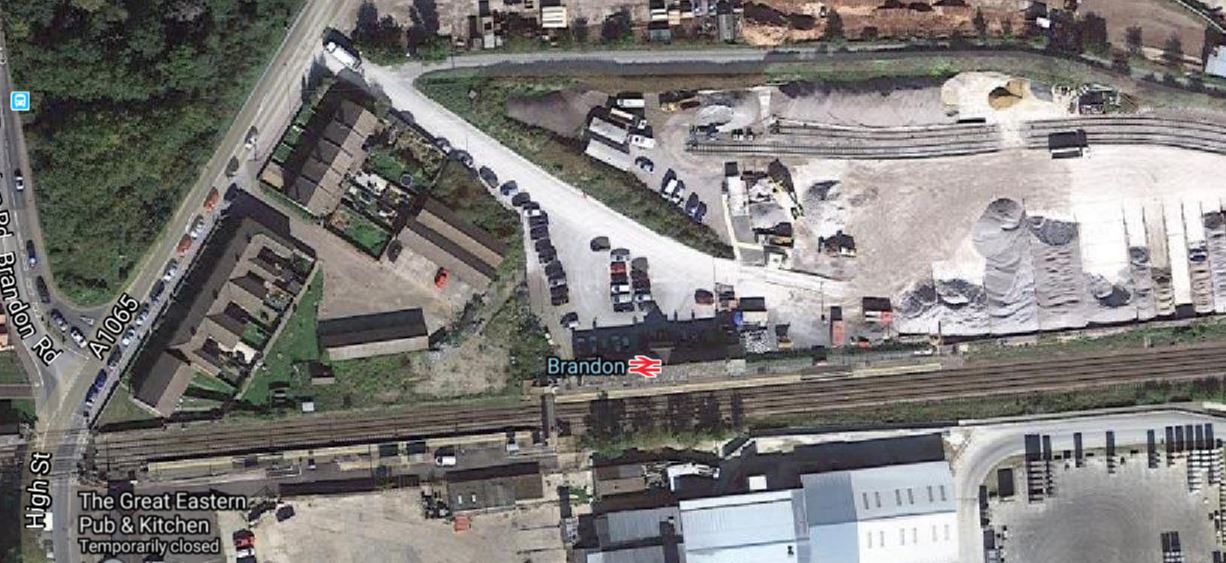
This Google Map shows the station.
Note.
- Cambridge and Ely is to the West and Norwich is to the East.
- The queues at the level crossing at the Western end of the station.
- I seem to remember, that it’s a Council Depot on the North side of the tracks.
At some time in the future the station will need a step-free footbridge.
Greater Anglia’s Norwich And Stansted Service
This is the main passenger service at Brandon station.
- Trains are four-car Class 755 trains.
- The service is hourly.
- Trains take about thirty minutes between Brandon and Cambridge stations.
- Trains take about an hour between Brandon and Stansted Airport stations.
- Trains take forty-five minutes between Brandon and Norwich stations.
Will there be enough car parking spaces?
Could Brandon Station Ever Have A Half-Hourly Service?
If there’s one city that will dominate the economy of East Anglia, it is Cambridge and its need for premises and housing for workers, will mean that there will be increasing numbers of passengers using the trains into Cambridge.
So I wouldn’t be surprised to see a half-hourly service between Norwich and Cambridge.
Could We See More Brandon Stations?
As I travel round the country, I’ve visited several stations like Brandon. Many could be improved by a radical restructuring or a comprehensive refurbishing.
Coronavirus Pandemic Could Cause Deepest Recession On Record, Bank Warns
The title of this post, is the same as that of this article on The Times.
If that is the bad news, what do I make of the sub-title of the article?
Economy projected to bounce back with 15 per cent growth in 2021
That would certainly be a lot better.
But is it feasible?
Readers of this blog, will know, that I regularly flag up ideas, that could help us all, create a greener planet.
Only yesterday, I wrote two articles about Equipmake; a company based in Norfolk, that aims to improve electric transport.
I can see a lot of these green ideas coming to fruition in the second half of this year, fuelled by copious thinking during the lockdown, furlough and the teaching of children. I believe the average guys and girls in the UK and the wider world will have been thinking hard about their future and that of the only planet we’ve got to live on.
This leads me to a green bounce, driven by renewable energy, energy storage, zero-carbon transport, fast internet, energy-efficient housing and other proven concepts.
I suspect though, it could be implemented in some new ways, which only now are being developed.
For every Equipmake, Highview Power, ITM Power and Riding Sunbeams how many other ideas are in development waiting to emerge?
There is also the question of finance.
- I think, that there are a lot of people, who because they have a reserved occupation or a good pension, when we come fully out of lockdown, will have sensible money to spend.
- Spending large amounts is difficult at present.
- Some may have the money in the bank which was reserved for this year’s holiday of a lifetime.
Prudence, would say they might spend it on low-risk purchases and not on expensive exotic holidays, where they might get trapped in a second spike of COVID-19.
Could we see a lot more sales of zero-carbon cars, solar panels, house batteries and air source heat pumps?
Installing these would need a lot of qualified builders, electricians and fitters.
 The Anonymous Widower