GB Railfreight Names Locomotive For Ukraine
The title of this post is the same as that of this article on Railnews.
This is the first paragraph.
GB Railfreight has unveiled a Class 66 locomotive bearing the nameplates ‘Glory to Ukraine’, and painted in a special livery using the Ukrainan colours. GBRf said it ‘stands with Ukraine, and this newly painted locomotive honours the people affected by the conflict as they continue to courageously defend their homeland’.
Perhaps not in the same class as this article from the Guardian, which is entitled Lithuania Names Road Leading To Russian Embassy ‘Ukrainian Heroes’ Street’.
But every little bit helps!
The TruckTrain
Note that I first came across the TruckTrain, when I wrote Innovative Composite Masts Look To Reduce Cost And Increase Efficiency Of Rail Electrification.
I have now decided that the concept could be so revolutionary, that it needs its own post.
The TruckTrain
TruckTrain is a concept with roots in Coventry University that could be off-beam enough to become a new normal.
The TruckTrain Web Site
The TruckTrain web site is the main source of information for the TruckTrain.
A sales leaflet for the TruckTrain can be accessed from the Home page.
The About page on the web site, gives this description of the TruckTrain.
TruckTrains® are short, fast, bi-directional self-propelled fixed freight train formations able to operate at passenger train speeds. Train sets can work in multiple in response to operational and commercial imperatives. Each vehicle is powered and all axles are powered to deliver the acceleration and braking required to achieve and to sustain this demanding level of performance. The initial configuration will use diesel-electric power to ensure freedom of operation over the national network. A hybrid design able to operate on electrified lines has also been developed together with an all-electric variant capable of extremely high-speed performance.
The Specifications page on the web site gives a detailed specification of the TruckTrain.
These are my thoughts.
The Basic Design Concept
The leaflet on their web site describes the concept.
This visualisation at the bottom of the leaflet shows four TruckTrains forming a train carrying twelve intermodal containers, each of which I suspect are 20 feet long.

Note.
- Each of the four TruckTrains appears to be carrying three intermodal containers.
- A 20 foot container is 6.096 metres long, so three are 18.288 metres long.
- Each TruckTrain has two bogies and four axles.
- The cabs at the two ends of each TruckTrain are different sizes.
- The longest carriages in use on the UK rail network are the 26 metre carriages used by Hitachi in their Class 800 and other trains.
I can deduce that with a twenty metre load space, a TruckTrain would accommodate any of the following.
- Three twenty-foot containers.
- A forty foot container and a twenty foot container.
- Large numbers of pallets.
- Ability to handle roll-cages as regularly used by supermarkets.
- A curtain-sided load space.
Any of these would give six metres for the two cabs.
This should be enough space for two cabs, but there are other possibilities.
- The longer cab could have a pantograph on the roof to use 25 KVAC electrification.
- The space behind the driver cab in the longer cab could be used for power-train gubbins.
- There must also be space under the load space for more power-train gubbins.
I feel certain, that an electrically-powered TruckTrain is more than a possibility.
The Width And Height Of A TruckTrain
This sentence from the Wikipedia entry for intermodal container, says this about their size.
Intermodal containers exist in many types and a number of standardized sizes, but ninety percent of the global container fleet are so-called “dry freight” or “general purpose” containers – durable closed rectangular boxes, made of rust-retardant Corten steel; almost all 8 feet (2.44 m) wide, and of either 20 or 40 feet (6.10 or 12.19 m) standard length, as defined by International Organization for Standardization (ISO) standard 668:2020. The worldwide standard heights are 8 feet 6 inches (2.59 m) and 9 feet 6 inches (2.90 m) – the latter are known as High Cube or Hi-Cube (HC / HQ) containers.
The Specifications page for the TruckTrain says this.
2-7 car Freight multiple unit capable of carrying combinations of 6 to 21 TEU of ISO containers, Hi-cube containers or swap bodies or 175 cubic meters of palletised cargo per vehicle with refrigeration available for both variants.
And the sales leaflet for the TruckTrain says this.
Performance and train path profile similar to a Turbostar passenger DMU.
Does that also mean that the width and height of a TruckTrain are no greater than that of a Class 170 train, which are respectively 2.69 and 3.77 metres?
It appears that international standards allow for a wagon floor height of 0.94 metres, which gives the following train heights to the top of the container.
- Standard container – 3.53 metres
- High Cube container – 3.84 metres
It will be a tight fit, but companies like Stadler use smaller wheels on some of their UK trains, which also have a height of 3.95 metres
I suspect that with a bit of selective bridge-raising TruckTrains will be able to go anywhere a Turbostar can go.
Connecting TruckTrains Together
The pictures of the TruckTrain on the web-site and the leaflet appears to show a standard multiple unit coupler like a Dellner.
The Specifications page for the TruckTrain says this.
2-7 car Freight multiple unit capable of carrying combinations of 6 to 21 TEU of ISO containers.
Is seven the maximum or just a marketing limit?
The technology and software to connect the trains and run them as a formation has been well and truly tested in many multiple units.
Motive Power Of TruckTrains
The About page for the TruckTrain says this.
The initial configuration will use diesel-electric power to ensure freedom of operation over the national network. A hybrid design able to operate on electrified lines has also been developed together with an all-electric variant capable of extremely high-speed performance.
As I said earlier, the pantograph could go on the roof of the longer cab for electric operation and the diesel engine could go under the load, as it does on most diesel multiple units.
I would think though, that one of the best variants would mount batteries under the load space.
Hydrogen would probably be a no-no, as this would limit the availability of the train to serve certain routes.
Performance Of TruckTrains
The Specifications page for the TruckTrain says this.
Maximum speed 140 kph for the inter-modal version, 160 kph for the pallet carrier.
As some of the routes, where these trains would be used is out of Felixstowe, where there is a 100 mph operating speed on the Great Eastern Main Line, I suspect that TruckTrains will sell better with a 100 mph (160 kph) operating speed on electric power.
125 mph Truck Trains
If they were running on a fully electrified route, I suspect the technology is available to run TruckTrains at 125 mph, which would make them ideal for parcels and light freight.
Manufacture Of TruckTrains
I don’t see that there would be many problems in manufacturing TruckTrains.
- 100 mph (160 kph) bogies are readily available for freight trains.
- A wagon manufacturer would probably be happy to design and build the chassis.
- The cabs could possibly be a standard multiple unit design.
- There shouldn’t be any problems with the power-train.
- Multiple running and splitting/joining technology is very much proven.
Certified rail components would probably be available for other parts and uses.
Combi TruckTrains
Combi Aircraft is defined in Wikipedia like this.
Combi aircraft in commercial aviation are aircraft that can be used to carry either passengers as an airliner, or cargo as a freighter, and may have a partition in the aircraft cabin to allow both uses at the same time in a mixed passenger/freight combination.
Would a Combi TruckTrain have applications on some routes in the world, where a passenger route carries the occasional container up and down the route?
Several ideas might be possible.
- The simplest would probably to have a twenty or forty foot passenger module, which could be lifted in and out like a standard intermodal freight container.
- TruckTrains could also be built with the load space fitted out for passengers, so they became a Class 153 replacement, that could be coupled to a freight TruckTrain.
- Could a TruckTrain be fitted out as a specialised work train to take workers and equipment to a work site, which had difficult road access?
It could almost be like a rail equivalent of Thunderbird 2.
Point-To-Point TruckTrains
The classic point-to-point train, could be run by someone like Toyota, where the engines for their cars are made in North Wales and the cars are assembled at Burnaston near Derby. I know there is a doubt over the future of Toyota’s engine plant, due to the stopping of manufacture of cars running on fossil fuels, but surely, an appropriate number of TruckTrains shuttling on the route would give advantages over a fleet of trucks, like, speed and reliability.
In the leaflet, they mention that the TruckTrain has been designed to use single-track short-terminals. These would surely be ideal for a company that decides to use TruckTrain as a point-to-point train between an important supplier and their main factory or distribution centre.
TruckTrains Could Use Stations
There has been a lot of talk recently about using major stations as freight terminals at night.
I doubt that a TruckTrain would have any problems using stations.
International TruckTrains
Why not? In Kraft Heinz And Freight Innovation, I talked about an international freight movement, that would be ideal for TruckTrains.
TruckTrains And Ferries
Could we even see the revival of train ferries?
Imagine a terminal at a port in Ireland, which could load and unload containers between standard gauge TruckTrains and trucks.
- A short length of standard gauge track would lead from the terminal to the quay, so that the TruckTrains could be driven on and off the ferry, either using a shunter or the TruckTrains’ own battery or diesel power.
- On the other side of the water, the TruckTrain would use the UK railways to get to its destination.
This concept would allow freight to go between most of Western Europe and Ireland with only a transfer to and from trucks at both ends.
It could even be improved with dual-gauge TruckTrains, which might be able to run between Ireland and Spain, through the Channel Tunnel.
Conclusion
I like the concept and I can’t see why it would not be successful worldwide.
Andrew Forrest Snaps Up Pilbara And Gascoyne Cattle Stations For Green Energy Production
The title of this post, is the same as that of this article on the Australian Broadcasting Corporation.
This is the first paragraph.
Australian mining billionaire Andrew Forrest has continued his land acquisition in Western Australia, purchasing another three cattle stations in the state’s north-west to generate renewable energy.
These are some points for the article.
- Andrew Forrest’s Fortescue Future Industries has purchased three cattle stations in northern WA
- The stations will continue to run stock, and contribute to the production of green energy
- FFI says it is looking at other parts of WA to acquire land for similar projects
- The energy created will be used to decarbonise Andrew Forrest’s mining operations by 2030.
- A renewable hub of 340 wind turbines alongside solar panels will be created, which will generate 5 GW of energy.
- The possibility of offshore energy is mentioned.
- There is no mention of energy storage.
I have a few thoughts.
For A Reliable 5 GW Of Energy, Storage Is Surely Needed
I would think that this is probably understood by Fortescue Future Industries and given their ambitions for hydrogen, this must surely be part of an energy storage strategy.
Will Hydrogen Be Exported By Fortescue Future Industries From Australia?
I would expect this depends on three things.
- How much green energy is generated.
- The energy needs of Andrew Forrest’s mining companies.
- How much hydrogen can be sold in Australia.
Fortescue Future Industries will certainly have the market, if they have a surplus.
How Much Energy Will Fortescue Future Industries Generate Per Hectare?
This paragraph from the article gives useful information.
The hub would consist of 340 wind turbines alongside solar panels across Emu Creek and Uaroo Stations, in a development envelope of more than 65,000 hectares of land and a disturbance footprint of more than 10,000 hectares.
- If you look at the 65,000 hectares, as the area of the renewable energy hub, 0.77 MW is generated per hectare.
- If you look at the 10,000 hectares, as the area of the renewable energy hub, 0.5 MW is generated per hectare.
- If you look at Shell’s Scotwind E2 lease, that is 2 GW in 86,000 hectares, where 0.023 MW is generated per hectare.
So on a brief look Australia is a more efficient place for renewable energy, than the seas around the UK.
Conclusion
Andrew Forrest is developing a more detailed plan.
Enter The Dragon
Look at this map of UK offshore wind farms. clipped from Wikipedia.
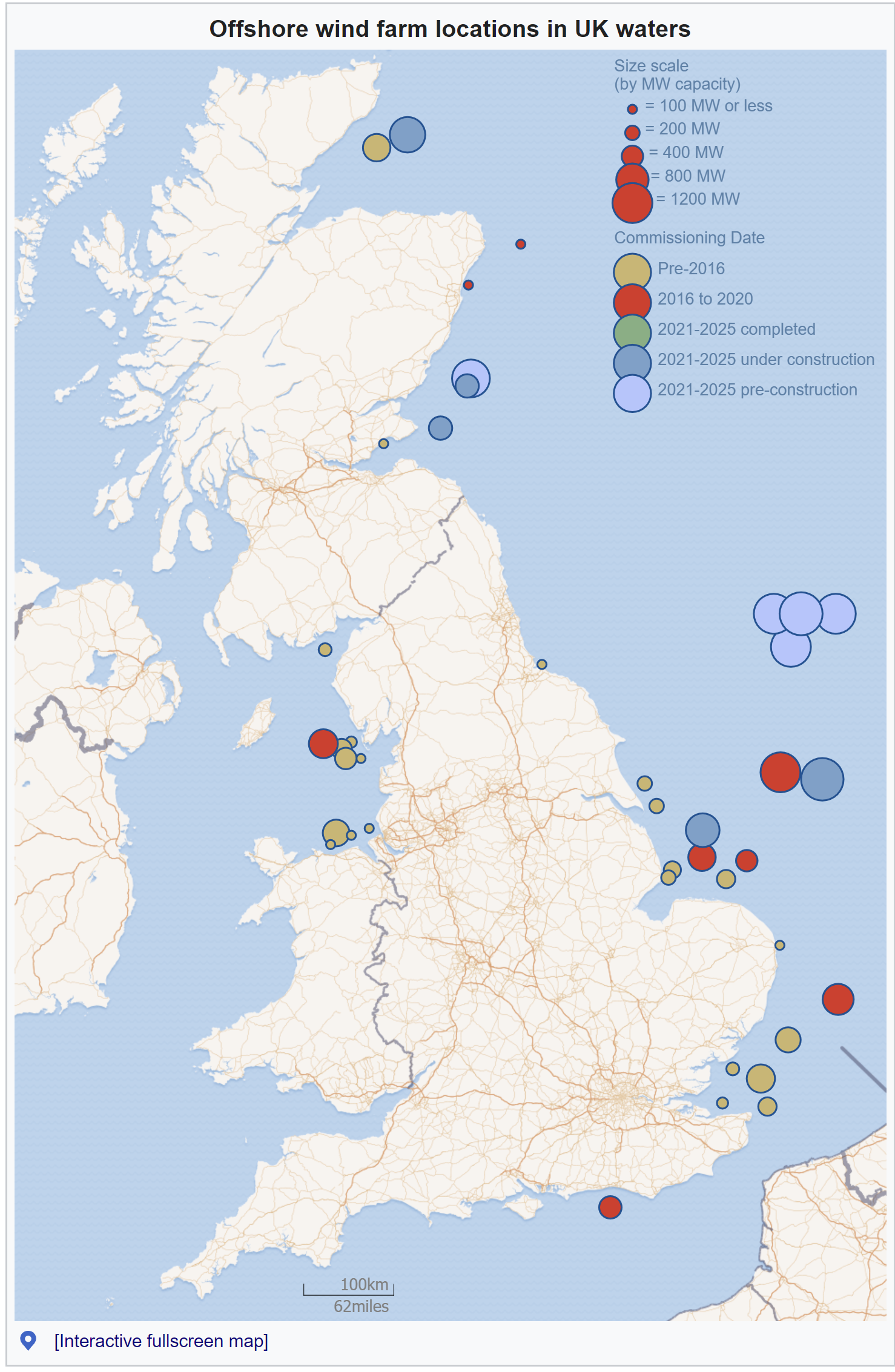
It is only a crude map, but it does show the lack of offshore wind farms around the coasts of Wales and South-West England.
This article on the Engineer is entitled Unlocking The Renewables Potential Of The Celtic Sea.
The article starts with these two paragraphs.
Over the last decade, the UK has become a global leader in renewable marine energy, tapping into the vast resources its coastal geography offers. Offshore wind, in particular, has flourished, with gigawatt-scale projects being deployed off the east coast of England and Scotland, at Hornsea, Dogger Bank and Moray.
However, looking at a map of existing and proposed wind farms, what’s perhaps most striking is the complete absence of projects in the southwest of Britain, off the rugged shores of Wales, Devon and Cornwall, shaped by the fierce North Atlantic. The Celtic Sea – which extends south off Wales and Ireland down past Cornwall and Brittany to the edge of the continental shelf – is estimated to have around 50GW of wind generating capacity alone. What’s more, it also delivers some of the highest tidal ranges in the world, alongside some of the best waters in Europe for generating wave energy. In a country blessed with renewable resources, the Celtic Sea may well be its biggest prize.
The article then discusses how the challenge of developing renewable energy around Wales is being met.
- It describes the relevance of Floating Offshore Wind (FLOW).
- It quotes someone who says. “Eighty per cent of the world’s wind resources are in waters deeper than you would traditionally go with fixed offshore wind.”
- It talks about Blue Gem Wind and their Erebus and Valorous wind farm projects, that I wrote about in Blue Gem Wind.
- It talks of how expertise from offshore oil and gas is being used to develop floating offshore wind.
The article then goes on to talk about tidal power.
The Welsh Government Tidal Lagoon Challenge is mentioned.
- The article notes “The IP for the Swansea Bay Tidal Lagoon has been purchased by a consortium led by Bridgend’s DST Innovations and has been reborn as Blue Eden.”
- Blue Eden is described on this page of the DST Innovations web site. The project is not in the least bit timid or small.
- The article also introduces to the Morlais Tidal Energy Scheme, which has its own web site.
The article then finishes with a few paragraphs about how wind, wave and tidal power can be combined in a single scheme.
Conclusion
The article finishes with this paragraph.
For now, Wales may be lagging slightly behind its Celtic cousin to the north, but if the true potential of the Celtic Sea can be unleashed – FLOW, tidal stream, lagoon and wave – it looks set to play an even more prominent role in the net zero pursuit.
The Red Dragon is entering the battle to replace Vlad the Mad’s tainted energy.
Lidl Supermarket Chain Dumps Battery Electrics For Hydrogen Fuel Cell Fleet
The title of this post, is the same as that of this article on Hydrogen Fuel News.
These are a few points from the article.
- Lidl Germany is replacing electric vehicles with hydrogen fuel cell vehicles.
- They are the first retailer to do this in Europe.
- They are also replacing electric fork-lifts in a major depot in France with hydrogen-powered ones.
- The green hydrogen for the depot will be produced by Lhyfe 75 kilometres away from wind energy.
- Lidl is also considering converting some of its delivery trucks to hydrogen.
With respect to the forklifts the article lists the advantages of hydrogen forklifts over electric.
- Hydrogen forklifts have a 97 % availability, as opposed to 50 % for battery ones.
- Refuelling a hydrogen forklift takes 2 to 3 minutes, whereas recharging a battery forklift can take several hours.
- Hydrogen forklifts allow a smaller fleet.
- Hydrogen forklifts need less refuelling bays.
The article shows some of the advantages of using hydrogen.
Conclusion
How many other supermarket groups will switch to hydrogen?
Innovative Composite Masts Look To Reduce Cost And Increase Efficiency Of Rail Electrification
The title of this post is the same as that of this article on New Civil Engineer.
This is the sub-title.
Engineering consultancy Furrer+Frey will this week unveil its innovative composite masts for rail electrification, which could revolutionise the way that rail electrification is undertaken.
Other points from the article include.
- Development has been undertaken with Cranfield, Southampton and Newcastle Universities and Prodrive and TruckTrain.
- The project was part funded by the Department for Transport and Innovate UK through the First Of A Kind competition.
- The first composite masts have been created and tested at St Bride’s feeder station, just outside Newport in Wales.
This Google Map shows the area, where the test will take place.
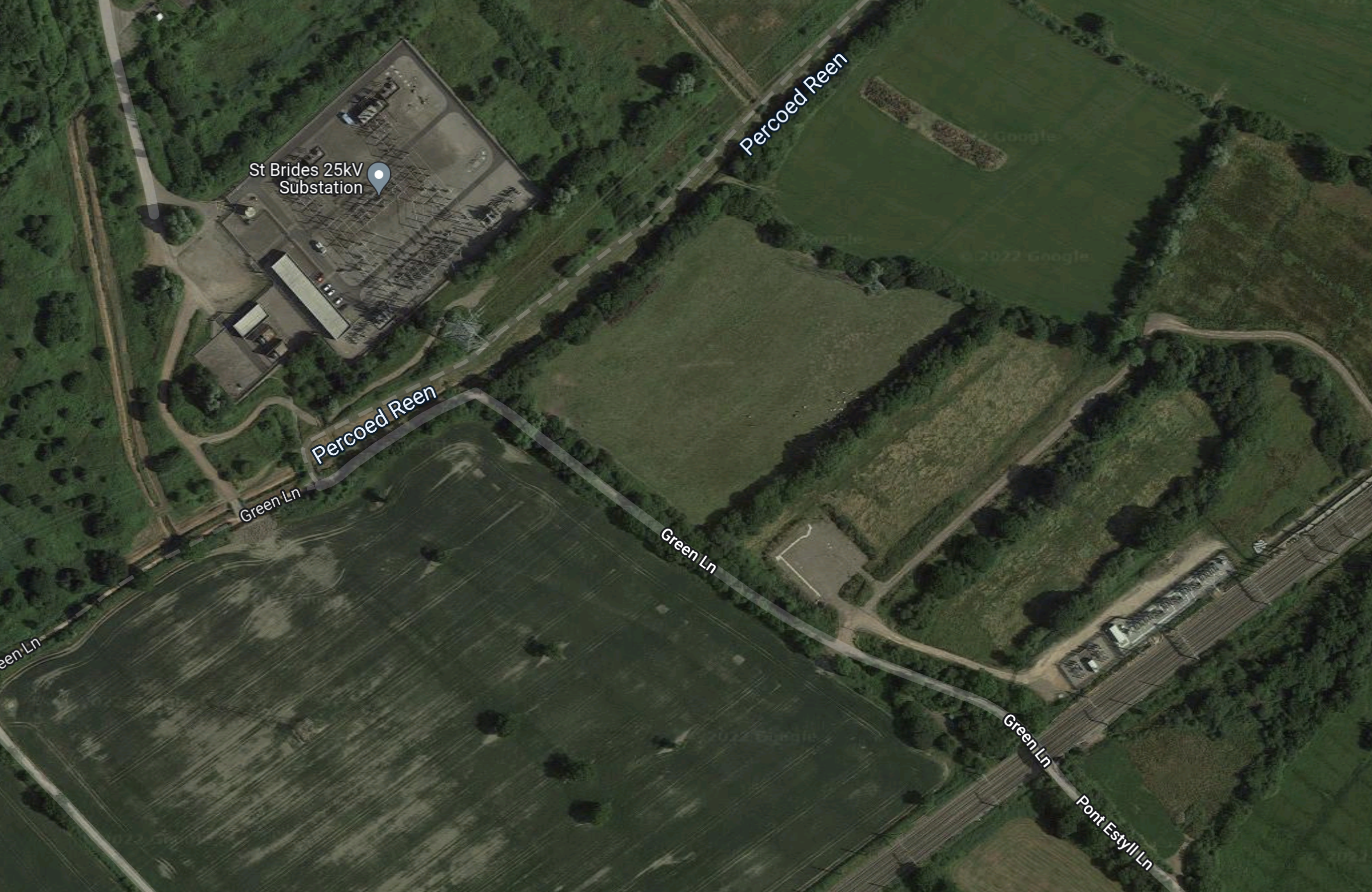
Note.
- The South Wales Main Line crossing the South-East corner of the map.
- Newport station is to the East and Cardiff station is to the West.
- The St. Brides feeder station alongside the railway, by the Green Lane bridge.
I would assume that the connection to the National Grid is via the St. Brides 25 kV Substation in the North-West corner of the map.
The article lists the features of the design.
- A typical steel mast weighs 750 Kg., whereas a composite mast weight just 80 Kg.
- I suspect that these masts can be lifted around by a couple of average workers.
- They have lower wind resistance.
- Piles can be less deep. The prototype piles are 1.25 m., as against many that are over four metres on recent schemes.
- The piles have sensors to detect, when they are out of kilter and need replacing.
- Currently, wonky masts need to be identified by hands-on measurement or observant drivers.
- Two masts have been tested to destruction, to see if they match the theory.
But this to me as an Electrical Engineer is the clincher.
Furrer+Frey GB head of UK projects Noel Dolphin says this about the new design.
When they do take it to a mass manufacturing stage, it will be without carbon fibre inside, which presents another opportunity. The other ultimate goal is that the structure is insulating in itself. It’s another big saving if you can remove the insulators on the electrification cantilevers, as they’re expensive in themselves.
It’s all going the way of much more affordable electrification.
I have a few further thoughts.
The Involvement Of Prodrive
Prodrive are best known for their involvement in motorsport, as the home page of their web site indicates.
But as their site also indicates they get involved in other forms of high-performance disruptive engineering, where their experience is relevant.
Prodrive build the prototypes, but won’t build the production masts, although I suspect, their expertise will be used.
The TruckTrain
TruckTrain is a concept with roots in Coventry University that could be off-beam enough to be the new normal.
I have updated my thoughts on the TruckTrain and it is now in a post called The TruckTrain.
My Conclusion About TruckTrains
I like the concept and I can’t see why it would not be successful worldwide.
The Involvement Of TruckTrain With Furrer+Frey
This puzzled me for a time, as undoubtedly, the TruckTrain will be able to use standard electrification.
But in the TruckTrain leaflet, they mention that the TruckTrain has been designed to use single-track short-terminals.
So did they approach Furrer+Frey to find out about electrifying short terminals and the Swiss company felt TruckTrain was a concept they could support?
Obviously, if the TruckTrain is developed to be a battery-electric train, some mini freight terminals will need the ability to charge the TruckTrain.
Could A TruckTrain Be Used to Support Electrification?
Would a TruckTrain be the ideal support vehicle to erect or repair electrification?
If you take the problem, when the wires have been damaged, a TruckTrain could get to the site at 100 mph, much faster than a truck on the road. It could also have a platform to lift the engineers for inspection and repair.
A TruckTrain could be more than just a transport system.
Conclusion
Furrer + Frey’s lightweight composite electrification masts are a good idea.
Teamed with TruckTrains, they could prove a very powerful freight concept, where new mini freight terminals are needed.
Essex And Network Rail Get Planning For Beaulieu Station
This page on the Network Rail website is entitled Network Rail And Essex County Council Are Working Together To Develop Proposals For The First Railway Station To Be Built On The Great Eastern Main Line For Over 100 Years.
These are the first two paragraphs.
The new station is part of a wider regeneration of the Beaulieu Park estate in Chelmsford with new road infrastructure and up to 14,000 homes.
Essex County Council, in partnership with Chelmsford City Council and the South East Local Enterprise Partnership (LEP), successfully secured £218m of funding from the Government’s Housing and Infrastructure (HIF) fund together with £34m contributions the South East Local Enterprise Partnership and developer Countryside Zest to deliver the wider scheme.
These are some more points from the page.
- There will be three platforms with a central loop line and new tracks to enable stopping services to call at the station while allowing fast trains to pass through unimpeded.
- The station will have lifts.
- There will be a large number of parking spaces and secure cycle storage.
- There will be taxis and buses.
There is a comprehensive video that describes the new station, the new roads and the housing developments.
Finally, Chelmsford is getting the transport system it needs.
Boris Johnson Wants To Build ‘Colossal’ Irish Sea Wind Farm Within A Year
The title of this post, is the same as that of this article in The Telegraph.
This is the sub-title.
Prime Minister tells industry leaders he has ‘a dream’ that giant floating wind farm could provide ‘gigawatts of energy’
These are the first three paragraphs of the article.
Boris Johnson is pushing energy firms to build a “colossal” offshore wind farm in the Irish Sea within 12 months.
The Prime Minister told industry leaders he has “a dream” that a giant floating wind farm could provide “gigawatts of energy and do it within a year”, according to a government source.
He was addressing wind energy firms at a round table discussion in Downing Street as the Government finalised its energy security strategy.
It is said in the article, that industry leaders smiled at the suggestion.
My feelings though are different and I wonder if Boris has been briefed by an offshore wind expert, who knows what they’re doing.
Quietly and unobtrusively, a new technology has been developed, that allows Boris the luxury to dream.
The World’s Largest Floating Wind Farm
In the UK, we are getting used to superlatives being applied to our offshore wind farms.
- According to Wikipedia at the current time, nine of the fifteenth largest offshore wind farms in the world are in the United Kingdom.
- The Hornsea wind farm, comprises the 1.4 GW Hornsea Two wind farm, which is the largest offshore wind farm in the world.
- Previously, the 1.2 GW Hornsea One wind farm was the largest offshore wind farm in the world.
In this article on offshoreWIND.biz, which is entitled World’s Largest Floating Offshore Wind Farm Fully Operational, this is said.
Located 15 kilometres off the coast of Aberdeenshire, Scotland, in water depths ranging from 60 metres to 80 metres, Kincardine is the largest operating floating wind farm.
The project consists of five Vestas V164-9.5 MW and one V80-2 MW turbine, each installed on WindFloat® semi-submersible platforms designed by Principle Power.
This picture from Cobra Group shows one of the turbines being towed into position at Kincardine.
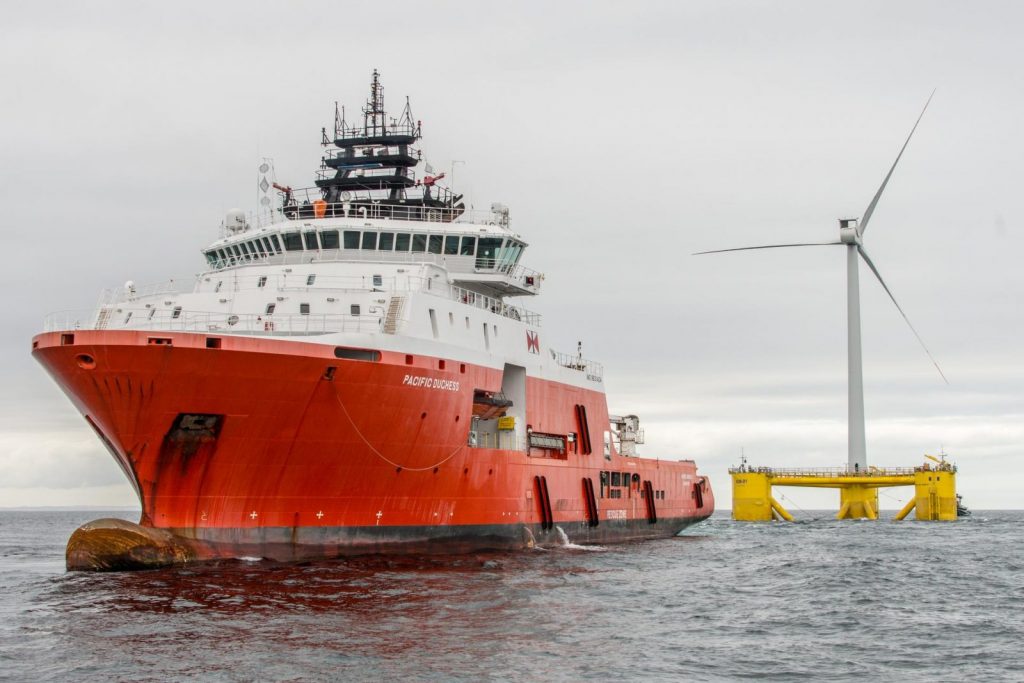
There are more pictures on this web page.
WindFloats would appear to be proven technology, as there are now two commercial wind farms using the technology and several others under development.
Erebus And Valorous
But Kincardine Wind Farm won’t be the world’s largest floating wind farm for long!
The next two wind farms, using the technology are Erebus and Valorous, who will provide a total of 400 MW from a company called Blue Gem Wind, which will use larger 14 MW turbines.
They will be installed to the South-West of the Pembrokeshire Coast.
Blue Gem Wind
Blue Gem Wind are based in Pembroke Dock and are a partnership of Simply Blue Energy, a pioneering Celtic Sea energy developer, and TotalEnergies.
Simply Blue Group are an Irish company, who are also working with Shell on the development of 1.35 GW of wind power to the West of Ireland.
50 GW Of Wind In The Celtic Sea
On the Projects page of the Blue Gem website, this is said about floating wind in the Celtic Sea.
Floating wind is set to become a key technology in the fight against climate change with over 80% of the worlds wind resource in water deeper than 60 metres. Independent studies have suggested there could be as much as 50GW of electricity capacity available in the Celtic Sea waters of the UK and Ireland. This renewable energy resource could play a key role in the UK meeting the 2050 Net-Zero target required to mitigate climate change. Floating wind will provide new low carbon supply chain opportunities, support coastal communities and create long-term benefits for the region.
Is this Boris’s project?
These are my thoughts.
How Many Turbines Would You Need For 50 GW?
If you need 7 x 14 MW turbines for each 100 MW, that would mean you need 3500 turbines and WindFloats for 50 GW.
How Would Each Turbine Be Installed?
It appears from pictures on the Cobra Group web site, that the turbine is mounted on the WindFloat using a large crane on a dock, whilst the WindFloat is alongside.
- The WindFloat and the turbine are then towed out into the desired position.
- It would then be anchored to the sea-bed.
- Finally, it would be connected to the power network.
I would doubt, that one team could probably install more than one turbine per day.
But I suspect more than one team could work in and out of one port at a time.
How Many Ports Could Be Used For Turbine Assembly?
As Blue Gem Wind is based in Pembroke Dock, I would assume that one of the ports would be on Milford Haven Waterway.
But there are other ports on the Welsh and Irish coasts, where the turbine lift could be accomplished.
How Much Capacity Could Be Installed In Twelve Months?
Suppose you had two ports doing assembly, with two teams working at each port, which would mean four turbines could be installed in a day.
- In a month, that would be 4 x 14 x 30 MW per month.
- This is nearly 1.7 GW per month or 20 GW per year.
It does appear to me, that floating wind farms with the right project management could be very much quicker to install than traditional fixed foundation wind turbines.
I believe that if we get the manufacturing and the project management right, that a colossal 20 GW of floating wind can be installed in twelve months.
Conclusion
Most people won’t believe Boris’s claim, but I feel that there is a degree of reality behind it, if we can produce four WindFloats and four turbines per day and enough cables and electrical gubbins to link them all together.
Birds And Offshore Renewable Energy
I have worried about this for some time, as die-hard wind farm opponents use birds being scythed to pieces in wind farms as an emotional reason for not building wind farms.
I searched the Internet and found this academic report from the University of Rhode Island, which is entitled How Are Birds Affected by the Block Island Wind Farm and How Do They Interact With the Wind Turbines?.
Note.
- Block Island Wind Farm is a mildly controversial 30 MW wind farm off the coast of Rhode Island.
- Block Island wind farm is the first commercial offshore wind farm in the United States.
The report gives three ways about how birds interact with wind farms.
Birds Fly Out Of The Way
First, many birds do not experience any interaction with the turbines at all as they fly either at a higher altitude or closer to the shore than the turbines’ locations.
Wind Farms Become A Food Source
The second interaction between birds and offshore wind turbines is a positive one that has been documented throughout Europe; but, with only the Block Island Wind Farm, it is too early to document in the United States. Researchers have found that the base of a wind turbine can create artificial reefs that act as an attractive site to both fish and shellfish. These artificial reefs provide a feeding ground for certain species of birds as the turbines essentially become a central habitat for many bird species’ prey.
Displacement Of The Birds
The final interaction that birds have with offshore wind turbines is displacement. This primary negative effect is experienced when wind turbines are constructed in areas that birds would naturally like to be; but, due to the structures, no longer have access to. To put it simply, he says, “if you put the turbines where the birds want to be, you take away these areas from the birds”.
Conclusion
It appears to me, that if you are putting up wind farms, whether they are offshore or onshore, that it is essential you do your research.
As in this case, experts from the local university are often a good resource to call upon.
Russia Destroys Ukraine’s Dream
The Antonov An-225 Mriya was a unique aircraft.
It was the biggest aircraft in the world and was regularly used to move heavy or awkward cargoes around the world, as a reading of its Wikipedia entry will disclose.
Mriya is Ukrainian for dream.
But all that useful work has come to an end.
This article on CNN is entitled World’s Largest Plane Destroyed In Ukraine.
These are the first two paragraphs.
The world’s largest plane, the Antonov AN-225, has been destroyed during the Russian invasion of Ukraine, according to Ukrainian officials, generating alarm and sadness among the aviation world in which it occupies almost cult status.
The enormous aircraft, named “Mriya,” or “dream” in Ukrainian, was parked at an airfield near Kyiv when it was attacked by “Russian occupants,” Ukrainian authorities said, adding that they would rebuild the plane.
I know it’s only a plane and in the current scheme of things, that is a minor loss, but the Mriya has proved itself to be so uniquely useful in moving awkward cargoes, that the plane would surely have played a major part in the humanitarian relief and the rebuilding of Ukraine.
Given, that the plane would have surely been of use to the Russians, it just shows how utterly stupid, they have been in this war.
 The Anonymous Widower