Highview Power Names Rupert Pearce Chief Executive Officer
The title of this post, is the same as that of this article on business wire.
This is the first paragraph.
Highview Power, a global leader in providing long duration energy storage and essential grid services, has named Rupert Pearce as its new CEO. In this role, Pearce will leverage his expertise in guiding technology companies through significant transformation and globalisation to position Highview Power as a leader in accelerating the energy transition.
He certainly seems to be type of CEO, that Highview needs to succeed.
NeuConnect Awards Two Major Contracts
This page on the NeuConnect web site is entitled NeuConnect Awards Over £1.5 billion Of Major Contracts As First Ever UK-German Energy Link Moves An Important Step Closer.
NeuConnect is a proposed interconnector between England and Germany.
- It will have a capacity of 1.4 GW.
- The interconnector will be around 450 miles long.
- It will be HVDC, like many similar undersea power cables.
- As the title says, it will be the first-ever UK-German energy link.
Wikipedia describes the route like this.
The cable will run between the Greystones substation on the Isle of Grain, in Kent in England to the new Fedderwarden substation in Wilhelmshaven in the Lower Saxony region of Germany. Landfall will be next to Grain Coastal Park, in Kent, and at Hooksiel, near Wilhemshaven in Germany.
Two contracts have been awarded.
- The contract to design, manufacture, install, test and commission the 725km interconnector has been awarded to Prysmian Group.
- The contract to design and build two converter stations in the UK and Germany has been awarded to Siemens Energy.
This sounds like a very simple plan to add an important interconnector between the UK and Germany.
I have some observations and thoughts.
The Isle Of Grain
The Isle of Grain is described in Wikipedia like this.
Isle of Grain (Old English Greon, meaning gravel) is a village and the easternmost point of the Hoo Peninsula within the district of Medway in Kent, south-east England. No longer an island and now forming part of the peninsula, the area is almost all marshland and is a major habitat for diverse wetland birds. The village constitutes a civil parish, which at the 2011 census had a population of 1,648, a net decrease of 83 people in 10 years.
Apart for the birds, over the last few decades it has been home to the following.
- Until 1982, it was the location of a BP oil refinery.
- In the 1990s, the isle was used to make the segments for the lining of the Channel Tunnel.
- Following completion of the Channel Tunnel, the site is now part-occupied by Thamesport, the UK’s third largest container port.
- Next to the former BP site is Grain Power Station, built in the 1970s, which previously burnt oil.
- This power station was demolished in the 2015 and replaced with a 1.275 GW gas-fired power station.
- Another major installation is a new Grain Liquefied Natural Gas (LNG) import facility, which takes heat from the gas-fired power station.
- The Isle of Grain is the landing point for the BritNed undersea power cable between The Netherlands and the UK.
The Google Map shows the Isle of Grain.
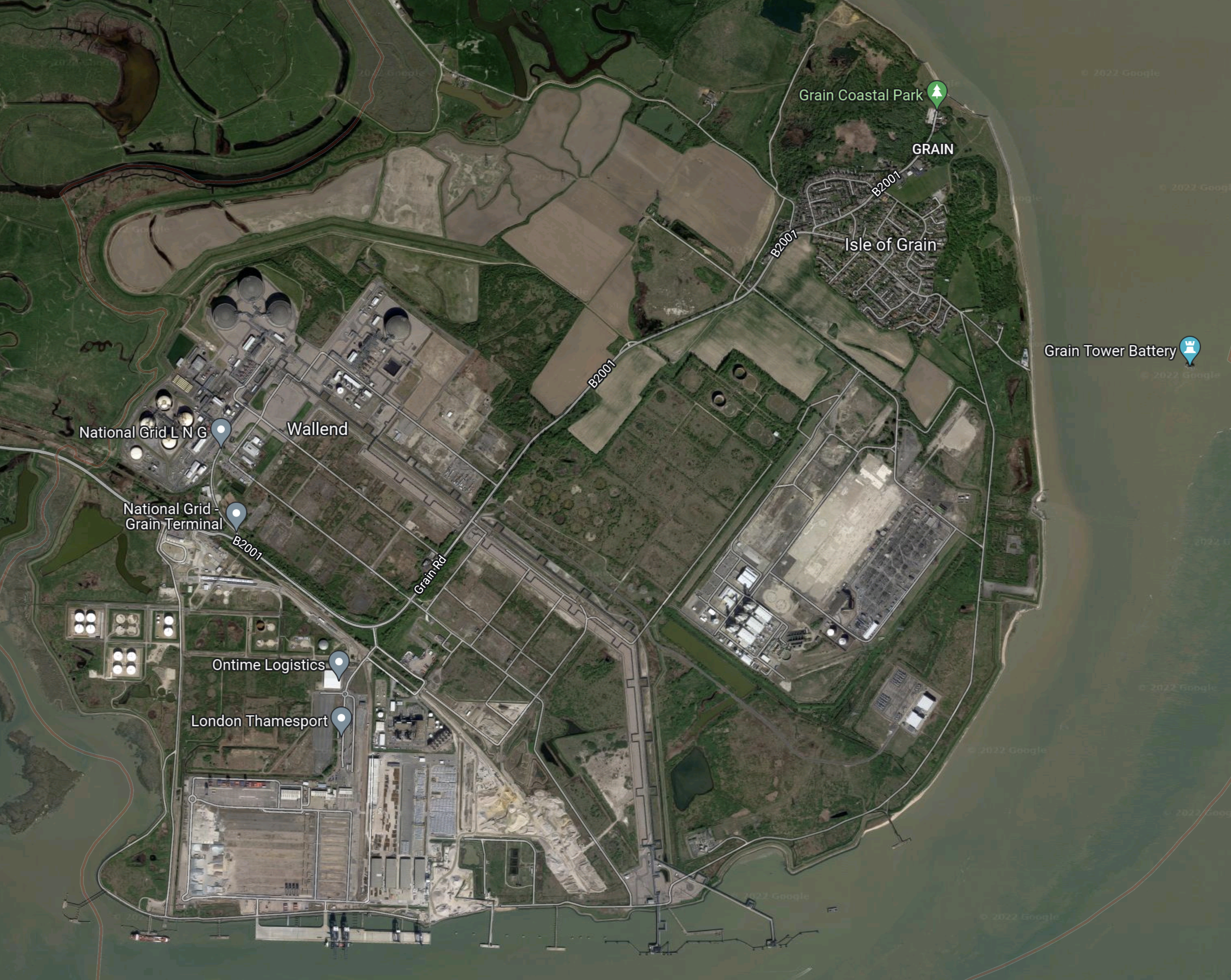
Note.
- Thamesport is in the South-West corner
- To its North is the LNG import facility.
- To the North-East of Thamesport is the 735 MW Medway power station.
- There is a rail connection to Hoo Junction on the North Kent Line.
This second Google Map shows the Eastern side of the Isle.
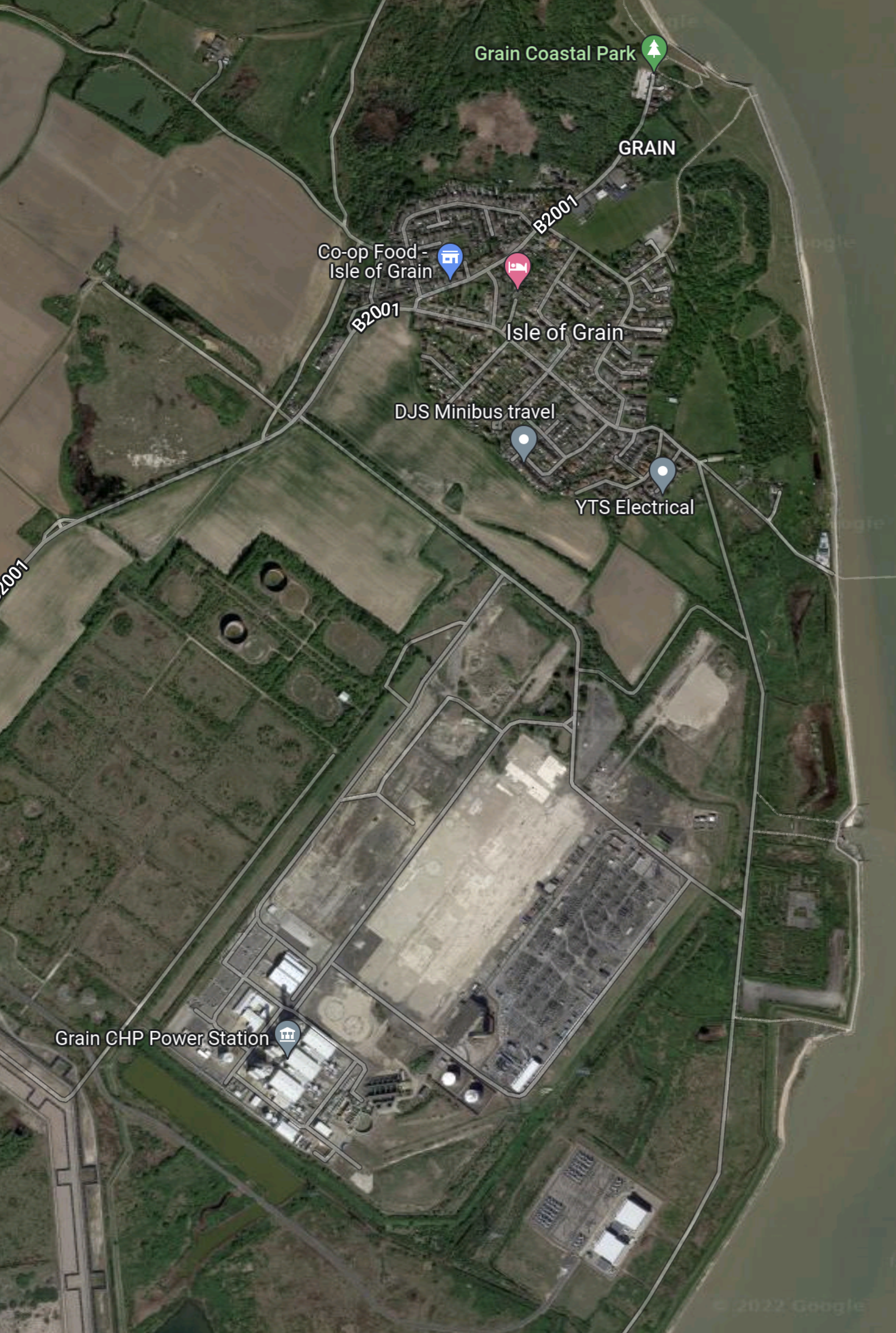
Note.
- Grain Coastal Park, where NeuConnect will make landfall, is marked by the green arrow at the top of the map.
- Towards the South-Eastern corner of the map is the 1.275 GW Grain gas-fired power station.
- To the East of the power station, there is more switchgear than you see in a bad Frankenstein film.
- The smaller square at the bottom with the two white squares could be the converter station for the BritNed interconnector.
I am sure there is space on the island for a connection for NeuConnect.
There is also a total of 2.01 GW of gas-fired power stations on the Isle of Grain.
Wind Power In The Thames Estuary
This Google Map shows the Thames Estuary.
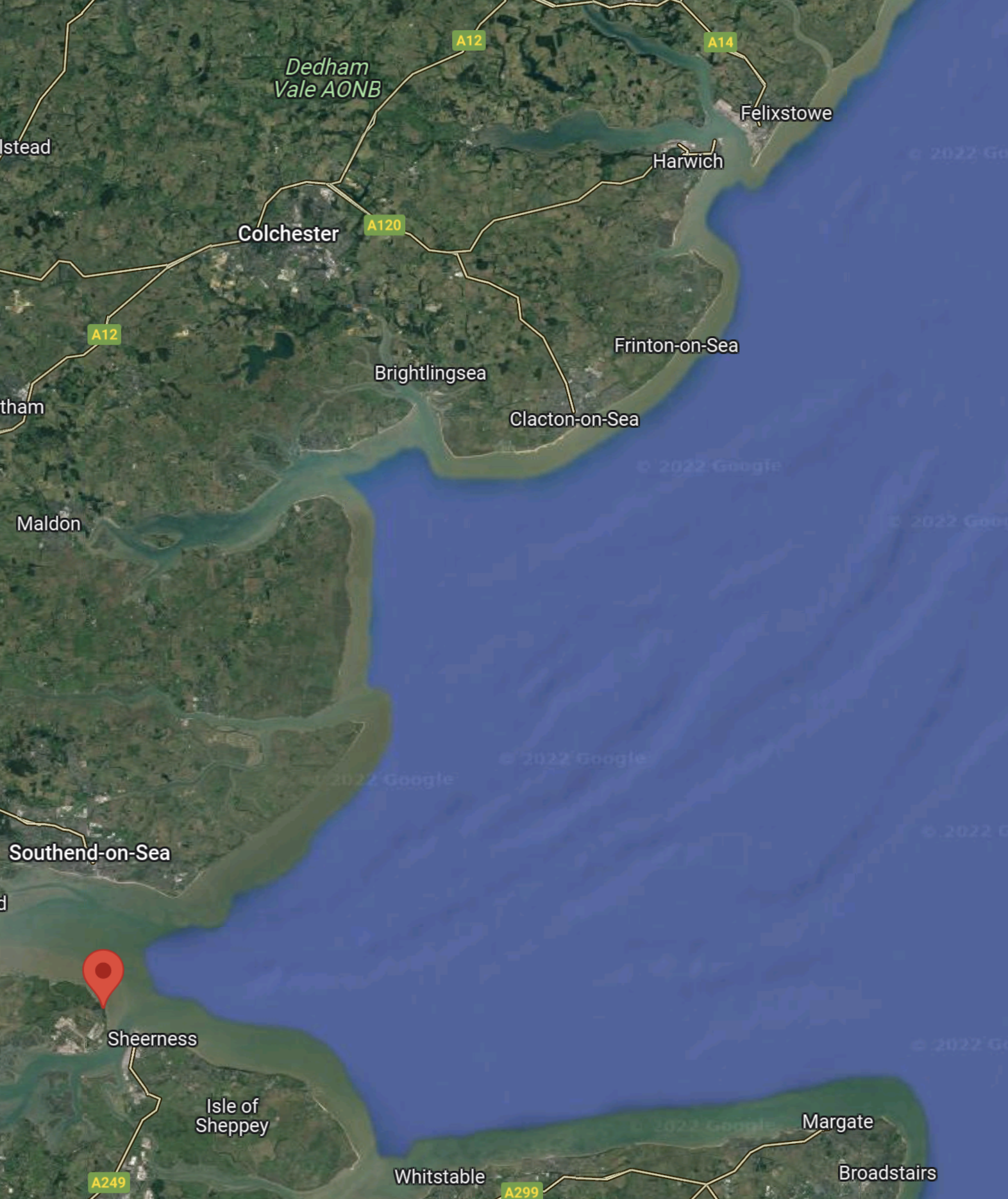
Note that the red arrow indicates the Isle of Grain.
This map from Wikipedia shows the wind farms in the area.
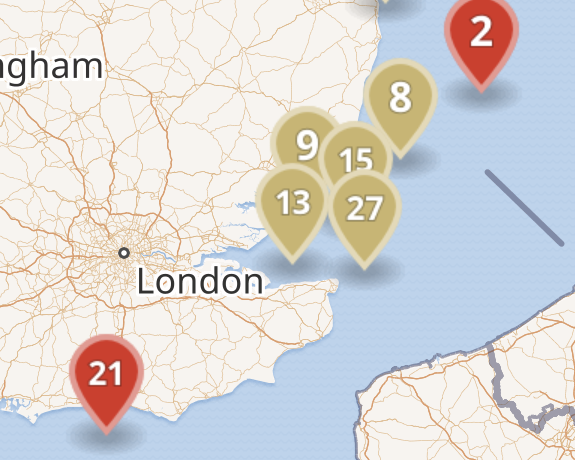
These are the ones that are operational.
- 2 – East Anglia Array – 714 MW
- 8 – Greater Gabbard – 504 MW
- 9 – Gunfleet Sands – 184 MW
- 13 – Kentish Flats – 140 MW
- 15 – London Array – 630 MW
- 27 – Thanet – 300 MW
Note.
- The Isle of Grain is just above the second o in London.
- I have ignored the Ramplion wind farm (21!), as it is too far from the Isle of Grain.
- This is a total of nearly 2.5 GW.
Planned extensions in the area include.
- East Anglia Array – 3.1 GW – Completion date of 2026
But the Wikipedia entry for the East Anglia Array says this about the wind farm.
The target capacity for the entire East Anglia Zone is 7200 MW which could require up to 1200 turbines.
Could we see one of the following?
- A connector from the East Anglia Array to the Isle of Grain.
- One or more new wind farms in the Thames Estuary connected to the Isle of Grain.
- German investment in a wind farm or farms connected to the Isle of Grain.
The Isle of Grain could become an island of energy providing power for London, the South-East of England, Germany and The Netherlands.
An Electrolyser On The Isle Of Grain
Consider.
- There will be plenty of renewable electricity.
- As there is a liquified natural gas terminal, there is plenty of gas storage.
- One or both of the gas-fired power stations can be converted to run on hydrogen.
- As more and more trucks are converted to hydrogen, there will be a large demand for hydrogen for heavy transport.
This must surely make a large electrolyser on the Isle of Grain a possibility.
The BritNed Interconnector
The BritNed interconnector is described like this in Wikipedia.
BritNed is a 1,000 MW high-voltage direct-current (HVDC) submarine power cable between the Isle of Grain in Kent, the United Kingdom; and Maasvlakte in Rotterdam, the Netherlands.
The BritNed interconnector would serve as a link for the foreseeable European super grid project.
Up to now, most of the electricity flow has been to the UK.
But surely, as more wind farms are developed power will flow the other way.
Wilhelmshaven Will Be A German Hub For Green Hydrogen
In Uniper To Make Wilhelmshaven German Hub For Green Hydrogen; Green Ammonia Import Terminal, I described plans by the Germans for a hydrogen hub at Wilhelmshaven.
The original story came from an article with the same name on Green Car Congress.
This is the first two paragraphs.
Under the name “Green Wilhelmshaven,” Germany-based international energy company Uniper plans to establish a German national hub for hydrogen in Wilhelmshaven and is working on a corresponding feasibility study.
Plans include an import terminal for green ammonia. The terminal will be equipped with an ammonia cracker for producing green hydrogen and will also be connected to the planned hydrogen network. A 410-megawatt electrolysis plant is also planned, which—in combination with the import terminal—would be capable of supplying around 295,000 metric tons or 10% of the demand expected for the whole of Germany in 2030.
As I said in the original post, I’m not happy about green ammonia, but the 1.4 GW NeuConnect interconnector has more than enough power to run a 410 MW electrolyser plant at full capacity.
It could even run three electrolysers of this size.
Hooksiel And Wilhelmshaven
NeuConnect will make landfall at Hooksiel.
This Google Map shows Hooksiel and Wilhelmshaven.
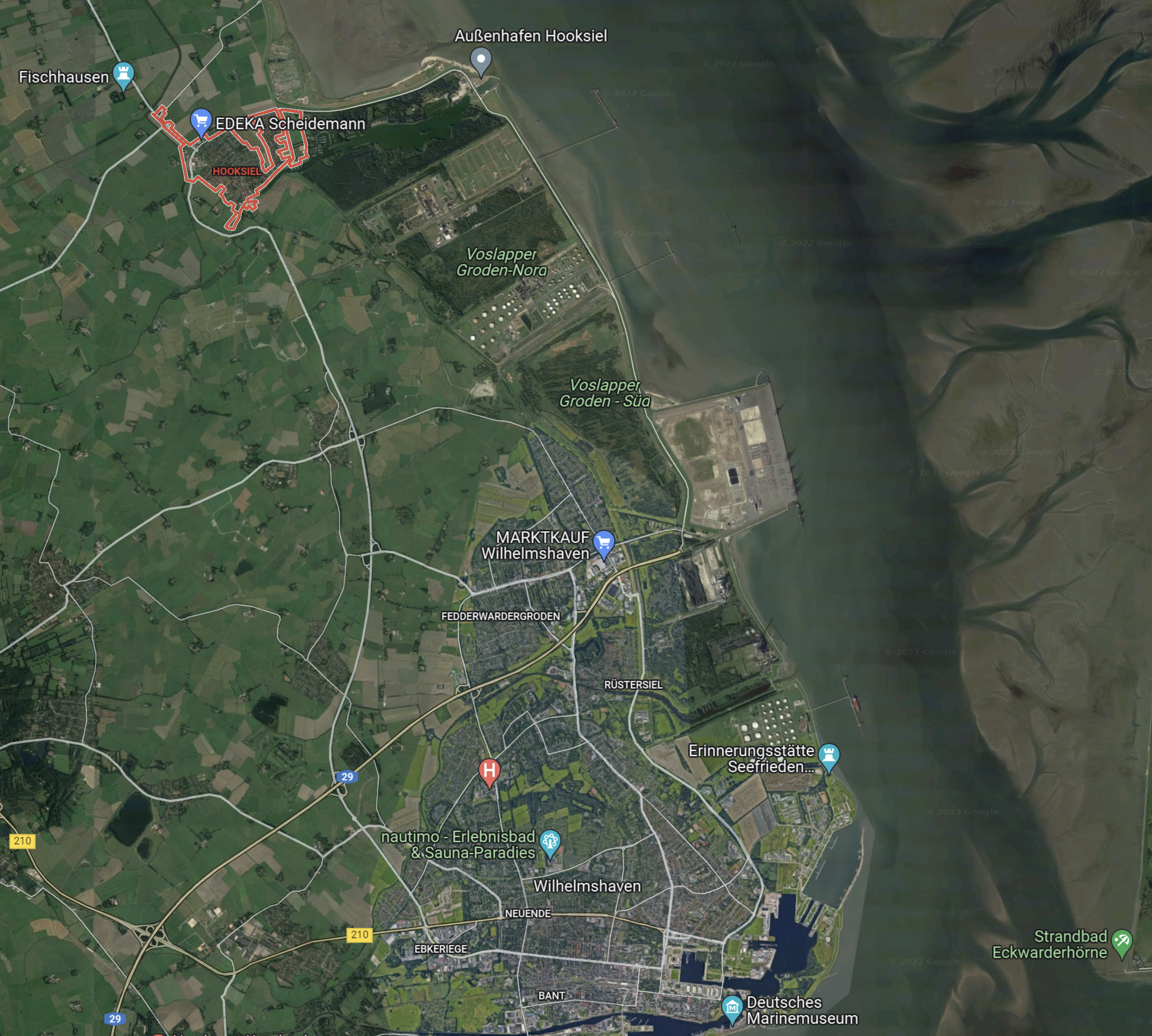
Note.
- Hooksiel is the village outlined in red.
- The water to the right of the map is the Jade Bight.
- The square block sticking out into the bight appears to be a container port.
- There appears to be chemical works or oil refineries North of the port.
- Wilhelmshaven is the town to the South of the port.
There would appear to be plenty of space for Uniper to construct Green Wilhelmshaven.
German And UK Wind Power Production
According to this page on Wikipedia, which is entitled Wind Power By Country, in 2020, these were installed wind power in various countries.
- Germany – 62,184 MW
- Spain – 27,089 MW
- UK – 24,665 MW
- France – 17,382 MW
- Italy – 10,389 MW
- Netherlands – 6,600 MW
In 2020 we were 37.5 GW behind Germany.
It looks like we’ll commission 3.3 GW this year and 6.1 in 2023, with Wikipedia saying that 12.9 GW is under development, which should close the gap to a certain extent.
In ScotWind Offshore Wind Leasing Delivers Major Boost To Scotland’s Net Zero Aspirations, I described how Scotland will add 15.1 GW of floating and 9.7 GW of fixed foundation offshore wind.
It looks like initially, we’ll be buying German wind-generated electricity, but in the future the direction could easily change around.
Boris And Olaf
There were mumblings from Boris, that energy was talked about in their meeting in Downing Street last week.
It does appear there is a lot of ways that the UK and Germany can co-operate in the future with respect to energy.
- German finance can be used to build wind farms in UK waters.
- German companies can build the turbines and the interconnectors we need to develop vast offshore wind farms.
- We can supply surplus energy to Germany through the NeuConnect interconnector.
I wouldn’t be surprised if Boris and Olaf had signed a very comprehensive energy co-operation agreement.
A Chiltern Class 68 Locomotive At Marylebone Station
As I was passing through Marylebone station, I took these pictures of a very clean Class 68 locomotive.
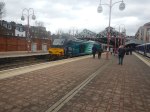
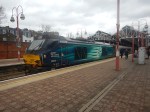

If I’m going to Birmingham, I generally use Chiltern, as often you get to travel in one of these well-restored Mark 3 coaches hauled by a Class 68 locomotive.
With the Mark 3 coach, you get a full size table and a large window to enjoy the countryside.
- The Class 68 locomotives were all built by Stadler in Spain, within the last ten years.
- The UK has a fleet of 34 Class 68 locomotives.
- They are powered by a Caterpillar diesel engine.
- The only problem with the trains is that the Class 68 locomotives are diesel.
But is Caterpillar working on a simple solution?
Search the Internet for “Caterpillar Hydrogen” and you find press releases and other items, like this press release, which is entitled Caterpillar to Expand Hydrogen-Powered Solutions to Customers.
I wouldn’t be surprised to find out, that Stadler and Caterpillar were working on a program to provide a solution to convert Class 68 locomotives to hydrogen.
One Broadgate – 9th April 2022
I haven’t walked down Eldon Street for some time from Moorgate to Liverpool Street station and last time, there was an office block on the North side of the street.












Note.
- Yesterday, there was just a large hole there, which will be filled by the new development of One Broadgate.
- The silver building in the background of many of these pictures is 5 Broadgate, which is the London offices of UBS.
- One Broadgate will be a ten story development.
- The development will be a mixed development with retail and leisure on the lower floors and offices above.
- The last three pictures show the developing plaza in front of Broadgate, with another new development in the South-West corner.
Despite Brexit, the Covid-19 pandemic and now the Russian attack on Ukraine, there seems to be no letup in the building of new offices in London.
The Covers Are Off At Tottenham Court Road Station
These pictures show some of the new signs at Tottenham Court Road station.







As the covers seem to have been taken off, does that mean that like with cricket, something is about to happen?
Is Volodymyr Zelenskyy Planning A Mosquito Moment?
Just imagine the scene in Berlin on January 30th, 1943, which was the tenth anniversary of Adolf Hitler’s rise to power.
A celebration had been planned with speeches by Goering and Goebbels to the Nazi faithful, which would be broadcast over the radio.
But precisely as Goering started to speak, three RAF Mosquitos arrived over Berlin.
This article on The Smithsonian Magazine, which is entitled When the RAF Buzzed Over Germany to Drown Out Nazi Broadcasts, describes the interruption like this.
When the bombs and the British engines intruded on the broadcast of Goering’s speech, radio engineers cut his feed and scrambled for safety. A bewildered German public instead heard the cacophony of bombers, which was soon replaced on their radios with a crackly recording of marching band music. It was more than an hour before a furious Goering returned to the airwaves.
Hours later, three more Mosquitos, gave Goebbels a similar treatment.
Wikipedia gives this quote from Goering about the Mosquito.
In 1940 I could at least fly as far as Glasgow in most of my aircraft, but not now! It makes me furious when I see the Mosquito. I turn green and yellow with envy. The British, who can afford aluminium better than we can, knock together a beautiful wooden aircraft that every piano factory over there is building, and they give it a speed which they have now increased yet again. What do you make of that? There is nothing the British do not have. They have the geniuses and we have the nincompoops. After the war is over I’m going to buy a British radio set – then at least I’ll own something that has always worked.
He was lecturing a group of German aircraft manufacturers.
It has been reported that Vlad the Mad is planning a spectacular parade on Victory Day, which is May 9th, 2022.
I can imagine that Ukrainian planners are working on ways to interrupt any speeches.
A drone spraying blue and yellow paint would be intensely funny and totally within the expertise of high-quality special forces.
The ZEROe Demonstrator Has Arrived
The title of this post, is the same as that of this press release from Airbus.
This is the introductory paragraph.
2022 marks a new and exciting phase for ZEROe – Airbus’ ambition to develop the world’s first zero-emission commercial aircraft by 2035. The multi-year demonstrator programme has officially been launched with the objective to test a variety of hydrogen technologies both on the ground and in the air.
The ZEROe demonstrator will be the first Airbus A 380 aircraft and it is shown in this Airbus visualisation.
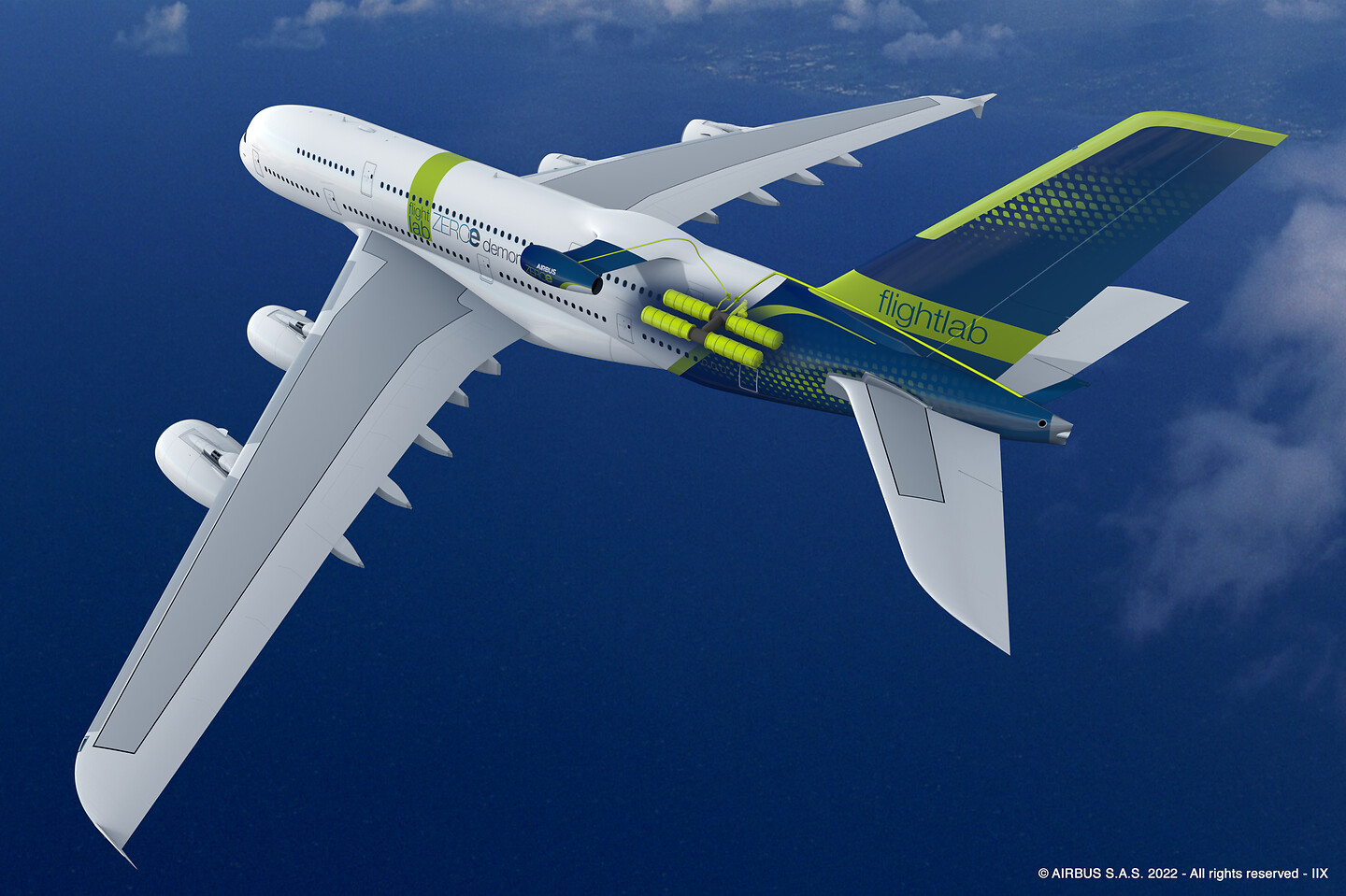
Note.
- The four hydrogen tanks in the fuselage.
- The fifth engine mounted in a pod on the fuselage.
- There’s certainly lots of space inside the fuselage for more hydrogen tanks and test and monitoring equipment.
I have a few thoughts.
This Aircraft Will Be A Superb Demonstrator
The press release says this about the use of an A 380 as a demonstrator.
The A380 is the world’s largest and most spacious passenger jet ever built – a size that makes it ideally suited to the role of test platform.
Today, the A380 MSN1 test aircraft is earmarked for a new role: to take the lead on testing the technologies that will be vital to bringing the world’s first zero-emission aircraft to market by 2035.
“The A380 MSN1 is an excellent flight laboratory platform for new hydrogen technologies,” says Mathias Andriamisaina, Airbus ZEROe Demonstrator Leader. “It’s a safe and reliable platform that is highly versatile to test a wide range of zero-emission technologies. In addition, the platform can comfortably accommodate the large flight test instrumentation that will be needed to analyse the performance of the hydrogen in the hydrogen-propulsion system.”
Initially, I suspect the aircraft will fly as a four-engined turbofan aircraft running on standard or sustainable aviation fuel.
The performance of the hydrogen engine will be tested in all phases of operation and at different altitudes.
What Size Is The Fifth Engine?
This layout is clever.
If Airbus want to test a smaller hydrogen engine for say an Airbus A 320-sized hydrogen aircraft like the ZEROe Turbofan shown in this Airbus visualisation, they fit it to the fifth pylon.
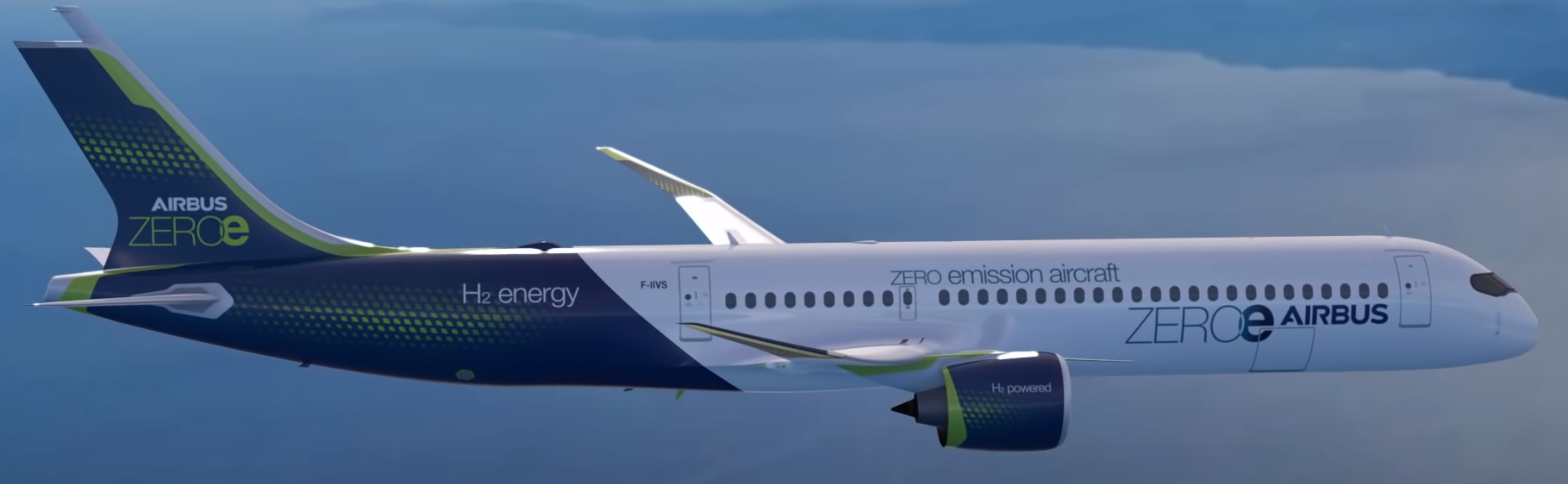
Note.
- The fifth pylon on the ZEROe Demonstrator could be the proposed pylon for the ZEROe Turbofan.
- The ZEROe Demonstrator could probably carry a lot of hydrogen to test out the hydrogen engine over a long duration.
- The hydrogen engine could be tested out over the full flight envelop of an Airbus A 380.
I would suspect that the tests on the hydrogen engine would be some of the most comprehensive ever carried out on a new engine.
If Airbus want to test a larger hydrogen engine for say an Airbus A 350-sized hydrogen aircraft, they would probably replace one of the four main engines with the hydrogen engine.
It looks like Airbus will be able to test hydrogen engines for all sizes of plane in their current range.
What Will Happen To Current A 380s?
Consider.
- The production of the A 380 has been stopped.
- There are 251 aircraft in service.
- They appear to be a reliable and safe aircraft.
- The aircraft can run on sustainable aviation fuel.
- The oldest aircraft are only thirteen years old.
- They are still reasonably modern aircraft, that if they needed to be updated to the latest standards could probably be easily done so.
- The aircraft have a lot of volume, which can hold over 500 passengers in a typical configuration.
- The flying characteristics and structure of the aircraft is well known.
I suspect there are a lot of aircraft leasing companies, who feel these aircraft are too good to scrap, just because they are not zero-carbon.
Could Hydrogen Be Stored In The Wing Of An A 380?
Hydrogen storage will get more capable in the next few years and we will see hydrogen stored in strange places in vehicles and aircraft using the gas as a fuel.
The A 380 may well have an advantage in that its wing is relatively thick compared to that of other airliners.
- The A 380 has a wing aspect ratio of 7.53.
- The Boeing 787 has a wing aspect ratio of 11.
- Gliders have wing aspect ratios as upwards of 30.
High aspect ratios are generally more economical on fuel.
But this relatively thick wing, may make it possible to store hydrogen in the wing of an A 380.
Could There Be A Hydrogen-Powered A 380?
I suspect part of the Airbus ZEROe progam will be to investigate the possibility of converting existing A 380 aircraft into a capable hydrogen-powered aircraft.
In Could An A320 neo Be Rebuilt As A ZEROe Turbofan?, I looked at the possibility of turning an existing Airbus A 320 neo into a ZEROe Turbofan running on hydrogen.
This was my conclusion.
I very much feel that there will be a route to convert some or all of the A 320 neo aircraft to hydrogen power.
So what will a ZEROe A 380 look like if it follows the same design route as an A 320 neo to a ZEROe Turbofan?
- There would be a large hydrogen tank in the rear fuselage.
- As I explained earlier, there may be a possibility for some hydrogen to be stored in the wing.
- Both passenger decks would be shortened and perhaps be able to hold the 350-410 passengers of the Airbus A350-1000.
- The cockpit, front part of the fuselage, wings, tailplane and landing gear would be unchanged.
- The aircraft would fit existing jetways at any airport, that can handle an existing A 380.
I believe that converting an existing Airbus A380 to a hydrogen-powered aircraft is possible and the conversion falls within Barnes Wallis‘s rule of problem solving.
There is no greater thrill in life, that proving something is impossible and then showing how it can be done.
The quote comes from a BBC program, where he was interviewed by Chris Brasher, who was another for whom impossible was just a minor hurdle in the way of meeting objectives.
Could There Be A Hydrogen-Powered A 380 Freighter?
Consider.
- I think it is likely, that companies like Amazon will come under pressure over their carbon footprint, as they transport increasing numbers of packages around the world.
- In DHL Express Shapes Future For Sustainable Aviation With First Order Of All-Electric Cargo Planes From Eviation, I talk about how DHL Express have ordered twelve Eviation Alice aircraft to create a zero-carbon service. DHL must feel this would be good for their image. So would they like an intercontinental zero-carbon freighter?
- Some people worry about the air-miles on their food!
There could be a worthwhile niche market for a high capacity intercontinental zero-carbon freighter.
Because it has such a large internal volume, an Airbus A 380 might make an ideal aircraft to convert.
Conclusion
Airbus will learn a lot from the ZEROe Demonstrator.
They may even learn how to develop, a long-range hydrogen-powered zero-carbon A 380 variant that could carry four hundred passengers between Europe and Australia.
Armoured Vehicles For Ukraine
I have just listened to extracts of the press conference by Boris and Olaf on the BBC and there was talk of boxers.
Not the Mayor of Kyiv, the admirable Vitali Klitschko, but the German-produced armoured fighting vehicle.
Looking at the Wikipedia entry for the Boxer, it states that up to 1500 Boxers for the British Army will start to be delivered from an updated BAe factory in Telford this year, for entry into service in 2023. So with two factories in Europe and another in Australia, will this allow older armoured vehicles to be passed on to Ukraine?
Australia has already stated they will send the Ukraine twenty of their thousand Bushmasters.
Perhaps we could send Ukraine some Mastiffs.
Velocys’s Waste-To-Fuel Project Moves Forward
The title of this post, is the same as that of this article on Let’s Recycle.
This is the first paragraph.
Velocys says it has completed works at its Altalto plant in Immingham, North East Lincolnshire, in preparation for a future connection to the East Coast Carbon Capture and Storage (CCS) cluster.
In partnership with British Airways, Velocys is developing a facility that could convert up to 500,000 tonnes of municipal solid waste into fuel for planes and cars each year.
At last, this very interesting and important project is underway.
I believe that plants like this could be the way we keep flying until hydrogen-powered planes are developed.
HS2 Reveals Dramatic Carbon Saving With Ambitious Modular Design For Thame Valley Viaduct
The title of this post, is the same as that of this press release on High Speed Two.
This is the first paragraph.
HS2 today revealed the final designs for the Thame Valley Viaduct and the pioneering pre-fabricated construction methods that will see the 880m long structure slotted together like a giant Lego set, cutting its carbon footprint by an estimated 66%.
This is one of the pictures released in this photoset.

This second picture shows a closer view of a pillar and the catenary.

It does appear in these two views that the catenary and the gantries that support it are more elegant than those that tend to be used on most electrification schemes at the present time.
These paragraphs describe how the design saved carbon emissions.
Applying lessons from recent high speed rail projects in Spain, the design team cut the amount of embedded carbon by simplifying the structure of the viaduct so that every major element can be made off site.
In a major step forward for viaduct design in the UK, the team opted for two wide ‘box girder’ beams per span instead of eight smaller beams – to simplify and speed up assembly.
The production of steel and concrete is a major contributor to carbon emissions, with the new lighter-weight structure expected to save 19,000 tonnes of embedded carbon in comparison to the previous design. That’s the same amount of carbon emitted by one person taking a flight from London to Edinburgh and back 70,000 times.
It would appear that saving weight and using less steel and concrete can save a lot of carbon emissions.
I once got a bonus at ICI because I saved ten metres on the height of a chemical plant. My boss said, I’d saved nearly a million. by using a mathematical model on an analogue computer to show that a vessel in the plant wasn’t needed and this eliminated a complete floor of the plant.
How much concrete and steel has been saved by High Speed Two on this viaduct, by making it more basset than Afghan hound?
Ever since I watched the building of Crossrail’s Custom House station, I have been in favour of off-site construction.
I wrote about it in An Express Station and am pleased to see it being used on High Speed Two.
 The Anonymous Widower