Hull Trains Sees Biggest Timetable Transformation In Its 23 Year History
The title of this post, is the same as that of this press release from Hull Trains.
These are the first two paragraphs.
Hull Trains has announced it is now running extended 10 carriage trains on a number of its services from Wednesday to Sunday due to growing passenger numbers, bringing an extra 4,000 available seats per week for customers.
Introducing this extra capacity, especially on a Sunday, has been an aspiration of the operator for some time now and it is delighted to finally be able to launch these longer train services. The change will bring additional seats and offers to Hull Trains’ services for customers.
These two paragraphs talks about their performance.
A report released in late 2023 by the Office of Road and Rail (ORR), showed that Hull Trains have led the way for long-distance train operators, reporting a 34% growth in journeys compared to the previous year.
This provided further evidence of Hull Trains’ stability and strength with the local open-access operator now delivering 28% more journeys than it was before the pandemic.
So why have they outperformed other operators?
A Local Presence And Name Must Help
So if you’re going to London, you’re probably more likely to use a local train company. It’s also easy to market.
Hull Has One Of The Best Bus/Train Interchanges In The Country
Recently, I went to an SSE presentation about their Hydrogen Pathfinder Project at Aldbrough. This was given at Horden about twenty miles from Hull and the buses to and from the station were just a hundred metres from the platform at Hull station.
They were also reasonable frequent.
At some stations like Leeds, Manchester Piccadilly and Newcastle the bus/train interchange is bad and require a walk halfway across the City Centre.
Money is Tight At The Moment
I suspect that bus and train is cheaper than going by car to the station.
As in many households there are at often two cars, I wouldn’t be surprised that if one partner can manage without a car, a lot of families have reduced the number of cars they have.
This would be difficult in some places as public transport, isn’t good enough to rely on.
So Hull’s excellent bus/train interchange would benefit train operators.
Interestingly, Doncaster has a co-located bus station.
Sheffield Also Is A Good Bus/Train Interchange
Hull Trains proposed new route is London and Sheffield, which I wrote about in FirstGroup Applies To Run New London To Sheffield Rail Service.
Conclusion
Hull trains are certainly getting it right, but I do think the buses in Hull help.
Centrica Business Solutions Delivers Significant Energy Savings For The Pirbright Institute
The title of this post, is the same as that of this press release from Centrica.
These three paragraphs outline the project.
Centrica Business Solutions has partnered with The Pirbright Institute to deliver sustainable on-site technology that will help reduce its net energy use by more than 10 per cent by 2026.
Centrica installed a new Combined Heat and Power Plant (CHP), which will provide around 75 per cent of Pirbright’s future power needs. The CHP uses natural gas to generate electricity and hot water at the site, with its exhaust gases also used to feed into a heat recovery generator to provide steam. It means CHP technology is over twice as efficient as conventional power sources and can lower organisational reliance on the Grid.
The Institute, which is dedicated to the study of infectious diseases of farm animals, has already devised an energy plan which has introduced energy-saving upgrades across the Surrey campus, including the closure of energy-inefficient buildings, the introduction of efficient lighting and a programme to raise staff awareness of energy consumption.
The system is still powered by natural gas.
Liverpool University
I was an undergraduate at Liverpool University and according to this page on their web site, which is entitled Sustainability, they seem to be following a similar route to the Pirbright Institute.
With a heading of Energy And Carbon, this is the mission statement.
The University’s ambition is to be a climate-resilient campus, that has minimal negative and maximum positive environmental impact, achieving net zero carbon by 2035. We monitor energy and carbon across the entire University as part of the Climate plan and in support of the Sustainability Strategy and Strategy2026 net zero carbon targets.
One section of the page has a title of The Green Recovery with Clarke Energy at the University’s Energy Centre, where this is said.
The University of Liverpool generates up to 90% of its campuses electricity needs on site in the Energy Centre, through CHP. Clarke Energy help the University operate CHP in the most efficient way, keeping us on track with technological developments, such as how the CHP can be adapted to take different fuel blends.
Although there is a nod to different fuel blends, I suspect that the system, like that at Pirbright, is currently powered by natural gas.
Clarke Energy, is headquartered in Liverpool and is a division of Kohler.
Centrica And HiiROC
CHP systems are becoming more common and like these two systems, they are generally powered by natural gas.
In Plans Submitted For Hydrogen Pilot Plant At Humber Power Station, I describe how Hull-based start-up; HiiROC are going to help fuel a gas-fired power station with a hydrogen blend.
This is a paragraph from this article on Business Live, which describes Centrica’s relationship with HiiROC.
It comes as the owner of British Gas has also increased its shareholding in the three-year-old business to five per cent. Last November it was one of several investors to pump £28 million into HiiRoc alongside Melrose Industries, HydrogenOne, Cemex, Hyundai and Kia, who joined existing strategic investors Wintershall Dea and VNG.
HiiROC’s system can take any hydrocarbon gas from biomethane, through chemical plant waste gas to natural gas and convert it to hydrogen and carbon black.
Carbon black has a large number of manufacturing uses and can also be used in agriculture to improve soil.
It looks to me, that HiiROC’s systems will be a simple way to convert natural gas-powered CHPs to zero carbon.
Moorgate Station’s Soldiers Are Now Painted
The City of London’s soldiers outside Moorgate station have now been painted.




But the plastic barriers haven’t been removed yet.
It looks like the station entrance could be finished soon.
If you want a bollard like this for your drive ATG Access make and sell them.
ORR Gives Approval For University Station, Birmingham, To Open
The title of this post, is the same as that of this article on RailUK.
These three paragraphs outline the opening of the rebuilt station.
The Office of Rail and Road (ORR) has authorised two new station buildings and other significant enhancements at University railway station in Birmingham, allowing them to enter into service.
This is a key milestone on the way to getting the station open in the next few weeks.
Linking the two new station buildings is an accessible rail link bridge, and there are new signage, lighting, CCTV and other systems throughout.
No opening date, other than next few weeks, has been given.
EDF Receives Green Light For Solar Farm At The Macallan Estate
The title of this post, is the same as that of this article on Solar Power Portal.
These three paragraphs outline the story.
Energy company EDF Renewables UK has been granted the green light to develop a 4MW solar farm to decarbonise the production of The Macallan’s single malt Scotch whisky in Craigellachie.
Located at The Macallan Estate in north-east Scotland, the distillery company alongside EDF Renewables will integrate ground-mounted solar panels to deliver up to 50% of the daytime electricity needs at peak output. In doing so, this could provide 30% of the site’s yearly electricity demand.
A key aspect of the project is biodiversity and local community engagement – aspects of solar projects which regular readers of Solar Power Portal will be aware of across a number of different schemes.
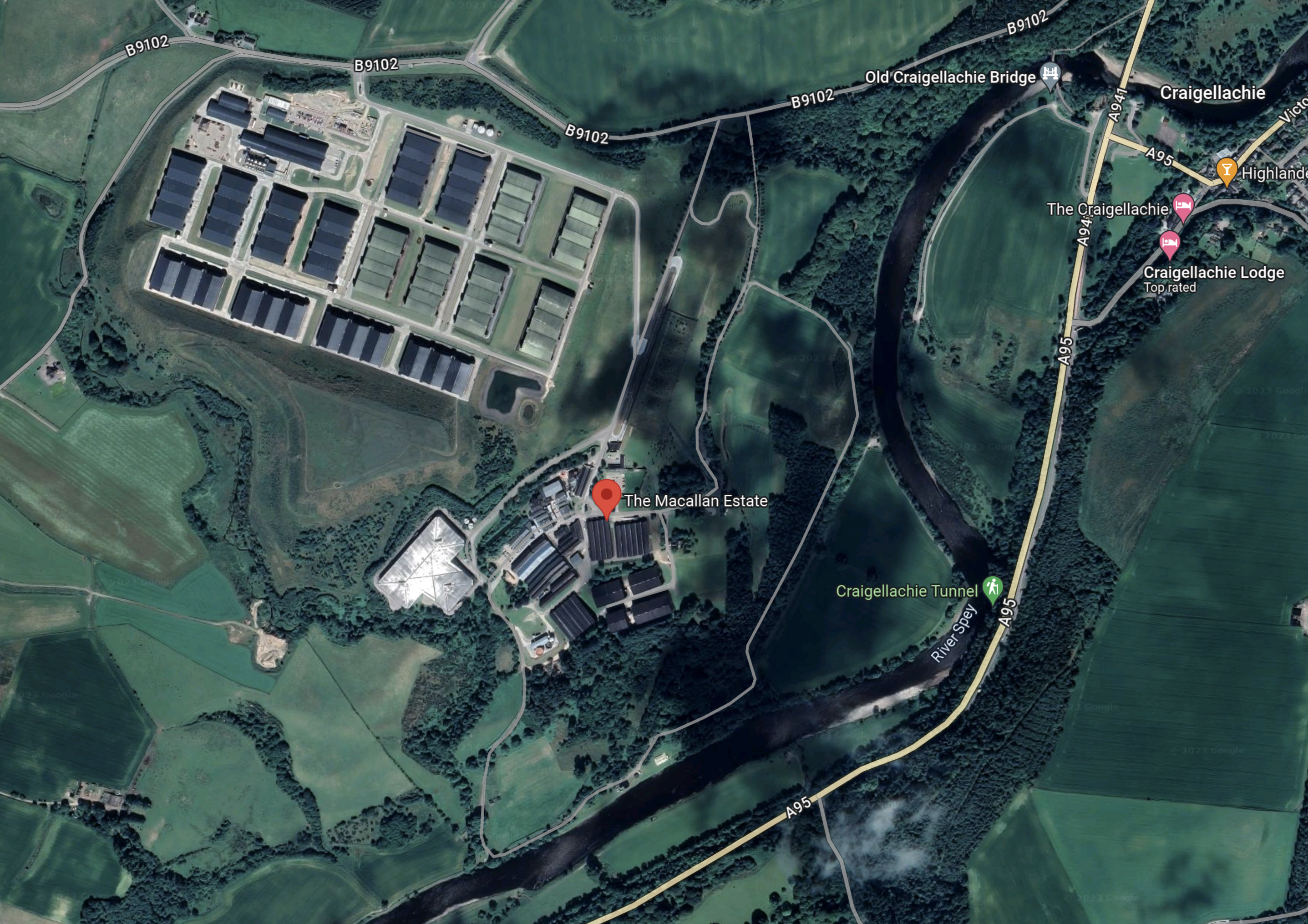
This Google Map shows the Macallan Estate about sixty miles to the North-West of Aberdeen.
This page on the Macallan Estate web site gives details about the company, its whisky and principles.
As the estate is 485 acres, they’ve certainly got enough space for 4 MW of solar panels.
I do wonder though if low- or zero-carbon whisky and other spirits is the way the industry is going.
Searching the Internet for “Zero-Carbon Whisky” gives some worthwhile results.
- NC’NEAN is organic Scotch Whisky distilled in a net-zero distillery in the Western Highlands of Scotland.
- Cooper King is the is the very first whisky in England to be distilled using net zero energy.
- Diageo opens its first carbon neutral whiskey distillery in North America
- The Scotch Whisky Association will achieve Net Zero emissions by 2040 in our own operations.
- Scotch Whisky Heads To Zero Emissions With Wind & …
Scotland seems to be moving to make whisky at least carbon neutral.
There are also two hydrogen projects aimed at distilleries under development.
This is a paragraph from the home page of the Cromarty Hydrogen Project.
The Cromarty Hydrogen Project is the first project in the Scotland Hydrogen Programme. It originated from a collaboration between the Port of Cromarty Firth, ScottishPower, Glenmorangie, Whyte & Mackay and Diageo and the project originator, Storegga during the feasibility stage. This project is looking to develop a green hydrogen production hub in the Cromarty Firth region and revolves around the local distilleries forming the baseload demand for early phases of the project, which would enable them to decarbonise in line with their own ambitions and sector targets.
This project appears to be backed by three companies, who produce Scotch whisky.
In Major Boost For Hydrogen As UK Unlocks New Investment And Jobs, I said this.
I have just looked at the InchDairnie Distillery web site.
- It looks a high class product.
- The company is best described as Scotch Whisky Reimagined.
- The company is based in Fife near Glenrothes.
- They appear to have just launched a rye whisky, which they are aiming to export to Canada, Japan and Taiwan.
The press release says this about InchDairnie.
InchDairnie Distillery in Scotland, who plan to run a boiler on 100% hydrogen for use in their distilling process.
That would fit nicely with the image of the distillery.
I suspect the hydrogen will be brought in by truck.
Would a zero-carbon whisky be a hit at Extinction Rebellion and Just Stop Oil parties?
Diageo
This page on the Diageo web site is entitled Accelerating To A Low Carbon World.
It would probably help if more companies thought like Diageo.
Conclusion
Macallan are certainly going in the right direction.
Q4 2023 Sees Largest Quarterly Increase In Battery Energy Storage
The title of this post, is the same as that of this article on Solar Power Portal.
These three paragraphs outline the story.
Energy research consultancy Modo Energy has confirmed that Q4 2023 saw 420MW of new battery energy storage capacity become commercially operational.
This new capacity represents a 13% increase on the previous quarter and, in doing so, becomes the largest ever quarterly increase in operating battery capacity in GB. The previous record was set in Q2 2023 when 413MW was added.
It is worth noting that the additional capacity now means that GB’s operational grid-scale battery energy storage capacity has now reached 4.6GWh. Modo also confirmed that 1.5GW of battery storage was added across 2023 – a record for a one-year period.
Note.
- Modo Energy has a web site.
- Hinckley Point C has a nameplate capacity 3.26 GW.
- The article also says that the average duration of battery storage in GB is now 1.3 hours.
Strangely, this gives a BESS total storage capacity of 4.55 GWh, which is half the capacity of Electric Mountain.
Exagen Given Green light for new 500MW / 1GWh Battery Storage Project In Leicestershire
The title of this post is the same as that of this article on PV Magazine.
This is the outline of the project, which will be called the Normanton Energy Reserve.
The new 500MW / 1GWh battery site will be capable of powering 235,000 homes for two hours, equivalent to 80% of the homes in Leicestershire.
Approximately 45% of the 19-acre site will be set aside to improve biodiversity by extending Normanton Millennium Wood and creating wildflower meadows. The project will deliver more than 25% biodiversity net gain.
Exagen will establish a circa £4M community fund to spend on improvements in the local area, with residents consulted on how the fund is used.
Note.
- A 500MW / 1GWh battery is not small.
- The size probably makes it a good backup for Leicestershire.
- Nineteen acres is a 277 metre square.
- Any biodiversity net gain is worthwhile.
- A £4M community fund is not to be sneezed at.
It all sounds very good.
Normanton Wood has a web site, where this is said on the home page.
Normanton Wood is one of The Woodland Trust’s ‘Woods on Your Doorstep’ woodlands created to commemorate the Millennium. It lies near Earl Shilton Leicestershire and was planted by members of the local community.
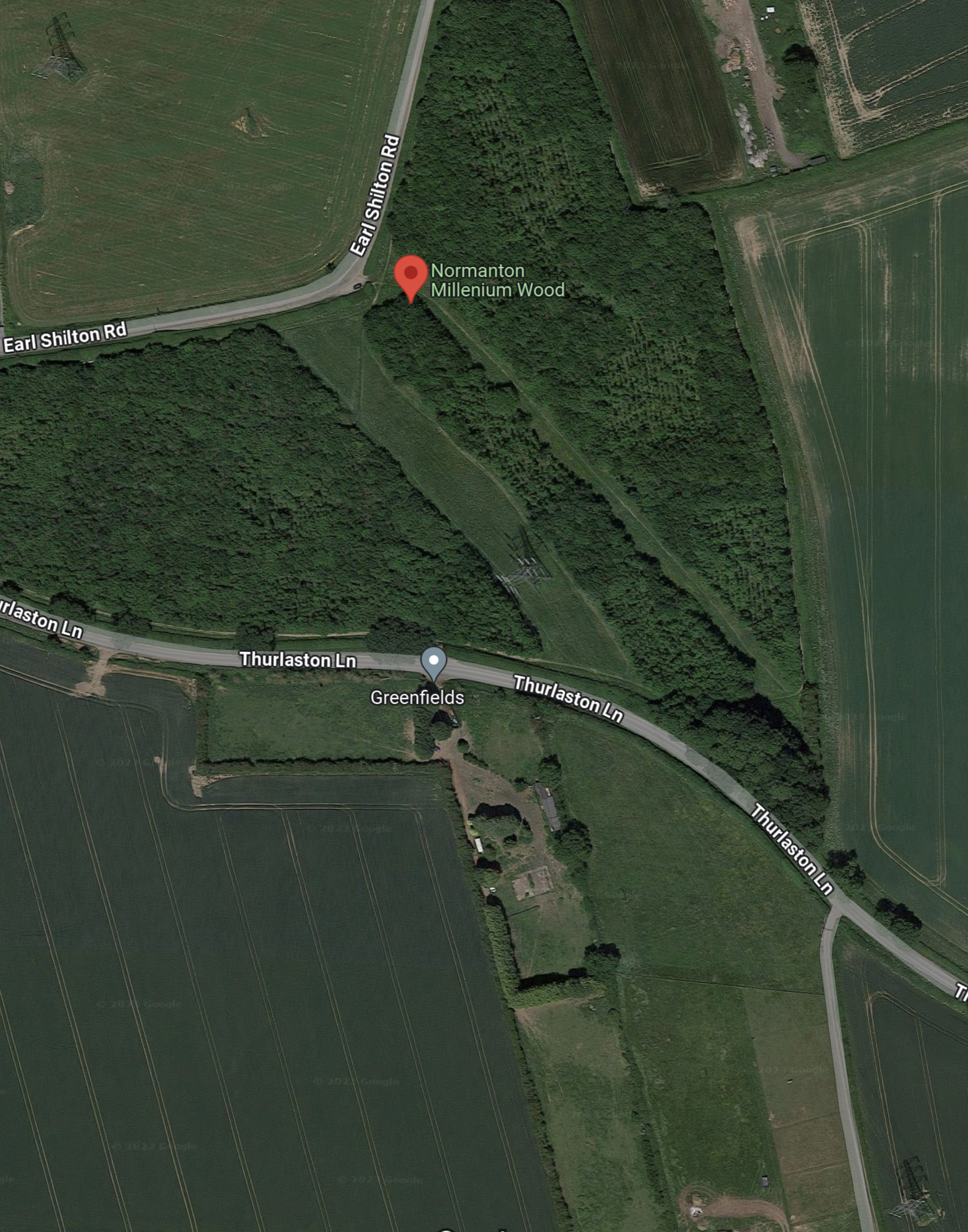
This Google map shows the wood.
Note.
- The red arrow indicates Normanton Millennium Wood.
- I suspect that cleared space in the woodland leading South-East from the red arrow is about 300 metres long and 15 metres wide, which is about 1.1 acres
- As Normanton Millennium Wood is 16.75 acres, I suspect it includes all the woodland to the East of the red arrow, up to the cultivated farmland.
- If you look carefully, you can see a large electricity pylon in the wider cleared area, to the South of the red arrow.
- When I created this map, I clipped it so that the next pylons to the North-West and South-East were in the respective corners of the map.
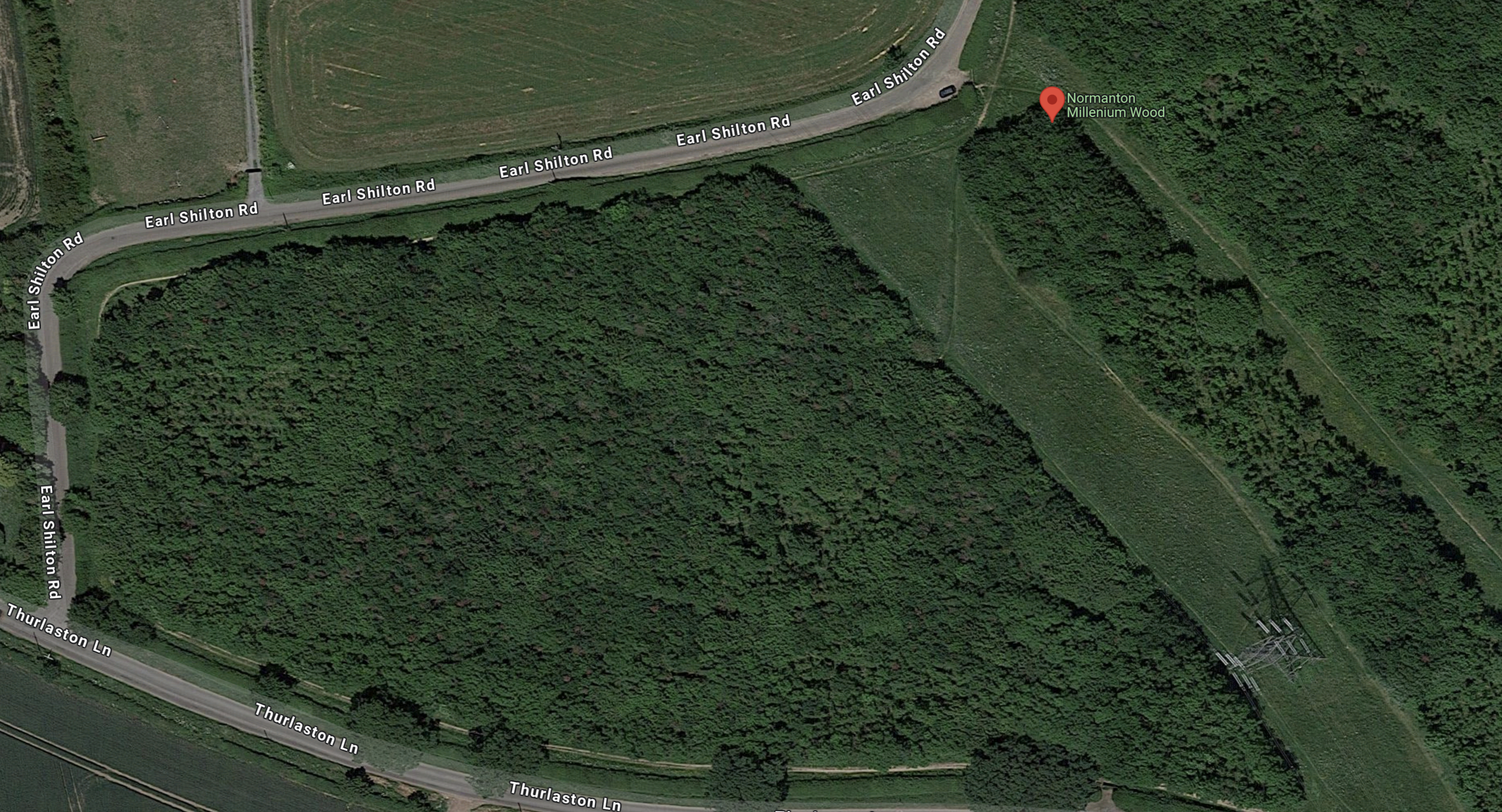
This second map shows the land to the West of the red arrow, which is enclosed by the roads.
Note.
- As before the red arrow indicates Normanton Millennium Wood.
- The electricity pylon is clearly visible on the cleared strip.
- The land to the East of the cleared strip looks like its been planted with trees in the last decade or so.
- The land to the West of the cleared strip looks more like scrub, that has grown up after years of neglect.
- I estimate that the area of the cleared strip and the scrub, is around nineteen acres.
- This news story from Exagen, is entitled Woodland Planting At Normanton Energy Reserve – Becca Leake is a must-read as it outlines how woodland will be planted at the site.
As there is no local substation, it looks to me, that a new substation will be built close to the electricity pylon, with the battery to its West.
Conclusion
It seems a good design for a large battery site, which will be shielded from neighbours by a large area of woodland.
I am also sure, that this battery and the one talked about in New Octopus Energy Makes First Investment To Develop UK’s Largest Battery, are the same battery.
All the numbers in both articles are identical.
Slow Tourism Train Operator Launches First Service
Tyhe title of this post, is the same as that of this article on Railway Gazette.
These are the first two paragraphs.
FS Group’s recently formed tourist train business FS Treni Turistici Italiani has launched its first service.
Branded Espresso Cadore, the overnight service between Roma Termini and Calalzo-Pieve di Cadore-Cortina will run every Friday night until mid-February. On arrival, a connecting bus takes passengers to Cortina d’Ampezzo in 45 min. The return train departs on Sundays, arriving at Roma Termini on Monday morning.
It is surely an interesting concept and I believe it could work on several routes in the UK.
- Settle and Carlisle would be an obvious route.
- Cumbrian Coast Line.
- Bristol and Oxford, which I wrote about in Leisure Market Boom? GWR’s Vision For Direct Bristol-Oxford Services.
There must also be a couple of routes in Scotland and Wales.
As the three routes, I named are electrified at both ends, there is a possibility that they could be run by quiet battery-electric trains.
World’s First Floating Wind Farm To Undergo First Major Maintenance Campaign, Turbines To Be Towed To Norwegian Port
The title of this post, is the same as that of this article on offshoreWIND.biz.
This is the sub-heading.
The world’s first commercial-scale floating wind farm, the 30 MW Hywind Scotland, officially entered the operations and maintenance (O&M) phase in October 2017. After a little over six years of operation, the wind farm’s Siemens Gamesa wind turbines are now due for some major maintenance work.
And this is the first paragraph.
While offshore wind farms undergo turbine maintenance work more than once during their lifespans and tasks such as major component exchange are nothing uncommon, this is the first time a campaign of this kind will be done on a floating farm.
Hywind Scotland has a web site, where this is said on the home page.
The world’s first floating wind farm, the 30 MW Hywind Scotland pilot park, has been in operation since 2017, demonstrating the feasibility of floating wind farms that could be ten times larger.
Equinor and partner Masdar invested NOK 2 billion to realise Hywind Scotland, achieving a 60-70% cost reduction compared with the Hywind Demo project in Norway. Hywind Scotland started producing electricity in October 2017.
Each year since Hywind Scotland started production the floating wind farm has achieved the highest average capacity factor of all UK offshore windfarms, proving the potential of floating offshore wind farms.
This news item from Equinor is entitled Equinor Marks 5 Years Of Operations At World’s First Floating Wind Farm, says this about the capacity factor of Hywind Scotland.
Hywind Scotland, located off the coast of Peterhead, Scotland, is the world’s first floating offshore wind farm and the world’s best-performing offshore wind farm, achieving a capacity factor of 54% over its five years of operations. Importantly, Hywind Scotland has run to high safety standards, marking five years of no loss time injuries during its operation.
Any capacity factor over 50 % is excellent and is to be welcomed.
Maintaining A Floating Wind Farm
One of the supposed advantages of floating wind farms, is that the turbines can be towed into port for maintenance.
This first major maintenance of a floating wind farm, will test that theory and hopefully provide some spectacular pictures.
Wales Puts Another Pumped Storage Hydroelectric Power Station Into Play
This page on World Energy is entitled Fortune Hydro AG and Voith Acquire 450 MW Dorothea Lakes Pump Storage.
This paragraph introduced the article.
Fortune Hydro AG, in collaboration with Voith Small Hydro, has acquired the 450 MW Dorothea Lakes Pump Storage project as part of an £800 million (US$1 billion) strategic investment in renewable energy in the UK.
It looks to me that this was a good buy in July 2023, as after last week, when I wrote Price Framework Paves Way For Vast Electricity Storage Scheme, in response to a UK Government announcement about funding pumped storage hydroelectricity.
These two paragraphs give more details of the project.
Located in Snowdonia, Northern Wales, this green storage facility presents a unique opportunity to integrate wind, solar and hydroelectric power, Fortune Hydro said. The Dorothea Lakes site was one of the largest slate quarries in Europe and the largest in North Wales.
Electricity produced by solar and wind during low demand can be stored until demand is there. This storage allows balancing of the production cycle in the large solar and wind farms in the north against the demand cycle of consumers and businesses in central and southern UK. It will generate up to 600 jobs and bring economic development and new business opportunities to the local community, the company said.
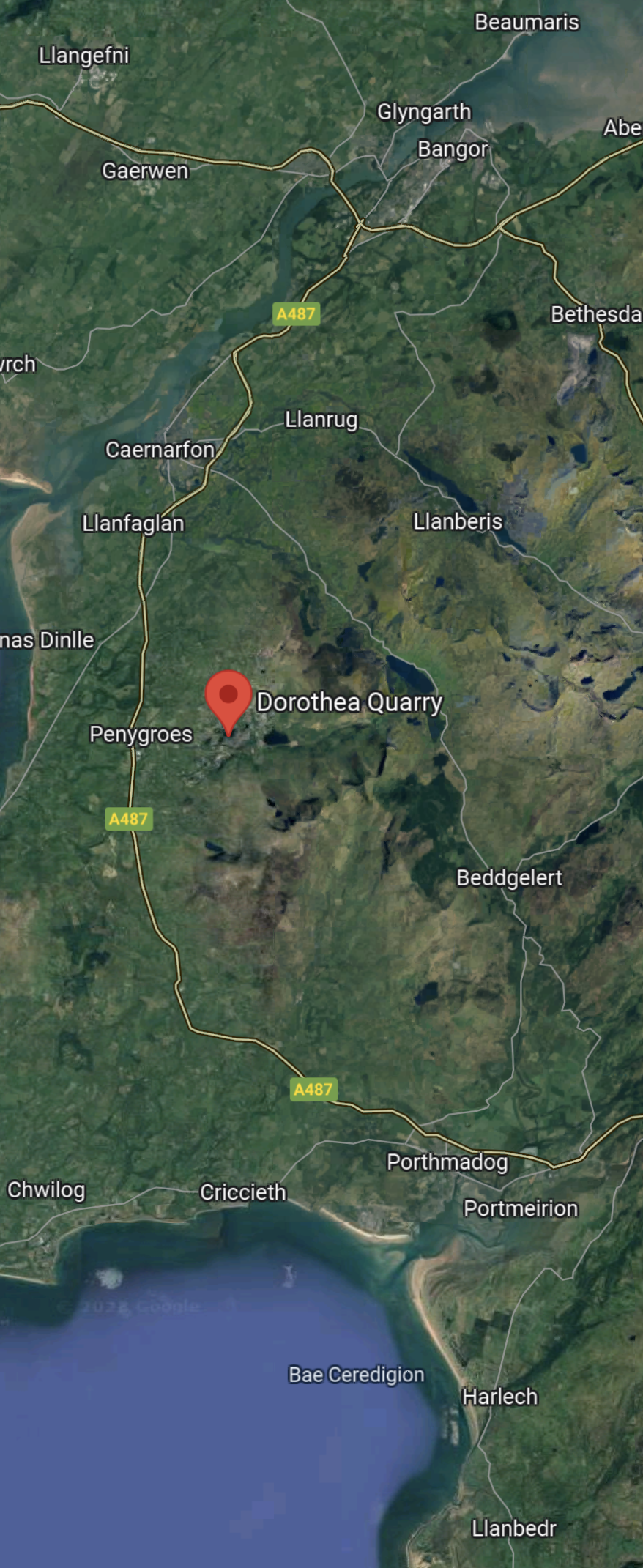
This map shows the location of Dorothea Lakes.
Note.
- Dorothea Lakes is indicated by the red arrow.
- The Menai Strait between Bangor and Caernarfon is at the top of the map.
- It is certainly in a convenient place, with all the wind farms off the North Wales Coast.
At 450 MW, it’s about a third the size of Electric Mountain, so I suspect it could hold about 3 GWh of electricity.
 The Anonymous Widower