Comings And Goings At Ely Station
On my meander around the Fens yesterday, I spent twenty minutes or so at Ely station, as the variety of trains came through the station, whilst I waited for a train to March.
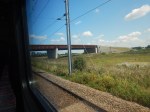


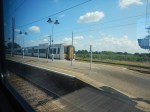


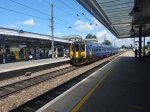
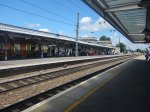
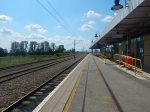
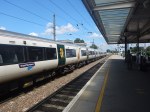
Ely and the surrounding lines are to be remodelled, so that more trains can pass through the complicated junctions.
I had hoped to see a freight train pass through, which would have used the avoiding lines to pass the station.
In some ways, Ely sums up the problems of some of our major railway junctions.
- Several important passenger services needing to pass through.
- Several long freight trains a day.
- Level crossings everywhere.
- More passenger services are needed.
And on top of it all, there is a need to decarbonise.
British Rail and Network Rail have been trying to sort Ely for decades and it should be noted that the Fen Line to King’s Lynn station was electrified in 1992, which was probably an early phase of their master-plan.
Ely And Battery-Electric Trains
These are the distances without electrification on the various routes from Ely.
- Ipswich – 39 miles
- Norwich – 52 miles
- Peterborough – 30.5 miles
- Wisbech – 25 miles
Routes to King’s Cross, King’s Lynn, Liverpool Street, Stansted Airport and Stevenage are all fully electrified.
It does appear to me, that the new generation of battery-electric should be able to handle services from Ely on battery power.
For many of these services, which are or will be run by Greater Anglia, the required battery range can be achieved by swapping some of the diesel engines in the Class 755 trains for batteries.
Freight And Hydrogen Power
In Was This The Most Significant Statement On Freight Locomotives Last Week?, I referred to this press release from Freightliner, which is entitled Freightliner Secures Government Funding For Dual-Fuel Project.
This sixth paragraph from the press release is very significant.
This sustainable solution will support a programme to decarbonise freight operating companies’ diesel fleets in a cost-efficient manner that does not require significant short-term investment and facilitates operational learning in support of a longer-term fleet replacement programme, potentially using 100% hydrogen fuel.
I believe the paragraph indicates, that Freightliner and possibly the other companies involved in the building and operation of heavy freight locomotives have concluded, that the technology is now such, that a zero-carbon rail locomotive powered by 100 % hydrogen is now possible.
Hydrogen offers several advantages.
- Large amounts of power.
- Range comparable with diesel locomotives.
- Depots and freight terminals can be without electrification.
- As hydrogen-powered locomotive will most likely have an electric transmission, this opens the possibilities of using electrification where it exists and regenerative braking to an onboard battery.
My unreliable crystal ball says that we’ll see hydrogen-powered locomotives by 2026.
Cambridge Station To Get Another Platform Lengthening
Of all the stations I use regularly, Cambridge seems to have more expansion programs than any other station I know.
When I first used it regularly it had the following platforms.
- One long through platform split into two numbered 1 and 4 to handle most traffic.
- Two bay platforms pointing North for services to Ipswich and Norwich.
- Two bay platforms pointing South to London.
These have since been joined by a pair of through platforms to the East of the main lines through the station.
Wikipedia says this about Platforms 1 and 4.
- Platform 1 is a 12-car bi-directional through platform generally used for southbound services to London King’s Cross and northbound services to King’s Lynn. It is also used for some early morning northbound services to Ely and for some late evening terminating services.
- Platform 4 is a bi-directional 10-car through platform generally used for northbound services to Ely, King’s Lynn and Birmingham New Street. It is also used for some early morning southbound services to London King’s Cross and London Liverpool Street and for some terminating late evening services.
I was told today, that Platform 4 is going to be lengthened by forty metres at its Northern end.
- This will make Platforms 1 and 4 the same length.
- It will probably allow twelve-car trains to be run from London to both Cambridge North and Kings Lynn stations.
As both Greater Anglia and Great Northern already have twelve-car trains, adding forty metres of new platform is probably an affordable way to increase capacity between Cambridge and London.
A West Anglia High Speed Service
I like the concept of a high speed service Between King’s Cross and Cambridge.
Cambridge is sucking in the best scientific, engineering and financial talent in the UK and a high speed service to and from London would be ideal for reverse commuters.
Trains would be as I described in Will Hitachi Announce A High Speed Metro Train?.
- The trains would run non-stop between King’s Cross and Cambridge.
- The trains would run every thirty minutes.
- Between London and Hitchen, the trains would run at up to 140 mph under digital signalling on the East Coast Main Line.
- Between Hitchin and Cambridge, the trains would run at up to 100 mph on the Cambridge Line.
- When Cambridge South station opens, the trains would stop at the station.
- I would run a pair of trains to Cambridge station, where they would split with one train going to King’s Lynn and the other to Norwich.
- Trains could split in the lengthened Platform 4 in Cambridge station.
- Returning to London, they would join in Platform 1 at Cambridge station.
- The King’s Lynn portion would stop at all stations to King’s Lynn.
- The Norwich portion would stop at Cambridge North and then all stations to Norwich.
- The 54 miles between Ely and Norwich would be on battery power.
- All stations to the North of Ely would get a service every thirty minutes.
I can see other services like this starting all over the country.
- London Euston and Milton Keynes, Rugby and Coventry.
- London Kings Cross and Leeds
- London Kings Cross and Lincoln, Grimsby and Cleethorpes
- London Paddington and Bristol
- London Paddington and Cardiff
- London Paddington and Oxford
- London St. Pancras and Leicester, Derby and Nottingham.
- London Waterloo and Portsmouth, Southampton and Bournemouth.
Note.
- The enabling factor would be trains running at 140 mph under full digital control.
- Existing 140 mph trains like Class 390 and Class 395 trains could also be used.
The services would generally handle shorter distances than High Speed Two and fill in the gaps left by that network.
Rye House Power Station
Rye House power station is gas-fired and I took these pictures as I passed today.
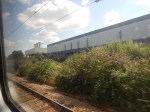

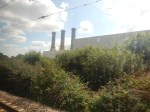


The 715 MW power station is nearly thirty years old and it will be interesting how it is replaced.
Tidying Up At Cheshunt Station – 4th August 2021
As I approached Cheshunt station, it looked like there had been some tidying up on the Western side of the line.
Unfortunately, I didn’t have my camera handy, so I was unable to take any pictures.
But I did take these pictures later from the station.
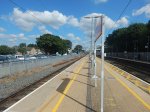
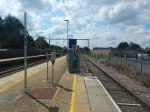
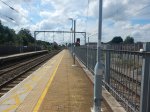

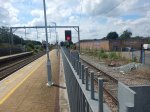
It does seem that Network Rail are tidying up the inside of the bend.
The Internet offers no clue, as to what is happening, but it could be anything from improving the car park entrance, to installing a second bay platform at the station, so that more trains can be run to and from Liverpool Street.
But there is a clue here in West Anglia Route Improvement – Cheshunt Station – 26th February 2017, which from the date is four years old.
The Google Map in this post, shows the Southern end of Platform 2 to be a different shape, to the pictures I took today.
It looks like the platforms have been lengthened.
- Originally, they could handle an eight-car Class 317 train, which are 160 metres long.
- It looks like now, they can handle a pair of five-car Class 720 trains, which are 244 metres long.
This will allow pairs of five-car Class 720 trains to work Cambridge services.
Pairs of four-car Class 710 trains are only 166 metres long, so they don’t need any platform lengthening.
The Sunset Studios Effect
If I was right in The Location Of Sunset Studios In Broxbourne, that a station will be built on the London Overground between Turkey Street and Theobalds Grove to serve the studio complex, then this may require modifications at Cheshunt, if traffic increases substantially.
- Cheshunt station will need to be step-free.
- Cheshunt station will need better passenger facilities, like more ticket machines.
- Cheshunt station may need more car parking.
- The bay platform at Cheshunt station will need to be handle upwards of four trains per hour (tph), all of which will be pairs of four-car trains.
A large housing development is planned for just to the North of Cheshunt station and hopefully, the developer will sort a lot of these issues.
The Location Of Sunset Studios In Broxbourne
This article on HertsLIve discloses the location of the new Sunset Studios in Broxbourne.
This is said.
Land to the west of Waltham Cross has been bought and is allocated in Broxbourne Borough’s Local Plan 2018 – 2033.
It’s just off J25 on the M25 and is thought to be land on either side of the A10 Great Cambridge Road.
James Seppala, Head of Blackstone Real Estate Europe, said: “The site is on the north-west corner of the M25-A10 junction. It’s ideal given its accessibility across Hertfordshire, into Central London, to London’s airports due to its proximity to the M25, and it has the scale for the scheme we’re planning to develop.
“Highways England are expanding the motorway junction currently which is helpful as well.
This Google Map shows the location.
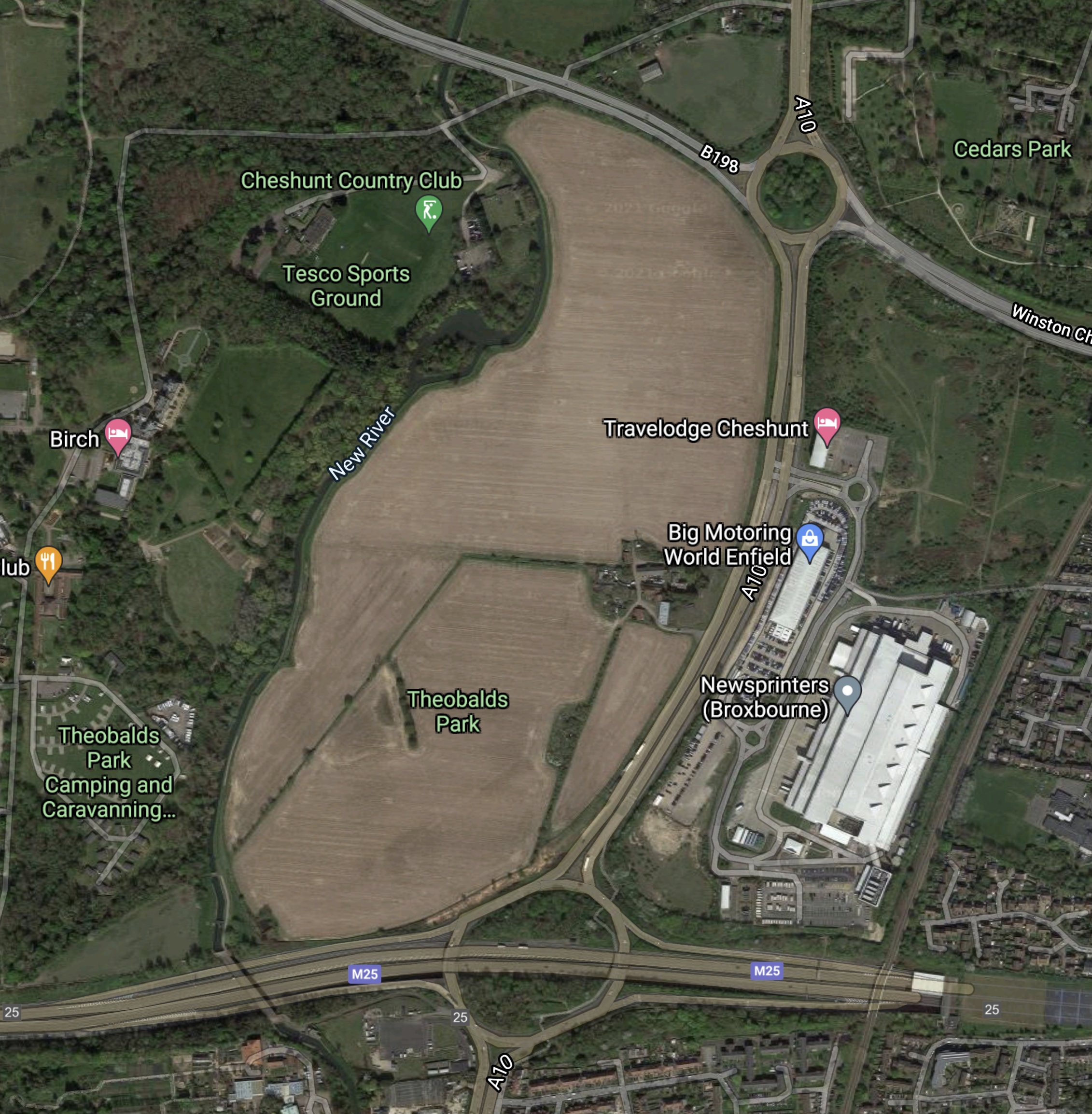
Note.
- The M25 runs across the bottom of the map.
- The A10 runs North-South between the two roundabouts.
- Newsprinters Broxbourne sits on a forty-acre site and is the largest newspaper printing site in the world.
I would expect that the brown agricultural site is where Sunset Studios will be located.
I have one big question.
Is It The Right Place For The Studios?
I know nothing about making films, but from what has been said, this development will produce up to 4,500 jobs.
How are all these people going to get in to work every day?
The site may have a good road network, but it doesn’t have a nearby rail connection.
But in my quote from Herts Live, this is said.
It’s just off J25 on the M25 and is thought to be land on either side of the A10 Great Cambridge Road.
Does that mean it includes the Newsprinter site as well?
This Google Map shows that site.
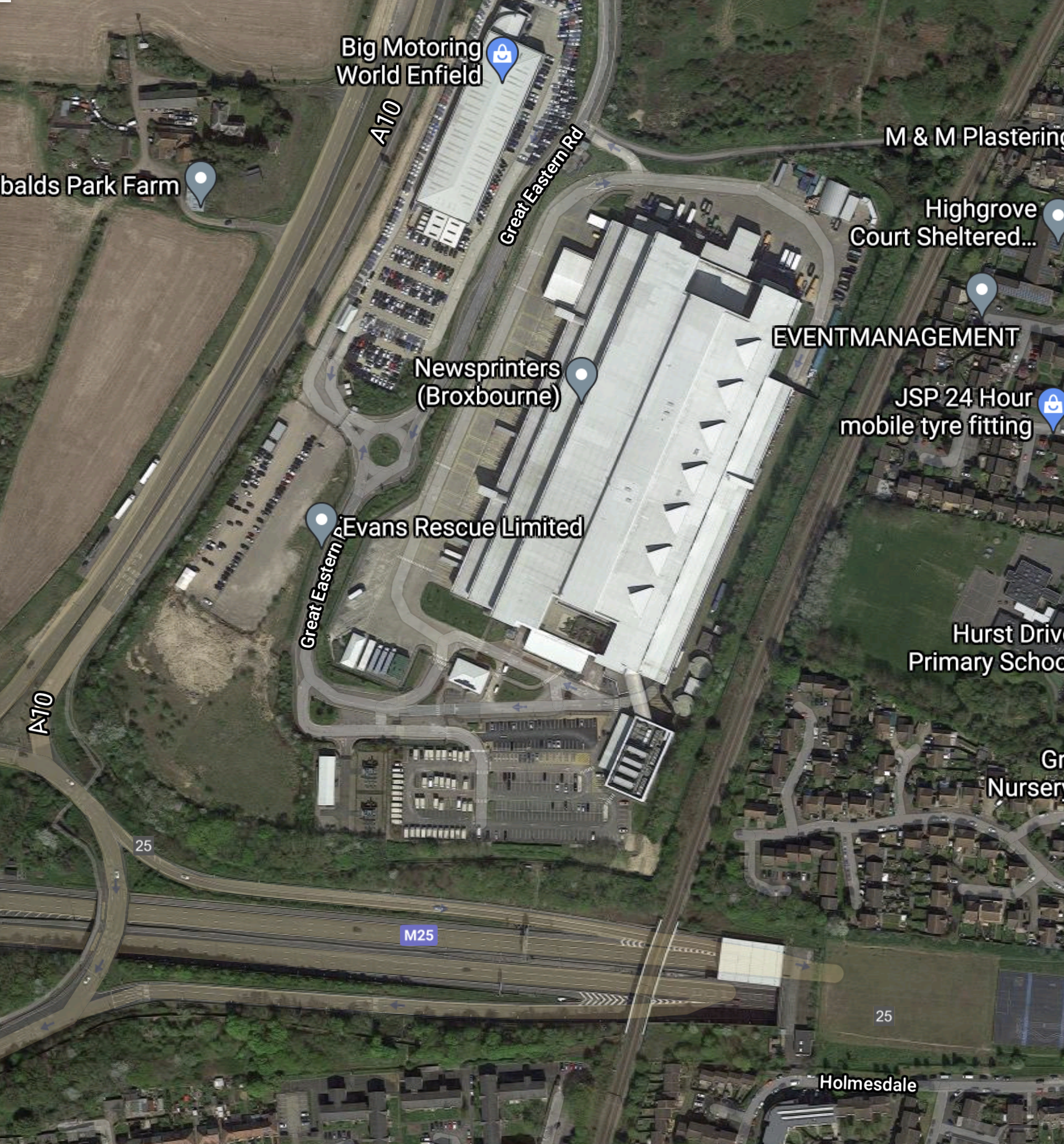
The site seems to be closed in by roads and on the Eastern side by the Cheshunt branch of the London Overground.
- It is a double-track railway.
- It runs between London Liverpool Street and Cheshunt stations.
- It only runs two trains per hour (tph) at present, but it has been designed to handle upwards of four tph.
- The trains on the route are new eight-car Class 710 trains, each of which can hold up to 1,300 passengers.
Could Sunset Studios be thinking about a rail-connected studio complex?
- Liverpool Street will be well-connected through Crossrail to much of London including Heathrow and Canary Wharf.
- Cheshunt is connected to Cambridge and Stansted.
- There are fifteen stations between Liverpool Street and Cheshunt, which must surely mean easy access to the complex for a massive number of potential employees.
A station at the complex, would certainly seem a possible move to cut the amount of road traffic travelling to and from the complex.
Riding Past The Sunset Studios Site On The London Overground
I took these pictures of the area around the Sunset Studios site from a train going North to Cheshunt.


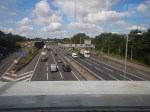
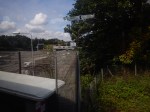






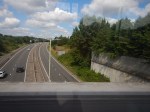
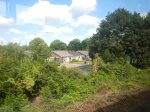

Note, that when the line was reopened in 1960, British Rail left wide margins and from my pictures and the Google Map indicates that building a station on this stretch of line wouldn’t be the most challenging of tasks.
The Hybrid-Electric Plane That Will Switch From Passenger To Cargo In 15 Minutes
The title of this post, is the same as that of this article on Simple Flying.
If you are sceptical about the concept of zero-carbon flying, then read this article, which takes the form of an interview with the Managing Director of Faradair.
DHL Express Shapes Future For Sustainable Aviation With First Order Of All-Electric Cargo Planes From Eviation
The title of this post, is the same as that of this press release from DHL Express.
They have ordered twelve cargo versions of the Eviation Alice.
- Planes will be flown by a single pilot.
- Each plane will be able to carry 1,200 Kg of cargo.
- Maximum range is up to 815 km.
- Each flight hour will require thirty minutes of charging.
When you consider Stansted and Charles de Gaulle Airports are 260 kilometres apart, these planes would be able to handle a lot of routes.
Plan Ahead – Bank London Underground Station Upgrades To Disrupt Underground Services
The title of this post, is the same as that of this article on Rail Advent.
This is the best summary I have seen about what will happen between the 15th January and mid-May next year, when the Northern Line is closed between Moorgate and Kennington stations to work on the upgrade to Bank station.
As I rarely use the Northern Line between Moorgate and Kennington stations, I probably won’t suffer much inconvenience.
But i do have two convenient bus routes between my house and London Bridge station and there is always the Overground and a change to the Jubilee Line at Canada Water station.
Talgo and Repsol To Develop Fuel Cell Trains Powered By Renewable Hydrogen
The title of this post, is the same as that of this article on Railway Gazette.
This article follows the pattern, of if you’re going to build hydrogen-powered trains, you need a quality partner for your hydrogen.
I still puzzle, what Talgo will do with their factory in Scotland, if they miss out on the orders for High Speed Two.
- Russia is an obvious market for their Spanish gauge high speed trains and delivery from Rosyth by ship is probably easier, than from Spain.
- The UK probably needs a quality modern hydrogen train for remote routes, as does the island of Ireland.
- As I indicated in LNER Seeks 10 More Bi-Modes, there could be a niche for a small fleet of 140 mph hydrogen bi-modes to run between London and the North of Scotland.
Note.
The UK probably has enough capacity for regional and commuter electric and battery trains, with Alstom, CAF and Hitachi all with modern trains in production.
Ireland and Russia, with their similar gauge to Spain could be worthwhile markets.
However, I do believe that the 140 mph hydrogen bi-modes would slot into substantial markets in continents and countries like Africa, Australia, Canada, India, Norway, South America, Sweden and the United States, where there are enormous mileages of standard gauge railways without electrification.
Form Energy’s New Low-Cost, Iron-Air Battery Runs For 100 Hours
The title of this post, is the same as that of this article on the Singularity Hub.
This paragraph sums up the genesis of the battery.
A secretive startup backed by Bill Gates’ Breakthrough Energy Ventures thinks it may have the answer, though. Form Energy, which was co-founded by the creator of Tesla’s Powerwall battery, Mateo Jaramillo, and MIT battery guru Yet-Ming Chiang, has unveiled a new battery design that essentially relies on a process of “reversible rusting” to provide multi-day energy storage at ultra-low costs.
And this paragraph describes the operation of the battery.
The company’s batteries are each about the size of a washing machine, and are filled with iron pellets and a water-based electrolyte similar to that used in AA batteries. To discharge, the battery breathes in oxygen from the air, converting the pellets to iron oxide, or rust, and producing electricity in the process. To charge, the application of a current converts the rust back into iron and expels the oxygen.
It’s all very fascinating and leads to a battery made from very affordable materials.
The article quotes between $50 to $80 per kilowatt-hour for lithium-ion batteries and around $20 per kilowatt-hour for Form Energy’s battery.
Conclusion
The article is definitely a must-read.
I feel that Form Energy should be added to my list of viable batteries.
 The Anonymous Widower