What Is Happening To The Greenford Branch?
It appears to me, that the Greenford Branch Line has been quietly shunted into a siding, as it has been some months since any statements of any worth have come from the Department of Transport, Transport for London, Great Western Raiiway or Network Rail.
The line now gets a two trains per hour shuttle service between Greenford and West Ealing stations. Trains that use the branch line to don’t go to Paddington any more.
West Ealing station is being rebuilt and looks like it won’t be complete for a couple of years.
This article on City AM is entitled Ealing Council seeks ‘urgent clarity’ over five delayed Crossrail stations as Network Rail retenders contracts to save money, which says a lot and may even explain, why nothing has been decided about the future of this branch line.
Current Speculation And Rumours
Various reports and forums outline solutions that suggest or include the following.
- It is probably not the easiest line operationally, as the train has to be stabled some distance away.
- Four trains per hour.
- Transfer of the line to the Overground.
- Run a shuttle from High Wycombe to West Ealing.
- Use London Overground’s Class 172 trains, when the Gospel Oak to Barking Line is electrified.
But there are a few problems.
- The incomplete West Ealing station.
- The platform at Greenford is rather short.
- Electrification would be difficult.
I hope all the silence is because the DfT, TfL, GWR, Network Rail and perhaps a train manufacturer are working hard to create an innovative solution for short branch lines like the Greenford Branch.
London’s Other Branches
London has two other short branch lines, that currently carry passengers.
Both are electrified and are run by a four-car shuttle using a bog-standard electric multiple unit.
But I doubt, they are some of most profitable routes in London.
In one forum, it was suggested that London Overground might use the Romford to Upminster Line for driving training on the new Class 710 trains.
In addition, there is the Brentford Branch Line, which has been proposed for reopening.
The Marlow Branch Line
I’m including the Marlow Branch Line, as according to the August 2017 Edition of Modern Railways, Network Rail have devised an innovative track layout for Bourne End station, that will allow trains to pass in the station and thus allow at least a two trains per hour service all day.
Modern Railways says this about financing the new track layout at Bourne End.
The LEP has allocated £1.5million to the infrastructure change needed to accommodate this proposal and GWR is seeking to close the funding gap on it.
There is also an informative diagram.
This Google Map shows Bourne End station.
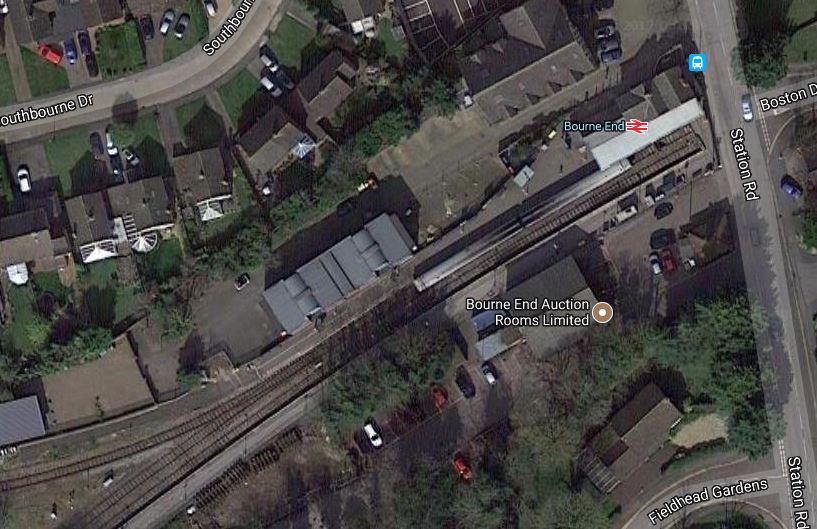
Note how a two-car Class 165 train is parked in the station with lots of space. These trains have two 23 metre long cars, so it would appear that a three-car train with possibly shorter length cars could be accommodated.
I wonder what is the maximum length train that the design team are working with.
Two three-car trains per hour would be a tripling of capacity over the current single two-car train per hour at present.
This innovative proposal certainly looks like one, that has a high chance of realisation.
Other Branch Lines
The UK probably has several short branch lines, with a similar profile to the Bromley North, Greenford and Marlow Lines, where often the service is inadequate or expensive and difficult to provide.
A Train For Branch Lines
Would it be possible to create a train using existing stock, that was ideal for these lines?
Vivarail with their Class 230 train have attempted to do this.
- Two or three cars.
- Diesel-electric or battery power.
- Designed to be serviced remotely.
It may turn out to be a high-class and reliable train, but there may be operational and marketing disadvantages, due to the train’s London Underground history.
But it is certainly a possibility.
Otherwise it is probably necessary to carry on as before with a two-car diesel multiple unit.
But at least, London Overground will be releasing eight Class 172 trains in Spring 2018.
The Unconventional Solution
Although two or three-car diesel multiple units will serve these branches well, I just wonder whether applying the same thinking that led to the Class 319 Flex train could produce a much better solution.
In their brochure for the train, Porterbrook state that they are thinking of adding a battery option to the train. The electrical layout of the Class 319 train leads me to believe it is certainly possible.
These branch lines are not arduous, so why not do the following.
- Replace one diesel power-pack of the Class 319 Flex train with a battery pack.
- Remove the trailer car to create a three-car train.
- Give the trains a good refurbished interior.
Note.
- A three-car train would probably not be a 100 mph train.
- A three-car Class 319 Flex train would only be fourteen metres longer than a two-car Class 165 train.
- Several similar four-car Class 321 trains have been converted to three-car Class 320 trains.
- Being able to run on electrified lines would ease operation, open up new services and charge the batteries.
I feel that having both diesel and battery power for working away from electrified lines would give the trains a high degree of reliability.
These trains could certainly work the Brentford, Greenford, Marlow and Windsor Branches.
The Bombardier Solution
In Will London Overground Fit On-board Energy Storage To Class 378 Trains?, I mused about this statement, after reading this article in Rail Technology Magazine entitled Bombardier enters key analysis phase of IPEMU. Marc Phillips of Bombardier is quoted as saying this in the article.
All Electrostars to some degree can be retrofitted with batteries. We are talking the newer generation EMU as well as the older generation. So, the 387s and 378s are the ones where we have re-gen braking where we can top-up the batteries and use the braking energy to charge the batteries. That gives us the best cost-benefit over operational life.
So it would seem that the Class 378 trains of the London Overground are candidates for fitting with batteries.
These trains started out with just three cars and have grown twice, by adding another motor car and a trailer car. So they are now five-car trains.
London Overground have said that they might lengthen the trains again to six cars.
I would suspect that Bombardier can play musical carriages and create, some six-car trains and a few three-car trains.
Fit batteries to the three-car trains and you have a battery-powered train for a short branch line, that starts in an electrified station.
Services on the Brentford, Greenford and Marlow branches could probably be run by these three-car battery-electric trains.
If the Class 378 train is too spartan, then there is always other Electrostars.
Just remember, that 4 + 4 = 5 + 3!
Conclusion
Don’t be surprised to see an innovative solution at Greenford.
Waterloo Upgrade August 2017 – Walking Between Wandsworth Common And Clapham Junction Stations
These pictures show my walk this morning.
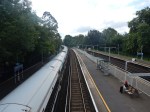
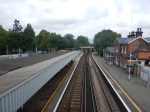
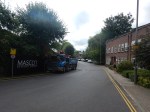
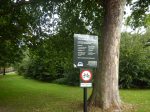
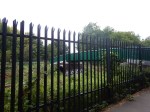
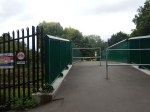
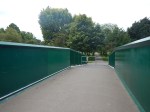
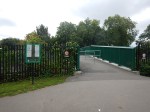
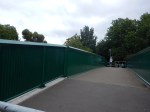
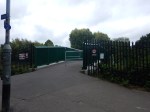
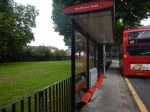
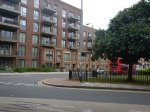
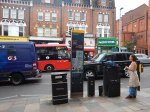


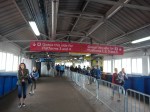
These are my thoughts on the various things I saw! Or in some cases didn’t!
Wandsworth Common Station
Wandsworth Common station is a curious station in some ways, as it certainly wouldn’t be built in the middle of Wandsworth Common in these conservation-minded days.
It also has an eleven trains per hour (tph) frequency to the next stations; Balham and Clapham Junction. Some trains take as little as two or three minutes.
Passenger numbers in 2015-16 at the three stations are as follows.
- Balham – 10,115,000
- Wandsworth Common – 1,690,000
- Clapham Junction – 32,282,000
Wandsworth Common station would appear to be just an overflow station to take pressure from the other two much busier stations.
In the Gibbs Report, one of the things that Chris Gibbs says is that there are too many Off Peak services.
Surely four or six tph stopping at Wandsworth Common station is enough, given that there’s only 24 parking spaces and bus stops are 450 yards away.
Currently, there are six tph between Victoria and West Croydon stations and all stop at Wandsworth Common station, with the fastest journeys taking thirty two minutes.
There are also six tph between Wandsworth Common and Norbury.
Surely on both these services stops can be eliminated, which would save a couple of minutes per stop.
Timing the trains for something like a Class 377 train and using a more efficient stopping pattern, might reduce timings between Victoria and West Croydon to under thirty minutes, which must help Southern to run a better service.
But would the good burghers of Wandsworth allow the simplification, even if it became a faster service?
The Cat’s Back Bridge
The Cat’s Back Bridge is a pedestrian bridge across the railway to the North of Wandsworth Common station.
The replacement of this bridge is described in this article on Rail Engineer, which is entitled A Trio Of Southern Bridges.
The article has some clear before and after pictures taken from the railway.
Wandsworth Seems An Information-Free Borough
Walking from the bridge to Clapham Junction station might have been quicker, if there had been some maps or information.
Perhaps, Wandsworth doesn’t welcome walkers!
At least I found a couple of helpful policemen!
Breakfast At Revolution
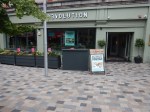
I had a hearty gluten-free breakfast at a bar-restaurant called Revolution in Clapham.
Incidentally, Clapham surprised me with the quality of the shops.
There were also a couple of interesting cafes, including one that was gluten-free and vegan called Without.
Clapham Junction Station And The Waterloo Upgrade
Again there was a lack of information.
Plenty of helpful Customer Service personnel were in attendance at the station, but some better signage was needed, for those unfamiliar with the station.
Conclusion
Wandsworth Council need to get their act together with regard to information.
I live in Hackney and the maps are so much better!
Virtual Speed Bumps
This article on the Mail Online is entitled What do YOU see? Optical illusions of speed bumps are being used in London to trick drivers into slowing down.
It is an interesting idea!
Waterloo Upgrade August 2017 – Mid-Platform Entrance/Exit On Platforms 23/24 At Waterloo Station
These pictures show the mid-platform entrance/exit on Platforms 23/24 at Waterloo station.
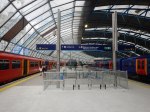

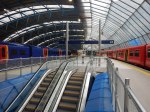
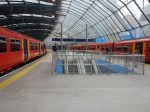
Note.
- This mid-platform entrance/exit must mean that Platforms 20 to 24 effectively have a double-deck gate line.
- Access is also to the Waterloo and City Line.
This article in Rail Engineer, which is entitled Waterloo and South West Route Upgrade, says this.
Improvements in access to the Bakerloo, Northern and Jubilee tube lines from platforms 1/2 and 3/4 and from the former International terminal.
These pictures were taken at 09:30 at the end of the Peak.



When finished it looks like it will be impressive.
Will the access on Platforms 1/2 and 3/4 be double-escalator like this access on the former International platforms?
As I indicated in Waterloo’s Wide Platforms, the design of the older platforms isn’t cramped, so it could be possible.
Incidentally, I couldn’t see any lifts on Platforms 23/24, but these structures behind the grey hoardings could be for lifts.
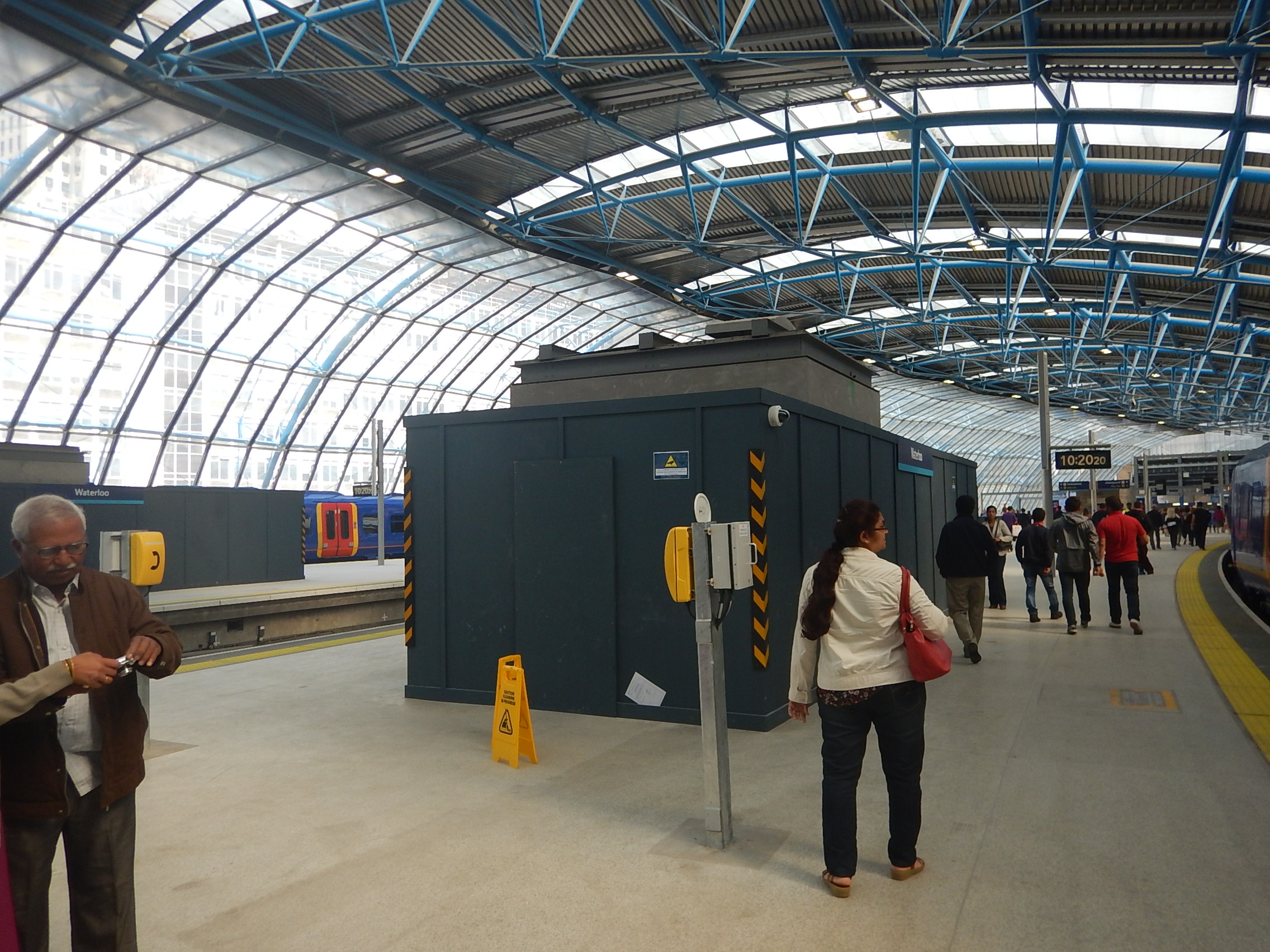
Will there be any platforms in the UK with better step-free access?
And it’s not as if the platforms are for an exotic destination like Cardiff, Huddersfield or Norwich, although I suspect services will go to the regal delights of Windsor! Will Liz be amused?
Waterloo Upgrade August 2017 – Waterloo’s Wide Platforms
These pictures compare the platforms at Waterloo station.
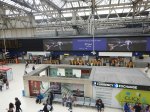
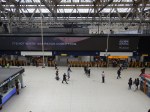
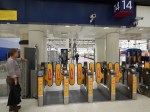
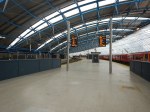
The pictures are shown in increasing platform number order.
Platforms 5 to 14 are in the old part of the station, which was opened in 1922, whilst Platforms 20 to 24 are in the former International station.
Surprisingly, the platforms in the old part of the station seem to be fairly generous in width compared to say those in other London terminals.
They are not much narrower than those built for Eurostar in 1994.
Note that it appears that the old platforms have around five to seven gates per platform, as the space allows, whereas the new ones have thirty gates for the five platforms.
As gates are reversible, that surely is enough to cope with the Peak, especially as there is a mid-platform entrance/exit on some platforms to the Underground.
I suspect the platforms can cope with a whole battalion of guardsmen complete with full kit, all arriving at the same time!
Waterloo Upgrade August 2017 – Was It Alright On The Day?
This article in the Standard had a headline of Waterloo station upgrade: Furious commuters hit out at ‘shambolic’ queues on first weekday of major works.
This article on the BBC had a headline of Waterloo station: Stations quiet after upgrade warnings.
This article on the Independent had a headline of Waterloo station upgrade: Passengers report trains better than normal despite predictions of ‘month of chaos’.
There certainly isn’t lots of interviews on the BBC this morning with irate passengers.
This was the first paragraph from the Independent.
Commuters reported easier journeys than normal on train lines into London Waterloo on Monday morning as some passengers apparently took alternative routes or worked from home to avoid a predicted “month of chaos”.
But I think that Network Rail and South West Trains must have got it more or less right.
London thought they would have a problem during the 2012 Olympics and Transport for London flooded the streets and stations with extra staff to help passengers.
And it worked!
Network Rail and South West Trains have done the same, at least at Waterloo.
And it seems to be working!
Is Highbury And Islington Station To Get An Upgrade?
This article on IanVisits is entitled New Entrance Planned For Highbury and Islington Station.
If this happens, it will be good news for me, as Highbury and Islington station is my nearest Underground station.
But it is a cramped, very busy station with extremely poor access. According to Wikipedia, it is the fifteenth busiest station in the UK and in terms of passenger numbers, handles more in a year, than Manchester Piccadilly, Edinburgh Waverley, Glasgow Queen Street and Liverpool Lime Street.
A lot of these high passenger numbers are due to the unrivalled carrying capacity and success of the Victoria Line and the recently-rebuilt North London Line.
Proximity to Arsenal’s Emirates Stadium has also added thousands of passengers.
The future will draw even more passengers to the station.
For the last two years, passengers like me, have tended to avoid the station, as contractors have been rebuilding the road bridge in front of the station.
But this will finish soon and Islington Council and Transport for London have grand plans to create a very pedestrian-friendly environment outside the station.
And then there’s Crossrail and the Northern City Line!
Crossrail doesn’t connect to the Victoria Line, but thanks to the Northern City Line, Highbury and Islington station has a good connection to Crossrail.
The Northern City Line is also getting new Class 717 trains and increased frequencies between Moorgate and Hertfordshire.
It all adds up to more pressure for something to be done at Highbury and Islington station.
This map from carto.metro.free.fr shows the lines at Hoghbury and Islington station.
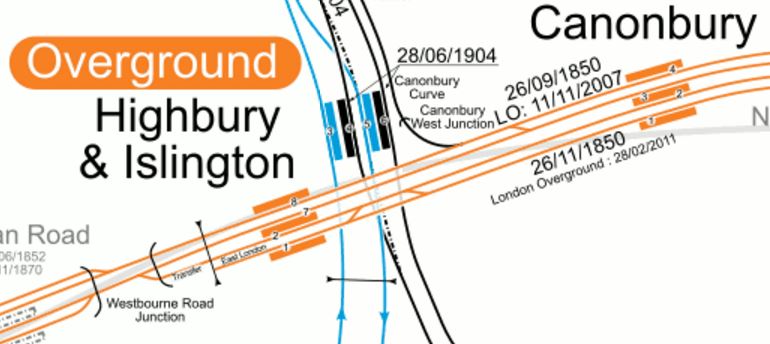
Note how the Northern City and Victoria Lines have cross-platform access, courtesy of some clever platform swapping, when the Victoria Line was built.
Two developments will give alternative routes that might take the pressure off the station.
The doubling in capacity of the Gospel Oak to Barking Line from early next year, will help.
Crossrail will benefit the station, in that a lot of passengers wanting to go between Eastern parts of London and the West End, currently use the Overground and the Victoria Line. Some of these passengers will use Crossrail to go direct.
But something needs to be done.
The four Overground platforms have full step-free access, but the deep-level Victoria Line and the Northern City Line both rely on just two crowded escalators.
If you look at the layout of the four deep-level platforms, they lie together and because the two Northern City Line platforms were dug as a pair in the first few years of the last century, I suspect that all platforms are roughly the same level.
As the lift shafts from the old Northern City Line station are still intact, although full of equipment, I feel that the plan of using this abandoned station to create another entrance to the deep-level platforms will be possible.
- A new ticket office can be provided in a quality building.
- It will need escalators, as well as lifts.
- It should be possible to connect directly to the four platforms, with perhaps a wide passenger tunnel under Holloway Road.
- This tunnel could also have lifts on the other side of the road to the Overground.
It is one of those smaller intricate projects, that can be really good value.
Waterloo Upgrade August 2017 – Feltham Station
I took these pictures at Feltham station.
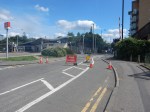


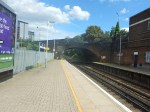

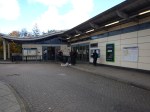
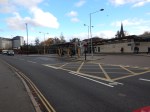
Feltham station is a particular problem, as the level crossing has to be closed.
At present it is closed for preliminary works to take place, so that it can be permanently closed.
This page on the Hounslow Council web site gives more details.
Bombardier On Track For Record Sale Of New Aventra Trains
The title of this post is the same as the title of this article in the Daily Telegraph.
This is the last paragraph.
Aventra trains use energy efficient measures such as regenerative braking, which collects energy generated by the trains slowing down and stores it for later use. They will also offer wifi, and USB sockets in seats.
Does that mean that the trains are fitted with energy storage or in simple terms; batteries.
The Automatic Splitting And Joining Of Trains
Hitachi And Automatic Splitting And Joining Of Trains
The Hitachi Class 395 train was the first train in the UK to be able to automatically split and join in service.
In The Impressive Coupling And Uncoupling Of Class 395 Trains, I linked to this video.
Impressive isn’t it?
In Do Class 800/801/802 Trains Use Batteries For Regenerative Braking?, I quoted this comment from a public on-line Hitachi document.
Because the coupling or uncoupling of cars in a trainset occurs during commercial service at an intermediate station, the automatic coupling device is able to perform this operation in less than 2 minutes.
This is definitely in line with Class 395 train performance.
This document from the Hitachi web site talks about the design of Hitachi’s Class 385 trains for Scotland. This is said.
The lead and rear railcars have an automatic coupler at the front and walk-through gangway hoods. When train sets are coupled together, the hoods fit together as part of the automatic coupling operation to provide access between train sets, meaning that passengers and staff are able to move freely from one train set to another.
Obviously, Hitachi have got automatic splitting and joining of trains spot on!
Current Split/Join Services
There are several places in the UK network, where splitting and joining of trains is used.
- Southeastern Highspeed do it at Ashford.
- Great Northern Kings Lynn do it at Cambridge.
- Southern do it at Haywards Heath.
- Virgin Trains do it at Crewe.
- South West Trains do it at Southampton.
But currently only the Class 395 trains can do it automatically.
The in-service entry of the Class 800 trains will change everything, as it will make a lot more new routes possible.
Virgin Trains East Coast
Currently, Virgin Trains East Coast (VTEC) run two trains per hour (tph) between Kings Cross and Leeds. In the Peak, some services are extended to Bradford Forster Square, Skipton and Harrogate, where the last route is not electrified.
Will some services to Leeds be run by two five-car Class 800/801 trains working together as a ten-car train?
- Class 800 trains are electro-diesel which could work to Harrogate under diesel power.
- Class 801 trains are all-electric, which could work all electrified routes from Leeds.
At Leeds the two trains could separate, with each train going to a different destination. Reading Hitachi’s published documents, the split would take under two minutes at Leeds and I don’t think there would be a restriction of a Class 800 and a Class 801 working together between Kings Cross and Leeds using the overhead electrification.
VTEC gets advantages by using this split and join approach.
- Frequencies and train length to the eventual destinations can be adjusted to what the market will sustain.
- Extra expensive train paths between the split/join station and London are not needed.
- Between the split/join station and London, the train can usually run using electrification.
- Costs are probably saved, if only a half-train is run to some destinations, as track access charges are based on weight.
- A five-car electro-diesel could probably access more routes than a nine-car train.
This is the fleet that VTEC have ordered.
- Class 800 – 10 x five-car
- Class 800 – 13 x nine-car
- Class 801 – 12 x five-car
- Class 801 – 30 x nine-car
These Class 800 and Class 801 trains give VTEC all sorts of of possibilities.
The backbone of the service which is a half-hourly service to Edinburgh probably needs about 35 nine-car trains, some of which would be electro-diesels to work North of the electrification to Aberdeen and Inverness.
But that still leaves quite a few five-car trains available for other services.
Great Western Railway
Great Western Railway (GWR) will probably use their Class 800/801802 trains in a similar manner.
This is the fleet that GWR have ordered.
- Class 800 – 36 x five-car
- Class 800 – 21 x nine-car
- Class 802 – 22 x five-car
- Class 802 – 14 x nine-car
Note that the electro-diesel Class 802 train is similar to the Class 800, but with the engines tuned for more power and larger fuel tanks, so it can handle Devon and Cornwall routes easier.
I think that given the number of five-car trains on order and the lack of promised electrification, I think that GWR will be using splitting and joining in some surprising places, to make sure that as many routes as possible get the new trains.
The Stadler Flirt
This article on Railway Technology describes the Stadler Flirts built for Swiss Federal Railways. This is said.
The train consists of articulated train sets, which contains light rail cars attached semi-permanently sharing a common bogie. The trains are available in two to six car combinations with two to six motorised axles. The automatic couplers, installed at both the ends of the trains, permit connection and disconnection of up to four train cars easily and quickly.
Does this mean that two trains can split and join like the Hitachi trains?
The Bombardier Aventra
The Aventra is a train that has been designed to have everything that customers might need. This is the description of the train in Wikipedia.
The train has been designed to be lighter and more efficient, with increased reliability. It will have lightweight all-welded bodies, wide gangways and doors to shorten boarding times in stations, and ERTMS. The design incorporates FlexxEco bogies which have been used in service on Voyagers and newer Turbostars. The gangway is designed to allow maximum use of the interior space and ease of movement throughout the train.
As Hitachi have published a lot of their thinking on Class 800/801 trains on the Internet, I would find it astounding that Bombardier and the other train building companies haven’t read it.
There have been four orders for the Aventras so far, which total over two thousand carriages.
Two of these orders are for mixed fleets of five-car and ten-car trains.
Are these trains and half-trains just like with the Hitachi trains?
If the answer is in the affirmative, I think it is very likely that Aventras will have the capability of splitting and joining automatically.
Greater Anglia
Greater Anglia has a complex route structure that fans out from a very busy electrified core into Liverpool Street on both their main lines.
They have ordered 89 x five-car and 22 x ten-car of Class 720 trains.
Many of their outer-suburban routes currently run twelve-car services and as their two main lines are only double-track, I can see a lot of five car trains working in pairs.
In Harlow Council Leader Jon Clempner Hopes Crossrail 2 Will Extend To Town, I suggested that Greater Anglia might use splitting and joining on the West Anglia Main Line to get four tph on the Hertford East Branch.
It may not be practical in that case, but Greater Anglia have several electrified branches.
South Western Railway
South Western Railway have a similar route structure to Greater Anglia, with a very busy electrified core into Waterloo.
They have ordered 30 x five-car and 60 x ten-car of Aventra trains.
In Waterloo Upgrade August 2017 – Virginia Water Station, I talked about used splitting and joining to provide a better service on the Waterloo to Reading Line and the Chertsey Branch.
However, I think that most services will be run by ten-car trains given the make-up of the fleet.
The five-cars could generally run on routes where the capacity only needs five-car trains or the infrastructure wouldn’t allow anything longer.
They could then split and join to maximise the capacity and use only one path from the split/join station to Waterloo.
 The Anonymous Widower