Construction Under Way To Double Power Station Capacity At Centrica’s Brigg Energy Park
The title of this post, is the same as that of this press release from Centrica.
This is the sub-heading.
Four ultra-efficient engines have arrived at Centrica’s former combined cycle gas power station at Brigg, with construction work underway on an expansion of the peaking plant at the Lincolnshire site.
These three paragraphs give more details about the project.
The business is installing the four engines inside the former turbine hall at the power station, which was decommissioned in 2020, helping to create nearly 100MW of fast response assets capable of meeting demand when renewable generation is low.
The expanded power plant will be hydrogen-ready, and form part of a trial due to start in late 2024 to blend hydrogen into the gas, ramping up from a three per cent blend to 20 per cent, with a long term vision to move towards 100 per cent hydrogen and to deploy similar technology across all peaking plants.
Work at Brigg is expected to last around nine months and the plant will be fully operational in early 2025.
These are my thoughts.
Hydrogen Blend Operation
The second paragraph indicates that Centrica will be using Brigg power station to research the use of hydrogen blends.
Hydrogen blends could offer a way an easy way to cut hydrogen emissions, so it is good, that Centrica are researching their use in gas-fired power stations.
Brigg As A Peaking Plant
This paragraph from the press release, explains what Centrica means by a peaking plant.
Peaking plants only generate electricity when there’s high or peak demand for electricity, or when generation from renewables is too low to meet demand. Once connected to the grid, the engines will have the capacity to power 20,000 homes for a full day when required, which will maintain stability and deliver reliable power across the grid.
The second paragraph also says this.
A long term vision to move towards 100 per cent hydrogen and to deploy similar technology across all peaking plants.
Does this mean that all peaking plants will move to hydrogen-fired generation?
Brigg Redevelopment
This paragraph from the press release, outlines Centrica’s plans for Brigg power station.
Centrica is redeveloping the Brigg energy park which, once complete, will be home to a 50MW battery, commercial-scale hydrogen production using HiiROC technology (in which Centrica has a five per cent stake), and 100MW of gas peaking plant.
Note.
- I would assume that the battery, will be able to provide 50 MW for at least two hours, so the battery electric storage system (BESS) will be at least a 50 MW/100 MWh unit.
- The HiiROC technology is being developed on the other side of the Humber in Hull.
- HiiROC technology captures the carbon in the gas as carbon black, which has uses in its own right, in agriculture and tyre and other manufacturing.
- Both a battery and a gas peaking plant, will be used at Brigg to match generation with demand.
I wouldn’t be surprised that to use both a battery and a gas peaking plant, is the most efficient way to balance the renewable energy.
Hydrogen Production
The HiiROC technology that will be used at Brigg can extract hydrogen from a variety of sources including biomethane, chemical plant off gas or natural gas.
The HiiROC technology can be scaled to fit the application.
I feel that the versatility of the HiiROC technology, may result in using some unusual feeds to produce hydrogen.
As an example of the deployment of a small HiiROC system , one at a sewage works could provide hydrogen for the utility company’s vehicles.
The main use of the hydrogen would be to provide a clean fuel for the gas-fired peaking plant.
I also wouldn’t be surprised to see the hydrogen, sold and distributed to the local area, from an energy park, like Brigg.
Conclusion
Increasingly, backup for renewables will use a wide range of zero-carbon technologies.
Ameresco And Envision Energy To Deploy 624MWh UK BESS For Atlantic Green
The title of this post, is the same as that of this article on Energy Storage News.
These three paragraphs describe the project.
Developer-operator Atlantic Green has enlisted system integrator Ameresco and clean energy manufacturer Envision Energy for a 300MW/624MWh BESS project in the UK.
The Cellarhead battery energy storage system (BESS) project will be connected to National Grid’s Cellarhead substation in the West Midlands and have a maximum energy capacity of 624MWh. Construction is expected to begin this year, with final connection to the grid slated for the end of 2026.
The deal between the parties is worth £196.5 million (US$250 million). Ameresco will build the project via an engineering, procurement and construction (EPC) and operation & maintenance (O&M) agreement while Envision Energy will supply the BESS units.
Note.
- It is another battery, that can provide full power for two hours.
- It is another battery, that is located near to one of National Grid’s substations.
As batteries seem to be made by different companies, it looks to me, that National Grid are possibly checking out, which batteries are best.
Fifth Hydro Project Proposed At Loch Ness
The title of this post. is the same as that of this article on the BBC.
This is the sub-heading.
The local community is to be asked for its views next week on plans for a new hydro-electric scheme at Loch Ness.
These three paragraphs introduce the new scheme.
Glen Earrach Energy’s, external (GEE) pumped storage hydro project is the fifth hydro scheme proposed for the Loch Ness area.
The company said its project on Balmacaan Estate would create clean energy while protecting the environment, and create 600 on-site jobs.
But concerns have been raised about the number of planned schemes, with Ness District Salmon Fishery Board worried about the effect on wild fish.
The project has a web site, which has a section entitled About The Project, where this is said.
Glen Earrach Energy, which means “Valley of Spring” in Gaelic, stands at the forefront of energy innovation. The Pumped Storage Hydro (PSH) project, located at Balmacaan Estate, Scotland, is a critical component for achieving a net-zero grid by 2030.
The project prioritises environmental preservation and biodiversity enhancement while achieving outstanding efficiency in energy storage and generation.
This ensures a healthier and more sustainable balance between harnessing natural energy resources and the maintenance and reinforcement of the surrounding ecosystem.
Note.
- It doesn’t say, but it looks like Glen Earrach Energy aim to complete the project by 2030.
- Glen Earrach Energy also seem to be playing a strong environmental card.
But nothing is said about the size of the project.
This article on Business Insider, which is entitled £3 billion Loch Ness Hydro Project Plans Unveiled, does give some details.
- Potential Investment – More than £2 billion
- Output – 2 GW
- Storage Capacity – 30 GWh
- The project could create at least 600 on-site construction jobs in Scotland over a six-year period, plus many thousands more locally in the supply chain.
It is larger, than SSE’s flagship Coire Glas pumped storage hydroelectric power station, which is planned to be a 1.5 GW/30 GWh station, at the other end of the Great Glen.
I have some thoughts.
The Existing Hydro Schemes On Loch Ness
According to the BBC article, there are two existing hydro schemes on Loch Ness.
- Foyers is described on this web site and is a reasonably modern 305 MW/6.3 GWh pumped storage hydroelectric power station, that was built by SSE Renewables in the last fifty years.
- Glendoe is described on this web site and is a modern 106.5 MW conventional hydroelectric power station, that was built by SSE Renewables in the last twenty years.
Foyers and Glendoe may not be the biggest hydroelectric power stations, but they’re up there in size with most solar and onshore wind farms. Perhaps we should look for sites to develop 100 MW hydroelectric power stations?
The Proposed Hydro Schemes On Loch Ness
According to the BBC article, there are four proposed hydro schemes on Loch Ness.
- Coire Glas is described on this web site and will be a 1.5GW/30 GWh pumped storage hydroelectric power station, that is being developed by SSE Renewables.
- Fearna is described on this web site and will be a 1.8GW/37 GWh pumped storage hydroelectric power station, that is being developed by Gilkes Energy.
- Loch Kemp is described on this web site and will be a 600MW/9 GWh pumped storage hydroelectric power station, that is being developed by Statera.
- Loch Na Cathrach is described on this web site and will be a 450MW/2.8 GWh pumped storage hydroelectric power station, that is being developed by Statktaft.
In addition there is, there is the recently announced Glen Earrach.
- Glen Earrach is described on this web site and will be a 2GW/30 GWh pumped storage hydroelectric power station, that is being developed by Glen Earrach Energy.
Note.
- The total power of the seven pumped storage hydroelectric power stations is 4.76 GW.
- The total storage capacity is 85.1 GWh.
The storage capacity is enough to run all turbines flat out for nearly five hours.
Could Glendoe Be Updated To Pumped Storage?
The Wikipedia entry for the Glendoe Hydro Scheme mentions pumped storage several times.
In Glendoe Hydro Power Station, I estimate that a Glendoe pumped storage scheme could be perhaps 50 % bigger than the system at Foyers.
I feel that if more storage capacity is needed in the Highlands, then Glendoe could be converted to pumped storage.
Gresham House BESS Fund Energises 50MWh Asset
The title of this post, is the same as that of this article on Solar Power Portal.
These three paragraphs detail the project.
Gresham House Energy Storage Fund has energised a 50MW/50MWh battery energy storage system (BESS) in Lancashire.
Situated in Penwortham, south-west of the county capital Preston, the 1-hour duration BESS is set to be expanded to 2-hours in the summer, meaning its capacity would be 50MW/100MWh.
With the commencement of this new BESS, Gresham House Energy Storage Fund’s operational capacity has now reached 790MW/926MWh. The project is the fund’s 25th operational asset since IPO.
Note.
- The battery will be upgraded to a two-hour battery in the summer.
- The average battery would appear to be 32 MW/37 MWh.
- The average full-power duration for all Gresham House’s batteries appears to be around 70 minutes.
This Google Map shows the battery, which is located next to National Grid’s Penwortham substation.
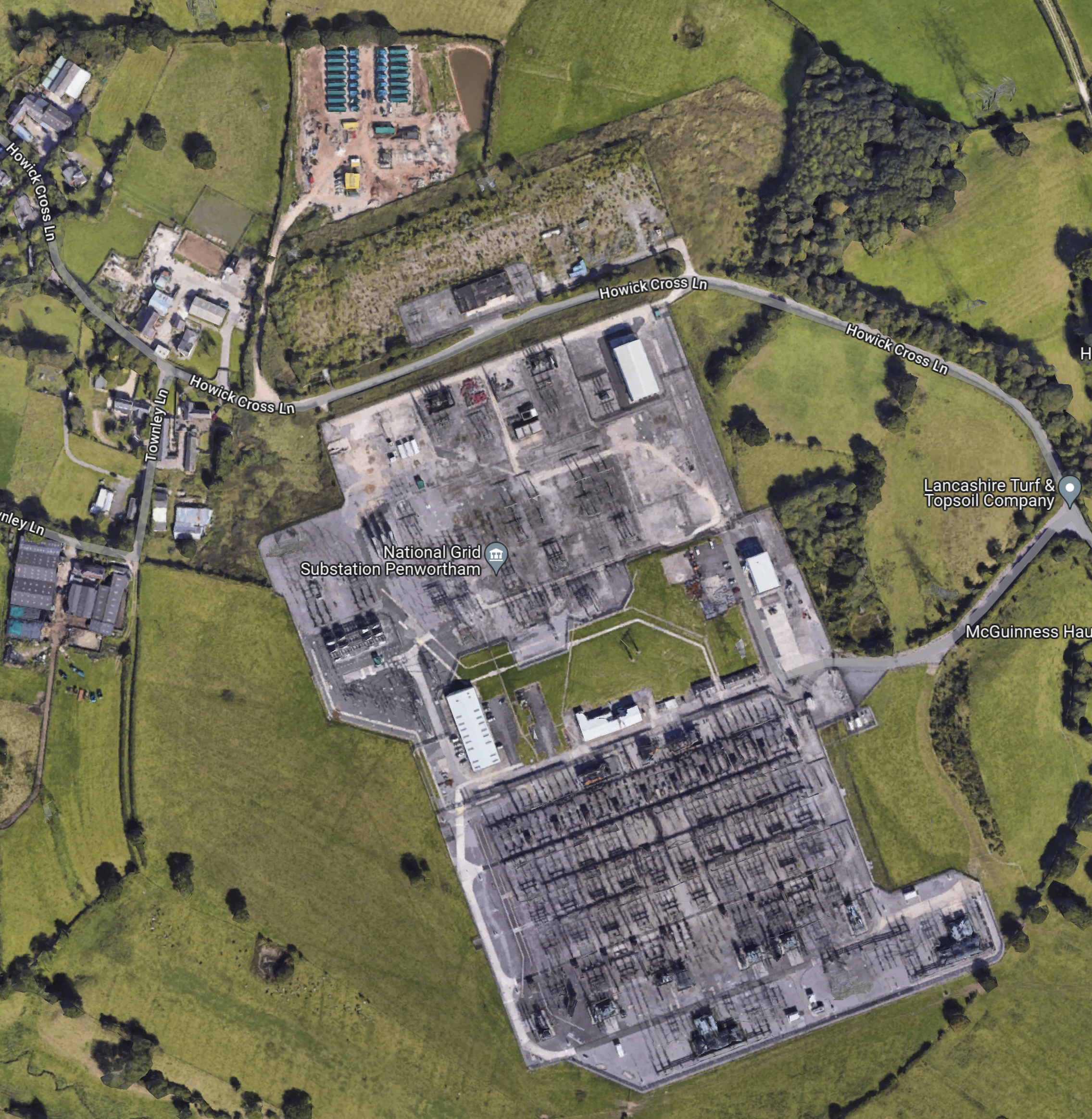
Note.
- The battery is the two rows of green containers at the top of the map.
- The substation appears to be large.
Co-location like this, must surely bring design, construction and operational advantages.
This page on the National Grid web site is entitled Network And Infrastructure, where this is said.
We own the national electricity transmission system in England and Wales. The system consists of approximately 4,500 miles of overhead line, over 900 miles of underground cable and over 300 substations.
If every substation in the UK were to be fitted with a 32 MW/64 MWh two hour battery, these would have a total capacity of 9.6 GW/19.2 GWh.
Compare that with these operational batteries and pumped-storage systems in the UK.
- Cruachan – 1000 MW/7.1 GWh – Pumped Storage
- Dinorwig – 1800 MW/9.1 GWh – Pumped Storage
- Ffestiniog – 360 MW/1.44 GWh – Pumped Storage
- Minety -150 MW/266 MWh – BESS
- Pillswood – 98 MW/196 MWh – BESS
And these systems are under development
- Coire Glas – 1.5GW/30 GWh – Pumped Storage
- Loch Na Cathrach/Red John – 450 MW/2.8 GWh – Pumped Storage
- London Gateway – 320 MW/640 MWh – BESS
There are at least another four substantial pumped storage systems under development.
Conclusion
A twin-track approach of grid-batteries at sub-stations and a few larger grid batteries and pumped storage hydroelectric schemes should be able to provide enough storage.
Ørsted, Simply Blue, Subsea7 Submit Application For 100 MW Scottish Floating Wind Farm
The title of this post, is the same as that of this article on offshoreWIND.biz.
This is the sub-heading.
Ørsted, Simply Blue Group and Subsea7, through their joint venture partnership in Scotland, have submitted an offshore consent application for the proposed 100 MW Salamander floating offshore wind farm, one of the 13 projects selected in Scotland’s Innovation and Targeted Oil and Gas (INTOG) leasing round.
The article starts with a map that shows the location of the Salamander floating offshore wind farm and it shows how the sea is getting very crowded 35 kilometres off Peterhead.
This map shows the various ScotWind leases, around the North of Scotland.

The numbers are Scotwind’s lease number in their documents.
These are the Scotwind wind farms to the North-East of Scotland.
- 1 – BP Alternative Energy Investments – 859 km² – 2.9 GW – Fixed
- 2 – SSE Renewables – 859 km² – 2.6 GW – Floating
- 3 – Falck Renewables Wind – 280 km² – 1.2 GW – Floating
- 4 – Shell – 860 km² – 2.0 GW – Floating
- 5 – Vattenfall – 200 km² – 0.8 GW – Floating
- 6 – DEME – 187 km² – 1.0 GW – Fixed
- 9 – Ocean Winds – 429 km² – 1.0 GW – Fixed
- 10 – Falck Renewables Wind – 134 km² – 0.5 GW – Floating
- 11 – Scottish Power Renewables – 684 km² – 3.0 GW – Floating
- 12 – BayWa r.e. UK – 330 km² – 1.0 GW – Floating
Note.
- Salamander is located to the South of wind farms 10, 11 and 12 and to the North-West of wind farm 5.
- These windfarms total up to 16 GW.
- 4.9 GW are fixed foundation wind farms.
- 11.1 GW are floating wind farms.
These are my thoughts.
The Salamander Project
In the big scheme of things, the 100 MW Salamander wind farm, is rather a tiddler of a wind farm.
On the Salamander wind farm web site, a section gives the Project Goals.
- Our innovative pre-commercial stepping-stone concept will use novel floating foundations to (i) maximise Scottish content, (ii) enable the Scottish supply chain to gear up for the future floating offshore wind commercial opportunities in ScotWind and (iii) reduce the financial, environmental and technology risks of floating offshore wind.
- The Salamander project will contribute to the Scottish Government and UK Government net-zero targets. The project can contribute to the Scottish government’s target of 11 GW of installed offshore wind by 2030, as well as the UK government’s target of 5 GW of operational floating offshore wind by the same date.
- We are dedicated to developing a sustainable and transformative project, working with the oceans, and enabling communities to benefit from Project Salamander. Therefore, we commit to having a continuous and strong stakeholder and community engagement.
It appears to me, that the Salamander project will be a pathfinder for the 11.1 GW of floating wind farms to be built off Peterhead.
Bringing The Electricity South
National Grid are building four interconnectors between Eastern Scotland and Eastern England.
- Eastern Green Link 1 – Torness and Hawthorn Pit
- Eastern Green Link 2 – Peterhead and Drax
- Eastern Green Link 3 – Westfield and Lincolnshire
- Eastern Green Link 4 – Peterhead and Lincolnshire
Note.
- All interconnectors are 2 GW.
- All interconnectors are offshore for a long part of their route.
- It also appears that National Grid are burying much of the onshore sections.
But the 4 GW of interconnectors will only be able to bring a quarter of the offshore electricity generated in the Peterhead area to the South.
What Will Happen To The Excess Electricity?
Consider.
- There could be 16 GW of planned offshore wind power around Peterhead and North-East Scotland.
- There is only 4 GW of interconnector capacity between Peterhead and Eastern England.
- There is another 6.8 GW of electricity around North-West Scotland.
- There is 2.8 GW of electricity being developed to the East of Shetland.
- The Crown Estate is thinking of increasing the size of some offshore wind farms.
It is likely, that other wind farms will be built in the seas around the North of Scotland.
It appears that the North of Scotland could have at least 20 GW of excess electricity.
Possible solutions would include.
- Developing energy intensive industries like metal refining.
- More interconnectors to Denmark, England, Ireland and Norway.
- Storage of the electricity in giant pumped storage hydroelectric power stations.
- Creation of green hydrogen for export.
Note.
- Aluminium refining has been developed in the North of Scotland before.
- More interconnectors are a possibility, especially as Scotland is developing cable manufacturing capacity.
- Some maps show extra interconnectors between West Scotland and Merseyside.
- At least 70 GWh of pumped storage hydroelectric power stations are being developed along the Great Glen.
- I suspect that the pumped storage hydroelectric power stations could be connected to the wind farms, by cables under the waters of Loch Ness.
But surely, production of green hydrogen for export would be a very good way to go.
- Extra electrolysers could be added as required.
- Because of the interconnectors down both East and West Coasts, electrolysers could be built in England, where there is a large need for hydrogen.
- Hydrogen would be exported initially by tanker ships.
- At some point in the future, it might be viable to build a hydrogen pipeline to connect to the growing European hydrogen network.
The giant pumped storage hydroelectric power stations and the hydrogen electrolysers would be sized to make sure, that no wind power is never wasted.
Conclusion
The 100 MW Salamander floating wind farm may only be small, but it will prove the technology, the manufacturing and the supply chains, so that Scotland can have a second energy boom from the North Sea.
But this boom will certainly last longer than a hundred years.
Europe’s Mines Look To Gravity Energy Storage For Green Future
The title of this post, is the same as that of this article on Global Mining Review.
This is the sub-heading.
Mine owners across Europe are looking at a new form of underground energy storage to offer a low carbon future as operations wind down.
These are the first four paragraphs.
Active deep mine operators in Slovenia, Germany, The Czech Republic and Finland are all examining how underground gravity energy storage – provided by Edinburgh firm Gravitricity – could offer green opportunities to mining communities facing a downturn in employment.
Gravitricity has developed a unique energy storage system, known as GraviStore, which uses heavy weights – totalling up to 12 000 t – suspended in a deep shaft by cables attached to winches.
This offers a viable alternative future to end of life mine shafts, which otherwise face costly infilling and mine decommissioning costs.
They have teamed up with energy multinational and winch specialist ABB alongside worldwide lifting specialists Huisman to commercialise the technology for mine operators.
Note.
- Four projects are mentioned.
- It appears to be less costly, than infilling.
- Gravitricity have teamed with ABB and Huisman, who are two of Europe’s specialist in this field.
- You can’t have too much energy storage.
The article is worth a full read.
Conclusion
Gravitricity’s simple idea could be a big winner.
Aura Power Secures £10 Million Funding From Novuna
The title of this post, is the same as that of this article on Solar Power Portal.
These two paragraphs introduce the deal.
Aura Power has announced the successful closing of a £10 million debt facility with Novuna Business Finance. Novuna is a part of Mitsubishi HC Capital UK PLC, designed to support projects from early development through to the operational phase.
Bristol-based Aura Power is developing an active pipeline of utility-scale solar PV and battery energy storage of about 12GW in the UK, Europe and North America. The funding will help progress global development for Aura, covering expenditures like grid payments, planning fees and legal land costs.
These two paragraphs describe some of Aura’s projects.
In December 2023, Aura was granted planning permission for a 100MW/400MWh battery energy storage (BESS) project in Capenhurst, Cheshire. It was the third UK project to receive planning permission last year, alongside Aura’s 49.9MW Horton Solar Farm located in East Devon and its 49.9MW Hawthorn Pit Solar Farm in Durham.
Aura has been active within the solar and battery industries, with a pipeline in development in excess of 20GW. Last week (2 May), following an appeal, the developer secured planning permission for an Essex solar farm that will have an export capacity of 30 MW.
Nearly, forty years ago, I started a finance company in Ipswich with a friend. Our financing was mainly directed towards truck leasing for companies moving containers to and from the Port of Felixstowe.
Before, I committed my money to that venture, I built a large mathematical model of the proposed business. I found, that there were some unique financial properties to leasing quality trucks, that meant losing large sums of money were difficult.
I wouldn’t be surprised that leasing battery energy storage (BESS) systems have a lot of things going for them, if you have the right contract.
This may explain, why there a large number of companies in the market of providing grid batteries.
- At the top end; Centrica, Rolls-Royce and SSE will supply you with one.
- Funds like Gore Street and Gresham House and others allow you to invest in batteries.
- At the other end of the market are companies like Aura Power.
I suspect, that as with truck-leasing company, the financial flows are very stable and investor-friendly, if you get the model right.
SSE Renewables Buys 100MW/200MWh Northern Ireland BESS Project
The title of this post, is the same as that of this article on Energy Storage News.
These five paragraphs describe the acquisition and SSE Renewables progress as they build a portfolio of Battery Energy Storage Systems.
A 100MW/200MWh BESS project in Northern Ireland has been acquired by the renewable energy development subsidiary of UK-headquartered power generator and developer SSE.
The 2-hour duration Derrymeen battery in Dungannon, County Tyrone was bought from developer Heron Energy and would be the largest installed BESS facility in Northern Ireland when online.
Subject to a final investment decision by SSE Renewables, the shovel-ready project will be constructed on a greenfield site located outside Coalisland, around five miles from Dungannon.
If approved for final delivery, construction could commence early next year and the BESS would be operational by the end of 2026. It will connect to the grid via an underground cable to the nearby existing Tamnamore substation.
This is SSE Renewables’ first battery storage development in Northern Ireland, having already an established green portfolio in Britain. The firm launched its first operational BESS in the GB market on 15 April in the form of a 50MW/100MWh asset located in Salisbury, Wiltshire.
This battery is a two-hour battery, as are the other two batteries, that are mentioned in the article, that are being developed by SSE Renewables.
Is this a standard for SSE Renewables?
 The Anonymous Widower