Sweden’s Grand Plan To Make Zero-Carbon Steel
The title of this post is the same as that of this article on theTelegraph.
It adds a lot of colour and background to Sweden’s plan to make zero-carbon stell using a process called HYBRIT, that I wrote about in Funding Award to Supply An 8MW Electrolyser and is illustrated in this infographic.
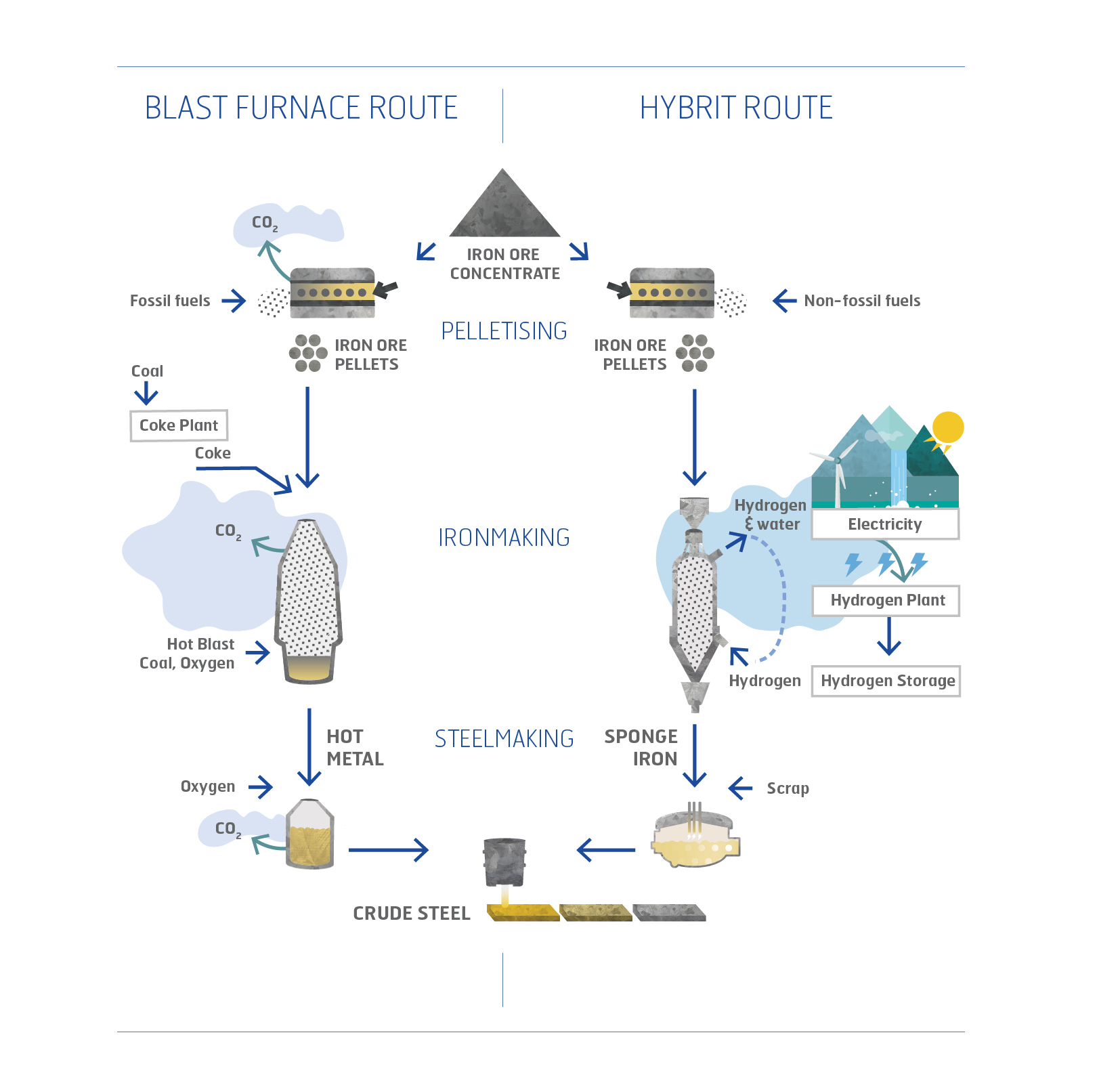
The amount of hydrogen needed is large as this paragraph from the Telegraph article says.
HYBRIT’s demonstration plant, for which an investment decision is due in 2022, will require 400MW of power just for the electrolysers to make the hydrogen. Sweden’s largest existing wind farm, Björkhöjden, produces just 288MW. Then to store the hydrogen, Vattenfall plans to build 120,000 m3 of lined underground storage, enough to store 100GWh worth of the gas.
Will they procure the electrolysers from the UK’s experts in the field; iTM Power? This innovative company is building the world’s largest electrolyser factory in Rotherham, which will be able to produce a GW of electrolysers in a year.
Conclusion
This well-written article in the Telegraph explains a lot about steel produced using hydrogen instead of coal.
Sweden has a lot of advantages at Lulea to create steel.
- The iron ore is mined locally.
- Sweden has ninety percent of Europe’s iron ore.
- Ships can sail to Lulea, which is at the top of the Baltic.
- There is gigawatts of zero-carbon electricity from the River Lule.
- They can build wind farms in the area, which has a low population.
It does look that they might export the iron ore as sponge iron, which can then be processed directly into steel products using electric arc furnaces.
EDF Determined To Play ‘Major Role’ In UK Flexibility As It Signs 50MW Battery Optimisation Deal
The title of this post is the same as that of this article on Energy Storage News.
This is the opening two paragraphs.
EDF is set to optimise Gresham House Energy Storage Fund’s 50MW Wickham Market lithium-ion battery site.
The French energy giant will use its Powershift platform to optimise the asset to deliver optimal value and minimise battery degradation at the site in Suffolk, England.
This is a paragraph from the article.
Recently, EDF has signed a number of agreements with battery storage owners, including to optimise SWGT‘s 30MW utility-scale battery earlier in December. The company is also working to build up its own battery portfolio, investing in cleantech startup PowerUp to support its 10GW of storage by 2035 ambition.
Note.
- I suspect in this section of the article, whoever wrote it, doesn’t know a MW from a MWh or a GW from a GWh. Storage or capacity should be measured in GWh not GW.
- SWGT would appear to be Still Waters Green Technology, who are building the 30 MW battery near Swindon.
- EDF purchased Pivot Power in June 2020.
It seems to me that EDF Energy are moving fast into both building and optimising energy storage.
Conclusion
Brexit seems to making little difference to EDF’s plans to invest in the UK.
But then we have the potential for the generation of Gigawatts of offshore wind, that is less of a resource for France.
New Device Separates Hydrogen From Natural Gas When The Two Gases Are Blended In Pipelines
The title of this post, is the same as that of on this article on Hydrogen Fuel News.
This is the introductory paragraph.
With clean hydrogen gaining recognition worldwide as the carbon-free fuel capable of making a significant contribution to addressing climate change, Southern California Gas Co. (SoCalGas) today announced it will field test a new technology that can simultaneously separate and compress hydrogen from a blend of hydrogen and natural gas.
It may sound rather mundane, but it means, you can convert surplus electricity into hydrogen and blend it with natural gas and distribute it in the local natural gas grid.
- As natural gas grids can contain a proportion of hydrogen, this shouldn’t be a problem.
- Any user, who needs hydrogen connects one of these clever devices to the grid and it separates out the hydrogen, for your use.
- All very simple and efficient, as you don’t need a second gas grid for hydrogen.
I very much like this idea, which was developed by a Dutch company called HyET Hydrogen.
There is also an explanatory video.
This invention could change the world!
Will The United States Be The Largest Battery In The World?
This article on Renewables Now is entitled Swell Bags Funds For 200 MWh Of Distributed Energy Storage In VPPs.
This is the introductory paragraph.
US distributed energy and grid solutions provider Swell Energy Inc has secured financial backing for up to USD 450 million (EUR 370.6m) worth of virtual power plants (VPPs) to be deployed across the country.
200 MWh a lot of energy storage and it works out at around $450,000 per MWh.
But it was the last paragraph that caught my eye.
Swell expects distributed energy systems in its portfolio to generate more than 3,000 GW over the next 20 years and customers to potentially store 1,000 GWh for later use.
If that should be 3,000 GWh, that will be 150 GWh per year. By comparison Drax, which is the largest power station in the UK, can generate 34,689.6 GWh in a year.
Drax may be 230 times bigger in GWh per year, but the US numbers are impressive and as wind and solar develop in the country, I suspect the United States will become the largest battery in the world.
Watch the US renewable energy sector grow!
Engineers Go Microbial To Store Energy, Sequester CO2
The title of this post, is the same as that of this article on the Cornell Chronicle.
This is the first two paragraphs.
By borrowing nature’s blueprints for photosynthesis, Cornell bioengineers have found a way to efficiently absorb and store large-scale, low-cost renewable energy from the sun – while sequestering atmospheric carbon dioxide to use later as a biofuel.
The key: Let bioengineered microbes do all the work.
This is slave labour, that even the most ardent of Human and Animal Rights activists would approve.
This is technology to watch!
Gore Street Energy’s £60mln Fundraise Significantly Oversubscribed
The title of this post, is the same as that of this article on Proactive Investors.
Surprise! Surprise!
Well not to me! Or I suspect Which!
This article on Which is entitled Solar Panel Battery Popularity Is Booming: Should You Buy One?
I have read the article and it leaves, the overall impression, that the UK population are thinking seriously about adding batteries to their solar panels.
So if the UK population is thinking seriously about personal energy storage, it would be very surprising if professional fund managers weren’t thinking the same.
After all, I did write World’s Largest Wind Farm Attracts Huge Backing From Insurance Giant, over two years ago.
So if we’re operating and commissioning offshore wind farms like these.
- Dogger Bank – 4.8 MW
- Gwynt y Mor – 576 MW
- East Anglia Array – 7.2 GW
- Hornsea – 6 GW
- London Array – 630 MW
- Walney – 1.7 GW
- Whitelee – 539 MW
We’re going to need some humungous batteries to tide us through calm periods.
As I write this post on a Monday afternoon, the UK is generating 11.5 GW of electricity by wind, which is more than we’re generating by biomass, coal and nuclear combined.
This is a quote from Alex O’Cinneide, who is Gore Street Capital’s chief executive, in the Proactive Investors article.
We are looking forward to deploying this capital against our significant global pipeline of 1.3GW and towards the capital expenditure requirements in the company’s existing 440MW portfolio.
Gore Street certainly seem to be expanding, their portfolio of batteries.
Conclusion
The City of London has discovered renewable energy and found a way to fund it, to the benefit of all investors, from the guy with a pension managed by a reputable company to global insurance companies, funds and other companies, who have billions of pounds, dollars or euros, that needs a profitable home.
The next big development will come, when a company like Gore Street goes Giga and decide to fund Gigawatt batteries being developed by the next generation of energy storage companies, like Gravitricity, Highview Power, Siemens Ganesa and Zinc8.
Thermal Energy Storage The Key To Reducing Agricultural Food Pollution
The title of this post, is the same as that of this article on EurekAlert.
These two paragraphs, introduce the article and give the aim of the project.
University of South Australia thermal energy researcher Professor Frank Bruno has been awarded almost $1 million by the Federal Government to find a solution to agricultural pollution in Australia and India.
Prof Bruno, South Australian Energy Chair at UniSA’s Future Industries Institute, will lead a collaborative project with India’s biggest private university, LPU, to develop a renewable energy-driven food processing and drying system which alleviates both pollution and landfill issues in both countries.
The big problem in India is air pollution, a lot of which is caused by farmers burning rice husks. By collecting solar energy, which will be stored as heat and used to dry crops, there is hope that this pollution can be reduced.
The whole article is very much a must-read.
Conclusion
This very much sounds like a good way to cut pollution in areas with lots of solar energy.
Limach And Hyperdrive Partner On Electric Machines
The title of this post, is the same as that as of this article on International Rental News.
This second deal from Hyperdrive Innovation is with Dutch excavator manufacturer Limach.
This paragraph from the article is important.
The construction industry is responsible for 40% of European carbon emissions, making it an urgent priority for decarbonisation to meet net zero targets.
That is a lot of carbon.
Multi-Million-Pound Battery Partnership Announced
The title of this post, is the same as that as of this article on Eureka magazine.
This is the introductory paragraph.
Hyperdrive Innovation, the UK’s leading designer and manufacturer of lithium-ion battery technology, today announces a new multi-million-pound 4-year supply agreement with Moffett, part of Hiab and world leading forklift truck manufacturer, to supply state-of-the-art battery packs for zero-emission machinery.
This seems to be a big deal for the Sunderland-based manufacturer, who are also working with Hitachi to provide battery packs for Hitachi’s Regional Battery Train.
Hyperdrive Innovation certainly must be developing some of the best battery technology available.
This Material Can Store The Sun’s Energy For Months, Maybe Even Years
The title of this post, is the same as that of this article on Anthropocene.
This is the sub-title.
Thin coatings of the material could soak up sun in summer months and provide heat to buildings in winter, all without using fuel or electricity.
This sounds like something to file under Too Good To Be True.
But the research does come from the University of Lancaster and uses a type of material called a metal-organic framework.
Conclusion
Increasingly, it seems to me, that we’re seeing lots of outstanding chemistry coming to the fore.
 The Anonymous Widower